Mantex

Tutorials, Study Guides & More

  • HOME
  • REVIEWS
  • TUTORIALS
  • HOW-TO
  • CONTACT
>> Home / Archives for 2009

Archives for 2009

Oxford Guide to World English

August 4, 2009 by Roy Johnson

modern English language in use throughout the world

English is now effectively a global lingua franca. But even as it enlarges its influence, it is assimilated and changed by the nations where it comes to rest. Tom McArthur’s new Oxford Guide to World Englishis a survey of English both as a pre-eminent world language and as an increasingly divergent language. It is both a compendious work of reference and a very readable series of essays detailing the way in which the language is changing and growing as it spreads from one country to another.
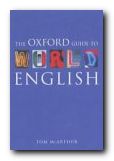
Oxford Guide to World English Each section is structured in a similar manner. First there is a brief historical account of the region’s connection with the English language; then he offers notes and examples of peculiarities in pronunciation, grammar , and vocabulary.

These prefatory remarks are like mini-essays on language history and development. He explains how Old English became modern, how English changed when it reached America, and even how it changed as it moved westwards. He also explains the social and cultural forces which lead to the development of a language.

At the center of his five hundred pages he confronts the issues which will be of interest to the two biggest user groups – the differences between English English and American English. All the basics of ise/ize and colour/color are explained, as well as a detailed history of the expression OK. There is also coverage of the huge variety of immigrant languages which have enriched the American vocabulary.

The range of countries he covers is truly astonishing. They range from whole continents such as Australia and Africa, to tiny islands such as Tuvalu and Tristan da Cunha. He illustrates a range of dialects and languages, including UK dialects, Spanglish, Jamaican Creole, Chicano English, Maor English, and even Chinese English.
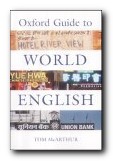
Oxford Guide to World English Even though it is based on sound scholarship, and comes with a very useful bibliography and chronology of English language development, the book is accessible for general readers, especially those interested in dialects and the history of world English. It will also be useful for students of A-level English Language in the UK and first-year undergraduates internationally; academics concerned with international English; and advanced foreign learners interested in developing an awareness of the differences in English around the world.

This is a wonderfully comprehensive resource which will appeal to anyone interested in language – and which OUP can justifiably feel proud to have produced.

Oxford Guide to World English   Buy the book at Amazon UK

Oxford Guide to World English   Buy the book at Amazon US

© Roy Johnson 2002


Tom McArthur, The Oxford Guide to World English, Oxford: Oxford University Press, 2002, pp.501, ISBN: 0198662483

More on dictionaries

More on language


Filed Under: Language use Tagged With: English language, Grammar, Language, Oxford Guide to World English, World English

Oxford Reference Grammar

August 2, 2009 by Roy Johnson

up-to-date guide to modern English grammar

This Oxford Reference Grammar guide is based on the most important chapters in Stanley Greenbaum’s authoritative work, The Oxford English Grammar. It is arranged thematically, starting from a description of the history of English language and grammar, then taking the major topics in turn – from words, phrases, and syntax, up to the point at which grammarians customarily stop – the sentence.

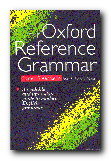
Oxford Reference GrammarThe explanations topics are broken up into small, easy-to-follow sections, and there is a full complement of bibliography, glossary, and comprehensive index. There is also a fussily detailed but ultimately useful numerical reference system. These are described as ‘links’ – a clear indication the influence hypertext and its language. It provides guidance on all word classes and word structures, including phrases, clauses, and sentences.

In line with contemporary attitudes to language studies, it takes a descriptive rather than a prescriptive attitude to grammar. That is, it describes how language is being used, rather than how somebody thinks it ought to be used. Each point is illustrated by quotations drawn from authentic spoken and written data. So a typical entry reads:

8.2.2 Adjectives that are predicative only

[17] Caroline is afraid Nellie’s attempts to get her to join in the nude dancing and runs off. [Jennifer Breen In Her Own Write]
[18] I was getting quite fond of him.
[19] Her office personality is a positive one; but she is not aware of this, any more than she is conscious of her breakfast-time vagueness. [W]

Many these predicative adjectives resemble verbs in their meanings: afraid ‘fear’, fond ‘like’, aware that ‘know that’.

It deals with all the standard difficulties in English, such as the issues who/whom, should/ought, that/which, and different from/to. Be warned however. Even though this is in handy paperback format, it’s not for beginners. You have to be prepared for sections labeled ‘Extraposition the postmodifier other than in the subject’, ‘Restrictive and non-restrictive modification’ and ‘Segregatory and combinatory coordination’.

It offers a compilation linguistic definitions and reference in a compact format which will be most useful for teachers language studies, students English language and linguistics, and lay readers who wish to understand some the niceties English grammar. It’s also worth saying that by covering the written and spoken language in both the UK and America, it is intended for English-speakers anywhere in the world.

© Roy Johnson 2000

Oxford Reference Grammar   Buy the book at Amazon UK

Oxford Reference Grammar   Buy the book at Amazon US


The Oxford Reference Grammar, (ed Edmund Weiner), Oxford: Oxford University Press, 2000, pp.410, ISBN: 0198600445


More on dictionaries
More on language
More on grammar


Filed Under: Grammar Tagged With: English language, Grammar, Language, Oxford Reference Grammar, Reference

Oxymoron – how to understand it

September 11, 2009 by Roy Johnson

free pages from our English Language software program

Oxymoron – definition

oxymoron Oxymoron is a figure of speech in which two incongruous or apparently contradictory words are combined to make a special effect.


redbtn An oxymoron is a contracted paradox.


Examples
  • He has a strong weakness for drink.
  • I’ll try the sweet and sour duck.
  • She is something of a cheerful pessimist
  • Their affair is an open secret.

Use

redbtn Oxymoron is used for emphasis or stylistic effect.

redbtn It’s often used in advertising.

redbtn NB! By the way, it’s pronounced ‘ox-ymoron’ — not ‘oxy-moron’.

redbtn The oxymoron is closely related to antithesis and paradox. Both of these are figures of speech.

redbtn An oxymoron is ‘a contracted paradox’. That is, the paradox is an apparently contradictory statement; whereas the contradiction in an oxymoron is reduced to just two antithetical terms.

redbtn It is the sort of playful and often witty effect used by those who wish to draw attention to their command of language.

redbtn The device is much-loved by poets, because it enables them to express complex ideas in a very compressed form:

Where grey-beard mirth and smiling toil retired
The toiling pleasure sickens into pain

[Oliver Goldsmith]

Self-assessment quiz follows >>>

© Roy Johnson 2003


English Language 3.0 program
Books on language
More on grammar


Filed Under: English Language Tagged With: English language, Figures of speech, Language, Oxymoron

Page layout – how to display writing

September 9, 2009 by Roy Johnson

free pages from our English Language software program

Page layout – definition

page layout Page layout is the physical organisation of text on the page, the screen, or any other medium of written communication.

redbtn It refers to the visual conventions of arranging text to assist reading and comprehension.


Examples

redbtn Good layout includes effective use of the following common features:

  • page margins
  • indentation
  • paragraphs
  • line spacing
  • justification
  • centring
  • type style
  • type size
  • italics
  • bold
  • capitals
  • underlining

Use

redbtn There are conventions of layout in written communication in English. Some of these are based purely on function, and some on tradition.

redbtn The modern trend is towards layout which results in fast and easy reading of the page.

redbtn Layout complements content in efficient communication. It facilitates the reading and the comprehensibility of the text.

redbtn NB! Readers are affected by these conventions, even though they may not be aware of them.

redbtn The conventions of layout for most writing (printed or written) are designed to make comprehension easier for readers. They are as follows:

  • text is surrounded by margins on the page
  • continuous writing is divided into paragraphs
  • paragraphs are separated by double spaces, or by indentation
  • sentences are separated by a single space
  • emphasis is indicated by italics or bold
  • headings are indicated by larger type size or emphasis [or both]
  • headings and sub-headings used to create logical organisation
  • indentation and spacing is used to present lists and diagrams

redbtn All this might seem rather obvious, but many people have difficulty reproducing or controlling these conventions.

redbtn These ‘rules’ apply to all languages which are written from left to right, and from the top to the bottom of the page. [Some languages are not!]

redbtn Most of these conventions can be reproduced in handwriting, as well as by typewriting and word-processing.

redbtn Faulty or inappropriate layout can seriously affect the legibility of text, and thus its comprehension.

redbtn Research shows that readers assimilate the content of a page in the following order:

  1. pictures
  2. diagrams
  3. tables
  4. bulleted lists
  5. headings
  6. continuous text

redbtn Layout choices. For every type of written communication, the writer has a choice to make regarding layout. An awareness of the conventions appropriate to the contents will make the writing more effective.

redbtn The layout for personal letters is known and used by most writers, as is the convention for addressing the accompanying envelope. Elements of the address are arranged on separate lines:

Mrs J Fingerbottom
14 Oildrum Lane
Accrington
Lancashire

Literary texts

redbtn Literary texts (stories, novels, biographies) are produced with layout conventions of which most people are unconsciously aware:

  • serifed type face
  • type size large enough for the normally sighted
  • between ten and twenty words per line
  • numbered pages and chapters
  • generous margins
Business documents

redbtn Contemporary business documents are often laid out following conventions which arise from economic considerations. [Time spent deciphering memos, reports, and proposals represent financial loss.]

redbtn A typical business document might have the following features:

  • sub-headings in the left margin opposite related paragraphs
  • small blocks of text with no more than five sentences
  • blocks of text separated by horizontal lines or double-spacing
  • extensive use of bulleted lists
  • document structure reflected in type size and emphasis
Newspapers

redbtn Newspapers have very distinctive conventions of layout which make them easily recognisable:

  • banner headlines in bold sans-serif type
  • body text in small serifed type
  • text arranged in narrow columns
  • text aligned with full justification
  • all page elements arranged on a ‘grid’
  • pictures and diagrams straddling columns
  • boxes and borders surrounding some page elements

redbtn Lists of items are easier to read if they are laid out vertically, rather than across the page as a line of text.

redbtn Tables are useful when lists become more complex than a collection of items. For instance, bus and train time-tables would be very difficult to use if the information were given as continuous prose.

redbtn One important feature of layout related to all text is the choice between serif and sans-serif type.

redbtn The serif is a tiny swirl at the tip and foot of letters. The serif aids the reading process by leading the eye from one letter to the next. These occur in type sets [fonts] such as Times Roman, Bookman, and Classroom.

view-08

redbtn Serif type is used for any substantial passages of text which will be read continuously.

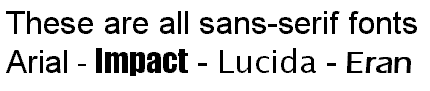
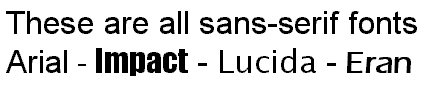
redbtn Sans-serif type on the other hand is plain. The edges of letters are straight, and devoid of swirls or serifs. Arial, Helvetica, and Courier are all sans-serif type sets.

redbtn Sans-serif is used for impact in short sequences of text which will not require continuous reading. It is often used to effect in titles, headings, and sub-headings.

view-07

redbtn Children begin to write in sans-serif characters and then graduate to using joined-up writing [which is equivalent to the serifed type style]. Some youngsters find it very difficult to make this transition and continue to write using separate letters — which they call ‘printing’.

redbtn Writing of this kind is very difficult to read, and it is discouraged in schools and colleges. This is because it obscures such features as capitalisation. It is a more laborious process for the writer to produce and makes understanding more difficult for the reader.

redbtn Two common faults of layout are the use of continuous capital letters in headings, and the use of underlining for emphasis. Both of these features make the text more difficult to read.

Self-assessment quiz follows >>>

© Roy Johnson 2003


English Language 3.0 program
Books on language
More on grammar


Filed Under: English Language Tagged With: English language, Page layout, Presentation, Text presentation, Writing

Page layout for essays

August 23, 2009 by Roy Johnson

sample from HTML program and PDF book

1. Academic page layout – using word-processors
Modern word-processors allow you to create attractive page layout for your documents. The impression made by your essays or reports will be enhanced by good design. You should practise controlling the basic functions of your word-processor to improve the presentation of text on your pages.

2. Margins
The default settings of most word-processors create a margin of one inch at each edge of the page. You should try increasing your side margins (say, to one-and-a-half inches). This not only improves the appearance of your work on an A4 page, it leaves more room in which your tutor can write comments.

3. Fonts
For the main text of your essay, choose a font with serifs (‘Times Roman’, ‘Garamond’, or ‘Schoolbook’).

serifed fonts

These make the text easier to read. Avoid sans-serif fonts such as ‘Arial’ or ‘Helvetica’: these make continuous reading more difficult. They may be used for headings however.

sans-serif fonts

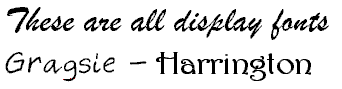
Display fonts (such as ‘Poster’ or ‘Showtime’) should not be used at all for academic work. They are designed for advertising.

display fonts

4. Font Size
In most cases, the size of font chosen should be eleven or twelve points. This will be easy to read, and will appear proportionate to its use, when printed out on A4 paper.

5. Quotes
Where you have quotations of more than three lines, they should normally be set in the same font as the body of the text, but the size may be reduced by one or two points. This draws attention to the fact that it is a quotation from a secondary source.

6. Spacing
Your word-processor will have single line-spacing as its default. This will produce a neat page. However, your text may be more usefully laid out in double line-spacing. This will leave more room for tutor comment.

7. Paragraphs
If you decide to stay with single line-spacing, put a double space between each paragraph. (In this case you do not need to indent the first line of the paragraph.)

8. Justification
You have two choices. Full justification arranges your text in a straight line on both the left and right-hand margins Left-justified will be straight only on the left, leaving the text ‘ragged’ on the right. This has the advantage of producing more regular word-spacing – but full justification will probably have a better visual effect overall.

9. Indentation
Never adjust your indentation using the spacebar. This will create very uneven layout when you print your document. Always use the TAB stop and the INDENT key. Remember that a TAB stop indents just the first line of a paragraph. The INDENT key will indent the whole of the paragraph.

10. Indenting quotes
Take full advantage of indenting to regularise your presentation of
quotations. Use double indentation for those longer quotations which would otherwise occupy more than two or three lines of the text in your essay. Try to be consistent throughout.

11. Indenting paragraphs?
If you do not show paragraphs by double-spacing, you will need to indent the first line of each new paragraph.

12. Italics and bold
Use italics for the titles of books and journals. (Also use it for emphasis.) Bold is best reserved for headings and sub-headings.

13. Headings
Headings, sub-headings, or essay questions may be presented in either a slightly larger font size than the body of the text, or they may be given emphasis by the use of bold.

14. Capitals
Don’t use continuous capital letters in a heading. This looks unsightly, and it makes the heading difficult to read.

15. Underlining
There is no need to underline headings or titles [even though many people think it is good practice]. If something is a title, a heading or a question at the top of an essay, then the larger font, or the use of bold should be enough to give it emphasis and importance. Underlining just makes text harder to read.

16. Page numbering
Use the automatic page-numbering feature to place numbers on all the pages of your essays. If for some reason you find this problematic (which many do), add the numbers by hand.

17. Hyphenation
If your word-processor automatically hyphenates words at the end of a line, take care to read through the work and eliminate any howlers such as ‘the-rapist’ and ‘thin-king’.

18. Widows and orphans
In laying out your pages, you should avoid creating paragraphs which start on the last line of a page or which finish on the first of the next. (These are called, in the jargon of the printing trade, ‘Widows and Orphans’). The solution to this problem is to control the number of lines on a page so as to push the text forward. An extra space at the bottom of a page is more acceptable than just one or two lines of text at the top of the next.

19. Page density
Do not create pages which are dense with closely-packed text. These will have an unattractive and off-putting effect.

20. Form
Don’t try to imitate the appearance of a printed book. Remember that an academic essay serves a different function. Leave plenty of white space around your work, and let the text ‘speak’ to the reader.

© Roy Johnson 2003

Buy Writing Essays — eBook in PDF format
Buy Writing Essays 3.0 — eBook in HTML format


More on writing essays
More on How-To
More on writing skills


Filed Under: Writing Essays Tagged With: Academic writing, Essays, Page layout, Reports, Study skills, Term papers, Writing skills

Paradox – how to understand it

September 11, 2009 by Roy Johnson

free pages from our English Language software program

Paradox – definition

paradox Paradox is a figure of speech in which a statement appears to be self-contradictory, but contains something of a truth.


Examples
  • The child is father to the man.
  • Cowards die many times before their death.

Use

redbtn Paradox is used for emphasis or stylistic effect.

redbtn The paradox is closely related to oxymoron — which is sometimes defined as ‘a contracted paradox’.

redbtn That is, the paradox is an apparently contradictory statement; whereas the contradiction in an oxymoron is reduced to just two antithetical terms – as in ‘living dead’ or ‘open secret’.

redbtn Paradox was much-used by the Metaphysical poets of the senteenth century — of whom John Donne is perhaps the best known. The following example is taken from one of his religious sonnets in which he appeals to God to strengthen his beliefs. He packs three paradoxes into these last four lines:

Divorce mee, untie, or breake that knot againe,
Take mee to you, imprison mee, for I
Except you enthrall mee, never shall be free,
Nor ever chast, except you ravish mee.

Self-assessment quiz follows >>>

© Roy Johnson 2003


English Language 3.0 program
Books on language
More on grammar


Filed Under: English Language Tagged With: English language, Figures of speech, Grammar, Language, Paradox

Paragraphs – how to write them

September 11, 2009 by Roy Johnson

free pages from our English Language software program

Paragraphs – definition

paragraphs Paragraphs are (usually) a group of sentences which deal with one topic.

redbtn The sentences are related to each other to produce an effect of unity.

redbtn The group of sentences form a single unit of meaning.


Examples

redbtn The following example of a paragraph is itself the definition of a paragraph:

The central thought or main controlling idea of a paragraph is usually conveyed in what is called a topic sentence. This crucial sentence which states, summarises or clearly expresses the main theme, is the keystone of a well-built paragraph. The topic sentence may come anywhere in the paragraph, though most logically and in most cases it is the first sentence. This immediately tells readers what is coming, and leaves them in no doubt about the overall controlling idea. In a very long paragraph, the initial topic sentence may even be restated or given a more significant emphasis in its conclusion.


Use

redbtn Paragraphs are used to divide a long piece of writing into separate sections.

redbtn Each of these sections should deal with one issue, or one topic in a sequence.

redbtn Paragraphs are a device to create firm structure in writing.

redbtn They can also be used to give rhythm, variety, and pace to writing.

redbtn NB! If in doubt, keep your paragraphs shorter, rather than longer.

redbtn The recommended structure of a typical paragraph in academic writing is as follows. [It is rather like a mini-version of the structure of a complete essay.]

  • The opening topic sentence
  • A fuller explanation of the topic sentence
  • Supporting sentences which explain its significance
  • The discussion of examples or evidence
  • A concluding or link sentence

redbtn The start of a new paragraph is usually signalled by either a double space between lines, or by indenting the first line of the new paragraph.

redbtn Very short paragraphs are often used in literary writing for stylistic effect.

redbtn One of the most famous examples of this device comes from the Bible [John 11:35].

When Jesus therefore saw her weeping, and the Jews also weeping which came with her, he groaned in the spirit, and was troubled. And said, Where have ye laid him? They said unto him, Lord, come and see.
Jesus wept.

redbtn The longer the paragraph, the more demands it makes on the reader.

redbtn The length of paragraphs can be varied to give rhythm and ‘pace’ to a piece of writing [rather like variations in sentence-length].

redbtn The last sentence in a paragraph is often used to provide a link to the next.

redbtn The following example [written by E.M.Forster] shows the skilful use of an attention-grabbing first sentence, and a concluding sentence which whets the reader’s appetite to know more about the subject:

John Skelton was an East Anglian: he was a poet, also a clergyman, and he was extremely strange. Partly strange because the age in which he flourished – that of the early Tudors – is remote from us, and difficult to interpret. But he was also a strange creature personally, and whatever you think of him when we’ve finished – and you will possibly think badly of him – you will agree that we have been in contact with someone unusual.

Self-assessment quiz follows >>>

© Roy Johnson 2003


English Language 3.0 program
Books on language
More on grammar


Filed Under: English Language Tagged With: English language, Grammar, Language, Paragraphs, Writing

Paragraphs in essays

August 24, 2009 by Roy Johnson

sample from HTML program and PDF book

1. The purpose (and definition) of paragraphs in essays is that they deal with just one topic or major point of argument in an essay. That topic or argument should normally be announced in the opening sentence, which is sometimes called a ‘topic sentence’.

2. The sentences which immediately follow the topic sentence should expand and develop the statement, explaining and relating its relevance to the question in general.

3. This opening statement and amplification should then be followed by evidence to support the argument being made. You should provide illustrative examples which are discussed as an explanation of the central idea.

4. Paragraphs in most academic essays should normally be between 50 words minimum and 200 words maximum in length. They could be longer if you were explaining a topic in detail in an extended piece of work.

5. The last sentence of a paragraph should try to round off consideration of the topic in some way. It may also contain some statement which links it to the one which comes next.

6. Consecutive paragraphs may be linked with terms such as ‘However’ and ‘On the other hand’ so as to provide a sense of continuity and structure in your argument. If you are in any doubt however, let them stand separately and speak for themselves.

7. The recommended structure of a typical paragraph in academic writing is as follows. It is rather like a smaller version of the structure of a complete essay.

  • The opening topic sentence
  • A fuller explanation of the topic sentence
  • A discussion of its significance
  • Consideration of examples or evidence
  • A concluding sentence

8. What follows is an example taken from an essay written in response to the question ‘Discuss the case for and against political censorship of the media.’

The arguments against political censorship however can be made on grounds which are surely just as firm. The moral arguments usually centre on notions of ‘freedom of information’ and the individual’s ‘right to know’. The legal arguments point to inconsistencies in current regulations as applied to the various forms of media (books, television, newspapers) and to differences in the law between the UK and other western countries. There are also a number of social and political arguments ranging from objections of class bias in the composition of those bodies which frame regulations, to similar objections to the ownership and control of the various forms of media. Exploring each one of these arguments in turn, it is possible to see that the case against political censorship can be just as strong.

9. Avoid very short paragraphs which contain only one or two sentences. These are sometimes used in fiction or journalism for dramatic effect. In an academic essay however, this device does not allow you to develop an argument or discuss evidence.

© Roy Johnson 2003

Buy Writing Essays — eBook in PDF format
Buy Writing Essays 3.0 — eBook in HTML format


More on writing essays
More on How-To
More on writing skills


Filed Under: Writing Essays Tagged With: Academic writing, Essays, Paragraphs, Reports, Study skills, Term papers, Writing skills

Parallel Lives

July 16, 2009 by Roy Johnson

studies of five unusual Victorian marriages

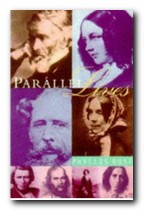
Parallel Lives made a big impact when it first appeared, and continues to be a source of inspiration to many biographers. I noticed an appreciative reference to it in Katie Roiphe’s recent study of unconventional literary relationships, Uncommon Arrangements, which deals with similar issues. Phyllis Rose has chosen to write about a series of fairly famous Victorian literary marriages in which the personal relationships were unusual by contemporary standards, and which she believes offer modern readers something to think about in our age of apparent sexual free-for-all.

Parallel Lives And I couldn’t help feeling from hints she drops at regular intervals throughout the book that she was working out some of her own personal issues at the same time. The subjects are Jane Welsh and Thomas Carlyle, Effie Gray and John Ruskin, Harriet Taylor and John Stuart Mill, Catherine Hogarth and Charles Dickens, and George Elliot and George Henry Lewes.

What she is trying to show is that in an age when marriages were often made as financial and social contracts, the arrangements made to cater for personal satisfaction were often more subtle and successful than we might imagine today, when sexual or romantic reasons are given precedence.

The story of Ruskin’s wedding night fiasco is reasonably well known: the authority on classical beauty took fright when he saw a real woman in the flesh. What is not so well known is that he never consummated the marriage, and after several years of misery, being presented with his failure to deliver as the grounds for divorce, he offered to ‘prove his virility’ in court. How exactly he would have gone about doing this is the source of some amused speculation.

John Stuart Mill’s case is slightly different, although it shared one important feature. He fell in love with Harriet Taylor, whose husband thoughtfully allowed them to carry on their relationship because it was sexually chaste. Even when the tolerant Mr Taylor died and the couple were able to marry, the habit stuck, reinforced by Mill’s belief that men should subjugate themselves to women’s will – in order to compensate for the historical injustices they had suffered.

It’s hard to see why Phyllis Rose included the similarly well-known case of Charles Dickens and his wife Catherine Hogarth, except as she concludes “he provides a fine example of how not to end a marriage”. Their early life together is a portrait of his energy and bonhomie; then comes his disenchantment and the separation. But of the twelve remaining years secretly engaged with Ellen Ternan – nothing is made. Dickens took such rigorous pains to conceal his tracks, there’s still no hard evidence on the degree of their intimacy – though it’s almost impossible to escape the conclusion that it was complete.

Rose makes the case that George Eliot, a woman blessed with high intelligence but not good looks, was forthright and enterprising enough to seek out what she says every normal woman wants – a man to love and be loved by. The man in question was George Henry Lewes, married though separated from his wife. But because his wife had three children by his friend Thornton Hunt, all of them were regarded as scandalous libertines by society at the time. Eliot lived with Lewes happily ‘outside the law’ for twenty-four years, then when he died she married her financial adviser, who was twenty years younger than her.

The strangest case of all is the Carlyles – of whom it was said that the best thing about their being married to each other was that only two people were miserable, not four. In another apparently sexless union, Mrs Carlyle, Jane Welsh, devoted herself to promoting his ‘greatness’ and was treated dreadfully in return. Confiding her unhappiness to a diary which he edited after she died, Thomas Carlyle spent the rest of his life afterwards eaten up by remorse because of the unhappiness he had engendered.

There are plenty of unusual arrangements here, but no easy solutions. Fortunately for us, separation and divorce are much easier in the twenty-first century. But Phyllis Rose wants us to reconsider these examples of Victorian challenges to orthodoxy and view them sympathetically – even when the cost in some cases seemed to be personal happiness and sexual fulfilment.

© Roy Johnson 2002

Parallel Lives Buy the book at Amazon UK

Parallel Lives Buy the book at Amazon US


Phyllis Rose, Parallel Lives, London: Vintage, 1994, pp.320, ISBN: 0099308711


More on lifestyle
More on biography
More on the Bloomsbury Group


Filed Under: 19C Literature, Lifestyle Tagged With: 19C Literature, Biography, Cultural history, Lifestyle, Literary studies, Marriage, Parallel Lives

Pardon My French

July 20, 2009 by Roy Johnson

Unleash your inner Gaul

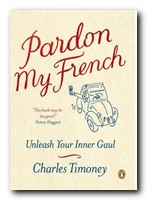
Don’t be misled by the title. This book isn’t about swearing or euphemism. It comes from the long tradition of the English writing about French language and culture as if it were that of another planet – but with a certain amount of self-deprecation and lots of affection. Charles Timoney went to live in France speaking only a few remnants of his GCE French – and what he offers here is what he’s learned in the years since – working in the country and learning from his French wife and in-laws. You can avoid making the same mistakes, and even get to understand some of the slang, idioms, and puzzling anomalies which he writes about so amusingly.

Pardon My FrenchThe entries are arranged in themes such as food and drink, travel, education, the office, history, slang, and the family. What you get is not only an explanation of linguistic oddities, but an insider’s glimpse into a foreign culture too. He explains how to survive in a French restaurant for instance, how to order steak well done and even ask for tap water, and why you should not call the waiter ‘Monsieur’.

There are also warnings that gateau doesn’t always mean cake (more likely a biscuit) and how French vegetable names are used as slang insults (Banane = idiot)

Because the French (like the English) have a habit of changing and abbreviating words, this guide is useful for explaining the quasi-slang terms for everyday things – such as apéro (aperitif) DOM – TOM (former colonies) Bac (A levels). He also explains why people in the provinces refer not to Parisiens but to les neufs trois (ninety-three being the number of a particularly low-rated parisian département).

He explains why nobody in their right mind would use the full name L’aéroport Charles de Gaulle when they can more easily use it’s original name of Roissy.

Buried within all the jokes there’s actually a lot of useful information regarding French culture such as getting married, driving round roundabouts, where to sit in a football stadium, and the fact that French cinemas change their films on a Wednesday, not Thursday as they do in the UK.

There’s an excellent chapter on slang (Mec = chap) backslang (Meuf = girl) and even instructions on how to use Merde! politely. It’s the sort of book you read with a permanent smile on your face.

© Roy Johnson 2007

Pardon My French   Buy the book at Amazon UK

Pardon My French   Buy the book at Amazon US


Charles Timoney, Pardon My French, London: Penguin, 2007, pp.233, ISBN: 1846140528


Filed Under: Language use, Slang Tagged With: Communication, French language, Language, Pardon My French, Slang

  • « Previous Page
  • 1
  • …
  • 60
  • 61
  • 62
  • 63
  • 64
  • …
  • 103
  • Next Page »

Get in touch

info@mantex.co.uk

Content © Mantex 2016
  • About Us
  • Advertising
  • Clients
  • Contact
  • FAQ
  • Links
  • Services
  • Reviews
  • Sitemap
  • T & C’s
  • Testimonials
  • Privacy

Copyright © 2026 · Mantex

Copyright © 2026 · News Pro Theme on Genesis Framework · WordPress · Log in