Mantex

Tutorials, Study Guides & More

  • HOME
  • REVIEWS
  • TUTORIALS
  • HOW-TO
  • CONTACT
>> Home / Archives for 2009

Archives for 2009

Evaluating online sources for essays

August 22, 2009 by Roy Johnson

sample from HTML program and PDF book

1. The Internet is the biggest library in the world, and tens of thousands of documents are added to it – every day. Evaluating the online sources of any information you download is a vital part of making sure it is relevant to your needs.

2. You also need to be sure about the accuracy, reliability, and value of any information you use. For instance, there is a big difference between a web site run by an amateur enthusiast and the official site of a big organisation.

3. Even the world’s largest encyclopedia — WIKIPEDIA — has its limitations. It is written by amateur volunteers and then edited by self-appointed experts, but it might contain mistakes or information which contains personal bias.

4. The following articles are designed to help you in the task of evaluating the information your retrieve from online sources.

5. You can print out this page for reference, or if you are connected to the Internet, just click the URL to go straight to the site named.

6. Documents are sometimes moved from one location to another on the Internet. If you receive a ‘Document not found’ message, try progressively removing the last section of the URL [ / this-bit] in your browser. Re-submit your search each time.

7. If you are reading this whilst connected to the Internet, click any of the addresses below and you will be taken directly to the document.

  • How to Evaluate a Web Page
  • Evaluating Web Pages
  • Evaluating Web Pages: Questions to Ask
  • Evaluating Web Resouces
  • Ten C’s for Evaluating Internet Resources
  • Evaluating Web Resources

© Roy Johnson 2003

Buy Writing Essays — eBook in PDF format
Buy Writing Essays 3.0 — eBook in HTML format


More on writing essays
More on How-To
More on writing skills

Filed Under: Writing Essays Tagged With: Academic writing, Essays, Evaluation, Online sources, Study skills, Technology, Web sources, Writing skills

Evidence in essays

August 22, 2009 by Roy Johnson

sample from HTML program and PDF book

1. Evidence in essays is the information you put forward to support your argument(s). This might be items of data or the illustrative examples which demonstrate the validity of your claims.

2. This evidence might be statistical data [51% of the population is female] illustrative examples [Milton’s ‘On his Blindness’ and Wordsworth’s ‘On Westminster Bridge’ are both written in sonnet form] or experimental results [Four out of the five control groups failed to meet these targets].

3. Many academic essays are normally concerned with the detailed inspection of evidence. A proposition is asserted, but then it must be substantiated by examples which are analysed and discussed.

4. Evidence might sometimes be a detailed selection of points from a body of data under consideration. For instance, in making a historical analysis of a subject, your particular selection of its chronological details might form the evidence supporting your argument.

5. In other essays, the evidence might have to be assembled or discovered as part of the examination of the subject. A project on urban traffic density or on public opinion regarding divorce for instance might require practical research to compile statistics.

6. Many subjects require the study of what are called ‘set texts’. That is, books which have come to be regarded as standard works on their subject:

  • Richard G. Lipsey, Positive Economics
  • Jean Jacques Rousseau, The Social Contract
  • Charles Dickens, Bleak House
  • Ernst Gombricht, The Story of Art
  • Donald Norman, The Design of Everyday Things

7. Essays, term papers, and assignments set in these subject require a close examination of these set texts, and the evidence used in your arguments will be drawn from the texts to show your understanding of them.

© Roy Johnson 2003

Buy Writing Essays — eBook in PDF format
Buy Writing Essays 3.0 — eBook in HTML format


More on writing essays
More on How-To
More on writing skills


Filed Under: Writing Essays Tagged With: Academic writing, Essays, Evidence, Study skills, Term papers, Writing skills

Exam tips and shortcuts

September 29, 2009 by Roy Johnson

guidance notes for success

These exam tips and shortcuts are techniques that anybody can use, without any special preparation or knowledge. They are practical, common-sense approaches to any kind of written exam. Even if you only adopt some of them, you will improve your chances of success.

An extract from our eBook — Revision and Examinations

Before you start

1. Take a selection of differently shaped pens.

2. These can ease the pressure on your fingers and thumbs when writing.

3. Take spares, a ruler, rubber, and any instruments you might need.

4. Settle in as quickly as possible, and avoid distractions.

5. Check the instructions and questions on the exam paper.

6. Confirm that the structure is what you expect [number of questions to be answered, time allocated].

7. Remember that the time allowed includes the time for reading the paper and preparing answers.

The paper

1. Make your choices and get started as quickly as possible.

2. Begin with an overview of the paper.

3. Identify those questions you can answer or prefer to attempt.

4. Eliminate any you can’t answer or prefer to avoid.

5. When you have eliminated questions, you have less material to deal with.

6. Analyse the questions as you would for course work – but do it quickly.

7. Some choices can be made [almost unconsciously] whilst you are writing.

8. Stick to those topics you have revised: don’t try something new.

9. Leave room for making changes as you go along.

Making choices

1. The easiest strategy is to start with your favourite topic.

2. This will give you a sense of confidence, and get your creatives juices flowing.

3. You can also gain marks easily this way.

4. However, you might start with a more difficult question, and save your favourite as a ‘reward’ for later.

5. This strategy has the advantage that you are tackling the more difficult question in a fresher state.

6. Remember that you might have ideas about one topic whilst writing about another.

Making plans

1. Make an outline plan or brief notes for your answer(s) in the exam booklet.

2. This provides guidance and a reminder you can refer to whilst writing.

3. Exam markers might give you credit for a plan if your answer is unfinished.

4. If possible, prepare brief plans for all your answers.

5. You can then add notes or examples as you are going along.

Rules and regulations

1. Some exam booklets might specify that notes should only be written on the outside and inside covers – as in the following example.

“For rough work unruled pages are provided on the cover of the book. If you require more than these, use a ruled page but cross the rough work through before handing the book in.”

2. If regulations permit, write your answers only on right-hand pages.

3. Leave left-hand pages blank for notes, corrections, or later additions.

Under way

1. Write as much as possible on each question.

2. If you finish a question early, either think up more to say or go on to the next question.

3. If you go on to the next question, leave blank space on the page for possible later additions.

4. Firm and concise answers are better than those that wander aimlessly just to fill up the page.

5. Keep an eye on the time allocated for each question.

General

1. Write as clearly as possible: examiners are easily annoyed by untidy writing.

2. It is easier to score the first half of the marks for any question than the second half.

3. A firm structure will help to clarify your arguments.

4. If you finish the paper early, use the time left to check and edit your work.

Answer the question

1. The examiner wants you to answer the question in a clear and simple manner.

2. A plain, direct answer with no frills is easier to mark than one which is ornate or flowery.

3. Getting straight to the point creates a favourable impression.

4. The more concise your answer, the easier it is to mark.

Misconceptions

1. There will not be any ‘hidden traps’ in the questions to catch you out.

2. There isn’t some magical key to unlock the secret of exam success.

3. You don’t have to ‘please’ the examiner – except by answering the question!

4. There isn’t a ‘knack’ to exam success. It’s a combination of hard work, preparation, and clear thinking.

Examiners are human too

1. Marking exam scripts is a very boring task.

2. Judging grades is a subjective and difficult matter.

3. Yes – some exam questions are occasionally hard to understand.

4. [But that means that they are hard for everybody.]

5. Poor writing makes scripts difficult to read.

What examiners DON’T want

1. Untidy work which is difficult to read.

2. Longwinded answers which drift on and off the subject.

3. Answers which have been written to ‘impress’, filled with lots of ill-digested jargon.

4. Too much personal opinion, name-dropping, and generalisation.

How to gain extra credit

1. Get straight to the point. No lengthy introductions.

2. Stay on the subject. No digressions, waffling, or ‘packing’.

3. Relate all parts of your answer to the original question.

4. Show evidence of your knowledge of the subject.

5. Wherever possible, give concrete examples as evidence.

Check your answers

1. Spend the last few moments glancing over what you have written.

2. Check for possible mistakes of fact, grammar, and punctuation.

3. Correct mistakes as neatly as possible. Don’t scribble.

4. Write any additions on the left-hand page, and show insertion points clearly.

5. Make sure your name, ID, and other details are on the cover sheet.

An extract from our eBook — Revision and Examinations

© Roy Johnson 2009


More on How-To
More on study skills
More on writing skills


Filed Under: Study Skills Tagged With: Academic writing, Exam skills, Examinations, Study skills

Examination essays

August 23, 2009 by Roy Johnson

sample from HTML program and PDF book

1. Examination essays are a very common form of writing exercise in further and higher education. During most examinations you will have to produce written responses to a number of questions in a very limited time. This might mean writing as many as three complete essays in rapid succession, each one in as little as forty-five minutes or an hour.

2. Because of this time limitation in exams, you don’t need to write out the essay question in full on your examination script, (otherwise you will be using up valuable time). But you must indicate clearly which question you have chosen to answer.

3. Read each of your chosen questions in very close detail, paying attention to their principal topic(s). You should check the rubric for any key terms, and such instruction terms as either-or options. Pay particularly close attention to the number of examples it requires you to consider in your answer.

4. Write a brief plan or a list of topics you will cover on the left-hand page of the examination booklet. This will show the examiner what you are setting out to consider. Such a layout has the advantage that you can change it or make additions whilst you are writing the essay. If you do not complete your answer, you might be given some credit for your plan.

5. Write your answers to the questions on the right-hand pages of the booklet only (unless you are instructed to do otherwise). Leave the left-hand pages blank. These blank pages can be used for making any later additions or alterations to your answer if necessary, giving some indication of where the extra material should be inserted.

6. You will not be expected to produce work of the depth or quality required in a normal coursework essay. However, you should make every effort to write clearly and concisely. Try to give your answer a firm structure.

7. You will not be expected to quote from memory extensive details of the texts and materials you have been studying. However, you should be as precise as possible. Avoid any impression of sloppiness or uncertainty.

8. If you make any mistakes of fact or grammar, do not be afraid to correct them. Do this as neatly and clearly as possible. If you find that you have wandered from the point of the argument for instance, it is quite acceptable to cross out a whole paragraph.

9. If you discover that you have missed out a vital earlier part of your argument, it is possible to go back, write out the missing part on a left-hand page, and indicate with an arrow where it belongs.

10. In ‘open book’ examinations you are allowed to take texts or course materials with you into the examination room. Do not spend too much time searching for information or suitable quotations. Quite apart from the valuable time this may consume, it is far more important that you construct your own argument. The secondary material is only used as supportive evidence or illustration.

11. If you do locate suitable quotations, you should avoid quoting them at too great a length. They might seem very relevant as a support for your case, but remember that the general requirement of most examinations is that you should produce your own argument in response to a question.

12. When you have finished answering the questions, even if there is time to spare, avoid the temptation to hand in your work and leave the examination room. Such time is much better used in checking through your work. Correct any factual errors and slips in punctuation or grammar.

© Roy Johnson 2003

Buy Writing Essays — eBook in PDF format
Buy Writing Essays 3.0 — eBook in HTML format


More on writing essays
More on How-To
More on writing skills

Filed Under: Writing Essays Tagged With: Academic writing, Essays, Examinations, Study skills, Term papers, Writing skills

Excellent Dissertations!

July 3, 2009 by Roy Johnson

advanced study and research skills as simple notes

Once you’ve got your first degree, it’s often assumed that you will know exactly what to do in any post-graduate research work. That’s not usually true, and books like Excellent Dissertations! are helping to rectify the deficiency. Peter Levin’s approach is to break everything down into the simplest possible units. The most important characteristic of this book is that it is short and gets straight to the point. He offers useful checklists of what examiners are looking for in the successful dissertation.

Excellent Dissertations!These are likely to be the same, no matter what your subject – clear methodology, firm structure, and attention to detail. In my experience, most people writing long projects and dissertations find all these quite hard to produce. That’s why this sort of advice is useful. He helps you to make the distinction between a project and a dissertation, between the research and the writing up of results. He shows you how to explore the existing literature on your subject – which is different than writing a literature review – often another popular writing task in HE, This is dealt with separately in some detail in a chapter of its own.

There’s advice on how to compile a list of sources accurately, and he gives you useful tips such as starting to create your bibliography right from the start.

writing a literature review when you aren’t yet on top of your material is one of the most mind-numbing, brain-deadening, sleep-inducing activities known to students

There’s a separate chapter on methodology, which can be anything from a technique, a procedure, a hypothesis, to a philosophic argument. And if you are stuck for ideas, he shows you how to choose a subject or topic for the dissertation – with examples.

He looks at the management of the project in terms of your time – how to plan, what do first, how to keep going when things get rough.

At the end of the book – and I think this is the right place for it – there is advice on planning your project outline, editing your drafts, and conforming to the academic styles of referencing and producing bibliographies.

My only criticism of this guide is that it needs lists of further reading, web references, and an index. Maybe these can be added if there’s a second edition.

© Roy Johnson 2005

Excellent Dissertations   Buy the book at Amazon UK

Excellent Dissertations   Buy the book at Amazon US


Peter Levin, Excellent Dissertations!, Maidenhead: Open University Press, 2005, pp.122, ISBN: 0335218229


More on study skills
More on writing skills
More on online learning


Filed Under: Study skills Tagged With: Academic writing, Dissertations, Excellent Dissertations!, Research, Theses, Writing skills

F.L.Lucas – Tragedy

October 4, 2009 by Roy Johnson

Hogarth Press first edition book jacket designs

 
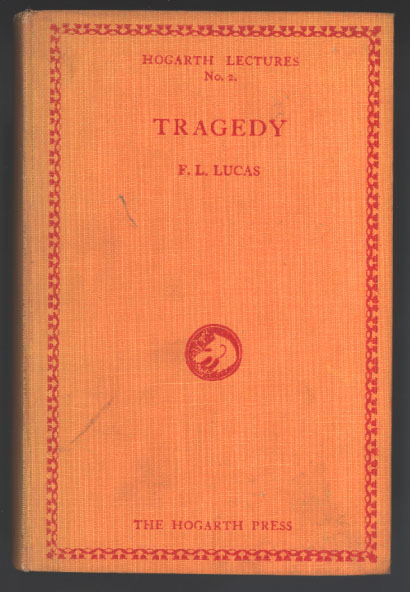
F.L.Lucas - Tragedy - first edition

F.L. Lucas,Tragedy in Relation to Aristotle’s ‘Poetics’ (1927) The Hogarth Lectures on Literature, First Series, No. 2.

F.L. (Peter) Lucas was a former Apostle and classical scholar at King’s College Cambridge. The Woolfs also published his unsuccessful novel The River Flows (1926).

previousnext


Hogarth Press studies

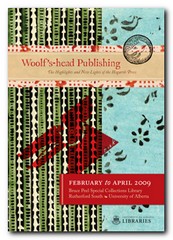
Woolf's-head Publishing Woolf’s-head Publishing is a wonderful collection of cover designs, book jackets, and illustrations – but also a beautiful example of book production in its own right. It was produced as an exhibition catalogue and has quite rightly gone on to enjoy an independent life of its own. This book is a genuine collector’s item, and only months after its first publication it started to win awards for its design and production values. Anyone with the slightest interest in book production, graphic design, typography, or Bloomsbury will want to own a copy the minute they clap eyes on it.

Woolf's-head Publishing Buy the book at Amazon UK
Woolf's-head Publishing Buy the book at Amazon US

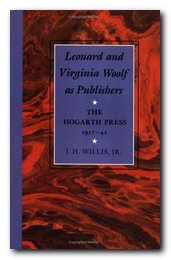
The Hogarth Press Leonard and Virginia Woolf as Publishers: Hogarth Press, 1917-41 John Willis brings the remarkable story of Leonard and Virginia Woolf’s success as publishers to life. He generates interesting thumbnail sketches of all the Hogarth Press authors, which brings both them and the books they wrote into sharp focus. He also follows the development of many of its best-selling titles, and there’s a full account of the social and cultural development of the press. This is a scholarly work with extensive footnotes, bibliographies, and suggestions for further reading – but most of all it is a very readable study in cultural history.

The Hogarth Press Buy the book at Amazon UK
The Hogarth Press Buy the book at Amazon US

© Roy Johnson 2005


Filed Under: Hogarth Press Tagged With: Art, Bloomsbury, F.L.Lucas, Graphic design, Hogarth Press, Literary studies

Figures of speech – understanding them

August 31, 2009 by Roy Johnson

free pages from our English Language software program

Figures of speech – definition

figures of speech ‘Figures of speech’ is a term used to describe the devices employed to add colour, decoration, and imaginative expression to linguistic use.

redbtn They distinguish figurative or imaginative language from its use in a literal manner.

redbtn Common figures of speech include the following:

alliteration, assonance, cliché, metaphor, metonymy, onomatopoeia, oxymoron, paradox, simile, synecdoche

redbtn These are also known as ‘rhetorical devices’.


Examples

Literal – He ran quickly down the street.

Simile – He ran like a hare down the street.

Metaphor – He hared down the street.


Use

redbtn Many people use these devices quite unconsciously as part of everyday communication.

redbtn For instance, a statement such as ‘His plan was given the thumbs down’ uses a figurative term, not a description of people waggling their thumbs. [It dates back to a Roman emperor’s decision on a gladiator’s fate.]

redbtn If we say ‘I’ve told him a thousand times!’ this is not literally true. We are using a figure of speech [hyperbole, or exaggeration] to make a point.

redbtn NB! Don’t try too hard to use figures of speech. They’ll come naturally.

redbtn Figures of speech or rhetorical devices are present in all cultures. It seems that it is in the very nature of linguistic discourse for speakers to act creatively. Indeed, it is that creativity in language use which ultimately divides language use in humans and animals.

redbtn A child begins to be creative by using various figures of speech at the very beginning of the acquisition process. Words such as ‘bang’, ‘smack’, ‘moo’, and ‘baa’ are all onomatopoeic figures of speech common to a child’s early vocabulary.

redbtn It is useful to contemplate a continuum of which the two opposites are literal and non-literal in terms of linguistic expression. We could envisage a statement of fact towards one extreme and a metaphor towards the other.

redbtn The statement of fact might be This is a wooden door.

redbtn An example of a metaphor might be The sunshine of your smile.

redbtn These two utterances comprise five words each, yet the metaphor says much more than the factual statement. Not only does it say more but it speaks of vast and abstract elements such as love, the sun, gesture, happiness, human warmth, pleasure and possibly more.

redbtn Figures of speech are often used to express abstract emotional or philosophical concepts. The figure of speech attaches the abstract concept to a material object and thus is instrumental in creating powerful and dynamic communication.

redbtn Original figures of speech are valued in both speech and in writing. We respect the ability to generate these. Politicians for instance often use figures of speech, and are variously successful with this practice.

redbtn Churchill’s image of ‘the iron curtain’ has stayed with us for over fifty years, although the phenomenon it described no longer exists. ‘The cold war’ superseded it, during which it was the threat of someone ‘pressing the button’ which was on everyone’s mind.

redbtn The ‘rhetorical question’ is a figure of speech favoured by politician and lay person alike. It is a powerful device because, although it has the appearance of being a question, it often acts as a form of persuasion or criticism.

redbtn ‘Is our country in danger of becoming a hot-bed of sleaze?’ we might hear a politician ask. ‘Are we going to stand by and let these atrocities continue?’ Listening to our car radio we might mentally frame an answer to this kind of question – or at least we might be drawn into contemplating the issue.

redbtn At a more domestic level we might be asked ‘What time do you call this?’ or ‘How many times have I told you …?’ These are questions which actively discourage any answer. They are a form of rebuke which is an established ritual. As competent language users, we know them and participate in the ritual – by not answering, or responding to the ‘real’ (unstated) criticism.

redbtn Another figure of speech which spans the social spectrum is the cliché. These are often derided, and the word itself has become a pejorative term. However, the cliché is very much ‘alive and kicking’, especially in the context of football. ‘Over the moon’ about a result and ‘gutted’ to hear the news, are just two such figures of speech heard almost daily over the popular media.

redbtn The cliché proves its function by its prolific use. Perhaps it is its over-use, or its application in inappropriate contexts which may cause distaste.

redbtn Figures of speech are also known as images. This indicates their function well. The outcome of using them is that the listener or the reader receives a multi-dimensional communication. Lewis Carroll coined the term ‘portmanteau’ for words which are packed with layers of meaning. Although Carroll’s usage is slightly different from that of figures of speech, it does illustrate that we have a strong drive as language users to convey meaning colourfully and economically.

Self-assessment quiz follows >>>

© Roy Johnson 2003


English Language 3.0 program
Books on language
More on grammar


Filed Under: English Language Tagged With: English language, Figures of speech, Grammar, Language, Speech

Finer Points in the Spacing and Arrangement of Type

June 15, 2009 by Roy Johnson

advanced topics in type design and good page layout

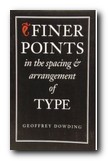
As the title implies, this is not a beginner’s book on typography. Most of the techniques discussed by Geoffrey Dowding, although sound and well presented, may not be beneficial to the reader without a working knowledge of design and type. Experienced designers, be forewarned; Dowding is unavoidably influential in this tome – the result of his lifetime of experience in the typographic arts. At the same time, he cannot escape that experience. He is an unabashed traditionalist, a master of the craft.

Finer Points in the Spacing and Arrangement of TypeSo if you think you might already be too sensitive to type and layout, don’t read this book. I’m kidding, of course, but let me explain: illustrating with examples, Dowding discusses typographical layout solutions which often suffer from lack of attention to detail, then provides corrected versions for comparison. This method combined with a concise writing style and his authoritative voice, will undoubtedly heighten your typo-senses.

You will begin to see mistakes where you read in blissful ignorance before. You will know why a given passage is harder to read than another (and no, it’s not necessarily the writer’s fault). And you’ll begin to realize – there are lots of layouts floating around out there that could use more than a little tweaking.

I don’t think that everything he proposes is necessarily right. For example, in the context of setting type for text – the omission of spaces after full points when followed by the capitals A, J, T, V, and Y. Although this is still logically consistent with his other principles, a possible sacrifice of legibility for color defeats what he wanted to achieve.

Still, I enjoyed reading this book and can safely say I will never look at another paragraph, sentence, or word, quite the same again. Having never seen the previous editions of this book, I cannot compare them, but this revised edition suits me just fine. The pages were faithfully composed employing Dowding’s own principles, which makes ‘Finer Points’ a pleasure to behold.

© Roy Johnson 2000

Buy the book at Amazon UK

Buy the book at Amazon US


Geoffrey Dowding, Finer Points in the Spacing and Arrangement of Type (Revised edition), Vancouver: Hartley & Marks, 1995, pp.96, ISBN 0881791199


More on typography
More on technology
More on digital media


Filed Under: Typography Tagged With: Finer Points in the Spacing and Arrangement of Type, Fonts, Graphic design, Page layout, Typography

Flickr Hacks

May 22, 2009 by Roy Johnson

tips and tools for sharing photos online

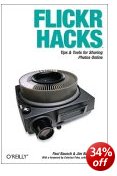
Photo blogging is one of the most expansive parts of the Internet and online media just at the moment. You take a picture with your digital camera or your mobile phone, and blog it straight onto a public site. Flickr is owned by Yahoo! They allow you to upload your photos into a web space, and you are given 20MB per month, which is quite generous. Instead of keeping your snaps just for yourself and family members on your hard disk, you can store them, share them with the world, tag them, and make them available for worldwide consumption. You can even make money out of them if you play your cards right.

Flickr HacksAlthough your photos are in the public domain, you can control who is allowed to see them. There are full instructions here for setting your privacy options. Tagging and meta-data are fully explained (that’s giving titles, categories, and links to your photos) and there are also tips on resizing photos to save on your allotted storage space.

When extra information in the form of meta-tags is added to the images, all sorts of new possibilities are created. Paul Bausch shows games involving comparisons with similarly tagged photos, and he demonstrates how geo-tagged images can be mapped.

With so many of these images being viewed and viewed across the web, it’s good that he also explains issues of copyright and licensing, including the relatively new Creative Commons licences.

He also show how you can subscribe to a news feed which will notify you when other people upload new images. Then the later part of the book offers some fairly simple scripts for constructing screensavers, tracking your friends’ favourites, and even plotting your personal contacts using Google Maps.

Assuming you eventually end up with a large collection of photos, the next more advanced level shows you how to back up the collection, then how to store and sort them.

Finally, for those who might wish to interact with Flickr and operate at an administrator level, there are some advanced scripts which allow you to act as a moderator, create custom mosaics and collages, and mash up your photos to produce all sorts of special effects.

© Roy Johnson 2006

Flickr Hacks   Buy the book at Amazon UK

Flickr Hacks   Buy the book at Amazon US


Paul Bausch, Flickr Hacks, Sebastopol: CA, O’Reilly, 2006, pp.335, ISBN: 0596102453


More on digital media
More on technology
More on theory


Filed Under: Media, Technology Tagged With: Flickr, Media, Social media, Technology

Footnotes in essays

August 23, 2009 by Roy Johnson

sample from HTML program and PDF book

1. When you offer quotations from other people’s work in an essay, the sources of the information may sometimes be given in footnotes printed at the bottom of the page. In modern word-processors footnotes can be added automatically. However, you should use this facility with care and restraint.

2. A bracketed number should be placed, as A.B. Smith suggests, ‘normally at the end of the sentence in which the reference is made’, and successive references are then given the next higher number. (1)

3. The number may be placed after a specific word if necessary, or at a break in the sense of the sentence.

4. Sometimes the footnote may be used to add an aside or to offer a comment on something which is only obliquely related to the topic in question. (2)

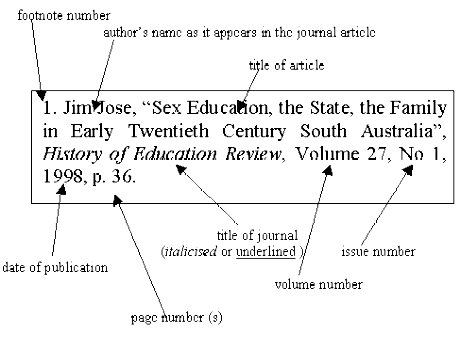
5. If a direct quotation is being used, the reference in the footnote should allow a reader to trace the source of the information if necessary. That is, you should give details of author, title, publisher, and date of publication, then page number. (If you are using the Harvard system of notation, remember that the date follows the author’s name.)

6. Successive quotations from the same source may be indicated by using the op. cit. and ibid. system of abbreviations. Alternatively, use the short-title system.

7. This system of footnoting can become extremely complicated and difficult to use – particularly if you wish to make changes. The addition of one new quotation in the middle of the essay can throw the whole system out of order. [If you are writing or typing it is difficult to know how much room to allow for the footnotes, and once the page is full you cannot add more.]


Footnotes


8. There are other reasonable arguments against using footnotes. The most important is that by their very nature they interrupt the flow of your argument. It is very difficult for a reader to resist the inducement to glance to the bottom of the page – no matter how lightweight the remarks which are placed there.

9. The easiest solution to these problems is to present this information as endnotes. These are given on a separate sheet at the end of your essay. This system is much easier to use, and additions or corrections can be more easily made when producing the final draft.

10. The general tendency in academic writing has recently been to offer endnotes rather than footnotes. This is because the printing of footnotes in academic publications is very costly. However, the automatic footnoting facility on modern word-processors might reverse this trend.


Footnotes

1. A.B. Smith, How to Use Footnotes Correctly, Manchester: Imaginary Press, 1999, p.368.

2. This system can easily become very unwieldy, even though it is obviously convenient for the reader. If the notes are no more than bibliographical information on your sources, the effect will be slightly irritating.

© Roy Johnson 2003

Buy Writing Essays — eBook in PDF format
Buy Writing Essays 3.0 — eBook in HTML format


More on writing essays
More on How-To
More on writing skills


Filed Under: Writing Essays Tagged With: Academic writing, Essays, Footnotes, Study skills, Term papers, Writing skills

  • « Previous Page
  • 1
  • …
  • 30
  • 31
  • 32
  • 33
  • 34
  • …
  • 103
  • Next Page »

Get in touch

info@mantex.co.uk

Content © Mantex 2016
  • About Us
  • Advertising
  • Clients
  • Contact
  • FAQ
  • Links
  • Services
  • Reviews
  • Sitemap
  • T & C’s
  • Testimonials
  • Privacy

Copyright © 2026 · Mantex

Copyright © 2026 · News Pro Theme on Genesis Framework · WordPress · Log in