Mantex

Tutorials, Study Guides & More

  • HOME
  • REVIEWS
  • TUTORIALS
  • HOW-TO
  • CONTACT
>> Home / Archives for 2009

Archives for 2009

How to summarize

September 16, 2009 by Roy Johnson

say the same thing in fewer words

1. A summary is a shorter version of a longer piece of writing. Summarizing means capturing all the most important parts of the original, and expressing them in a shorter space. The shorter space could be a lot shorter.
How to Summarize
2. A summary is sometimes known as a précis, a synopsis, or a paraphrase.

3. In academic writing, summarizing exercises are often set to test your understanding of the original, and your ability to re-state its main purpose.

4. In business writing, you might need to summarize to provide easily-digestible information for customers or clients.

5. Summarizing is also a useful skill when gathering information or doing research.

6. The summary should be expressed – as far as possible – in your own words. It’s not enough to merely copy out parts of the original.

7. The question will usually set a maximum number of words. If not, aim for something like one tenth of the original. [A summary which was half the length of the original would not be a summary.]

8. Read the original, and try to understand its main subject or purpose. Then you might need to read it again to understand it in more detail.

9. Underline or make a marginal note of the main issues. Use a highlighter if this helps.

10. Look up any words or concepts you don’t know, so that you understand the author’s sentences and how they relate to each other.

11. Work through the text to identify its main sections or arguments. These might be expressed as paragraphs or web pages.

12. Remember that the purpose [and definition] of a paragraph is that it deals with one issue or topic.

13. Draw up a list of the topics – or make a diagram. [A simple picture of boxes or a spider diagram can often be helpful.]

14. Write a one or two-sentence account of each section you identify. Focus your attention on the main point. Leave out any illustrative examples.

15. Write a sentence which states the central idea of the original text.

16. Use this as the starting point for writing a paragraph which combines all the points you have made.

17. The final summary should concisely and accurately capture the central meaning of the original.

18. Remember that it must be in your own words. By writing in this way, you help to re-create the meaning of the original in a way which makes sense for you.


Summarizing – Example

Original text
‘At a typical football match we are likely to see players committing deliberate fouls, often behind the referee’s back. They might try to take a throw-in or a free kick from an incorrect but more advantageous positions in defiance of the clearly stated rules of the game. They sometimes challenge the rulings of the referee or linesmen in an offensive way which often deserves exemplary punishment or even sending off. No wonder spectators fight amongst themselves, damage stadiums, or take the law into their own hands by invading the pitch in the hope of affecting the outcome of the match.’ [100 words]

Summary
Unsportsmanklike behaviour by footballers may cause hooliganism among spectators. [9 words]


Some extra tips

Even though notes are only for your own use, they will be more effective if they are recorded clearly and neatly. Good layout will help you to recall and assess material more readily. If in doubt use the following general guidelines.

1. Before you even start, make a note of your source(s). If this is a book, an article, or a journal, write the following information at the head of your notes: Author, title, publisher, publication date, and edition of book.

2. Use loose-leaf A4 paper. This is now the international standard for almost all educational printed matter. Don’t use small notepads. You will find it easier to keep track of your notes if they fit easily alongside your other study materials.

3. Write clearly and leave a space between each note. Don’t try to cram as much as possible onto one page. Keeping the items separate will make them easier to recall. The act of laying out information in this way will cause you to assess the importance of each detail.

4. Use a new page for each set of notes. This will help you to store and identify them later. Keep topics separate, and have them clearly titled and labelled to facilitate easy recall.

5. Write on one side of the page only. Number these pages. Leave the blank sides free for possible future additions, and for any details which may be needed later.

© Roy Johnson 2004


More on How-To
More on literary studies
More on writing skills

Filed Under: How-to guides, Study Skills, Writing Skills Tagged With: Academic writing, Study skills, Summaries, Summarising, Summarizing, Writing skills

How to Survive your Viva

July 11, 2009 by Roy Johnson

defending a thesis in an oral examination

This is the first book of its type (in the UK) to focus entirely on this one short but vital part of the PhD process. It’s a vital stage in gaining your degree, yet most people make surprisingly little preparation for it. Rowena Murray starts off with a look over research on the viva in an attempt to learn what we know about what goes on ‘behind closed doors’. The answer is that we don’t know a lot, which is her justification for writing the book. How to Survive your Viva gets straight down to defining the viva and its purpose – which is not as easy as it might seem, because practice varies from one institution to another, and the process is often shrouded in secrecy.

How to Survive your VivaShe makes this even more scary by pointing to the reason: there isn’t even a set of universally agreed criteria for what constitutes a successful PhD. Her advice is grounded in experience, and is perfectly sound. For instance, on the common occurrence of ‘pass subject to revisions’ which often seems so disappointing when candidates hear the words spoken, she offers this reassurance:

The viva is built up to be ‘the end’ of the doctoral process, but in reality the doctorate does not end with the viva. There is almost always some more work to do… Since the most common outcome is a pass with revisions and/or corrections, then you are not quite finished. Nor is it the end of the world if you have to do some more work; most people do. Do not, therefore, let the stakes get too high, so that it will seem like the end of the world if you have more work to do. Do not do that to yourself.

When it comes to preparing for the viva, she offers an amazingly thorough checklist of questions to ask your institution. These range from ‘Can I have a copy of the university’s code of practice on the conduct of the doctoral examination?’ to ‘Can I have a copy of the examiner’s form to be used in my viva?’

Students have far more extensive ‘consumer powers’ these days, and you have every right to ask for such information. You will certainly be much better prepared with it in your possession.

Her next chapter offers a timetable of what to do in the last few weeks leading up to the event, followed by how to handle the different types of questions likely to be raised in the interview, including what to do if you get stuck or flummoxed.

There is even a whole chapter on answering questions, striking the right attitude, responding to challenges, and even doing presentations. She also recommends mock vivas, shows you how to cope with the revisions, and how to recover from the whole experience afterwards.

My own PhD viva had some bad moments because I invited an extra examiner who didn’t really need to be there – and he decided to make waves (because he had no personal investment in the process). If I had read this book first, I wouldn’t have made that mistake. It’s a crucial moment in your academic career. The price of a book like this will repay itself a hundredfold in your first year of subsequent employment.

© Roy Johnson 2009

How to Survive your Viva   Buy the book at Amazon UK

How to Survive your Viva   Buy the book at Amazon US


Rowena Murray, How to Survive your Viva, Maidenhead: Open University Press, 2009, pp.208, ISBN: 0335233821


More on study skills
More on writing skills
More on online learning


Filed Under: Study skills Tagged With: Education, How to Survive your Viva, Oral examinations, Postgraduate studies, Research, Study skills

How to take notes

September 15, 2009 by Roy Johnson

important skills for successful study

1. In preparation for writing a piece of work, you should take notes from a number of different sources: course materials, set texts, secondary reading, interviews, or tutorials and lectures. You might gather information from radio or television broadcasts, or from experiments and research projects. The notes could also include your own ideas, generated as part of the planning process.

2. The notes you gather in preparation for writing will normally provide detailed evidence to back up any arguments you wish to make. They might also be used as illustrative material. They might include such things as the quotations and page references you plan to use in an essay. Your ultimate objective in planning will be to produce a one or two page outline of the topics you intend to cover.

3. Be prepared for the fact that you might take many more notes than you will ever use. This is perfectly normal. At the note-taking stage you might not be sure exactly what evidence you will need. In addition, the information-gathering stage should also be one of digesting and refining your ideas.

4. Don’t feel disappointed if you only use a quarter or even a tenth of your materials. The proportion you finally use might vary from one subject to another, as well as depending on your own particular writing strategy. Just because some material is not used, don’t imagine that your efforts have been wasted.

5. When taking notes from any source, keep in mind that you are attempting to make a compressed and accurate record of information, other people’s opinions, and possibly your own observations on the subject in question.

6. Your objective whilst taking the notes is to distinguish the more important from the less important points being made. Record the main issues, not the details. You might write down a few words of the original if you think they may be used in a quotation. Keep these extracts as short as possible unless you will be discussing a longer passage in some detail.

7. Don’t try to write down every word of a lecture – or copy out long extracts from books. One of the important features of note-taking is that you are making a digest of the originals, and translating the information into your own words.

8. Some people take so many notes that they don’t know which to use when it’s time to do the writing. They feel that they are drowning in a sea of information.

9. This problem is usually caused by two common weaknesses in note-taking technique:

  • transcribing too much of the original
  • being unselective in the choice of topics

10. There are two possible solution to this problem:

  • Select only those few words of the source material which will be of use. Avoid being descriptive. Think more, and write less. Be rigorously selective.
  • Keep the project topic or the essay question more clearly in mind. Take notes only on those issues which are directly relevant to the subject in question.

11. Even though the notes you take are only for your own use, they will be more effective if they are recorded clearly and neatly.

12. Good layout of the notes will help you to recall and assess the material more readily.

General guidelines
  • Before you even start, make a note of your source(s). If this is a book, an article, or a journal, write the following information at the head of your notes: Author, title, publisher, publication date, and edition of book.
     
  • Use loose-leaf A4 paper. This is now the international standard for almost all printed matter. Don’t use small notepads. You will find it easier to keep track of your notes if they fit easily alongside your other study materials.
     
  • Write clearly and leave a space between each note. Don’t try to cram as much as possible onto one page. Keeping the items separate will make them easier to recall. The act of laying out information in this way will cause you to assess the importance of each detail.
     
  • Use some system of tabulation. This will help to keep the items separate from each other. Even if the progression of numbers doesn’t mean a great deal, it will help you to keep the items distinct.
     
  • Don’t attempt to write continuous prose. Notes should be abbreviated and compressed. Full grammatical sentences are not necessary. Use abbreviations, initials, and shortened forms of commonly used terms.
     
  • Don’t string the points together continuously, one after the other on the page. You will find it very difficult to untangle these items from each other after some time has passed.
     
  • Devise a logical and a memorable layout. Use lettering, numbering, and indentation for sections and for sub-sections. Use headings and sub-headings. Good layout will help you to absorb and recall information. Some people use coloured inks and highlighters to assist this process of identification.
     
  • Use a new page for each set of notes. This will help you to store and identify them later. Keep topics separate, and have them clearly titled and labelled to facilitate easy recall.
     
  • Write on one side of the page only. Number these pages. Leave the blank sides free for possible future additions, and for any details which may be needed later.

Tony Buzan explains mind mapping

Mind-mapping guru Tony Buzan gives a brief demonstration of how the system works. Mind maps can be used for both note taking and note making.

This approach works for some but not all people.


Sample notes

What follows is an example of notes taken whilst listening to an Open University radio broadcast – a half hour lecture by the philosopher and cultural historian, Isaiah Berlin. It was entitled ‘Tolstoy’s Views on Art and Morality‘, which was part of the third level course in literary studies A 312 – The Nineteenth Century Novel and its Legacy.

Isaiah Berlin – ‘Tolstoy on Art and Morality’ – 3 Sep 89

1. T’s views on A extreme – but he asks important questns which disturb society

2. 1840s Univ of Kazan debate on purpose of A

T believes there should be simple answers to probs of life

3. Met simple & spontaneous people & soldiers in Caucasus

Crimean Sketches admired by Turgenev & Muscovites but T didn’t fit in milieu

4. Westernizers Vs Slavophiles – T agreed with Ws

but rejects science (Ss romantic conservatives)

5. 2 views of A in mid 19C – A for art’s sake/ A for society’s sake

6. Pierre (W&P) and Levin (AK) as egs of ‘searchers for truth’

7. Natural life (even drunken violence) better than intellectual

8. T’s contradiction – to be artist or moralist

9. T’s 4 criteria for work of art

  • know what you want to say – lucidly and clearly
  • subject matter must be of essential interest
  • artist must live or imagine concretely his material
  • A must know the moral centre of situation

10. T crit of other writers

  • Shkspre and Goethe – too complex
  • St Julien (Flaubert) inauthentic
  • Turgenev and Chekhov guilty of triviality

11. What is Art? Emotion recollected and transmitted to others

[Wordsworth] Not self-expression – Only good should be transmitted

12. But his own tastes were for high art

Chopin, Beethoven, & Mozart

T Argues he himself corrupted

13. Tried to distinguish between his own art and moral tracts

14. ‘Artist cannot help burning like a flame’

15. Couldn’t reconcile contradictions in his own beliefs

Died still raging against self and society

© Roy Johnson 2004


Filed Under: How-to guides, Literary studies, Study Skills Tagged With: Academic writing, note taking, Study skills, Taking notes, Writing skills

How to use abbreviations

June 17, 2009 by Roy Johnson

commonly used abbreviations in academic writing

1. The following is a list of abbreviations you will often see in the text, the index, or the bibliography of books designed for serious readers.

2. They are nearly all brief or shortened forms of expressions in Latin.

3. Many people also make use of abbreviations when taking notes, and they are also used in the footnotes and endnotes of academic writing. Examples are shown below.

4. Don’t use abbreviations in the main text of any formal writing. If you wish to use these terms, they should be written out in full.

5. That is, don’t put e.g., but write out for example.

6. Notice that a full stop is placed after an abbreviation, but not when the full word is used.

7. This is correct usage, but sometimes the full stop may be omitted in order to avoid double punctuation.

8. Note that these terms are often shown in italics.

9. You should never begin a sentence with an abbreviation.

10. If you are in any doubt, always write out the expression in full.

Abbrev. Full term
app. appendix
b. born. For example, b.1939
c. (circa) about: usually with a date.
For example: c.1830.
cf. (confer) compare.
ch. chapter (plural chaps.)
col. column (plural cols.)
d. died. For example, d.1956
do. (ditto) the same.
e.g. (exempli gratia) for example.
ed. edition; edited by; editor (plural eds.)
esp. especially.
et al. (et alii, aliae, or alia) and others.
For example, Harkinson et. al.
et seq. (et sequens) and the following.
For example, p.36 et seq.
etc. (et cetera) and so forth. [An over-used term. Worth avoiding.]
fig. figure (plural figs.)
f./ff. following.
For example, 8ff. = page 8 and the following pages.
ibid. (ibidem) in the same place: from the source previously mentioned.
i.e. (id est) that is.
inf. (infra) below: refers to a section still to come.
l. line (plural ll.) [NB! easily mistaken for numbers ‘One’ and ‘Eleven’.]
loc. cit. (loco citato) at the place quoted: from the same place.
n. note, footnote (plural nn.)
n.d. no date given
op. cit. (opere citato) from the work already quoted.
p. page (plural pp.) For example, p.15 [Always precedes the number.]
para. paragraph (plural paras.)
passim in many places: too many references to list.
q.v. (quod vide) look up this point elsewhere.
For example, q.v. p.32.
sic thus. As printed or written in the original. usually in square brackets [sic].
supra above: in that part already dealt with.
trans. translator, translated by.
viz. (videlicet) namely, that is to say.
For example: Under certain conditions, viz…
vol. volume (plural, vols.)

Examples

Here’s the use of abbreviation in an academic footnote. The first reference used edn for edition and p for page. The second reference uses ibid for ‘in the same place’.

2. Judith Butcher, Copy Editing: the Cambridge Handbook for Editors, Authors, and Publishers, 3rd edn., Cambridge University Press, 1992, p.234.

3. Butcher, ibid., p.256

Here’s an example which uses the abbreviated names of two well-known organisations:

The BBC reported yesterday that the leaders of NATO had agreed to discuss the crisis as a matter of urgency.

Abbreviations are commonly used in displaying web site addresses:

http://www.bath.ac.uk/BUBL/home.html

Every term in this address, apart from the names ‘Bath’ and ‘home’, are abbreviations

http = hypertext transfer protocol

www = world wide web

ac = academic

uk = United Kingdom

html = hypertext markup language

© Roy Johnson 2000


More on How-To
More on study skills
More on writing skills


Filed Under: Study Skills Tagged With: Abbreviations, Language, Study skills, Writing skills

How to use Harvard referencing

September 15, 2009 by Roy Johnson

standard system of academic citation and quotation

1. Some subjects adopt the Author-Date method of referencing – which is also known as the Harvard referencing system. Full details of the texts you have quoted are placed in a bibliography at the end of an essay or a report. These details are recorded in the following order:

Author – Date – Title – Place – Publisher

Smith, John. (1988) The Weavers’ Revolt, Chicago, Blackbarrow Press.

2. References in your text give the surname of the author, plus the publication date of the work to which reference is being made. This information is placed in brackets – thus:

Some research findings (James and Smith 1984; Brown 1987) have argued that these theories are not always reliable.

3. When you wish to draw attention to a particular page, this is done by simply adding the page number directly after the date of publication:

The development of these tendencies during the 1960s have been discussed by Brown (1977,234) and others (Smith 1992,180 and Jones 1993,88-90).

4. Note that when the author’s name is given in your text, it should not be repeated in the reference. You should simply give the date, then the page number(s). When you give the author’s name, the reference should either follow it directly, or it may come at some other point in the same sentence:

Smith (1987,166) argues that this was …

Smith, who is more positive on this issue, argues (1987,166) that …

5. If two or more works by the same author have the same publication date, they should be distinguished by adding letters after the date. This can be quite common with articles in journals.

Some commentators (Mansfield 1991b and Cooper 1988c) have argued just the opposite case, that …

6. The list of texts which appears at the end of your essay should be arranged in alphabetical order of the author’s surname. The list differs from a normal bibliography in that the date of publication follows the author’s name:

Mansfield, M.R.1991a. ‘Model Systems of Agriculture in Early Britain’, Local History Journal Vol XX, No 6 ,112-117.

Mansfield, M.R.1991b. ‘Agriculture in Early Britain’, History Today Vol 12, No 3, 29-38.

7. Don’t list works you have not consulted or from which you have not quoted. Doing this creates the impression that you are trying to claim credit for work you have not actually done.

8. You might find that your bibliography repeats much of the information given in your endnotes or footnotes. Don’t worry about this: these two separate lists have different functions. In addition, your bibliography may contain works from which you have not directly quoted.

Bibliography

Beeton, I. 1991 Beeton’s Book of Household Management,
Chancellor Press.

Best, G. 1979 Mid-Victorian Britain 1851-75, Fontana.

Burman, S. 1979 (ed), Fit Work for Women, Croom Helm.

Darwin, E. 1890 ‘Domestic Service’, The Nineteenth Century, Vol.28,
August.

Davidoff, L. 1973 The Best Circles, Croom Helm.

Davidoff, L. 1974 ‘Mastered for Life: Servant and Wife in Victorian
and Edwardian England’, Journal of Social History,
Vol.7.

Davidoff, L. 1987 and Hall, C., Family Fortunes, Hutchinson.

[…and so on]

© Roy Johnson 2004


More on How-To
More on literary studies
More on writing skills


Filed Under: How-to guides, Study Skills Tagged With: Academic writing, Harvard referencing, Reference, Study skills, Writing skills

How to use quotations

September 16, 2009 by Roy Johnson

the conventions and techniques of quotation

Quotations

1. There are in general two instances when you may wish to use quotations from other writers’ work:

Evidence – when quoting from other sources to support your own argument(s)

Reference – when a text is itself the subject of your essay and you need to refer to it in your discussion.

2. The conventions of accurate quotation and referencing are relatively simple, and they are based on the need for accuracy, consistency, and clarity. There are a number of slightly different systems of notation. The two most widely used are:

  • a quotation, with an endnote giving the source
  • the Harvard system (described separately)

3. The whole purpose of both systems is that tutors marking your work should be able, if they wish, to check the accuracy of the quotations you use.

Evidence

4. In a discussion of the development of Marx’s philosophy for example, you might argue that his work was a natural development of his predecessors, supporting your assertion by quoting David McLellan. He points out that

Marx began by paying tribute to the achievements of Feuerbach, particularly in having shown that Hegel’s philosophy was no more than a rationalisedtheology. (1)

5. A bracketed number is added immediately after the quotation, and the source of your quotation is given as an endnote on a separate sheet at the end of your essay. (You might wish to place the information as a footnote at the bottom of the page, though this system can become rather complicated.)

NOTES

1. David McLellan, The Thought of Karl Marx, London: Macmillan, 1971, p.26.

6. Note that this information is given in the following order, and you should remember to indicate the titles of books by using italics.

Author – Book Title – Publisher – Date – Page

7. The material you quote is placed between two single quotation marks if it is run in as part of your text:

this is what David McLellan calls a ‘rationalised theology’ (1) in his discussion of the relationship between Marx and Hegel

8. If the length of the quote amounts to more than three lines of your own text however, it should be indented separately, and no quote marks are necessary:

Marx began by paying tribute to the achievements of Feuerbach, particularly in having shown that Hegel’s philosophy was no more than a rationalised theology, and having discovered the true materialist approach by starting from the social relationship of man to man. (1)

9. Your own argument should normally be offered first, and you then reinforce it with quotation from an authoritative source. You are using this secondary evidence from acknowledged specialists to support your own views. Do not offer the quotation first, otherwise what should be your own argument will tend to be come more a ‘commentary’ upon it.

10. The quotations you offer should be as brief as possible to make their point. Don’t be tempted to offer long quotations from other people’s work in the hope that this will act as a substitute for your own argument. Nor should you stitch together a patchwork of quotations from a variety of sources with a few words of your own. This creates the impression that you are relying too heavily on other people’s work.

11. Sometimes in more advanced essays it might be necessary to quote longer passages. You would do this if you were going to analyse the author’s arguments in detail and at quite some length. This should only be done occasionally.

12. Each main point of your argument should be made and discussed in its own separate paragraph. This should not normally need more than one quotation to support it. Too many quotations can create the impression that you are relying too heavily on secondary sources.

Reference

13. When the subject of your essay is the discussion of a text (say, criticism of a novel or an article) you should follow the same system of notation. Directly after the first quotation you should give a full bibliographic description of the text you are discussing.

14. This information could be given within brackets in the body of your essay, but you will be developing good academic habits if you place the information as an endnote after the conclusion of your essay.

15. If your essay is predominantly concerned with just one text, all subsequent quotations from it may simply be followed by page references. Simply add an explanation to the first endnote, saying – all subsequent page references are to this edition.

16. If you will be quoting from a variety of other sources in the same essay, you should number the quotations and give the sources accurately as a series of endnotes.

17. It is also possible to mix these two forms of referencing, so long as the distinctions are made clear. If your piece of work was a long essay on Bleak House for instance, it would be acceptable to identify all your quotations from the novel with page references. Quotations from other critics or sources would numbered and their sources identified as separate endnotes.

18. There must be grammatical continuity and sense maintained between any quotation and your own argument. To arrange this, it might be necessary to add or delete words from the material quoted, or to change the tense of the original. Whenever you do this, any changes should be very small. They must also be properly acknowledged.

[It was] as if she were truly loved by him, but notwithstanding this impression she regarded the man as no more than a casual acquaintance who occasionally made her laugh (p.7)

19. Square brackets are used to indicate any words which you have added in order to make the quotation fit grammatically or otherwise within your own argument.

20. If you wish to draw attention to a particular word or some part of the quotation, you should provide the emphasis by using italics. You should then immediately admit the fact ‘as if she were loved by him’ [p.7 – my emphasis] and then carry on with what you wish to say in the remainder of your argument.

21. In order to shorten a quotation or to remove some part of it which is not relevant to your argument, you may wish to omit a number of words. To denote this omission (which is called an ellipsis) you should use the convention of the three dots ‘…’ in the space which is left:

He had even a kind of assurance on his face … the assurance of a common man filled with pride. (p.7)

22. This device should not be used to change the sense of the original in any way, or to misrepresent its spirit: such practices are regarded as academically fraudulent.

23. The three dots denoting an ellipsis do not need to be placed at the beginning or the end of your quotation, even if you are quoting a few words from within a sentence.

24. The general convention for indicating quotation is to use single quote marks (‘unmitigated’) and to reserve double quotes marks for indicating speech (“Good gracious!” cried the duchess.)

25. When quoting conversation, follow these rules, but if it makes things easier put the words spoken within double quote marks even if they were in single quote marks in the original:

Kayerts is being even more hypocritical and self-deceiving when he ‘observe[s] with a sigh: “It had to be done”‘ (p.39)

26. If you are quoting more than once from a number of works in an essay, you can avoid confusion and save yourself the trouble of giving a full reference each time. Use either the op. cit. and ibid. or the short title convention.

27. Different subjects have their own conventions in this respect – but the short title system is becoming more widely used and is easier to follow. However, an enormous number of academic books have been produced using the older system, so it is worth understanding how it operates, even if you decide not to use it.

28. Using the system of Latin abbreviations, the first quotation from a text is referenced fully with an endnote. In the case of any references which follow, just give the author’s name followed by op. cit. (which means ‘in the work already quoted’) and then the page number – as follows:

11. J.D. Bryant, The Origins of Mythology, London: Carfax Press, 1971, p.234.

12. History Today, Vol XXXIV, No 18, p.123.

13. Bryant, op. cit., p. 387.

29. If the very next quotation is again from the same work, the abbreviation ibid. (which means ‘in the same place’) is followed by a page reference. You do not need to give the author’s name. The sequence just given would therefore be extended:

11. J.D. Bryant, The Origins of Mythology, London: Carfax Press, 1971, p.234.

12. History Today, Vol XXXIV, No 18, p.123.

13. Bryant, op. cit., p. 387.

14. ibid., p. 388.

30. The short title system is particularly useful for longer essays which might deal with a number of texts or different books by the same author. Second and third year undergraduate studies often require a lengthy piece of work such as this. The principle is the same one of giving full bibliographical details in the first reference. Subsequent quotations are given a reference which is composed of the author’s surname, a shortened form of the book title, and the page number. The examples shown above would therefore appear as follows:

11. J.D. Bryant, The Origins of Mythology, London: Carfax Press, 1971, p.234.

12. History Today, Vol XXXIV, No 18, p.123.

13. Bryant, Mythology, p. 387.

31. The conventions of quoting from poetry and plays are exactly
the same, but for the convenience of the reader, line numbers are given.

32. There are a number of widespread misunderstandings about the use of quotation and systems of referencing. It is worth taking the trouble to follow the conventions outlined above (or use the Harvard system). Once you have brought simplicity and clarity to the presentation of your quotations it will help to improve the appearance and credibility of your work.

Some do’s and don’ts
  • You should not put page references in margins: they are placed immediately after the quotation, within your text.
     
  • You should not locate references as part of your own argument with expression such as ‘and we see this on page 27 where he collapses slowly … then later in the paragraph where he recovers’.
     
  • Ellipses are shown by three dots only [ … ] not a random
    number scattered across the page.
     
  • References and note numbers should form part of the text of your argument. They should not be added to the essay at a later stage and written into the margins or squeezed above the text as superscripts.

33. You should avoid using too many quotations and references to secondary material. In some subjects this can sometimes be required (as in a ‘review of the literature’) but in most it is not. Packing your essay with references to other people’s ideas creates the impression that you are unable to create an argumentof your own. Remember that your own evidence or points should come first. Quotation should normally be offered after you have established your own argument.

34. Some people use quotations as a means of starting an introduction or rounding off the conclusion to an essay. This can give your work a touch of sparkle if the quote is well chosen. However, you should minimise the use of this strategy in the body of the essay itself. Paragraphs which begin with a quotation can weaken your argument – for two reasons.

  • First, you are not leading with your own ideas in the form of a topic sentence directly related to the question.
     
  • Second, the substance of your argument in what follows might give the impression of being a commentary on the secondary source quoted, rather than an answer to the original question.

© Roy Johnson 2004


More on How-To
More on literary studies
More on writing skills


Filed Under: How-to guides, Literary studies, Study Skills Tagged With: Academic writing, Essay writing, Quotations, Referencing, Study skills, Writing skills

How to Win as a Final-year Student

July 15, 2009 by Roy Johnson

writing, study, and life skills for undergraduates

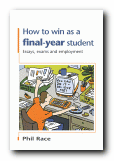
This is a book of skills and strategies for students facing their last year of undergraduate studies. It covers the problems of writing longer essays, reports, and dissertations, passing exams, and preparing for future employment. A final-year student faces a particular set of challenges. What you do in your final year is critical to your future. You must cope with revision for final exams, as well as completing course-work and sometimes working on extended dissertations or projects. At the same time you need to be taking strategic decisions about your future career. You might also be handling job applications and interviews, or going though the selection process for entry into postgraduate study.

Final-year StudentPhil Race has produced a guide which covers all these problems. His basic approach is very practical. The book is packed with checklists, action plans, and self-assessment exercises. All the advice is sensible and realistic, and it is geared to help you work out your best solutions. What I particularly liked was the fact that it recognises the uncertainties of the final year. You often need to plan for two or three different eventualities, depending on the outcome of your exam results. This is very stressful – and Race recognises the fact, then provides solutions for coping.

In the latter part of the book, Race even looks ahead to preparing you for job interviews. How to assemble a curriculum vitae; how to prepare for interviews; and how to get through tests. However, not all final year students want to go into business, so he also covers what should be taken into account if you are contemplating post-graduate research.

This is a good addition to the excellent series of study skills guides from Open University Press. I only wish books like this had been available when I was in my final year.

© Roy Johnson 2005

How to Win as a Final-year Student   Buy the book at Amazon UK

How to Win as a Final-year Student   Buy the book at Amazon US


Phil Race, How to win as a final-year student: essays, exams and employment, Buckingham, UK: Open University Press, 2005, pp.181, ISBN: 0335205119


More on study skills
More on writing skills
More on online learning


Filed Under: Study skills Tagged With: Education, How to Win as a Final-year Student, Study skills, Writing skills

How to work from home

September 16, 2009 by Roy Johnson

working from home – living at work

Work from home – and survive

Lots of people work from home today. If you have a mobile phone, an email address, a broadband connection, and a laptop on your coffee table, nobody knows you’re a consultant dog on the Internet. You could be:

  • starting up your own business
  • switching from employed to ‘homeworking’
  • creating a job for yourself
  • downsizing from larger commercial premises
  • making money from your hobby

Making a start

Working from home can have plenty of advantages – and you can use all of them to make your life easier – and bring everything under your own control..

  • you don’t need to rent expensive offices
  • you can combine work with home life
  • you don’t have to travel to work
  • you’re your own boss
  • it’s tax deductible

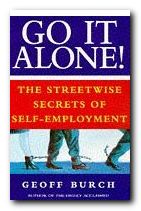
Work from homeThis is a morale-boosting guide for anybody who wants to start their own business, or who harbours deep desires to be their own boss. Geoff Burch takes an entirely practical approach and shows how it can be done – by cutting your costs to a minimum and steering clear of get-rich-quick schemes. It will also be useful for all those folk who are facing early retirement and wondering what to do with themselves. Do your own thing – and walk tall!


Buy the book from Amazon UK
Buy the book from Amazon US


A Room of Your Own
Some people can work with very little in the way of equipment. But for most of us, if you’re going to be business-like, you’ll need a space of your own in which to work. Even if most of your activity is outside the house (working as a hairdresser, surveyor, plasterer, gardener) you need a space in the house which is your own.

The options are usually quite obvious. It could be a spare bedroom, an attic, or even the garage or a garden shed. In smaller spaces it might be one corner of a flat. The important thing is that you establish a space in which to conduct your business.

In his best-selling book on self-employment, Go It Alone! Geoff Burch describes the ultra minimalist approach were you have no office and no equipment at all. But even he agrees that you need to establish your own space – even if this is a psychological space.

Take a professional attitude and carve out a space for whatever you need. Your equipment could be no more than a few box files, a telephone, a computer, or folders full of papers. Keep this space for yourself, and don’t let it get mixed up with household matters. Don’t try to work off the edge of the kitchen table.

And Geoff Burch has another excellent piece of advice, which I firmly endorse. Don’t try to re-create a typical office environment. Why should you be surrounded by ugly metal filing cabinets and cardboard boxes full of rubbish. There are perfectly good storage solutions available at suppliers such as IKEA and Habitat which will visually enhance your environment, as well as being functional.


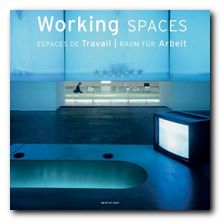
work from homeThis is visual proof that you don’t need to be surrounded by empty cardboard boxes and metal filing cabinets. The examples in this beautifully illustrated book include quite small family homes which have been adapted to the demands of creating a working space within a domestic environment. Learn from the principles illustrated: no clutter, clean spaces, and a well organised room.

Buy the book from Amazon UK
Buy the book from Amazon US


The home office
But if it gets more serious and you want to establish a grown-up home office, you might want to create a professional work space. The basic requirements for a home office are a desk, a telephone, and storage for paperwork. Depending on the nature of your business, that’s probably the minimum. But if you want to give yourself a chance of being taken seriously, I would recommend two additions – a computer and a connection to the Internet. Since you’re reading this on the Internet, you’ve probably already got that.

The telephone
Get a dedicated line or use your mobile telephone number exclusively for your business calls. Don’t try to piggy-back off the household telephone line. Nobody will take you seriously if they ring up and are answered by a child who says “I’ll pass you to my Mum/Dad”. You might need a separate land line or a mobile number – but this is a small and worthwhile investment. Just look around you. Painters, plumbers, decorators, sales reps – everybody these days has a mobile phone.

Don’t even share a line with your spouse/partner/wife/husband (does that cover it all?) because when the phone rings, who answers it? Believe me, it’s a recipe for arguments and territorial squabbling. A separate telephone number is a minimal requirement for anybody wanting to be taken seriously in business. You’ll also benefit by having an answerphone. They’re cheap, and will cover any time you’re not in your office.

Email
The same’s true of an email address. Your customers will not be impressed if they are asked to reply to <johnandbarbara@fireside.Yahoo.co.uk>. Who is running the business – John, or Barbara? Do they both read the emails?

You should have an email address of your own – and it should have your business as a domain name. In other words <Barry@hotmail.com> could be anybody in the world. It gives you no identity, no distinction, and no business credibility. On the other hand, <info@bigservices.co.uk> looks more professional.


Fax
A fax machine used to be a badge of pride for anybody setting up their own business. But now you’ll find that it’s only the most old-fashioned concerns such as solictors who use them. Everybody else uses documents sent as attachments to email messages. So you can save on setup expense by ditching this cumbersome bit of Old Technology. All you need instead is an all-in-one printer-scanner-copier. At the time of writing these start at only thirty pounds.

Meeting clients
If you are working from home – from an office in the box room or even a corner of the spare bedroom – there comes a moment when you make contact with a potential client and need to meet up to discuss business. Ooops! It wouldn’t look good to invite Mr Big from Megabucks Ltd to your semi at 13, Oildrum Lane. You’re certainly not going to invite them back to your house to discuss business surrounded by unmade beds and children’s toys.

Don’t worry. This happens to everybody when they start up. But there are perfectly simple solutions. Either you offer to meet them on their premises (and you turn up on time, looking smart) or you invite them to meet in a public space in a location convenient to both of you. This could be a hotel lounge, a restaurant, or a bar somewhere convenient.


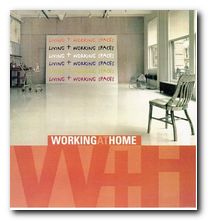
Work from HomeWorking at Home shows interiors for writers, artists, musicians, and graphic designers. Most are minimalist design – plain walls and floors, no decoration, wood in teak or beech, lots of opaque tinted green glass, polished chrome fittings, simple halogen lights, chairs with tubular chrome legs, and giant settees in black leather. And the clutter which blights commercial offices has been purged – to stunning effect.

Buy the book from Amazon UK
Buy the book from Amazon US


Extra tips

Here are some tips for making your work space more professional, more visually appealing, and more productive. All the suggestions are easy to implement, and they’ll make an immediate improvement to your working life.

Straighten your bookshelves
If you have books, folders, box files, or any other items stored on open bookshelves – get them straightened up. Make the items stand up straight; get them in line; and eliminate any flopping and sloping items. Leave any empty spaces free or fill them with decorative objects, such as vases or ornaments.

Clear the desk
A cluttered desk is a recipe for constant irritation. Get rid of papers, memos, post-it notes, paper-clips, coffee mugs, photographs of the family, ‘amusing’ messages, and any other detritus from your working space. Be completely ruthless, and start from a clear working space. You’ll immediately feel better.

I know that there are exceptions. The painter Francis Bacon famously worked in a state of abject squalor. But you’re not Francis Bacon – and anyway most successful business people don’t work that way.

De-clutter regularly
Every day you will receive circulars, flyers, bills, advertising, and publicity materials through the post. Take one look at each item; decide if it’s important or if you want to keep it; and if not – throw it away. Don’t have a big IN-tray – otherwise that’s extra work to be done.


work from homeLive/Work is a collection of projects where living and working environments have been merged. The results prove that you can transform a house, a flat, or even an industrial site so that it becomes a very comfortable and attractive hybrid. Examples include the homes of architects, a painter, a photographer, a fashion designer, a restaurateur, a documentary film maker, a physical trainer, even a priest marrying people out of his own home-church.

Buy the book from Amazon UK
Buy the book from Amazon US

© Roy Johnson 2004


More on How-To
More on literary studies
More on writing skills


Filed Under: How-to guides, Lifestyle Tagged With: Business, Home office, Home working, Interior design, Lifestyle

How to Write

June 19, 2009 by Roy Johnson

basic writing skills explained in easy stages

This is an introductory guide to writing, aimed at people who think they can’t write, or for whom writing is an ordeal. Broken down into short topic-based chapters on everything from beginning to revising, it demystifies the writing process by taking the reader through each stage necessary to bring a piece of writing to a decent finish. Follow the advice, and you will learn how to write. Alastair Fowler kicks off by considering the advantages and disadvantages of composing and editing directly on a computer screen.

How to WriteThen comes a series of short chapters, each one dealing with a different aspect of the writing process: outlines, drafts, paragraphs, sentences, arguments, punctuation, researching, and grammar. His model is formal academic writing, but his advice will be of use to anybody who wants to understand writing skills and improve their own. He deals with those tricky issues that distress beginners, such as ‘making a start’, and offers tips which at first glance can seem counter-intuitive, but reveal a voice of experience:

For most sorts of writing, the best way to begin is not to. Or rather, to have already begun in the past.

He also covers how to plan what you intend to write, and how to create order in what it will contain; then how to flesh out your rough notes into a first draft.

Beginners will also find it reassuring that he shows how to get a feel for the scale of a piece of writing – how to assess the required length and thereby the scope of its content.

I also found his advice on paragraphs sound. Once you have grasped the concept of structure and rhythm in a paragraph, most other problems of construction and format should fall easily into place.

He goes into quite some detail on how to construct persuasive arguments. It is in this sense that the book really is fundamentally about writing essays, and I think on reflection that it’s for people who have mastered the basics of writing and who wish to hone their skills.

Next comes how to arrange the parts of a sentence to make meaning clearer, and then an explanation of all the common marks of punctuation, which he manages with being either pedantic or boring. (If you want advice on punctuation delivered in a humorous manner, try Lynne Truss’ excellent Eats, Shoots & Leaves.)

For those who really are brushing up their essay writing skills, Fowler has some useful advice on quotation – how to do it, and what real function it serves. The same is true of plagiarism, which he discusses in the light of re-working other people’s ideas in a legitimate manner.

He finishes with a conducted tour of the available reference books and guidance notes on writing skills – which is a lot more useful than just a bare, unannotated bibliography. It’s a short book, but probably all the more useful for that – and amazingly good value at the price.

© Roy Johnson 2006

How to write   Buy the book at Amazon UK

how to write   Buy the book at Amazon US


Alastair Fowler, How to Write, Oxford: Oxford University Press, 2006, pp.202, ISBN: 0199278504


More on journalism
More on creative writing
More on writing skills
More on publishing


Filed Under: Creative Writing, Journalism, Writing Skills, Writing Skills Tagged With: Creative writing, How to Write, Journalism, Writing skills

How to write book reviews

September 16, 2009 by Roy Johnson

book reviewsnotes and style guide for reviewers

1. Good book reviews should as a bare minimum be informative, but if they are good they will also be entertaining. Keep three things in mind whilst writing – your readers, the type of review, and the purpose of the review.

2. Your readers may be beginners – or advanced specialists. You should write reviews in different ways, according to the audience. A general reader will not have detailed technical knowledge. Advanced readers will want specialist information. The type of audience is likely to be determined by the publication – either in print or on the Web.

3. The kind of publication will also determine the type of review that is required. Popular newspapers and magazines have very short reviews – some as short as 100-200 words. Specialist journals might have reviews up to 2,000 words long. Make sure you have a clear idea of the type of review you are writing by getting to know the publication first.

4. The purpose of a review is to give an account of the subject in question (the book, film, play, or event) and offer a reasoned opinion about its qualities. Your main task is to report on the content, the approach, and the scope of the work for the benefit of your readers.

5. Even short reviews will be more successful if they have a firm structure. Here’s a bare-bones plan for a review:

  • Brief introduction
  • Description of contents
  • Assessment of value
  • Comparison with others
  • Conclusion

6. Unless you are writing for a specialist journal, you should write in an easy reader-friendly manner.

7. Some publications give their reviewers scope for showing off or being controversial. (Pop music, restaurant, and television reviewers seem particularly prone to this.) In general however, you will be doing your readers a favour by putting their interests before your own.

8. If you are writing for the Web (in pages like these) remember to write in shorter sentences and shorter paragraphs than you would for a print publication. Reading extended prose on a computer screen is not easy. You will keep your reader’s attention by ‘chunking’ your information.

9. Apart from professional journalists, most reviewers do not get paid. However, you will get to keep the book, CD, or the object you are reviewing.

Review Structure

Here is the structure of a typical book review from this Mantex web site.

1. Title

2. Sub-title

3. One-sentence summary (ten words maximum)

4. Opening paragraph. This should be attention-grabbing, conversational in tone, and it might be slightly provocative. It’s purpose is to introduce the work under review – and to encourage the site visitor to read on. (Fifty words maximum)

5. Body of review. This will be a series of short paragraphs – around fifty words each in length. The total length of the review should be between 500 and 1,000 words – with longer reviews for exceptionally good or interesting works.

6. The review should give some account of the work’s positive qualities.

7. A typical review might take into account any of the following topics:

  • What is the intended audience?
  • Is it physically well produced?
  • Is it pitched at the right level?
  • Does it have any unusual features?
  • What distinguishes it from similar publications of its type?

8. Concluding paragraph (fifty words maximum). This can summarise the reviewer’s opinion and may offer a personal flourish which echoes the introduction.

9. Full bibliographic details of the work under review – Author(s) – Title and Sub-title – Place of publication – Publisher – Date of publication – Number of pages – Full ISBN

10. The review should be accompanied by a graphic file of the book jacket or the software package design. These can be taken from the publisher’s site, or from Amazon.

Some Do’s and Don’ts

Do give examples
A brief quotation to illustrate good qualities of the work will brighten up your review. But keep it very short. Alternatively, use it as a ‘pull quote’. This is a statement which can appear separated from the main text of your review – placed in a box or highlighted in some way. These are usually chosen to capture the flavour of the work under review.

Don’t go on too long
Reviews which are short and to-the-point are more effective than ones which go on at great length. Unless you have lots of interesting things to say, readers will quickly become bored.

Don’t be over-negative
If you think something is entirely bad, then it’s probably not worth writing the review. After all, why bother giving publicity to bad work? There are only a couple of exceptions to this. One is if you wish to counter other reviews which you think have been mistaken or over-generous. The other is if the author is very well known and seems to you to have written badly. In such cases, make sure you give convincing reasons for your negative opinions – otherwise you risk seeming prejudiced.

How to write reviews of fiction

1. When reviewing fiction you are writing as an experienced reader, and your review is a personal response to your reading experience. A first person mode of address is permitted more than normal.

2. If possible you should consider the text in the context of the type or genre to which it belongs. It’s no good judging science fiction against the conventions of a traditional realist novel.

3. However, it always helps to have the full range of literary traditions in mind. If somebody writes about ‘floating islands’ you will look fairly silly if you don’t know that Jonathan Swift did it in 1726.

4. Give a brief summary of the plot – but don’t on any account give away any surprise or trick endings. You can say that the book ends in a dramatic or unexpected manner, but don’t spoil the reader’s pleasure.

5. Consider the book in the light of others of its kind. Is it offering something new, or just a variation on an old theme? Maybe the variation itself reflects some contemporary issue?

6. Comment on the quality of the writing. Is the prose style worthy of mention? Here is where a brief quotation can be very telling. Does the author do anything original in the way of presentation?

7. Are any large scale contemporary themes being explored? What are the underlying issues beneath the surface story-line? These may not be immediately evident, and sometimes authors write about one subject as a metaphor or a symbol for another.

8. Are the characters vividly portrayed and memorable? If so, try to give a brief example.

9. Has the author given obvious thought to the plot and the structure of the novel? Plot is usually easy to perceive, but structure can be a more difficult feature to isolate and describe.

10. You do not need to cover every detail of the book. It will be enough if you deal with the most important issues. Make your review as interesting as possible.

return button   Publish your writing

© Roy Johnson 2004


More on How-To
More on literary studies
More on writing skills


Filed Under: How-to guides, Literary studies, Writing Skills Tagged With: Book reviews, Essays, Reviews, Writing reviews, Writing skills

  • « Previous Page
  • 1
  • …
  • 41
  • 42
  • 43
  • 44
  • 45
  • …
  • 103
  • Next Page »

Get in touch

info@mantex.co.uk

Content © Mantex 2016
  • About Us
  • Advertising
  • Clients
  • Contact
  • FAQ
  • Links
  • Services
  • Reviews
  • Sitemap
  • T & C’s
  • Testimonials
  • Privacy

Copyright © 2026 · Mantex

Copyright © 2026 · News Pro Theme on Genesis Framework · WordPress · Log in