sample from HTML program and PDF book
1. The following is a list of abbreviations in essays you will often come across – mainly in the text, the index, or the bibliography of books designed for serious readers.
2. They are nearly all brief or abbreviated forms of expressions in Latin.
3. Many people also make use of them when taking notes, and they are also used in the footnotes and endnotes of academic writing. Examples below.
4. Don’t use abbreviations in the main text of any formal writing. If you wish to use these terms, they should be written out in full.
5. That is, don’t put e.g., but write out for example.
6. Notice that a full stop is placed after an abbreviation, but not when the full word is used.
7. This is correct usage, but sometimes the full stop may be omitted in order to avoid double punctuation.
8. Note that these terms are often shown in italics.
9. You should never begin a sentence with an abbreviation.
| Abbrev. | Full term |
|---|---|
| app. | appendix |
| b. | born. For example, b.1939 |
| c. | (circa) about: usually with a date. For example: c.1830. |
| cf. | (confer) compare. |
| ch. | chapter (plural chaps.) |
| col. | column (plural cols.) |
| d. | died. For example, d.1956 |
| do. | (ditto) the same. |
| e.g. | (exempli gratia) for example. |
| ed. | edition; edited by; editor (plural eds.) |
| esp. | especially. |
| et al. | (et alii, aliae, or alia) and others. For example, Harkinson et. al. |
| et seq. | (et sequens) and the following. For example, p.36 et seq. |
| etc. | (et cetera) and so forth. [An over-used term. Worth avoiding.] |
| fig. | figure (plural figs.) |
| f./ff. | following. For example, 8ff. = page 8 and the following pages. |
| ibid. | (ibidem) in the same place: from the source previously mentioned. |
| i.e. | (id est) that is. |
| inf. | (infra) below: refers to a section still to come. |
| l. | line (plural ll.) [NB! easily mistaken for numbers ‘One’ and ‘Eleven’.] |
| loc. cit. | (loco citato) at the place quoted: from the same place. |
| n. | note, footnote (plural nn.) |
| n.d. | no date given |
| op. cit. | (opere citato) from the work already quoted. |
| p. | page (plural pp.) For example, p.15 [Always precedes the number.] |
| para. | paragraph (plural paras.) |
| passim | in many places: too many references to list. |
| q.v. | (quod vide) look up this point elsewhere. For example, q.v. p.32. |
| sic | thus. As printed or written in the original. usually in square brackets [sic]. |
| supra | above: in that part already dealt with. |
| trans. | translator, translated by. |
| viz. | (videlicet) namely, that is to say. For example: Under certain conditions, viz… |
| vol. | volume (plural, vols.) |
Here’s the use of abbreviation in an academic footnote. The first reference used edn for edition and p for page. The second reference uses ibid for ‘in the same place’.
2. Judith Butcher, Copy Editing: the Cambridge Handbook for Editors, Authors, and Publishers, 3rd edn., Cambridge University Press, 1992, p.234.
3. Butcher, ibid., p.256
Here’s an example which uses the abbreviated names of two well-known organisations:
The BBC reported yesterday that the leaders of NATO had agreed to discuss the crisis as a matter of urgency.
Abbreviations are commonly used in displaying web site addresses:
http://www.bath.ac.uk/BUBL/home.html
Every term in this address, apart from the names ‘Bath’ and ‘home’, are abbreviations
http = hypertext transfer protocol
www = world wide web
ac = academic
uk = United Kingdom
html = hypertext markup language
© Roy Johnson 2003
Buy Writing Essays — eBook in PDF format
Buy Writing Essays 3.0 — eBook in HTML format
More on How-To
More on writing essays
More on writing skills
 Accent refers to a speaker’s style of pronunciation.
 And yet for all that he takes a jokey line, he offers lots of interesting insights – such as the reasons why some software lasts, unlike hardware which on average is replaced every three years. It’s a shame, because he is clearly well informed and at some points has interesting things to say about technological developments and even the philosophy of the internet – but his efforts are dissipated by a lack of focus. He throws off ideas and sketches topics every few pages which warrant a book in themselves, but he can’t quite make up his mind if he’s a historian of technology or a commentator on business methods.

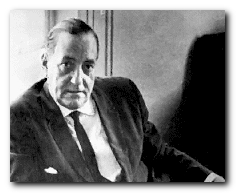 Alejo Carpentier was a Cuban writer who straddled the connection between European literature and the native culture of Latin-America. He was for a long time the Cuban cultural ambassador in Paris. Carpentier was trying to place Latin-American culture into a historical context. This was done via a conscious depiction of the colonial past – as in The Kingdom of This World, and Explosion in a Cathedral (title in Spanish El Siglo de las Luces – or The Age of Enlightenment).
 The Kingdom of This World
 The Lost Steps
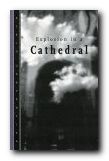 Explosion in a Cathedral
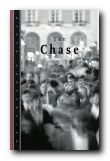 The Chase
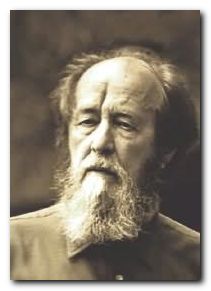 Alexander Solzhenitsyn (1918-2008 ) was both the continuation of the nineteenth century Russian realist literary tradition, and the nearest the twentieth century had to a Tolstoy figure – a great writer who became a self-appointed conscience to the Russian nation. Solzhenitsyn survived four of the most severe tests known to human beings – war, cancer, unjust imprisonment, and exile. He made all of them the materials of his fiction. He was awarded the Nobel Prize for Literature in 1970. This did not prevent him being expelled from the Soviet Union in 1974 under Brezhnev. He then lived in the United States until he was invited back to his homeland in 1994 following the collapse of communism.
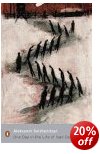 One Day in the Life of Ivan Denisovitch (1962) is a short novel that made Solzhenitsyn famous overnight. It recounts a typical day’s work, deprivation, and suffering of a prisoner in one of Stalin’s labour camps. Publication was ‘allowed’ because it suited Krushchev in his post 1956 reforms and his criticism of Stalin. The facts of prison camp life were deliberately understated to meet the censor’s requirements. It catapulted Solzhenitsyn to fame, and yet within two or three years his work was banned all over again. Beginners should start here.
 The Gulag Archipelago (1973-1978) could eventually turn out to be Solzhenitsyn’s masterpiece. It’s a three-volume encyclopedia of the forced labour camps which underpinned the communist system – from Lenin onwards. It was written in secret under incredibly difficult conditions and smuggled out to the West. It’s a history, a sociology, a complete political and social record of the labour camps. Rather unusually for Solzhenitsyn it is recounted via a series of poetic metaphors which hold together a wonderful collection of stories, statistics, and anecdotes. There are heartbreaking tales of endurance, survival, escape, and recapture. It is truly one of the great documents of historical witness. In retrospect it probably helped to bring about the collapse of the totally corrupt communist regime in the USSR. But most importantly it helps to document a tragically bleak period of quite recent European history. This is a work which could significantly affect your life.
 The First Circle (1968) is set in a special research-cum-detention centre reserved for mathematicians and scientists who are nevertheless political prisoners. This is what might be called a novel of ideas, as the characters discuss the political and historical forces which have brought them to their present unjust imprisonment. Of the main characters, one is eventually released, another is sent off to a much harsher regime, and the third remains where he is. Includes a satirical portrait of Stalin.
 August 1914 (1971) is the first part of a multi-volume epic, a historical novel on a grand scale about the origins of the Soviet Union and how communism came to take root there. The cycle is called The Red Wheel, and was never finished. Solzhenitsyn sees the Battle of Tannenberg at the start of the First World War as the first major turning point in this process. Using a range of modernist and vaguely experimental techniques, he sets in motion a huge cast of characters against the backdrop of this decisive battle.
 Lenin in Zurich (1976) is a short section from The Red Wheel which focuses largely on Lenin in exile, immediately prior to his triumphant return in a sealed train to St Petersburg’s Finland Station. It’s a very interesting study, because Solzhenitsyn is clearly critical of Lenin as one of the central architects of communism – yet he narrates the novel largely from Lenin’s point of view, blending a psychological character study and real historical detail with a witheringly ironic critique. Steeped in history, this is a major attempt at a political and psychological portrait of a historical figure.