Mantex

Tutorials, Study Guides & More

  • HOME
  • REVIEWS
  • TUTORIALS
  • HOW-TO
  • CONTACT
>> Home / Archives for 2009

Archives for 2009

Online style guides

September 16, 2009 by Roy Johnson

Online style guides The Writer’s Workshop
Writing skills, grammar, teaching notes, bibliographic style, tips, and plenty more.
http://www.cws.illinois.edu/workshop/

style guides Guide to Grammar and Writing
Very good grammar guide, plus other resources.
http://www.englishgrammar.org/

style guides Purdue On-line Writing Lab
Purdue’s famous OWL, useful for general writing concerns
http://owl.english.purdue.edu/

Online style guides How to Cite Electronic Sources
Practical examples from Library of Congress.
http://lcweb2.loc.gov/ammem/ndlpedu/start/cite/index.html

Online style guides The Elements of Style
William Strunk, Jr.’s original 1918 classic. The ‘bare bones’ approach to common problems.
http://www.bartleby.com/141/

Online style guides On-Line Study Resources
Style, grammar, essay-writing, citations and footnotes, plagiarism and presentation from the University of New South Wales.
http://www.lc.unsw.edu.au/olib.html

Online style guidesWIRED Style
Wired Magazine’s online version of their print publication Principles of English Usage in the Digital Age. A guide to writing and editing which looks at the problems thrown up by the new language of the digital age.
http://hotwired.lycos.com/hardwired/wiredstyle/

Online style guides alt.usage.english – Style FAQ
Mark Israel’s Frequently Asked Questions covers common English usage questions, word etymology, online and offline references, and more.
http://www.english-usage.com/faq.html

Online style guides WebGrammar
Judy Vorfeld’s excellent site covers some of the most common writing mistakes, including spelling, grammar and homonym errors.
http://www.webgrammar.com

Online style guides IEEE Computer Society Style Guide
Handy if you wish to submit papers going to their journals, or do any work using their style.
Download the style guide here (PDF)

Here are some other UK journalism styleguides available online:

Online style guides The Guardian

Online style guides The Economist

Online style guides Reuters

Online style guides Associated Press

Online style guides The Telegraph

Online style guides Financial Times Lexicon

© Roy Johnson 2004


More on How-To
More on literary studies
More on writing skills

Filed Under: How-to guides, Study Skills, Study skills Tagged With: Academic writing, Online style guides, Referencing, Style guides, Technology, Writing skills

Online! a guide to using Internet sources

November 20, 2009 by Roy Johnson

academic referencing and writing style guide

This is a handy spiral-bound pocketbook which offers a compact guide to academic writing and its relation to the Internet. It presents standards for accessing, evaluating, and quoting Net sources. Most importantly, it shows you how to present digital referencing in academic writing. These are issues facing many students [and tutors] in the sudden eruption of the digital world into what was a bibliographic tradition dating back to the early Renaissance.

Digital referencingThe orientation is entirely American, but it includes models for citation in four different systems: the Modern Languages Association (MLA), American Psychological Association (APA), Council of Biology Editors (CBE) and Chicago University Press styles. Any of these could be adapted by European readers. They go into all the nit-picking details of where colons and angled brackets should be placed, where to use mono-spaced fonts to indicate addresses, and how best to break long URLs across consecutive lines.

The guide also includes tips for writing and publishing on the Net, and a directory of Net sources in the major academic disciplines. There is a rather good glossary, imaginatively placed at the front of the book; it has a full index, and the contents pages are well-designed. It includes some very helpful tips by the way – such as examples of lesser-know but useful URLs, and it even includes a brief chapter on how to create your own Web site.

In a bibliographic world where locations are ever-shifting, and where files can be updated on the hour, it includes important details on the dating and updating of files for the purposes of academic accuracy, and the evaluation of sources.

There has been some discussion in mailing list groups recently which has criticized the obsession with accuracy on these issues as an arm of the academic establishment’s concern with form at the expense of content. (This seems to be an issue which is more prevalent in the US than the UK it seems.) However, anybody who anticipates referencing digital sources in academic writing will find this a useful resource – and terrific value at the price.

citing Internet sources   Buy the book at Amazon UK

citing Internet sources   Buy the book at Amazon US

© Roy Johnson 2009


Andrew Harnack and Eugene Kleppinger, Online! a reference
guide to using Internet sources
, New York: St Martin’s Press, 1997, pp.162, ISBN: 0312150237


More on study skills
More on writing skills
More on online learning


Filed Under: Study skills Tagged With: Academic writing, Electronic Writing, Internet sources, Quotations, Referencing

Onomatopoeia – how to understand it

September 11, 2009 by Roy Johnson

free pages from our English Language software program

Onomatopoeia – definition

onomatopoeia Onomatopoeia is a figure of speech in which the sound of a word echoes the thing it describes.
redbtn It is a form of symbolism in sound.


Examples
buzz pop bang
swish cuckoo hissing
burble twitter sizzle

Use

redbtn Onomatopoeia is used for emphasis or stylistic effect.

redbtn It is featured very heavily in children’s rhymes and poetry in general.

redbtn It is also used extensively in advertising, as in the slogan

‘Snap, crackle, pop!’

redbtn NB! ‘Onomatopoeia’ is derived from the Greek term ‘make a word’.

redbtn ‘Onomatopoeia’ is the only example in English of a word which has a direct and intrinsic connection with the thing it describes.

redbtn For example, if we say that the boy made a ‘splash’ jumping into the pool, the noun ‘splash’ actually imitates the thing to which it refers.

redbtn ‘Splash’ is not simply an arbitrary code for the sound made when someone jumps into a swimming pool. It is an aural echo of that very thing.

redbtn The very concrete nature of onomatopoeia needs to be stressed. This applies in most cases where a word imitates a sound which we all recognise.

redbtn The English language is a coded system in which most words have a completely arbitrary link with the object or state which they describe.

redbtn For example, the word ‘house’ is a code term for the building with rooms in which we live. Similarly, ‘fear’ is a four-letter code for the unpleasant sensation of acute apprehension. [These terms are quite different in other languages.]

redbtn Onomatopoeia is thus an exceptional case because the word has at least an aural similarity with the thing it describes.

redbtn Perhaps the original symbols which comprise a pictographic language such as Chinese can be seen as a useful visual analogy with onomatopoeia. Chinese characters derive from pictures of the things they describe. They therefore have an intrinsic connection with them, just as the English words such as ‘splash’ ‘plop’ ‘bang’ ‘tinkle’ are the auditory equivalent.

redbtn Studying onomatopoeia thus highlights the ideographic nature of English and to take this to a purist extreme, we see that even the most literal use of language is only literal in a relative sense because the words themselves are at a semantic distance from the thing to which they refer.

redbtn We learn to connect the word ‘house’ with the building we call home, but we take it completely on trust because there is no essential connection there between word and phenomenon.

redbtn The same principle applies to every unit of meaning except onomatopoeic words and for that reason alone onomatopoeia is of interest to linguists.

redbtn Animal calls are evoked onomatopoeically in all languages. For example ‘cock-a-doodle-do!’ is conventionally the English representation for the crowing of a cock. Interestingly, the French represent the same phenomenon as ‘cocorico!’, which is significantly different, although logic tells us that the rooster’s cry is constant across the world.

redbtn This variation in the representation of animal calls has helped researchers into language change to chart developments in the English language. In ancient poetry, for instance, if the word ‘go’ was rhymed with ‘cuckoo’, we could be fairly sure that the pronunciation of the word ‘go’ had changed rather than the birdsong.

Self-assessment quiz follows >>>

© Roy Johnson 2003


English Language 3.0 program
Books on language
More on grammar


Filed Under: English Language Tagged With: English language, Figures of speech, Language, Onomatopoeia

Open Here: instructional design

July 24, 2009 by Roy Johnson

illustrated and amusing instruction design graphics

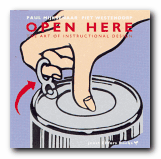
Have you ever tried to erect a wardrobe from the instructions in a self-assembly pack? Or followed the printed notes for programming your VCR? Open Here presents an entertaining collection of diagrams, graphics, and visual instructions for tackling the problems of everyday life which baffle us all. It includes such tricky examples as how to tie a bow tie whilst looking in a mirror, and what instructions to give people for the emergency evacuation of an aeroplane.

Open Here: instructional designMijksenaar and Westendorp achieve much of their effect from the vibrant colour reproductions of instructional design with which the book is packed. Every page is a visual treat. The examples they give are so wide-ranging that I often wished they had stayed longer on any one, providing a more extended analysis, rather than flitting so swiftly onto the next after a few comments.

There’s also an interesting historical overview which shows the presentation of instructions going from realistic photos or drawings of whole objects in the nineteenth century, to more recent depictions which tend to focus on specific parts or functions.

However, applying the principles they espouse to the book itself reveals a weakness as far as the serious sector of their potential market is concerned. Some pictures have explanatory captions, whilst others do not; and on the whole, rather too much space is devoted to visuals and too little to their textual commentary, which for the most part is tantalisingly cryptic.

In addition, they don’t always make a clear distinction between the good and bad examples, and I was disappointed that they didn’t provide a bibliography, because the book is obviously based on a lot of research. They also make little distinction between simple diagrams produced for the lay user and those expanded technical illustrations of cross-sections through a car engine which are produced for engineers. But then, this variety adds to the book’s visual appeal. I was yearning for more analysis, but read it with a permanent smile on my face.

This is a lively and refreshing publication which will make anyone reading it intensely conscious of instructional design. The text suggests that their examples are drawn from an archive of materials which has been built up over thirty years, so I hope that their next publication provides a more extended analysis using similar examples, but without sacrificing any of the graphic zest which makes this book so attractive.

© Roy Johnson 2000

Open Here   Buy the book at Amazon UK
Open Here   Buy the book at Amazon US


Paul Mijksenaar and Piet Westendorp, Open Here: the art of instructional design, New York: Joost Elffers Books, 1999, pp.144, ISBN: 1556709625


More on web design
More on technology
More on digital media
More on study skills
More on information design


Filed Under: Graphic design Tagged With: Graphic design, Information design, instructional design, Open Here

Open Sources

June 15, 2009 by Roy Johnson

policy essays by the free software movement pioneers

O’Reilly publications have decided to throw their weight behind the Open Source movement. This timely compilation of essays written by its leaders reveal why it came into being, how it works, why they think it will succeed, and where it is going – particularly in its fight against Microsoft. Open Source is a form of collaborative software development in which programmers give their time and expertise freely.

Open Sources They create programs which are written and de-bugged without any concern for commercial gain. Then they give away the code for anyone to use. As you can guess, this is just about the complete antithesis of Microsoft and its business strategy, which has recently been judged as a near-monopoly unfairly exploiting its power. The competing Open Source-Microsoft philosophies are now locked in a battle for the future.

All this is all quite recent. In April 1998 O’Reilly invited software developers to the first Freeware Summit, where participants agreed to work together to increase acceptance and use of open-source software. Since then, the influence of this movement has grown steadily – especially with the increasing popularity of Linux, a very stable and efficient operating system which threatens the dominance of Windows.

One of the things I liked most about this collection is the variety of approaches the auithors adopt to their proselytizing, plus the fact that new concepts are made accessible to the non-specialist reader. Eric S. Raymond, one of the founding fathers (whose collected essays, The Cathedral and the Bazaar have just appeared) explains the origins of the movement in his ‘Brief History of Hackerdom’.

Richard Stallman writes on the history of free software and its supporters. Robert Young, the CEO of RedHat, explains how they are able to successfully market Linux, the free software [it’s because they offer a good backup service]. Bruce Perens offers a definition of Open Sources – which is more complex than you might think. The collection ends with a transcript of the 1992 Tannenbaum-Torvalds debate in which Linus Torvald defends his new Linux operating system and his concept of free software in the COMP.OS.MINIX newsgroup. It is refreshing to encounter the modesty of this pioneer and be reminded of the limits under which he was working:

‘Linux has very much been a hobby (but a serious one: the best type) for me: I get no money for it, and it’s not even part of my studies in the university. I’ve done it all on my own time, and on my own machine [a 386PC].’

So these are rather like the crusading documents of a new movement. They might sometimes read as rather idealistic, but they also contain hard-headed facts from the worlds of big business, software engineering, and even jurispudence. They see these issuess as a matter of moral, philosophical choice, even though the medium is technological. As Chris DiBona argues in his scene-setting introduction:

Industry has produced some marvellous innovations: Ethernet, the mouse, and the Graohical User Interface (GUI) all came out of Xerox PARC. But there is an ominous side to the computer industry as well. No one outside of Redmond [Microsoft headquarters] really thinks that it is a good idea for Microsoft to dictate, to the extent that they do, what a computer desktop should look like or have on it.

© Roy Johnson 2005

Open Sources   Buy the book at Amazon UK

Open Sources   Buy the book at Amazon US


Chris DiBona et al, Open Sources: Voices from the Open Source Revolution, Sebastapol, CA: O’Reilly, pp.272, ISBN: 15659258237


More on eCommerce
More on media
More on publishing
More on technology


Filed Under: e-Commerce, Open Sources Tagged With: e-Commerce, Open Sources, OSS, Technology

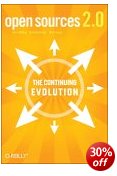
Open Sources 2.0

June 15, 2009 by Roy Johnson

essays and reports from the free software movement

When we reviewed Open Sources: Voices from the Open Source Revolution six years ago, the movement for free software was only just gathering momentum – and O’Reilly were publishing a collection of essays which were essentially explaining its key concepts. Now this second collection is symbolically twice as big, and reporting on a worldwide uptake.

Open Sources 2.0The first part of the book deals with the technical and business aspects of open sources. There’s a report on the development of Mozilla.org, which produced the Firefox browser and Thunderbird email program, and an account of working on Samba, which acts as a ‘glue’ between the separate worlds of Unix and Windows. All of these Open Source programs are available at SourceForge.net – 100.000 projects and one million registered developers.

The amazing thing is that some people are able to develop business models using open source software. They do this by offering services which provide consultancy and support to users of open source. Michael Olson even describes a dual license system whereby the software is provided free to one set of users, and is sold at a charge to another. This essay also includes a very useful explanation of copyright law and warrantees.

The first half of the book deals with these conundrums and apparent contradictions introduced into the world of software and IT. What happens when people decide to make their software freely available to download at no charge to the end user?

There’s a very enjoyable chapter by Russ Nelson on developing his own small business enterprise dealing with open source. This will be music to the ears of anyone who would like to make a living writing and selling software and their related services.

There are fully detailed surveys of the development of open source software in Europe, India, and even China. In Europe there is a growing pattern of local and regional government adopting OSS for both political and financial reasons. In India takeup of OSS is slower because of rampant piracy of proprietary software. Piracy exists in China too, but the potential for growth in country which actually manufactures a lot of the world’s digital hardware is so great that OSS support companies are moving in to be part of the booming economy.

The second part of the book looks ‘beyond’ open sources as a technology to the philosophy of what’s at its base – collaborative forms of working. These chapters examine new business models, such as Amazon for instance which operates using open source software, but also invites collaborative input from its customers and even its competitors. Other examples include open source legal researching and even biology.

There’s a very interesting contribution from Larry Sanger on the history of the Wikipedia project – the open source encyclopedia of which he was a co-founder. Some of the problems raised in keeping Wikipedia free of vandals is answered in a similar account of the rise and rise of Slashdot.org (“News for nerds. Stuff that matters”) the socio-technological news site which permits submissions and comments in an open source sort of way. It has developed a form of hands-off self-monitoring system which welds people together into a community.

This book is as important and impressive as its predecessor. It offers updates on practical examples of the social and technological innovations of the late twentieth century and gives us a glimpse of what might become working models for what lies ahead in the twenty-first.

© Roy Johnson 2005

Open Sources 2.0   Buy the book at Amazon UK

Open Sources 2.0   Buy the book at Amazon US


Chris DiBona et al, Open Sources 2.0, Sebastopol: CA, O’Reilly, 2005, pp.445, ISBN: 0596008023


More on eCommerce
More on media
More on publishing
More on technology


Filed Under: e-Commerce, Open Sources Tagged With: e-Commerce, Open Sources, Open Sources 2.0, OSS, Technology

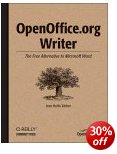
OpenOffice Writer

July 23, 2009 by Roy Johnson

The free alternative word-processor to Microsoft Word

OpenOffice is one of the big success stories of the Open Source Software movement – along with programs such as Linux and Apache. Open Source seeks to design software by voluntary collaboration, then makes it freely available for anyone to use . Writer is the word-processing package part of OpenOffice and, not to put too fine a point on the matter, it’s a free alternative to the costly and ponderous Microsoft Word.

OpenOffice WriterBecause the software comes free of charge however, there is no printed manual, so the ever-enterprising publishers O’Reilly have produced one as part of their Community Press series. The book comes complete with a CD-ROM containing the whole of the OpenOffice.org suite which you can freely install on as many machines as you wish. The full suite of programs includes packages for spreadsheets (Calc) presentations (Impress) and drawings (Draw) as well as file conversion facilities.

Jean Hollis Weber’s guide starts by showing you how to set up the interface to suit your style of working and your own personal preferences. This includes features such as page appearance, font options, multiple undo, spellchecking, custom dictionaries, and auto-correction.

Basically, Writer works in a very similar manner to Word, but it is more customisable, less intrusive, and less bossy. You don’t get the impression that it’s trying to take over the world, as you do with Word. And even if in the end you decide you don’t like it, you haven’t lost a penny, because it’s free.

She covers working with templates and shows you how to apply styles. For people working on long documents there are tutorials on tables of contents, indexes, bibliographies, footnotes and endnotes, and cross referencing.

Writer and other Open Source software offers an ideal solution for people who cannot afford Microsoft prices, but who wish to undertake professional quality work. This is why it is being taken up so rapidly in poorer countries and even some hard-pressed local governments in the West. (As a result of this incidentally, Microsoft have started to do secret cut-price deals with some big customers in order to keep their share of the market.)

Since most of her potential readers are likely to be migrating from Word, she ends her tour through the program with a useful series of comparison tables. These explain the small differences in how common commands and actions are performed in Word and Writer respectively.

If you need the reassurance of a manual, plus the convenience of a whole suite of programs on one ready-to-hand CD, this is a bargain. It’s sort of a version of O’Reilly’s ‘Missing Manual’ series.

© Roy Johnson 2004

artie shaw Buy the book at Amazon UK

artie shaw Buy the book at Amazon US


Jean Hollis Weber, OpenOffice.org Writer, Sebastopol, CA: O’Reilly, 2004, pp.213, ISBN: 0596008260


More on writing skills
More on creative writing
More on grammar


Filed Under: Open Sources Tagged With: Open Sources, Software, Word-processing, Writing skills

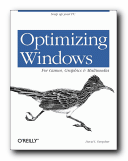
Optimizing Windows

June 18, 2009 by Roy Johnson

advice on improving power, performance, and efficiency

This guidance manual is far more comprehensive than its title suggests. Although the main focus is Windows, it deals with optimizing all operating systems, plus offering tips on speeding up the boot process, freeing up memory, disk partitioning, and generally squeezing the best performance out of your system. David Farquhar’s approach is reassuring and friendly, and he provides commonsense reasons for each of the changes he recommends.

Optimizing Windows He starts with simple suggestions for freeing up disk space by deleting temporary files, obsolete programs, desktop icons, and all those fonts you never actually use. He’s keen on disk defragmentation, and points out that when Windows says it’s not necessary, that’s because its definition of 0% or 1% are so wide. He also recommends disk partitioning, and for each improvement he explains how to use a resident Windows tools utility if there’s one available, a commercial utility if it’s not, or a share/freeware program for which he gives the URL.

For instance, he describes a clean-up and optimization procedure using three of the utility programs he recommends – Norton Utilities, Fix It 99, and Nuts and Bolts 98. Then the same for a couple of uninstallers.

He also covers upgrading from Win95 to Win98, though so rigorous is his search for maximizing performance that much of his advice is focussed on what not to accept during customized setup. He ends with advice on hardware upgrades – memory, hard drives, video cards, even motherboards.

You can ignore the gaming and multimedia in the title. This is for anyone who wants to make sure their computer is running as well as it should. And it’s not just for optimizing and tweaking: it will teach you about the Windows operating system, as well as the underlying architecture of the PC.

© Roy Johnson 2000

Buy the book at Amazon UK

Buy the book at Amazon US


David L. Farquhar, Optimizing Windows for Games, Graphics, and Multimedia, Sebastopol, CA: O’Reilly, 2000, pp.278 ISBN: 1565926773


More on technology
More on digital media
More on online learning
More on computers


Filed Under: Computers Tagged With: Computers, Optimization, Optimizing Windows, Technology, Windows

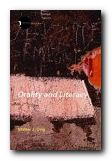
Orality and Literacy

July 13, 2009 by Roy Johnson

Speaking, Writing, Technology, and the Mind

Orality and Literacy has become a classic since it was first published in 1982. It is concerned with the differences between oral and literary cultures. In making this exploration, it throws light onto the essential elements of writing which will be of interest to anyone concerned with the process at a theoretical or deeper level. It starts with the observation that speech and writing are two separate systems, and that ‘oral literature’ is a contradiction in terms. Much of the early argument deals with the issues of ‘authorship’ of Homer’s two epics The Odyssey and The Iliad. Were they written or spoken?

Orality and LiteracyHe suggests a fundamental difference in oral culture and its dependence on formulas, cliche, and kennings. Not an oak tree, but ‘the noble oak’; not the Mediterranean, but ‘the wine dark sea’. He also makes interesting use of the work of the Soviet psychologist Luria [also recommended by neurologist Oliver Sacks] to demonstrate the non-abstract thinking of people in oral cultures.

You’ve got to be prepared for some abstract but often delightful language in his expression. Terms such as ‘verbomotor lifestyle’, ‘chirographic culture’, and ‘noetic economy’ nestle alongside some compressed reflections on language, time, space, and our sense of self.

The second part of the book deals with the relationship between consciousness, writing, and technology from the relatively recent 3500 BC onwards. He explains the importance of the alphabet (a one-off invention) and even argues that writing down words – as distinct from speaking them – has an effect on our thought process.

without writing, human consciousness cannot achieve its true potential, cannot produce … beautiful and powerful creations

His comments on the relationship between writing and the body (headings, chapters, footers) are wonderfully suggestive, as are his observations on the fictionality of the addressee in personal diaries. He also dives into the pedagogical debates on language, arguing cogently that whilst all dialects are potentially equal in that they must use the same grammar, it is bad practice not to urge exposure to the full grapholect of the written language, which has “infinitely more resources”

En passant, there’s a very good account of classical rhetoric (antinomasia, paradiastole) which explains why this was important to classical Greeks. He even has an explanation for the importance of female authors in the rise of the novel.

Next comes the importance of space in the rise of print, and the origin and significance of things we take for granted – such as title and content pages, indexes, paragraphs, even page numbers. These further separate print from oral culture and make the book less of a recording of something spoken, more an object in its own right.

The latter parts of the book take his observations into the realm of literature and criticism, using the examples of narrative, closure, and character to illustrate the changes from an oral to a print culture.

He ends with what he calls ‘theorems’ – topics for further consideration in the orality-literacy shift. These include literary history, New Criticism, Structuralism, Deconstruction, and Reader-response Theory.

This is a book which throws off thought-provoking ideas on every page. It has been inexplicably out of print for some time. If you are interested in the psychology or the philosophy of what it means to produce writing on paper or screen – get a copy now.

© Roy Johnson 2005

Buy the book at Amazon UK

Buy the book at Amazon US


Walter J. Ong, Orality and Literacy, London: Routledge, 2002, pp.204, ISBN: 0415281294


More on digital media
More on theory
More on typography
More on writing skills


Filed Under: Theory Tagged With: Language, Orality and Literacy, Theory, Walter Ong, Writing, Writing Theory

Organising and Participating in Meetings

July 3, 2009 by Roy Johnson

how to run meetings and produce the paperwork

Oxford University Press have just brought out a series of short beginners’ guides on communication skills. The emphasis is on compact, no-nonsense advice directly related to issues of everyday life. In this case it’s organising and running meetings, creating the documents which support them, and participating in them to best effect. Judith Leigh usefully starts off Organising and Participating in Meetings with the language of meetings and the roles of key figures such as minutes secretary, chair, and observers.

Organising and Participating in MeetingsShe then describes how to recruit suitable people to participate in a meeting and serve on a committee, and how to arrange the practicalities of booking venues and travel arrangements so as to maximise the chances of a successful outcome. She then covers the key documentation of meetings – discussion papers, agendas, and reports. This includes the order in which items should be tabled and recorded, plus tips on dealing with documents in paper and electronic form.

There’s a chapter on participation which includes both the ‘rules’ of debate and argument, as well as advice on doing Powerpoint presentations. Then comes the most unpopular task of all – taking the minutes. You’ll be lucky if you can get anybody to volunteer for this job.

Then comes a real gem I haven’t seen in books of this kind before – how to participate in meetings conducted by telephone, email, and video conferencing. She finishes with a checklist of steps to be taken, a glossary of Latin terms and financial jargon, and some templates for meeting papers and agendas.

The chapters of this book are short, but almost every page is rich in hints and tips. The strength of this approach is that it avoids the encyclopedic volume of advice which in some manuals can be quite frightening. This is a book which will reassure those who need it.

If you’ve never run a meeting before, this tells you everything you need to know. And it’s all presented in a clear and simple manner, with the emphasis on achieving a positive outcome. That’s a long way from some of the farcical, corrupt, and often pointless meetings which I’ve had to sit through in the world of education in the last thirty years.

© Roy Johnson 2004

Organising and Participating in Meetings   Buy the book at Amazon UK

Organising and Participating in Meetings   Buy the book at Amazon US


Judith Leigh, Organising and Participating in Meetings, Oxford: Oxford University Press, 2003, pp.144, ISBN: 019866284X


More on study skills
More on writing skills
More on online learning


Filed Under: Study skills Tagged With: Business, Communication, Communication skills, Meetings, Project management, Taking minutes

  • « Previous Page
  • 1
  • …
  • 58
  • 59
  • 60
  • 61
  • 62
  • …
  • 103
  • Next Page »

Get in touch

info@mantex.co.uk

Content © Mantex 2016
  • About Us
  • Advertising
  • Clients
  • Contact
  • FAQ
  • Links
  • Services
  • Reviews
  • Sitemap
  • T & C’s
  • Testimonials
  • Privacy

Copyright © 2026 · Mantex

Copyright © 2026 · News Pro Theme on Genesis Framework · WordPress · Log in