Mantex

Tutorials, Study Guides & More

  • HOME
  • REVIEWS
  • TUTORIALS
  • HOW-TO
  • CONTACT
>> Home / Archives for 2009

Archives for 2009

Pears’ Cyclopaedia

July 14, 2009 by Roy Johnson

best-selling one-volume encyclopaedia, issued annually

What is the population of Stockholm? the atomic number of calcium? or the best way to treat frostbite? To get all the answers in a one-volume reference guide, you need Pears Cyclopaedia. Pears’ (not the soap or fruit) is a long-established classic of compressed facts and knowledge. It packs all sorts of topics into a handy desktop book of reference. Editions vary from year to year, but the fundamental sections remain the same. An edition bought at any time will last you for years and years. There’s a potted chronology of world events (starting at 70,000,000 BC); then a list of prominent people, with thumbnail biographies; and sections on literature, art, and music – complete with mini-essays on the major topics covered.
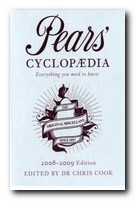
Pears CyclopaediaThe centre of the book is an atlas with a huge index which even lists the position and populations of small villages. There are sections on economic events and political institutions (including recent UK parliamentary statistics); and an encyclopaedia of general knowledge, plus science in the form of chemistry, medicine, computers, and the environment. Ideas and beliefs cover the major world philosophies, and the myths and legends get a section of their own, as does a Biblical glossary.

You have to put up with an absence of page numbers, and strangely enough, the index to the book itself is quite small; but since the entries in most sections are arranged either chronologically or alphabetically, information is easy to locate. This is the work of reference I use most apart from dictionaries and my old copy of Encyclopaedia Britannica. It’s one of those books which you’ll find difficult to put down, once you start browsing. New editions appear in August of each year.

Pears’ Cyclopedia was first produced by the Queen’s soap-makers in 1897 on the occasion of Victoria’s diamond jubilee. It has been revised and updated every year since then, and is still going strong as what the publisher’s rightly claim as ‘the Swiss Army penknife of reference books.

© Roy Johnson 2000

Pears' Cyclopaedia   Buy the book at Amazon UK

Pears' Cyclopaedia   Buy the book at Amazon US


Pears’ Cyclopaedia London: Allen Lane, (issued annually) pp.832, ISBN: 1846143764


More on language
More on literary studies
More on writing skills
More on creative writing
More on grammar
Filed Under: Dictionaries Tagged With: Dictionaries, Pear's Cyclopaedia, Reference books

Peggy Guggenheim

October 15, 2009 by Roy Johnson

poor little rich girl

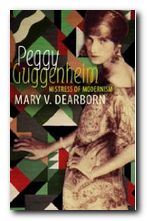
Peggy Guggenheim came from a family of rich Jewish business people who had made fortunes as immigrants in the nineteenth century from trade, mining, and eventually banking. Her father was a womaniser who died aboard the Titanic in 1913 – putting on his dinner clothes to go down in style. When she was nineteen she inherited five million dollars, though as Mary Dearborn points out in this fairly even-handed biography, everybody assumed that she had even more, and couldn’t understand that by Guggenheim standards she came from a ‘poor’ side of the family.

Peggy Guggenheim: Mistress of ModernismThe first thing she spent the money on was an operation to reduce the size of her nose. The procedure went badly wrong and had to be aborted, leaving her worse off than before. In 1921 she married Franco-American Laurence Vail, who introduced her to Bohemian life in the Latin Quarter and in Montmartre. She also met two of his ex-lovers who were to become lifelong friends – Mary Reynolds and Djuna Barnes. Her marriage (the first of many) was a mixture of restless Bohemianism and physical abuse from her husband.

They settled in a house near Toulouse, she had two children, and she sent $10,000 to support the 1926 General Strike in the UK. With Vail she mixed in a fast and arty set: the pages are littered with the names of the now famous – Jean Cocteau, Man Ray, Isodora Duncan, Marcel Duchamp, and Ernest Hemingway – all of whom were happy to share her largesse. She managed to extricate herself from the abusive marriage with the help of her friend and neighbour, Emma Goldmann, the feminist and anarchist. No sooner was this accomplished than she paired off with the Englishman John Holmes who Mary Dearborn describes as “one of the most singularly unproductive men of letters that England may have every known”

There are interesting revelations of the sheer dilettantism which underpins the arty bohemianism of these people. At one point Peggy Guggenheim was trailing across the Atlantic trying to sell decorative lampshades made by her friend Mina Loy.

It’s a life of living in rented houses – in France, England, Switzerland – wherever is fashionable – making visits to America, endless parties, oceans of Champagne, violent rows, fights in restaurants, sexual infidelities – and nobody in sight engaging anything remotely like paid employment.

When John Holmes died unexpectedly (largely of alcohol poisoning) she replaced him with Douglas Garman, another would-be writer, and under his left-wing influence she even joined the Communist Party. A further succession of weekend (and week long) house parties ensued. And rather like the Bloomsbury Group they combined their promiscuity with a curious form of ‘keeping up appearances’ in a bid to preserve social respectability. In common with aristocratic practices, the children produced in these alliances were billeted in outhouses, sent off to boarding schools, raised by paid help, and put unaccompanied on trains to travel half way across Europe at holiday times.

When she got rid of her third abusive husband she began, at forty, what was to become her life vocation. Advised by Marcel Duchamp, she opened a gallery on London devoted to modern art – and surrealism in particular. She began serious collecting, and quickly ammassed a large collection of works by its foremost practicioners, most of whom she knew personally.

In fact many of them either had been or would become her lovers, because free of marriage, she began a mid-life career of sexual emancipation which few would be able to match. Her list of conquests is almost endless: Giorgio Joyce (son of James), Yves Tanguay, Roland Penrose, E.L.T.Mesens, Max Ernst, Marcel Duchamp, and even Samuel Beckett.

By 1940, living in France, she was under serious threat from the Nazis, even though they didn’t seem to realise that she was Jewish. So like many other people she moved to the south then emigrated to America – cleverly arranging for her collection of art works to be sent as ‘household effects’ to avoid tax. Having assembled the collection as a work of love, she wished to put it on show, and despite all the odds she did so in 1942 in New York.

Her concept was novel: it was not just a museum type exhibition, but a living gallery which promoted the work of new young American artists alongside her examples of European art. The gallery was designed to be interactive, and it was a huge success. New York life suited her: she continued to bed men at a prodigious rate, and at one time she lived with a homosexual man with whom she went out on fishing expeditions to pick up sexual partners who they shared.

She exhibited and established the reputations of Mark Rothko, Robert Motherwell, and Jackson Pollock. This was the period in which abstract expressionism swept American modernism into the limelight, propelled by influential critics such as Clement Greenberg and Harold Rosenberg. [See Tom Woolf’s The Painted Word for a sceptical view of the same period.]

And yet almost immediately after the war ended, having established this influential presence in the USA, she closed up shop and decamped to Venice, where she opened the museum that now bears her name. Despite attempts from friends and family alike to deflect her from her purpose, she kept the collection intact, and it now stands as a testament to her personal vision.

In fact last time I visited the gallery it struck me how it encompassed quite a short period of art and a part of the modernist movement which now seems rather tacky – with all the mumbo-jumbo of ‘the unconscious’, the empty posturing of ‘manifestos’, and jejune works by second-rate painters. So the collection is quite an accurate reflection of her life, the later years of which were spent as the grand old lady of the international art scene. But behind the public front of naked sunbathing on the roof of her Grand Canal Palazzo, her gay assistants, and being punted around in the last private gondola in Venice, her real concerns were those of many other elderly ladies the world over – her pet dogs (Lhazo apsos) her wayward children (daughter dead from drugs) and the loneliness of old age.

Peggy Guggenheim Buy the book at Amazon UK

Peggy Guggenheim Buy the book at Amazon US

© Roy Johnson 2009


Mary Dearborn, Peggy Guggenheim: Mistress of Modernism, London: Virago, 2004, pp.448, ISBN 1844080609


More on art
More on media
More on design


Filed Under: 20C Literature, Art, Biography, Lifestyle Tagged With: Art, Biography, Cultural history, Modernism, Peggy Guggenheim, Surrealism

Penguin by Design

May 21, 2009 by Roy Johnson

a history of Penguin’s typography and graphic designs

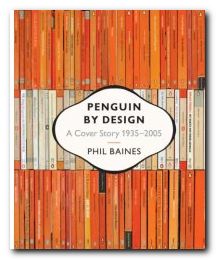
If you’re interested in typography, graphic design, bibliography, collecting books, or just cultural nostalgia, this book is an absolute treat. It’s a beautifully illustrated history of the graphic design used for the Penguin imprint book jackets from its creation in 1935 to the present. Penguins were first sold for sixpence (2.5p) which was the price of a packet of ten cigarettes. That’s cheap by today’s standards when ten fags cost £2.70 but a typical Penguin costs twice that. Right from the start, Penguins were marketed via the elegance and consistency of their cover designs, with their easily recognisable orange covers and their perky logo. Its founder Allen Lane employed some of the most gifted graphic designers and typographists of the day.

Penguin DesignSo it’s no accident that Penguin was (and still is) such a successful imprint. Cover designs changed subtly to keep up with modern fashion, and even the famous penguin logo itself has changed shape, size, and even posture during its seventy year lifespan. It also morphed into the puffin for children and the pelican for the non-fiction series, the best-seller of which my father once urged on to me as a birthday present. Metals in the Service of Man was my bedtime reading as a child – which might explain a lot.

In the 1930s there were lots of polemical titles – not unlike Gollancz’s Left Book Club – and there were also lots of special ventures which are well presented here – children’s books during the war, American titles shortly after it, and books on art in the lead up to the Festival of Britain.

Jan Tschichold helped to bring the cover designs into the post-war world. He worked on the covers for a couple of years, but his attention to small details and his tight, conservative designs established a convention via a house style manual Penguin Composition Rules, which was a precursor to his essays in The Form of the Book.

The book is elegantly designed, set in Adobe Sabon and Monotype Gill Sans Display Bold, and laid out in what are largely double-page spreads. In addition to fiction, Penguin titles covered poetry, science, current affairs, architecture, the history of art, and even music scores – though these were dropped because they didn’t make enough money. The same was true of Pevsner’s famous Buildings of England, despite the fact that he waived his royalty payments.

Anyone who has been closely associated with the world of books during the last fifty years will feel that reading this book is like watching a moving picture of their own intellectual history. What’s more, it is difficult to imagine anybody not being overcome with an almost overwhelming desire to start their own collection – something quite easy with second-hand copies available for pennies in charity shops and online bookstores. And if you want to see an online gallery of cover designs, have a look at the collection Joe Kral has started in his picture collection at Flickr.

Phil Baines also traces the history progression of Penguin’s modern designers – Germano Facetti, Romek Marber, Alan Aldridge, and David Pelham, revealing en passant that all was not necessarily sweetness and light in the offices where design policies were made.

It is interesting to note that most of the designs look more attractive when viewed in groups – because this emphasises the unity of design, the form of the page, and the texture of patterns – such as the wallpapers and fabrics used in the poetry series.

There are some weak patches in the 1970s and 1980s, and I don’t think many of the current fiction cover designs will be remembered affectionately. But the downward trend has been reversed in two recent series: the reference books with their rounded corners, and the classics, which feature black covers and centred titles. In both cases there has been a return to two key elements of the classic Penguin: the horizontal division of the cover page into three distinct bands; and the reintroduction of the plucky little penguin itself – which had almost been sent to extinction in the previous decade.

© Roy Johnson 2006

Penguin by Design   Buy the book at Amazon UK

Penguin by Design   Buy the book at Amazon US


Phil Baines, Penguin by Design , London: Penguin, 2006, pp.256, ISBN: 0713998393


More on typography
More on technology
More on digital media


Filed Under: Graphic design, Typography Tagged With: Bibliography, Book jackets, Graphic design, Penguin Books, Penguin by Design, Typography

Peter Norton’s Inside the PC

June 19, 2009 by Roy Johnson

encyclopaedic practical guide to the working of computers

Have you ever started to wonder how your computer actually works? We’ve all been using them for some time now, and it’s possible to get along without knowing what goes on under the bonnet (just as we drive cars without becoming motor mechanics). But when the man who cleans my windows revealed that he had built his own, I thought it was time to open the tower case and see what was inside. I did just that, closed it again quickly, and bought this book instead. John Goodman is the real author here: (Peter Norton is now a sort of trademark name).

Peter Norton's Inside the PC He starts with an explanation of bits, bytes, and binary coding to establish the basis on which it all works. Then he gets down fairly quickly to an explanation of what’s inside your PC – from motherboard, disks, and memory to the CPU how it works, plus why it’s called a 386, 486, or a Pentium. The most important feature of this approach is that you’re given an explanation of how these features have evolved, and what’s likely to be the next step.

For this reason, there are plenty of good tips for people thinking of upgrading their equipment. He writes using a very conversational style, the advantages of which are ease and approachability, and the disadvantages padding and occasional redundancies. The result is slow reading, but a very detailed treatment of every topic. This is intermediate to advanced stuff, and the opposite of the “Dummies” approach – deep, slow, and thorough, rather than quick and shallow.

There’s a lot on disks – floppy, hard, zip, and CD-ROM – and he explains such detailed but vital matters as file allocation tables (FATs) and the differences between static and dynamic memory (SRAM and DRAM). He even covers keyboards, mice, monitors, and printers, which make this a useful resource if you want to understand how these peripherals talk to each other.

But the section I found most interesting was that on operating systems, because this gives him the chance to explain the continuing importance of our old friend DOS (“Windows is simply DOS in a dress”). This leads naturally into a discussion of OS futures and his guess that Win95 will be around for some time yet, Win98 is a mixed blessing, and Windows NT is a ‘safe choice’ but ‘finicky’. He even explains how to run more than one OS on a single machine. He finishes with a consideration of speech recognition software, multimedia, and 3D modeling, laptops, modems, then sign off with a quick tour of issues raised by the connection of PCs to the Net. As you would expect from a serious work of reference, there’s also a huge index.

So – he starts from the almost mathematical origins of ‘what makes a computer more than a calculator’ and takes you through every part of a PC, explaining how its parts work and relate to each other. I’m still not sure that I understand every detail of BIOS systems and interrupt vector tables, but now that I feel a lot more confident, I’m going to have another look inside the box.

© Roy Johnson 2003

Buy the book at Amazon UK

Buy the book at Amazon US


Peter Norton and John Goodman, Peter Norton’s ‘Inside the PC’, (eighth edition) Indiana: Sams, 1998, pp.721, ISBN 0672315327


More on technology
More on digital media
More on online learning
More on computers


Filed Under: Computers Tagged With: Computers, Peter Norton's Inside the PC, Technology

Phonology – how to understand it

September 11, 2009 by Roy Johnson

free pages from our English Language software program

Phonology – definition

phonology Phonology is the study of the sounds in any language.


redbtn The smallest unit of sound is known as a phoneme.

redbtn The phonemic alphabet is a complete set of symbols, each of which represents a single sound belonging to a specific language.


Examples

redbtn Here are some of the phonemic symbols representing sounds in English [received pronunciation]:

/ æ / = the ‘a’ in hat

/ k / = the ‘c’ in cap


Use

redbtn Phonology is a study of how sounds are organised in languages.

redbtn It is the province of linguists who study language varieties and who chart language change and development.

redbtn Phonemic symbols are used in all dictionaries to indicate the received pronunciation of each word.

redbtn Phonology is also used in therapeutic fields such as audiology and speech therapy.

redbtn NB! Phonetics [as distinct from phonology] is the study of how speech sounds are made, transmitted, and received.

redbtn The International Phonetic Alphabet [IPA] is a set of symbols which attempts to represent every unit of sound contained in every known language. [In this context the symbols are known as phonetic symbols.]

redbtn For instance, the words ‘butter’, ‘carriage’, and ‘chocolate’ (spoken in received pronunciation) would be represented as follows:

Butter = phonol-1
Carriage = phonol-2
Chocolate = phonol-3

redbtn The term phonemic symbol is used to refer to a set of sounds representing a specific language such as English, Turkish, Urdu, Icelandic, or any other.

redbtn It is as if there were a box containing all phonetic symbols for all languages, and when we select those which serve our own language we call that selection a set of phonemes.

redbtn A phoneme is the smallest unit of sound in any language.

redbtn It is represented in writing by placing a phonetic symbol between slanted lines. This indicates that it is part of a language.

redbtn For instance the simple word ‘pig’ would be represented by
/p/I/g/ because it is composed of three separate sounds.

redbtn Phonemes are the sounds of a language in received pronunciation. Regional varieties of that language may use sounds which differ from the RP version — and the symbols used to represent the dialect version are known as allophones.

redbtn An example of an allophone in English is seen in the vowel sound of words such as ‘bath’, ‘path’ and ‘castle’. The phoneme for the RP version of these sounds would be a: — representing the long open vowel b/a:/ð in ‘bath’.

redbtn The northern dialect version of the same sound in the context of those same words would be an allophone represented as b/æ/ð in ‘bath’.

redbtn Even though the symbol used is a phoneme representing RP, it becomes known as an allophone in the context of regional pronunciation.

redbtn It is important when attempting to grasp the concept of phonology and phonetics, to put to aside all notions of the orthodox spelling system.

redbtn An introduction to phonetics is useful to students of language in understanding the important distinction between speech and writing.

redbtn Phonetics also highlights the differences between spelling and pronunciation. When we learn to read [that is, to understand writing] we are learning a code. This is related to the spoken language in a crucially significant way, but in its nature and function it is distinct and discrete.

redbtn Phonology in context. The pronunciation system in English is extremely varied, and this variety springs from context.

redbtn The geographical context or the social context can be seen to determine the speech style of both individuals and of groups of speakers.

redbtn On a smaller scale, certain words themselves are context-specific in terms of pronunciation.

redbtn For example, ‘hand’ is pronounced roughly as it is spelt if it is spoken in isolation as a single word. However, in ‘handbag’ it is pronounced ‘ham’ or ‘han’.

redbtn The reason for this is ease of articulation. Clusters of consonants [three in succession in ‘handbag’] are difficult to pronounce.

redbtn If ‘hand’ is spoken after the adjective ‘left’ in ‘lefthand’, the initial aspirant [h] of ‘hand’ is to varying degrees eliminated to produce the sequence ‘left’and’.

redbtn Similarly, if the word ‘crisp’ is spoken in isolation, it is pronounced as written. If the plural ‘s’ is added however, the ‘p’ almost disappears to produce the sequence ‘criss’.

redbtn The definite article itself is subject to phonological variation which is determined by its context. That is, if it precedes a vowel sound as in ‘the other’ ‘the’ is pronounced ‘thee’. If it precedes a consonant, or is articulated in isolation, it is pronounced ‘the’, with the narrower vowel sound.

Self-assessment quiz follows >>>

© Roy Johnson 2003


English Language 3.0 program
Books on language
More on grammar


Filed Under: English Language Tagged With: English language, Grammar, Language, Phonology, Speech

Phrases – how to understand them

September 11, 2009 by Roy Johnson

free pages from our English Language software program

Phrases – definition

phrases Phrases are part of a sentence which does not contain a finite verb.

redbtn [This feature distinguishes a phrase from a clause, which does have a finite verb.]

redbtn It is a group of words which acts as a noun, adjective, or an adverb.


Examples
up the street my father’s dog
to hunt the killer the house with big windows
strawberries and cream having a wonderful time

Use

redbtn Phrases are sequences of meaning and are used in both speech and writing.

redbtn A grammatically complete sentence requires a finite verb. However, in some contexts phrases can convey as much meaning as is required.

redbtn In these cases the verb may not be expressed but will be implied by the speaker and understood by the listener.

redbtn In writing, the phrase would only be punctuated as a sentence in special cases and for special effects.

redbtn NB! Remember – a phrase does not contain a finite verb, but a clause does.

redbtn The term ‘phrase’ is used generally to suggest a saying or a brief statement.

redbtn The most interesting thing regarding phrases is that when uttered in isolation they have a verb which is understood or implied.

redbtn If we say to a child ‘Up those stairs!’ it usually means something like, ‘It’s time you went up those stairs to bed’. In the more complete utterance ‘you went’ is a finite verb.

redbtn Similarly, the question ‘Where are the glasses?’ may be answered by ‘Inside the cabinet’. The semantic implication is ‘The glasses are inside the cabinet’ in which ‘are’ is the finite verb whose subject is ‘the glasses’.

redbtn Many proverbs are expressed as phrases but with the finite verb understood.

redbtn For instance ‘More haste less speed’, suggests that, ‘more haste results in less speed’. However, this addition of the finite verb ‘results’ makes the saying less succinct and epigrammatic.

redbtn A very unscientific but efficient way to test whether an utterance is a sentence or a phrase is to imagine addressing a stranger with the statement. The response to a phrase would be ‘What on earth are you talking about?’

redbtn For example, imagine making any of the following statements to someone. They would not know what you meant.

‘The green book’
‘A lovely surprise’
‘Over there’

redbtn On the other hand, even a stranger would make some sense of the following sentences:

‘That’s the green book I left in the park.’
‘The bus stops over there.’
‘I have a lovely surprise for you.’

Self-assessment quiz follows >>>

© Roy Johnson 2003


English Language 3.0 program
Books on language
More on grammar


Filed Under: English Language Tagged With: English language, Grammar, Language, Phrases

Plagiarism in essays

August 24, 2009 by Roy Johnson

sample from HTML program and PDF book

1. Plagiarism in essays occurs when you take someone else’s ideas or words and try to pass them off as your own original work. In its worst form this happens when someone is stuck for ideas and lifts a passage from a textbook, hoping that the use of this ‘borrowed’ material will not be noticed. [It is usually very noticeable.]

2. Sometimes this can happen unintentionally, because the student uses a passage from someone else’s work – but forgets to put quote marks around it. These lifted passages are easily noticeable because of the sudden shift in tone in the writing.

3. You should always acknowledge the original source of any words or ideas which you use in your own work. Any attempt to pass off work which is not your own is regarded as cheating in academic circles, and is usually severely censured.

4. You can either acknowledge any idea you use in summary form:

This is what the critic Stanley Fish has called ‘interpretive communities’ (1) as a strategy in his argument that …

5. Alternatively, you can interrupt your own argument to briefly quote a passage from the original source. As Stanley Fish suggests:

Interpretive communities are made up of those who share interpretive strategies not for reading (in the conventional sense) but for writing texts, for constituting their properties and assigning their intentions. (1)

6. In both cases you must acknowledge that original source, either in a footnote or an endnote, which is shown as follows:

NOTES
1. Stanley Fish, Is There a Text in this Class, Harvard University Press, 1980, p.169.

7. Unless you have specifically been asked to discuss or summarise other people’s arguments, you should avoid composing an essay by stringing together accounts of other writers’ work.

8. More difficult instances occur when dealing with ideas that are in the public domain. For instance, you might not know who first thought of a concept you wish to bring into play. In such a case you should simply acknowledge the fact that the idea is not your own.

What follows is the rather stringently worded code on plagiarism from a typical university handbook.


Plagiarism

Plagiarism is the theft or appropriation of someone else’s work without proper acknowledgement, presenting the materials as if they were one’s own. Plagiarism is a serious academic offence and the consequences are severe.

a) Course work, dissertations, and essays submitted for assessment must be the student’s own work, unless in the case of group projects a joint effort is expected and indicated as such.

b) Unacknowledged direct copying from the work of another person, or the unacknowledged close paraphrasing of somebody else’s work, is called plagiarism and is a serious offence, equated with cheating in examinations. This applies to copying both from other student’s work and from published sources such as books, reports or journal articles.

c) Use of quotations or data from the work of others is entirely acceptable, and is often very valuable provided that the source of the quotation or data is given. Failure to provide a source or put quotation marks around material that is taken from elsewhere gives the appearance that the comments are ostensibly one’s own. When quoting word-for-word from the work of another person quotation marks or indenting (setting the quotation in from the margin) must be used and the source of the quoted material must be acknowledged.

d) Paraphrasing when the original statement is still identifiable and has no acknowledgement, is plagiarism. A close paraphrase of another person’s work must have an acknowledgement to the source. It is not acceptable to put together unacknowledged passages from the same or from different sources link these together with a few words or sentences of your own and changing a few words from the original text: this is regarded as over-dependence on other sources, which is a form of plagiarism.

e) Direct quotation from an earlier piece of the student’s own work, if unattributed, suggests that the work is original, when in fact it is not. The direct copying of one’s own writings qualifies as plagiarism if the fact that the work has been or is to be presented elsewhere is not acknowledged.

f) Sources of quotations used should be listed in full in a bibliography at the end of the piece of work and in a style required by the student’s department.

g) Plagiarism is a serious offence and will always result in imposition of a penalty. In deciding upon the penalty the University will take into account factors such as the year of study, the extent and proportion of the work that has been plagiarised and the apparent intent of the student. the penalties that can be imposed range from a minimum of zero mark for the work (without allowing resubmission) through to downgrading of degree class, the award of a lesser qualification (eg a Pass degree rather than Honours, a certificate rather than a diploma) to disciplinary measures such as suspension or expulsion.

© Roy Johnson 2003

Buy Writing Essays — eBook in PDF format
Buy Writing Essays 3.0 — eBook in HTML format


More on writing essays
More on How-To
More on writing skills


Filed Under: Writing Essays Tagged With: Academic writing, Copying, Copyright, Essays, Plagiarism, Reports, Study skills, Term papers, Writing skills

Plan and Manage E-learning

July 4, 2009 by Roy Johnson

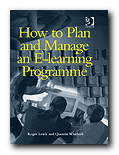
Plan and Manage E-learning looks at the practical steps that need to be taken to create E-learning courses and the infrastructure that supports them. It covers all aspects of this process – including planning, course design, materials creation, course delivery, and tutoring. Lewis and Whitlock take a Web-oriented approach to their exposition. Each step is broken down into manageable chunks, and they use a wide range of examples and plenty of checklists to make this a very practical route map in course design.

Plan and Manage E-learningDespite its reliance on technology, E-learning is heavily dependent for its success on personal interaction, and they spend a lot of space offering support for teachers and learners. This is the part of online learning which is often forgotten by people racing to get onto the technological bandwagon. Much of their content is a sensible and practical approach to course planning – every step geared to think carefully about aims and how they are to be achieved. There are lots of checklists of things to take into account when planning, designing, and running a learning program.

They even deal with tricky issues such as online assessment and moderation, as well as the costs of development time, making the materials cost-effective, and cost-recuperation via clever marketing.

This book will be of most use to course designers, heads of department, or training managers who have been given the task of organising learning programs by people who think it’s just a matter of transferring information quickly from paper to screen.

© Roy Johnson 2004

Buy the book at Amazon UK

Buy the book at Amazon US


Roger Lewis and Quentin Whitlock, How to Plan and Manage an E-learning Programme, London: Gower, 2003, pp.185, ISBN 0566084244


More on online learning
More on technology
More on digital media
More on web design
More on computers


Filed Under: Online Learning Tagged With: Communication, Education, eLearning, Online learning, Plan and Manage E-learning

Planning essays

August 24, 2009 by Roy Johnson

sample from HTML program and PDF book

1. Planning essays – strategy
You can approach planning essays using a number of different writing strategies. Some people like to start writing and wait to see what develops. Others work up scraps of ideas until they perceive a shape emerging. However, if you are in any doubt at all, it’s a good idea to plan your work. The task of writing is usually much easier if you create a set of notes which outline the points you are going to make. Using this approach, you will create a basic structure on which your ideas can be built.

2. Plans
This is a part of the essay-writing process which is best carried out using plenty of scrap paper. Get used to the idea of shaping and re-shaping your ideas before you start writing, editing and re-arranging your arguments as you give them more thought. Planning on-screen using a word-processor is possible, but it’s a fairly advanced technique.

3. Analyse the question
Make sure you understand what the question is asking for. What is it giving you the chance to write about? What is its central issue? Analyse any of its key terms and any instruction terms. If you are in any doubt, ask your tutor to explain what is required.

4. Generate ideas
You need to assemble ideas for the essay. On a first sheet of paper, make a note of anything which might be relevant to your answer. These might be topics, ideas, observations, or instances from your study materials. Put down anything you think of at this stage.

5. Choosing topics
On a second sheet of paper, extract from your brainstorm listings those topics and points of argument which are of greatest relevance to the question and its central issue. Throw out anything which cannot be directly related to the essay question.

6. Put topics in order
On a third sheet of paper, put these chosen topics in some logical sequence. At this stage you should be formulating a basic response to the question, even if it is provisional and may later be changed. Try to arrange the points so that they form a persuasive and coherent argument.

7. Arrange your evidence
All the major points in your argument need to be supported by some sort of evidence. On any further sheets of paper, compile a list of brief quotations from other sources (together with page references) which will be offered as your evidence.

8. Make necessary changes
Whilst you have been engaged in the first stages of planning, new ideas may have come to mind. Alternate evidence may have occurred to you, or the line of your argument may have shifted somewhat. Be prepared at this stage to rearrange your plan so that it incorporates any of these new materials or ideas. Try out different arrangements of your essay topics until you are sure they form the most convincing and logical sequence.

9. Finalise essay plan
The structure of most essay plans can be summarised as

  • Introduction
  • Arguments
  • Conclusion

State your case as briefly and rapidly as possible, present the evidence for this case in the body of your essay, then sum up and try to ‘lift’ the argument to a higher level in your conclusion. Your final plan should be something like a list of half a dozen to ten major points of argument. Each one of these points will be expanded to a paragraph of something around 100-200 words minimum in length.

10. Relevance
At all stages of essay planning, and even when writing the essay, you should keep the question in mind. Keep asking yourself “Is this evidence directly relevant to the topic I have been asked to discuss?” If in doubt, be prepared to scrap plans and formulate new ones – which is much easier than scrapping finished essays. At all times aim for clarity and logic in your argument.

11. Example
What follows is an example of an outline plan drawn up in note form. It is in response to the question ‘Do you think that depictions of sex and violence in the media should or should not be more heavily censored?’. [It is worth studying the plan in its entirety. Take note of its internal structure.]


Sample Plan

QUESTION: ‘Do you think that depictions of sex and violence in the media should or should not be more heavily censored?’

Introduction

Sex, violence, and censorship all emotive subjects

Case against censorship

1. Aesthetic: inhibits artistic talent, distorts art and truth.

2. Individual judgement: individuals have the right to decide for themselves what they watch or read. Similarly, nobody has the right to make up someone else’s mind.

3. Violence and sex as catharsis (release from tension): portrayal of these subjects can release tension through this kind of experience at ‘second hand’.

4. Violence can deter: certain films can show violence which reinforces opposition to it, e.g. – A Clockwork Orange, All Quiet on the Western Front.

5. Censorship makes sex dirty: we are too repressed about this subject, and censorship sustains the harmful mystery which has surrounded us for so long.

6. Politically dangerous: Censorship in one area can lead to it being extended to others – e.g., political ideas.

7. Impractical: Who decides? How is it to be done? Is it not impossible to be ‘correct’? Any decision has to be arbitrary

Case for censorship

1. Sex is private and precious: it should not be demeaned by representations of it in public.

2. Sex can be offensive: some people may find it so and should not have to risk being exposed to what they would find pornographic.

3. Corruption can be progressive: can begin with sex and continue until all ‘decent values’ are eventually destroyed.

4. Participants might be corrupted: especially true of young children.

5. Violence can encourage imitation: by displaying violence – even while condemning it -it can be legitimised and can also encourage imitation amongst a dangerous minority.

6. Violence is often glorified: encourages callous attitudes.

Conclusion

Case against censorship much stronger. No necessary connection between the two topics.

© Roy Johnson 2003

Buy Writing Essays — eBook in PDF format
Buy Writing Essays 3.0 — eBook in HTML format


More on writing essays
More on How-To
More on writing skills


Filed Under: Writing Essays Tagged With: Academic writing, Essay plans, Essays, Planning, Reports, Study skills, Term papers, Writing skills

Pocket Oxford Spanish Dictionary

August 2, 2009 by Roy Johnson

dictionary + grammar + culture + communication

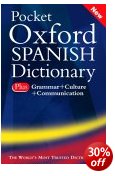
Don’t be misled by the title of this book. The Pocket Oxford Spanish Dictionary is not simply a Spanish dictionary. It’s a full English-Spanish and Spanish-English dual-language dictionary, aimed at intermediate students and the everyday user. In fact it’s even more than that, because the two big lexicons are surrounded by lots of other support materials. There is enough supplementary material in this book to provide a substantial insight into Spanish culture and society.

Pocket Oxford Spanish DictionaryThere are guides to pronunciation; a list of traditions, festivals, and holidays; an A to Z gazette of life and culture; guidance notes on writing letters; and even notes on grammar plus verb tables. These are presented in both languages in all cases. The only thing that struck me as very odd is the fact that pronunciation is given for English words, but not for Spanish. Since this book is aimed at English buyers, this ought to be the other way round, at least.

It covers over 90,000 words and phrases and 120,000 translations of contemporary Spanish and English, and the technical supplement provides full information on all the key points of Spanish and English grammar,

In addition to a new 32 page grammar supplement for this edition, there are example letters, emails, postcards, and CVs.

Language is now studied in the context of its culture, so the existing culture section has been revised and expanded to offer lively and useful information on life in the Spanish-speaking world – everything from political institutions to how weddings are celebrated.

So – the presentation of a typical entry goes as follows – for the verb perder – to lose.

perder
[E8] vt 1. (en general) to lose; perdi el pasaporte I lost my passport; quiere ~ peso he wants to lose weight; con conguntar no se pierde nada we’ve/you’ve nothing to lose by asking; ~ la vida to lose one’s life, to perish; • CABEZA 1E, VISTA 3; yo no pierdo las esperanzas I’m not giving up hope; ~ la práctica to get out of practice; ~ el equilibrio to lose one’s balance; ~ el conocimiento to lose consciousness, to pass out; ~ el ritmo (Mús) to lose the beat; (en trabajo) to get out of the rhythm

2. (a) (autobús/tren/avión) to miss (b) (occasión o opportunidad) to miss; sin ~ la detalle without missing any detail (c) (tiempo) to waste; no me hagas ~ (el) tiempo! don’t waste my time!; no hay tiempo que ~ there’s no time to lose

3. (a) (guerra/plaito/partido) to lose (b) (curso/año) to fail; (examen) (Ur) to fail

4. (agua/aciete/aire) to lose

One thing is for certain however. Unless you are wearing an oversized hunting jacket, this book will definitely not fit in your pocket. But it’s an excellent dictionary and a good source of reference about everyday communication in Spanish.

© Roy Johnson 2009

Pocket Oxford Spanish Dictionary   Buy the book at Amazon UK

Pocket Oxford Spanish Dictionary   Buy the book at Amazon US


Pocket Oxford Spanish Dictionary, Oxford: Oxford University Press, 4th edition, 2009, pp.1088, ISBN: 0199560773


More on dictionaries
More on language
More on grammar


Filed Under: Dictionaries Tagged With: Cultural history, Dictionaries, Language, Reference, Spanish language

  • « Previous Page
  • 1
  • …
  • 62
  • 63
  • 64
  • 65
  • 66
  • …
  • 103
  • Next Page »

Get in touch

info@mantex.co.uk

Content © Mantex 2016
  • About Us
  • Advertising
  • Clients
  • Contact
  • FAQ
  • Links
  • Services
  • Reviews
  • Sitemap
  • T & C’s
  • Testimonials
  • Privacy

Copyright © 2026 · Mantex

Copyright © 2026 · News Pro Theme on Genesis Framework · WordPress · Log in