Mantex

Tutorials, Study Guides & More

  • HOME
  • REVIEWS
  • TUTORIALS
  • HOW-TO
  • CONTACT
>> Home / Archives for 2009

Archives for 2009

Russian Literature: a short introduction

August 4, 2009 by Roy Johnson

Russian poetry and prose 1800-2000

Catriona Kelly takes a rather unusual approach to the task of presenting two centuries of Russian literature without going for a chronological list or a ‘great writers’ structure. What she does instead is take Pushkin as a central starting point, then follows themes that arise from a consideration of his work and looks at other Russian writers en passant.

Russian Literature: a short introductionStarting from the importance of Pushkin to Russian society and culture, she puts nineteenth and twentieth-century Russian literature into a context which includes the political, social, and cultural history of a country which has gone from absolute monarchy, through totalitarian dictatorship, to a rough-hewn and precarious democracy in less than a hundred years. This book is not simply about literature: you’ll learn a lot about history from it too.

Her early chapters discuss Pushkin’s language and his thematic connections with other Russian writers as diverse as the poets Osip Mandelstam and Boris Pasternak, and novelists Gogol, Chekhov, and Mikhail Bulgakov.

There’s a thoughtful chapter on novels and poetry during the Soviet period, and she makes a brave attempt to re-examine literature from this dark era and defend it against accusations of crude propaganda.

She also looks at the role and significance of women in Russian literature – both as subjects and authors. Her observations seem to be based on a close acquaintance with ‘gender-aware criticism’ in the last years of the twentieth century, and there are cascades of new names in addition to those already well known, such as Akhmatova and Tsvetaeva.

There are also chapters on religious belief and the nature of good and evil (plenty on Dostoyevsky there); Russia’s imperialistic relations with its neighbours and the cult of the exotic; and the writer as a guide to public morals.

This book could easily have as its alternative sub-title ‘An Introduction to Alexander Pushkin’, but taking him as her inspiration she considers just about every other major Russian writer of the last two hundred years – plus plenty more besides.

These very short introductions from OUP are an interesting and attractive format – a small, pocket-sized book, stylishly designed, with illustrations, maps, endnotes, suggestions for further reading.

Buy the book at Amazon UK

Buy the book at Amazon US

© Roy Johnson 2001


Catriona Kelly, Russian Literature: a very short introduction, Oxford: Oxford University Press, 2001, pp.164. ISBN: 0192801449

Filed Under: 19C Literature, 20C Literature Tagged With: Cultural history, Literary studies, Russian literature

Sample Essay Economics

August 26, 2009 by Roy Johnson

sample pages from PDF book

First year undergraduate study

This example is from a first year undergraduate course in social studies. The course is designed to introduce students to selected topics in economics, government, and social policy. Students taking the course might be from other disciplines, and tutors are expected to take this into account.


Question

Assess the claim that market forces, if left to themselves, will reduce regional inequalities over time.

Answer

In assessing the effects of undisturbed market forces on regional inequalities is necessary to outline the models of the market – namely Schumpeter’s model of creative destruction, and the neoclassical model of perfect competition. It is also relevant to address the meaning of regional inequality and the divisions that are created. There are three main causes of these equalities: the liberal idea of supply and demand; and cumulative causation. Marxists suggest the capitalist society causes an uneven distribution of wealth throughout the United Kingdom. The strengths, weaknesses and coherence of these theories will be discussed and a conclusion of their relevance in today’s society sought.

When writing Capitalism Socialism and Democracy (1943) J.A.Schumpeter outlined a model of creative destruction which “conceptualises competition as a dynamic forward-looking quest for innovation in products and processes that will put the corporation ahead of its rivals in the race for market leadership” (Module 3, page 85). The firms involved are competing against each other for business and so they are keen to seek new ideas for the latest innovations in production. Constant change occurs in a market in which articles and superseded constantly and made obsolete by innovation. Improvements in processing goods (for example in machinery) enables the supplier to manufacture economically. Economies of scale make fixed financial outgoings (such as maintenance to buildings) spread out over larger output. Increased profit ensures success for the best companies.

‘Perfect competition’ is the neo-classical idea of a balancing mechanism controlling the market. The supply side is affected by the availability of labour, raw materials, machinery, power and technology. On the demand side, individuals income, lifestyle, age, social conventions and expectations affect the balance. Firms have little say in setting the price of their goods because if the supply exceeds the demand the
price will decrease. Conversely if the demand for an article increases, but it cannot be supplied readily enough, then the price will increase. This theory is a classic example of liberal ideology because the starting point is the individual.

Similarly, as with their choice in purchase, the individual and employer are in a position to make rational choices about where they, respectively, choose to work and where they choose to invest. Due to them wanting the best for themselves, they will move to suit their needs. An employee may move area to receive higher pay, or company establish in an area where rent is lower. This theory suggests moving in such a way will equalise any disparities over time.

This was the thinking of the newly-elected conservative government in 1979 under the leadership of Margaret Thatcher. Liberal economic policies were introduced at this time. Competitive markets leading to efficiency, freedom of choice from more traders, and less burden on the countries economy. Deregulation (for instance transport) and privatisation (for example gas) would boost competition. A market led system in which “the free and undisturbed play of market forces could normally act as the invisible hand, efficiently and effectively co-ordinating the activities of the individual in ways which advance the interests of all” (Society and Social Science – A Reader Anderson + Ricci, page 262).

Prior to this, in the post-war period (1945-1970) state involvement in market activity meant high taxes and high public expenditure support of regionally based and nationalised industries. Then globalisation meant the United Kingdom faced competition not only from within but now from the rest of the world, thus affecting the demand side of the balancing mechanism. If a natural resource is present, such as oil three pre-conditions apply “that the technology exists to extract and use the oil, that there is sufficient demand for the oil (at the right price) and that the power to exploit and use the oil is present” (Module 20, page 69)

The cumulative causation theory opposes ‘supply and demand’ because “regional advantages are seen to accumulate rather than even out, once ahead a prosperous region will stay ahead” (module 20, page 87). Myrdal (1957) suggested the idea of vicious and virtuous circles. Areas would either spiral up or down in their fortunes. This is known as a ‘regional multiplier effect’. Growth generates growth. Development of a region occurs when more investment in that region means more direct employment (real jobs with security, good working conditions, improved employment structure, better pay structure, and good working conditions). Also related employment is created in connection with services for the new earning workforce with their enhanced spending in services such as entertainment. New communities become established with better housing, transport, shops, schools, and a greater share of the public spending budget going towards improved health and education. Dependent employment, this would include manufacturers of the machinery in the factory, workers who depend on the initial investment indirectly.

Development in a region may occur when industry is established bringing little employment, with less control at work, less income generated for the region, and perhaps negative attributes such as pollution and environmental risks (chemical industry, nuclear station or screwdriver plant).

The cumulative causation theory sees the core regions developing at the expense of the peripheral areas. The skilled workers will be drawn to the core to fill the best employment possibilities. These so-called ‘backwash effects’ are counteracted by ‘spread effects’ as economic growth continues the virtuous circle spreads out. The periphery benefits from the cores achievement. This is especially significant today in the ‘shrinking world’. The United Kingdom is the locality (local) within Europe (global).

Marxist ideology is based on a capitalist society with production for profit. Unevenness of wealth within Britain is due to the dominance of one area over another, and is socially constructed. The main example of this being the north-south divide.

Traditionally the south (particularly the south-east) has been wealthier than the north. “A line running across the country usually from the mouth of the river Severn to the Wash is said to divide the prosperous south from the ailing north” (Module 22, page 55). Employment and career prospects, average earnings and success companies is statistically better in the south. Marxist geographers blame the lack of investment and different types of work in the north for the divide.

This issue is raised in ‘Regions Apart’ where William Clance CBE, chairman of ANZ merchant bank is questioned about the reason for this. he talks of how historically the south in particular London has developed as an administrative capital because traders for instance those wanting to import/export goods and ship owners would meet at the Baltic exchange to strike a deal. This has continued to the present day. Businessmen still meet in the capital even though communication networks (faxes, Internet, etc) have transformed. Meeting face to
face is more satisfactory. Companies fund corporate lunches, in which firms attempt to clinch deals with clients. Similarly, because the government is based in London, it would be beneficial to be there. Many companies have a political connection (for example Satchi and Satchi) or lobbying of parliamentarians to persuade decision makers of political effects on their company.

Academically, the best teaching hospitals and top universities are in the south (Oxford and Cambridge) only the very brightest students attend, and the graduates are trained as leaders of men and eventually hold the highest positions in society. Most large companies have their headquarters in London (eg – Hambro Countrywide –
Britain’s largest estate agents) and the major professional institutions
(eg ACCA – Association of Certified Chartered Accountants and Royal College of Nursing). Due to all these factors the relative skill level in the south is better, so too are the average earnings, but there is hardship and affluence on both sides of the divide.

In Britain today many geographical areas are indistinguishable. Large inner cities, housing estates and out of town shopping centres. Despite this each region has its individuality. This can depend on its past character, for example a town previously devoted to cotton production may still have cotton mills on its landscape and perhaps a heritage centre. This can encapsulate also with a traditional labour force.

It can depend on local natural resources such as coal or waterways. Similarly much can depend on an areas links with the wider world, internationalisation has brought many cultures, religions and creeds together.

Many foreign owned and some British based firms brought about a city-country divide in the 1960s. Decentralisation involved their head offices dismantling large workplaces in the inner city and moving to branch plants or back offices in the country. The advantages included less congestion and closer proximity to the market and a new ‘green workforce. This comprised unradical women who were willing to accept lower pay and conditions, instead of militant men who demanded more of the company.

Either of the liberal methods of supply and demand or cumulative causation would in theory work if no intervention was applied, because of their very nature they would even out regional equalities over time. Exponents of each theory choose to quote a time in history that emphasises their model to suit themselves.

Note that nonetheless these have opposite views. Neo-classicism suggests that inequality will eventually disappear. Whereas, despite spread effects the cumulative causation theory postulates continued inequality (unless of course government actively takes measure to counteract it.)

There seems to me more weight behind the Marxist theory, because regional inequality exists everywhere. In all regions there are affluent areas and slums. Also this can be a matter of opinion “one man’s palace is another man’s prison” and each locality has interlocking activity space. In the world we live in today, it would be impossible to create a system without intervention even if it was government policy. The European government would want to intercept and help the poorest places in the United Kingdom as it does today.


Tutor comment

What you have written in conclusion is interesting and relevant to the general discussion of regional inequality, but re-read the question. It asks you to “assess the claim that market forces if left to themselves will reduce regional inequalities”. This is clearly the position of the Neo-classical school so your conclusion should specifically assess. That is, say what its strengths and weaknesses are in comparison to the other two theories. You have tended to conflate the Neo-classical and Cumulative Causation theories, though you imply an assessment by saying that there is more weight behind the Marxist analysis. However, you do not overtly assess the Neo-classical theory. Note that the essay question guidance notes suggest that you judge theories by their explanatory power, openness, and reach. Some use of these concepts would have enabled you better to assess the Neo-classical claim. Have another look at the course module.

However, this is an interesting and well-informed essay which indicates that you have a good knowledge of the course materials. Regrettably you did not read the student guidance notes or the question rubric carefully enough, and as a result your assessment of the Neo-classical perspective is implicit rather than overt. Paradoxically your writing is rather glib in some respects and yet rather prolix in others. For example you omit crucial aspects of the Marxist position and yet go into a lot of descriptive detail with respect to other examples.

Note that the Cumulative Causation theory does accept the notion of markets and supply and demand [see my note on your script] but suggests a different outcome than the Neo-classical School, namely that despite some spread effects, inequality persists over time. To improve your marks you need to make sure that you are saying precisely what you mean, and focus on what the question asks more directly. In this case assessing the Neo-classical claim [see my earlier note concerning the criteria of comparison – explanatory power, reach and openness.

On the whole though a rich and interesting essay.


Script monitor’s comments

Plenty here for the student to get her teeth into. Your comments are informative and should help her iron out her misunderstandings of and engage more meaningfully with the theories she has covered. Her failure to address the question is a common one I find at all level courses, and your comments will help put her back on track, while warning her of the penalties inherent in ignoring guidance given in the notes. On the other hand she will also be in no doubt about what she is doing right and should be encouraged by the positive tone of what you have to say.

© 2003

Buy Writing Essays — eBook in PDF format
Buy Writing Essays 3.0 — eBook in HTML format


More on writing essays
More on How-To
More on writing skills


Filed Under: Writing Essays Tagged With: Academic writing, Economics, Essays, Sample essays, Study skills, Writing Essays, Writing skills

Sample Essay Government

August 26, 2009 by Roy Johnson

sample from HTML program and PDF book

G.C.E. ‘A’ level

Students working at this level are expected to show that they have a firm grasp of the basic concepts and principles of the subject. They should also demonstrate that they are capable of extending their understanding into more advanced aspects of the discipline. They are required to show that they have studied selected aspects of the subject in considerable detail. Essays set at this level require the student to produce clear and thoughtful answers with some sense of organised construction and evidence of close analysis and coherent argument.


Question

What has the premiership of Mrs. Thatcher told us about the need for reform of the powers of the British prime minister?

Answer

The government and politics of Great Britain is concerned with the use of political power. It should, therefore, come as no surprise that many of the debates concerning British politics tend to concentrate on the institutions which supposedly wield power. One such debate is concerned with the proposition that the Prime Minister has replaced the Cabinet as the centre of political power in British government.

Most people would agree that Mrs. Thatcher has displayed many of the classical characteristics associated with Prime Ministerial government. She has used her powers of patronage to gradually replace the Heathite ‘wets’ in the cabinet with people who share her radical beliefs. Furthermore Mrs. Thatcher has convened various ad hoc and ‘standing’ Cabinet committees (the choice of membership is up to her) to by-pass full Cabinet meetings.

A case in point was the ad hoc committee set up to consider Michael Heseltine’s proposals for helping the inner cities. Heseltine’s report (based on his visits to Merseyside after the 1981 riots in Toxteth) advocated vastly increased spending on inner city regeneration but the amount was drastically slashed because all the other members of that committee were Thatcher loyalists who were committed (as she was) to reducing public spending. Thus Heseltine was isolated when faced with a committee loaded against him.

To add to this Mrs Thatcher has often attempted to stifle Cabinet discussion by firmly controlling the Cabinet agenda and minutes. This was why Michael Heseltine eventually resigned over the Westland affair and it provides a good example of how the use of the powers of a Prime Minister can seriously damage his or her de facto power. Mrs. Thatcher’s undoubted dominance has been aided by strict party discipline of Conservative MPs in the House of Commons and the prerogative to call a general election at a time most beneficial to the Conservative Party.

However all these characteristics have been displayed by Prime Ministers in the pre-Thatcher era. For instance Harold Wilson came under considerable criticism for his Ministerial appointments after the 1964 General election because they were based on loyalty rather than any reasons of merit. Richard Crossman also cited many cases of the operation of Wilson’s ‘kitchen Cabinets’ which were composed of the Prime Minister’s personal cronies. Crossman claimed that it was these bodies which took all the major decisions and that the full Cabinet was by-passed. Wilson also attempted to control the Cabinet agenda in a way which would stifle discussion. This was shown by his failed attempt to restrict Cabinet discussion over the devaluation of the pound in 1967.

Strict party discipline in the House of Commons has been with us since the Reform Act of 1867 and so it is not a phenomenon peculiar to the Thatcher years. Similarly the power of dissolution has been used by successive Prime Ministers to try and enable their party to win the general election. In 1935 for instance, the National Government gained a majority of 247 thanks to the decision of Stanley Baldwin to hold a general election after Great Britain had applied sanctions against fascist Italy.

Therefore as far as these classic characteristics of Prime Ministerial power are concerned, Mrs Thatcher has only continued to pursue the same lines of action as other Prime Ministers before her. From this evidence it can only be concluded that as far as these classic characteristics are concerned, the Premiership of Mrs Thatcher has not told us anything new about the need for reform of the powers of the Prime Minister.

It is certainly true that Mrs. Thatcher has used these powers more effectively than most. However this does not mean that we are provided with any further justifications for reform of the powers of the Prime Minister. However this is not to say that Mrs. Thatcher’s Premiership has not demonstrated the need for reform. In certain areas Mrs. Thatcher has greatly enhanced her own powers in a way that none of her predecessors did.

The Prime Minister’s control over Cabinet appointments is nothing new. But Mrs. Thatcher has extended such blatant patronage to the higher ranks of the higher Civil Service. Before 1979 the convention was that the Prime Minister merely ratified candidates put in front of them by the Civil Service itself. But Mrs. Thatcher has deliberately interfered in the appointment of top Civil Servants because she wants to avoid any possibility of Civil Service obstruction towards her monetarist policies. This has entailed appointing so-called ‘can-do’ men who will advise on policy as well as carry it out in a manner which shows them to be totally committed to government ideas.
This politicization of the Civil Service has been matched by a decision making structure which has brought Civil Servants far more into policy making than ever before. All this has been Mrs. Thatcher’s creation.

There are very serious dangers concerning these events. For instance what will be the reaction of a future Labour or SLD government who face a supposedly neutral higher career Civil Service staffed with Thatcher appointees committed to Thatcherite policies? Since 1979, Mrs. Thatcher has appointed 43 Permanent Secretaries and 138 Deputy Secretaries. Will the Civil Service become a political football with all parties trying to shape it in their own image? Moreover one of the great virtues of a totally neutral Civil Service is the fact that it will provide an idea of the possible dangers of a policy.

A Civil Service which is as committed to policy objectives as the politicians may well become so shortsighted as to laugh off serious dangers in the same way as the politicians do, with the end result being a policy disaster which could affect the whole country. To add to this there is always the danger that civil servants may conspire with the politicians to falsify public information (such as unemployment statistics) in order to win votes for the party in power. In fact with the abolition of the Central Review Policy Staff and the subsequent creation of the ‘Number Ten Policy Unit’ an intricate system of objective advice and information has virtually disappeared.

The very fact that all this has been the work of one woman and her team of advisers shows that there has been a serious erosion of the ‘separation of powers’ principle within the executive structure. Any reform of Prime Ministerial power should concentrate on trying to stop politicians blatantly shaping a very powerful higher Civil Service according to their own needs. Mrs. Thatcher has created this trend and consequently it is her Premiership which has shown the true need for the reform of Prime Ministerial powers in terms of the power of the Prime Minister over the higher Civil Service.


Tutor Comment

This is a very competent essay with a number of very positive features, the most important of which is that it answers the question in a serious and intelligent manner. You also offer evidence to support your arguments and make a successful attempt to be ‘even-handed’ in your consideration of the issues involved. There are weaknesses too, but they are of a minor stylistic nature and can easily be corrected with more practice. You became slightly repetitious at some points (‘powers of the Prime Minister … Prime Ministerial power’) and some of your paragraphs are rather long. [I have indicated where a change of topic calls for a new paragraph.] At this level such thorough work fully deserves a good ‘A’ grade.

© 2003

Buy Writing Essays — eBook in PDF format
Buy Writing Essays 3.0 — eBook in HTML format


More on writing essays
More on How-To
More on writing skills


Filed Under: Writing Essays Tagged With: Academic writing, Education, Essays, Government, Study skills, Term papers, Writing Essays, Writing skills

Sample essay introductions [advanced]

September 29, 2009 by Roy Johnson

getting your essay off to a good start

The essay introductions that follow are all taken from third-year undergraduate courses in literary studies. They are not being offered as models of perfection – but all of them met the requirements for a first-class grade. The fifth example is from a coursework assignment at postgraduate level – an MA in Literary Studies.

Essay introductions – Example 1

Question
In an essay of about 1,500 words analyse either ‘A Painful Case’ by James Joyce or ‘The Old Chief Mshlanga’ by Doris Lessing, paying close attention to narrative technique, including narrative voice, characterization, imagery and symbolism, dialogue and descriptive detail.


Answer
‘A Painful Case’ by James Joyce is a short story taken from a collection entitled ‘Dubliners’, which was first published in 1914. Joyce makes use of a variety of narrative techniques and literary devices in the construction of his work.

Joyce’s chosen method of discourse is a third-person omniscient narrator. Unlike the first-person narrative mode, which only gives access to the thoughts and feelings of one of the characters, an omniscient narrator has the advantage of being in a position to know everything about all the characters in a story. The opening sentence provides an example of how the narrator is able to reveal the opinions of the main character through focalization: ‘Mr James Duffy lived in Chapelizod …because he found all the other suburbs of Dublin mean, modern and pretentious.’ (1) The narrator is speaking, but the viewpoint is that of Mr Duffy, and is presented without any narrative comment. The reader is, therefore, free to draw his or her own conclusions as to what this reveals about the personality of Mr Duffy, without guidance from the narrator.

Overall grade=88

[The overall grade is determined by a number of qualities in the work – not simply the introduction.]


Essay introductions – Example 2

Question
‘The language of poetry resembles dancing; it has no purpose beyond itself. “Dancing goes nowhere”‘. Discuss the ideas in Paul Valéry’s essay ‘Remarks on Poetry’ in the course materials by considering in detail a passage from The Waste Land and a paragraph from Mrs Dalloway.


Answer
Mrs Dalloway displays many of those aspects of language which Paul Valéry identifies as essentially poetic. I have chosen to concentrate upon paragraph two on page 124 (Grafton edition) to illustrate this argument.

Going and coming, beckoning, signalling, so the light and shadow, which now made the wall grey, now the bananas bright yellow, now made the Strand grey, now made the omnibuses bright yellow, seemed to Septimus Warren Smith lying on the sofa in the sitting room; watching the watery gold glow and fade with the astonishing sensibility of some live creature on the roses, on the wall-paper. Outside the trees dragged their leaves like nets through the depths of the air; the sound of water was in the room, and through the waves came the voices of birds singing. Every power poured its treasures on his head, and his hand lay there on the back of the sofa, as he had seen his hand lie when he was bathing, floating, on the top of the waves, while far away on shore he heard dogs barking and barking far away. Fear no more, says the heart in the body; fear no more.

Attention is drawn to the language itself, to the relationship between words and phrases. For example, the alliterative quality of words is clearly exploited in phrases such as ‘seemed to Septimus Warren Smith lying on the sofa in the sitting room’ where the repetition of the soft ‘s’ sound (carried on still further into the next clause of the sentence) imitates the sound of rustling leaves or water. Alliteration and assonance work together to develop an ‘ebbing’ or ‘lapping’ rhythm which underlines the imagery of waves and water developed throughout the paragraph: ‘watching the watery gold glow …’

Similarly, words are grouped and repeated so as to reinforce a sense of underlying patterning. Notably the first sentence has alternating images of light and shadow, yellow and grey, and repeated sequences of words and stresses: ‘which now made the wall grey, now the bananas bright yellow, now made the Strand grey, …’

Overall grade=80

[The overall grade is determined by a number of qualities in the work – not simply the introduction.]


Essay introductions – Example 3

Question
According to Pierre Macherey, the ideology of a literary work resides in its incompleteness, in its significant gaps and silences. With reference to two texts from different genres, suggest how Macherey’s theory of ideology might yield new insights and meanings in literary criticism.


Answer
No text is ‘complete’ in itself according to Macherey. The words on the page may appear to produce a clear-cut, easily discemable meaning, however if we accept this at face value we are not appreciating the work as a whole, for as well as the explicit meaning of a work, the reader should also be aware of the gaps, silences and contradictions inherent in a text. Only in this way can we understand the full significance of a literary work, and reveal its relation to the circumstances in which it was produced.

Although Macherey argues that the silences are a prior condition of the text, in that without absences the text itself would not exist, the reader must first examine what is given, the explicit ideas and arguments presented, in order to spot the gaps and silences. When we first read ‘A Sahib’s War’ by Rudyard Kipling, for example, we learn about the characters, the events which make up the story, note the use of an unusual narrative technique and also form opinions as to the meaning or intention of the story. From this basis we can then go on to consider elements not present, and judge whether these reinforce or contradict the explicit meaning of the text.

Overall grade=88

[The overall grade is determined by a number of qualities in the work – not simply the introduction.]


Essay introductions – Example 4

Question
‘silence is both a condition of women’s oppression and a part of their language’. With detailed reference to at least TWO texts from different genres, discuss the relation between gender and silence


Answer
Simone de Beauvoir, in her book, The Second Sex, says that ‘One is not born but rather becomes a woman’ and goes on to say that there is no such thing as a female nature, consisting of essentially female qualities. She holds that concepts of femininity are socially constructed and not biologically determined.[1]

At the time de Beauvoir wrote her book, the currently operating social construct was that language in the public domain was very much organised by males and the language in the private domestic world was organised by women. The implication being, that men’s language dealt with the ‘weighty’ issues of the world, whilst women’s language dealt with the domestic trivia.

To this one could also add that, historically, women have only been able to guarantee their economic security through marriage. This meant that sexual relations were also economic relations and therefore, whilst marriage satisfied the problem of the woman’s economic insecurity, it constrained her to the public silence required of her by both society and her husband. At the same time, of course, we could usefully argue that the husband was equally a ‘prisoner of the system’ in that society demanded of him, a wife who obeyed the rules and accepted her socially constructed subordinate role. A husband who could not keep his wife within the limits of expected behaviour, could expect criticism of his failure, from society. The effect of this pressure was to force women into roles that were recurrent stereotypes, virgin, whore, spinster, etc. (p.9)

Grade = First class

[The overall grade is determined by a number of qualities in the work – not simply the introduction.]


Essay introductions – Example 5

Question
Discuss how a scholarly editor of a novel by Charles Dickens might approach the task of establishing an accurate text. You should outline both the practical and theoretical questions involved.


Answer
It is acknowledged in textual criticism that any act of transmission is inherently partial to corruption. Moreover, that when further copies of a text are made new errors can be introduced. The consequences of this means that in novels for instance (subject to compositorial mistakes, deletions and so on), the first and subsequent editions seldom presents the reader with the author’s intentions or even his exact words. As a printed text, Bleak House has been subject to the above conditions. The scholarly editor then is faced with the task of trying to present the text as accurately as Dickens intended, elucidating features which have been obscured by misreadings or the passage of time. The key word here is ‘intended’, for the status of authorial intention has become one the most contentious issues in twentieth century textual theory, and the textual scholar’s choices in editing a critical text (choices which at some point must be conjectural) subject to intense scrutiny.

The problem of intention is closely allied to the choice of copy text (the version on which to base a single edition) – and before the editor decides which version of the novel to adopt as copy-text, he must first consider what system or rationale to use to make these decisions. The most dominant copy-text theory in the second half of the twentieth century has been W.W. Greg’s. Briefly, Greg called into question the then-held belief that the authoritative copy-text should be the last edition published in the author’s lifetime. He proposed that wherever possible the editor should select a copy-text on the basis of its accidentals (punctuation, spelling, and typographical matters such as the use of italics), this being as close as possible to authorial intention (therefore usually a manuscript if one exists), and that this copy-text should be emended when it could be shown that later versions of the text contained substantive changes introduced by the author. After this assimilative process, the editor would then assemble a new eclectic version of the text, one based on editorial interpretation of an author’s putative intentions.

Overall grade=88

[The overall grade is determined by a number of qualities in the work – not simply the introduction.]

© Roy Johnson 2009


More on How-To
More on literary studies
More on writing skills


Filed Under: Literary studies, Study Skills Tagged With: Academic writing, Essay introductions, Essay writing, Introductions, Study skills, Writing skills

Sample Essay Literary Studies

August 26, 2009 by Roy Johnson

sample essay from PDF book

Access to further and higher education

This example is from an access course which offers students an introduction to literary studies. It allows them to explore their own potential for the subject before either passing on to ‘A’ level or undergraduate study. The student in this case has a much higher than usual ability in analytic and conceptual skills, and a very firm sense of structure in essay construction. However, because the conventions of academic writing take some time to acquire, there is still plenty of comment to be made about the details of this essay.


Question

Present an analysis of the main characters in Thomas Hardy’s story, ‘The Withered Arm’. In other words, say what we know about them in terms of their physical appearance, their psychological motivation, and their relationship to each other.

Answer

Thomas Hardy tells the story of ‘The Withered Arm’ using three main characters: Rhoda Brook, Farmer Lodge, and Gertrude Lodge; and three subsidiary characters: the son of Farmer Lodge and Rhoda Brook, ‘Conjurer’ Trendle and the executioner Davies. The drama is played out in and around Hardy’s imaginary village of Holmstoke and town of Casterbridge, and the action takes place between the years 1819 and 1825. Rhoda Brook is introduced in the opening paragraphs of the story as a forlorn character – the eternal fallen and abandoned woman.

When the story opens Hardy describes her as thirty-years-old, thin and faded (p.25). But, as the story is developed, he gives many clues to her previous appearance, and a clear picture emerges of a tall, large-framed woman of enduring strength, with well defined features (p.34) dark, handsome eyes (p.27) and an abundance of dark hair. We can appreciate that, at the age of seventeen, it would have been a girl of considerable attraction to whom Farmer Lodge was drawn.

Rhoda’s affair with Lodge gave them a son – who is twelve years old when the story begins. But the relationship does not appear to have endured. Lodge has not spoken to Rhoda for years, (p.26) and always ignores his son whenever he sees him.

Although the relationship is long over for Lodge, it is plain that Rhoda has continued to hold on to the idea that there might be, in time, some sort of compensation for what she must have seen as a ruined life. All chances of such an event happening vanished with the arrival of Gertrude as Lodge’s wife (p.36) but the kind of reparation that lay in Rhoda’s mind is revealed by the importance of the wedding ring with which the spectre in her nightmare torments her (p.31). Rhoda had, it seems, dreamed of marriage and respectability.

Although she has had a hard life, Rhoda is not a hard woman. She is, for example, inclined to be indulgent with her son by allowing him to stay at home instead of sending him to work in the fields (p.36). When she meets Gertrude in the flesh she responds readily to her ‘sweet voice and winning glance’ and quickly forms a good relationship with her which borders on affection.

When Gertrude first reveals to her the blight on her arm, Rhoda feels some elation that the beauty of the young girl has been tarnished (p.36) but she also feels the beginnings of a guilt which is to become obsessive. She is a simple countrywoman strongly inclined towards superstitious beliefs and, during her years of rejection and relative isolation, she knows that she has been called a witch (p.35). Her troubled mind refuses to accept the blight on Gertrude’s arm for the coincidence that it really is (p.34) and she allows herself to believe that she might indeed have some malignant powers and, in fact, be responsible for Gertrude’s suffering.

Gertrude Lodge enters the story as the nineteen year old bride of Farmer Lodge. Hardy gives a clear picture of her appearance at that time through the eyes of Rhoda Brook’s son, who reports back to his mother that Gertrude is a small, pretty young woman, doll-like, with fair hair, blue eyes, and a soft complexion. She is almost the perfect opposite to the tall and darkly handsome Rhoda.

Although little more than a girl, Gertrude is mature and ‘a lady complete’ (p.29) and immediately on her arrival in the village sets about the duties of the yeoman’s wife by bringing gifts to the poorer people in the parish. She is however, timid by nature, and has a natural shyness, as is shown by the ordeal of her first public appearance in church (p.30).

When the blight first appears on her arm Gertrude’s enlightened and educated mind accepts it as a natural misfortune. Although blessed with good looks she is not vain, for she confides to Rhoda that she herself ‘does not much mind it’ (p.36). But she does mind the effect that she thinks it has on Farmer Lodge. She is astute enough to realise that personal appearance is very important to him, and she begins to fear losing his love.

When the suggestion to visit conjurer Trendle is first made, Gertrude rejects the idea out of hand as superstitious nonsense (p.37). But as the condition becomes worse, she abandons reason and is willing to try Trendle’s powers. During the following five years Gertrude’s interest in her arm declines into an obsession, and she becomes ‘irritable and superstitious’ (p.42), seeking a cure in the wildest of remedies from herbs to black magic. The pursuit of a cure demonstrating considerable single-mindedness and strength of purpose.

Although she loves her husband, Gertrude is distanced from him by age and her irrational fears, and is unable to discuss the misery of her affliction calmly with him. She is tortured by the belief that the disappearance of the blight from the arm will re-generate her husband’s lost interest in her, and she summons up all of her dwindling strength to face the awful contact with the freshly-hanged corpse. An encounter which proves altogether too much for her ‘delicate vitality’ (p.54).

In contrast to the liberal and detailed description of the two women, Hardy gives very little information about the physical appearance of Farmer Lodge. He is, at the time of his marriage to Gertrude, about forty years old (p.25) and in the prime of his life. We are told that his face is clean-shaven, and has a ‘bluish vermilion hue’, which suggests a very dark-haired man, otherwise there are no clues on which to build a picture.

Lodge is a man of considerable means, the inheritor of land which has been owned by his family for over two hundred years (p.42). He is a proud man, and given to ostentation. He brings his new wife home in a bright, handsome new gig (p.27) wears ‘great seals’ in his waistcoat, and swells with pride when he makes his first public appearance with his bride (p.30). Appearances do seem to be important to him.

Lodge’s behaviour during the telling of the story shows him to be an enigma. He is able, publicly, to ignore his son completely (p.29) and yet harbour notions of adopting him. He is unable to give Gertrude the comfort and reassurance that she needs when the blight first appears and flies into a fury at the mention of superstitious village beliefs (p.45). He is however gentle enough to her when he suggests ‘for her own good’ (p.42) that she rids herself of her hoard of quack cures.

He becomes ‘gloomy and silent’ (p.41) as time passes, but in spite of Gertrude’s distress gives her no real cause to think that he has ceased to love her. He does not appear to have contributed any of his considerable wealth towards the upkeep of Rhoda and his son, for they live in a dilapidated cottage, relying for their living on Rhoda’s hard work as a milkmaid and the boy’s occasional poaching (p.30). And yet in Rhoda’s hour of desperate need he takes time away from his business to attend the trial of his son, and appears with Rhoda to claim his corpse for burial (p.53); although he has no tears to shed for the boy. His subsequent softening of character is as puzzling as the rest of his behaviour.

Of the minor characters in the story much less detail is given. The ill-fated boy – we are provided with no name or physical description – is bright-minded, perceptive and impressionable when judged by his reports about Gertrude Lodge (p.30). But there are suggestions of the lack of discipline – his carving of the chair (p.27) reluctance to work in the fields (p.32) and his poaching – which led him into the trouble which bring his life to a tragically early end. There is an interesting comparison between the grey-bearded, red-faced Trendle, who affects not to believe in his powers, and the hangman Davies, an old man who earns his living as a jobbing gardener, but who insists that his ‘real calling ‘ is that of an Officer of Justice (p.50).

Hardy takes quite unrelated happenings and links them through bitterness and superstition to produce this gloomy drama. The affair between Rhoda and Lodge, and her subsequent rejection with the burden of an illegitimate child, sets the seeds of bitterness which Lodge’s eventual marriage to enter Rhoda’s frustrated mind. Gertrude’s unfortunate but natural affliction becomes, for Rhoda, a source of guilt fed by superstition and her own unhappiness. Gertrude’s fear of losing Lodge’s love displaces her natural reason and deteriorates into an obsession. Lodge’s inability to give comfort and reassurance to his young wife allows her mental anguish to fester for years and leads her to seek the most outrageous of cures. The boy’s lack of discipline leads to the grisly scene which brings them all together again for the last time.


Tutor comment

This is a first rate piece of work Ken. You have obviously read the story very attentively, and the remarks you make about it indicate a mature perception. You also give plenty of evidence of ‘close reading’ – that is, paying scrupulously close attention to the text in its detail. I was also struck by the very firm control you have over your material: the sense of a solid and well-planned structure was very striking.

The only thing I felt was missing was that there might have been a little more explication of the change in Gertrude’s nature as she becomes more distressed. Her moral deterioration might then have been linked to Hardy’s sense of ‘tragic fatalism’ which is very strong in this story.

You have made very good progress on the course, and you are now operating at a level which is the equivalent of university undergraduate studies. This gets an A- grade on this course.

© 2003

Buy Writing Essays — eBook in PDF format
Buy Writing Essays 3.0 — eBook in HTML format


More on writing essays
More on How-To
More on writing skills


Filed Under: Writing Essays Tagged With: Academic writing, Education, Essays, Literary studies, Study skills, Term papers, Writing skills

Sample Essay Sociology

August 26, 2009 by Roy Johnson

sample from HTML program and PDF book

Second year university undergraduate study

Students working at this level are required to show that they are developing confidence in their grasp of their chosen subject and beginning to develop their powers of independent and critical examination. They should by this stage be able to produce fluent and well argued responses to essay topics and questions, and show that they are conversant with the set texts and the secondary literature of criticism and commentary in their subject. They should by now be at ease with the conventions of academic writing and if they have any flair or originality it is around this stage that it is likely to show. They may also be required to produce essays of up to 3000 words in length as part of assessed course work. The example is from a second year course dealing with issues in sociological thought.


Question

What is the value of studying the writings of dead men? Is sociology too obsessed with the classics?

Answer

The glib and superficial answer to the first part of this question is that the work of the great thinkers of the past has an influence on the present, and is therefore worthy of consideration. Perhaps, however, this answer is not as glib as it appears at first sight, but is indeed founded on a fundamental truth. In this essay I shall attempt to argue that this is in fact the case, and that the classical legacy of sociology quite rightly exerts a strong influence on contemporary thought.

Comte, Spencer, Marx, Weber, Simmel and Durkheim: nineteenth century names whose influence on modern society can be realised by a brief survey of the terminology used in dealing with almost any social issue today. It is impossible to talk of politics, poverty, education, work, or religion without recourse to concepts of class, status, alienation and anomie; of structure, interaction or social phenomena – all issues which were rigorously studied and researched by these earlier masters.

Auguste Comte first coined the term sociology in the early nineteenth century. Living as he did in the wake of the French Revolution, and at a time of tremendous social upheaval, instability and disorganisation, he must have felt a great need to produce a rational system of thought which would explain the social behaviour of men, and offer some sort of counter-balance to the seemingly destructive nature of organised groups. Comte was, of course, influenced by the science and reason of the Enlightenment. He was interested in the progress of science and felt that human intelligence had evolved to a stage where it could provide a scientific explanation of human behaviour. Comte’s interest was in the methodology of social research and his approach was a positivist one: all knowledge should be subject to canons of verification in terms of experience. Comte’s credo can be summed up in the words “To know in order to predict and to predict in order to control” (Coser and Rosenberg, 1964, p.2).

It is this question of control which, Dawe argues, is at the root of conflict within modern sociology. If we view sociology as having been shaped by the conservative reaction to the French Revolution and the Industrial Revolution, then we must see sociology itself as a response to the problem of social order. Conservative thinkers, most notably Burke, sought a restoration of social order in the face of the subversive, anti-religious rationalism of the Enlightenment, the traumatic chaos of the French Revolution and, later, the evils of industrialisation. Thus Comte’s holistic view of society as an organic community became linked to concepts of authority. Conservative reaction confirmed Hobbes’s view of men’s lives as “solitary, poor, nasty, mean, brutish and short” (Hobbes, Leviathan, Pt I, Ch.13). Therefore, men needed constraints in order for society to function above the level of animals. The internalisation of these constraints is a feature of Durkheim’s work on moral solidarity, and also in Weber’s study of bureaucracy.

However, we can also view sociology as springing directly from the ideas of the Enlightenment, in which case we are dealing with ideas of human liberation and individual freedom. In this case, the problem is one of control: how can humans regain control over man-made institutions? Hence there is a contradiction between the construction of an external social system which exercises constraints, and the more subjective concept of social action. The social system theory argues that in order to provide for individual well-being, society exists before its participants: a view subscribed to by Durkheim. The social action theory argues that man is essentially autonomous and only able to create a social order when freed from constraints – as argued by Marx.

Thus there is a tension, not only between differing sociological ideas; mechanical versus organic, atomism versus holism, individualism versus collectivism; but also within the works of individual sociologists. Therefore we have Durkheim’s ideal of “a sociology justifying rationalist individualism but also preaching respect for collectivist norms” (Aron, Main Currents in Sociological Thought, 1968, p.97). There is also Marx’s conflict between his humanitarian ideal of socially creative man and his pessimistic view of the nature of nineteenth century capitalists.

Gouldner (1971) also argues that there is ambiguity and conflict inherent in sociology in that culture and society are man-made creations, but take on a life of their own quite apart from their creator. It could be argued that it is this autonomous nature of society which makes it worthy of scientific study. In this way, sociology can be seen as a response to the alienation of men from the society which they have created. But if sociology retains the idea of man as creator, then it has a potentially liberating capacity.

So, a powerful argument for the importance of studying classical theorists is that they have been influenced by the earlier events of history; thus they represent a continuity in human wisdom. But what about criticisms of the continuing importance of what may appear to be anachronistic theories? Do such ideas have any contemporary relevance? Why study sociology at all?

Perhaps it is helpful to start with the last question. It is often suggested that the concept of “society” is merely an abstraction and therefore not a viable subject for study. For instance, if we accept that there is no society, only individuals, sociology can be subsumed by psychology. Philosophers have spent centuries arguing about the concept of language and how we name things. On the one hand, everything can be seen as a particular and individual form, whether we are discussing tomatoes or people. On the other hand, we do abstract general terms for reality, so that we can observe enough resemblance between things we recognise; for example, a particular style of painting or architecture, or to discuss such concepts as Protestantism, liberalism, racism, or feminism.

All these are collective phenomena, and all conform to Durkheim’s view that “the whole does not equal the sum of its parts; it is something different” (Durkheim, 1982, p.128). Therefore sociology differs from psychology, because society is a collection of individuals in association, it is a group, a separate entity which acts and exerts influence and force over its individual members. We may all become extremely well-balanced individuals by means of expert psycho-analysis, but in life we have to interact with others and make sense of the way in which they behave.

Is sociology too theoretical and divorced from real life? Certainly theory was of prime importance to nineteenth century thinkers on the subject, although the practical application of such theories was frequently the ultimate objective. The emphasis on theory stemmed from the desire to create a social science, and no one would deny the importance of theory in physical sciences. They can solve practical problems when allied with research, and this is exactly what the classicists attempted. One thinks of Durkheim’s work on suicide, of the hours spent by Marx in the British Museum, and of Engels’ empirical work on new industrial cities such as Manchester. It is equally important to remember that no single theory is an absolute truth. In order to have contemporary relevance, sociology must develop and adapt, just as science has evolved and made new discoveries. But the basic tenets of any ‘ology’ retain their significance. Although modern physics has evolved at a phenomenal rate, no scientist would deny the importance of Newton’s discovery of the laws of motion.

Perhaps another criticism of sociology is that it is just based on common sense. Certainly many sociological statements do appear to be stating the obvious. “Two’s company: three’s a crowd” might be one interpretation of Simmel’s work on the dyad and the triad. Nonetheless, how many laymen stop to examine what lies behind the obvious fact that a close relationship between two people is altered by the arrival of a third person.

In the same way, wise women and herbalists have prescribed remedies without knowing why they work: for example, the use of dried foxgloves as a heart stimulant without knowing about the existence of digitalis. There can be a world of difference between knowing that something works and understanding why – a difference which can sometimes be crucial in terms of life and death.

Modern studies of society are ineluctably linked with the writings of Marx, Weber and Durkheim, whether in agreement with them or in conflict. Capitalism, class, status, bureaucracy, and organicism are all issues of contemporary concern. One cannot envisage a study of work, for instance, which does not consider the tension generated between capital and labour. Sociology itself is subject to criticism on the grounds of class. The Left attacks its practitioners as being too middle-class and, therefore, afraid and incapable of inquiring too deeply into areas which the rich and powerful wish to protect. Alternatively, the Right views sociology as a hotbed of subversive radicalism. None of these arguments would be possible without the work of Marx.

Nor is it possible to discuss bureaucracy, social interaction or the work ethic without first referring to Weber’s studies. Weber’s work on the Protestant ethic and capitalism is particularly valuable for the way in which it linked two apparently unconnected ideas, and also for its notion of unintended consequences. Certainly the works of the classical theorists have sometimes had consequences unintended by their authors. It might be interesting to speculate on what these dead men would make of modern sociology.

The creative imaginations of the nineteenth century thinkers sparked off ideas which led them to attempt to construct whole social systems which were based on theory and verified by scientific data and research. No doubt they would have welcomed many of the further developments and specialisations which have followed, although it is difficult to imagine what they would have made of such subjects as the sociology of jazz, or of sleep. The important thing about all these sub-divisions is that they are but particular manifestations of the overall study of men’s social relationships.

One significant feature of the classical legacy is that it cast a totally different perspective on history. It enabled us to escape from ‘Whig’ history, from the ‘Great Men’ accounts of the past, and to allow for the importance of individuals; of the social conditions in which people lived as well as the outcome of political battles. In The Sociological Imagination, C. Wright Mills argues that the purpose of sociology is to provide this link between biography and history; between personal problems and public issues. Thus men see themselves as “minute points of the intersections of biography and history within society” (Mills, 1959, p.7).

The success of this idea can be seen in the increasing popularity of social history and in the number of Marxist historians such as Eric Hobsbawm, E.P. Thompson, and Christopher Hill, who have provided new angles on our interpretation of past events via the study of individual lives. As Engels remarked in his letter to Bloch in 1890, “the ultimately determining factor in history is the production and reproduction of real life.”

Men are conscious and active, therefore sociology must remain conscious and active. Of course we must beware of falling into the trap of accepting classical theories as unchallengeable conventional wisdoms: it is doubtful whether knowledge as absolute truth exists in the field of the social sciences. Nonetheless, the works of the founding fathers of sociology contain much of relevance and value and a study of their works may save us the task of re-discovering certain basic facts.

The one thing all these thinkers have in common is that they were trying to provide solutions to the problems of human existence. As science rationalised the physical world, so the desire to rationalise human activity became stronger. It may well be that human behaviour is essentially subjective and incapable of being totally understood. This may not be such a bad thing. The implications otherwise are that whole groups of people could be subject to experiments in social engineering. Nevertheless, it seems certain that people will never stop trying to make sense of the often chaotic conditions in which they find themselves. If that is the case, then we ignore history at our peril: a refusal to learn from the mistakes of the past can only lead to a repetition of such errors. The great men of sociology’s past have at least provided us with some ammunition to protect ourselves against such eventualities.

BIBLIOGRAPHY

Coser, L. & Rosenberg, B., Sociological Theory, Macmillan, 1964.

Durkheim, E., The Rules of Sociological Method, Macmillan, 1982.

C. Wright Mills, The Sociological Imagination, O.U.P., 1959.

Thompson, K. & Tunstall, J., Sociological Perspectives, Penguin, 1971, (especially essays by Dawe, A. ‘The Two Sociologies’ (1970) and Gouldner, A. ‘Sociology’s Basic Assumptions’ (1971) in the above).


Tutor Comment

This is an elegant and thoughtful essay which covers a lot of the central issues. You might possibly have mentioned the gender issue – that these were literally ‘founding fathers’ – but this might have made for another and much longer essay. This is a well argued defence of the classic tradition with some interesting illustrations.

Mark – a clear 1st – 75 plus.

© 2003

Buy Writing Essays — eBook in PDF format
Buy Writing Essays 3.0 — eBook in HTML format


More on writing essays
More on How-To
More on writing skills


Filed Under: Writing Essays Tagged With: Academic writing, Essays, Sample essays, Sociology, Study skills, Term papers, Writing skills

Samuel Beckett complete works

July 28, 2009 by Roy Johnson

beckett-1C=criticism
D=drama
F=fiction
P=poetry
T=translation
X=miscellaneous

Beckett is an interesting case of a bilingual author. He began writing in English, then switched to the French language when he went to live there. But he also translated his own work from French back into English. Keep in mind too that he was Irish.

English Works

1929. Dante…Bruno.Vico..Joyce (C); Assumption (F); Che sciagura (F?)

1930. ‘For future reference’; ‘Whoroscope’; ‘From the only poet to a shining whore, for Henry Crowder to sing’ (P)

1931. The possessed (D?); Proust (C); ‘Hell crane to starling’; ‘Alba’; ‘Casket of pralinen for a daughter of a dissipated mandarin’; ‘Text’; ‘Yoke of liberty’; ‘Return to the vestry’ (P)

1932. Sedendo et quiescendo; ‘Text’ (F); ‘Home olga’ (P); ‘Dante and the lobster’ (F)

1934. More pricks than kicks (F); ‘Poems, by R. M. Rilke, Thomas Mc Greevy’; ‘Ex cathezra’; ‘Papini’s Dante’; ‘The essential and the incidential’ (C); ‘Gnome’ (P); ‘A case in a thousand’ (F)


Samuel Beckett complete worksThe Complete Critical Guide to Samuel Beckett is a good introduction to the man and the writer. Includes a potted biography of Beckett, an outline of the stories, novels, plays, and poetry, and pointers towards the main critical writings – from the 1960s to critics of the present day. Also includes a thorough bibliography which covers biography, criticism in books and articles, plus pointers towards specialist journals. These guides are very popular. Strongly recommended. Samuel Beckett complete works Complete Critical Guide Buy the book here

1935. ‘Echo’s bones and other precipitates’ (P)

1936. ‘An imaginitive work!’ (C); ‘Cascando’ (P)

1938. – Murphy (F); ‘Ooftish’ (P); ‘Denis Devlin’ (C)

1945. ‘McGreevy on Yeats’ (C)

1946. ‘Saint-Lo’ (P)

1949. Three dialogues (C)

1953. Watt (F, 1942-1944)

1956. ‘From an abandoned work’ (F)

1957. All that fall (D)

1958. ‘Fourteen letters on Endgame’ (X); Krapp’s last tape (D)

1959. Embers (D)

1961. Happy Days (D)

1962. Words and music (D)

1963. Play (D)

1965. Film

1966. Come and Go; Eh Joe (D)

French Works

1945. ‘La peinture des van Velde, ou le monde et le pantalon’ (C)

1946. ‘Suite’; ‘L’expulse’ (F); Poemes 38-39

1948. ‘Trois poemes’; ‘Peintres de l’empechement’ (C)

1951. Molloy; Malone meurt (F, c.1949)

1952. ‘Henri Hayden, homme-peintre’ (C); En attendant Godot (D, c.1949)

1953. L’innommable (F, c.1949)

1954. ‘Hommage a Jack B. Yeats’ (C)

1955. ‘Trois poemes’; Nouvelles et Textes pour rien (F, 1945, 1950)

1957. Fin de partie; Acte sans paroles I (D)

1961. Comment c’est (F)

1963. Cascando; Acte sans paroles II (D, latter c.1956)

1965. Imagination morte imaginez (F)

1966. Assez; Bing (F)


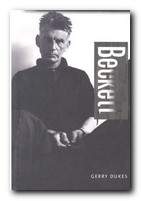
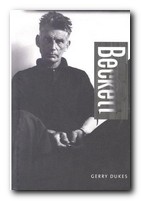
dukesSamuel Beckett: an illustrated life gives a short account of Beckett’s little-known private life in a book which is packed with rare photographs and shots of his stage productions. The life is quite surprising: a privileged upbringing, with talented academic prospects which he abandoned for a bohemian life. Fighting with the Maquis during the war. Little artistic success, but lots of relationships with women – and then the big breakthrough with Waiting for Godot. This is a stunning little book. Samuel Beckett complete works An Illustrated Life Buy the book here


Translations and Miscellaneous

1930. Texts and poems translated from the Italian

1931. ‘Anna Livia Plurabelle’ (T)

1932. ‘Poetry is vertical’ (X); Translations from Breton, Crevel, and Eluard

1934. ‘Negro’ (T)

1937. Contributions to a symposium on the Spanish Civil War (X)

1938-1939. Translations of art texts

1948-1950. Translations for post-war Transition

1958. Anthology of Mexican poetry (T, 1951)

1960. The old tune (T)

1963. Second testament (T)

Principal and Unpublished Works

1928. Research essay on Unanimistes

1931. Le kid (D)

1932. ‘Le bateau ivre’ (T); ‘Dream of fair to middling women’ (F)

1945. ‘Premier amour’; ‘Mercier et Camier’; ‘Les bosquets de Bondy’ (F)

1947. Eleutheria (D)

© Roy Johnson 2005 – with thanks to Damian Grant


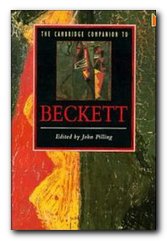
Samuel Beckett The Cambridge Companion to Beckett
The world fame of Samuel Beckett is due to a combination of high academic esteem and immense popularity. An innovator in prose fiction to rival Joyce, his plays have been the most influential in modern theatre history. This book provides thirteen introductory essays on every aspect of Beckett’s work, some paying particular attention to his most famous plays (e.g. Waiting for Godot and Endgame) and his prose fictions (the ‘trilogy’ and Murphy). Other essays tackle his radio and television drama, his theatre directing and his poetry, followed by more general issues such as Beckett’s bilingualism and his relationship to the philosophers. Samuel Beckett Buy the book here


Samuel Beckett – web links

Samuel Beckett web links Samuel Beckett at Mantex
Biographical notes, complete bibliography, selected criticism, book reviews, videos, and web links.

Samuel Beckett web links Resources Samuel Beckett Online Resources
This is a giant collection of papers, reviews, videos, journals. An old site, but packed with information. It looks very much like a labour of love by an enthusiast.

Samuel Beckett web links Exhibition Samuel Beckett Exhibition at University of Texas
Biograhical notes, manuscripts, mini-essays, a timeline, and illustrations.

Samuel Beckett web links The Samuel Beckett Endpage
Performances, illustrated journals, interviews, and conferences

Samuel Beckett web links Movies Samuel Beckett at the Internet Movie Database
Adaptations for the cinema and television – in various languages. Some very rare examples of television films of Beckett’s shorter and less well known works. Full technical details of directors, actors, and production.

Samuel Beckett web links Samuel Beckett at Literary History.com
Collection of articles on literary criticism, plus reviews.

Samuel Beckett web links Echo’s Bones – a newly discovered story

Samuel Beckett web links Samuel Beckett – at Wikipedia
Life and career, Works, Collaborators, Legacy, Honours and awards, Selected works, Further reading, Web links.

© Roy Johnson 2009


More on Samuel Beckett
Twentieth century literature
More on biography


Filed Under: Samuel Beckett Tagged With: Literary studies, Samuel Beckett

Samuel Beckett life and works

July 26, 2009 by Roy Johnson

Samuel Beckett life and worksSamuel Beckett was born near Dublin on April 13, 1906. He had an uneventful childhood, and as a young man he studied modern languages at Trinity College, Dublin, graduating in 1927. Beckett then spent two years (1928-1930) teaching English at the Ecole Normale Superieure in Paris. After returning to Trinity College for a year of graduate work in 1931, he taught French there in 1931-1932. He spent the next few years wandering in London and through France and Germany, contributing stories and poems to avant-garde periodicals, before settling in Paris in 1937.

Finding himself in what at the time was the capital of modernism, he embraced it fully. He had a long-standing affair with the rich art patroness Peggy Guggenheim, and for a short time he worked as secretary to James Joyce, who was also living in Paris at that time. Early in World War II, during the German occupation of France, the Gestapo discovered Beckett’s activities in connection with the French Resistance movement, and he was compelled to flee to the unoccupied zone about 1942. He found sanctuary at Roussillon in the department of Vaucluse.


Samuel Beckett selected criticism The Complete Critical Guide to Samuel BeckettThe Complete Critical Guide to Samuel Beckett is a good introduction to the man and the writer. Includes a potted biography of Beckett, an outline of the stories, novels, plays, and poetry, and pointers towards the main critical writings – from the 1960s to critics of the present day. Also includes a thorough bibliography which covers biography, criticism in books and articles, plus pointers towards specialist journals. Samuel Beckett selected criticism Buy the book here


After the war he returned to Paris and began writing in earnest. He was writing novels in the period 1940-50, but later turned to drama. Waiting for Godot brought him international fame after 1952, as translations and productions of the play proliferated throughout the world. However, he continued to lead an utterly secluded life. It is worth noting that he wrote much of his later work in French, and then translated it himself into English. He was awarded the 1969 Nobel Prize in literature and died in Paris on 22 Dec 1989.

Writings

Beckett’s first novel, Murphy (1938), contains all the elements of his later work: the normal, busy world; someone who cannot come to terms with it; and a language whose low-keyed precision is disturbed by nothing it undertakes to describe, however grotesque or ridiculous.

In Beckett’s next novel, Watt (1942-1944), the language remains explicit though the situations become increasingly strange. In the trilogy Molloy, Malone Dies, and The Unnameable (1947-1949), the reader is plunged into a world of terminal exhaustion and tragi-comic desperation where Beckett appears most at home.


Beckett Illustrated Life - book jacketSamuel Beckett: an illustrated life gives a short account of Beckett’s little-known private life in a book which is packed with rare photographs and shots of his stage productions. The life is quite surprising: a priviledged upbringing, with talented academic prospects which he abandonded for a bohemian life. Fighting with the Maquis during the war. Little artistic success, but lots of relationships with women – and then the big breakthrough with Waiting for Godot. This is a stunning little book. Samuel Beckett selected criticism Buy the book here

In Beckett’s world, readers are clearly told everything except the things they are used to knowing. Thus, in Waiting for Godot, which was written in 1948 and published in French in 1952 and in English in 1953, it is clear that two tramps are waiting for Godot, that they return to their rendezvous night after night, that they fill up time with games and dialogues, and that Godot may make an immense difference to their lives. But who Godot may be and what difference he will make is never indicated. Beckett denied that Godot was a symbol for God and that any general scheme of systematic meanings underlay the work. Its mysteriousness is the deliberate instrument of the play’s disturbing power.

Endgame, possibly Beckett’s most remarkable single work, appears to be about the end of humanity. His later works include the plays Happy Days (1961), Not I (1973), That Time (1976), Rockaby (1981), and the novel How It Is (1964). These bleak, enigmatic works are unsettlingly funny. Their precision of style and extravagance of conception are hallmarks of a first-class comic writer.


Samuel Beckett – web links

Samuel Beckett web links Samuel Beckett at Mantex
Biographical notes, complete bibliography, selected criticism, book reviews, videos, and web links.

Samuel Beckett web links Resources Samuel Beckett Online Resources
This is a giant collection of papers, reviews, videos, journals. An old site, but packed with information. It looks very much like a labour of love by an enthusiast.

Samuel Beckett web links Exhibition Samuel Beckett Exhibition at University of Texas
Biograhical notes, manuscripts, mini-essays, a timeline, and illustrations.

Samuel Beckett web links The Samuel Beckett Endpage
Performances, illustrated journals, interviews, and conferences

Samuel Beckett web links Movies Samuel Beckett at the Internet Movie Database
Adaptations for the cinema and television – in various languages. Some very rare examples of television films of Beckett’s shorter and less well known works. Full technical details of directors, actors, and production.

Samuel Beckett web links Samuel Beckett at Literary History.com
Collection of articles on literary criticism, plus reviews.

Samuel Beckett web links Echo’s Bones – a newly discovered story

Samuel Beckett web links Samuel Beckett – at Wikipedia
Life and career, Works, Collaborators, Legacy, Honours and awards, Selected works, Further reading, Web links.

© Roy Johnson 2005


More on Samuel Beckett
Twentieth century literature
More on biography


Filed Under: Samuel Beckett Tagged With: Biography, Critical studies, Literary studies, Modernism, Samuel Beckett

Samuel Beckett selected critcism

November 7, 2009 by Roy Johnson

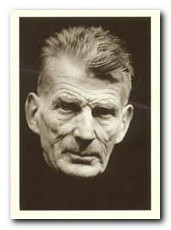
Samuel Beckett - portraitThe biography of Beckett by Deirdre Bair [Samuel Beckett, 1975], while not having any particular critical pretensions itself, is a very useful adjunct to this list of Samuel Beckett criticism, containing as it does not only the background, context, composition and publishing details of the work but also a good deal of miscellaneous comment and anecdote from Beckett himself and his friends, in the form of interviews and correspondence. Enoch Brater’s Why Beckett (1989) takes the form of a pictorial biography, with over a hundred (often excellent) black-and-white photographs. There are some good points (and quotes) in the succinct text, too.

These biographical works have now been superseded by James Knowlson’s Damned to Fame: The Life of Samuel Beckett (1996), a work of great insight as well as scholarship by someone who was close to Beckett in his last years.

It is inevitably the case that Beckett features, often centrally, in many works on twentieth-century fiction and drama, where his place as an innovator and explorer of extremes is recognized. The Irish context of his work is also receiving more attention than formerly. See for example Beckett: The Irish Dimension by Mary Junker (1995), and the excellent short accounts of Beckett’s work given in Richard Kearney’s Transitions …, Robert Welch’s Changing States: Transformations in Modern Irish Writing (1993), and Declan Kiberd’s Inventing Ireland (1996).

[Works are listed here in chronological order.]

Martin Esslin, The Theatre of the Absurd, New York: Doubleday, 1961.

Ruby Cohn, Samuel Beckett: The Comic Gamut, New Brunswick (NJ): Rutgers University Press, 1962.

Frederick J Hoffman, Samuel Beckett: The Language of Self, Carbondale: Southern Illinois University Press, 1962.

Martin Esslin (ed), Samuel Beckett: A Collection of Critical Essays, Englewood Cliffs (NJ): Prentice-Hall, 1965.

John Fletcher, The Novels of Samuel Beckett, London: Chatto and Windus, 1964.

Raymond Federman, Journey to Chaos: Samuel beckett’s Early Fiction, Berkley (CA): University of California Press, 1965.


Samuel Beckett selected criticism The Complete Critical Guide to Samuel BeckettThe Complete Critical Guide to Samuel Beckett is a good introduction to the man and the writer. Includes a potted biography of Beckett, an outline of the stories, novels, plays, and poetry, and pointers towards the main critical writings – from the 1960s to critics of the present day. Also includes a thorough bibliography which covers biography, criticism in books and articles, plus pointers towards specialist journals. Samuel Beckett selected criticism Buy the book here


John Fletcher, Samuel Beckett’s Art, London: Chatto and Windus, 1967.

Ruby Cohn, A Casebook on ‘Waiting for Godot’, New York: Grove Press, 1967.

Ronald Hayman, Samuel Beckett, London: Heinemann, 1968.

Michael Robinson, The Long Sonata of the Dead: A study of Samuel Beckett, London: Rupert Hart-Davis, 1970.

Raymond Federman and John Fletcher, Samuel Beckett: His Work and His Critics, Berkley (CA): University of California Press, 1970

Melvin J. Friedman (ed) Samuel Beckett Now: Critical Approaches to his Novels, Poetry, and Plays, Chicago: University of Chicago Press, 1970.

Francis Doherty, Samuel Beckett, London: Hutchinson, 1971.

Colin Duckworth, Angels of Darkness: Dramatic Effect in Beckett with Special Reference to Ionesco, New York: Barnes and Noble, 1972.

John Fletcher, Beckett: A Study of his Plays, New York: Hill and Wang, 1972.

Brian Finney, ‘How It Is’: A Study of Samuel Beckett’s Later Fiction, London: Covent Garden Press, 1972.

Al Alvarez, Samuel Beckett, New York: Viking, 1973.

Ruby Cohn, Back to Beckett, Princeton: Princeton University Press, 1973.

Hugh Kenner, A Reader’s Guide to Samuel Beckett, 1973.

H. Porter Abbott, The Fiction of Samuel Beckett, Los Angeles: University of California Press, 1973.

Ruby Cohn (ed), Samuel Beckett: A Collection of Criticism, New York: McGraw-Hill, 1975.

Hannah-Case Copeland, Art and the Artist in the works of Samuel Beckett, Paris: Mouton, 1975.

James Eliopulos, Samuel Beckett’s Dramatic Language, The Hague: Mouton, 1975.

Katherine Worth (ed), Beckett the Shape Changer, London: Routledge, 1975.

John Pilling, Samuel Beckett, 1976.

S.E. Gontarski, Beckett’s ‘Happy Days’: A Manuscript Study, Columbus: Ohio State University Press, 1977.

Beryl Fletcher et al, A Student’s Guide to
The Plays of Samuel Beckett
, London: Faber and Faber, 1978.

James Knowlson and John Pilling, Frescoes of the Skull: The Later Prose and Drama of Samuel Beckett, 1979.

Robin J. Davis, Samuel Beckett: Checklist and Index of his Published Works, Stirling: The Library: University of Stirling, 1979.


Beckett Illustrated Life - book jacketSamuel Beckett: an illustrated life gives a short account of Beckett’s little-known private life in a book which is packed with rare photographs and shots of his stage productions. The life is quite surprising: a priviledged upbringing, with talented academic prospects which he abandonded for a bohemian life. Fighting with the Maquis during the war. Little artistic success, but lots of relationships with women – and then the big breakthrough with Waiting for Godot. This is a stunning little book. Samuel Beckett selected criticism Buy the book here


Barbara R. Gluck, Beckett and Joyce: Friendship and Fiction, Lewisberg (PA): Bucknell University Press, 1979.

Lawrence Graver and Raymond Federman, Samuel beckett: The Critical Heritage, London: Routledge and Keegan Paul, 1979.

Ruby Cohn, Just Play: Beckett’s Theatre, Princeton: Princeton University Press, 1980.

Helene L. Baldwin, Samuel Beckett’s Real Silence, 1981.

John C. DiPierro, Structures in Beckett’s ‘Watt’, York (SC): French Literature Publications, 1981.

J.E. Dearlove, Accommodating the Chaos: Samuel Beckett’s Nonrelational Art, Durham: Duke University Press, 1982.

Lance St. John Butler, Samuel Beckett and the Meaning of Being: A Study in Ontological Parable, 1984.

Virginia Cooke, Beckett on File, London: Methuen, 1985.

S.E. Gontarski, The Intent of ‘Undoing’ in Samuel Beckett’s Dramatic Texts, Bloomington: Indiana University Press, 1985.

Enoch Brater (ed), Beckett at 80/Beckett in Context, 1986.

S.E. Gontarski (ed) On Beckett: Essays and Criticism, New York: Grove Press, 1986.

John Calder (ed), As No Other Dare Fail: for Samuel Beckett on his 80th birthday, 1986.

James Knowlson (ed), Samuel Beckett: A Celebration, 1986.

Eoin O’Brien (ed), The Beckett Country: Samuel Beckett’s Ireland, 1986.

Peter Gidal, Understanding Beckett: A Study of Monologue and Gesture in the Work of Samuel Beckett, London: Macmillan, 1986.

Ruby Cohn (ed) Samuel Beckett: ‘Waiting for Godot’: A Casebook, London: Macmillan, 1987.

Enoch Brater, Beyond Minimalism: Beckett’s Late Style in the Theatre, 1987.

James Acheson and Kateryna Arthur (eds), Beckett’s Later Fiction and Drama: Texts for Company, London: Macmillan, 1987.

Alan Warren Friedman et al, Beckett Translating/ Translating Beckett, University Park: Pennsylvania State University Press, 1987.

Jane Alison Hale, The Broken Window: Beckett’s Dramatic Perspective, West Lafayette (IN): Purdue University Press, 1987.

Steven Connor, Samuel Beckett: Repetition, Theory and Text, Oxford: Blackwell, 1988.

Robin J. Davis and Lance St. John Butler (eds) Make Sense Who May: Essays on Samuel Beckett’s Later Works, Gerrards Cross: Colin Smythe, 1988.

Mary A. Doll, Beckett and Myth: An Archetypal Approach, Syracuse: Syracuse University Press, 1988.

Brian Fitch, Beckett and Babel: An Investigation into the Status of the Bilingual Work, Toronto: University of Toronto Press, 1988.

Lawrence Graver, Samuel Beckett: ‘Waiting for Godot’, London: Thames and Hudson 1989.

Jonathan Kalb, Beckett in Performance, 1989.

Katherine Worth, ‘Waiting for Godot’ and ‘Happy Days’, Basingstoke: Macmillan, 1990.

M.R. Axelrod, The Politics of Style in the Fiction of Balzac, Beckett, and Cortazar, 1992.

Steven Connor, ‘Waiting for Godot’ and ‘Endgame’, New York: St Martin’s Press, 1992.

Anna McMullan, Theatre on Trial: Samuel Beckett’s Later Drama, 1993.

Eyal Amiran, Wandering and Home: Beckett’s Metaphysical Narrative, University Park: Pennsylvania University Press, 1993.

Paul Davies, The Ideal Real: Beckett’s Fiction and Imagination, Toronto: Associated University Press, 1994.

Christopher Ricks, Beckett’s Dying Words, 1995.

H. Porter Abbott, Beckett Writing Beckett: The Author in the Autograph, Ithaca: Cornell University Press, 1996.

Anthony Cronin, Samuel Beckett: The Last Modernist, London: Harper-Collins, 1996.

James Acheson, Samuel Beckett’s Artistic Theory and Practice: Criticism, Drama, and Early Fiction, New York: St Martin’s Press, 1997.

Thomas Coisineau, ‘Waiting for Godot’: Form in Movement, Boston: Twayne, 1990.

Anthony Farrow, Early Beckett: Art and Allusion in ‘More Pricks than Kicks’ and ‘Murphy’, Try (NY): Whitson, 1991.

S.E. Gontarski (ed) The Theatrical Notebooks of Samuel Beckett, Vol 2: ‘Endgame’, London: Faber and Faber, 1992.

S.E. Gontarski (ed) The Beckett Studies Reader, Gainsville: University Press of Florida, 1993.

S.E. Gontarski (ed) The Theatrical Notesbooks of Samuel Beckett, Vol 4: The Shorter Plays, London: Faber and Faber, 1993.

Lois Gordon, The World of Samuel Beckett, New Haven: Yale University Press, 1996.


Samuel Beckett – web links

Samuel Beckett web links Samuel Beckett at Mantex
Biographical notes, complete bibliography, selected criticism, book reviews, videos, and web links.

Samuel Beckett web links Resources Samuel Beckett Online Resources
This is a giant collection of papers, reviews, videos, journals. An old site, but packed with information. It looks very much like a labour of love by an enthusiast.

Samuel Beckett web links Exhibition Samuel Beckett Exhibition at University of Texas
Biograhical notes, manuscripts, mini-essays, a timeline, and illustrations.

Samuel Beckett web links The Samuel Beckett Endpage
Performances, illustrated journals, interviews, and conferences

Samuel Beckett web links Movies Samuel Beckett at the Internet Movie Database
Adaptations for the cinema and television – in various languages. Some very rare examples of television films of Beckett’s shorter and less well known works. Full technical details of directors, actors, and production.

Samuel Beckett web links Samuel Beckett at Literary History.com
Collection of articles on literary criticism, plus reviews.

Samuel Beckett web links Echo’s Bones – a newly discovered story

Samuel Beckett web links Samuel Beckett – at Wikipedia
Life and career, Works, Collaborators, Legacy, Honours and awards, Selected works, Further reading, Web links.

© Roy Johnson 1999-2002 – with thanks to Damian Grant


More on Samuel Beckett
Twentieth century literature
More on biography


Filed Under: Samuel Beckett Tagged With: Literary studies, Modernism, Samuel Beckett

Samuel Beckett: An Illustrated Life

June 16, 2009 by Roy Johnson

short biographical study – with rare archive photos

This short biographical study offers an introduction to Samuel Beckett and his amazingly difficult and rather bohemian life, which was unrelenting devoted to creativity no matter what his circumstances. It’s written by an expert, and presented in a very attractive manner with archive photographs on almost every page. Beckett is a well-known author, but not much is generally known about his personal life. He avoided interviews and shunned publicity – even sending his publisher to collect his Nobel Prize.

Samuel BeckettThis short book isn’t an attempt to deliver a full scale biography (that has already been done by Deirdre Bair, Anthony Cronin, and James Knowlson) but it offers a potted account of his life accompanied by the most original set of photographs that I have ever seen – some from his personal life, and others from stage productions.

Beckett was from a fairly well-to-do family; he had a privileged, well educated upbringing, and by the time he graduated with first class honours from Trinity College Dublin it looked as if a standard academic career was his natural progression route.

But he had won a lectureship at the Ecole Normale Superieure – and during his time in Paris he fell in with fellow Dubliner James Joyce. This experience led him to give up his work as an academic and to embrace the Bohemian life of being a poet, a critic, a translator, and a novelist – from which activities he made no money at all. He lived on allowances from his family until he was middle-aged.

The 1930s passed in a flurry of Bohemianism, occasional publication in obscure magazines, and a fair amount of hardship. He suffered from a number of what seemed to have been psycho-somatic ailments, and even spent some time in psycho-analysis. He also had a rather complex personal life – a wife whom he married for ‘testamentary’ reasons, and overlapping and simultaneous relationships with other women which required ‘timetabling’.

Samuel Beckett’s bookshelves

The war years were a period of hardship and bare survival. He spent time hiding from the Nazis (and fighting with the Maquis) in southern France, then working with the Red Cross. After the war he returned to live in Paris and began to write in French.

The period immediately after the war he called ‘the siege in the room’, where he shut himself away and produced an enormous amount of writing – none of which was immediately published. This period lasted for about four years. And then in the early 1950s he had his first successes – novels published in France, followed by a big breakthrough with Waiting for Godot.

From that point on, his star rose, and yet his work was always surrounded by controversy. People found his writing difficult to understand; theatre directors weren’t sure how to stage his plays; he had different publishers for the three or four genres in which he wrote; and rather like Vladimir Nabokov he spent a lot of time translating his work from one language to another – and sometimes back again.

As he got older his works got shorter, more compressed, and eventually reached the point of silence as he produced mimes and silent films. However, it’s quite possible that his oeuvre will continue to grow, even after his death, because he wrote so much which never got into print. This is a short but very attractive publication that’s worth it just for the photographs.

© Roy Johnson 2004

Buy the book at Amazon UK

Buy the book at Amazon US


Gerry Dukes, Samuel Beckett: an illustrated life, New York: Overlook Press, 2004, pp.161, ISBN 1585676101


More on Samuel Beckett
Twentieth century literature
More on biography


Filed Under: Biography, Samuel Beckett Tagged With: Biography, English literature, Literary studies, Modernism, Samuel Beckett

  • « Previous Page
  • 1
  • …
  • 67
  • 68
  • 69
  • 70
  • 71
  • …
  • 103
  • Next Page »

Get in touch

info@mantex.co.uk

Content © Mantex 2016
  • About Us
  • Advertising
  • Clients
  • Contact
  • FAQ
  • Links
  • Services
  • Reviews
  • Sitemap
  • T & C’s
  • Testimonials
  • Privacy

Copyright © 2026 · Mantex

Copyright © 2026 · News Pro Theme on Genesis Framework · WordPress · Log in