Mantex

Tutorials, Study Guides & More

  • HOME
  • REVIEWS
  • TUTORIALS
  • HOW-TO
  • CONTACT
>> Home / Archives for 2009

Archives for 2009

Web Design in a Nutshell

July 12, 2009 by Roy Johnson

comprehensive manual, plus tips and explanations

Web site design manuals are often all screen shots and little substance. These can be quite useful for beginners, who might be intimidated by too many technicalities. At the other extreme there are the dense catalogues of coding definitions issued by the standards authorities which only an expert would ever need to consult. In between are all the rest, which need to present something original or at least interesting to distinguish themselves from the mass. Web Design in a Nutshell manages to combine the best of the intermediate and advanced worlds.
Web Design in a NutshellThey feature a compressed mixture of instruction and reference which cuts out all dross, and offer their usual excellent value. Jennifer Niederst explains that she felt the urge to produce yet another book on Web design for the simplest of motives – her own use.

I was becoming frustrated with the time I was spending on the Web tracking down the answers to little questions: ‘Which tag does that attribute go in?’, ‘Does this browser support that technology?’, ‘What’s the best way to put audio on the Web?’ And I’m not ashamed to admit that I’ve been reduced to tears after hours of battling a table that mysteriously refused to behave, despite my meticulous and earnest efforts. You just can’t keep all this stuff in your head any more.

Niederst is one of their former staff writers and designers [see her recent Learning Web Design]. She explains HTML in a clear and sensible manner, starting with what she calls ‘the web environment’ – how it all works, why you should keep different browsers in mind, and what ‘screen resolution’ really means.

Then there is a very thorough coverage of all the basic elements: HTML coding, text formatting, links and images, tables, frames, and forms; then graphics in .gif, .jpg and .png formats; colours, audio, video, and javascript. The latter part of the book is devoted to what she calls ‘the emergent technologies – cascading style sheets, dynamic HTML, XML, and font embedding.

All the way through, she throws out tips, hints, and warnings which give you confidence that she knows whereof she speaks, and as you would expect in a work of this kind, there are a full range of reference tables – the complete HTML 4.0 specification, ‘deprecated’ and proprietary tags, a glossary of terms, and even an extended table of the latest support for style sheets in a wide range of browsers.

The latest edition has been substantially revamped and extended. Additions include more on printing pages from the Web, using Flash and Shockwave, using SMIL for multimedia presentations, and designing for the wireless web using WML.

At the risk of sounding like an O’Reilly groupie, I have to say that their productions are almost always a bibliographic joy to behold. They are well written, elegantly designed, meticulously edited, and flawlessly printed. This one is no exception.

© Roy Johnson 2001

Buy the book at Amazon UK

Buy the book at Amazon US


Jennifer Niederst, Web Design in a Nutshell: A Desktop Quick Reference, 2nd edition, Sebastopol: O’Reilly & Associates, 2001, pp.640, ISBN: 0596001967


More on web design
More on digital media
More on technology


Filed Under: Web design Tagged With: Computers, CSS, HTML, Web design, Web Design in a Nutshell

Web Design: Start Here

July 11, 2009 by Roy Johnson

from zero to web design hero in easy lessons

ILEX are in the business of producing very high quality books which offer beautiful page layout and graphic design, elegant fonts, and a crisp approach to digital production. Their latest volume on web design is an excellent example of putting computer technology onto the printed page with no loss of visual aesthetics. This guide assumes that you are going to use a web editor to do all the coding for producing a web site. It concentrates therefore on the general principles.

Web Design: Start HereThere’s very little detail – and that’s the weakness of this approach. The strength is that it provides an excellent overview of what’s required in web design. Obviously there are lots of different skills required, and Nick Nettleton sketches out the basics for each phase of the design process. He also tells you what freeware is available for each stage in the process – even for graphics editing and FTP programs for uploading. He covers fonts, colour, graphics, and links – in which I liked his idea of creating a web page of links to sites whose appearance you prefer, which is something I have started doing on my Mantex Blog.

There’s also plenty on the use of tables to control the layout of the text on the page, and he warns (quite rightly) about the problems of browser versions – now thankfully receding.

Next comes creating graphics and fonts, including the sort of special effects that are available in most programs – gradients, fills, drop shadows, distortions, and textures.

He discusses the creation of buttons and designing the overall look and feel of a web site, and there’s a section on optimising and compressing graphics to minimise download times. This leads naturally enough into the graphic images which are a central feature of many web sites these days, increasingly exploited in an era of increasing band width.

He includes guidance on how to use digital cameras, editing photos with software such as Photoshop, and treating the results so that they look good on the screen.

This is followed by the conceptual art of organising the structure and navigation of a good site – a the part which many designers neglect. He shows the basics, then demonstrates how to create navigation bars, image maps, and rollovers.

He finishes with more advanced techniques such as nested tables, use of frames, and animated rollovers.

This is a guide which gives quick glimpses of what is possible in web design. It’s classy, well presented, and good value. You’ll need to look at any given topic in more detail, but this is a good place to start.

© Roy Johnson 2003

Buy the book at Amazon UK

Buy the book at Amazon US


Nick Nettleton, Web Design: Start Here, Lewes, Sussex: ILEX, 2003, pp.192, ISBN 1904705030


More on web design
More on digital media
More on technology

Filed Under: Web design Tagged With: HTML, Web design, Web Design: Start Here

Web Design: Tools and Techniques

July 1, 2009 by Roy Johnson

design with emphasis on graphics and advanced effects

This is the second edition of a very successful Web design manual. It spells out the basics of good design, but then concentrates on the graphic design elements of building good pages and effective sites. Peter Kentie begins by outlining the principles of HTML and Web design. Then he explains the basics of coding – starting from text and graphics, then forms and tables, frames and style sheets. Those who wish to take the route of using a text editor will be glad to know that he discusses Front Page, HotMetal, BBEdit, PageMaker, and even Word. The later two thirds of the book are taken up with what is obviously his forte – ‘creative Web design’.

Web Design: Tools and TechniquesThis involves using intermediate graphics techniques and ‘advanced’ multimedia effects such as Flash, sound, video, 3-D, and Java Programming. All of which makes it very much a book which will appeal to graphic designers. He deals with colour adjustment, Gif and Jpg image manipulation, background effects, image maps, shadows, and 3-D effects. There’s lots of use of Adobe Illustrator and Photoshop, as well as the Macromedia Web tool programs.

The advanced section deals with making animated Gifs. He’s very enthusiastic about Flash, which allows you to create animations which are amazingly small in terms of file size. And if you feel very adventurous, you can even try his suggestions for Shockwave movies, Virtual Reality, or streaming video. He ends with the advanced possibilities now possible using XML, WAP, Java, and Active Server Pages.

These effects are explained clearly but quickly – so this book is most suitable for intermediate users. I think it will be most useful for those people with an existing web site who want to improve and develop it using the latest technologies. Those who are in the beginner stages of web design should try checking out a free website at webstarts.com. The book is very elegantly produced, and packed with both coding and screen shots, showing you what can be done.

© Roy Johnson 2002

web design   Buy the book at Amazon UK

web design   Buy the book at Amazon US


Peter Kentie, Web Design: Tools and Techniques, Berkeley (CA) Pearson/Peachpit Press, (second edition) 2002, pp.485, ISBN: 0201717123


More on design
More on media
More on web design


Filed Under: Graphic design, Web design Tagged With: Graphic design, Web design, Web graphics

Web Essay 1 – Contents page

November 23, 2009 by Roy Johnson

This essay comes from a short first year undergraduate course on the history of the Internet. The course had a couple of face-to-face seminar meetings, but was mainly taught on line. Coursework essays [US – term papers] were submitted in the form of ‘web essays’. Students were asked to create pages with hyperlinks, and although marks were given principally for the content of the essay, the final grade also took into account their web design skills.


Assignment question

The Internet has expanded very rapidly in the years between 1990 and 2000, but its origins go back to the post-war years.

Discuss the earlier phases of the development of the Net, and in particular consider the outstanding figures who have made significant technological contributions. Does any one of them seem to warrant the description of ‘creator of the Internet’?

Web Essay

Student: James Higginson

Course: An Introduction to the Internet

redbtn   Introduction

redbtn   What is the Internet?

redbtn   Internet evolution

redbtn   Father of the Internet?

redbtn   Assignment resources

redbtn   Plan for this assignment

redbtn   Definition of terms

redbtn   Tutor comment


Home
Introduction – What is the Internet? – Internet evolution – Father of the Internet
Assignment resources – Essay plan – Definition of terms – Tutor comment
 

Copyright © James Higginson 2000


Filed Under: How-to guides, Study Skills Tagged With: Internet history, Sample web essay, Study skills, Writing skills

Web Essay 2 – Introduction

November 23, 2009 by Roy Johnson

Student: James Higginson
Course: An Introduction to the Internet


Introduction
It is very true that the world’s media and Internet users are beginning
to label specific individuals as the ‘father of the internet’. Indeed, whilst
researching this assignment, there were no less than 4,000 matches on a web search engine for the phrase “father of the internet”, and suggestions ranging from Marconi (inventor of the telephone) to Al Gore (Presidential Candidate in the U.S.A.). But what do these people mean when using the term ‘father of the Internet’, are they talking about an inventor, a guardian or even promoter. The Oxford Dictionary of Current English, defines the word ‘father’ to be:

Forefather; founder or originator; early leader;

Through detailing the historical development of the Internet in the
following sections, I hope to ascertain which people have a claim to be the ‘father of the internet.’


Home
Introduction – What is the Internet? – Internet evolution – Father of the Internet
Assignment resources – Essay plan – Definition of terms – Tutor comment
 

Copyright © James Higginson 2000


Filed Under: How-to guides, Study Skills Tagged With: Internet, Sample web essay, Study skills, Technology, Writing skills

Web Essay 3 – What is the Internet?

November 23, 2009 by Roy Johnson

Student: James Higginson
Course: An Introduction to the Internet


What is the Internet?

There are many different definitions of the Internet and many people
often confuse the Internet with some of the applications, which run on it, such as E-Mail, World Wide Web and File Transfer Protocol (FTP).

So what is the Internet? In general terms, the Internet is a system of
computer networks, a network or networks that allow users of the Internet to exchange information, files or even talk directly to users of other computers around the world, through the use of set protocols.

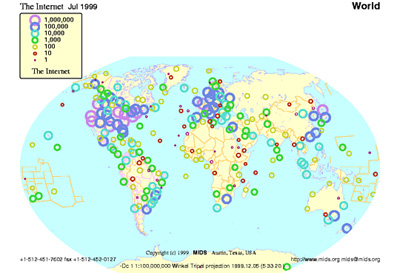
To give you an indication of the size of the Internet, the following map
shows the number of hosts on the Internet throughout the world as at July 1999.

web_map - image


Copyright © 1999 MIDAS


Home
Introduction – What is the Internet? – Internet evolution – Father of the Internet
Assignment resources – Essay plan – Definition of terms – Tutor comment
 

Copyright © James Higginson 2000


Filed Under: How-to guides, Study Skills Tagged With: Internet history, Study skills, Technology, Web essay, Writing skills

Web Essay 4 – Internet evolution

November 24, 2009 by Roy Johnson

Student: James Higginson
Course: An Introduction to the Internet


The Internet was not an overnight development, it has evolved over thirty years and can be traced back to the first computer networking projects, the key developments & personalities of which will be explained in this section.

Following the launch of Sputnik (the first artificial earth satellite) by the USSR in 1957, the US Department of Defense formed the Advanced Projects Research Agency (ARPA) to establish a lead in world technology for the USA.

The first head of this organisation was J.C.R. Licklider, who wrote a series of memos in 1962 discussing his ideas of a “Galactic Network”, a global set of computers that were interconnected and allowed users to access data and programs from any site. He promoted his networking theory to his successors at ARPA, Ivan Sutherland, Bob Taylor and Lawrence G Roberts.

In 1965, Lawrence Roberts directly connected a TX-2 computer at MIT in Massachusetts to a Q-32 computer in California via a dedicated phone line. This experiment was the first-ever Wide Area Network (WAN), (the first Local Area Network (LAN) was developed some years later by Bob Metcalfe at Xerox PARC, using the Ethernet protocol, which is probably the dominant network technology on today’s Internet).

The experiment proved that time-sharing computers could network but it also proved that the circuit switching was not adequate and he approached ARPA to develop the computer network concept further. The result was his plan for the ARPANET, a number of individual computers connected by leased lines using packet switching. Roberts had been convinced on the theory of using packet switching by Leonard Kleinrock, who wrote the first paper on packet-switching theory in 1961, although three independent bodies worked on this concept, the National Physical Laboratory (NPL), RAND and MIT.

The first four nodes of ARPANET were at UCLA, Stanford Research Institute, UC Santa Barbara and University of Utah and these formed the initial ARPANET in 1969. The Network Working Group, headed by Steve Crocker, finished the initial ARPANET Host-to-Host protocol in 1970 which was called the Network Control Protocol (NCP). The implementation of this protocol enabled the network users to develop applications.

Bob Kahn, who had been working at Bolt Beranek & Newman (BBN), the company which had built the Interface Message Processors (IMPs) of the ARPANET, posed the problem of how computers could interwork without any knowledge of the characteristics of the underlying networks as there were more than one packet switched network. Bob Kahn employed the skills of Vint Cerf (previously involved in the design of NCP and the measurement of ARPANET) to establish a solution to getting these to “internetwork”. They concluded that the following key features were needed:

  • Using computers as gateways or routers between different networks
  • Making hosts responsible for end-to-end transmission of packets together with error correction and retransmission if necessary
  • Devising the protocols necessary to make the first two points happen

In 1974 Bob Kahn and Vint Cerf published “A Protocol for Packet Network Interconnection” which specified the Transmission Control Protocol (TCP). This new protocol, TCP, was eventually split into Transmission Control Protocol/Internet Protocol (TCP/IP) to make it even more efficient. In the early 1980s, TCP/IP was established as the protocols on the ARPANET, replacing the NCP.

Through the 1980’s ARPANET was revised, and new networks were established including NSFNET, but TCP/IP was essential to them all. More and more networks have interconnected to form the Internet. Vint Cerf has stated in an online interview:

“Today, there are an unknown number of networks interconnected to form the Internet – certainly in excess of 200,000 around the world and likely more than that. There are at least 60 million computers on the Internet and possibly as many as 200 Million.”

As the Internet and its capabilities has developed, more protocols have been added in a layered approach in addition to TCP/IP, such as the Domain Name System (DNS), the email protocols POP3, IMAP, and SMTP) and the World Wide Web protocols (HTTP, HTML, and XML).

One of the keys to the rapid growth of the Internet has been the availability of basic documents and specifications of the protocols. These were available as Requests for Comments (RFCs). Jon Postel acted as the RFC Editor; in addition to his role as director of the Internet Assigned Numbers Authority, a non-profit body that administers the required protocol number assignments.


Home
Introduction – What is the Internet? – Internet evolution – Father of the Internet
Assignment resources – Essay plan – Definition of terms – Tutor comment
 

Copyright © James Higginson 2000


Filed Under: How-to guides, Study Skills Tagged With: Internet history, Study skills, Technology, Web essay, Writing skills

Web Essay 5 – Father of the Internet?

November 24, 2009 by Roy Johnson

It could be claimed that J.C.R. Licklider was a forefather of the Internet, as his ideas of a “Galactic Network” do have a resemblance to the current Internet. He promoted the theories of networking to his successors at ARPA, without whose funding the development of ARPANET and hence Internet could be called into question.

Robert Kahn was responsible for the system design of the ARPANET whilst at Bolt Beranek and Newman (BBN). After joining ARPA, he conceived the idea of open-architecture networking, the underlying principle of the Internet, which led him to co-develop the protocols required to make the Internet a reality, namely TCP/IP.

Through working for Leonard Kleinrock, Vint Cerf helped to develop the host level protocols of the ARPANET and then on software for the Network Measurement Centre, which measured the performance of the ARPANET. His work led him to work with Robert Kahn in co-developing the protocols, TCP/IP.

Jon Postel is often touted as a father of the Internet. Indeed, he had a significant part to play in the development of the Internet, through his control of the Requests for Comments and founder of the Internet Assigned Numbers Authority.

For the Internet to exist there had to be a method of embracing open-architecture networking, this was only possible through the introduction of TCP/IP. I therefore believe that Robert Kahn and Vint Cerf have the strongest claims to be called father(s) of the Internet, In fact Vint Cerf maybe more so, he has continued to nurture and promote the Internet (as any father would do) through his roles as President of the Internet Society (the closest thing the Internet has to a governing body), Chairman of the Internet Societal Task Force and his work at the Jet Propulsion Laboratory to design an interplanetary Internet. Kahn and Cerf received the U.S. National Medal of Technology from President Clinton in December 1997, for founding and developing the Internet.

However, if we the use concept of Systems Thinking, i.e. looking at the whole, then the development of the Internet has relied on more than just the development of TCP/IP, developments such as packet-switching were vital, the freedom of information provided by Jon Postel enabled rapid growth, and support of Government in providing an envirnoment & funding for it to have been developed. In fact, Vice President of USA, Al Gore, has even claimed his role:

"During my service in the Unites States Congress,
I took the initiative in creating the Internet"

The Internet may have two father figures in Vint Cerf and Robert Kahn but there are many more who have a valid claim to its birth. The media will always look for an inventor or creator, but in this instance there is a whole family who are responsible for the fatherhood of the Internet.


Home
Introduction – What is the Internet? – Internet evolution – Father of the Internet
Assignment resources – Essay plan – Definition of terms – Tutor comment
 

Copyright © James Higginson 2000


Filed Under: How-to guides, Study Skills Tagged With: Internet history, Study skills, Technology, Web essay, Writing skills

Web Essay 6 – assignment resources

November 24, 2009 by Roy Johnson

Student: James Higginson
Course: An Introduction to the Internet


Click HERE to view my plan for this assignment

Katie Hafner, Matthew Lyon, Where Wizards stay up late – Touchstone Publications – 1998

Katz, John, “Mourning the Father of the Internet” – 27/10/98 –
(visited 30 August 2000)

Rodriguez, Karen, “Plenty deserve credit as ‘father’ of the Internet” – 25/10/99
http://www.bizjournals.com/sanjose/stories/1999/10/25/newscolumn2.html
(visited 30 August 2000)

The Corporation for National Research Initiatives, “Robert E Kahn biography” – 18/08/00
<http://www.cnri.reston.va.us/bios/kahn.html>
(visited 30 August 2000)

Worldcom, “Vinton G Cerf – Personal Prospective”
(visited 30 August 2000)

The Internet Engineering Task Force
<http://www.itef.org>

Vint Cerf & Robert Kahn, “A Protocol for Packet Network Intercommunication” – May 1974 –
(visited 30 August 2000)

The Internet Society (ISOC)
<http://www.isoc.org>

Robert Hobbes’ Zakon, “Hobbes’ Internet Timeline v5.1” – 01/07/00
(visited 30 August 2000)

Worldcom, “Cerfs Up: Internet History”
(visited 30 August 2000)

Whatis.com
<http://www.whatis.com>

Open University – T171 Course Material
<http://www.open.ac.uk>

N.B. I did email Vint Cerf at http://www.worldcom.com to find out if he is comfortable with the title “father of the Internet”. Unfortunately, as of 01/09/2000, I have not received a reply.

Tutor’s note: Vint Cerf’s very generous reply arrived a few days after the assignment went into the Open University’s inflexible assessment system – but I had already given the student extra points for this initiative. Both of us were justified when Vint Cerf’s assessment turned out to be almost identical to the ‘conclusion’ of the assignment.


Home
Introduction – What is the Internet? – Internet evolution – Father of the Internet
Assignment resources – Essay plan – Definition of terms – Tutor comment
 

Copyright © James Higginson 2000


Filed Under: How-to guides, Study Skills Tagged With: Internet history, Study skills, Technology, Web essay, Writing skills

Web Essay 7 – essay plan

November 24, 2009 by Roy Johnson

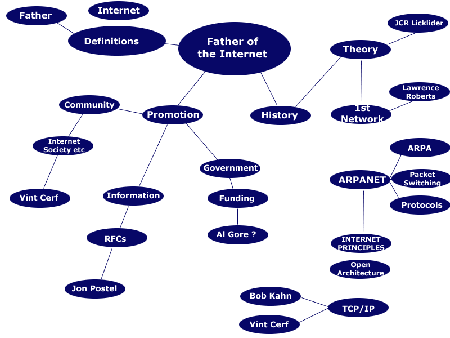
Essay plan as a mind map


mindmap - graphic


Home
Introduction – What is the Internet? – Internet evolution – Father of the Internet
Assignment resources – Essay plan – Definition of terms – Tutor comment
 

Copyright © James Higginson 2000


Filed Under: How-to guides, Study Skills Tagged With: Internet history, Study skills, Technology, Web essay, Writing skills

  • « Previous Page
  • 1
  • …
  • 94
  • 95
  • 96
  • 97
  • 98
  • …
  • 103
  • Next Page »

Get in touch

info@mantex.co.uk

Content © Mantex 2016
  • About Us
  • Advertising
  • Clients
  • Contact
  • FAQ
  • Links
  • Services
  • Reviews
  • Sitemap
  • T & C’s
  • Testimonials
  • Privacy

Copyright © 2026 · Mantex

Copyright © 2026 · News Pro Theme on Genesis Framework · WordPress · Log in