Mantex

Tutorials, Study Guides & More

  • HOME
  • REVIEWS
  • TUTORIALS
  • HOW-TO
  • CONTACT
>> Home / Archives for 2009

Archives for 2009

Style – ten lessons in clarity and grace

July 25, 2009 by Roy Johnson

how to refine your writing style

This is a twenty year old book already in its sixth edition, and the author admits that it’s still ‘evolving’, which is a good sign that serious thought is going into its composition. Style ten lessons in clarity and grace is based on a course Joseph Williams teaches at the University of Chicago. His approach is based on two principles – that ‘it’s good to write clearly, and anyone can’ – and the second part of the proposition is what he’s teaching here. His approach is to draw attention to the finer issues of clarity in prose, and to show how language can be used with subtelty to effect it.
Style ten lessons in clarity and grace His ten seperate chapters deal with each of these issues in turn, and his own prose style is engaging and friendly – which both proves his point and shows that he knows what he is talking about. He starts with a brief and amusing guide to bad prose and what creates it, and he ends with the most celebrated advice on creating effective prose – that good writing is about ‘rewriting’. His general advice is that improvement can be made – if you go slowly. So what then are his ten ‘lessons’?

  1. Write with readers in mind
  2. Write clearly
  3. Write concretely
  4. Write in an active mode
  5. Put the subject at start of sentence
  6. Put rhetoric at end of sentence
  7. Edit, edit, edit; and cut, cut, cut
  8. Get the verb in the main clause
  9. Create structure
  10. Write ethically

It’s pitched at a fairly sophisticated level, suitable for intermediate to advanced users. Williams assumes that readers know the basics of what is right and wrong, but want to improve in matters of clarity and elegance. He makes an interesting and useful distinction between three types of correctness – and offers different levels of response to them.

There are are exercises in each chapter with suggested answers, which I think makes this a text which might be more popular with tutors than with the students for whom it was presumably written. You’ve got to put up with a lot of grappling with ‘nominalizations’, ‘resumptive modifiers’, and elimination of the passive voice, as well as the same examples worked over and over until they’re right.

There’s a particularly good chapter on deleting redundant expressions, writing more concisely, and eliminating ‘metadiscourse’ [signposting or ‘writing about writing’]. He gives one example where a fifty word statement is edited down to a sentence of six. His advice includes one point I write on something like fifty percent of all student essays: ‘Put the subject at the start of the sentence, and follow it as soon as possible with the verb’.

Towards the end of the book he tries to ‘teach the unteachable’ – elegance and ‘good style’. This section requires quite a sophisticated level of literary experience, and strangely enough he ends on punctuation – but pitched at quite an advanced level.

This isn’t a book for beginners. It’s for people who want to improve their existing writing skills, who want to rid themselves of officialese and cloudy abstraction and garbled syntax so as to produce writing which is clear and efficient. If you follow his advice, read carefully what he’s got to say, and complete the exercises, I think you’ll find it money well spent.

© Roy Johnson 2000

Style ten lessons in clarity and grace   Buy the book at Amazon UK

Style ten lessons in clarity and grace   Buy the book at Amazon US


Joseph Williams, Style: ten lessons in clarity and grace, New York: Addison Wesley, (6th edn) 1999, pp.309, ISBN: 0321024087


More on language
More on literary studies
More on writing skills
More on grammar


Filed Under: Creative Writing, Journalism, Writing Skills, Writing Skills Tagged With: Creative writing, Writing guides, Writing skills, Writing style

StyleWriter

July 19, 2009 by Roy Johnson

grammar, spelling, and editing software program

Lots of people don’t like spelling-checkers and grammar-checkers. It’s no fun having your weaknesses highlighted. Yet they can save you from many embarrassing mistakes – and you can learn good writing habits from them. STYLEWRITER tries to overcome this problem by offering a wide palette of distinctions and a selection of writing styles from which to choose. Its stated aim is to help users produce plain English. As the guidance notes say, “A low average sentence length and a low Passive Index makes your writing much more readable and interesting.”

StylewriterThe program is invoked from within your word-processor, and it works by splitting the screen in two. The top window reveals several lines of your text, with any problems highlighted. This has the advantage that individual items can be seen in their grammatical context.

The highlights are also colour-coded: dark red for suggested improvements, black for misused words, and bright red for spelling mistakes. The bottom window contains your original file, which can be edited. This editing function is commendably efficient: it takes the cursor to the exact spot in your text where corrections will be made. A full help system is available from pull-down menus, and this also includes tips on punctuation, grammar, and appropriate style.

At the end of the check, a full statistical report is available. This includes a word and sentence count, and a natty bar chart with encouraging comments on your results [Sentence-length ‘Excellent!’] There is also a summary which reveals the number of occurrences of features such as complex words, business clichés, foreign words, hidden verbs, and jargon. These can all be customised.

It is easy to observe that many great prose stylists would not pass the test of the forty word maximum sentence length which the program recommends. Henry James would only just be approaching the subject of his sentence after such a short preamble, and his verb would be still some way off. But for we lesser mortals the strictures are probably useful.

So – the program is well worth recommending. I ditched Grammatik in its favour, hardly without thinking. The publishers have recently dropped the price if you download it from their website.

It also allows you to choose the type of writing you wish to check and edit – so it copes with the various requirements for writing by lawyers, government officials, engineers, educators, or accountants. There’s even a setting for ‘creative’ writing that permits the bending of grammatical rules.

But on the whole it aims to produce witing which is shorter, clearer, and free from cloudiness and jargon. You even get a statistical summary of what you write (keep an eye on those long sentences) and if you don’t agree with a particular item of advice, you can remove it. On the other hand you can add rules and dictionary items.

The latest version has been completely re-vamped, and the best feature of all that’s been added is a free trial version which you can download here.

© Roy Johnson 2002


StyleWriter: the plain English editor – Version 4. Editor Software, 64 Woodmancote, Dursley, Glos, GL11 4AQ, England. Tel: 01453-548409


More on writing skills
More on language
More on grammar


Filed Under: Writing Skills Tagged With: Editing, Software, StyleWriter, Writing skills, writing software

Stylistic analysis – how to do it

September 13, 2009 by Roy Johnson

free pages from our English Language software program

Stylistic analysis – definition

stylistic analysis Stylistic analysis in linguistics refers to the identification of patterns of usage in speech and writing.
redbtn Stylistic analysis in literary studies is usually made for the purpose of commenting on quality and meaning in a text.


Examples

redbtn A stylistic analysis of a roadsign which reads NO LEFT TURN might make the following observations.

  • The statement is a command.
  • It is cast in the imperative mode.
  • The statement lacks a subject and a verb.
  • These are implied [THERE IS].
  • The statement is unpunctuated.
  • Capitals have been used for emphasis.
  • Simple vocabulary to suit wide audience.
  • Extreme compression for rapid comprehension.
  • Form entirely suited to audience and function.

Use

redbtn In linguistics the purpose of close analysis is to identify and classify the elements of language being used.

redbtn In literary studies the purpose is usually an adjunct to understanding, exegesis, and interpretation.

redbtn In both cases, an extremely detailed and scrupulous attention is paid to the text.

redbtn This process may now be aided by computer programs which able to analyse texts.

redbtn NB! At this point, the study of language moves into either ‘stylistics’ or ‘literary studies’.

redbtn Stylistic analysis is a normal part of literary studies. It is practised as a part of understanding the possible meanings in a text.

redbtn It is also generally assumed that the process of analysis will reveal the good qualities of the writing.

redbtn Take for example the opening lines of Shakespeare’s Richard III:

Now is the winter of our discontent
Made glorious summer by this sun of York;

redbtn A stylistic analysis might reveal the following points:

  • the play is written in poetic blank verse
  • that is — unrhymed, iambic pentameters
  • the stresses fall as follows
  • Now /i/s the w/i/nter /o/f our d/i/scont/e/nt
  • [notice that the stress falls on vowel sounds]
  • the first line is built on a metaphor
  • the condition of England is described in terms of the season ‘winter’
  • the term ‘our’ is a form of the royal ‘we’
  • the seasonal metaphor is extended into the second line …
  • … where better conditions become ‘summer’
  • the metaphor is extended even further by the term ‘sun’
  • it is the sun which appears, ‘causing’ the summer
  • but ‘sun’ is here also a pun – on the term ‘son’…
  • … which refers to the son of the King
  • ‘York’ is a metonymic reference to the Duke of York

redbtn In a complete analysis, the significance of these sylistic details would be related to the events of the play itself, and to Shakespeare’s presentation of them.

redbtn In some forms of sylistic analysis, the numerical recurrence of certain stylistic features is used to make judgements about the nature and the quality of the writing.

redbtn However, it is important to recognise that the concept of style is much broader than just the ‘good style’ of literary prose.

redbtn For instance, even casual communication such as a manner of speaking or a personal letter might have an individual style.

redbtn However, to give a detailed account of this style requires the same degree of linguistic analysis as literary texts.

redbtn Stylistic analysis of a non-literary text for instance means studying in detail the features of a passage from such genres as:

Instruction notes for programming your video-recorder
Information a history text book
Persuasion an advertisement or a holiday brochure

redbtn The method of analysis can be seen as looking at the text in great detail, observing what the parts are, and saying what function they perform in the context of the passage.

redbtn It is rather like taking a car-engine to pieces, looking at each component in detail, then observing its function as the whole engine starts working.

redbtn These are features which are likely to occur in a text whose function is to instruct:

imperative or
command
‘remove the outer covering’
direct address ‘check voltage system before you install the unit’
numbered points [because sequencing is important in carrying out a procedure]
technical terms
or jargon
‘piston’, ‘carburettor’, ‘spark plug’
diagram with
call-out labels
[an extra level of communication to aid understanding]

redbtn Features are dealt with in three stages, as follows:

identify — describe — explain

redbtn The features chosen from any text will be those which characterise the piece as to its function. They will be used by the analyst to prove the initial statement which is made about the linguistic nature of the text as a whole.

redbtn This method puports to be fairly scientific. A hypothesis is stated and then proved. It is a useful discipline which encourages logical thought and can be transferred to many other areas of academic study.

redbtn This is one reason why the discipline of stylistic analysis is so useful: it can be applied to a variety of subjects.

Self-assessment quiz follows >>>

© Roy Johnson 2004


English Language 3.0 program
Books on language
More on grammar


Filed Under: English Language Tagged With: English language, Language, Literature, Stylistic analysis, Writing

Subediting for Journalists

June 27, 2009 by Roy Johnson

the art and skills of subediting for publication

The best thing about Subediting for Journalists is that it is quite clearly based on practical experience in professional journalism. There are some interesting accounts from newspaper and magazine journalists describing exactly how they work. It’s all to do with rigour and attention to detail. They deal with the basics of house style – adhering to a set of standards in spelling and representation. This means taking care with punctuation and grammar, spotting cliché, and getting names right.

Subediting for JournalistsMost of what they have to say concerns correcting common mistakes – dangling participles, misused phrases, and unnecessary repetition. Anyone who wants to improve their writing skills could learn valuable lessons here. They also cover all those grammatical niceties such as that/which and who/whom which you look up then forget about by the next time you need to use them. The advice they give could not be more up to date:

your publication …. could be printed, it could be uploaded onto a website, it could be cannibalised for delivery to WAP or G3 mobile phones and it could also appear on television.

There are plenty of examples of re-written news items which illustrate the advice being given. They deal neatly with issues of names, dates, places, accuracy, and getting to the point. There are sections on writing headlines and photograph captions. These need to be snappy, but the advice is the same in both cases – make it accurate.

They outline the main legal and ethical problems confronting subeditors – issues of copyright, libel, slander, defamation, and contempt of court.

They also explain the print production process. This includes the use of computer software such as Quark Publishing System (QPS) to control what can become a very complex collection of documents. It’s like a peek behind the scenes for the uninitiated.

There’s also a chapter on print technology which won’t tell you much about subediting, but which is a fascinating sketch of the revolution which took place in 1983 when hot metal was replaced by digital typesetting.

They finish with a chapter on subediting web pages. They conclude with a glossary of journalism terms, a sample house style guide, and standard proof correction symbols in UK and US style.

This is a good book. It’s readable, written by people who are clearly well-informed, and just about as up-to-date as it’s possible to be in the old-ish world of print publication.

© Roy Johnson 2002

Subediting for Journalists   Buy the book at Amazon UK

Subediting for Journalists   Buy the book at Amazon US


Wynford Hicks and Tim Holmes, Subediting for Journalists, London: Routledge, 2002, pp.180, ISBN: 0415240859


More on journalism
More on creative writing
More on writing skills
More on publishing


Filed Under: Journalism, Publishing, Writing Skills Tagged With: Creative writing, Editing, Journalism, Publishing, Subediting for Journalists, Writing skills

Subject to Change

July 9, 2009 by Roy Johnson

creating products and services for an uncertain world

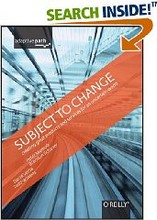
This book is about design theory for the digital age, and aspires to be read alongside Viktor Papanek’s Design for the Real Word and Donald Norman’s The Design of Everyday Things or his ‘revised’ views in Emotional Design. It’s written by four guys from Jesse James Garrett’s company, Adaptive Path, and draws heavily on their work in what they call ‘experience design’. They are challenging conventional wisdoms of commercial practice in the light of the new digital possibilities. For instance, piling more and more features into a product may not be a good thing – as users of VCR machines will confirm. Neither will building a novelty if nobody has a use for it – as the Segway proved. Subject to Change proposes radical alternatives.

Subject to ChangeThey suggest that designers must learn to empathise with the people whose interests they wish to serve. They should forget about consumers and learn to embrace the fact that the Customer is King. Their arguments stray into fields of business management, economics, and sales strategies – but they come back in the end to what these factors mean for design.

If there is a hidden sub-title to this work it’s “What is experience design?” – because the main thrust of their arguments is that whilst many companies have learned how to deliver a product, few of them have realised the importance of offering a rich and gratifying experience for their customers.

If there is a weakness, it’s a slightly Utopian notion that large businesses would allow experience design solutions policy to reach down to lower levels of company employees. It might be true that a postman or a sales clerk could offer a valuable suggestion for improving customer satisfaction – but can you imagine the directors of Royal Mail, British Gas, or – come to think of it – the government paying any attention? But of course, they would argue that this is the whole point of what they’re saying. It’s a shift in culture that’s required.

They are (quite rightly) great believers in the advantages of prototyping. James Dyson created more than 5,000 versions of his bagless vacuum cleaner before he came up with the definitive model. In fact they miss the opportunity to stress the huge advantages of prototyping in the digital world. A web site can be updated or remodeled unlike physical products such as cars or refrigerators, at virtually zero cost in no time at all by re-jigging a style sheet (CSS) or a content management system (CMS).

They are also advocates of ‘losing control’ – that is, giving customers (and even your competitors) access to tools to create their own experiences. The Internet world is littered with examples of companies who have made millions by giving away their product [Google, Linux, Mozilla]. It seems counter-intuitive, but that’s the way digital commerce works.

To conservatives, many of these ideas will seem quite impractical; but to anybody with even half a foot in the contemporary world of digital technology, they will seem like roadmaps to a New Future, employing methods which you might already be using – such as ‘managing with less’.

The latter part of the book becomes quite inspirational as they spell out their concept of ‘The Agile Manifesto’. This is a method of design and product development which does almost the exact opposite of conventional notions (which they call the ‘Waterfall Approach’). The only problem was that this section doesn’t carry any references to secondary sources – so it’s not possible to follow up their suggestions with any further reading.

Individuals and interactions not processes and tools
Working software not comprehensive documentation
Customer collaboration not contract negotiation
Responding to change not following a plan

The authors all work for the same firm (Adaptive Path) and there’s quite a lot of unashamed trumpet-blowing about their success which has drawn down severe criticism from some reviewers. But if you can stomach this (or ignore it) the book offers some useful pointers in the world of design theory and the New eCommerce.

© Roy Johnson 2008

Subject to Change   Buy the book at Amazon UK

Subject to Change   Buy the book at Amazon US


Peter Merholz et al, Subject to Change, Sebastopol, CA: O’Reilly, 2008, pp.178, ISBN: 0596516835


More on design
More on media
More on web design
More on information design


Filed Under: e-Commerce, Product design Tagged With: Design, e-Commerce, eCommerce, Subject to Change, Web design

Succeeding with a Masters Dissertation

May 24, 2009 by Roy Johnson

a step-by-step guide to post-graduate writing

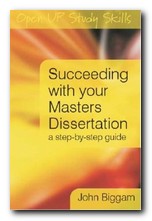
Many students find the idea of writing a masters dissertation at postgraduate level a daunting prospect. And that’s quite understandable. They will probably never before have had to produce a work of 10,000 to 15,000 words; they will be uncertain about its content; and they will almost certainly never have seen what a dissertation looks like. John Biggam’s book is a guide to the entire process of developing postgraduate writing skills, from start to finish, and the most useful aspect of his approach is that he breaks the procedure down into separate steps and explains each of them in detail.

Masters Dissertation He starts from what is often the most puzzling stage of all – defining the project. Many students know the topic which interests them most, but turning this into a research proposal can be a long and frustrating process. It’s easy to lose a lot of time changing your mind and pursuing ideas which shift amorphously the very moment you think you have pinned them down.

He offers templates to help solve this problem, outlines the key issues at each stage, and even points to the most common traps that students fall into. This is valuable advice – and it comes from a research supervisor who has seen hundreds and hundreds of examples.

His chapters follow the stages of the process of producing the dissertation itself. How to define the project; making a start with the writing; doing a literature review; choosing the right research methods; dealing with the evidence and producing a conclusion; writing an abstract; and how to present the finished work.

Embedded within all this there are other important issues such as how to create structure, how to define your terms, and how to link one part of your writing to the next so as to create a continuous argument.

He also deals with the issue which many students right up to PhD level find difficult – how to quote from secondary sources and use a referencing system accu rately. He recommends the Harvard system as being popular with both students and tutors alike. Also included is how to conduct both qualitative and quantitative surveys, and what to do with the results when they have been assembled.

One of the suggestions he makes more than once which I thought very useful is that students should make their claims clearly and boldly. Your piece of research may be modestly (and wisely) limited in scope, but there’s no reason why you shouldn’t treat it as something important, even if it is only to make your purpose clear to the person reading and assessing it.

He also offers some very good tips for dealing with the oral defence of your work – the viva – and he ends with what many students will probably find the most useful of all – sample extracts of introductions, literature reviews, research methods, project structures, and questionnaires.

Read the advice, follow it, even use the book as a source of reference, and I’m fairly confident that it will help you to produce a masters dissertation that succeeds. Just like it says on the tin.

© Roy Johnson 2008

Buy the book at Amazon UK

Buy the book at Amazon US


John Biggam, Succeeding with your Masters Dissertation, Berkshire: Open University Press, 2008, pp.268, ISBN 0335227198


More on study skills
More on writing skills
More on online learning


Filed Under: Study skills Tagged With: Academic writing, Masters Dissertation, Research, Study skills, Thesis, Writing skills

Successful Writing for Qualitative Researchers

July 25, 2009 by Roy Johnson

guidance on advanced academic writing techniques

Yet another writing guide. Successful Writing for Qualitative Researchers is aimed at post-graduates in the social sciences and education. It covers the process of writing from the first steps in conducting research, through to the production of papers for scholarly journals and full length published books. The emphasis throughout is on work which is non-quantitative – that is, writing which knowingly includes a degree of subjectivity and impressionistic reporting – a side of research Peter Woods describes as ‘ethnography’ and which much of the time seems to come dangerously close to creative writing.

Successful Writing for Qualitative ResearchersHe starts with a chapter describing the problems and pain of writing, with copious illustrations from authors who have found it difficult to make a start and just as hard to keep going. This is intended to reassure those struggling that their experience is not unique. Next he discusses the separate parts of a typical academic article, with illustrations from his own work – though strangely enough, he doesn’t spell out first of all what these parts should be.

On the other hand, a chapter on ‘alternative forms of writing’ [non-standard approaches to academic writing] struck me as more interesting, because it offers practical advice on the manner in which writing projects can be presented. Similarly, the best parts of his comments on editing are those in which he examines specific examples, with plenty of good advice on content editing for bias, ambiguity, weak structure, and even libel – though he has an unfortunate tendency to keep bringing in his own publications as source material. [Readers might keep in mind that in the UK ‘researchers’ are assessed on the number of times their work is cited in published works. This might be one sneaky way of pushing up the score.]

There’s a section on collaborative writing where he describes the benefits and dynamics of working as part of a team – though rather too much of this fell back into personal anecdote for my liking. There are other weakness too. His approach often switches disturbingly between guidance and speculation; the mode of address occasionally wobbles uncertainly between ‘one’ and ‘you’; and his exposition switches from surmise to an analysis built on quotes from other writers.

Too often, his emphasis is on describing problems, rather than showing how to solve them. Sometimes, the subject of consideration in any chapter slithers around alarmingly. Chapter sub-headings fail to clarify the internal hierarchy of contents (though this could be the publisher’s fault) and at one point he even includes a personal anecdote into the middle of a bulleted list. These are not examples of good quality writing.

The chapter which I suspect is most likely to be of interest and use to his audience is the last – ‘Writing for Publication’. In this he provides valuable advice on researching the market, with real-life examples. These include how to cope with rejections and how to learn from examples of readers’ reports – which he quotes. He even includes guidance on submitting book proposals, and on negotiating a contract if you have the good luck to have one accepted (and it is often luck). There are also specimen publishers’ guidelines and a sample book proposal which intending writers, from the field of social sciences and education (and well beyond) would do well to study closely.

So, in a sense, this is a book which gets better as it goes along, though the good advice he offers would be more effective if he had followed his own recommendations on clarity of structure, thematic coherence, and rigorous editing.

© Roy Johnson 2005

 Buy the book at Amazon UK

Buy the book at Amazon US


Peter Woods, Successful Writing for Qualitative Researchers, London: Routledge, 2nd edition 2005, pp.200, ISBN: 0415355397


More on study skills
More on writing skills
More on online learning


Filed Under: Study skills Tagged With: Academic writing, Qualitative research, Research, Writing skills

Supervising the Doctorate

June 14, 2009 by Roy Johnson

good practice for supporting research projects

Now that supervisor training is compulsory, this practical, no-nonsense handbook is essential reading for both the novice and the experienced higher degree supervisor. But I suspect it will be just as useful for the serious postgraduate research student as well. It is reassuring to know that the book is based on the experiences of a postgraduate research skills workshop run at Cardiff University, and the authors illustrate the procedures and problems with real life examples – all of which ring convincingly true to me.

Supervising the Doctorate They start out by recommending that firm guidelines should be established for the nature and structure of the relationship between supervisor and student. Everything needs to be made explicit, and in my experience students need to be made aware of exactly what they are undertaking. Next comes drawing up some sort of schedule of work which is loose enough to give the student flexibility, but firm enough to prevent wasteful ‘drift’. It’s also essential at the outset to establish if the project is feasible. Can it be done? Are any ethical issues raised?

They then go on to the literature review. How to find the literature; how to read it; and how to write about it, including the all important issue of accurate referencing and citation. If you are a supervisor, they offer some good exercises: if you are a student, this section tells you what you should be doing.

They include advice on what is often the laborious issue of data collection. This includes the interesting phenomenon of using post-doctoral researchers as a bridge between supervisor and student.

There are also personal matters to take into account – isolation, poverty, and low morale- all of which can easily develop in the three years or more of doctoral research. They provide useful and realistic advice on these matters, as well as on what they see as the core issue – developing the student’s sense of judgement and good taste.

Of course for most people the hardest part of doing a PhD is writing up to 100,000 words. It’s not something you do often. Their key advice is good: ‘write early and write often’. And they also offer some useful tips on helping to overcome writer’s block.

Probably the most frightening part is the PhD viva, and since it’s something that only happens once for the candidate, it’s not easy to prepare for. But the supervisor can prepare, and they show some case studies to prove the point.

Finally they offer the bonus of advice for activity beyond the degree – that is, helping successful post-docs to advance their careers through networking, teaching, attending conferences, and publishing their work.

This is a very thorough and a thoroughly decent guide to what is often a long and complex process. It’s written for supervisors, but it’s worth reading, whichever side of the examination process you are on.

© Roy Johnson 2005

Buy the book at Amazon UK

Buy the book at Amazon US


Sara Delamont, Paul Atkinson, and Odette Parry, Supervising the Doctorate: a guide to success, Berkshire: Open University Press, 2nd edn, 2004, pp.220, ISBN 0335212638


More on study skills
More on writing skills
More on online learning


Filed Under: Study skills Tagged With: Academic writing, Doctorate, Education, PhD, Research, Study skills, Supervising the Doctorate

Symbols – how to understand them

September 14, 2009 by Roy Johnson

free pages from our English Language software program

Symbols – definition

symbols A symbol is an object which stands for something else.

redbtn In language it is a reference in speech or in writing which is made to stand for ideas, feelings, events, or conditions.

redbtn A symbol is usually something tangible or concrete which evokes something abstract.


Examples

redbtn The following are standard symbols in the context of English culture.

  • The rose often stands for love.
  • The colour red stands for passion.
  • The dove stands for peace.
  • The ace of spades stands for death.
  • The cross stands for Christianity.

Use

redbtn All cultures use symbols which are actual, tangible objects — such as the cross in a Christian church, the Union Jack flag in the UK, or the Statue of Liberty in the USA.

redbtn These standard symbols and others more original are evoked by conscious and deliberate use of language by writers, advertisers and speakers.

redbtn NB! Symbols are evoked or depicted by language. The very language which evokes the symbol is itself a code or symbol!

redbtn Symbols in the context of language use are sometimes created by the use of words such as ‘cross’ or ‘rose’ or ‘blood’.

redbtn The rose has been used so often in connection with love that it has become a symbol of it.

redbtn But the human heart is also used as a symbol for love – so there can be more than one symbol for the same thing.

redbtn Fire is often used as a symbol, both for danger and for human passion — so a single word or object can sometimes symbolise more than one thing.

redbtn The moon is sometimes used as a symbol for the female — because both have a ‘monthly cycle’.

redbtn In literature, a writer such as D.H. Lawrence exploits this symbolic connction by using images of the moon to stand for female sexuality.

redbtn Even when the word ‘moon’ itself is not used explicitly in his work, any pale nocturnal light can have the same symbolic effect in suggesting the female and her sexual nature.

redbtn In a novel, poem, short story or play, symbols are often introduced at the beginning and then developed and sustained throughout the work by means of various literary techniques.

redbtn Sometimes a symbol is created only for the duration of the work in which it is used. This is called ‘context-bound’ — because it does not have symbolic value outside the work.

redbtn For instance, the handkerchief in Shakespeare’s Othello is used as the symbol of Othello’s mistrust of Desdemona, his wife. [This is because it has come into the possession of his ‘rival’, Iago.] The material, tangible object stands for the emotion jealousy, bringing it into dramatic relief for the audience.
redbtn A handkerchief could be used as a completely different symbol in another piece of work.

redbtn Symbols are used very commonly in daily life. Many road signs are symbols, as is the traditional red and white pole for a barber’s shop.

Self-assessment quiz follows >>>

© Roy Johnson 2004


English Language 3.0 program
Books on language
More on grammar


Filed Under: English Language Tagged With: English language, Language, Semiotics, Symbols

Synecdoche – how to understand it

September 14, 2009 by Roy Johnson

free pages from our English Language software program

Synecdoche – definition

synecdoche Synecdoche is a figure of speech in which a part of something is substituted for the whole thing.

redbtn The part chosen is usually important or essential, and thus the whole (although implied) is easily recognised or understood.


Examples

In the expression ‘United won the match’, the term ‘United’ stands for ‘Manchester United Football Club’ [or Leeds, or some other team].

In the expression ‘Give us this day our daily bread’ the term ‘bread’ stands for the meals eaten each day.


Use

redbtn Synecdoche [pronounced sin-eck-doh-key, by the way] is part of everyday speech. It is usually used quite unconsciously.

redbtn It is often used in imaginative writing such as fiction and poetry to clarify and enhance an image.

redbtn NB! If you can’t remember the difference between synecdoche and metonymy – don’t worry. You’re not alone.

redbtn In the expression ‘All hands on deck!’, the term ‘hands’ stands for ‘mariners’.

redbtn The term ‘hand’ has been chosen to represent the whole expression ‘able-bodied seaman’ [or in PC (politically correct) terms ‘sea-person’] because that is the most important feature required for work on deck.

redbtn In the expression ‘United won the match’, the term ‘United’ (in the case of Manchester United Football Club) might not appear to be the most important or essential item to represent the whole.

redbtn However, Manchester has two football teams — the other being Manchester City Football Club. A supporter of MUFC would therefore be selecting the one important lingustic feature which distinguished his team from the other fotball club.

redbtn The parts of the name ‘Manchester’ and ‘Football Club’ would be implied by the speaker, and understood by the listener.

redbtn Similarly, a supporter of Manchester City Football Club would say ‘City won the match’.

Self-assessment quiz follows >>>

© Roy Johnson 2004


English Language 3.0 program
Books on language
More on grammar


Filed Under: English Language Tagged With: English language, Figures of speech, Language, Synechdoche

  • « Previous Page
  • 1
  • …
  • 72
  • 73
  • 74
  • 75
  • 76
  • …
  • 103
  • Next Page »

Get in touch

info@mantex.co.uk

Content © Mantex 2016
  • About Us
  • Advertising
  • Clients
  • Contact
  • FAQ
  • Links
  • Services
  • Reviews
  • Sitemap
  • T & C’s
  • Testimonials
  • Privacy

Copyright © 2026 · Mantex

Copyright © 2026 · News Pro Theme on Genesis Framework · WordPress · Log in