Mantex

Tutorials, Study Guides & More

  • HOME
  • REVIEWS
  • TUTORIALS
  • HOW-TO
  • CONTACT
>> Home / Archives for 2009

Archives for 2009

Conclusions in essays

August 22, 2009 by Roy Johnson

sample from HTML program and PDF book

1. The conclusions of essays should draw together all the previous points of your argument into one general statement which is then directly related to the essay topic or the question you have been answering.

2. Do not end an essay abruptly. This creates the impression that you have suddenly run out of things to say, or that you are unable to produce a complete and reasoned argument.

3. The conclusion should not normally occupy more than five to ten per cent of the total length of the essay (rather like the introduction).

4. Try to avoid repeating any of the statements you have already made in your introduction. To do so creates the impression that you have not developed your argument or made any progress from the point at which you started.

5. Do not just re-state the original question, and if possible try to avoid using the same terms as those in which it is posed. This too creates the impression that you are not trying to produce an argument of your own.

6. Try to end the essay on a crisp note. This can sometimes be done with an appropriate phrase or a quotation. It should illustrate your argument and be directly related to the topic(s) in question. Many people save their most clinching quotation for last.

7. The following example illustrates the concluding paragraph of a second year undergraduate essay on George Orwell. You will notice that it is clearly ‘summing up’ its earlier arguments and offering a final judgement.

So in conclusion it seems reasonable to say of Orwell that he contradicted himself, that he did not recognise his own class bias, that he misunderstood political theory, and that he was not really aware of his own prejudices. Yet for all this, he was a courageous writer who made a serious attempt to understand a particularly difficult and confusing period of history.

© Roy Johnson 2003

Buy Writing Essays — eBook in PDF format
Buy Writing Essays 3.0 — eBook in HTML format


More on writing essays
More on How-To
More on writing skills


Filed Under: Writing Essays Tagged With: Academic writing, Conclusions, Essays, Study skills, Term papers, Writing skills

Conjunctions – how to understand them

August 31, 2009 by Roy Johnson

free pages from our English Language software program

Conjunctions – definition

conjunctions There are two main types of conjunctions:
  • Co-ordinating conjunctions join together parts of a sentence which are of equal status.
  • Subordinating conjunctions join together parts of a sentence which have a complex relationship.

Examples

redbtn There are five co-ordinating conjunctions in English:

and   or   nor   but   for

redbtn There are many more subordinating conjunctions:

whereas, where, if, because, while, as, when, since


Use

redbtn Co-ordinating conjunctions are used in the following statements:

Jim and Sally are going to the concert.
Give me that gun or I’ll call the police.
Neither a lender nor a borrower be.
We have no lemons but we do have some limes.

redbtn NB! It is possible for a word to be a conjunction in one sentence and a different part of speech in another.

redbtn The words and, or, nor, but, for are all co-ordinating conjunctions.

redbtn They are conjunctions because they usually join together parts of a sentence.

redbtn They are co-ordinating because the parts they join are of equal rank. For example:

We have no limes but we do have some lemons.

redbtn Conjunctions should not be confused with adverbs such as:

moreover, besides, so, consequently, however, also

redbtn Take the following statement:

The weather was bad last Tuesday so we stayed at home.

redbtn Here the word so links the two parts, but it creates a sequence and a sense of cause and effect — rather than the joining of two equal statements.

redbtn The conjunction may not always be placed between the words being linked. It can appear elsewhere:

Because I was tired, I went to bed early.

Self-assessment quiz follows >>>

© Roy Johnson 2003


English Language 3.0 program
Books on language
More on grammar


Filed Under: English Language Tagged With: Conjunctions, English language, Grammar, Language

Conrad’s Heart of Darkness

July 18, 2009 by Roy Johnson

a guide to Conrad’s classic critique of imperialism

Joseph Conrad retired from the sea and started writing romantic adventure stories. His first works were popular but light, but then in 1899 he produced a novella which struck such dark tones and offered a reading of European imperialism so profound, that it still strikes deep resonances today. Heart of Darkness, which is aimed at students and general readers who might wish to extend their understanding of Conrad and what he has to offer. The first chapter puts Conrad into historical, intellectual, cultural, and literary context. He was of the nineteenth century, but he signalled many of the concerns and even the literary techniques of twentieth century modernism. And of course, even though he is now regarded as a pillar stone of English Literature, he was Polish.

Conrad's Heart of DarknessThis is a study guide to that work, Allan Simmons then takes you straight into an analysis of the story via his consideration of Conrad’s use of English (which was his third language) his narrator Marlow, and his use of the novella as a literary form. A level students and undergraduates will find his analyses of the details thought-provoking – and the process should lead them towards the complexities of investigation they might be making on their own behalf. At the same time, anyone teaching the novella will find his approach useful.

The central part of the book is a reading of the novella, tracing the narrator Marlow’s journey from Europe, into the ‘dark continent’, and back out again – an ambiguously changed man. Simmons traces all the subtle allusions, symbols, and thematic parallels in the narrative.

Despite the ultimate pointlessness of comparing fiction with what might have been its real life inspiration, I think a map of the Congo would have been useful here.

In the two final chapters Simmons traces Conrad’s reputation as a writer from the publication of Heart of Darkness to the present, then he looks at the adaptations – nearly ninety films and even a piano concerto.

There is still interpretive work to be done on many aspects of Conrad – not least his attitude to women – but studies such as this help to provide the means whereby this work will be done.

© Roy Johnson 2007

Buy the book at Amazon UK

Buy the book at Amazon US


Allan Simmons, Conrad’s Heart of Darkness, London: Continuum, 2007, pp.132, ISBN: 0826489346


More on Joseph Conrad
Twentieth century literature
More on Joseph Conrad tales


Filed Under: Joseph Conrad Tagged With: 20C Literature, Conrad's Heart of Darkness, Heart of Darkness, Joseph Conrad, Literary studies, Study guides, The Novella

Consonants – how to understand them

August 31, 2009 by Roy Johnson

free pages from our English Language software program

Consonants – definition

consonants The terms vowels and consonants refer to the sounds which make up the spoken language.

redbtn Vowels are open sounds and consonants are relatively closed.

redbtn The idea that English has five vowels – a, e, i, o, and u – is slightly misleading. This statement refers to those letters of the alphabet which can be used to represent some of the many open sounds of the language.


Examples

redbtn Here are some examples of words which end with a vowel:

agenda, bar, go, queue, tea, empty

redbtn Here are some examples of words which end with a consonant:

brick, hat, grab, tap, plum, fuss, does, which, belong


Use

redbtn The terms vowel and consonant are fairly loose terms for the vast variety of sounds which make up any language.

redbtn Most people are comfortable with words which are spoken as

vowel-consonant-vowel-consonant

redbtn This sequence of sounds is easy to articulate – as in potato.

redbtn Consumer products are given such terms because they are easily repeated and memorised:

redbtn There are approximately forty-two vowel sounds and fifty consonant sounds in English.

redbtn The written code which attempts to represent all known sounds in all known languages is the International Phonetic Alphabet.

redbtn The symbols comprising the code are used in dictionaries to indicate the pronunciation of a word:

hat  =  /hæt/

redbtn The code can be useful to non-native students of any language as a guide to pronunciation — provided they understand the code.

redbtn If the code has been learned, a speaker can—in theory!— read out a paragraph in any language without understanding its meaning. [Accomplished actors have been known to use this technique.]

redbtn Phonology is a complex and detailed study of language sounds in which the smallest unit of sound is known as a phoneme – one single sound which cannot be split up into anything smaller as part of a particular language.

redbtn English spelling and English pronunciation have an extremely loose connection. This is a product of the history of the language, the wide-ranging mixture of speakers, and the important fact that speech and writing in any language are two separate systems.

redbtn Linguists regard speech as primary and writing as secondary.

redbtn We acquire speech naturally, just as we grow taller or get a second set of teeth. Writing on the other hand has to be learned – in the same way as we learn to drive a car.

Self-assessment quiz follows >>>

© Roy Johnson 2003


English Language 3.0 program
Books on language
More on grammar


Filed Under: English Language Tagged With: Consonants, English language, Grammar, Language

Contemporary Art: a short introduction

July 19, 2009 by Roy Johnson

New movements in art 1989—2005

Contemporary art has hardly ever been as notorious as it is today. We need all the help we can get in understanding sharks pickled in formaldehyde, unmade beds, paintings which feature elephant dung, and people having live cosmetic surgery as a form of performance art. Julian Stallabrass clearly knows this world and what is going on in it, and his book is a spirited attempt to situate and explain work which is breaking every known boundary. You’ll have to be prepared for an introduction which is largely devoted to a study of contemporary politics and economics, because he clearly believes that these have a direct effect on art via the close connections between art galleries, museums, and exhibitions and investors from the corporate world.

Contemporary Art: a short introductionThese are the people he believes are controlling the art world today. He covers performance art, painting, sculpture, installations, and mixed media, no matter how bizarre. But the problems is that he tends to analyse works in relation to what motivated the artist – political protest, social outrage – making no attempt to say how valuable they are artistically. And most of his argument is posed in the form of abstract generalisations. This has the effect of holding the reader a long way off, remote from the art itself.

One of his central arguments is that art is gradually merging with fashion and advertising. But this claim is founded on two weaknesses. The first is that he takes the claims of all the artists at face value without any attempt at critical evaluation. The second is that he doesn’t make any attempt to place his examples in any sort of historical perspective.

The latter part of the book deals with the relationship between art and money, and the current state of art criticism. He has some interesting revelations to make about price fixing, corporate investment, and secret deals as a means of inflating reputations – and we feel no shame in the schadenfreudliche thrill of learning that some speculators have lost their shirts to the tune of 99 percent on their original investment.

One other feature struck me as odd or unconvincing. It’s that many of the examples he discusses are ‘projects’ which are clearly forms of political activity. Not just propaganda, but demonstrations, protests, and even theoretical discussions masquerading as works of art.

I was glad to see that he concluded with examples of Internet art, but once again, because of his bias in favour of protest, most of the sites had been closed down by the time I came to check them.

© Roy Johnson 2006

Contemporary Art Buy the book at Amazon UK

Contemporary Art Buy the book at Amazon US


Julian Stallabrass, Contemporary Art: A Very Short Introduction, Oxford: Oxford University Press, 2006, pp.154, ISBN: 0192806467


More on art
More on media
More on design


Filed Under: Art Tagged With: Art, Contemporary art, Cultural history, Modern art, Theory

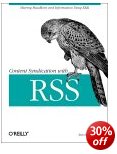
Content Syndication with RSS

June 26, 2009 by Roy Johnson

Sharing headlines and information using XML

Content syndication means making headlines and information from one web site available for distribution to any others that want it. This is done technically by using RSS, which stands for RDF Site Summary, Rich Site Summary, or Really Simple Syndication. If you need to go all the way, RDF stands for Resource Description Framework. Ben Hammersley first of all explains the separate standards which have arisen, taking them in chronological order.

Content Syndication with RSS Then he describes the software which has been written both to generate RSS feeds, and to receive and read them on screen. There’s also a short XML tutorial, as well as a list of useful sites and resources. Unfortunately there are two camps of competing standards, each with two current versions – rather like the early days of the browser wars.

Fortunately he covers them all in his description of how to use RSS and what it does. The separate standards are complex in their differences, and he obviously belongs to one of the rival camps promoting them; but he is even handed in his treatment, and gives them all comprehensive coverage.

Much of the book is rather technical, with pages full of coding; but anyone familiar with HTML or XML will feel pretty much at home.

He gives fully written out examples of pages in each of the standards. As in strict XML, there is a complete separation of style and content. This is because the recipient might be reading the news feed as part of a blog, on on a PDA, or even as a text message.

RSS is sprouting all over the Web at the moment. Wherever you see one of the small buttons saying “News Feed” or “XML Feed”, you have the ability to receive information from that site. And of course it’s all free.

This publication is aimed at web developers and web site authors who want to share their site with others by offering RSS-based feeds of their content. It’s also for developers who want to use the content that other people are syndicating. As usual with O’Reilly publications, the presentation is impeccable.

© Roy Johnson 2003

Content Syndication with RSS   Buy the book at Amazon UK

Content Syndication with RSS   Buy the book at Amazon US


Ben Hammersley, Content Syndication with RSS, Sebastopol, CA: O’Reilly, 2003, pp.208, ISBN: 0596003838


More on technology
More on digital media
More on online learning
More on computers


Filed Under: Computers, Media Tagged With: Communication, Computers, Content Syndication with RSS, RSS, Technology

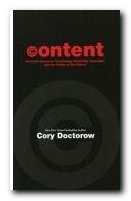
Content: Copyright and DRM

December 2, 2009 by Roy Johnson

Selected Essays on Technology, Creativity, Copyright, and the Future of the Future

Cory Doctorow is a young Canadian freelance writer and web entrepreneur who lives in London. He’s an editor of Boing-Boing and former director of the Electronic Frontier Foundation; he writes science fiction novels, and he gives his work away free of charge – yet makes a living from his writing. How can it be done? That’s one of the things he explains here. Content: Copyright and DRM is a collection of speeches, essays, and articles he has produced in the last few years, proselytising in favour of open source software, against digital rights management (DRM) systems, against censorship, on copyright, and in favour of the free exchange of information, unhindered by state controls or commercial prohibitions.

Content: Copyright and DRMAt their most fervent, his arguments come across like those of a students’ union activist – but he’s brave. He speaks against Digital Rights Management (DRM) to an audience at Microsoft. The reason he’s a successful journalist is that he understands new media technology, and he has a gift for wrapping up his arguments in a vivid and succinct manner:

Books are good at being paperwhite, high-resolution, low-infrastructure, cheap and disposable. Ebooks are good at being everywhere in the world at the same time for free in a form that is so malleable that you can just pastebomb it into your IM session or turn it into a page-a-day mailing list.

He has a racy and amusing journalistic style. He writes in short, almost epigrammatic statements with a no-holds-barred attitude to any potential opposition.

As Paris Hilton, the Church of Scientology, and the King of Thailand have discovered, taking a piece of [embarrassing] information off the Internet is like getting food colouring out of a swimming pool. Good luck with that.

Some of the items are quite short – quick reprints of web pages from the Guardian technology section – but they are all pertinent to the issues of creativity and new media. Why for example does the best eCommerce site in the world (Amazon) want to control what you do with your Kindle downloads? Doctorow argues that these are short-sighted policies which prevent the spread of information and the creation of new developments.

He’s gung-ho about the business of eBooks and eCommerce. He makes his books available free as downloads on the Internet, confident that this will result in more sales of the printed book. There’s no actual proof that it results in more sales – but he’s happy with the results, and so is his publisher, and the publicity gives him income from other sources, such as journalism and speaking engagements.

Having said that, more than 300,000 copies of his first novel were downloaded for free, resulting in 10,000 printed books sold. As he argues, that’s like thirty people picking up the book and looking at it in a bookstore for every one who made a purchase. But the thirty pickups cost almost nothing, and I think many authors would be very happy with sales of ten thousand.

[It should be remembered that the average full time writer makes approximately £3,000-5,000 a year – and if you look at that in terms of a forty hour week, it’s less than £2.50 per hour.]

The sheer range of his subjects is truly impressive. There’s a chilling insider report from a committee discussing DRM, an essay on a sub-genre of science fiction writing called fanfic, and even a satirical piece calling into question the limitations of meta-data.

He’s at his strongest on the subject of copyright – and that includes the rights of the person who buys the book, the film, or the MP3 music file. The author has the right to be paid for selling it to you, but you have the right to do with it (almost) whatever you wish.

He has any number of interesting things to say about the nature of eBooks – from their apparent problems, their multiple formats, and their malleability, to the issues surrounding copyright. And the encouraging thing is that he writes not just in theory but as a working writer who is exploring the eBook business and what it can do – for both authors and readers.

If you want to know what’s happening at the sharp end of digital publication and new ideas about the relationships between authors and their readers – do yourself a favour and listen to what he has to say. You might not agree with it all, but it will give you plenty to be thinking about.

copyright   Buy the book at Amazon UK

copyright   Buy the book at Amazon US

© Roy Johnson 2009


Cory Doctorow, Content: Selected Essays on Technology, Creativity, Copyright, and the Future of the Future, San Francisco: Tachyon Publications, 2008, pp.213, ISBN: 1892391813


More on eCommerce
More on media
More on publishing
More on technology


Filed Under: e-Commerce, Journalism, Media, Open Sources, Publishing, Theory Tagged With: Business, Copyright, Digital Rights Management, DRM, e-Commerce, Media, Open Sources, Publishing

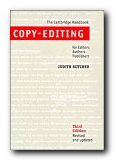
Copy Editing

May 31, 2009 by Roy Johnson

a handbook for editors, authors, and publishers

Judith Butcher’s Copy Editing is now firmly established as the UK classic reference guide for editors and others involved in preparing text for publication. It is written from the perspective of a professional copy-editor, and covers just about everything you would need to know in preparing any sort of text for publication. It deals with all the details of preparing a typescript for setting, house styles and consistency, reading and correcting proofs, and how to present indexes and bibliographies.

Copy-Editing - The Cambridge Handbook for Editors, Authors and Publishers Every suggestion is scrupulously illustrated without being pedantic, and there is a very helpful degree of cross-referencing. I originally bought my own copy of this book to sort out the finer points of bibliographic referencing for academic writing – and I’ve been using it regularly ever since. The book itself is almost a tutorial on the very principles it illustrates, and it is a very handsomely produced and elegantly designed publication. You will learn a lot on the presentation of text just from turning the pages.

It contains explanations of every part of a book – from details such as preliminary matter, frontispiece, title page, and content, through to lists of tables and illustrations, acknowledgements, bibliographies, notes, and indexes. And it covers many types of printed book – from conventional prose, through books on mathematics, music, books with tables and illustrations, and books set in foreign languages.

The latest edition also deals with issues of copyright, the conventions of presenting text in specialist subjects, guidance on digital coding and publishing in other media such as e-books, and a chapter devoted to on-screen copy-editing.

It has also been updated to take account of modern typesetting and printing technology. This is a good investment for writers who are serious about preparing their work for publication, and an excellent source of reference when you get stuck with the minutiae of bibliographies and typographic presentation. It’s also now available in paperback.

© Roy Johnson 2007

Copy Editing   Buy the book at Amazon UK

Copy Editing   Buy the book at Amazon US


Judith Butcher, Copy-Editing: The Cambridge Handbook for Editors, Authors and Publishers, 4th edition, Cambridge: Cambridge University Press, 2006, pp.558, ISBN: 0521847133


More on creative writing
More on writing skills
More on publishing


Filed Under: Creative Writing, Journalism, Study skills, Writing Skills, Writing Skills Tagged With: Academic writing, Bibliography, Copy Editing, Reference, Writing skills

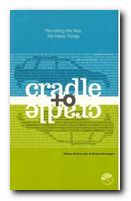
Cradle to Cradle

July 8, 2009 by Roy Johnson

re-thinking the way we make things

Cradle to Cradle is the programme for a philosophy of ecological design principles based on a consciousness of the global environment. IT raises fundamental issues about sustainability, well-used resources, and sensitivity to eco-systems. The authors are an architect and a chemist who between them tackle issues from major construction projects, to the design of shampoo and re-cyclable running shoes. It’s a work whose primary purpose it to make you think about design issues. Don’t expect glamorous colour photographs or examples of slick kettles and toasters – but be prepared to have your notions of ‘waste’ and ‘re-usability’ challenged in a radical manner.

Ecological DesignTheir stated aim is to re-think the way in which everything is made. And though they posit a very radical philosophy of using design intelligently, they are not reactionary when it comes to modern industry. In fact the book starts with an account of the Industrial Revolution which focuses on many of its good intentions – before listing its contemporary weaknesses in terms of the world’s ecology. They make their case for eco-consciousness using the very book itself:

It is printed on a synthetic ‘paper’…made from plastic resins and inorganic fillers. This material is not only waterproof, entirely durable, and (in many localities) recyclable by conventional means; it is also a prototype for the book as a technical nutrient’, that is, as a product that can be broken down and circulated indefinitely in industrial cycles – made and remade as ‘paper’ or other products

Good you might think: but the book is surprisingly heavy, and (though most people don’t know this) the biggest part of the cost of getting printed books to the public is transportation costs, based on weight.

They are also critical of what they see as shortsighted attempts to solve ecological waste by recycling:

your [recycled] rug is made of things that were never designed with this further use in mind, and wrestling them into this form has required as much energy – and generated as much waste – as producing a new carpet

The solution often proposed for these problems is called eco-efficiency – ‘doing more with less’. But they suggest that this just gives the appearance of social concern without changing the basic systems of industrial production. As they put it, ‘Being ‘less bad’ is not good: it is to accept things as they are.’

Examining the relationship of human beings to the planet at a very fundamental level, they come up with an interesting concept – that there is really no such thing as ‘waste’. Because when we throw things away, they do not go away. Indeed there is and can be no ‘away’. These things stay with us even if they are dumped in landfills, and even if they are incinerated we are still left with the by-products of combustion (including the CO2).

There is no need for shampoo bottles, toothpaste tubes, yogurt and ice-cream cartons, juice-containers, and other such packaging to last decades (or even centuries) longer than what came inside them

Some of the ideas they propose as alternatives seem rather fanciful. Recyclable televisions for instance: could their internal parts really be cost-effectively extracted and re-used? Running shoes with replaceable soles? But they do claim to have had a success with an upholstery fabric which is bio-degradable.

They are very much in favour of using local materials (think how wasteful it is transporting them from afar) and encouraging the use of local labour, which promotes the local economy.

It’s a book crying out for graphic illustration – particularly when they come to describing the ecologically positive buildings they have designed – with grass-carpeted roofs and tree-lined interiors. Nevertheless, I think this may well be one of those modern design classics which will find its way alongside Donald Norman’s The Design of Everyday Things and Viktor Papanek’s Design for the Real World as a standard text on every design curriculum.

© Roy Johnson 2002

Cradle to Cradle   Buy the book at Amazon UK

Cradle to Cradle   Buy the book at Amazon US


William McDonough and Michael Braumgart, Cradle to Cradle, New York: North Point Press, 2002, pp.193, ISBN: 0099535475


More on design
More on media
More on web design
More on information design


Filed Under: Product design Tagged With: Design, Design theory, Product design, Theory

Create your First Web Page in a Weekend

June 3, 2009 by Roy Johnson

well-planned tutorials on HTML design basics

Can it really be done in a weekend? Well, if you set some time aside and follow the tutorials in this clearly-written guide, it’s possible that you could have a few decent pages up within the forty-eight hours. Steve Callihan kicks off with some background explanation of Web matters, and information on what you’ll need. This is designated as what you might do as preparation on ‘Friday night’. On Saturday morning there’s a first step-by-step tutorial on HTML code basics. This is followed by tips and tricks which will help you to control the layout and appearance of your Web pages.

First Web PageThe Saturday afternoon tutorial covers graphics, wrapping text around images, and how to deal with the tricky issue of browser-safe colours. Everything is spelled out very clearly, strictly one topic per paragraph, and everything clearly labelled and well illustrated. Assuming that you don’t go out on Saturday evening, it is devoted to learning the mysteries of tables. Then during the rest of the weekend you put what you have learned into practice by making a small web site. There is quite a heavy emphasis on graphics, so this will appeal to people interested in such visual effects as drop shadows, decorated text, and creating your own 3-D buttons.

When that is done, he shows you how to get your site up onto the Web, and there are bonus extras on those items which seem to be popular with beginners – hit counters, guestbooks, image maps, and animated gifs.

This book is in its third edition – so the basic approach has obviously been successful. To be truthful and realistic, I would suggest spending at least a week reading it and absorbing what it has to say first. Then a weekend at the keyboard might yield decent results. And if you need extra help, there are plenty of page templates, plus lots of free software on the accompanying CD-ROM.

© Roy Johnson 2000

Buy the book at Amazon UK

Buy the book at Amazon US


Steve Callihan, Create your First Web Page in a Weekend, (third edition) Rocklin, CA: Prima Publishing, 1999, pp.425, ISBN 0761524827


More on web design
More on digital media
More on technology


Filed Under: Web design Tagged With: HTML, Technology, Web design

  • « Previous Page
  • 1
  • …
  • 17
  • 18
  • 19
  • 20
  • 21
  • …
  • 103
  • Next Page »

Get in touch

info@mantex.co.uk

Content © Mantex 2016
  • About Us
  • Advertising
  • Clients
  • Contact
  • FAQ
  • Links
  • Services
  • Reviews
  • Sitemap
  • T & C’s
  • Testimonials
  • Privacy

Copyright © 2026 · Mantex

Copyright © 2026 · News Pro Theme on Genesis Framework · WordPress · Log in