up-to-date survey of online learning
Online learning is everywhere these days – for good reasons. Schools want to encourage the use of IT; colleges want their courses to be available 24/7; and universities want to sell their courses to people all around the world. eLearning: the key concepts is aimed at intermediate to advanced users which seeks to explain the main issues. An introductory essay clears the ground by looking at the many terms used in eLearning to describe what is sometimes almost the same thing (eLearning, distance learning, blended learning, flexible learning, and computer assisted learning).
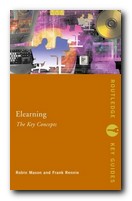 They are nearly the same, but not quite, and the authors do a good job of making the necessary distinctions. This also acts as a survey of the problems and possibilities of teaching and learning in the online world. They take account of such issues as the fact that many tutors in higher education receive no career advancement or recompense for the courses they might design. And they recognise that students are often more advanced than their conservative tutors in the adoption of digital technology and its multimedia attractions.
The second and major part of the book is an extended glossary of terms, explaining in detail everything from (alphabetically) ‘accessibility’ to ‘wireless networks’. All the entries are extensively cross-referenced, and there are web links to further resources where appropriate.
Some of the terms are to do with educational theory, such as ‘assessment’ and ‘problem-based learning’; others are technological, such as ‘open source software’ and ‘voice over Internet protocol (VOIP); and others deal with educational issues, such as ‘plagiarism’, ‘feedback’, and ‘quality assurance’.
Wherever possible, they give examples of the topic. Defending the use of video animations and blogging as educational tools for instance, they give examples of sites where these techniques are being used to advantage.
They have some interesting things to say about ‘learning objects’ – small, subject-independent re-usable units of teaching. These can be taken off the shelf and combined with others to save course designers the trouble of re-inventing wheels. They’re an amazingly good idea – yet very few people use them. Why? Because teachers traditionally wish to create their own materials, and they want to place the items of instruction in the context of their own subject discipline. It’s often said ironically of learning objects that they are the solution to a problem which has not yet been identified.
I have been designing and teaching online courses more or less since they first came into being, and this book seems to me as up to date as its possible to be in the plodding world of dead tree publishing. They missed the spectacular growth of Moodle which has replaced almost all other virtual learning environments (VLEs) in the last couple of years. But apart from that, everything you need to know about eLearning is well defined here.
© Roy Johnson 2006
Robin Mason and Frank Rennie, eLearning: the key concepts, London: Routledge, 2006, pp.158, ISBN: 0415373077
More on online learning
More on technology
More on digital media
More on web design
More on computers

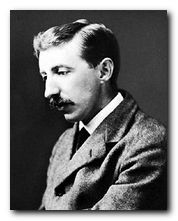 E.M.Forster is often seen as a bridge between the nineteenth and the twentieth century novel. He documents the Edwardian and Georgian periods in a witty and elegant prose, satirising the middle and upper classes he knew so well. He was a friend of Virginia Woolf, with whom he worked out some of the ground rules of literary modernism. These included the concept of what they called ‘tea-tabling’ – making the substance of serious fiction the ordinary events of everyday life. He was also an inner member of
 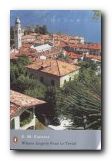 Where Angels Fear to Tread
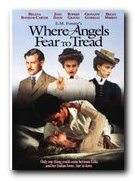 Where Angels Fear to Tread – DVD This film version is not a Merchant-Ivory production, although it’s done very much in their style. But it is accurate and entirely sympathetic to the spirit of the novel, possibly even stronger in satirical edge, well acted, and superbly beautiful to watch. Much is made of the visual contrast between the beautiful Italian setting and the straight-laced English capital from which the prudery and imperialist spirit emerges. The lovely Helena Bonham-Carter establishes herself as the perfect English Rose in this her breakthrough production. Helen Mirren is wonderful as the spirited Lilia who defies English prudery and narrow-mindedness and marries for love – with results which manage to upset everyone.
 A Room with a View
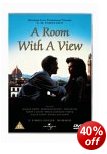 A Room with a View – DVD This is a Merchant-Ivory production which takes one or two minor liberties with the original novel. But it’s still well acted, with the deliciously pouting Helena Bonham Carter as the heroine, Denholm Eliot as Mr Emerson, Daniel Day-Lewis as a wonderfully pompous Cecil Vyse, and Maggie Smith as the poisonous hanger-on Charlotte. The settings are delightfully poised between Florentine Italy and the home counties stockbroker belt. I’ve watched it several times, and it never ceases to be visually elegant and emotionally well observed. This film was nominated for eight Academy awards when it appeared, and put the Merchant-Ivory team on the cultural map.
 The Longest Journey
 Howards End
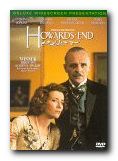 Howards End – DVD This is arguably Forster’s greatest work, and the film lives up to it. It is well acted, with very good performances from Emma Thompson and Helena Bonham Carter as the Schlegel sisters, and Anthony Hopkins as the bully Willcox. The locations and details are accurate, and it lives up to the critical, poignant scenes of the original – particularly the conflict between the upper middle-class Wilcoxes and the working-class aspirant Leonard Baskt. This is another adaptation which I have watched several times over, and always been impressed.
 A Passage to India, (1923) was started in 1913 then finished partly in response to the Amritsar massacre of 1919. Snobbish and racist colonial administrators and their wives are contrasted with sympathetically drawn Indian characters. Dr Aziz is groundlessly accused of assaulting a naive English girl on a visit to the mystic Marabar Caves. There is a set piece trial scene, where she dramatically withdraws any charges. The results strengthen the forces of Indian nationalism, which are accurately predicted to be successful ‘after the next European war’ at the end of the novel. Issues of politics, race, and gender, set against vivid descriptions of Chandrapore and memorable evocations of the surrounding landscape. This is generally regarded as Forster’s masterpiece.
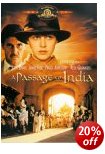 A Passage to India – DVD This adaptation by David Lean is something of a mixed bag. It’s well organised, reasonably true to the original, and has some visually spectacular scenes. James Fox is convincing as the central character Fielding. But it has tonal inconsistencies, and to cast Alec Guinness as the Indian mystic Godbole is verging on the ridiculous. Nevertheless there is some good cameo acting, particularly Edith Evans as Mrs Moore. Watch out for the Indian signpost half way through that looks as if it’s made out of cardboard.
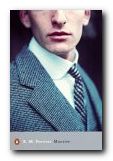 Maurice, (1967) is something from Forster’s bottom drawer. It was written in 1913-14, but not published until after his death. It’s an autobiographical novel of his gay university days which is explicit enough that couldn’t be published in his own lifetime. It’s light, amusing, and fairly inconsequential compared to the novels he wrote whilst pretending to be straight. This poses an interesting critical problem, when you would imagine he could have been more honest and therefore more successful.
 Aspects of the Novel (1927) was originally a series of lectures on the nature of fiction. Forster discusses all the common elements of novels such as story, plot, and character. He shows how they are created, with all the insight of a skilled practitioner. Drawing on examples from classic European literature, he writes in a way which makes it all seem very straightforward and easily comprehensible. This book is highly recommended as an introduction to literary studies.
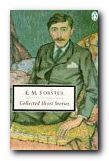 Collected Short Stories is like a glimpse into Forster’s workshop – where he tried out ideas for his longer fictions. This volume contains his best stories – The Story of a Panic, The Celestial Omnibus, The Road from Colonus, The Machine Stops, and The Eternal Moment. Most were written in the early part of Forster’s long career as a writer. Rich in irony and alive with sharp observations on the surprises in life, the tales often feature violent events, discomforting coincidences, and other odd happenings that throw the characters’ perceptions and beliefs off balance.
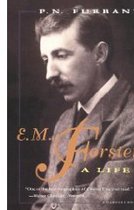 E.M.Forster: A Life is a readable and well illustrated biography by P.N. Furbank. This book has been much praised for the sympathetic understanding Nick Furbank brings to Forster’s life and work. It is also a very scholarly book, with plenty of fascinating details of the English literary world during Forster’s surprisingly long life. It has become the ‘standard’ biography, and it is very well written too. Highly recommended.