Mantex

Tutorials, Study Guides & More

  • HOME
  • REVIEWS
  • TUTORIALS
  • HOW-TO
  • CONTACT
>> Home / Archives for 2009

Archives for 2009

Fresh Styles for Web Designers

June 8, 2009 by Roy Johnson

new web design strategies and techniques

So far, web design theory has been split between usability minimalism as urged by gurus such as Jakob Nielsen at one end of the spectrum, and the bandwidth-hogging graphic designs of David Siegel at the other. Now Curt Cloninger suggests we can combine the two approaches – and he shows how it can be done. This is one of those Web strategy guides which assume you know the details of designing pages.

Fresh Styles for Web Designers What it offers is a survey of new strategies in structure and graphic presentation – some of them on the edge of the avant garde. Cloninger takes the line that these are the early days of the Web, that there are severe limitations on what is possible, but that inventive designers will embrace the limitations and turn them into positives.

The reasons he offers are that not all sites are driven by e-commerce or a desire to maximise hits. Some are exhibition or display sites; galleries or individual portfolios of work – something like an elaborate visiting card. There is no reason why such sites shouldn’t indulge themselves with the sorts of glamorous graphics and ‘entry pages’ supported by designers such as David Siegel.

He categorises sites as ‘Gothic’, ‘Grid-based’, ‘Grunge’, ‘Mondrian poster’, ‘Paper Bag’, and ‘HTMinimaLism’ – and despite his post-hippy approach these distinctions do eventually make sense. Designers in these camps treat the page design, the Web strategy, and the visitor experience in significantly different ways.

One of my favourites was the minimalist style – sites from the competition www.the5K.org which feature pages of games, puzzles and art collections the total size which must come in under five kilobytes. [Try it!] The other was the sci-fi look of what he calls ‘Drafting/Table Transformer’ style led by Mike Young, whose work is featured in the recently published book of animated graphics.

Each chapter describes the features of one style. It then analyses examples, with well-produced screenshots of sites which are often private and experimental. Then he tells you how to achieve these effects. It’s a very good formula – no matter what you think of the sites.

He’s quite keen on distressed backgrounds and the grunge typography of designers such as David Carson – and he tells you how to create the effects. This will appeal to those who want to make a visual impact. He has favoured designers who he claims have been influential – Mike Cina, Miika Saksi, and a Chicago design group 37signals.

There’s a lot of detailed instruction on how to achieve special effects – most of them done in Photoshop. The general strategy is to maximise visual effects whilst minimising download time. And it has to be said that all the effects are beautifully illustrated, with full pages of elegantly presented coding.

© Roy Johnson 2004

web design   Buy the book at Amazon UK

web design   Buy the book at Amazon US


Curt Cloninger, Fresh Styles for Web Designers, Indianapolis IN: New Riders, 2001, pp.211, ISBN: 0735710740


More on design
More on media
More on web design

Filed Under: Graphic design, Web design Tagged With: Fresh Styles for Web Designers, Graphic design, HTML, Navigation, Usability, Web design

Full Marks punctuation for scientists

July 1, 2009 by Roy Johnson

advice on punctuation for scientific and technical writing

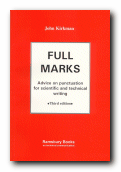
Do scientists and technical writers need special advice on punctuation? Well, in one sense – who doesn’t? John Kirkman sets out here to answer what he describes as ‘the queries raised most frequently by practitioners in computing, engineering, medicine, and science as they grapple with day-to-day tasks in writing and editing’. So, it’s a guide based on practical experience, and probably the better for it. Punctuation for Scientists is a specialist style guide aimed at practicioners in these disciplines.

Punctuation for scientistsThere is an introduction explaining why good punctuation is necessary. This is slightly more complex than it needs to be, and might more usefully been placed at the end of the book. But after that he gets down to a simple explanation of the basics – apostrophes, capitals, colons, commas, full stops, hyphens, and quotation marks. The advice might be aimed at technical authors, but there’s no reason why other writers shouldn’t profit from it.

One of the strengths of the book is that it has plenty of practical examples. Another is that John Kirkman has spent quite some time teaching in the USA, and he offers UK/US equivalents wherever appropriate, which gives the guide some added value for those who need to keep such matters in mind.

On the whole, he wisely avoids the jargon of grammar in his explanations, but there’s rather a lot of intrusive first person singular (which doesn’t always inspire confidence) and some of the advice is expressed in terms which are likely to confuse the very people it is written for:

English teachers may have told you that you should always signal restrictive intention by starting your relative clause with that…

Of course one might quibble with some of his recommendations (are continuous capitals ever necessary?) but he offers very sensible and non-dogmatic advice on issues such as the use of the hyphen in terms like ‘re-activate’, ‘de-energise’, and ‘re-adjust’, and he quite rightly alerts his readers to the different names used for brackets, parentheses, and braces in the UK, the US, and non-scientific writing. To a beginner this might seem like pedantry, but ultimately it’s the stuff of which accuracy and scholarship is made.

There are three appendices – one on paragraphing, one on word division (hyphenation at line ending) and one on differences between UK and US English. There’s a brief bibliography, a full index, and by current book price standards, it’s dirt cheap.

© Roy Johnson 2000

punctuation for scientists   Buy the book at Amazon UK

punctuation for scientists   Buy the book at Amazon US


John Kirkman, Full Marks: Advice on punctuation for scientific and technical writing, (3rd edn) Wiltshire: Ramsbury, 1999, pp.115, ISBN: 0952176246


More on study skills
More on writing skills
More on online learning


Filed Under: Study skills, Writing Skills Tagged With: Academic writing, Full Marks, Punctuation for scientists, Scientific writing, Study skills, Writing skills

Full stops – how to use them

September 6, 2009 by Roy Johnson

free pages from our English Language software program

Full stops – definition

full stops Full stops are punctuation marks indicating a strong pause.
redbtn Full stops are used most commonly at the end of complete sentences – like this one.


Examples
  • This is a short sentence. This is another.
  • It happened suddenly in 1996.
  • There are two reasons for this (in my opinion).

Use

redbtn The full stop is the strongest mark of punctuation. It is sometimes called the ‘period’.

redbtn The stop is also used following many abbreviations.

redbtn NB! A full stop is not necessary if the sentence ends with a question or an exclamation mark. Got that?

redbtn Full stops are commonly placed after abbreviations:

ibid. – No. 1 – ff. – e.g. – etc.

redbtn The stop is normally placed inside quotation marks but outside brackets:

“What joy we had that particular day.”

Profits declined (despite increased sales).

redbtn However, if the quotation is part of another statement, the full stop goes outside the quote marks:

Mrs Higginbottam whispered “They’re coming”.

redbtn If the parenthesis is a complete sentence, the full stop stays inside the brackets:

There was an earthquake in Osaka. (Another had occurred in Tokyo the year previously.)

redbtn No full stop is required if a sentence ends with a question mark or an exclamation, or a title or abbreviation which contains its own punctuation:

Is this question really necessary?
What a mess!
He is the editor of Which?
She gave her address as ‘The Manor, Wilts.’

redbtn Full stops are not required after titles, headings, or sub-headings:

The Turn of the Screw
Industrial Policy Report
Introduction

redbtn The stop is not necessary following common titles which are shortened forms of a word (technically, ‘contractions’):

Dr – [Doctor]
Mr – [Mister]
St – [Street]
Mme – [Madame]

redbtn Full stops are not necessary after the capital letters used as abbreviations for titles of organisations and countries:

NATO – North Atlantic Treaty Organisation
BBC – British Broadcasting Corporation
UNO – United Nations Organisation
USA – United States of America

redbtn They are not used where the initials of a standard work of reference are used as an abbreviated title:

OED – Oxford English Dictionary
DNB – Dictionary of National Biography
PMLA – Papers of the Modern Languages Association

Self-assessment quiz follows >>>

© Roy Johnson 2003


English Language 3.0 program
Books on language
More on grammar


Filed Under: English Language Tagged With: English language, Full stops, Grammar, Language, Punctuation

Full stops in essays

August 23, 2009 by Roy Johnson

sample from HTML program and PDF book

1. Full stops in essays (a full stop is sometimes called a ‘period’) are used at the end of complete sentences – like this one.

2. The only common exception to this rule occurs when the sentence is a question or an exclamation (both of which should be avoided in academic essays).

Is this question really necessary?
What a mess!

Notice that both these marks of punctuation have their own built-in full stop.

3. The stop is also used following abbreviations:

ibid.     No. 1     ff.     e.g.

4. The stop is not necessary following common titles which are shortened forms of a word (technically, contractions):

Dr     Mr     St     Mme

5. Full stops are not necessary after the initial capital letters commonly used as abbreviations for the titles of organisations and countries:

NATO     BBC     UNESCO     USA

6. They are not used where the initial letters of a standard work of reference is used as an abbreviated title:

OED [Oxford English Dictionary]
DNB [Dictionary of National Biography]
PMLA [Papers of the Modern Languages Association]

7. No full stop is required if a sentence ends with a title or an abbreviation which contains its own punctuation:

He is the editor of Which?

She gave her address as ‘The Manor, Wilts.’

8. Full stops should not be used after titles, headings, or sub-headings.

Introduction
The Turn of the Screw
Industrial Policy Report

9. The stop is normally placed inside quotation marks but outside a parenthesis:

“What joy we had that particular day.”
Profits declined (despite increased sales).

10. However, if the quotation is part of another statement, or the parenthesis is a complete sentence, the full stop goes inside:

Mrs Higginbottam whispered “They’re coming”.

There was an earthquake in Osaka. (Another had occurred in Tokyo the year previously.)

© Roy Johnson 2003

Buy Writing Essays — eBook in PDF format
Buy Writing Essays 3.0 — eBook in HTML format


More on writing essays
More on How-To
More on writing skills


Filed Under: Writing Essays Tagged With: Academic writing, Essays, Full stops, Punctuation, Reports, Study skills, Term papers, Writing skills

Function – how to understand it

September 6, 2009 by Roy Johnson

free pages from our English Language software program

Function – definition

function Function is the term used to express the purpose of a text or of a speech act.

redbtn This function can be determined by the writer or by the reader.


Examples

redbtn Texts or spoken pieces might fall into one of the following broad categories:

WRITING
persuasion an advertisement
information a train timetable
entertainment a short story
instruction how to build a wardrobe
SPEECH
persuasion a sermon
information a radio weather forcast
entertainment a joke
instruction how to get from A to B

Use

redbtn The term ‘function’ is used as a technical term in linguistics and in literary criticism.

redbtn An awareness of function helps to produce efficient writing and speaking.

redbtn An awareness of function also results in efficient reading and listening.

redbtn NB! Function is one of the three important features of communication. The other two are audience and form.

redbtn The four general functions possess certain stylistic features or attributes:

Instruction the imperative mode and direct address
[Stir the mixture]
Persuasion emotive vocabulary
[beautiful, duty, militant, heart]
Information factual data
[time, locations, measurements]
Entertainment often breaks rules of grammar, spelling, pronunciation

redbtn Awareness of these in the production of speech or writing leads to effective communication and an appropriate style.

redbtn For instance, if we buy a product such as a chicken casserole from a supermarket we may be more interested in what’s in it than how to cook it. We may be interested in both these elements, but we certainly wouldn’t want them mixed together.

redbtn Food manufacturers for this reason present the list of ingredients [information] separately from how to prepare the dish [instructions]. This simple example shows the concept of function working efficiently.

redbtn If we receive a phone call from a close relative who comes to visit more often than we would like, we immediately try to ascertain the purpose [function] of the call. Is it –

  • an attempt to fix up the next visit? [persuade]
  • to tell us the possible dates? [inform]
  • to explain how their vegetables should be cooked? [instruct]
  • to tell us that the cat has learned to swim? [entertain]

redbtn In this example, the person who phones to arrange the visit may have every interest in obscuring the function of the call. As a recipient however, we are very interested in finding out what it is. Such is the crucial nature of function.

redbtn The National Curriculum for the teaching of English in Schools now states the importance of making children aware of the function of all the varied pieces they read and write.

redbtn Examining boards for A level English will only accept written work which has an authentic function. That is, it should be as close as possible to an example which could be used in real life.

Self-assessment quiz follows >>>

© Roy Johnson 2003


English Language 3.0 program
Books on language
More on grammar


Filed Under: English Language Tagged With: English language, Function, Grammar, Language, Speech, Writing

Futurize your Enterprise

July 18, 2009 by Roy Johnson

radical advice on customer-centred business methods

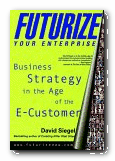
David Siegel is a Web design guru who made his name with the best-selling Creating Killer Web Sites. That was a manifesto on graphic presentation: this is his thesis on business strategy and e-Commerce. The message is quite uncompromising – you must pay attention to what your customers want, or be prepared for extinction. He’s a great believer that total de-regulation and the freedom for anybody to trade on line will allow the best ideas and services to prevail. He argues that commercial success in the online world comes from giving things away, letting go of control, networking, and above all in giving customers exactly what they ask for.

Futurize your EnterpriseAt times he becomes slightly Utopian, arguing that Truth will out, and the Little Man will prevail, but he has very direct, practical advice for those who want to seriously participate in the new e-Commerce. For instance, he suggests that you ditch voice mail:

It’s slow, retrieval is cumbersome, it can’t be skimmed, it’s almost impossible to annotate, it doesn’t take attachments, it can’t be archived easily, and it doesn’t tie into any other kind of system. Voice mail may be useful for some things, but switching to e-mail will pay off quickly.

He takes what sometimes seems like a New Age approach in expecting business executives to become altruists, to empower their employees, and even to give away time, effort, and information. Yet there does seem to be some logic to all this in the odd new world of e-commerce. It’s also good that he draws his illustrative examples from a wide variety of businesses.

His advice is aimed at big businesses, but the underlying principles will be equally applicable to small start-ups or individual entrepreneurs. It will be of most use to those people who realise that the Internet offers a new way of doing business, but can’t quite see how it could be realised.

He also throws out plenty of practical tips – such as the suggestion that most web sites could be improved by the use of plain English. This is because “most companies communicate using the passive rather than the active voice … and copywriters sanitize their corporate communications until they become meaningless … most web sites are full of jargon”

The latter part of the book contains eight business case studies – companies selling health foods, magazines, steel, real estate, books, and such. He analyses where they are going wrong in their web strategies; how they should make closer contact with their customers; and how they can change their behaviour to survive in the New Age. Unfortunately, these are all hypothetical companies, so his arguments are seriously weakened. With Siegel’s resources, he could surely have given real case studies, which would have been infinitely more convincing to his case.

So, like his killer web sites book, this one is full of thought-provoking ideas expressed in an energetic and ‘committed’ style. There’s quite a lot of generalization and wish-fulfilment too – but on the whole anyone who is interested in e-commerce and web-based business will profit from considering what he has to offer.

© Roy Johnson 2003

Futurize your Enterprise   Buy the book at Amazon UK

Futurize your Enterprise   Buy the book at Amazon US


David Siegel, Futurize your Enterprise: Business Strategy in the Age of the e-Customer, London/New York, John Wiley, 2003, pp.318, ISBN: 0471357634


More on eCommerce
More on media
More on publishing
More on technology


Filed Under: e-Commerce Tagged With: Business, e-Commerce, Futurize your Enterprise, Web design

Fyodor Dostoyevski – Stavrogin’s Confession

October 4, 2009 by Roy Johnson

Hogarth Press first edition book jacket designs


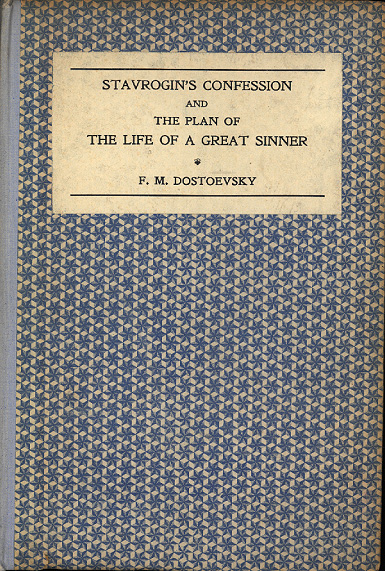
Stavrogin's Confession - first edition

 
Fyodor Dostoyevski, Stavrogin’s Confession, (1922)

This unpublished material from The Possessed was translated by S.S.Koteliansky with Virginia Woolf. The financial success of these Russian translations enabled the press to transform itself from a handpress cottage industry into an established commercial publisher. The origins of the text were explained in their ‘Translator’s note’:

“The Russian government has recently published a small paper-covered book containing Stavrogin’s Confession, unpublished chapters of Dostoyevski’s novel The Possessed, and Dostoyevski’s plan or sketch of a novel which he never actually wrote but which he called The Life of a Great Sinner.”

J.H. Willis Jr, Leonard and Virginia Woolf as Publishers: The Hogarth Press 1917-1941

Leonard Woolf provides an account of the book as a physical object with his customary attention to fine detail:

“These books, which I still think to be beautifully printed and bound, were very carefully designed by Virginia and me, and they were unlike the books published by other publishers in those days. They were bound in paper over boards and we took an immense amount of trouble to find gay, striking, and beautiful papers. The Dostoyevski and Bunin were bound in very gay patterned paper which we got from Czechoslovakia … We printed, I think, 1,000 of each and [sold] the Dostoyevski at 6s. [They] sold between 500 and 700 copies in twelve months and made us a small profit, and they went on selling until we reprinted or they went out of print.”

Leonard Woolf, An Autobiography

previousnext


Hogarth Press studies

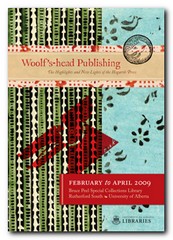
Woolf's-head Publishing Woolf’s-head Publishing is a wonderful collection of cover designs, book jackets, and illustrations – but also a beautiful example of book production in its own right. It was produced as an exhibition catalogue and has quite rightly gone on to enjoy an independent life of its own. This book is a genuine collector’s item, and only months after its first publication it started to win awards for its design and production values. Anyone with the slightest interest in book production, graphic design, typography, or Bloomsbury will want to own a copy the minute they clap eyes on it.

Woolf's-head Publishing Buy the book at Amazon UK
Woolf's-head Publishing Buy the book at Amazon US

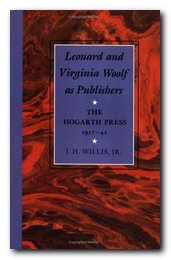
The Hogarth Press Leonard and Virginia Woolf as Publishers: Hogarth Press, 1917-41 John Willis brings the remarkable story of Leonard and Virginia Woolf’s success as publishers to life. He generates interesting thumbnail sketches of all the Hogarth Press authors, which brings both them and the books they wrote into sharp focus. He also follows the development of many of its best-selling titles, and there’s a full account of the social and cultural development of the press. This is a scholarly work with extensive footnotes, bibliographies, and suggestions for further reading – but most of all it is a very readable study in cultural history.

The Hogarth Press Buy the book at Amazon UK
The Hogarth Press Buy the book at Amazon US

© Roy Johnson 2005


Filed Under: Hogarth Press Tagged With: Art, Bloomsbury, Dostoyevski, Graphic design, Literary studies, Stavrogin's Confession

Gallimaufry

July 15, 2009 by Roy Johnson

a hodgepodge of our vanishing vocabulary

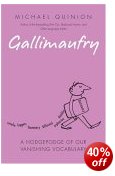
Michael Quinion is a word nerd. He’s an expert on obscure terms, word etymologies, and the origins of strange expressions. His last book Port Out, Starboard Home discusses myths and false explanations for the meanings of well known sayings, and he runs an excellent compilation of lexical back-history at World Wide Words. Gallimaufry is his latest collection of notes on ‘disappearing language’ – terms that are vanishing from common usage for a variety of reasons.

GallimaufrySome go because the object they describe no longer exists (liberty-bodice and sixpence) and some are meanings that disappear because the word is now used to describe something quite different (chaperone was in medieval times a sort of cap.) Mercifully, he splits up his offerings into themed chapters – on food and drink, health and medicine, entertainment and leisure, transport and fashion, then family names and communication.

In explaining the meaning of terms such as lamprey-pie, hog’s pudding, and flummery, he takes you into the realms of medieval cooking practices, the relationship of Latin and French to English linguistic development, and the eating habits of kings and commoners as they struggled to add nutrition and flavour to their diet of boiled wheats and gruel.

In no time this leads in its turn to the worlds of medicine, naval history, and eighteenth century nutrition. It’s unlikely that anybody will need to bring many of these terms back into general circulation, but it’s interesting to realise that spalling-poppy, biting assmart, and alexipharmic contain lexical elements which are still alive and well today, even though we have stopped using the herbal remedies to which they refer.

These are not just terms that have disappeared, but also the remote origins of terms which we still use today. For instance, you would never guess that the term slush fund originated in the mass of semi-liquid fat that floated on the top of boiling up unappetising salt pork on board a ship.

This all passes later into a form of social history when Quinion describes the forms of long-forgotten dances such as the cotillion, the quadrille, and the galliard. He then goes on to explain the distinctions between various nineteenth-century vehicles such as the landau, the barouche, the cabriolet, and the handsome.

It’s a gold mine for people who enjoy both arcane knowledge and the strange linguistic depths of the everyday world. For instance, he discusses old forms of measurement (of the rod, perch, and pole variety) and points out that ell, the old way to measure woollen cloth, gets its length (22-23 inches) as well as its name from the fact that this is the approximate distance from the shoulder to the wrist. The Old English term for the arm is ell, which is why in its turn the place where it bends is called the elbow.

Quinion is certainly a scholar. He gives meticulously drawn sources for his definitions and admits doubt or complete ignorance when supporting evidence is not available. He finishes with a selection of terms which are probably on their way out because of technological change: blotting paper, usherette, gramophone, and bus conductor will probably never be required again, even though they are probably still in the active vocabulary of older people today.

OK – you are either interested in old and possibly obscure words or you’re not. This is a cornucopia for those of us who are not ashamed to be counted amongst the lexical anoraks.

© Roy Johnson 2008

Gallimaufry   Buy the book at Amazon UK   Buy the book at Amazon US


Michael Quinion, Gallimaufry, Oxford: Oxford University Press, 2008, pp.288, ISBN: 0199551022


Filed Under: Language use Tagged With: Gallimaufry, Language, Language change, Language use, Reference

Generalizing in essays

August 23, 2009 by Roy Johnson

sample from HTML program and PDF book

1. You should avoid generalizing in essays. It works against the spirit of academic inquiry, and leads away from precision and accuracy. Instead, it leads towards sloppy thinking and the sort of empty prejudice which fills tabloid newspapers.

2. Generalizing often arises from attempts to avoid the first person mode, or from misguided efforts to appear rather grandiose in style.

‘Encountering Katherine Mansfield’s well-sculpted prose, the reader immediately feels that …’

3. As a substitute for ‘I feel …’ this is both clumsy and unacceptable. It suggests that all readers will respond in the same way and that there is only one possible response to the subject in question.

4. Try to avoid this expression and all its variations, such as ‘the reader becomes involved with…’ and ‘the reader’s attention is gained … ‘.

5. Another common form of generalizing arises when a specific example is discussed as if it were a general truth. It might be tempting to say ‘Thus Marx’s work shows us that …’ However, this suggests that you have read everything Marx ever wrote – which is probably not the case.

6. Variations of this approach occur in phrases such as ‘Women in the nineteenth century were all …’ and ‘The French have always been a nation which finds it impossible to …’.

7. Whatever the conclusions to these two statements, they are making claims about every woman in the nineteenth century and the entire population of France. Neither statement is likely to be true, because there will be so many exceptions.

8. The solution to this problem (in both cases) is to be more accurate and precise. This is a matter of clear thinking rather than written style – but it is at this point that the two subjects intersect.

9. If you wish to make such a claim but do not have exact numbers or percentages – then you should be more cautious and modest. You could at least say ‘Many women in the nineteenth century were …’ and ‘Many French people seem to …’.

10. Keep in mind that most essay assignments are asking you to deal with the specific details of your subject. You will gain more credit for claims which are modest yet accurately supported, than ones which are grandiose but unproven.

© Roy Johnson 2003

Buy Writing Essays — eBook in PDF format
Buy Writing Essays 3.0 — eBook in HTML format


More on writing essays
More on How-To
More on writing skills


Filed Under: Writing Essays Tagged With: Academic writing, Essays, Generalizing, Reports, Study skills, Term papers, Writing skills

Generating ideas for essays

August 23, 2009 by Roy Johnson

sample from HTML program and PDF book

1. Generating ideas is a useful preliminary stage when faced with an essay writing task. Start by ‘brainstorming’ the subject or the topic(s) concerned. This is often a good way to produce material for planning your answer.

2. Keep in mind that it is a preliminary stage in the essay writing process. It is designed to supply you with ideas, topics, and material for preparing the essay.

3. Take a sheet of blank paper and write in the middle of it the subject, topic(s), or the question concerned. Then, write down everything that comes into your mind which is connected with the question or the subject. Do this without editing or questioning your thoughts in any way.

4. This should be done in note form, single words, or with very brief reminders. Do not try to write out grammatically complete sentences.

5. Give your thoughts a chance to flow freely. Use one-word triggers,
abbreviations, or even symbols. Write down even trivial or vaguely associated items. They might help you to make connections with other items which are more centrally important to the subject.

6. When you have finished doing this, your task will be to make some sense of the topics or the ideas you have produced. You will need to put this material in some sort of order. This process is often known as categorizing.

7. Prior to that stage however you might first look over what you have written down. Eliminate anything which is not connected to the subject in question.

8. Be as rigorous as possible at this stage. Keep asking yourself “Are these arguments or topics directly relevant to what the question is asking for?”

© Roy Johnson 2003

Buy Writing Essays — eBook in PDF format
Buy Writing Essays 3.0 — eBook in HTML format


More on writing essays
More on How-To
More on writing skills


Filed Under: Writing Essays Tagged With: Academic writing, Essays, Generating ideas, Reports, Study skills, Term papers, Writing skills

  • « Previous Page
  • 1
  • …
  • 32
  • 33
  • 34
  • 35
  • 36
  • …
  • 103
  • Next Page »

Get in touch

info@mantex.co.uk

Content © Mantex 2016
  • About Us
  • Advertising
  • Clients
  • Contact
  • FAQ
  • Links
  • Services
  • Reviews
  • Sitemap
  • T & C’s
  • Testimonials
  • Privacy

Copyright © 2026 · Mantex

Copyright © 2026 · News Pro Theme on Genesis Framework · WordPress · Log in