Mantex

Tutorials, Study Guides & More

  • HOME
  • REVIEWS
  • TUTORIALS
  • HOW-TO
  • CONTACT
>> Home / Archives for 2009

Archives for 2009

Hypertext in Hypertext

July 3, 2009 by Roy Johnson

hypertext essays on literature and literary theory

This is a two-disk hypertext version of Landow’s 1992 print publication, Hypertext: the convergence of contemporary critical theory and technology. For those who are not acquainted with the original, Landow sets out a case for hypertext which looks at issues of textual authority, intellectual ownership, and the philosophy of a writing which can never be ‘finished’.
Hypertext in HypertextHe notes the similarities between the new technology and contemporary critical theory which seeks to undermine the authority of texts and authors. So what’s new in the electronic version? Well, Landow has included many of the texts from which he quotes in the earlier printed book. There are also essays on Barthes, Bhaktin, and Foucault. He includes reviews of the original book, as well as some (typically feeble) parodies by Malcolm Bradbury.

There are mini-essays from students explaining and often criticizing some of the arguments. Landow observed in the original version that hypertext was ripe for exploiting this all-inclusiveness, and he has been as good as his word by adding material which even undermines his own work in this way. This might be seen as a courageous move from someone who could easily have insisted on absolute textual authority. Alternatively, you could say that it reflects his impregnability in the academic hierarchy. Would someone without tenure dare risk such a venture?

Some material has been added for this hypertext edition. For instance, it includes the text of the original proposal to Johns Hopkins Press: “This project will include …” and so forth. But I’m not so sure that readers want to know about these details of the planning stage. It’s one thing to have the early drafts of “King Lear”, but presenting the outline plans for a book of cultural argument (even an interesting one) is another matter. We warn students against discussing the process of composing their essays. All that’s required is the finished product – not the means by which it arrived.

The bibliographical jump-links are good. This is technology which works more efficiently than a printed book. Strangely enough though, there are not as many notes or pop-up screens as one might expect. Perhaps this is because the basic text was conceived and executed in the Old Days of sequential writing?

What he has done is split the original into smaller sections – but they’re still not small enough. On my 17-inch monitor screen there are ‘pages’ which require so much scrolling that one craves for the start of a paragraph. The fact is that even with a knowledge of the original printed text, reading this version on screen is not easy. It’s difficult to keep any sense of structure in mind. This experience supports the notion that writing for screen and for print require quite different skills.

He argues fairly persuasively that Hypertext is useful in learning the
culture of a discipline, because we can switch easily from the principal text to supplementary readings of it:

hypertext materials provide the student with a means of experiencing the way an expert works in an individual discipline … such a body of electronically linked material also provides the student with an efficient means of learning the vocabulary, strategies, and other aspects of a discipline that constitute its particular culture

Anyone interested in the potential relationships between hypertext and cultural theory should try to see this program in action. It may well be that sustained and continuous arguments made in prose are not actually suitable for this format, but one can hardly blame him for trying out his theories. He could be a little more inventive with his titles, though, couldn’t he?

© Roy Johnson 2000

Hypertext   Buy the book at Amazon UK
Hypertext   Buy the book at Amazon US


George P. Landow, Hypertext in Hypertext, Baltimore/London: Johns Hopkins University Press, 1994, ISBN: 0801848695 (Windows version) ISBN: 0801848709 (Mac version)


More on literature
More on the novella
More on literary studies
More on short stories


Filed Under: Literary Studies, Media, Theory Tagged With: Electronic Writing, Hypertext, Hypertext in Hypertext, Literary studies

Hyphens – how to use them correctly

September 7, 2009 by Roy Johnson

free pages from our English Language software program

Hyphens – definition

hyphens Hyphens are short horizontal marks – (shorter than the dash).
redbtn Hyphens are used to show a link between words.


Examples

mother-in-law
re-enter
matter-of-fact
author-critic
president-elect
co-operation


Use

redbtn Hyphens are used to join words when forming compounds.

redbtn They are also used after prefixes – especially where it is necessary to avoid an awkward or confusing sequence of letters (as in re-enter).

redbtn Notice the difference between a compound word and the same terms used separately:

a fifteenth-century manuscript
in the fifteenth century

redbtn NB! The hyphen is not the same thing as the longer dash ( — ) but this distinction is rarely made in the UK.

redbtn Hyphens should be used where it is necessary to avoid ambiguity:

two-year-old cats
two year-old cats

redbtn They should also be used to distinguish terms which are spelled identically, but which have different meanings:

reformation – change for the better
re-formation – to form again

recover – to regain control
re-cover – to cover again

resign – to stand down
re-sign – to sign again

redbtn Hyphens are used when new terms are formed from compounds, but they are dropped when the compound is accepted into common usage. (This process is usually more rapid in the USA than in Europe.)

bath-tub -> bathtub
book-shelf -> bookshelf
club-house -> clubhouse

redbtn This phenomenon is currently visible in computer technology, where all three forms of a term may co-exist:

Word processor
Word-processor
Wordprocessor

redbtn Remember that the hyphen is not the same thing as the longer dash. A distinction between the two is commonly made in the US, but not in the UK.

Self-assessment quiz follows >>>

© Roy Johnson 2003


English Language 3.0 program
Books on language
More on grammar


Filed Under: English Language Tagged With: English language, Grammar, Hyphens, Language, Punctuation, Writing

Hyphens in essays

August 23, 2009 by Roy Johnson

sample from HTML program and PDF book

1. Hyphens in essays are most commonly used to join words when forming compounds:

mother-in-law     president-elect

matter-of-fact     author-critic

2. They are also used after prefixes – especially where it is necessary to avoid an awkward or confusing sequence of letters:

re-enter    co-operation    pre-ignition

3. Notice the difference between a compound word and the same terms used separately:

a fifteenth-century manuscript     in the fifteenth century

4. Hyphens should be used where it is necessary to avoid ambiguity:

two-year-old cats   — two year-old cats

In the first case, all the cats are two years old. In the second case, two cats are each one year old.

5. Hyphens should also be used to distinguish terms which are spelled identically, but which have different meanings:

reformation  re-formation
recover   re-cover
resign   re-sign

6. Hyphens are used when new terms are formed from compounds, but they are dropped when the compound is accepted into common usage. (This process is usually more rapid in the USA than in Europe.)

bathtub —   was once bath-tub

bookshelf —   was once book-shelf

clubhouse —   was once club-house

7. This phenomenon is currently visible in computer technology,where all three forms of a term may co-exist:

Word processor —   Word-processor —   Wordprocessor

© Roy Johnson 2003

Buy Writing Essays — eBook in PDF format
Buy Writing Essays 3.0 — eBook in HTML format


More on writing essays
More on How-To
More on writing skills


Filed Under: Writing Essays Tagged With: Academic writing, Essays, Hyphens, Punctuation, Reports, Study skills, Term papers, Writing skills

Idioms – how to understand them

September 7, 2009 by Roy Johnson

free pages from our English Language software program

Idioms – definition

idioms Idioms are fixed phrases which are only meaningful as a whole.

redbtn All languages contain idiomatic phrases.

redbtn Native speakers learn them and remember them as a complete item, rather than a collection of separate words.


Examples
IDIOM MEANING
a red herring a false trail
raining cats and dogs raining very hard
fly in the ointment spoiling the effect

Use

redbtn Idioms often break semantic conventions and grammatical logic – as in I’ll eat my hat [I’ll be amazed if …].

redbtn The object of the verb ‘to eat’ is conventionally something edible, but as part of this idiom it is something definitely inedible.

redbtn Non-native speakers find the idiomatic side of any language difficult to grasp.

redbtn Native speakers of a language acquire idioms from a very early stage in their linguistic development.

redbtn NB! You’re getting this advice straight from the horse’s mouth.

redbtn Idioms are generally impossible to translate between languages, although some families of languages use idioms based on identical ideas.

redbtn In French, for example, the idiomatic phrase ‘mon vieux’ is parallel in its meaning with the English ‘old chap’.

redbtn Idioms very often contain a metaphor, but not always. For example, ‘How do you do’ is an idiomatic greeting but it is not a metaphor.

redbtn Idioms are not always used or recognised by the whole of the language community. Sub-groups of speakers employ idioms peculiar to themselves.

redbtn Teenagers, occupational groups, leisure groups, and gender groups all employ idioms or special phrases. These will mean something within the context of the group and its communication.

Medicine I went to the GP for a check-up
Sport He was caught leg-before-wicket
Gender She was at her sister’s hen-party

redbtn Idiom also determines the way that certain combinations of words make meaningful statements, but not others.

redbtn For instance, we are ‘in a quandry’ but ‘at a loss’; we are ‘out of sorts’ but ‘in low spirits’; whereas the expressions ‘at a quandry’ or ‘in sorts’ would have no meaning in English.

Self-assessment quiz follows >>>

© Roy Johnson 2003


English Language 3.0 program
Books on language
More on grammar


Filed Under: English Language Tagged With: English language, Grammar, Idioms, Language

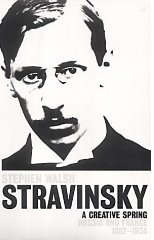
Igor Stravinsky: 1882-1934

August 9, 2009 by Roy Johnson

part one of the definitive biography

This is the currently definitive biography of Igor Stravinsky – master of European modernism whom many consider to be the greatest composer of the twentieth century. It’s a consummate and magisterial piece of work – superbly referenced and annotated; and just about every claim made within it is backed up with evidence. The notes to the text itself run to 113 pages.

Stephen Walsh begins by clearing the ground between himself and Robert Craft – the man who made himself Stravinsky’s amanuensis, secretary, helpmate, and collaborator towards the end of his life. Craft wanted to control the Stravinsky estate (including the money) as well as his critical reputation, but Walsh is having none of that. He insists on factual accuracy, backed up with hard evidence.

Igor StravinskyYet even though it’s quite clear that he knows everything there is to know about the details of Stravinsky’s life, and can justify every claim with a fully referenced source, he has problems constructing a logical and readable narrative of the composer’s life. For instance Stravinsky’s brother Roman dies three times within as many short chapters at the start of the book, and Stravinsky is abruptly announced to be twenty years old and has completed his first piece of music on page fifty. Most of the previous forty-nine have been devoted to describing the Russian countryside.

Walsh is exceptionally good at recreating the social and historical context in which Stravinsky was raised – from the lack of sanitation in late nineteenth-century Petersburg to the fact that the composer didn’t even go to school until he was nearly eleven.

The story of Stravinsky’s life is already fairly well known, so what does Walsh offer that’s new? Well, quite apart from his claim to accuracy in interpreting textual evidence, it’s quite clear that he is an authority on Russian cultural history. Every time a friend, relative, or acquaintance enters the story, his narrative swells out for pages on end with their biographical details – to the extent that (especially in the earlier part of the book) Stravinsky himself becomes a indistinct figure, hovering indistinctly like some half-forgotten ghost.

This is a feature of Walsh’s approach which you would expect to diminish as Stravinsky becomes more successful – largely because he is endlessly on the move from one city and country to another – Petersburg, Brittany, Switzerland, Paris, Cote d’Azur. This is the material of a biographer’s dream. But Walsh is more interested in scouring correspondence to apportion exact responsibility for the plot development of the early masterpieces (Firebird, Petrushka, The Rite of Spring) The composer’s dramatic private life is left relatively unexamined – despite his meeting with such luminaries as Debussy, Ravel, Proust, Schoenberg, and Manuel de Falla.

And this avoidance of the personal has some serious repercussions. When Diaghilev throws an enormous tantrum on hearing of Nijinsky’s marriage, Walsh still can’t bring himself to mention the fact that they had been lovers. Diaghilev shunned The Rite of Spring because of its close connection with his ex-favourite – and this immediately affected Stravinsky’s ability to earn a living from its success – for a personal, not a musical reason.

But we do gain benefits from his thoroughness, as well as having to endure its longeurs. On Stravinsky’s first visit to Spain, an affair with the ballerina Lydia Lopukhova is followed up biographically to record that she later married Diaghilev’s financial manager, and then later after eloping from London with a Russian general, she eventually married John Maynard Keynes.

Another thing which emerges instructively from all the background commentary on Stravinsky’s work (and that of his collaborators) is what utter rubbish many of the so-called critics wrote about the music. Jacques Riviere on the Rite of Spring for instance:

The Rite of Spring … has no juice to dull its brilliance, no cookery to rearrange or spoil its contours. It is not a “work of art”, with all the usual palaver. Nothing blurred, nothing reduced by shadows; no veils or poetic softenings; no trace of atmosphere. The work is whole and untreated…

As he becomes more successful, the 1920s are passed in the swirl of a quasi-bohemian, quasi-aristocratic milieu. Oedipus Rex was a collaboration with opium-addicted Jean Cocteau, whose detoxification cures were paid for by Coco Chanel, with whom Stravinsky had a brief affair.

But the dominant figure in this first volume is certainly Diaghilev, with whom Stravinsky collaborated on almost all his early major works. The two men had their differences, especially over money; but they respected each other as artists, and seemed to bring out the best in each other.

The other problematic leitmotif in Stravinsky’s life is that of copyright, which had not been internationally agreed at the time of his early works. There were also very complex arrangements whereby some people ‘owned’ works because they had paid a commissioning fee, and others held the rights to performances for a limited period. This resulted in erratic income for the composer – though a man who could buy a large chauffer-driven automobile in the 1920s was not in financial difficulties.

Stravinsky also had the expense of keeping two ‘families’. For his life was divided permanently between his lover Vera Sudeykina, with whom he lived in Paris and took on concert tours, and Katya, his wife and the mother of his four children, whom he left at home and visited when required.

It’s interesting to note how fond Stravinsky was of any technical developments which would assist him in both making a record of his own work and exploring the possibilities of new sounds. He made piano rolls, bought a player-piano, learnt to play the cimbalom, and eagerly recorded his work on both mechanical and electrical equipment.

Serious musicologists will be glad to learn that Walsh puts a lot of effort into tracing the developments in Stravinsky’s musical style. This goes (in this volume) from the expressive force of the Rite to the neo-classicism of Apollo. This is done in an all-round manner by looking at the original ‘idea’ (often the result of a commission) then the musical material from which he took his inspiration, through to the actual conditions (and possible limitations) which surrounded the first performance.

Despite some of the negative effects of Walsh’s writing, I found this a fascinating account of the artist and a well-informed glimpse into a rich period of cultural history. Volume one ends in 1934 with the Nazis in the ascendant and Stravinsky sharing musical chit-chat with Mussolini, for who he had a high regard. In this climactic year Stravinsky took out French citizenship and moved his entire extended family into a fifteen-room apartment near the Place de la Concorde – in the arrondissement next to his lover Vera. Stravinsky’s main worry about this proximity was that his eighty-year-old mother should not find out about his not-so-secret other life.

Igor Stravinsky - Part 2 See part two of this biography

© Roy Johnson 2009

Igor Stravinsky Buy the book at Amazon UK

Igor Stravinsky Buy the book at Amazon US


Stephen Walsh, Igor Stravinsky – A Creative Spring: Russia and France 1882-1934, London: Pimlico, 2002, pp.696, ISBN: 1845952219


More on music
More on media
More on lifestyle


Filed Under: Biography, Music Tagged With: Biography, classical music, Cultural history, Igor Stravinsky, Modernism, Music

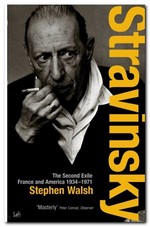
Igor Stravinsky: 1934-1971

September 3, 2009 by Roy Johnson

second volume of the definitive biography

The first volume of this masterly biography ends in 1934 with the death of Diaghilev, Igor Stravinsky’s composition of Persephone, his adoption of French citizenship, and his no less important decision to move his extended family from the south of France to take up residence in Paris – in the next arrondissement to his lover, Vera Sudeykima.

To give some idea of the complexities of these arrangements, Stravinsky not only made it known to his wife that he paid Sudeykima an allowance, but as if this was not enough he heaped onto it the additional humiliation that in his absence she should hand over the money to her in person – which she did.

Igor StravinskyThe second volume opens with the darkening years of the mid-1930s, and Stravinsky remaining as politically naive as ever in the face of rising fascism and anti-Semitism. The only thing which seemed to disturb him was a general assumption that he was Jewish – which was not the case. He continued to give his moral if not practical support to Mussolini and Franco, and he conducted the Berlin Philharmonic in 1938 with the somewhat disingenuous excuse that he needed the money to pay his daughter’s medical bills.

As the 1930s progressed Stravinsky’s personal life seems to have become worse and worse. There were problems with his four children, all of whom had difficulties creating independent destinies for themselves, permanently overshadowed as they were by the fame and the rather dictatorial manner of their father. His wife Katya became ill and was confined to an Alpine sanatorium, run along similar lines to the Berghof in Thomas Mann‘s The Magic Mountain. Her daughter accompanied her on the journey, and was also kept there as a patient.

Then in 1938 fate struck a double blow. First Stravinsky’s daughter died, then his wife. Yet so many people rallied to help him that within a short time he had secured a teaching post at Harvard, married Sudeykima, and he ended up living in California – like Arnold Schoenberg ‘expelled into Paradise’.

This was a period in which he tried without much success to find work composing for the film industry. He knew all the right people, and Hollywood was happy to adapt his earlier works, but none of the big projects mooted came to fruition. Instead, he produced such miniatures as the Circus Polka for dancing elephants and the Ebony Concerto for Woody Herman’s band. However, he came back in full force with the composition in 1946 of the Symphony in Three Movements.

Interestingly enough the copyright issue crops up yet again (just as it did in the first volume) – but with a new twist. Stravinsky and his advisors hit upon the ruse of his revising earlier pieces of work. If they could be made sufficiently distinct from the originals, they could be re-copyrighted. Moreover, if Stravinsky took out US citizenship (which he promptly did) he would have full protection and ownership of the new versions – which could be translated into hard cash.

The war in Europe had one good effect on Stravinsky: it caused him to re-think his reactionary political views – rather as it did for his fellow-exile Thomas Mann. He became a Trueman-supporting democrat.

If Diaghilev was the presiding secondary figure in Volume One, the equivalent figure in Two is Robert Craft. He was a young American student of composition and conducting who managed to inveigle himself into the Stravinskys’ affections to such an extent that he became a combination of amanuensis, secretary, manager, advisor, and even domestic help. He also had close access to Stravinsky’s manuscripts – which was to cause a lot of trouble later.

Musically, the centrepiece of this second volume is the composition of The Rake’s Progress which took three and a half years. He worked with Auden and Chester Kallman as librettists. This was followed by Agon and the premiere of Canticum sacrum in St Mark’s, Venice. From this point on, his compositions became increasingly influenced by a Schoenbergian twelve-tone scale form of writing, even though he had kept himself at a very long arm’s length during his rival’s own lifetime.

Since Stravinsky’s personal life had settled into an almost conventional marriage with Vera, Walsh’s account now begins to focus on a concert-by-concert account of his professional life: (Stravinsky maintained that he earned his living as a conductor). Walsh records every possible detail of the choice of programme, the fee paid, the musical rehearsals, and the roles played by agents, go-betweens, and performers.

The latter part of the book traces Stravinsky’s last (and serial) compositions, but it is really a detailed examination of just how much Robert Craft controlled, contributed to, or even created works which were published under Stravinsky’s name. He also began writing letters and memoirs which were attributed to the man who was in a roundabout way his employer.

As Stravinsky declines into ill-health approaching death, the story becomes an almost nineteenth-century inheritance drama of tax lawyers, relatives, Craft, and various hangers-on vying for control of Stravinsky’s assets and archive with a view to lining their own pockets. And when he did eventually expire the conflict between warring parties became pure Jarndyce Vs Jarndyce, with the widow Vera eventually paying out $200,000 to retain control – and even that was only an interim measure. The dispute continued even after her death; the relatives died off in their turn; and even the eventual purchaser of the archive, Paul Sacher, was duped out of almost two million dollars by the lawyers.

Fortunately for us, the music lives on.

Igor Stravinsky - Part1 See part one of this biography

Igor Stravinsky Buy the book at Amazon UK
Igor Stravinsky Buy the book at Amazon US

© Roy Johnson 2003


Stephen Walsh, Igor Stravinsky – The Second Exile: France and America 1934-1971, London: Pimlico, 2007, pp.709, ISBN: 0712697950


More on music
More on media
More on lifestyle


Filed Under: Biography, Music Tagged With: Biography, classical music, Cultural history, Igor Stravinsky

In Other Words

July 10, 2009 by Roy Johnson

a language lover’s guide to intriguing foreign words

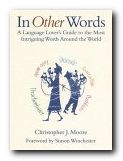
This is a book for people who love words – no matter what their origin. In Other Words collects some of the most intriguing and peculiar expressions from countries around the globe for which there are no easy English equivalents. There is an expression in Japanese for instance which describes the particular stress the people there feel when speaking another language. But translated literally, Yokomeshi is ‘a meal eaten sideways’. Yoko means ‘horizontal’ and meshi means ‘boiled rice’. The explanation (and joke) is that Japanese language is normally written vertically. Makes sense now, doesn’t it?

In Other WordsEntries are listed alphabetically by country, and the languages covered include East and West Europe, Nordic, Middle Eastern, African, Asian, and Creole and Pidgin languages. The entries for each group are prefaced by a short essay outlining examples of contemporary usages and problems.

Examples include explanations of terms which have been commonly taken up in English such as enfant terrible and doppelganger, as well as those special terms for which there is no English equivalent, such as the German Torschlusspanik (literally ‘door-shutting panic’) for which the nearest would be ‘fear of being left on the shelf’, and the Yiddish luftmensch – literally somebody who lives on air, but figuratively a person who sponges off those around him.

Actually, some of the examples he offers disprove his own thesis about translatability. The Italian attaccabottone (literally ‘button attacker’) is exactly as the person who in English ‘buttonholes’ you to relate some long tale of woe.

It doesn’t have the in-depth comprehensiveness of a reference such as The Oxford Dictionary of Foreign Words and Phrases, but it offers much longer and quite amusing explanations.

© Roy Johnson 2005

In Other Words   Buy the book at Amazon UK

In Other Words   Buy the book at Amazon US


C.J. Moore, In Other Words, Oxford: Oxford University Press, 2005, pp.127, ISBN: 0192806246


Filed Under: Language use Tagged With: English language, Etymology, In Other Words, Language, Language use

Indie Fonts

July 15, 2009 by Roy Johnson

compendium of digital type from independent foundries

This is a wonderful collection of over 2000 fonts from eighteen of the most innovative independent type designers. It’s essentially a typographic sample book, but some top class design and innovative presentation make it much more than that. Indie Fonts itself is an amazingly stylish production. It’s well designed, beautifully printed on good quality paper, and laid out in a way which displays full font sets without every page ending up the same. They don’t do the usual thing of simply showing the alphabet in upper and lower case over and over again. Every page is different, and the text often describes what the font is attempting to do.

Indie FontsThe font styles include serif, sans serif, script, display, non-Latin, and ornaments. They also include all sorts of page decorations, swashes, figures, icons, and dingbats. Another interesting feature is that almost all these fonts are actually usable for practical day-to-day applications. There are none of the scribbles, distortions, and virtually unreadable grunge fonts that sometimes wish to pass as clever modern typography. Even the wacky and avant-garde Chank studio of Minneapolis produces font sets that can be read and used commercially.

The foundries represented range from Letterror, PSY/OPS, and Test Pilot Collective, to P22 type foundry, Font Diner, and Astigmatic One Eye Typographic Institute. Each of them is introduced with the print equivalent of a colour splash page. There are also introductory notes on each foundry, and the entries for Matthew Carter for instance offer mini-essays in typeface construction and the practical reasoning behind design decisions.

Type styles range from the best of Carter’s classic designs to the latest irreverence of Chank Diesel. Any designer searching for unique typefaces will find what they are looking for, from historical revivals to futuristic techno faces.

The book comes with a CD-ROM which features a selection of thirty-three font sets which are free for you to use – but not distribute. Anybody who is interested in typography ought to see this book. Serious designers will want to own it.

© Roy Johnson 2002

Buy the book at Amazon UK

Buy the book at Amazon US


IndieFonts, Buffalo, NY: P-Type Publications, 2002, pp.408, ISBN: 0963108220


More on typography
More on technology
More on digital media


Filed Under: Typography Tagged With: Digital type, Fonts, Graphic design, Indie Fonts, Typography

Industrial Design A-Z

June 18, 2009 by Roy Johnson

influential 20C designers, companies, and products

These Taschen pocketbooks are very well produced, with high quality print, full colour illustrations, and amazingly cheap. I’ve bought several of them, both in the UK and abroad, and somehow always been surprised at the integrity of the writing and the scholarship. But I have not been surprised at the quality of the illustration and the graphic design. It’s always been first rate.

Industrial Design A-Z This particular volume concentrates on industrial design – which authors Charlotte and Peter Fiell suggest is a twentieth century concept which essentially adds aesthetics to functionality and mass production. It’s an A to Z listing of designers and companies, running from AEG, via Herman Miller, to Xerox and the stylish but ill-fated product of Ferdinand Graff von Zeppelin.

Each entry consists of a biographical sketch or a historical account of a design company. The range of products represented is truly amazing – everything from the ball-point pen to aeroplanes designed by Boeing and McDonnell Douglas. There are cars, cameras, telephones, vacuum cleaners, computers, typewriters, radios, and kettles, electric shavers, and office furniture. All of these design classics are illustrated by well-chosen full colour photographs.

Standout individuals include the multi-talented and hugely influential Peter Behrens, Henry Dreyfuss, and Raymond Loewy. It’s interesting to note how many of the most influential were trans-nationals and how many German – either by birth, education, or influence.

The authors are both experts in industrial design, both ex-Sotheby’s, and now running their own design consultancy in London, specialising in industrial design. They offer some fascinating information which reveals the breadth of their knowledge. Did you know that over 15 million BIC pens are sold every day, and that the best-selling iMac was created by the English designer Jonathan Ive?

If you are the slightest interested in design, it’s really impossible to go wrong with this book – which is itself well designed, stylishly illustrated, and amazingly cheap.

© Roy Johnson 2004

Industrial Design A-Z   Buy the book at Amazon UK

Industrial Design A-Z   Buy the book at Amazon US


Charlotte and Peter Fiell, Industrial Design A—Z, Taschen, 2003, pp.190, ISBN: 3822824267


More on design
More on media
More on web design
More on information design


Filed Under: Product design Tagged With: Industrial design, Product design, Reference

Information Age Journalism

June 8, 2009 by Roy Johnson

contemporary journalism in an international context

This is a book which looks at the state of journalism (newspaper, radio, and TV) in the context of globalisation of media control and the Internet age of instant communication. Vincent Campbell starts with a look at the decline in newspaper circulation – a more-or-less universal phenomenon. The dangers he sees are the monopolisation of ownership, tabloidization, and the onset of the Internet which has thrown everything into a state of uncertainty.

Information Age JournalismHe looks at the relationship between journalism and the state, arguing that whilst most people in liberal democracies want the removal of state controls, when they are replaced by the demands of the free market they do not diminish but simply change their form. This leads to a detailed examination of the concept of ‘press freedom’, with examples drawn from all over the world – only forty percent of which is ‘free’. He covers newspaper ownership, the role of advertising, and he also deals with the ethical questions surrounding the manner in which journalists gather information – their relationship with sources, and where news management ends and spin begins.

He includes a detailed analysis of the workings of a typical newsroom. This includes how news stories are discovered, selected, written, edited, then presented.

There’s a comprehensive discussion of all the ethical dilemmas commonly raised in journalism – invasion of privacy, naming and shaming, chequebook journalism, libel, blasphemy, and protecting your sources – as the editor of the Guardian, Peter Preston, spinelessly failed to do after printing Sarah Tisdall’s whistle-blowing revelations.

This leads logically enough into a consideration of objectivity, opinion, bias, and slant. Most of his arguments are illustrated by examples drawn from recent high profile cases from the print press and TV which most people will remember.

He then looks at various alternatives to conventional journalism – where one might expect to hear more radical views. These range from political satire, as in The Onion and Private Eye to literary journalists of the Tom Woolfe school.

Although it certainly makes his coverage comprehensive, I was surprised that he gave so much space to (so-called) reality TV such as Big Brother, sports journalism, confessional television chat shows, and the amazingly vacuous Cosmopolitan, which he categorises as ‘lifestyle journalism’.

The result of this is that the coverage of Internet journalism is squashed into a few brief pages right at the end of the book. No mention of blogging at all – which is strange after two hundred pages in search of something new and radical.

It’s a book which could do with a few more pictures to break up page after page of dense text. But it’s suitable for anyone who wants to make an in-depth study of journalism, particularly in an international context, or in its relationship to politics and the current ownership of mass media companies.

© Roy Johnson 2005

Information Age Journalism   Buy the book at Amazon UK

Information Age Journalism   Buy the book at Amazon US


Vincent Campbell, Information Age Journalism, London: Arnold, 2004, pp.306, ISBN: 0340763493


More on journalism
More on creative writing
More on writing skills
More on publishing


Filed Under: Journalism, Publishing Tagged With: Journalism, Media, Writing

  • « Previous Page
  • 1
  • …
  • 44
  • 45
  • 46
  • 47
  • 48
  • …
  • 103
  • Next Page »

Get in touch

info@mantex.co.uk

Content © Mantex 2016
  • About Us
  • Advertising
  • Clients
  • Contact
  • FAQ
  • Links
  • Services
  • Reviews
  • Sitemap
  • T & C’s
  • Testimonials
  • Privacy

Copyright © 2026 · Mantex

Copyright © 2026 · News Pro Theme on Genesis Framework · WordPress · Log in