Mantex

Tutorials, Study Guides & More

  • HOME
  • REVIEWS
  • TUTORIALS
  • HOW-TO
  • CONTACT
>> Home / Archives for 2009

Archives for 2009

Quotations in essays

August 24, 2009 by Roy Johnson

sample from HTML program and PDF book

1. There are in general two instances when you may wish to use quotations from other writers’ work:

  • Evidence – when quoting from other sources to support your own argument(s)
  • Reference – when a text is itself the subject of your essay and you need to refer to it in your discussion

2. The conventions of accurate quotation and referencing are relatively simple, and they are based on the need for accuracy, consistency, and clarity. There are a number of slightly different systems of notation. The two most widely used are:

  • the traditional combination of numbered quotation, plus an endnote giving the source
  • the Harvard system (described separately)

3. The whole purpose of both systems is that tutors marking your work should be able, if they wish, to check the accuracy of the quotations you use.

Evidence

4. In a discussion of the development of Marx’s philosophy for example, you might argue that his work was a natural development of his predecessors, supporting your assertion by quoting David McLellan. He points out that

Marx began by paying tribute to the achievements of Feuerbach, particularly in having shown that Hegel’s philosophy was no more than a rationalised theology. (1)

5. A bracketed number is added immediately after the quotation, and the source of your quotation is given as an endnote on a separate sheet at the end of your essay. (You might wish to place the information as a footnote at the bottom of the page, though this system can become rather complicated.)

NOTES
1. David McLellan, The Thought of Karl Marx, London: Macmillan, 1971, p.26.

6. Note that this information is given in the following order, and you should remember to indicate the titles of books by using italics.

Author-Title-Publisher-Date-Page

7. The material you quote is placed between two single quotation marks if it is run in as part of your text:

this is what David McLellan calls a ‘rationalised theology’ (1) in his discussion of the relationship between Marx and Hegel

8. If the length of the quote amounts to more than three lines of your own text however, it should be indented separately, and no quote marks are necessary:

Marx began by paying tribute to the achievements of Feuerbach, particularly in having shown that Hegel’s philosophy was no more than a rationalised theology, and having discovered the true materialist approach by starting from the social relationship of man to man. (1)

9. Your own argument should normally be offered first, and you then reinforce it with quotation from an authoritative source. You are using this secondary evidence from acknowledged specialists to support your own views. Do not offer the quotation first, otherwise what should be your own argument will tend to be come more a ‘commentary’ upon it.

10. The quotations you offer should be as brief as possible to make their point. Don’t be tempted to offer long quotations from other people’s work in the hope that this will act as a substitute for your own argument. Nor should you stitch together a patchwork of quotations from a variety of sources with a few words of your own. This creates the impression that you are relying too heavily on other people’s work.

11. Sometimes in more advanced essays it might be necessary to quote longer passages. You would do this if you were going to analyse the author’s arguments in detail and at quite some length. This should only be done occasionally.

12. Each main point of your argument should be made and discussed in its own separate paragraph. This should not normally need more than one quotation to support it. Too many quotations can create the impression that you are relying too heavily on secondary sources.

Reference

13. When the subject of your essay is the discussion of a text (say, criticism of a novel or an article) you should follow the same system of notation. Directly after the first quotation you should give a full bibliographic description of the text you are discussing.

14. This information could be given within brackets in the body of your essay, but you will be developing good academic habits if you place the information as a note at the end of the essay.

15. If your essay is predominantly concerned with just one text, all subsequent quotations from it may simply be followed by page references. Simply add an explanation to the first endnote, saying – all subsequent page references are to this edition.

16. If you will be quoting from a variety of other sources in the same essay, you should number the quotations and give the sources accurately as a series of endnotes.

17. It is also possible to mix these two forms of referencing, so long as the distinctions are made clear. If your piece of work was a long essay on Bleak House for instance, it would be acceptable to identify all your quotations from the novel with page references. Quotations from other critics or sources would numbered and their sources identified as separate endnotes.

18. There must be grammatical continuity and sense maintained between any quotation and your own argument. To arrange this, it might be necessary to add or delete words from the material quoted, or to change the tense of the original. Whenever you do this, any changes should be very small. They must also be properly acknowledged.

[It was] as if she were truly loved by him, but notwithstanding this impression she regarded the man as no more than a casual acquaintance who occasionally made her laugh (p.7)

19. Square brackets are used to indicate any words which you have added in order to make the quotation fit grammatically or otherwise within your own argument.

20. If you wish to draw attention to a particular word or some part of the quotation, you should provide the emphasis by using italics (or underlining). You should then immediately admit the fact ‘as if she were loved by him’ [p.7 – my emphasis] and then carry on with what you wish to say in the remainder of your argument.

How to shorten a quote

21. In order to shorten a quotation or to remove some part of it which is not relevant to your argument, you may wish to omit a number of words. To denote this omission (which is called an ‘ellipsis’) you should use the convention of the three dots ‘…’ in the space which is left:

He had even a kind of assurance on his face … the assurance of a common man filled with pride. (p.7)

22. This device should not be used to change the sense of the original in any way, or to misrepresent its spirit: such practices are regarded as academically fraudulent.

23. The three dots denoting an ellipsis do not need to be placed at the beginning or the end of your quotation, even if you are quoting a few words from within a sentence.

24. The general convention for indicating quotation is to use single quote marks (‘unmitigated’) and to reserve double quotes marks for indicating speech (“Good gracious!” cried the duchess.)

25. When quoting conversation, follow these rules, but if it makes things easier put the words spoken within double quote marks even if they were in single quote marks in the original:

Kayerts is being even more hypocritical and self-deceiving when he ‘observe[s] with a sigh: “It had to be done”‘ (p.39)

26. If you are quoting more than once from a number of works in an essay, you can avoid confusion and save yourself the trouble of giving a full reference each time. Use either the abbreviations op. cit.. and ibid. or the short title convention.

27. Different subjects have their own conventions in this respect – but the short title system is becoming more widely used and is easier to follow. However, an enormous number of academic books have been produced using the older system, so it is worth understanding how it operates, even if you decide not to use it.

28. Using the system of Latin abbreviations, the first quotation from a text is referenced fully with an endnote. In the case of any references which follow, just give the author’s name followed by op. cit.. (which means ‘in the work already quoted’) and then the page number – as follows:

11. J.D. Bryant, The Origins of Mythology, London: Carfax Press, 1971, p.234.
12. History Today, Vol. XXXIV, No 18, p.123.
13. Bryant, op. cit., p. 387.

29. If the very next quotation is again from the same work, the abbreviation ibid.. (which means ‘in the same place’) is followed by a page reference. You do not need to give the author’s name. The sequence just given would therefore be extended:

11. J.D. Bryant, The Origins of Mythology, London: Carfax Press, 1971, p.234.
12. History Today, Vol. XXXIV, No 18, p.123.
13. Bryant, op. cit., p. 387.
14. ibid., p. 388.

30. The short title system is particularly useful for longer essays which might deal with a number of texts or different books by the same author. Second and third year undergraduate studies often require a lengthy piece of work such as this. The principle is the same one of giving full bibliographical details in the first reference. Subsequent quotations are given a reference which is composed of the author’s surname, a shortened form of the book title, and the page number. The examples shown above would therefore appear as follows:

11. J.D. Bryant, The Origins of Mythology, London: Carfax Press, 1971, p.234.
12. History Today, Vol. XXXIV, No 18, p.123.
13. Bryant, Mythology, p. 387.

31. The conventions of quoting from poetry and plays are exactly the same, but for the convenience of the reader, line numbers are given.

32. There are a number of widespread misunderstandings about the use of quotation and systems of referencing. It is worth taking the trouble to follow the conventions outlined above (or use the Harvard system). Once you have brought simplicity and clarity to the presentation of your quotations it will help to improve the appearance and credibility of your work.


What to avoid

  • You should not put page references in margins: they are placed immediately after the quotation, within your text.
  • You should not locate references as part of your own argument with expression such as ‘and we see this on page 27 where he collapses slowly … then later in the paragraph where he recovers’.
  • Ellipses are shown by three dots only [ … ] not a random number scattered across the page.
  • References and note numbers should form part of the text of your argument. They should not be added to the essay at a later stage and written into the margins or squeezed above the text as superscripts.

33. You should avoid using too many quotations and references to secondary material. In some subjects this can sometimes be required (as in a ‘review of the literature’) but in most it is not. Packing your essay with references to other people’s ideas creates the impression that you are unable to create an argument of your own. Remember that your own evidence or points should come first. Quotation should normally be offered after you have established your own argument.

34. Some people use quotations as a means of starting an introduction or rounding off the conclusion to an essay. This can give your work a touch of sparkle if the quote is well chosen. However, you should minimize the use of this strategy in the body of the essay itself. Paragraphs which begin with a quotation can weaken your argument – for two reasons.

  • First, you are not leading with your own ideas in the form of a topic sentence directly related to the question.
  • Second, the substance of your argument in what follows might give the impression of being a commentary on the secondary source quoted, rather than an answer to the original question.

© Roy Johnson 2003

Buy Writing Essays — eBook in PDF format
Buy Writing Essays 3.0 — eBook in HTML format


More on writing essays
More on How-To
More on writing skills

Filed Under: Writing Essays Tagged With: Academic writing, Essays, Quotations, Reports, Study skills, Term papers, Writing skills

R.C.Trevelyan – Beelzebub

October 5, 2009 by Roy Johnson

Hogarth Press first edition book jacket designs


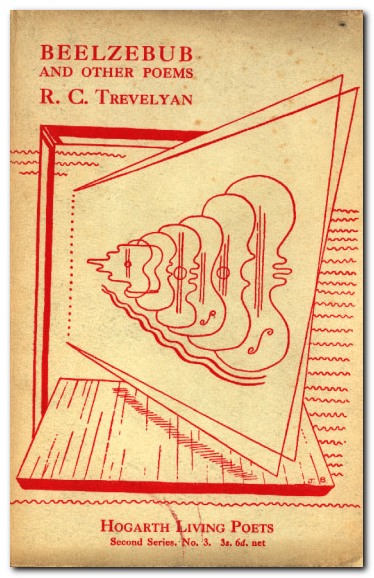
Beelzebub - first edition

 
R.C. Trevelyan, Beelzebub and other poems, Hogarth Living Poets, second series, Number 3.

“R.C. Trevelyan, member of a distinguished Victorian family and brother of the Cambridge historian G.M. Trelyan, had been an Apostle at Trinity College, friend of the Woolfs for years, and by the 1920s was a classical scholar, a translator (Sophocles, Aeschylus, Lucretius, Theocritus), and a poet. He would eventually publish over twenty volumes of poetry.”

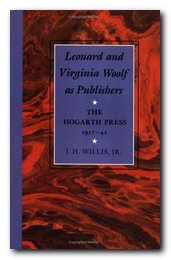
J.H. Willis Jr, Leonard and Virginia Woolf as Publishers: The Hogarth Press 1917-1941

previousnext


Hogarth Press studies

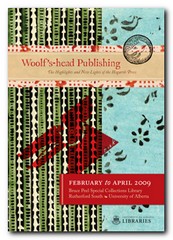
Woolf's-head Publishing Woolf’s-head Publishing is a wonderful collection of cover designs, book jackets, and illustrations – but also a beautiful example of book production in its own right. It was produced as an exhibition catalogue and has quite rightly gone on to enjoy an independent life of its own. This book is a genuine collector’s item, and only months after its first publication it started to win awards for its design and production values. Anyone with the slightest interest in book production, graphic design, typography, or Bloomsbury will want to own a copy the minute they clap eyes on it.

Woolf's-head Publishing Buy the book at Amazon UK
Woolf's-head Publishing Buy the book at Amazon US

The Hogarth Press Leonard and Virginia Woolf as Publishers: Hogarth Press, 1917-41 John Willis brings the remarkable story of Leonard and Virginia Woolf’s success as publishers to life. He generates interesting thumbnail sketches of all the Hogarth Press authors, which brings both them and the books they wrote into sharp focus. He also follows the development of many of its best-selling titles, and there’s a full account of the social and cultural development of the press. This is a scholarly work with extensive footnotes, bibliographies, and suggestions for further reading – but most of all it is a very readable study in cultural history.

The Hogarth Press Buy the book at Amazon UK
The Hogarth Press Buy the book at Amazon US

© Roy Johnson 2005


Filed Under: Hogarth Press Tagged With: Art, Bloomsbury, Graphic design, Hogarth Press, Literary studies, R.C.Trevelyan

Re-writing essays

August 24, 2009 by Roy Johnson

sample from HTML program and PDF book

1. Re-writing is an important part of producing successful essays and term papers. Your first draft is a temporary document which can be altered. Treat it as a rough version of your essay upon which the final version will be constructed. Don’t think it’s the best you can produce, just because it might have cost a lot of effort.

2. Most successful authors make several drafts of their work. They edit and re-write what they produce, correct mistakes, and make additions and deletions. Good writing is often the result of extensive re-writing before the final draft. Don’t imagine that you should be able to write perfectly well at your first attempt.

3. Get used to the idea of re-working your ideas and your expression. Don’t feel guilty about correcting and revising several times over.

4. A word-processor is ideally suited to working with multiple drafts. This can be done in two ways. You can choose to keep polishing and refining the same basic document, saving it to incorporate each set of changes. Alternatively, you can create and save separate drafts. These may then be compared and mixed until you have produced something to your satisfaction.

5. If necessary, you may also wish to read the work out loud to check for weak grammar. However, keep in mind that a conversational tone and style is best avoided in formal essays.

6. When producing successive drafts of your work, keep in mind the following suggestions.

Checklist for re-writing

  • Simplify any awkward grammar
  • Split up sentences which go on too long
  • Re-order paragraphs to improve your argument
  • Eliminate repetitions
  • Correct errors of spelling or punctuation
  • Create smooth transitions between paragraphs
  • Add any important ideas you have missed out
  • Delete anything which is not strictly relevant

© Roy Johnson 2003

Buy Writing Essays — eBook in PDF format
Buy Writing Essays 3.0 — eBook in HTML format


More on writing essays
More on How-To
More on writing skills


Filed Under: Writing Essays Tagged With: Academic writing, Editing, Essays, Re-writing, Reports, Study skills, Term papers, Writing skills

Reading at University

June 18, 2009 by Roy Johnson

reading [and writing] skills for academic work

Students in higher education probably spend more time reading at university than doing anything else – at least in terms of studying. And the same is probably true for their teachers as well. But do we always read as efficiently as we might? This book sets out to explore all aspects of this key technique of reading skills. The Fairbairns (Mr and Mrs) very wisely point out that reading is not just one, but a set of skills – and they encourage choosing your reading approach according to the nature of the task.

Reading skills It is certainly true that many inexperienced students are hampered by the unconscious habit of reading everything at the same speed and with the same degree of attention. They also encourage readers to become more aware of what they are reading, why they are reading, and what is the academic objective of their reading task. They trace the development of reading skills and discuss the pros and cons of different types of reading – such as speed reading, skimming, searching, scanning, and sampling.

There are some useful tips on analysing academic books and reading lists, as well as how to take notes whilst reading. They even include a chapter which explains how to quote and cite references in academic writing; and another called ‘Reading your Own Work’ which is effectively how to edit and proof-read your writing before submitting it for assessment.

All this advice is aimed at undergraduate students – but most of it will be just as useful to other groups, such as trainee teachers who need to unravel some of the mysteries of the learning process at the same time as sharpening their own study skills.

© Roy Johnson 2001

Reading at University   Buy the book at Amazon UK

Reading at University   Buy the book at Amazon US


Gavin J. Fairbairn and Susan A. Fairbairn, Reading at University: A Guide for Students, Buckingham/Philadelphia: Open University Press, 2001, pp.209, ISBN: 033520385X


More on study skills
More on writing skills
More on online learning


Filed Under: Study skills Tagged With: Education, Reading at University, Reading skills, Study skills

Rebecca West – A Letter to a Grandfather

October 5, 2009 by Roy Johnson

Hogarth Press first edition book jacket designs


A Letter to a Grandfather - first edition

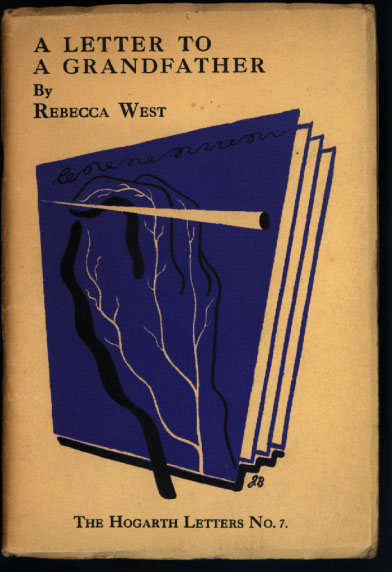
Rebecca West, A Letter to a Grandfather (1933) Hogarth Letters, Number 7. Cover design by John Banting.

“In spite of his financially cautious recruitment of Margaret West for Hogarth manager in February 1933 and his by-now-familiar claim that he did not want to publish books merely because they might be profitable, Leonard Woolf did not neglect to pump up the press income when he could. In that very month he tried to rescue the Hogarth Letters series after twelve titles by binding together eleven of the letters into a single volume with a new title page as The Hogarth Letters. The effort was not successful, and he terminated the series after publishing the last one in March, Rebecca West’s Letter to a Grandfather.”

J.H. Willis Jr, Leonard and Virginia Woolf as Publishers: The Hogarth Press 1917-1941

previousnext


Hogarth Press studies

Woolf's-head Publishing Woolf’s-head Publishing is a wonderful collection of cover designs, book jackets, and illustrations – but also a beautiful example of book production in its own right. It was produced as an exhibition catalogue and has quite rightly gone on to enjoy an independent life of its own. This book is a genuine collector’s item, and only months after its first publication it started to win awards for its design and production values. Anyone with the slightest interest in book production, graphic design, typography, or Bloomsbury will want to own a copy the minute they clap eyes on it.

Woolf's-head Publishing Buy the book at Amazon UK
Woolf's-head Publishing Buy the book at Amazon US

The Hogarth Press Leonard and Virginia Woolf as Publishers: Hogarth Press, 1917-41 John Willis brings the remarkable story of Leonard and Virginia Woolf’s success as publishers to life. He generates interesting thumbnail sketches of all the Hogarth Press authors, which brings both them and the books they wrote into sharp focus. He also follows the development of many of its best-selling titles, and there’s a full account of the social and cultural development of the press. This is a scholarly work with extensive footnotes, bibliographies, and suggestions for further reading – but most of all it is a very readable study in cultural history.

The Hogarth Press Buy the book at Amazon UK
The Hogarth Press Buy the book at Amazon US

© Roy Johnson 2005


Filed Under: Hogarth Press Tagged With: Art, Bloomsbury, Graphic design, Hogarth Press, Literary studies, Rebecca West

Received pronunciation – what it means

September 13, 2009 by Roy Johnson

free pages from our English Language software program

Received pronunciation – definition

received pronunciation Received Pronunciation [or RP] refers to the accent used by such people as the Royal Family, BBC newsreaders, and members of the upper class.

redbtn It refers entirely to accent and not to content.

redbtn RP is a speech style which is based on social class and not on geographical region.


Examples

redbtn Some characteristic features of pronunciation in RP are as follows:

The long vowel in words such as ‘bath’, ‘path’, ‘ask’

Diphthongs in words such as ‘so’, ‘go’, ‘no’, ‘flow’


Use

redbtn Less than six per cent of the population of the UK speaks RP.

redbtn Although this speech style still carries notions of prestige, regional varieties of English are acquiring status equal to RP.

redbtn NB! Remember, RP is not the same thing as Standard English.

redbtn Received pronunciation (RP) is an accent of English which is based on social class rather than on region. Its origins are rooted in notions of prestige and status and impulses of exclusivity.

redbtn However, RP was itself once a regional variety of English. It originated in the East Midlands among the merchants who migrated towards London and the source of trade and wealth.

redbtn RP is therefore not the native London accent (as many people imagine). It is one which acquired strong connotations of prestige, because of its close connections with wealth and power.

redbtn The Cockney accent is the indigenous speech style of the London area. The two styles have existed alongside each other for hundreds of years.

redbtn Because many RP speakers happen to work in the capital city, the accent is falsely perceived as being regional and as belonging to London. On the contrary, RP speakers are scattered throughout the country and throughout the world. For instance, it is quite common for upper class people in Scotland to speak RP – without any trace of a Scottish accent.

redbtn The expansion of the mass broadcast media (radio and television) has meant that a huge variety of speech styles are heard by listeners and viewers every day. It seems as though this is gradually eroding the idea that RP is somehow superior to all other English accents.

redbtn RP is an approximate description of speech style, rather than being an exact specification. This applies to the classification of other accents too. Because speech varies subtly between individuals and between groups and areas, a broad description is all that can be achieved.

redbtn RP itself has changed slightly even over the past fifty years or so. This can be observed by watching films made during the nineteen-thirties and forties. The most obvious development has been the vowel sound in words such as ‘Harry’ which has become much more open. This feature is now used in parodies of that period.

redbtn Even the Queen, as head of state, speaks with a different accent than she had fifty years ago. In 1952 she would have been heard referring to thet men in the bleck het. Now it would be that man in the black hat. Similarly, she would have spoken of hame rather than home. In the 1950s she would have been lorst, but by the 1970s lost.

redbtn Many regional speakers feel embarrassed by their accents. It seems that much social pressure is felt generally because of the long-standing prestige given to RP. Certainly to linguists, RP is only one of many accents, although its special identity as a class accent is interesting.

redbtn Attitudes to RP. The new National Curriculum requires school students to be competent in using Standard English. Many teachers (and parents) wrongly take this to refer to accent. What it actually requires pupils to understand is the use of standard grammatical constructions, together with a comprehensive standard vocabulary.

redbtn There are a number of possible options available regarding one’s own attitude to speech-style:

  • be comfortable with a regional accent
  • be uncomfortable with a regional accent
  • change a regional accent in favour of RP
  • adapt speech-style to the social context

Self-assessment quiz follows >>>

© Roy Johnson 2003


English Language 3.0 program
Books on language
More on grammar


Filed Under: English Language Tagged With: English language, Language, Pronunciation, RP, Speech

References in essays

August 24, 2009 by Roy Johnson

sample from HTML program and PDF book

1. Most tutors will normally be satisfied with references which are given in the standard form suggested here:

Author, Title, Publisher, Date, Page

J. Brown, Applied Physics, Routledge, 1986, p.89.

2. Remember that these bibliographic details are given so that the source of the information could be traced. If your information is from an electronic source you should consult these pages for details of presentation.

3. If your subject-discipline requires you to use the Harvard system of referencing, this information is given with the date of publication following the author’s name:

Author, Date, Title, Publisher, Page

Brown, J. (1986) Applied Physics, Routledge, p.89.

4. There are a number of subtle refinements to this basic system which may be of interest to those students moving on to more advanced study. The suggestions that follow refer to the UK conventions. They are based on Judith Butcher’s classic study of bibliographic presentation, Copy Editing: the Cambridge Handbook for Editors, Authors and Publishers, 3rd edition, Cambridge University Press, 1992.

American users may wish to consult Kate L. Turabian’s A Manual for Writers of Term Papers, These, and Dissertations, Sixth edition, University of Chicago Press.

5. Always quote the sub-title to a work if it is necessary to explain the main title:

Alan Harvey, Writing in Numbers: Dickens and Serial Fiction, Cambridge University Press, 1987, p.25.

6. The title of another work included in any title should be shown in single quotation marks:

R.W.M. Stapford, The Textual History of ‘King Henry IV’, London: Scholar Press, 1980, p.40.

7. The name of an editor is placed after the author and title:

Fanny Burney, Camilla: or A Picture of Youth, ed. Edgar J. Broom and Liam S. Trentham, London: Oxford University Press, 1972, p. 112.

8. If there is no author, the editor or compiler will precede the title:

J. Melford Britain (ed.), Religious Drama 2: Twenty-one Medieval Mystery and Morality Plays, New York: Meridan, 1958, p.12.

9. Edition and volume numbers are given following the title:

John A. Smith, The Growth of the Cotton Trade in Lancashire, 3rd edn, 4 vols., London: Textile Press, 1987-8, vol. 3, p.2.

10. The name of translators should be placed after the title:

Lara-Vinca Masini, Art Nouveau, tr. Lucy Fairbrook, London: Thames and Hudson, 1984, p.45.

11. The name of someone revising a work should be placed after the edition number:

H.W. Fowler, A Dictionary of Modern English Usage, 2nd edn, revised by Sir Ernest Gowers, Oxford: Clarendon Press, 1965.

12. In references to articles or chapters within books, the author and article title are given first:

R.S. Craft, ‘Monastic sites’ in D. Masters (ed), The Archeology of Anglo-Saxon England, London: Routledge, 1962, pp.101-52.

13. References to articles within journals are shown in the same way:

Moreton Winslow, ”Craft against Vice’: morality play elements in Measure for Measure’, Shakespeare Studies, 14 (1981), pp.229-48.

14. References to editions of ‘standard’ texts are given in the normal manner, but if the emphasis of the book is on the editor’s work it is better to give that name first:

J.W.Smithson (ed), John Locke, An Essay concerning Human
Understanding
, London: Macmillan, 1983, p.45.

15. The presentation of items in bibliographic references may vary according to the conventions of the subject discipline. You should be prepared to follow the order which is common in the subject you are studying. Details of references to electronic sources are given here in a separate section.

16. In scholarly texts and in library records, the author’s surname will often be given first, and there is an increasing tendency to follow this with the date of publication, as in the Harvard and the short title referencing system.

© Roy Johnson 2003

Buy Writing Essays — eBook in PDF format
Buy Writing Essays 3.0 — eBook in HTML format


More on writing essays
More on How-To
More on writing skills


Filed Under: Writing Essays Tagged With: Academic writing, Citation, Essays, References, Reports, Study skills, Term papers, Writing skills

Release 2.1

June 16, 2009 by Roy Johnson

social, moral, and political issues raised by the Internet

Esther Dyson is renowned for her digital savvy and is much syndicated as a sybil of cyberculture. She aims to bring us all out of the dark ages into the Brave New World of the digital age. This compilation is the hardback version of her electronic mailing list – Release 1.0. It’s a populist text aimed at the ‘beginner’ and the small businessman, which addresses general topics such as communities, work, education, Net governance, intellectual property rights, and privacy. Her purpose is to reveal how information technology is affecting all aspects of our lives.

esther dysonHer approach is to pose questions – ‘What is the right size for a [Net] community?’ or ‘What kinds of investment can one make in a community?’ This appears to be a communicative and intelligent approach to discussing problems of the Net, but when you begin to think about it these are actually non-questions. What’s more they are followed by non-answers, and these in turn are followed by non-predictions. For instance, “Those who succeed will be those who are good at getting their new designs or themselves noticed”. When was this ever not the case, one wonders?

She poses too much of her argument as speculation and questions about what might be the case, what could be – not what is the case.

On the subject of employment she speaks of people working in ‘co-operative teams’ and paints an almost ridiculously rosy picture of commercial life – completely ignoring the nasty and competitive side of work, even though she’s part of it. At one point she gives something of the game away by casually mentioning that part of her brief is to advise companies on ‘which people to fire’.

It’s the same when it comes to education. She sets up Utopian notions of teachers emailing parents to discuss students’ progress – but then pulls them down again with finger-wagging paragraphs of caution. The result is dampening and very, very conservative. She warns us: ‘Kids can find one another, talk about their parents – or drugs or sex – in a medium inaccessible to many parents and teachers’. She assumes that this is a Bad Thing and ignores the fact that they could do this just by talking to each other, either on the telephone or even in the playground. On this score, she’s the Norman Rockwell of the Net:

Your English teacher does more than force you to read and discuss novels. He encourages you to think; you’re eager to win his approval and so you work a little harder, think a little longer…you kind of like him…and he’s … well, he’s a role model.

On Net governance she’s a little more objective, and less dewy-eyed, if rather descriptive. There’s not much here that most Net enthusiasts won’t already know. She deals interestingly with Spam – but it’s difficult to repress a sneaky suspicion that she doesn’t know much about the technicalities involved. In technical terms for instance, she doesn’t make any clear distinctions between email, the Web, newsgroups, mailing lists, and FTP – it’s all called ‘the Net’. Her generalizations look shallow compared with the impressive close-reading skills that are common amongst analysts of message headers in on-line groups.

A chapter on privacy deals with the right of consumers to protect themselves against cookies. She argues that consumers should have choice and be able to trade information about themselves with agencies who reveal up front what they will do with the information. On these issues she takes a reasonable and libertarian position, and the answer to all these issues that she offers is sensible: maximum transparency.

As we draw nearer to the world of business in the section on copyright she seems to be on firmer ground – but still doesn’t supply the sort of detailed evidence which would demonstrate intellectual rigour and make her suggestions more convincing. Unfortunately, it’s not long before the Net disappears more or less altogether and we’re in the world of advertising and PR consultancy where she obviously feels at home.

This compilation of market-speak reaches its nadir in a section on the organisation of conferences where people pay steep fees for the privilege of rubbing shoulders with self-elected experts. This might be where she makes her money, but it has very little to do with ‘living in the digital age’, and she seems unaware of the contradiction between assembling people at conference centres and preaching the advantages of digital technology.

She comes up with completely unconvincing arguments about ‘the need to be there’ at these events and even descends to enthusing about the marketing opportunities for spin-off T-shirts! Just imagine – all those keynote speeches could be zipped into a 50K text file and made available the day they were written. Instead, people traipse half way across a continent, dragging their atoms to a conference centre for two or three day’s expense-account junketing. But this is what keeps her in business.

There’s rather a lot of first person address which at times comes close to egomania: “Central and Eastern Europe needed me” and “a group of ‘big thinkers’ (including me)”. But for somebody who seems to be well connected in the commercial world and who drops hints about her investments, there is remarkably little here about hard finance. Her arguments are vague political wish-fulfilments peppered with occasional anecdotes [I met a man once who said…] and all the time, the really exhilarating developments on the Net go unexamined.

If you think this is a harsh judgement, remember that this is a woman who has founded a business empire and is syndicated world-wide as a futurist and guru of the digital world: and for someone offering advice on the bleeding edge of technological developments, it is a little disconcerting to see occasional practical examples pop up, only to be left behind, unexamined.

There is a reasonable index, only very rare references to sources, no bibliography, and a short list of URLs is not annotated in any way. All this suggest that she is not in the habit of scrutinising her claims carefully – and keep in mind that she makes her living by selling advice to other people. She might have an impressive track record as an investment analyst, but on the strength of this, I don’t think I would take her technological advice on which brand of floppy disk to buy.

© Roy Johnson 2000

Release 2.1   Buy the book at Amazon UK

Release 2.1   Buy the book at Amazon US


Esther Dyson, Release 2.1: A design for living in the digital age, London: Viking, 1997, pp.307, ISBN: 0670876003


More on eCommerce
More on media
More on publishing
More on technology


Filed Under: e-Commerce, Techno-history Tagged With: Computers, e-Commerce, Release 2.1, Technology

Relevance in essays

August 24, 2009 by Roy Johnson

sample from HTML program and PDF book

1. Relevance is an all-important feature of good essays and term papers. It is very important that all parts of an essay are directly related to answering the question. Any parts which wander away from the topic(s) concerned will weaken its effectiveness.

2. Making judgements about the relevance of what you produce is not always easy. Concentration and clear thinking are required. However, there are a number of strategies you can adopt to help you stay on target.

3. The essay question should be written out accurately and in full – both on your notes and your finished essay. This will help you to understand any key terms and instruction terms, and it will help you to keep the essay topic(s) in mind whilst you are writing.

4. It should also help whilst you are planning your answer and writing the first draft of the essay. You should consult the wording, and relate each part of your argument to the topic(s) in question.

5. Remember that each paragraph should contain just one idea or topic which is announced in its first sentence. This idea or topic should be directly related to the question or the subject you have been asked to discuss.

6. The idea, topic, or argument of this first sentence should then be expanded and developed in the sentences of the paragraph which follow. Each part of your explanation should be directly related to the question or the subject.

7. Part of the substance of each paragraph should be that it explains the relevance of your argument to the question. Avoid straying onto other topics, no matter how interesting they might seem. If they are not directly related to the question, have the courage to delete them from your drafts.

8. If you feel it really is necessary to introduce a separate issue into an essay in order to illustrate some part of your argument, make sure that you return to the original subject as soon as possible. Part of your discussion should explain why and how this secondary issue is relevant.

9. Maintaining this degree of control over your argument requires a great deal of careful planning. At each stage of the argument, you should keep asking yourself ‘Is this relevant?’, ‘Am I answering the question?’, ‘Does this relate directly to the subject I have been asked to discuss?’

© Roy Johnson 2003

Buy Writing Essays — eBook in PDF format
Buy Writing Essays 3.0 — eBook in HTML format


More on writing essays
More on How-To
More on writing skills

Filed Under: Writing Essays Tagged With: Academic writing, Essays, Relevance, Reports, Study skills, Term papers, Writing skills

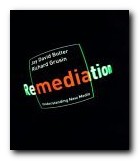
Remediation: Understanding New Media

May 26, 2009 by Roy Johnson

new media – theoretical and practical studies

Jay Bolter is the author of Writing Space, one of the most important books on hypertext of the early 1990s. Here he continues with co-author Richard Grusin his theoretical and practical consideration of digitisation into the realm of ‘new media’: that is, computer graphics, streamed video, and virtual reality. He begins by looking at the ways in which various media – from Renaissance paintings to modern 3D digital images – have tried to render convincing images of the real world.

Remediation: Understanding New MediaThe first part of the book discusses the interesting distinctions to be made between immediacy and hypermediacy. Their definition of remediation is ‘the representation of one medium in another’ and they argue that this is ‘a defining characteristic of the new digital media’.

Their premise is that all new media take over and re-use existing media. Thus the Web grabs aspects of television and printed books. A good Web homepage presents all its most important information visible ‘above the fold’, in the same way as newspapers are designed.

This doesn’t prevent some of the ‘old’ media fighting back. So, for instance, television news programs begin to show separate ‘windows’ on screen – in a clear imitation of the multitasking environment of the computer monitor to which we are now all accustomed.

There’s some heavy-duty language to get through in this section – but the tone lightens in the second part of the book. This deals with studies of a dozen contemporary forms of digital media – computer games, virtual reality, digital art and photography, television, and the Web.

This includes an extended analysis of the game Myst, which is seen in terms of a remediation and critique of film. They chase the differences between photo-realistic painting and digital art all around the houses. It also includes an interesting analysis of Hitchcock’s Vertigo, of Disney theme parks, and of web cam sites.

The analysis does include some dubious assumptions – such as the idea that the difference between film and TV is that we watch films in public and television in private. The truth is that not many people go to the cinema any more, and lots of people watch television films with friends.

The last part of the book returns to a theoretical consideration of the effect of all this on the individual. We are taken into issues such as ‘gender problems in MUDs’ and what it is like in VR experience to be a molecule or virtual gorilla.

It might be hard work to read, but it’s stimulating stuff. There may be further theoretical questions posed on many of these issues – but anybody interested in the uses of new media will not wish to miss what Bolter and Grusin have to say about them.

© Roy Johnson 2000

New Media   Buy the book at Amazon UK

New Media   Buy the book at Amazon US


Jay David Bolter and Richard Grusin, Remediation: Understanding New Media, Cambridge (MA): MIT Press, 2000, pp.295, ISBN: 0262522799


More on digital media
More on technology
More on theory


Filed Under: Media, Theory Tagged With: Jay Bolter, Media, New media, Remediation, Technology, Theory

  • « Previous Page
  • 1
  • …
  • 65
  • 66
  • 67
  • 68
  • 69
  • …
  • 103
  • Next Page »

Get in touch

info@mantex.co.uk

Content © Mantex 2016
  • About Us
  • Advertising
  • Clients
  • Contact
  • FAQ
  • Links
  • Services
  • Reviews
  • Sitemap
  • T & C’s
  • Testimonials
  • Privacy

Copyright © 2026 · Mantex

Copyright © 2026 · News Pro Theme on Genesis Framework · WordPress · Log in