Mantex

Tutorials, Study Guides & More

  • HOME
  • REVIEWS
  • TUTORIALS
  • HOW-TO
  • CONTACT
>> Home / Archives for 2009

Archives for 2009

Small Things Considered

November 5, 2009 by Roy Johnson

reasons why there is no perfect design

Henry Petrowski is professor of civil engineering and history at Duke University, North Carolina. He writes extensively on engineering and design in a populist manner which helps to explain academic and scientific matters to the average reader. And he does it very well. He has a fluent and easy style which reads like someone talking to you over drinks on a veranda on a hot sunny afternoon. Small Things Considered is a good example of his work.
Small Things ConsideredHis main argument in this, one of his many books on the subject, is that considerations of design affect even the small matters of everyday life. And I mean small. Nothing is too insignificant in the running of a normal house to escape his attention – thirty pages on a glass of water, a whole chapter on coffee cup holders in cars, or on the design of paper bags. There’s even a chapter on the positioning of handles on doors.

The reason this is all spelled out at such length is that as part of his leisurely style, he looks at all the ways the design of something might have gone wrong, how the designers could have failed or overlooked some important requirement – before he goes on to look at the more essential element of how they got it right. Nevertheless, his sub-title is significant: even the best-designed objects can eventually be improved upon. As he points out, most patent applications carry ‘Improvement on …’ as part of their title.

The best parts of his accounts are where he delivers the history of a design or an invention, the practicalities of making something work and the financing of prototypes and commercial models. He’s also good the moment he strays into issues of patents, copyright, and ownership, because he obviously knows the history of his subject.

He waxes eloquently about very basic products such as duct tape, WD-40, and Teflon, pointing out just how much research and design went into these apparently simple items. Indeed, WD-40 even gets its name from the fact that the manufacturer’s previous thirty-nine attempts to develop a Water Displacement prototype had not been successful. It was the fortieth that delivered the goods – and then more so when people found all sorts of inventive uses for it. Now it is used for oiling squeaky hinges, loosening stubborn bolts, dissolving glue, and even killing insects.

The most successful chapters are those that consider the details of a specific and complex product. Office chairs are a good case in point. His account of how the Herman Miller Aeron displaced the Steelcase chair of the 1950s takes into account ergonomics, materials, design innovation, ecology, and even social attitudes, though curiously enough he doesn’t mention economics (the Aeron is formidably expensive – as I discovered when I tried to buy one recently).

This is a book to be read alongside Donald Norman’s The Design of Everyday Things and Victor Papanek’s Design for the Real World. It certainly warrants a place on the syllabus of any serious design course, though I doubt that it will reach the classic status of those other two texts, even though it attempts to do so.

Small Things Considered   Buy the book at Amazon UK

Small Things Considered   Buy the book at Amazon US

© Roy Johnson 2009


Henry Petrowski, Small Things Considered, New York: Vintage Books, 2003, pp.288, ISBN: 1400032938


More on design
More on media
More on web design
More on information design

Filed Under: Product design Tagged With: Cultural history, Design, Henry Petrowski, Product design

Some People (Harold Nicolson)

July 11, 2009 by Roy Johnson

amusing character sketches, fictions, and memoirs

Harold Nicolson was a career diplomat, best known for the fact that he was married to Vita Sackville-West, who had a love affair with Virginia Woolf (and other women) and that despite his own homosexuality they kept going a marriage whose apparent success was recorded in their son’s account, Portrait of a Marriage. Nicolson blew this way and that in both literary and sexual terms, but in 1927 he produced a wonderful collection of portraits, Some People, which is part documentary and part fiction.

Some People (Harold Nicolson) They are based on his experiences of public school and the diplomatic service. The idea he explained to a friend ‘was to put real people into imaginary situations, and imaginary people into real situations’. You can view this as a new literary form, alongside such works as Virginia Woolf’s Orlando or just a personal whim, but the result is surprisingly polished and amusing. The sketches are based upon just the sort of upper-class privileged life Nicolson had led – scenes of a childhood spent in foreign legations supervised by a governess; life as a boarder at Wellington College; and early postings amongst similar toffs at the Foreign Office.

In one story Nicolson accompanies Lord Curzon on a diplomatic peace mission to Lausanne where he is due to negotiate with Poincaré and Mussolini – but the whole of the tale is focused on the Dickensian figure of Lord Curzon’s valet who drinks too much and disgraces himself in comic fashion at a high-ranking gala.

The stories are written in the first person – and for someone who had the opinions for which Nicolson became infamous, they are refreshingly self-deprecating. The narrator is more often than not the character in the wrong, the person who has a lesson to learn from others or from life itself. Real people such as Nicolson himself, Marcel Proust, Princess Bibesco, and Winston Churchill flit amongst fictional constructions in a perfectly natural and convincing manner.

The world of public school and Oxbridge run straight through seamlessly into that of the diplomatic service, and even though Nicolson’s conclusions are that its stiff conventions should be challenged and even broken, his stories rest heavily on the shared values of the Old School Tie, letters of introduction, and the right accent.

They reminded me of no less than the early stories of Vladimir Nabokov (written around the same time) which similarly combine autobiographical memoirs with fictional inventions. And the style is similar – supple, fast-moving sentences, a fascination with foreign words and places, and the phenomena of everyday life pinned down with well-observed details.

There was a lake in front of the hotel, cupped among descending pines, and in the middle of the lake a little naked island, naked but for a tin pagoda, with two blue boats attached to a landing-stage of which the handrail was of brown wood and the supports of pink.

It was this that made me think again of Jeanne de Hénaut.

It is writing which is very sophisticated, and which ultimately flatters the reader – it draws you seductively into this world of privilege, clubishness, and money. And yet if he had written more, I should certainly want to read them.

© Roy Johnson 2001

Buy the book at Amazon UK

Buy the book at Amazon US


Harold Nicolson, Some People, London: Constable, 1996, pp.184, ISBN: 094765901


More on Harold Nicolson
More on the Bloomsbury Group
Twentieth century literature
More on short stories


Filed Under: 20C Literature, Bloomsbury Group, Harold Nicolson, Short Stories, The Short Story Tagged With: Biography, Bloomsbury Group, Harold Nicolson, Literary studies, Modernism, Some People

South from Granada

May 26, 2009 by Roy Johnson

life, art, culture, and food of 1920s Spain

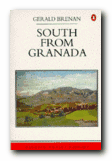
Gerald Brenan was a Bloomsbury Group fringe figure who spent much of his adult life living in and writing about Spain. This is his much-loved travel memoir which recounts setting up home in the Alpujarras in the 1920s – a beautiful but fairly remote area of the south between Granada and the coast. It’s a joy to read for all sorts of reasons – partly because of his amazing fortitude and resourcefulness, and partly because of the empathy he shows towards everything with which he comes into contact.

South from Granada At first he lived on next to nothing, with no water, gas, or electricity, settling in a village miles from anywhere. His idea was to spend his time reading, catching up on an education which he had not received at public school. His food came virtually straight off the land – for this area is rich in fruit, vegetables, and the olive oil for which it is famous. He integrates completely with the locals, and gives wonderfully sympathetic accounts of their customs and behaviour. Anything he wants to buy is miles away in Almeria, Orgiva, or Malaga, and his account includes expeditions we would now consider positively heroic:

I set out therefore on foot by the still-unfinished coast road, buying as I went bread, cheese, and oranges, and sleeping on the beaches. Since I was in poor walking condition, I took five days to do the hundred a fifty miles.

He is amazingly at one with nature. I imagine a keen botanist would find double pleasure in his description of excursions into the Sierra Nevada. And literary fans will be amused at his accounts of visits from Lytton Strachey and Dora Carrington, then Leonard Woolf and Virginia Woolf. His portrait of Strachey’s calvary on the outing to Lanjaron, riding over mountains side-saddle on a mule, carrying a parasol, and complaining of piles – is pricelessly funny.

There are chapters on the calendar of village life, of festivals and religious beliefs, and in particular the powerful local superstitions; a whole section on local food – paella, bacalao, and gazpacho – all quite common now, but at the time, like food off another planet.

There’s a chapter which creates en passant a whole analysis of the Bloomsbury Group and most of its major figures, plus why he felt that by 1930 it had outlived itself as a cultural force. His description of the pleasures and riches of walking in the mountains would take you several holidays just to re-trace his steps.

He offers a history of the region which starts at the Mesolithic Age and traces its development in terms of agriculture, architecture, politics, and land cultivation. He even throws in a chapter describing a guided tour to the brothels of Almeria.

It’s no wonder why this book has remained a popular classic which never goes out of print. Read it if you are interested in Spain, Bloomsbury, or just an account of life, art, and culture from a sensitive and intelligent human being. He went on to write one of the definitive accounts of the Spanish Civil War – but it’s this book which you will want to keep on your shelf.

© Roy Johnson 2008

Buy the book at Amazon UK

Buy the book at Amazon US


Gerald Brenan, South from Granada, London: Penguin, 2008, pp.336, ISBN 0141189320


More on Gerald Brenan
More on the Bloomsbury Group
More on literary studies
More on short stories


Filed Under: Bloomsbury Group, Gerald Brenan Tagged With: Bloomsbury Group, Cultural history, English literature, Gerald Brenan, South from Granada

Specialist Dictionaries

November 5, 2009 by Roy Johnson

Specialist dictionaries have two distinct advantages over conventional reference books. First, they can include far more specialist terms, technical jargon, and explanations of meanings than a normal (average-sized) dictionary. And second, they will help cut down the amount of time you are likely to spend searching for terms. Many of them also include mini-essays on complex topics.

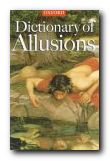
Specialist Dictionaries - Dictionary of AllusionsThe Oxford Dictionary of Allusions is a guide to and an explanation of cultural references commonly found in writing and arts of all kinds. It covers major issues from the classical period to contemporary mass media – including cinema and television. Topics are listed thematically – dancing, danger, darkness – and all entries are cross referenced in an index. This is an attractive new publication.


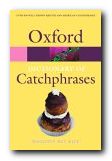
Specialist Dictionaries - Dictionary of CatchphrasesThe Oxford Dictionary of Catchphrases is a compendium of famous sayings and expressions from the world of film, radio, television, and the music hall on both sides of the Atlantic. The sort of thing you might recognise in – Can I do you now, sir?, Shut that door!, Who loves ya, baby?, Bono Estente!, and Eat my shorts!. It offers the original sources for the sayings, as well as fascinating background details about the context and sometimes the history of the performer.


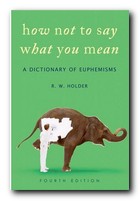
Specialist Dictionaries - Dictionary of EuphemismsThe Oxford Dictionary of Euphemisms is much more than a collection of polite expressions. It’s also a detailed inventory of slang, sexual code terms, metaphors, evasiveness, underworld argot, and indecent language. Topics that invoke euphemism are sex, lavatories, drinking, drugs, crime, and death. The not-so-obvious are commerce, politics, warfare, illness, and ideological belief. Written in a scholarly yet very witty style. Packed with goodies.


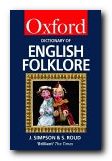
Specialist Dictionaries - Dictionary of FolkloreThe Oxford Dictionary of English Folklore is a compendium of folklore, beliefs, customs, myths, and superstitions. It covers activities such as cheese rolling, Morris dancing, and well dressing; mythical characters such as Robin Hood, Merlin, Beowulf, and father Christmas; what people believe about parts of the body or days of the week; and beliefs associated with simple items such as plants and hedgehogs.
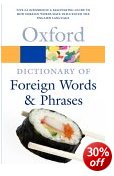
 

Specialist Dictionaries - Dictionary of Foreign Words and PhrasesThe Oxford Dictionary of Foreign Terms lists 8,000 terms, drawn from over forty countries around the world, that have found their way into the English language. From ab origine to mystagogue and zucchetto. What is the plural of fez? How should we pronounce millefeuille? And where would you see a strabismus?


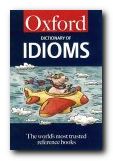
Specialist Dictionaries - Dictionary of IdiomsThe Oxford Dictionary of Idioms explains the meanings of proverbs, traditional sayings, and metaphorical expressions – such as raining cats and dogs and over the moon. It contains American and Australian as well as UK examples. A date of origin is often given and many entries are supported by illustrative quotations. This will certainly be useful for anybody learning English, as well as for people interested in the oddities of the language.


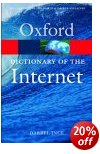
Specialist Dictionaries - Dictionary of the InternetThe Oxford Dictionary of the Internet explains the thousands of new technical terms which have come into use via the Net. Includes newsgroup abbreviations, the language of e-commerce, software technology, security, and the arcane language of hackers, whitehats, and alpha geeks. It gains its strength from concentrating in depth on the Internet and its infrastructure, rather than on general computing terms. Comes with CD-ROM.


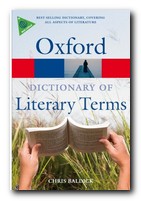
Specialist Dictionaries - Literary TermsThe Oxford Dictionary of the Literary Terms explains the difference between an epic poem and a tragedy, between classical and romantic, between naturalism and realism. The entries range from definitions of the absurd to zeugma, and it is in fact a guide to a mixture of old-fashioned grammatical terms, traditional drama, literary history, and criticism. It contains over 1000 of the most troublesome literary terms you are likely to encounter.
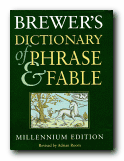
 

Specialist Dictionaries - Brewer's DictionaryBrewer’s Dictionary of Phrase and Fable is an old classic which lists the meanings and origins of common phrases, sayings, and fables. It also covers both real and mythological people and places. Its unique charm – which has kept it a best-seller for more than a hundred years – is that it is based on a solid foundation of the Greek and Roman classics. Much loved by crossword puzzle fans. Once you start reading, it’s a difficult book to put down.


Specialist Dictionaries - Oxford Dictionary of QuotationsThe Oxford Dictionary of Quotations is a compendium of memorable sayings by the witty and famous – from Mae West’s Is that a pistol in your pocket, or are you just glad to see me? to Lytton Strachey’s pithy last words, If this is dying, I don’t think much of it.. Fully cross-referenced. Can serve as a straight work of reference if you are stuck for the source of a famous quotation.


Specialist Dictionaries - Roget's ThesaurusRoget’s Thesaurus is a classic and much-loved reference book. It’s a compilation of synonyms and antonyms – words which mean the same or the opposite of a word you choose. Most people use it to find alternatives for words which they wish to avoid repeating. It can save you hours of head-scratching. So popular that it never goes out of print. A great reassurance for anyone who might feel insecure about language matters.

And now, as Monty Python used to say, for something completely different …

Specialist Dictionaries - Roger's ProfanisaurusRoger’s Profanisaurus is a compendium of all the slang words, smut, double entendres, and sex and toilet talk you will ever need – plus a lot more you might not actually want to know. It’s compiled from the pages of VIZ – the very politically UN-correct comic monthly, and it’s hysterically funny. This is DEFINITELY not for the faint-hearted, but if you understand even half the terms, you’ll get full marks for street cred.


Specialist Dictionaries - Cassell's DictionaryCassell’s Dictionary of Slang is a guide to ‘unconventional English’ – as slang and swearing is often called. It contains over 60,000 entries covering slang from all parts of the English-speaking world, including Britain, North America, Australia, New Zealand and South Africa, from Elizabethan times to the present. It gives definitions for the jargon used by criminals in Victorian London to the drugs culture of the modern world.


Specialist Dictionaries - Oxford Writers DictionaryDictionary for Writers & Editors is a specialist dictionary for writers, journalists, and text-editors. It offers rulings on words and spellings which are commonly problematic (Muslim or Moselm, gypsy or gipsy?); the names of people and places; foreign words and phrases we commonly use (petit-bourgeois); abbreviations; capitalization and punctuation. Covers the difference between hyphens and dashes and acts as a potted encyclopedia for historical names.


Specialist Dictionaries - Oxford Spelling DictionaryThe Spelling Dictionary from Oxford University Press is a dictionary in which the meanings of words are not included. What you have instead is an account of how the word is spelled (or spelt) any variant spellings it might have, and how it is used in different parts of speech. Each entry also shows where the major and minor words breaks should occur in the case of its being hyphenated.


Specialist Dictionaries - Dictionary of Classical Myth and ReligionThe Dictionary of Classical Myth and Religion is a comprehensive A to Z reference to the classical world. In addition to Greek myths and Roman festivals, it covers Greek and Roman religious places, monuments, religious personnel, divination, astrology and magic, and contains many entries on Judaism and Christianity in Greek and Roman times. Some of the entries are the length of mini-essays.
© Roy Johnson 2009


More on dictionaries
More on language
More on literary studies
More on writing skills


Filed Under: Dictionaries Tagged With: Dictionaries, Reference, Specialist Dictionaries

Specials

June 8, 2009 by Roy Johnson

graphic design examples from the stuff of everyday life

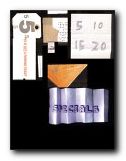
This is an eclectic assembly of graphic design stimulus material. It’s a handsomely printed samples book – if you’re interested in the scratchy-grunge school of typography and design. The examples are drawn from an amazing variety of everyday sources. If there’s a theme that emerges, it’s that a lot of the illustrations originate in one-off events. They come from exhibition catalogues; interactive software paint programs; advertising hoardings; and digitized typefaces.

Specials Some of the more interesting are from business cards; CD covers and record albumn sleeves; art gallery exhibition flyers; and print magazine pages. A lot of the ‘design’, it has to be said, is pretty flimsy. But amongst the more substantial offering are web site home portals; designs for promotional packaging; and some curious examples from public signage.

For trivia enthusiasts there are football score sheets; art college doodlings; some amusing, ultra-utilitarian birthday cards; a carrier bag design; three-dimensional postcards, and (I’m not kidding) instructions for making an origami snowball.

Some of the ideas behind the exhibits are more interesting than the finished work itself, but the book is packed with visual stimulation. In fact the dust cover inserts an interesting invitation to aspiring designers – “It’s about more than just typography. If your work isn’t here, let us know, and perhaps you’ll make it into our next book.”

© Roy Johnson 2002

specials   Buy the book at Amazon UK

specials   Buy the book at Amazon US


Claire Catterall (ed), Specials, London: Booth-Clibborn, 2001, pp. ISBN: 1861542208


More on design
More on media
More on web design


Filed Under: Graphic design Tagged With: Graphic design, Specials, Typography

Speech – how it differs from writing

September 13, 2009 by Roy Johnson

free pages from our English Language software program

Speech – definition

speech Speech is the universal means of oral communication.

redbtn It distinguishes humans from the rest of the animal kingdom.

redbtn Speech (not writing) is considered by linguists as the primary material for study.


Examples

redbtn German, Italian, French, Spanish, are all varieties of European languages.

redbtn Legal, religious, medical, and technical language are all varieties of spoken occupational jargon.

redbtn There are many varieties of spoken language, many of which are used even on an individual basis.


Use

redbtn Speech is innately acquired — unlike writing, which is a skill which has to be learned.

redbtn Speech is used constantly by everyone for a variety of functions, from the passing of information to the sharing of emotions.

redbtn There are no designated human speech organs, but respiratory and digestive organs are adapted to produce speech.

redbtn The pharynx is purely the sound box, shared by other animal species, primarily designed to produce mating, warning, and herding calls.

redbtn Speech and writing are two separate systems and an individual’s linguistic competence depends on the ability to make a clear distinction between the two.

redbtn NB! In linguistic study, speech is primary.

redbtn Speech normally contains hesitations, repetitions, and grammatical ‘errors’. It contains lots of ‘ums’ and ers’, and all sorts of sounds which have no connection with writing as a means of communication.

redbtn Speech is normally accompanied by many other non-verbal features which affect communication — such as intonation and stress, facial expressions, physical gestures, and even bodily posture.

redbtn In the study of language, speech is considered primary and as a system which is entirely separate from writing.

redbtn Children who are learning to write often confuse the two. They produce a written form of speech.

redbtn Maturity is demonstrated by the ability to use a literary style which is completely discrete and separate from speech.

redbtn Humans acquire speech due to their innate programming. Writing on the other hand is a skill which must be learnt in the same way as driving, sewing, or cooking.

redbtn There are still some societies in the world which have no written form of language, but which depend entirely on speech.

redbtn Sign language, among the profoundly hearing-impaired, is a system which can perform all that a spoken language can in terms of communication. In this case, the hands are adapted instead of respiratory and digestive organs in order to communicate.

redbtn As far as Linguistics is concerned, there is no such thing as a primitive language. All languages are equal in potential, to perform any communication task required by its users.

redbtn The organs used in speech are as follows:

lips teeth tongue palate glottis
uvula nose trachea lungs pharynx

redbtn All children develop their ability to use language at approximately the same rate, despite the variations in nationality or circumstances.

redbtn In the process of a child’s development, the acquisition of phonology, semantics and grammar progresses simultaneously.

redbtn This continues until linguistic maturity is reached around the age of seven. After this, an individual’s linguistic competence varies according to training, environment, and perceived necessity.

redbtn This development runs as follows:

Months Sounds
00—03 non-linguistic vocalisations
03—06 babbling
06—09 beginnings of recognisable speech sounds
09—12 one-word sentences such as ‘dada’

redbtn By the age of seven years all the phonological sounds of the language have been acquired.

Self-assessment quiz follows >>>

© Roy Johnson 2004


English Language 3.0 program
Books on language
More on grammar


Filed Under: English Language Tagged With: English language, Grammar, Language, Speech

Speed Up Your Site

July 1, 2009 by Roy Johnson

tips and techniques for improving download times

According to Andrew King, the best way to get people to your site and keep them there is to provide speed, feedback, clear navigation, and fun. His new book Speed up your Site is essentially a series of guidance notes and techniques for shaving every ounce of excess fat from your web pages. This means trimming everything which is not necessary, shortening every bit of code, and compressing the pages wherever possible. It’s intermediate level technically, but anybody with a web page or two could learn something from what he offers – and his instructions are clearly written and well illustrated.

Speed Up Your SiteHe starts out with a chapter of evidence to support the notion that “without feedback, the length of time that users will wait for web pages to load is from 8 to 12 seconds” – though in days where people are increasingly on broadband, these figures seem a bit high to me. One of the novel concepts he introduces is the idea of ‘flow’ – a state of being when we are at one with the activity at hand. What this means in Web terms is that we will go back to those sites where we get rapid feedback.

It becomes really interesting when he embarks on HTML optimisation. Since most people have sites written in HTML, this advice is very useful in showing you how to minimise code and shrink pages.

Every byte counts – Think fast and small

Next he shows how to update pages from HTML to XHTML as well as how to deal with style sheets. He shows how to minimise file sizes as well as how to make the most of the latest CSS-2 conventions, such as replacing JavaScript with CSS-2 rollovers, and how to compress the instructions in the code.

For those who want to tackle really advanced techniques, he shows how JavaScripts can be compressed for speed and even scrambled (obfuscated) for security. He even shows his principles at work in a series of site make-overs.

The latter parts of the book deal with how to optimize graphics and minimize the size of multimedia files, and there’s a very good chapter on different forms of file compression.

For those like me who are a bit intimidated by the more advanced strategies, he also has lots of advice on improving your chances with the search engines by choosing meta-tags and keywords that count.

This is an excellent book for intermediate to advanced users – people who already have a web site, but who want to make it more efficient. Be prepared for a lot of work – but he shows you clearly what to do.

© Roy Johnson 2003

Speed Up Your Site   Buy the book at Amazon UK

Speed Up Your Site   Buy the book at Amazon US


Andrew B. King, Speed up your Site: Web Site Optimisation, Indianapolis (IN): New Riders, 2003, pp.496, ISBN: 0735713243


More on eCommerce
More on media
More on publishing
More on technology


Filed Under: e-Commerce, Web design Tagged With: Computers, e-Commerce, Optimization, Speed Up Your Site, Web design

Spelling checkers used for essays

August 25, 2009 by Roy Johnson

sample from HTML program and PDF book

1. Most word-processors have spelling checkers these days. You should use the checker before printing out your documents. This should form part of your regular editing procedures.

2. Checking your work with a spell-checker will help to highlight and correct commonly mis-spelt words such as ‘accommodation’, ‘parallel’, ‘recommend’, and ‘silhouette’.

3. The checker will also highlight mis-keyed words such as ‘hte’ for ‘the’ or ‘nad’ for ‘and’. You may either choose the correct word from a list, or the processor may offer you the opportunity to reverse the mis-keyed letters. [The latest even perform this function automatically.]

4. It will not be able to recognise specialist terms and unusual proper nouns – names such as Schumacher, Derrida, or Nabokov. These will not be in the processor’s memory. You will have to check the correct spelling of these yourself, as you would do with any other unusual words.

5. Remember that a spell-checker will not alert you to a mistake if you write ‘They washed there own clothes’ instead of ‘They washed their own clothes’. That’s because the word ‘there’ is spelt correctly even though it is being used ungrammatically in this sentence. The same would be true of ‘It is over hare’ instead of ‘It is over here’. That’s because ‘hare’ exists in its own right as a correctly spelt word.

6. Most spell-checkers will spot unwanted double words such as ‘going to to the fair’, and will offer you the opportunity to delete the second occurrence. But they will not notice anything wrong with a word broken by a space such as ‘to morrow’. That’s because these two terms exist in their own right as separate words.

7. The checker will not alert you to any mistake if you key the word ‘practice’ instead of ‘practise’, because both words exist separately. The same would be true of ‘advise’ and ‘advice’. [Most grammar-checkers will alert you to these common problems.]

8. If you decide to add to the processor’s memory names which are frequently used in your own subject discipline (Freud, Jung, Adler or Marx, Engels, Bukharin) make sure that you enter them correctly spelt.

9. Beware of adding too many names which might be thrown up in the checking of your document. Some proper nouns may be the same as mis-spelt words. If you were to add ‘Fischer’ to the dictionary as a name, this would mean that the spell-checker would not alert you to a problem if you mis-keyed ‘fisher’ as ‘fischer’.

10. Beware of adding to your processor’s dictionary just because it is easy and seems a profitable thing to do. You might for instance add your own postcode of ‘SE9 6OY’ – but if you then mis-keyed the word ‘TOY’ as ‘6OY’ the spell-checker would not then be able to pick up your mistake. It would assume that you wished to regard ‘6OY’ as an acceptable ‘word’.

11. A spell check is usually performed after all your text has been generated and edited. However, there are good arguments for using the checker at earlier stages. Layout and spacing might be affected; the document will be in a reasonably good condition at any given stage; and it may eliminate the necessity for a search and-replace procedure at a later stage.

12. Finally, here is a cautionary (and amusing) ditty which might help you to remember some of these points:

‘My New Spell Checker’

Eye halve a spelling chequer
It came with my pea sea
It plainly marques four my revue
Miss steaks eye kin knot sea.

Eye strike a key and type a word
And weight four it two say
Weather eye am wrong oar write
It shows me strait a weigh.

As soon as a mist ache is maid
It nose bee fore two long
And eye can put the error rite
Its rare lea ever wrong.

Eye have run this poem threw it
I am shore your pleased two no
Its letter perfect awl the weigh
My chequer tolled me sew.

[Sauce unknown]

© Roy Johnson 2003

Buy Writing Essays — eBook in PDF format
Buy Writing Essays 3.0 — eBook in HTML format


More on writing essays
More on How-To
More on writing skills


Filed Under: Writing Essays Tagged With: Academic writing, Essays, Reports, Spelling, Study skills, Term papers, Writing skills

Spelling Guide

May 21, 2009 by Roy Johnson

beginner’s simple guide to spelling and language

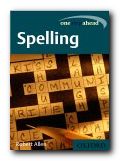
Spelling worries many people. Understandably so, because mistakes in spelling are often regarded as a black mark in terms of literacy and written competence. Oxford University Press have just brought out a series of short beginners’ guides on communication skills. The emphasis is on compact, no-nonsense advice directly related to issues of everyday life. In his Spelling Guide Robert Allen takes a reassuring line in explaining why spelling is difficult in English, and he offers a variety of solutions to the problem.

Spelling Guide Beginners in particular will find his approach very helpful, and even advanced users will probably learn a thing or two. He starts by showing you how to use dictionaries, then how to use spell-checkers. He explains how and why English spellings have often become so irregular. And fortunately, he also explains the cases where some rules do apply.

Some of his advice tips over into tutorials on the nature of language – quite rightly. For instance, one good tip for many people is that the apostrophe in terms such as who’s and it’s stands for a missing letter. Knowing this might help you to understand the spelling, and help you put the apostrophe in the right place.

He deals with all the most common problems – not only the most notorious misplaced apostrophe, but the s/z issue in words such as realise/realize, and word endings, especially the doubling of consonants in words such as regret/regretted. (Yet it’s target/targeted – how strange!)

There’s a whole chapter explaining why spelling is such a complex issue. Basically, it’s because English is comprised of so many different languages. The influence of Latin, Greek, Anglo-Saxon, French, and German are all still actively present.

The second half of the book is a series of checklists of ‘problem’ words – short (weird) long (accommodation) confusables accept/except) noun and verb forms (advice/advise) how to choose the right ending (stationary/stationery) verb endings (finalize/surprise) irregular plurals (banjos/zeros) and words with Latin and Greek endings (addendum/vortex).

The chapters of this book are short, but almost every page is rich in hints and tips. The strength of this approach is that it avoids the encyclopedic volume of advice which in some manuals can be quite frightening. This is a book which will reassure those who need it.

© Roy Johnson 2003

Spelling Guide   Buy the book at Amazon UK

Spelling Guide   Buy the book at Amazon US


Robert Allen, Spelling, Oxford: Oxford University Press, 2002, pp.128, ISBN: 0198603835


More on writing skills
More on language
More on grammar


Filed Under: Grammar, Language use, Writing Skills Tagged With: Language, Spelling, Writing skills

Spelling reform

October 26, 2009 by Roy Johnson

A Plan for the Improvement of English Spelling

Spelling Reform was a much debated issue in the latter part of the nineteenth century and the early years of the twentieth. Various schemes were put forward for simplifying English spelling, which was thought to be difficult and obscure. These schemes often involved phonetic spelling, and some even went so far as proposing the creation of new alphabets. George Bernard Shaw funded one such scheme. A more recent example is Sayspel, devised by hydraulic engineer Roy Blain. None of these ideas came to anything – for very good reasons. This is also the period which gave rise to Esperanto, a totally artificial, invented language which nobody except enthusiasts actually speaks.

The famous short passage that follows is a satirical response to this idea attributed to the American humorist Mark Twain.


For example, in Year 1 that useless letter c would be dropped to be replased either by k or s, and likewise x would no longer be part of the alphabet. The only kase in which c would be retained would be the ch formation, which will be dealt with later.

Year 2 might reform w spelling, so that which and one would take the same konsonant, wile Year 3 might well abolish y replasing it with i and Iear 4 might fiks the g/j anomali wonse and for all.

Jenerally, then, the improvement would kontinue iear bai iear with Iear 5 doing awai with useless double konsonants, and Iears 6-12 or so modifaiing vowlz and the rimeining voist and unvoist konsonants.

Bai Iear 15 or sou, it wud fainali bi posibl tu meik ius ov thi ridandant letez c, y and x — bai now jast a memori in the maindz ov ould doderez — tu riplais ch, sh, and th rispektivli.

Fainali, xen, aafte sam 20 iers ov orxogrefkl riform, wi wud hev a lojikl, kohirnt speling in ius xrewawt xe Ingliy-spiking werld.

Mark Twain


More on language
More on literary studies
More on writing skills
More on creative writing
More on grammar


Filed Under: How-to guides Tagged With: Language, Mark Twain, Spelling

  • « Previous Page
  • 1
  • …
  • 70
  • 71
  • 72
  • 73
  • 74
  • …
  • 103
  • Next Page »

Get in touch

info@mantex.co.uk

Content © Mantex 2016
  • About Us
  • Advertising
  • Clients
  • Contact
  • FAQ
  • Links
  • Services
  • Reviews
  • Sitemap
  • T & C’s
  • Testimonials
  • Privacy

Copyright © 2026 · Mantex

Copyright © 2026 · News Pro Theme on Genesis Framework · WordPress · Log in