Mantex

Tutorials, Study Guides & More

  • HOME
  • REVIEWS
  • TUTORIALS
  • HOW-TO
  • CONTACT
>> Home / Archives for 2009

Archives for 2009

Test Driving Linux

May 31, 2009 by Roy Johnson

try out Linux without installing it on your hard disk

Linux is the completely free operating system which has been developed as part of the Open Source Software movement. It offers a powerful and safer alternative to Windows XP, which many people cannot afford, particularly where multiple installations are concerned. But switching from a well known operating system to something new can be a scary experience. Wouldn’t it be good if you could take a test drive first. That’s where the clever idea behind this book appears. It comes with a CD that lets you run Linux off the disk, without installing it onto you hard drive.
Test Driving Linux It will run more slowly off the CD, but you get to try Linux without taking any risks. David Brickner even supplies the neat wrinkle of saving your settings onto a USB flash disk so that you don’t need to reconfigure Linux each time you boot up. The CD also comes with a full copy of OpenOffice, the free alternative to Microsoft Office, as well as free browsers, graphics editing software, and hundreds of other applications for every type of daily computer task. The desktop interface which comes on the CD is called K Desktop Environment (KDE). He explains how this works and shows how a variety of applications run in it. KDE also has a number of key features of its own – such as the ability to run virtual desktops.

After guiding you through KDE (which works in a similar way to Windows XP) he offers a tour of the free Linux software applications which come on the CD – Konqueror web browser and file manager, Totem multimedia player, Kontact personal information manager, GIMP image editor, and OpenOffice.org. This is a fully featured suite of word processor, spreadsheet, and presentations programs which can open any files from Microsoft Office and save back into that format.

If you don’t like these particular applications, you can just as easily download the Firefox browser or the Thunderbird email client. Almost all these programs are more bug-free and more secure than their Windows counterparts.

The book’s subtitle is “from Windows to Linux in 60 seconds”. You might boot up from the CD in that time, but you’ll want to spend a while using all the programs and trying out the software provided.

If when you’ve finished you feel like making the switch to Linux or running it alongside Windows on a dual-boot system, then he has a very useful conclusion which explains the advantages and shortcomings of the many versions of Linux available.

© Roy Johnson 2005

Buy the book at Amazon UK

Buy the book at Amazon US


David Brickner, Test Driving Linux, Sebastopol, CA: O’Reilly, 2005, pp. 341, ISBN: 059600754X


Filed Under: Technology Tagged With: Linux, Open Sources, Operating Systems, Technology

Text – how to understand it

September 14, 2009 by Roy Johnson

free pages from our English Language software program

Text – definition

text Text literally means ‘a piece of writing’.
redbtn It has now acquired the meaning ‘the object being studied’.


Examples

Charles Dickens’ novel Bleak House is a text.
A letter from the Gas Board is a text.
The caption to a picture is a text.
A painting by Picasso can be a text.


Use

redbtn The term is most used in literary studies, where it was originally used as a synonym for ‘book’.

redbtn But it could just as easily be a poem, a letter, or a diary.

redbtn It is now in general use in other branches of the humanities such as cultural studies and film studies – where its meaning becomes ‘the thing being studied’.

redbtn So — in these other fields it could also be a video film, an advertisement, a painting, or a music score.

redbtn It is used so as to concentrate attention on the object being studied, rather than its author.

redbtn The term ‘text’ is most likely to mean a piece of writing which is the subject of study.

redbtn It is important to remember those elements which are the substance of textual analysis.

redbtn These are all relevant to analysing a text or piece of writing.

audience form function genre
layout subject structure style
syntax tone vocabulary

redbtn The term ‘text’ is used in other areas of enquiry to mean ‘the item being studied’.

redbtn This contemporary usage reflects a concentration on the object of study, rather than on its author.

redbtn This is another point at which the study of language blends into literary studies or ‘critical theory’.

Self-assessment quiz follows >>>

© Roy Johnson 2004


English Language 3.0 program
Books on language
More on grammar


Filed Under: English Language Tagged With: English language, Language, Text, Writing

Text Production

October 31, 2009 by Roy Johnson

the production, transmission, and reception of a text

Text production offers a series of discussion points from a presentation on literary studies. The points focus on the physical production of a text as it progress from author, via publisher, to reader. These are in fact lecture notes from a post-graduate foundation course on the very nature of literary studies. Course participants are invited to reflect on the entire process of literature as a cultural phenomenon – from its origins in the mind of the author, then through the various physical stages of reproduction until it is consumed by the reader.

By taking a historical, philosophical, and materialist view on the nature of what we call ‘literature’, we are forced to recognise the changing nature of the medium of literature itself, as well as notions of ‘authorship’, the creative process, and the physical consumption of language.

Medium

  • carved into wood or stone
  • handwriting on leather, parchment, paper
  • dictation to stenographer, amanuensis
  • written with fountain pen
  • typewriter [from late 19th C]
  • dictaphone [from early 1900s]
  • word-processor [from 1980]
  • World Wide Web [from 1990]

Author

  • legibility of handwriting
  • spelling irregularities
  • punctuation [subjective]
  • revisions to draft
  • multiple versions of a text

Compositor

  • mis-readings of the text
  • ‘regularisation’ of author’s spelling or punctuation
    * in line with ‘house style’
    * on compositor’s whim
  • commercial requirements of space

Printer

  • choice of typeface
  • choice of font size
  • page layout
  • page size
  • paper quality
  • binding

Editor

  • choice of copy text
  • editorial policy on corrections, spelling, substantives and accidentals

Publisher

  • paper and binding quality
  • print run (number of copies)
  • print or digital text
  • selling price
  • number of editions
  • advertising and promotion

Context

  • genre (type) of publication
  • its relation to others of its type
  • social status of such publications

Audience

  • readership and its expectations
  • reader’s ‘purpose’

Reception

  • Critical comment on the text
  • ‘reputation’ of text
  • context in which it is read

© Roy Johnson 2005


More on language
More on literary studies
More on writing skills
More on creative writing
More on grammar


Filed Under: Study Skills Tagged With: Book history, Literary studies, Text production

Textual Bibliography – selected reading

October 27, 2009 by Roy Johnson

recommended fundamental studies in textual scholarship

This is a short but highly selective list of studies in textual bibliography. That is, the classic theories and approaches related to the establishment of authoritative texts. These theories take into account multiple versions and editions of a single work; the ‘intentions’ of the author; printed variants in the text; and the issues arising from authorial revisions.

Textual BibliographyJaques Barzun, On Writing, Editing and Publishing, Chicago: University of Chicago Press, 1986.
George Bornstein (ed), Representing Modernist Texts: Editing as Interpretation, Ann Arbor: University of Michigan Press, 1991.

Fredson Bowers, Textual and Literary Criticism, Cambridge: Cambridge University Press, 1959.

Fredson Bowers, Bibliography and Textual Criticism, Oxford: Clarendon Press, 1964.

Fredson Bowers, Essays in Bibliography, Text, and Editing, Charlottesville: University Press of Virginia, 1975.

Peter Davison, The Book Encompased: Studies in Twentieth Century Bibliography, Cambridge: Cambridge University Press

Philip Gaskell, From Writer to Reader: Studies in Editorial Method, Oxford: Clarendon Press, 1978.

Ronald Gottesman and Scott Bennett, Art and Error: Modern textual editing, London: Methuen, 1970.

D.C. Greetham, Textual Scholarship: An Introduction, New York: Garland, 1994.

John Lennard, But I Digress: The Exploitation of Parentheses in English Printed Verse, Oxford: Clarendon Press, 1991.

G. Thomas Tanselle, A Rationale of Textual Criticism, Philadelphia: University of Pennsylvania Press, 1989.

G. Thomas Tanselle, Textual Criticism since Greg: A Chronicle, Charlottesville: University Press of Virginia, 1987.

[NB! Greetham’s excellent book Textual Scholarship contains a 106 page bibliography covering all aspects of the subject.]

© Roy Johnson 2009


More on language
More on literary studies
More on writing skills
More on creative writing
More on grammar


Filed Under: How-to guides Tagged With: Bibliography, English literature, Literary studies, Reference, textual scholarship

The Art and Science of Screenwriting

July 14, 2009 by Roy Johnson

creative writing guide for the cinema and television

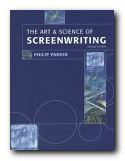
This is a practical handbook on screenwriting, an explanation of what a screenplay is, a guide to getting your own ideas into the correct format, and an account of all the stages that follow the production of a first draft. Philip Parker starts off by explaining the key concepts of any dramatic narrative and showing their relationship to each other in what he calls a ‘creative matrix’. These are story, theme, form, plot, genre, and style. He explains how each of these is relevant, then takes you through what he calls ‘the tools of the trade’ – the original Proposal, the Outline, the Treatment, the Step Outline, and the Screenplay Layout.

The Art and Science of ScreenwritingThese are all progressively longer documents which specify exactly what the film is about and what happens in it. He shows you how to produce these documents, and even how to lay out their contents on the page. He also shows how to develop screen ideas out of novels and stories, contemporary events, historical happenings, even newspaper stories or your own life or dreams. There is also an explanation of the differences in writing for television and the cinema.

The most basic elements are how to establish credible characters and how to best arrange the sequence of events in a multi-strand narrative. To demonstrate this in practice, he offers examples and analyses of film scripts for both television and cinema, showing how scenes are paced and edited, and how narratives are controlled.

He also identifies what he calls the ‘ten basic stories’ and ‘eight basic themes’. I’m not sure that all narratives can be so reduced, but it leads to a lot of useful discussion of genres and stereotypes – and how to recognise them. He also goes on to show the different styles in which films can be shot appropriate to their genre.

He finishes with two important chapters. First, having written the initial draft of your screenplay, how to go about re-writing it to produce a sharper version. Second, how to get your work accepted, deal with agents, cope with rejections, and strike deals which lead to your getting paid.

It’s suitable for anyone who has an interest in screenwriting – from would-be first time writers, to experienced professionals such as directors, producers, and media teachers.

What he emphasises is that producing for the screen is an industry in which the screenwriter is only one part. It might be an important part, but you have to be prepared to co-operate with other people. There are useful suggestions for further reading, but one thing that’s missing is a glossary of technical jargon. That’s one for the next edition.

I still don’t know why screen scripts present their instructions in ugly continuous capitals, but he shows you exactly how to do it. If you want to get on in this business, you have to conform to its rules.

© Roy Johnson 2000

The Art and Science of Screenwriting   Buy the book at Amazon UK

The Art and Science of Screenwriting   Buy the book at Amazon US


Philip Parker, The Art and Science of Screenwriting, Exeter: Intellect, 2nd edn, 1999, pp.219, ISBN: 1841500003


More on creative writing
More on writing skills
More on publishing


Filed Under: Creative Writing, Writing Skills Tagged With: Creative writing, Film, screenwriting

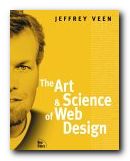
The Art and Science of Web Design

July 22, 2009 by Roy Johnson

web design strategies – for the present and the future

Jeffrey Veen is a webmaster who put the pages of avant-garde magazine WIRED onto the Net, and he went on to have something of a best-seller with his first book – HotWired Style: Principles of Building Smart Web Sites. The Art and Science of Web Design is his follow-up, and if anything, it’s even better. Be warned though. It’s not a practical HTML manual, with lots of advice about how to write web pages. It’s a study of how the Web works, why it works how it does, and what strategies serious users ought to adopt to make it work for their benefit.

The Art & Science of Web Design He starts from a simple premise. Any graphic designers creating attractive printed pages know that they must have a comprehensive knowledge of their tradition. This means they should know the principles of good layout, modern print technology, paper, inks, and the full range of resources for translating their ideas from one medium into another. They are in fact drawing on a design tradition which is nearly six hundred years old.

If that is the case, web designers need to know how their own (new) medium works – and he sets out to make it clear. He starts with a history of the Web, and how its content has always been separated from its appearance. We all know about the constraints and limitations of HTML coding – but now there are style sheets to give us more control. And he shows how this can be done.

In fact he is what might be called a radical traditionalist. He believes that you must respect the fact that web visitors bring notions of navigation and structure from the other sites they have visited. You can introduce novelties onto your site – but these should be subtle, and they absolutely must keep the user’s needs in mind at every click of the mouse.

There are some wonderful in-depth analyses of major sites, showing how they have managed to keep user’s needs in mind, even when building their information from huge databases. Yahoo and Amazon come out well – because they create fast downloading pages which give visitors what they want.

On browsers and speed he is quite uncompromising. You must check your pages in as many browsers as possible, and you must eliminate all superfluous coding so that users get what they are looking for immediately. There’s a fascinating page of screenshots from a competition for high quality homepages – all created within a size of 5Kb maximum.

The other central feature of his argument is an interesting notion of what he calls ‘liquid’ pages. He argues that designers ought to stop worrying about the exact appearance of the layout and graphic features of their pages. Instead they should design so that the page will flow into any browser, on any screen size, set at any resolution.

And he shows how it can be done. There is a wonderful example, reduced to only a few lines of code, showing how style sheets and a clever use of font specifications can be used to create paragraphs which will look good in any browser.

Finally, he presents the idea of what he calls ‘object oriented publishing’. This is creating dynamic websites using templates, stylesheets, and information stored in databases so that the work of the designer is minimised. This part is more technically demanding, but he keeps jargon and coding to a minimum.

Click for details at AmazonIt’s written in an engaging, accessible style. You can try out his ideas immediately, and he gives an account of the way modern web technology works which is inspiring and enthusiastic. This is a very impressive follow-up to his earlier best-seller HotWired Style, and even though it will be of most use to those who already have web sites, anybody with an interest in web design will find something of interest in what he says. It’s going straight onto the Highly Recommended list at this site, and then after fiddling with some code, the first thing I’m going to do is read the book again.

© Roy Johnson 2002

artie shaw Buy the book at Amazon UK

artie shaw Buy the book at Amazon US


Jeffrey Veen, The Art & Science of Web Design, Indianapolis (IN): New Riders, 2001, pp.259, ISBN 0789723700


More on web design
More on technology
More on digital media


Filed Under: Web design Tagged With: Technology, The Art & Science of Web Design, Web design

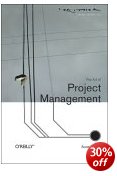
The Art of Project Management

May 24, 2009 by Roy Johnson

Project Management skills from A to Z

Scott Berkun was a senior project manager at Microsoft who worked on the development of Internet Explorer, Windows XP, and MSN. These are his reflections on the philosophy and practice of project management, and on software development in particular. Three things immediately stand clear: he knows a lot about his subject from practical experience; he’s thought a lot about its underlying principles; and he expresses his ideas in a fluent manner.

The Art of Project ManagementThe structure of the book is to take you through all stages of a software design project, from its first conception, through to testing and completion. There are lots of useful tips – such as his ‘rule of thirds’ in which the time devoted to any task of a project schedule is broken down into equal parts – one for designing or planning, another for implementation or programming, and a third for testing or troubleshooting.

He splits his exposition into admirably straightforward topics, such as ‘How to figure out what to do’, ‘Writing good specifications’, and ‘What to do when things go wrong’. His use of jargon is kept to a minimum and he explains any new terms the first time he uses them.

Much of the advice he offers involves nothing more than asking simple but deep questions about each stage of the project: ‘What is the product for?’ Who will use it? How will it be made? Who is responsible for design/testing/implementation?’ These might seem very obvious, but as he points out, many projects fail because nobody takes the trouble to ask them. He even provides a list of common bad ways to decide what to do.

He’s very good on the need for clear expression in all plans and documentation:

It should be understood that clear thought does not require many pages. The most effective leadership documents in the world are not very long. The US constitution, including the Bill of Rights, is a mere 7,000 words (about six pages). The 10 commandments are 300 words. The Magna Carta is 5,000.

Yet strangely enough he does not follow his own advice. His style is lose and conversational. It’s like someone talking to you in a bar. Although this makes for ease, it also extends the page count. This book could easily cover the same ground in a half of its length.

Next he shows what to do with ideas once you have got them, work gets under way, and the project starts to develop its own momentum. The answer to this problem is to use affinity diagrams. This is a fancy term for brainstorming, post-it notes, and putting ideas into logical groups or categories.

The next part of the book deals with the skills a good project manager needs: how to make good decisions; how to write clear specifications; how to develop good communication skills; and what to do when things go wrong (break the problem into small pieces).

The third part of the book deals with the psychological and political part of project management skills – building trust through commitment; getting things done by drawing up clear priorities and plans of work; and recognising that big deadlines are a series of smaller deadlines

Hitting deadlines is like landing airplanes: you need a long, slow approach. And you want to be ready to take off again quickly, without having to do major repairs.

Along the way there are many interesting anecdotes from his years at Microsoft, so the theory is backed up by real-life practical examples. For anybody engaged in projects, whether as manager or humble foot soldier, this offers a clear and reassuring account of the whole process.

© Roy Johnson 2005

Buy the book at Amazon UK

Buy the book at Amazon US


Scott Berkun, The Art of Project Management, Sebastopol: CA, O’Reilly, 2005. pp.488. ISBN 0596007868


More on web design
More on digital media
More on information design
More on technology


Filed Under: Web design Tagged With: Management skills, Project management, Web design

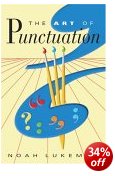
The Art of Punctuation

July 4, 2009 by Roy Johnson

how to use common marks of punctuation

Noah Lukeman is a writers’ agent with a lot of top class clients, so maybe he knows whereof he speaks on this issue. He is concerned with the business of clarifying your writing by using punctuation in an efficient manner. The unique selling point in The Art of Punctuation is that there are no grammar lessons and no attempt to bore the reader with rules and conventions. Instead, he seeks to inform by showing examples of successful use by well-known authors.

The Art of PunctuationAnd his exposition is aimed at creative writers, who I suspect will enjoy this approach. Most of his argument is posed in the form of metaphors (commas: the speed bumps of punctuation) and when he analyses examples, he tries to show how professional writers achieve their special effects. He starts off with an examination of what he rightly identifies as the ultimate basic set, which he calls ‘the triumvirate’ – the comma, semicolon, and the full stop. It’s amazing how much there is to say about them.

You might disagree with some of his arguments. I don’t think it’s a good idea to discuss the dash and brackets at the same time, as if they perform the same function, But on the whole readers unsure about punctuation are likely to profit from what he has to say.

He illustrates his guidance with brief quotes from famous writers – all of which I think will make readers more sensitive to the subtleties of punctuation.

No iron can stab the heart with such force as a full stop put just at the right place. — Isaac Babel

I have been told that the dying words of one famous 20th century writer were ‘I should have used fewer semicolons’. — Lynn Truss

By its very form (;) the semicolon betrays its dual nature; it is both period and comma. — Eric Partridge

He’s quite good on quotation marks, and I think anyone writing character-based work would do well to look closely at the variety of different ways dialogue can be presented in prose fiction.

The same is true of the paragraph. This in my experience is a much neglected aspect of giving structure to writing. I spend a lot of time teaching my students how to identify a topic, how to introduce it, discuss it, and conclude in such a way that brings the topic to a close yet leads on to the next.

This is a non-technical and non-judgemental approach to the subject of how to give pace, flow, and cadence to your writing. It’s also full of insider tips which he drops in from time to time. For instance, he reveals that publishers’ readers will know on the first page of your submitted work if its punctuation is amateurish or professional. And they will know by page five if it goes in the bin or not. So be warned. Get it right.

© Roy Johnson 2007

Buy the book at Amazon UK

Buy the book at Amazon US


Noah Lukeman, The Art of Punctuation, Oxford: Oxford University Press, 2007, pp.208, ISBN 0199210780


More on writing skills
More on language
More on grammar


Filed Under: Writing Skills Tagged With: Grammar, Punctuation, The Art of Punctuation, Writing skills

The Arts Good Study Guide

July 12, 2009 by Roy Johnson

best-selling introduction to study skills for the arts

This is a set text on one of the Open University’s humanities foundation courses, and it has quite rightly become a best-seller. The Arts Good Study Guide can be used as an introductory workbook or as a source of reference. It deals with reading and note-taking, essay writing, working with numbers, and preparing for examinations. It starts with getting yourself organised and managing your time, then goes on to the core study skills for subjects in the arts and humanities. These are reading skills and taking notes, various approaches to studying, writing skills, and then the central issue of writing essays. There’s a useful section on what is particular to studying the arts – questions of analysis, meaning, and interpretation.

The Arts Good Study GuideIt also deals with how you communicate your ideas and opinions; what constitutes evidence; and how you might conduct your own research or projects. Finally, there is a section on revision and examination skills, dispelling some myths about exams, pointing to some of the common pitfalls, and providing tips on the best approach This is a text-heavy book – no pictures – but all the advice is intensely practical and based on real-life examples. The main features worth recommending are its use of realistic examples and the friendly manner in which it addresses the reader. It engages you as actively as possible by posing questions, highlighting important points, setting short quizzes, and breaking up the exposition into manageable chunks.

This approach to active and [in educational jargon] ‘open’ learning is particularly suitable for anyone embarking on a distance-learning course, or students engaged in any form of independent learning. In fact there are now separate versions for sciences and social sciences. There are suggestions for further reading, there’s a full index, and at its current price this is exceptionally good value.

© Roy Johnson 2002

Buy the book at Amazon UK

Buy the book at Amazon US


Ellie Chambers and Andrew Northedge, The Arts Good Study Guide, Milton Keynes: The Open University, 2002, pp.276, ISBN: 0749287454


More on study skills
More on writing skills
More on online learning


Filed Under: Study skills Tagged With: Academic writing, Study guides, Study skills, The Arts Good Study Guide

The Author

November 1, 2009 by Roy Johnson

theories of authorship from Homer to the present

This volume in the Critical Idiom series investigates the changing definitions of the author, what it has meant historically to be an ‘author’, and the impact that this has had on literary culture. Andrew Bennett discusses the various theoretical debates surrounding authorship, exploring such concepts as authority, ownership, originality, and the ‘death’ of the author. Scholarly, yet stimulating, this study offers the ideal introduction to a core notion in critical theory.

The Author He deals with the fundamental question of ‘what is an author?’ and its correlative ‘what does the text mean?’ Asking these question leads to others which take into account copyright law, printing technology, censorship, plagiarism, and forgery. The study begins (rather curiously) by looking at two influential essays – Roland Bathes’s ‘The Death of the Author’, and Michel Foucault’s riposte ‘What is an Author?’ Their theories appear to remove the author, but in fact they are just saying that taking the author into account is only one way of interpreting a text.

You need a strong intellectual stomach to take this as a starting point. Andrew Bennett might have been kinder to his readers if he had led up to this abstract theorising after an explanation of more traditional notions of authorship, such as that offered by Martha Woodmansee which he quotes:

an individual who is solely responsible – and thus exclusively deserving of credit – for the production of a unique, original work

Beginners could easily skip to chapter two and come back later, because he then goes on to trace the history of authorship through European cultural history.

First there is the question of Homer. Was he a real person, of just a ‘figure of speech’ or a ‘back-formation’ in the tradition of oral poetry which produced The Iliad and The Odyssey?

In the medieval period the author was only one of a number of people who might contribute to the composition of a work. Their fundamental concept of authorship was different than ours, and the author might even be anonymous:

Since manually copied books were … distributed amongst the limited circle of the writer’s community, adding the writer’s name to a manuscript was largely redundant. [Then] as the copied manuscript was disseminated more widely, the writer’s name became irrelevant in a different, opposite sense: precisely because the writer was not known to readers outside his community, his name had little importance.

There’s a fascinating discussion of Chaucer as a major transitional figure who straddles three traditions: the oral poet performing to a group; the writer working in a textual tradition; and the precursor of a modern author who inserts himself between the text and the reader. It is at this point that the modern concept of authorship enters European culture – at the end of the fourteenth century.

Then comes the important development of the age of printing. This changes everything, and introduces notions of control, censorship, and copyright. This in turn leads to some mind-turning concepts – for instance that print leads to something fundamentally new and contributes to the process of individualisation. Much of his argument at this point is heavily indebted to the work of Elizabeth Eisenstein and Walter Ong.

It should be remembered that in the early Renaissance there was “an aristocratic disdain for the profession of writing and a prejudice against publication in print on account of its perceived propensity to undermine the fragile class boundary between the aristocracy and the lower gentry”.

This is a tough read, but it’s exciting because it raises so many issues that are important to our understanding of what constitutes ‘literary studies’, and it also seems that these relationships between author, text, and reader are being given a re-shaping with the advent of the Internet and digital writing (though he doesn’t deal with that).

He covers Romantic notions of authorship, which persisted well into the twentieth century, then looks at Formalism, Feminism, and New Historicism. This involves the famous Wimsatt and Beardsley essay ‘The Intentional Fallacy’; the attempts made by feminists to reconcile ‘death of the author’ with their desire to rescue women authors; and what he sees as the New Historicists failure to get rid of the individual creator.

There’s a chapter on collaborative authorship which also includes consideration of film, and he ends by testing out contemporary notions of authorship on recent examples of literary ‘events’ – in particular the publication of Ted Hughes’ Birthday Letters.

This will be of interest to all students of literature at undergraduate level and above – and in particular those taking courses which include consideration of authorship and the history of the book. One thing is for sure. Anyone who has not considered these theoretical issues before will find some thought-provoking ideas here.

The Author   Buy the book at Amazon UK

The Author   Buy the book at Amazon US

© Roy Johnson 2005


Andrew Bennett, The Author, Abingdon: Routledge, 2005, pp.151, ISBN: 0415281644


More on language
More on literary studies
More on writing skills
More on creative writing
More on grammar


Filed Under: Literary Studies, Theory Tagged With: Literary studies, The Author, The novel, Theory

  • « Previous Page
  • 1
  • …
  • 74
  • 75
  • 76
  • 77
  • 78
  • …
  • 103
  • Next Page »

Get in touch

info@mantex.co.uk

Content © Mantex 2016
  • About Us
  • Advertising
  • Clients
  • Contact
  • FAQ
  • Links
  • Services
  • Reviews
  • Sitemap
  • T & C’s
  • Testimonials
  • Privacy

Copyright © 2026 · Mantex

Copyright © 2026 · News Pro Theme on Genesis Framework · WordPress · Log in