Mantex

Tutorials, Study Guides & More

  • HOME
  • REVIEWS
  • TUTORIALS
  • HOW-TO
  • CONTACT
>> Home / Archives for 2009

Archives for 2009

English language terms – a glossary

September 15, 2009 by Roy Johnson

terms used in the study of English language

This glossary of English Language terms contains the vocabulary and the jargon you will need in any analysis of language and its use. These terms are needed in a number of different subjects: language and linguistics, communication skills, the analysis of prose and poetry, and even certain aspects of philosophy. Click on the links for further explanations and examples.

Abbreviations
letter(s) or shortened word used instead of a full word or phrase

Accent
the features of pronunciation which indicate the regional or the social identity of a speaker

Acquisition
the process by which language skills are developed – particularly in infancy

Adjectives
a word which modifies a noun or a pronoun

Adverbs
a word which modifies a verb, an adverb, or an adjective

Agreement
the grammatical logic and coherence between parts of a sentence

Alliteration
the repetition of consonant sounds – usually at the beginning of words

Apostrophes
a raised comma used to denote either possession or contraction

Articles
a word that specifies whether a noun is definite or indefinite

Assonance
the repetition of vowel sounds

Audience
the person or persons receiving a speech or piece of writing

Brackets
Curved or square punctuation marks enclosing words inserted into a text

Capitals
Upper-case letters used to indicate names, titles, and important words

Clauses
a structural unit of language which is smaller than the sentence but larger than phrases or words, and which contains a finite verb

Cliché
an over-used phrase or expression

Colons
a punctuation mark indicating a pause ranking between a semicolon and a full stop

Commas
a punctuation mark indicating a short pause in a sentence

Conjunction
a word which connects words or other constructions

Consonant
an alphabetic element other than a vowel

Dialect
a form of speech peculiar to a district, class, or person

Figure of speech
expressive use language in non-literal form to produce striking effect

Form
the outward appearance or structure of language, as opposed to its function, meaning, or social use

Full stop
a punctuation mark indicating the end of a sentence

Function
the role language plays to express ideas or attitudes

Grammar
the study of sentence structure, especially with reference to syntax and semantics

Graphology
the study of writing systems

Homonyms
words with the same spelling but with different meanings

Hyphen
a short horizontal mark used to connect words or syllables, or to divide words into parts

Idiom
a sequence of words which forms a whole unit of meaning

Irony
saying [or writing] one thing, whilst meaning the opposite

Jargon
the technical language of an occupation or group

Language change
the development and changes in a language

Lexis
the vocabulary of a language, especially in dictionary form

Metaphor
a figure of speech in which one thing is described in terms of another

Metonymy
a figure of speech in which an attribute is substituted for the whole

Morphology
a branch of grammar which studies the structure of words

Noun
a word which names an object

Onomatopoeia
a word that sounds like the thing it describes

Oxymoron
a figure of speech which yokes two contradictory terms

Paradox
a figure of speech in which an apparent contradiction contains a truth

Paragraph
a distinct passage of writing which is unified by an idea or a topic

Participle
a word derived from a verb and used as an adjective or a noun

Phonetics
the study of the production, transmission, and reception of speech sounds

Phrase
a group of words, smaller than a clause, which forms a grammatical unit

Point of view
a term from literary studies which describes the perspective or source of a piece of writing

Preposition
a word which governs and typically precedes a noun or a pronoun

Pronoun
a word that can substitute for a noun or a noun phrase

Punctuation
a system of marks used to introduce pauses and interruption into writing

Received pronunciation
the regionally neutral, prestige accent of British English

Semantics
the study of linguistic meaning

Semicolon
a punctuation mark which indicates a pause longer than a comma, but shorter than a colon

Sentence
a set of words which form a grammatically complete statement, usually containing a subject, verb, and object

Simile
a figure of speech in which one thing is directly likened to another

Slang
informal, non-standard vocabulary

Speech
the oral medium of transmission for language

Spelling
the convention governing the representation of words by letters in writing systems

Standard English
a dialect representing English speech and writing comprehensible to most users

Structure
the arrangement of parts or ideas in a piece of writing

Style
aspects of writing (or speech) which have an identifiable character generally used in a positive sense to indicate ‘pleasing effects’

Stylistic analysis
the study of stylistic effects in writing

Symbol
an object which represents something other than its self

Synonym
a word which means (almost) the same as another

Syntax
the arrangement of words to show relationships of meaning within a sentence

Tense
the form taken by a verb to indicate time (as in past-present-future)

Text
any piece of writing or object being studied

Tone
an author’s or speaker’s attitude, as revealed in ‘quality of voice’ or ‘selection of language’

Verb
a term expressing an action or a state of being

Vocabulary
the particular selection or types of words chosen in speech or writing

Writing
the use of visual symbols to represent words which act as a code for communication

© Roy Johnson 2004


More on How-To
More on literary studies
More on writing skills

Filed Under: How-to guides, Study Skills Tagged With: English language, English language terms, Glossary, Grammar, Language

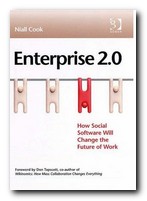
Enterprise 2.0

June 12, 2009 by Roy Johnson

how social media will change the future of work

The title of this book combines two coded terms – Web 2.0 and ‘The Enterprise’ – for which read social media software’ and Big Business. And the purpose is to show how the techniques and concepts behind Web 2.0 applications (blogs, wikis, tagging, RSS, and social bookmarking) can be used to encourage collaboration efforts in what was previously thought of as secretive, competitive businesses.

social mediaIt’s an argument which is fast becoming quite familiar. To succeed in modern business, managers and directors must learn to listen and talk to their customers and staff. They need to be more agile in their thinking, less monolithic in their practices, and they need to catch up to new Internet-based activities which can sweep away unwary traditionalists overnight [look what happened to Encyclopedia Britannica] and create multi-billion pound enterprises almost as quickly [Amazon, Google].

Niall Cook realises that there will be problems and resistance to such suggestions from within orthodox business communities. But he also points to their existing weaknesses.

Companies spend millions of dollars installing information and knowledge management systems, yet still struggle with the most basic challenges of persuading their employees to use them.

Will it be difficult to persuade large organisations to adopt these very democratic tools? He offers case studies from companies such as the BBC, IBM, Microsoft, and BUPA and others to show that it might. He even makes a case for the use of instant messaging and social presence software (MSN and Twitter).

He also has an example of the US Defence Intelligence Agency using mashups to provide simultaneous streams of information through a single interface (because that’s what its users want), and a multinational software company using Facebook as an alternative to its own Intranet (because its employees use it more).

He gives a very convincing example of the creation of a wiki running alongside the company Intranet in a German bank. The IT staff started using the wiki to generate documentation, and within six months use of the Intranet was down 50%, email was down 75%, and meeting times had been cut in half.

In fact he misses the opportunity to point out that one of the biggest incentives for companies to embrace Web 2.0 software is that much of it is completely free. Almost all major programs are now available in Open Source versions – including such fundamentals as operating systems (Linux) content management systems (Joomla) and virtual learning environments (Moodle).

In the UK, government institutions have invested and wasted billions of pounds after being bamboozled by software vendors. In the education sector alone, VLEs such as Blackboard and WebCT have proved costly mistakes for many colleges and universities. They are now locked in to proprietary systems, whilst OSS programs such as Moodle run rings round them – and are free.

Is the embracing of social software solutions likely to take place any time soon? Well, Cook has some interesting answers. His argument is that these developments are already taking place. Smart companies will catch on, and obstructors will fall behind with no competitive edge.

Bear in mind that within just five years, members of the MySpace generation are going to be entering the workforce, bringing their collaborative tools with them. If you don’t have the software that allows them to search, link, author, tag, mashup, and subscribe to business information in the ways they want to, they are going to do one of three things: use third party software that does; leave to join a competitor that does; not want to work for you in the first place.

Even the software solutions in this radical, indeed revolutionary development, must be fast, light, and quick to implement.

Speed and flexibility. Oracle’s IdeaFactory took just a few days to build. Janssen-Cilag’s wiki-based Intranet was purchased, customised, and launched within two weeks.

This is all part of what Peter Merholz in his recent Subject to Change calls agile technology. Cook provides strategies for those who wish to implement these ideas within their own company – and it has to be said that he assumes a certain degree of subversiveness might be necessary.

The book ends with a review of the literature on social software and a comprehensive bibliography – so anyone who wants to pursue these matters at a theoretical level has all the tools to do so. But I suspect that anybody who is taken with these new ideas – if they have any blood in their veins – will immediately want to go away and put them into practice.

This is a truly inspirational book which should be required reading for managers, IT leaders, systems analysts, developers, and business strategists in any enterprise, small, medium, and especially large. I can think of two organisations I am working with right now (one a university, the other a large city college) who ought to be implementing these ideas but who are doing just the contrary – stifling innovation. One, following its culture of ‘no change’ has just been swallowed up by its rival. The other is running onto the financial rocks precisely because it refuses to learn from its users and its own staff – whilst claiming to do just the opposite.

© Roy Johnson 2008

Enterprise 2.0   Buy the book at Amazon UK

Enterprise 2.0   Buy the book at Amazon US


Niall Cook, Enterprise 2.0: how social software will change the future of work, London: Gower, 2008, pp.164, ISBN: 0566088002


More on eCommerce
More on media
More on publishing
More on technology


Filed Under: e-Commerce Tagged With: e-Commerce, Enterprise, Media, Social media, Technology

Envisioning Information

July 20, 2009 by Roy Johnson

best-selling illustrated essays on presenting information

Over the last twenty years, Edward Tufte has published three impressive volumes setting forth his ideas on information design. The first, The Visual Display of Quantitative Information was designated as ‘pictures of numbers’ and dealt with statistical charts, graphs, and tables. This second volume deals with ‘pictures of nouns’, which is his metaphorical way of describing the ‘strategies for high-dimensional data, and how to increase information depth on paper and computer’.

To envisage information…is to work at the intersection of image, word, number, art

Envisioning InformationHe makes a persuasive case for layering, colour, and separation as a means of clarifying information when it is rendered in two dimensions – principally on the printed page. What he calls an ‘escape from flatland’ is illustrated in a series of wonderfully complex diagrams: a Javanese railway timetable shows departures and arrivals, distance, altitude, and even facilities at each station.

He explores the interesting notion that in a world of marks on paper, good presentation is affected by the rule that ‘1 + 1 = 3 or more’. That is, even two simple lines become three visual units because of the space between them – and he provides plenty of information to prove his case, illustrated with such diverse materials as old maps, musical notation, and even medical records.

His argument that small multiple images are the best way to reveal differences is beautifully illuminated by photographs of Chinese calligraphy and nineteenth century engravings of fly fishing lures, but it doesn’t seem altogether convincing – and as in the other volumes of this trilogy, some of the bad examples are just as visually attractive as the good – which appears to spoil the point he’s trying to make.

He’s much more persuasive on the use of colour to impart information, although at some points, even if the prints and engravings are stunning, the reading is not easy:

Transparent and effective deployment of redundant signals requires, first, the need – an ambiguity or confusion in seeing data display that can in fact be diminished by multiplicity – and, second, the appropriate choice of design technique (from among all the various methods of signal reinforcement) that will work to minimize the ambiguity of reading.

For somebody who claims to be aiming for clarity in communication, this reads like a bad example out of a writer’s style manual.

He keeps coming back, as do many other theorists of two-dimensional spatial design, to one of the most interesting challenges of all – the notation of dance. Cue eighteenth-century engravings of dancing masters with fancy hats and weird hieroglyphics trailing out of their feet. Other examples in the book range from flight schedules from Czech airways to Japanese railway timetables, rowing contests, and even a diagram of Wagner’s operas.

If we want to take a robust line on someone who is obviously very successful, it’s possible to argue that Tufte designs more successfully than he writes. Much of the time, his text reads as if it has been badly translated from German; yet if ever he issues his books in paperback, they are so attractive he’ll be able to retire on the proceeds.

© Roy Johnson 2002

Envisioning Information   Buy the book at Amazon UK

Envisioning Information   Buy the book at Amazon US


Edward Tufte, Envisioning Information, Cheshire, CT: Graphics Press, 1990, pp.126, ISBN: 0961392118


More on information design
More on technology
More on digital media


Filed Under: Graphic design, Information Design Tagged With: Displaying information, Edward Tufte, Envisioning Information, Graphic design, Information design

ePublishing and eBooks

October 2, 2009 by Roy Johnson

a selection of resources reviewed

One rapidly expanding opportunity for writers using the Internet is the creation of eBooks. These have the advantage that they can be written, stored, and sent electronically. ePublishing is available for whatever you wish; it doesn’t cost much; you can start small; there are no printing, storage, or postage costs; and you can control the whole process from your back bedroom.

eBooks can be read on desktop computers, but many people prefer to use laptops, eBook readers, or PDAs (Personal Digital Assistants) such as the Palm Pilot. Other people print off the pages and read from the conventional page. So you’ve got to be prepared to supply your text in a number of different formats if you want to reach all audiences.

ePublishingCreating E-books
Chris Van Buren and Jeff Cogswell address all these issues, and provide you with all the information you need to make a start. They include a survey of the e-publishing business; planning and creating an e-book; getting the book published; finance and copyright; and a selection of personal success stories. One of the more interesting features of the advice they give is that it’s suitable either for individuals with just one book to market, or for people who might wish to set up as publishers, ready to promote several titles. As usual with the excellent Topfloor ‘Poor Richard’ series, every chapter is packed with recommendations for online resources – many of which are low-budget or free.

You can market your own eBooks, but a very popular alternative is to place titles with distributors like Fatbrain and split the proceeds. There are also electronic versions of conventional publishers who will pay you royalties up to fifty percent.


The Internet Writer's HandbookThe Internet Writer’s Handbook
This is a detailed guide to publishers of the two formats which are most digital – e-zines and e-books. It’s in the form of an international A-Z listing of the best websites for writers to target, with full contact details for all websites listed. It offers plenty of detail on how to submit your work , how much publishers will pay, and even how they are most likely to respond. The topics these publishers cover range from poetry and fiction, through non-fiction writing, to specialist publications.


eMail Publishing - Click for details at AmazonEmail Publishing
It’s quickly apparent to most writers that this system means that self-publication is an attractive option. In fact Chris Pirillo argues that email publishing can be much more effective than the Web. How is this? Well, he describes publishing via a web site as “like opening a hamburger stand in a dead-end street”. Not many people will pass by, and even fewer are likely to make a purchase.

On the other hand, almost everybody reads their e-mail, so why not use it as a vehicle for publishing instead? Some of the more popular e-mail newsletters have up to 400,000 regular subscribers. In he outlines all the possibilities – discussion groups, bulletins, and announcement lists – but it’s the free e-mail newsletter which is at the heart of this book. He takes you through all the technicalities of how to run one.

This can be used to promote your writing – or even as a hot and direct form of journalism if you are a non-fiction writer. And this guy knows whereof he speaks. He publishes several email newsletters every day, draws down revenue from advertisers, and earns a living from it.

return button Publish your writing

© Roy Johnson 2009


More on publishing
More on journalism
More on creative writing
More on writing skills


Filed Under: How-to guides, Journalism, Publishing, Writing Skills Tagged With: eBooks, Electronic Writing, Journalism, Newsletters, Publishing, Writing skills

Eric Meyer on CSS

July 9, 2009 by Roy Johnson

web design using cascading style sheets

This is essentially a series of practical tutorials on using style sheets. Eric Meyer on CSS talks you through a series of web page makeovers in fine detail, illustrating the tips and tricks of a professional designer. It’s a book for people who already know HTML, but who want to move on into using style sheets. In fact that’s the point from which he starts – showing you how to convert an existing HTML page. The advantages of using CSS are threefold. Your web pages will be smaller and will download more quickly; you gain fine control over the layout of the page; and if you change the appearance of your site, it can be done with no more than one or two lines of code in the style sheet.

Eric Meyer on CSSHe goes through one makeover project in each chapter, showing how each additional line of coding affects the layout of the page. The changes are illustrated with screenshots each step of the way. For those who are really keen to learn, the book has its own web site where you can download all the pages and style sheets used in the tutorials. The idea is you can read his advice and work through the pages in a text editor at the same time.

His examples include styling a press release and an events calendar; bringing hyperlinks to life; controlling and styling navigation menus; and dealing with forms and background images using layers.

One of the most interesting chapters for me was creating style sheets for producing print versions of Web pages – something we have been asked to do a lot recently.

He also covers how to float and position page elements, how to create multi-column pages, and even how to combine sliced graphics with style sheet positioning to make non-rectangular pages.

It all becomes quite technically advanced, but he sticks to his one step at a time approach and explains every change of code and what effect it will have.

This will appeal to those people who want to get hands-on experience of style sheets, and I imagine it will also be useful as a reference for checking the effect of using any coding element – including the often unforeseen side effects.

© Roy Johnson 2003

Buy the book at Amazon UK

Buy the book at Amazon US

Eric A. Mayer, Eric Mayer on CSS: Mastering the Language of Web Design, Indianapolis: IN, New Riders, 2003, pp.322, ISBN 073571245X


More on technology
More on digital media
More on web design
More on computers


Filed Under: HTML-XML-CSS, Web design Tagged With: CSS, Eric Meyer on CSS, HTML-XML-CSS, Web design

Escaping the Delta

July 22, 2009 by Roy Johnson

Robert Johnson and the Invention of the Blues

Escaping the Delta isn’t a conventional biography of Robert Johnson, the most influential blues player ever, but a critical study of the blues itself as a social and musical phenomenon. It takes Johnson as a central, crucial figure and looks at the musical traditions out of which he sprang, looks at his recorded legacy in detail, then examines the manner in which his influence spread following his tragically early death. Elijah Wald takes the somewhat controversial view that the early blues players were simply playing what was for them popular music.

Robert Johnson “No one involved in the blues world was calling this music art. It was working-class pop music, and its purveyors were looking for immediate sales, with no expectation that their songs would be remembered once the blues vogue had passed.” He also poses difficult questions such as why Robert Johnson was ignored by the core black audience of his time yet is now celebrated as the greatest figure in blues history.

Wald is immensely well-informed on the social, historical, and musical background of his topic. All his claims about the relative popularity of musicians is backed up by statistics of the recordings they made, their record sales (where known), and even the most-played records on jukeboxes. Every page is littered with the names of blues musicians – men and women whose work he obviously knows inside out.

The book is structured in three parts – the first is a contextualisation of blues music in the USA in the years 1900-1930; the second is his account of the life of Robert Johnson and an analysis of his recorded legacy; and the third is his socio-musical account of what happened to the blues after his death.


He argues that commentators have persistently ignored the sophistication of black musicians, and failed to acknowledge that the blues might be only one of a variety of styles in which they played, depending on the occasion.

White urbanites, for obvious reasons, are fascinated by a creation myth in which genius blossomed, wild and untamed, from the delta mud, and are less interested in the unromantic picture of Muddy Waters sitting by the radio listening to Fats Waller, or a sharecropper singing Broadway show tunes as he followed his mule along the levee.

When he comes to Robert Johnson, the romantic, tempestuous life is sketched out in a single chapter; but this is followed by three devoted to a examination of Johnson’s complete oeuvre – a couple of dozen songs recorded at two sessions in 1936. He shows in fine detail where Johnson was following the blues tradition and where he was doing something new.

Following Johnson’s death in 1938, Wald then traces how the blues morphed into rhythm and blues, rock and roll, and soul music in the post war period. The torch was just about kept aflame by figures such as Muddy Waters. But by 1960 this flame was almost on the point of being extinguished when along came white English bands such as the Beatles and the Rolling Stones who re-introduced the blues and its original heroes to the USA – where they had come from in the first place.

It’s a controversial claim, but as usual he backs it up with plenty of evidence – not least from figures such as Muddy Waters himself:

I thinks to myself how these white kids was sitting down and thinking and playing the blues that my black kids was bypassing. That was a hell of a thing, man, to think about.

This is a passionately and intelligently argued study which situates blues music in the social and economic world out of which it grew. But what stands clear most of all is the towering romantic figure of Robert Johnson. Reading this book makes you ache to hear his wonderful music yet again.

© Roy Johnson 2005

Robert Johnson Buy the book at Amazon UK

Robert Johnson Buy the book at Amazon US


Elijah Wald, Escaping the Delta: Robert Johnson and the Invention of the Blues, New York: HarperCollins, 2005, pp.342, ISBN: 0060524278


More on music
More on lifestyle
More on biography


Filed Under: Music Tagged With: Blues, Cultural history, Escaping the Delta, Music, Robert Johnson

Essay plans

September 16, 2009 by Roy Johnson

creating firm structure and clear argument

1. Essay plans
You can approach the composition of an essay using a number of different writing strategies. Some people like to start writing and wait to see what develops. Others work up scraps of ideas until they perceive a shape emerging. However, if you are in any doubt at all, it’s a good idea to create essay plans for your work. The task of writing is usually much easier if you create a set of notes which outline the points you are going to make. Using this approach, you will create a basic structure on which your ideas can be built.

2. Planning techniques
This is a part of the essay-writing process which is best carried out using plenty of scrap paper. Get used to the idea of shaping and re-shaping your ideas before you start writing, editing and rearranging your arguments as you give them more thought. Planning on-screen using a word-processor is possible, but it’s a fairly advanced technique.

3. Analyse the question
Make sure you understand what the question is asking for. What is it giving you the chance to write about? What is its central issue? Analyse any of its key terms and any instructions. If you are in any doubt, ask your tutor to explain what is required.

4. Generate ideas
You need to assemble ideas for the essay. On a first sheet of paper, make a note of anything which might be relevant to your answer. These might be topics, ideas, observations, or instances from your study materials. Put down anything you think of at this stage.

5. Choosing topics
On a second sheet of paper, extract from your brainstorm listings those topics and points of argument which are of greatest relevance to the question and its central issue. Throw out anything which cannot be directly related to the essay question.

6. Put topics in order
On a third sheet of paper, put these chosen topics in some logical sequence. At this stage you should be formulating a basic response to the question, even if it is provisional and may later be changed. Try to arrange the points so that they form a persuasive and coherent argument.

7. Arrange your evidence
All the major points in your argument need to be supported by some sort of evidence. On any further sheets of paper, compile a list of brief quotations from other sources (together with page references) which will be offered as your evidence.

8. Make necessary changes
Whilst you have been engaged in the first stages of planning, new ideas may have come to mind. Alternate evidence may have occurred to you, or the line of your argument may have shifted somewhat. Be prepared at this stage to rearrange your plan so that it incorporates any of these new materials or ideas. Try out different arrangements of your essay topics until you are sure they form the most convincing and logical sequence.

9. Finalise essay plan
The structure of most essay plans can be summarised as follows:

Introduction
Arguments
Conclusion

State your case as briefly and rapidly as possible, present the evidence for this case in the body of your essay, then sum up and try to ‘lift’ the argument to a higher level in your conclusion. Your final plan should be something like a list of half a dozen to ten major points of argument. Each one of these points will be expanded to a paragraph of something around 100-200 words minimum in length.

10. Relevance
At all stages of essay planning, and even when writing the essay, you should keep the question in mind. Keep asking yourself ‘Is this evidence directly relevant to the topic I have been asked to discuss?‘ If in doubt, be prepared to scrap plans and formulate new ones – which is much easier than scrapping finished essays. At all times aim for clarity and logic in your argument.

11.Example
What follows is an example of an outline plan drawn up in note form. It is in response to the question ‘Do you think that depictions of sex and violence in the media should or should not be more heavily censored?‘. [It is worth studying the plan in its entirety. Take note of its internal structure.]


Sample essay plan

Question

‘Do you think that depictions of sex and violence in the media should or should not be more heavily censored?‘

Introduction

Sex, violence, and censorship all emotive subjects

Case against censorship

1. Aesthetic: inhibits artistic talent, distorts art and truth.

2. Individual judgement: individuals have the right to decide for
themselves what they watch or read. Similarly, nobody has the right to make up someone else’s mind.

3. Violence and sex as catharsis (release from tension): portrayal of these subjects can release tension through this kind of experience at ‘second hand’.

4. Violence can deter: certain films can show violence which
reinforces opposition to it, e.g. – A Clockwork Orange, All Quiet on the Western Front.

5. Censorship makes sex dirty: we are too repressed about this
subject, and censorship sustains the harmful mystery which has surrounded us for so long.

6. Politically dangerous: Censorship in one area can lead to it
being extended to others – e.g., political ideas.

7. Impractical: Who decides? How is it to be done? Is it not
impossible to be ‘correct’? Any decision has to be arbitrary

Case for censorship

1. Sex is private and precious: it should not be demeaned by
representations of it in public.

2. Sex can be offensive: some people may find it so and should not have to risk being exposed to what they would find pornographic.

3. Corruption can be progressive: can begin with sex and continue until all ‘decent values’ are eventually destroyed.

4. Participants might be corrupted: especially true of young
children.

5. Violence can encourage imitation: by displaying violence – even while condemning it -it can be legitimised and can also encourage
imitation amongst a dangerous minority.

6. Violence is often glorified: encourages callous attitudes.

Conclusion

Case against censorship much stronger. No necessary connection between the two topics.

© Roy Johnson 2004


More on How-To
More on literary studies
More on writing skills


Filed Under: How-to guides, Literary studies, Study Skills Tagged With: Academic writing, Essay planning, Essays, Planning essays, Study skills

Essays and Dissertations

July 10, 2009 by Roy Johnson

the basics of academic planning and writing skills

Oxford University Press have just brought out a series of short beginners’ manuals on communication skills. Their emphasis is on compact, no-nonsense advice directly related to issues of everyday life. Chris Mounsey’s Essays and Dissertations tackles the essentials of academic writing in a systematic manner. He begins with understanding and interpreting essay questions, then moves on to the research you might have to do to answer them.

Essays and Dissertations This involves selecting books, finding quotes, and developing the outline of your own arguments. This is followed by the central point of almost all successful writing – planning. Next comes editing and writing drafts, then how to present your results, using a word processor.

Having covered these basics, he then moves up a notch to cover the more advanced skills of time management, Internet research, and alternative strategies for writing essays. This leads into the special problems posed by dissertations, then exams.

The book ends with a series of writing checklists, guidance on common mistakes, how to deal with footnotes and bibliography, and suggestions for further reading.

The chapters are short; almost every page has hints, tips, and quotes in call-out boxes, there are checklists and suggestions for further reading. The strength of this approach is that it avoids the encyclopedic volume of advice which in some writing guides can be quite frightening.

This book provides students at all levels with easy-to-follow guidance on how to structure an essay and how to select and research the most appropriate subject to write on. You will need more guidance when it comes to writing a long dissertation, but this book will certainly help you to reach that point.

© Roy Johnson 2002

Essays and Dissertations   Buy the book at Amazon UK

Essays and Dissertations   Buy the book at Amazon US


Chris Mounsey, Essays and Dissertations, Oxford: Oxford University Press, 2002, pp.128, ISBN: 0198605056


More on study skills
More on writing skills
More on online learning


Filed Under: Study skills, Writing Skills Tagged With: Academic writing, Dissertations, Education, Essay writing, Essays and Dissertations, Writing skills

Essential Blogging

June 15, 2009 by Roy Johnson

writing for the Web – a popular revolution

Blogs (it’s a contraction of Web Logs) are a form of personal diary kept as Web pages. They can record anything from the trivial details of your own life to online political manifestos. But why would anybody want to read them? Well, some people have transformed the personal diary into an art form, most sprinkle their pages with useful links, others develop what amounts to a one-person daily newspaper, and a few manage to spin out an entirely new form of instant journalism.

Essential Blogging It’s so easy, you see. All you need to do is register with a Blogging site, type your thoughts into the templates they provide, and press the Go button. A few seconds later, you’re published on the Web. Of course there’s a little more to it than that – but not much. This book offers a tour of the best blogging sites, how to upload and maintain your pages, and how to configure the options to get the best effects.

A series of chapters, clearly written by enthusiasts, takes you through which Blog sites and software are available – from Blogger, Radio Userland (free software), Moveable Type, and WordPress. Some of these have developed rapidly beyond mere blogging tools into small-scale content management systems.

All this is expanding at a breathtaking rate. Some people even have blogs running alongside serious Web sites. When you come to look at the thousands upon thousands of blogs, you will be amazed at the variety and the skill of the best.

There’s an element of evangelical fervour in all this. Many bloggers seem like techno-Hippies, but the most thoughtful, such as Meg Hourihan, have made claims for blogging as a new form of writing:

Freed from the constraints of the printed page (or any concept of ‘page’), an author can now blog a short thought that previously would have gone unwritten. The weblog’s post unit liberates the writer from word count.

And just in case you think this might all be a little trivial, these blogs are real Web pages. So they are tracked by search engines – and if enough people read them, they might therefore become ‘famous’. Many are already joining affiliate programmes and even attracting advertising.

If you want to join in this frenzy of personal expression, build your own soap box, or develop your own one-person newspaper – everything you need by way of instructions is in this one book.

© Roy Johnson 2002

Essential Blogging   Buy the book at Amazon UK

Essential Blogging   Buy the book at Amazon US


Cory Doctorow et al, Essential Blogging, Sebastopol (CA): O’Reilly, 2002, pp.244, ISBN: 0596003889


More on publishing
More on journalism
More on creative writing
More on writing skills


Filed Under: Journalism, Media, Publishing Tagged With: Blogging, Cory Doctorow, Essential Blogging, Journalism, Media, Writing skills

Essential English for Journalists

June 18, 2009 by Roy Johnson

guidance on good writing and editing techniques

Harold Evans was editor of The Sunday Times from 1967 to 1981 and then of The Times for a year. [He’s now a New York celebrity with a famous wife]. His earlier publication Newsman’s English was written in the 1970s and has now been revised and updated. Essential English for Journalists is a guide to improving the efficiency of your writing by a method which he announces at the outset as ‘a process of editorial selection, text editing, and presentation’.

Essential English for JournalistsIn fact he gets off to a slightly shambolic start by describing the various responsibilities for writing in the newsroom, but then settles down to his main subject – the crafting of good prose – where he is quite clearly at home. There’s plenty of good advice on sentence construction, editing for clarity, choice of vocabulary, avoiding obscurity and abstraction, plus eliminating vagueness and cliche. He also includes explanations of words commonly misunderstood – such as chronic, disinterested, and viable (to which he might have added aggravate, which is mistakenly used in the text as a synonym for annoy) – plus some interesting comments on how speeches can be economically digested and reported.

The general tendency of his advice is to prefer the shorter, concrete, and Anglo-Saxon term to the longer, abstract, and Latinate expression which is all-too-prevalent: fire not conflagration, try not endeavour, end not terminate.

He also offers a long and entertaining list of common expressions which roll out of literary-cum-oral usage whose redundancies can be edited to produce a tighter result – ‘blue coloured car’, ‘crisis situation‘, and ‘in the city of Manchester’

Evans gives detailed advice on the structure of good writing. His pages on how to write an introduction will be useful to anybody who wants to make their writing more effective. [In fact I would urge the strategy on those who would like to make the arguments of academic writing stand more clear.] The basic rule is to strike out anything which is not absolutely necessary.

In the centre of the book there is a detailed exposition of how newspaper reports should be written – with critical comments on their structure and narrative strategy. Evans shows how the same basic facts can be arranged to create different emphases. This is an exemplary tutorial for anyone who wishes to acquire the skills of reporting and successful composition.

For all its subject, it’s written in a slightly inflated style which combines the short journalist’s sentence with the vocabulary of an Edwardian litterateur – very self-conscious and aware of its own rhetorical devices.

Readers have not the time and newspapers have not the space for elaborate reiteration. This imposes decisive requirements.

But the advice is sound, and it’s likely to make you look more closely at your own prose. In fact the book has at least three possible readers. It would be an excellent textbook for trainee journalists, especially given the number of clumsy examples Evans quotes and then rewrites as demonstration pieces. Second, it has plenty of tips for experienced journalists and editors trying to write more efficiently. Third, it is full of useful guidance for anyone – beyond the media – who wants to write more coherently.

Evans’ fellow journalist Keith Waterhouse wrote a similar and very amusing guide called Waterhouse on Newspaper Style which unfortunately often seems to be out of print. The two books would make an excellent pairing on any writer’s desk. It would be wise to grab Evans whilst he’s back in re-issue.

© Roy Johnson 2000

Essential English for Journalists   Buy the book at Amazon UK

Essential English for Journalists   Buy the book at Amazon US


Harold Evans, Essential English for Journalists, Editors and Writers, London: Random House, 2nd revised edn 2000, pp.256, ISBN: 0712664475


More on writing skills
More on language
More on grammar


Filed Under: Journalism, Writing Skills, Writing Skills Tagged With: Editing, English language, Essential English for Journalists, Journalism, Publishing, Writing skills

  • « Previous Page
  • 1
  • …
  • 29
  • 30
  • 31
  • 32
  • 33
  • …
  • 103
  • Next Page »

Get in touch

info@mantex.co.uk

Content © Mantex 2016
  • About Us
  • Advertising
  • Clients
  • Contact
  • FAQ
  • Links
  • Services
  • Reviews
  • Sitemap
  • T & C’s
  • Testimonials
  • Privacy

Copyright © 2026 · Mantex

Copyright © 2026 · News Pro Theme on Genesis Framework · WordPress · Log in