Mantex

Tutorials, Study Guides & More

  • HOME
  • REVIEWS
  • TUTORIALS
  • HOW-TO
  • CONTACT
>> Home / Archives for 2009

Archives for 2009

Brewer’s Dictionary of Phrase & Fable

May 26, 2009 by Roy Johnson

famous encyclopedia of references and sources

Who were Gargantua’s parents? What are ‘naughty figs’? And what is the origin of the pub name, ‘The Dog and Duck’? It’s no use looking in a dictionary to answer questions like these – and if you pick up an encyclopedia, where would you start? What you need is an old, old favourite reference manual for the humanities – Brewer’s Dictionary of Phrase and Fable.
Brewer's Dictionary of Phrase & FableIt is a compilation of people, places, sayings, customs, and mythology – first published by the Reverend Ebenezer Cobham Brewer in 1870 and massively popular with writers, readers, and crossword-puzzle fans ever since. Brewer was a clergyman-scholar who wrote books on popular education and literature. He drew the bulk of his materials from his reading of the classics.

But to this is added a now-quaint Victorian gloss of the public school polymath. Adrian Room, the editor of this latest version, has introduced French jargon, inkhorn literary terms, and many more historical and fictional characters to those legendary, mythical, and fabulous creatures in the original.

Sometimes Brewer’s entries are so blindingly obvious, you wonder why they were included [‘Fore’ – in the front rank; eminent] but most of the time his examples are very entertaining. A section on ‘Death from Strange Causes’ includes ‘Aeschylus was killed by the fall of a tortoise on his bald head from the claws of an eagle in the air’ and ‘Margutte died of laughter on seeing a monkey trying to pull on a pair of boots’. To this he adds the footnote: ‘It will be observed that four of the last died of laughter. No doubt the reader will be able to add other examples.’

He is particularly good at explaining the historical origins and the symbolic connotations of things we often take for granted, such as pub names, expressions such as ‘too bandy about’ and the hidden meanings in such expressions as ‘a game-leg’. The compilation is also stuffed with potted biographies of Biblical, mythical, and fictional characters, along with all sorts of other ‘knowledge – from the origins of the letter ‘A’, to the note on Zulfagar, which turns out to be the name of Ali’s sword – Ali of course being the cousin and son-in-law of Mahomet.

As you can probably tell, it’s an interesting mixture of really useful reference material and slightly dotty erudition. But it’s that which gives the book its charm. It’s the sort of compilation which when you look up a reference, you can hardly stop yourself reading through lots of the adjacent entries and marvelling at the breadth of learning it represents. It’s the only work of reference I can think of in which you’re guaranteed a laugh on just about every page.

© Roy Johnson 2012

Brewer's Dictionary of Phrase & Fable   Buy the book at Amazon UK

Brewer's Dictionary of Phrase & Fable   Buy the book at Amazon US


Brewer’s Dictionary of Phrase and Fable, London: Chambers, 19th revised edition 2012, pp.1536, ISBN: 0550102450


More on language
More on literary studies
More on writing skills
More on creative writing
More on grammar
Filed Under: Dictionaries Tagged With: Brewer's Dictionary, Cultural history, Fables, Language, Phrases, Reference

Cambridge Encyclopedia of Language

June 14, 2009 by Roy Johnson

history, grammar, and use of world’s languages

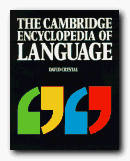
If you take a close interest in language, a dictionary alone is sometimes not enough. You occasionally need a book like this which can explain basics. It isn’t an encyclopaedia in the normal sense: it’s a very readable series of articles, essays, definitions, tables, maps and pictures on every conceivable aspect of languages from around the world. In fact it’s the only reference book of its kind I’ve ever read all the way through, from start to finish. David Crystal has devoted his life to the study of language, and of all his many books on the subject, his Cambridge Encyclopedia of Language is the one to which I return most often.

Encyclopedia of Language It’s a wonderful compendium of easily accessible information on all aspects of language, and there are gems of information on every page. It is written in a lively, non-pedantic style, and is profusely illustrated in such a way as to reinforce our understanding and make it more interesting.

He offers a very readable and humane way to introduce anyone to the wonders and mysteries of human language. He covers topics such as the origins and diversity of languages; the differences between the spoken and the written word; phonetics, semantics, and stylistics; the contentious issues of pronunciation, accent, dialect, and slang; alphabets, dictionaries, and thesauri; language acquisition and language change; grammar, spelling systems, and graphology. If it’s remotely connected with language, you will find it here – explained in a straightforward and often quite amusing manner.

I’ve used this book regularly ever since it first appeared. In fact it oscillates between office and home. The first version appeared in 1987, but you should make sure you get the latest second edition, because David Crystal has added material which takes into account the linguistic changes wrought in the decade since the original’s inception. It also includes a comprehensive glossary of terms and long lists of suggestions for further reading. There’s everything here you will need until you are ready to study language at quite an advanced level.

© Roy Johnson 2010

Cambridge Encyclopedia of Language   Buy the book at Amazon UK

Cambridge Encyclopedia of Language   Buy the book at Amazon US


David Crystal, The Cambridge Encyclopedia of Language, Cambridge: Cambridge University Press, 3rd edn 2010, pp.524, ISBN: 0521736501


More on language
More on literary studies
More on writing skills
More on creative writing
More on grammar


Filed Under: Dictionaries, Grammar, Language use Tagged With: Cambridge Encyclopedia of Language, Communication, Grammar, Language, Reference

Canonising Hypertext

June 17, 2009 by Roy Johnson

putting literary hypertext into the curriculum?

I remember first coming across hypertext in the early 1990s, and feeling that it was like a glimpse of a newly discovered world. Ted Nelson, Jay Bolter, and George Landow all became my heroes overnight. There wasn’t much you could do with it in those days, outside struggling with a few bits of proprietary software such as Hypercard. But as soon as we got the Web, HTML and the first browser (Mosaic: still got my copy) – we were away!

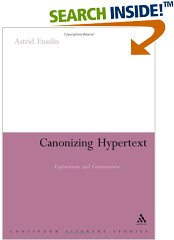
Canonising HypertextSome hyperfictions had been written at that time – and more have since: stories which exploit the possibilities of non-sequential narratives, hyperlinks between pages (or lexia), multiple navigation systems, and reader-generated choices. Astrid Ensslin thinks these creations deserve more attention. Indeed, she wants to argue that they should be included in the ‘canon’ of literary studies – and this is a book-length explanation of why that should be.

But along the way she takes in lots of other issues. the current state of hypertext writing; educational theories and policies; debates regarding the ‘canon’ of English literature; and IT skills in the classroom. It is something of an uphill struggle, because she is surrounded wherever she looks by a lack of evidence to support her claim or any enthusiasm for its implementation.

As a postmodern critic, she is sceptical about the very notion of a canon, yet she is eager to see examples of hypertexts included within it – seemingly oblivious to the fact that it takes a long time for any writer to be canonized. Even modern classics such as D.H. Lawrence and James Joyce were censored and banned before they became a part of Eng. Lit.

So in the absence of any hypertext in the canon of English Literature, she is forced to propose her own. These turn out to be the fairly well-known Michael Joyce (afternoon), Stuart Moulthorpe (Victory Garden) and Jayne Yellowlees Douglas (I Have Said Nothing). These are the ‘first generation’ of hypertext writers. There are ‘plot summaries’ so far as this is possible with non-sequential writing, yet even whilst making great claims for their work, she is curiously reluctant to quote from them to prove that these qualities exist. [I have checked out the work where it’s accessible, and I can tell you that there is nothing to get excited about.]

[As an aside, I simply cannot understand why so many of these writers imprison themselves within the confines of proprietary software (Eastman’s Storyspace) when the vast, free, and ubiquitous resources of HTML-based multimedia is open to them. Maybe it’s because Eastman also acts as a publishing house, and sells their products on its site?]

She then makes something of a swerve – into the realms of the philosophy of education – before getting back to hypertext in the classroom. There, to what should be nobody’s surprise, there is little evidence of its being used to its full potential, let alone being ‘canonized’. Ensslin huffs and puffs at length considering what could be done, what might be done, and what should be done about it. She even spells out the curriculum for a project she ran – and shows the results, which were ‘encouraging’.

Does any of this alter the potential of literary hypertext? I’m afraid not – because she ignores two very important factors. Number one – every day, millions of people are reading and writing hypertexts on blogs and Wikis (two terms which only crop up once in the whole book). Of course she would argue that the sort of hypertexts she has in mind are creative, literary, and fictional – whereas the majority of bloggers are writing non-fictional prose.

Number two – It doesn’t seem to occur to her that hypertext simply isn’t an appropriate medium for imaginative literature. This is because it lacks the features which readers value very highly in imaginative literary genres – a highly organised and very subtle sense of structure in the work. We like tightly organised plots, themes, symbols, and carefully articulated stories. These are what separate ‘literature’ from plain prose. Moreover, we have prized equally highly, since the middle of the nineteenth century, a subtly controlled point of view. This is not possible if the reader is genuinely free to take any route through a collection of documents or pages.

I have to warn you that she writes in a style which is designed to impress academic promotion committees – turgid, abstract, clotted with qualifiers, over-signposted, and dripping with ‘scholarly references’. At one point I began to suspect that the book might be an undeclared research project – perhaps a postgraduate dissertation or thesis.

Nevertheless, for anyone interested in the subject of electronic writing, hypertext, or experimental narratives, I think it’s worth grappling with the difficulties to get an up-to-date view on the issues.

© Roy Johnson 2007

Canonising Hypertext   Buy the book at Amazon UK

Canonising Hypertext   Buy the book at Amazon US


Astrid Ensslin, Canonizing Hypertext, London: Continuum, 2007, pp.197, ISBN: 0826495583


More on literature
More on the novella
More on literary studies
More on short stories


Filed Under: Literary Studies Tagged With: Canonising Hypertext, English literature, Hypertext, Literary studies, Theory

Capital letters – how to use them

August 30, 2009 by Roy Johnson

free pages from our English Language software program

Capital letters – definition

capital letters Capital letters are used to show the importance of particular words.
redbtn They are always used for proper nouns (people’s names) ; at the start of sentences ; and for places and events of a public nature.


Examples
  • He entered the room, accompanied by Christine Bowman.
  • John wrote a letter to the Bishop of Chester.
  • We will visit Sherwood Forest at Easter this year.

Use

redbtn Capital letters are always placed at the beginning of a sentence.

redbtn They are also used to indicate names and titles, as well as holidays and well-known public places.

redbtn NB! Avoid continuous capitals.

THEY LOOK VERY UNSIGHTLY AND ARE HARD TO READ

redbtn Capitals are used to denote the names of particular or special things.

days of the week Wednesday, Friday
places East Anglia
rivers the river Mersey
buildings the Tate Gallery
institutions the Catholic Church
firms British Aerospace
organisations the National Trust
months of the year April, September

redbtn However, when such terms are used as adjectives or in a general sense, no capital is required:

the King James Bible / a biblical reference

Oxford University / a university education

the present Government / governments since 1967

redbtn Capitals are used when describing intellectual movements or periods of history:

Freudian – Platonism – Cartesian – the Middle Ages
the Reformation – the Enlightenment

redbtn They are also used in the titles of books, plays, films, newspapers, magazines, songs, and works of art in general. The normal convention is to capitalise the first word and any nouns or important terms. Smaller words such as ‘and’, ‘of’, and ‘the’ are left uncapitalised:

A View from the Bridge
The Mayor of Casterbridge
North by Northwest
The Marriage of Figaro

redbtn Notice the difference between the same term used in a general and a particular sense:

The children’s Uncle Fred is seventy.
Their uncle is the oldest in the family.

Self-assessment quiz follows >>>

© Roy Johnson 2003


English Language 3.0 program
Books on language
More on grammar


Filed Under: English Language Tagged With: Capital letters, English language, Grammar, Language, Spelling

Capital letters in essays

August 22, 2009 by Roy Johnson

sample from HTML program and PDF book

1. Capital letters in essays are always placed at the beginning of a sentence, and they are used for all proper nouns:

He slowly entered the room, accompanied by his friend James Bowman.

2. They are used when a particular thing is being named. For instance

days Wednesday, Friday
places East Anglia
rivers the river Mersey
buildings the Tate Gallery
institutions the Catholic Church
firms British Aerospace
organisations the National Trust
months April, September

3. However, when such terms are used as adjectives or in a general sense, no capital is required:

the King James Bible   BUT   a biblical reference

Manchester University   BUT   a university education

4. Capitals are used when describing intellectual movements or periods of history:

Freudian      Platonism      Cartesian

The Middle Ages      the Reformation

5. They are also used in the titles of books, plays, films, newspapers, magazines, songs, and works of art in general. The normal convention is to capitalise the first word and any nouns or important terms. Smaller words such as and, of, and the are left uncapitalised:

A View from the Bridge
The Mayor of Casterbridge
North by Northwest
The Marriage of Figaro

6. The convention for presenting titles in French is to capitalise only the first or the first main word of a title:

A la recherche du temps perdu
La Force des choses

7. However, there are many exceptions to this convention:

Le Rouge et le Noir
Entre la Vie et la Mort

8. In German, all nouns are given capitals:

Reallexikon zur deutschen Kunstgeschichte

9. Works written in English which have foreign titles are normally
capitalised according to the English convention:

Fors Clavigera       Religio Medici

10. Interesting exception! Capitals are not used for the seasons of the year:

autumn      winter      spring      summer

© Roy Johnson 2003

Buy Writing Essays — eBook in PDF format
Buy Writing Essays 3.0 — eBook in HTML format


More on writing essays
More on How-To
More on writing skills


Filed Under: Writing Essays Tagged With: Academic writing, Capital letters, Essays, Punctuation, Study skills, Term papers, Writing skills

Carlyle’s House and Other Sketches

July 25, 2009 by Roy Johnson

Virginia Woolf’s previously unpublished early works

This is an unusually exciting event for Woolf fans – the first publication of an undiscovered notebook which had been lost for seventy years. Carlyle’s House was written in 1909 when Virginia Woolf was living with her brother Adrian in Fitzroy Square. She was struggling with her first Novel, The Voyage Out and wondering if she would ever be married. It was discovered only a couple of years ago, in Birmingham. The contents of the notebook (which she made herself, by hand) is a series of seven portraits written, as she says of them herself as a sort of artist’s notebook: “the only use of this book is that it shall serve for a sketch book; as an artist fills his pages with scraps and fragments, studies of drapery – legs, arms & noses … so I take up my pen & trace here whatever shapes I happen to have in my head … It is an exercise – training for eye & hand”.

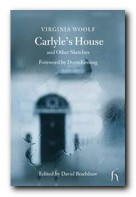
Carlyle's House and Other Sketches They are an attempt to capture people visually, socially, and even morally. She is trying out the literary techniques which were later to make her famous – capturing the sense of life by a combination of shrewd observation, making imaginative connections between disparate subjects, and sliding effortlessly into philosophic reflections on the topic in question.

Some of her observations and commentary are amazingly snooty and condescending. Speaking of the children of Sir George Darwin who she visits in their campus home in Cambridge, she observes:

Margaret is much less formed; but has the same determination to find out the truth for herself, and the same lack of any fine power of discrimination. They enjoy things very much, and fancy that this is due to their superior taste; fancy that in riding about the streets of Cambridge they are building up a theory of life.

Even people’s furniture and choice of paintings and home decor is subject to a scrutiny so close that it becomes like a moral measuring tape:

In the drawing room, the parents’ room, there are prints from Holbein drawings, bad portraits of children, indiscriminate rugs, chairs, Venetian glass, Japanese embroideries: the effect is of subdued colour, and incoherence; there is no regular scheme. In short the room is dull.

As Christopher Reed argues in his authoritative study of this subject, Bloomsbury Rooms, the aesthetics of interior design and furnishing held amongst the Bloomsberries was shot through with a political ideology.

Woolf idolatrists will have to swallow hard to stomach the disgusting anti-semitism of her revealingly entitled piece ‘The Jews’ – for it is in fact a sketch of a single person, Mrs Loeb, who she had visited at Lancaster Gate.

There’s a commendably thorough introduction by Woolf specialist David Bradshaw, full explanatory footnotes, and a foreward by Doris Lessing which is so poorly written that it throws the style of the young Virginia Woolf into high relief. Bradshaw also offers a commentary on each sketch, setting it in context and bringing together all the observations from wide-ranging Woolf scholarship which throw light on these episodes.

This might be the work of the young and untried Woolf, and it might reveal the less-developed and even unappealing side of her character. But we know that she revised many of these attitudes and beliefs in later life. This is a brief collection which enthusiasts will not want to miss.

© Roy Johnson 2005

Carlyle's House Buy the book at Amazon UK

Carlyle's House Buy the book at Amazon US


Virginia Woolf, Carlyle’s House and Other Sketches London: Hesperus, 2003, pp.88, ISBN: 1843910551


More on Virginia Woolf
Virginia Woolf – web links
Virginia Woolf – greatest works
Virginia Woolf – criticism
More on the Bloomsbury Group


Filed Under: Virginia Woolf Tagged With: Biography, Bloomsbury Group, Carlyle's House and Other Sketches, Essays, Literary studies, Virginia Woolf

Carrington: A Life of Dora Carrington

June 19, 2009 by Roy Johnson

Art, love, and Bohemian life in Bloomsbury

Dora Carrington was a painter, an early feminist, and a figure who flits in and out of the lives of several members of the Bloomsbury Group, of which she was a significant member. This is the (so far) definitive biography of her troubled existence, which covers her day-to-day life in great detail – much of it based upon her voluminous correspondence. She grew up in a stiflingly conventional home in Bedford, loving her father and hating her mother.

Carrington: A Life of Dora Carrington With a talent for art, she was glad to get away from home at seventeen and spread her wings at the Slade, living in Gordon Square, right in the heart of Bloomsbury. Her style of painting and drawing was firmly traditional, and it fitted with the aesthetic of the Slade.

She was unaffected by the craze for Post-Impressionism which followed Roger Fry’s famous 1910 exhibition at the Grafton Galleries which Virginia Woolf claimed changed human nature that year. She cut her hair short in a style which became famous (‘crop head’) and two of her fellow students, ‘Chips’ Nevinson and Mark Gertler, promptly fell in love with her. This resulted in the first of her many love triangles, plus a form of unhappiness for all concerned. Although she behaved in a provocative manner, she refused to choose between them, or to have a sexual relationship with either of them.

In 1914 she met D.H. Lawrence and David Garnett, joined Roger Fry’s Omega Workshop, and was moderately successful in her decorative art work. Then in 1915 she spent a weekend amongst the Bloomsbury Group at Asheham which was to change her life. Lytton Strachey (who was in love with Mark Gertler) made a sexual pass at her, and she immediately fell in love with him.

Although she had kept Gertler at bay for five years, she gave herself to Strachey from the outset – then ended up having a sexual relationship with both men at the same time, even though Strachey was really a homosexual. [Remember – this is Bloomsbury.] Eventually she set up home with Strachey at Tidmarch Mill House and found her first sustained period of happiness.

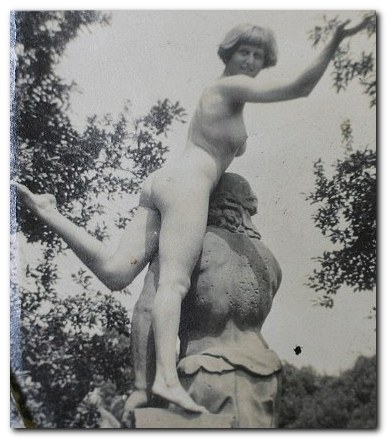
Dora Carrington nude

Yes – that’s Dora Carrington

However, with a twist which typifies relationships in the Bloomsbury Group, they moved Ralph Partridge in to live with them. Carrington shared his bed, and Strachey fell in love with him. She then moved to live with Partridge in Gordon Square when he was given a job at the Hogarth Press, and then married him in 1921, even though she claimed she was still in love with Strachey – who with characteristic generosity paid for their honeymoon, and even joined them on it.

Not long afterwards she started an affair with her husband’s best friend, Gerald Brenan – around the same time that Partridge moved his new lover Valentine (actually Gladys) Dobree into their family home at Tidmarsh.

It is commonly assumed that Carrington sacrificed her artistic possibilities to the effort of looking after Strachey and Partridge, but Gretchen Gerzina argues that on the contrary, she was at her most productive when her domestic and personal life were settled and untroubled by romantic entanglements.

But the level of emotional masochism in her life is remarkable. Whilst her husband took his new lover Frances Marshall on holiday to Paris, he forbade her to even write to Gerald Brenan. She distracted herself from this humiliating position by starting an affair with Henrietta Bingham, the daughter of the American ambassador, a foray into Sapphism which made her regret she hadn’t started earlier. And this didn’t stop her sleeping with Gerald Brenan as well – so by this time she had certainly got rid of her earlier sexual reluctance.

Almost all the evidence for this personal narrative comes from letters. These people were super-communicative on paper. But the correspondence needs to be carefully interpreted – because they often wrote knowing that third parties might read what they said. Partridge not only banned Carrington from writing to Brenan, but insisted on reading all her correspondence. So she developed the strategy of inserting personal messages into secret addenda – which were nevertheless sometimes intercepted. And she was much given to reading other people’s private mail too.

As the menage she helped to create with Strachey and Partridge began to fall apart, she consoled herself with Bernard (Beakus) Penrose [brother of Sir Roland] in one last romance. But it was Strachey who remained her most lasting affection, and when he died (of undiagnosed stomach cancer) in 1932 she felt that she could not live without him. So she shot herself – aged just thirty-nine.

© Roy Johnnson 2012

Dora Carrington Buy the book at Amazon UK

Dora Carrington Buy the book at Amazon US


Gretchen Gerzina, Carrington: A Life of Dora Carrington 1893-1932, London: Pimlico, 1995, pp.342, ISBN 0712674209


More on art
More on biography
More on the Bloomsbury Group
Twentieth century literature


Filed Under: Art, Biography, Bloomsbury Group, Individual designers Tagged With: Art, Biography, Bloomsbury Group, Cultural history, Dora Carrington

Cascading Style Sheets

July 9, 2009 by Roy Johnson

complete explanation of style sheets for web designers

This is the second edition of Eric Meyer’s best-selling guide to cascading style sheets. It covers CSS1 in impressive depth, and cautions readers quite frankly about some the problems of the still immature CSS2. Style sheets are the solution to the one big limitation of HTML. They allow authors to control the appearance of what’s on the page, leaving the HTML code to describe the content and its structure – which was its purpose in the first place.

Cascading Style Sheets The original guide to CSS, Cascading Style Sheets, produced by its inventors Hakon Lie and Bert Bos, is thorough and well illustrated, but it’s written in a very dry manner. Eric Meyer manages to make his account more readable, and more easily digestible for those who will need it. His ‘definitive guide’ is organised in logical sections which discuss what can be done with fonts, colour, the appearance of text, and layers – which is the introduction of a third dimension to what appears on screen.

He explains the many ways of creating colour – with a humane description of the mind-bending hexadecimal system. Then he deals with the complications of length units, the arrangement of text on the page (using spacing, justification, decoration, and alignment) and the way in which fonts and the appearance of text can be controlled.

He goes into a lot of detail on the manner in which fonts are rendered – their family, size, weight, attributes. The same is true on backgrounds. It’s a pity that O’Reilly have decided to limit the book illustrations to white, grey and black – because the topic is crying out for colour illustration.

Sometimes there are extended descriptions of what CSS tags will do, when an illustration would have been more useful, but he explains which elements are ‘deprecated’ – that is, ‘in the process of being phased out’ from the HTML Specification.

CSS also allows authors to get ready for the eventual move from HTML to extensible markup language (XML) so it’s worth learning about style sheets if the current enthusiasm for XML is going to last. There are some amazingly complex effects described which involve background images and negative positioning – pushing graphics off the screen.

You have to be prepared to embrace another set of jargon – declarations, elements, selectors, properties, pseudo-elements, values, specificity, and inheritance – but no doubt these terms will become familiar.

There are also three useful appendices – an annotated list of resources, a complete list of CSS1 and CCS2.0 properties, a sample style sheet, and a list of browser support. O’Reilly have occasionally been criticised for calling so many of their manuals ‘the definitive guide’ – but in this case there’s a good case to say the title is fully justified.

© Roy Johnson 2006

Buy the book at Amazon UK

Buy the book at Amazon US


Eric A. Meyer, Cascading Style Sheets: The Definitive Guide, Sebastopol, CA: O’Reilly, third edition, 2006, pp.518, ISBN 0596527330


More on technology
More on digital media
More on web design
More on computers


Filed Under: HTML-XML-CSS Tagged With: Cascading style sheets, CSS, HTML-XML-CSS, Web design

Cascading Style Sheets

July 4, 2009 by Roy Johnson

explanation – by the guys who invented them

What are cascading style sheets (CSS)? Answer – “a simple mechanism for adding style (fonts, colors, spacing) to Web documents”. If you have spent any time at all wrestling with HTML code, trying to control the layout and appearance of text on a page, you will know one thing. It’s an almost hopeless task. What looks good in Netscape might be a dog’s breakfast in Internet Explorer, and it will probably look even worse in Opera. The same would be true of more recent browsers such as FireFox and Google Chrome.

Cascading Style SheetsAs Lie and Bos explain: “HTML doesn’t pay much attention to the document’s appearance” – so CSS offers “a simple language that can be read by humans”. It’s basically another system of coding which can be added to .htm pages which allows the author more control over the physical appearance of what’s on the page. It also begins the process of separating appearance from content. They start with an introduction to basic HTML (which they claim can be learned in less than a day!) before describing CSS in all its detail. This is where any normal user will encounter the first difficulty – because the code is defined in a relentlessly arbitrary jargon – of ‘selectors’, ‘declarations’, ‘properties’, and ‘values’.

Then they go on to describe the variety of ways in with a style sheet can be ‘glued’ to a document. This fortunately offers the user more than one way to achieve a particular effect. But there’s no escape from the abstract style:

Recall from Chapter 1 that an attribute is a characteristic quality, other than the type or content of an element. In that chapter we discussed the attributes HREF, SRC, and ALT. In this chapter we will discuss two new attributes that have been added to all HTML elements to support style sheets

But what it lacks in accessibility, it makes up for in thoroughness, and fortunately, the book is very well illustrated. They cover all the features of this mini-technology which Web designers are likely to require – fonts, spacing, layers, colours, and the tricky issue of forward compatibility. They describe the issues of cascading and inheritance which advanced users might wish to exploit. I would have liked to see the page code for some of the wonderful examples they reproduce in full colour, but at least they show what CSS can do.

Style sheets may well become more popular as the early generations of browsers which didn’t support them fade into the ancient history of the Web [that is, anything more than five years old]. If you’re interested in exploring the possibilities of CSS, then you might as well get the story from the guys who invented the idea – and make sure you buy the latest (third) edition, which contains a useful comparison of browser-support. As the HTML standard is developed to keep pace with browsers in their latest versions, this is a book with a bright future.

© Roy Johnson 2005

Buy the book at Amazon UK

Buy the book at Amazon US


Hakon Lie and Bert Bos, Cascading Style Sheets: Designing for the Web, New York/London: Addison-Wesley, (third edition) 2005, pp.416, ISBN 0321193121


More on technology
More on digital media
More on online learning
More on computers


Filed Under: HTML-XML-CSS Tagged With: Cascading style sheets, CSS, HTML-XML-CSS, Web design

Case agreement – how to understand it

August 29, 2009 by Roy Johnson

free pages from our English Language software program

Case agreement – definition

case agreement There must be grammatical logic or case agreement in the links between parts of a sentence.

redbtn This coherence is called ‘case agreement’ or ‘concord’.


Examples

The boy is swimming.
[singular subject, singular verb form]

The boys are swimming.
[plural subject, plural verb form]


Use

redbtn Agreement may be required in tense, number, or case.

redbtn Problems are more likely to occur in writing than in speech.

redbtn NB! To avoid such problems in writing, keep your sentences short.

redbtn If the subject of a sentence is singular, then the verb form must be singular as well:

The shop [singular] opens at nine o’clock.
On Thursdays the shops [plural] open late.

redbtn Sometimes confusion occurs because a statement begins in the singular but then drifts into the plural:

wrong
It can be argued that a person has the right to know when they are dying.

redbtn The easiest solution to this problem is to make the subject plural and its verb plural as well:

correct
It can be argued that people have the right to know when they are dying.

redbtn Sometimes a singular noun is used to denote a plural or a collective thing – such as ‘government’ or ‘parliament’.

redbtn Either the singular or the plural verb form may be used – but the important thing is to be consistent.

wrong
The government prefers to let matters rest, but events may make them change their minds.

correct
The government prefers to let matters rest, but events may make it change its mind.

correct
The government prefer to let matters rest, but events may make them change their minds.

redbtn Agreement is necessary in English because the language is ‘uninflected’.

redbtn That is, most words are not given separate endings to indicate which part of the statement they represent.

redbtn English relies very heavily on grammatical rules and syntax [word order] to make sense.

redbtn [In some languages — classical Latin, for instance — word order is not important.]

Self-assessment quiz follows >>>

© Roy Johnson 2003


English Language 3.0 program
Books on language
More on grammar


Filed Under: English Language Tagged With: Case agreement, English language, Grammar, Language

  • « Previous Page
  • 1
  • …
  • 12
  • 13
  • 14
  • 15
  • 16
  • …
  • 103
  • Next Page »

Get in touch

info@mantex.co.uk

Content © Mantex 2016
  • About Us
  • Advertising
  • Clients
  • Contact
  • FAQ
  • Links
  • Services
  • Reviews
  • Sitemap
  • T & C’s
  • Testimonials
  • Privacy

Copyright © 2026 · Mantex

Copyright © 2026 · News Pro Theme on Genesis Framework · WordPress · Log in