Mantex

Tutorials, Study Guides & More

  • HOME
  • REVIEWS
  • TUTORIALS
  • HOW-TO
  • CONTACT
>> Home / Archives for 2009

Archives for 2009

Creating eBooks

May 31, 2009 by Roy Johnson

complete guide to e-book publishing – on a budget

Creating eBooks offers distinct advantages to writers. You can publish whatever you wish; it doesn’t cost much; you can start small; there are no printing, storage, or postage costs; and you can control the whole process from your back bedroom. It’s true that there are also problems of which format to choose and what to do about copying, but technical solutions to these problems are emerging rapidly. Chris Van Buren and Jeff Cogswell address all these issues, and provide you with all the information you need to make a start.
Creating eBooksThey include a survey of the e-publishing business; planning and creating an e-book; getting the book published; finance and copyright; and a selection of personal success stories. The variety of e-book readers and file formats is explored fully, giving a reasonably even-handed account of the advantages and drawbacks of each one. They cover GlassBook, Acrobat, Rocketbook, and Softbook, as well as Microsoft’s Reader which has caught up after a late start.

They also discuss print on demand (POD) in a lot of detail, pointing out that some authors even give away their e-books, calculating that it will create a demand for sales of the print version. En passant they point out that despite all the obvious novelties in e-books, the most commercially successful business models are those which are gradually merging with traditional book publishing.

They also give a detailed account of how the new e-publishing industry works, and how important it is for authors and publishers to know about such things as digital object identifiers (DOI) and meta-data descriptions. The importance of XML becomes apparent at this point. Describing data in a general, universal language makes it more useable, re-useable, and transferable from one form to another.

Why is XML important? Because this is the manner in which electronic books will be described in the future. The truth is that writing e-books is relatively easy. This part of the process involves skills many people already possess. It’s the promotion and marketing of them which is difficult – and will be new to most folk.

They describe all the options and methods of copyright, encryption-protection, and digital rights – then they suggest that we wait and see. Their argument is that we are more frightened of people swapping free copies than we need to be.

One of the more interesting features of the advice they give is that it’s suitable either for individuals with just one book to market, or for people who might wish to set up as publishers, ready to promote several titles (which they argue can be done almost as easily as one).

You will also learn a lot about the economics and business practices of the traditional book publishing trade – on which so much of the e-book world is based. There are also in-depth tutorials on copyright and the small print of writer-publisher contracts.

As usual with the excellent Topfloor ‘Poor Richard’ series, every chapter is packed with recommendations for online resources – many of which are low-budget or free.

There’s also a useful list of e-book publishers and the literary genres they handle. Anybody who is interested in the e-book phenomenon – whether as writer, publisher, or both – needs to understand the issues discussed here.

© Roy Johnson 2002

Creating eBooks   Buy the book at Amazon UK

Creating eBooks   Buy the book at Amazon US


Chris Van Buren and Jeff Cogswell, Poor Richard’s Creating E-Books, Lakewood (CO): Topfloor Publishing, 2001, pp.317, ISBN: 1930082029


More on eCommerce
More on media
More on publishing
More on technology

Filed Under: e-Commerce, Publishing Tagged With: Business, Creating eBooks, e-Commerce, eBooks, Print on demand, Publishing

Creating Killer Web Sites

July 18, 2009 by Roy Johnson

best-selling web design guide with graphics emphasis

Design guru David Siegel posits the notion that web sites exist in three ‘generations’. First generation sites, created in the mad rush of the early 1990s, were not much more than text files with hyperlinks – and they were inescapably linear:

most had edge-to-edge text that ran on for pages, separated by meaningless blank lines. At best, they looked like slide presentations shown on a cement wall.

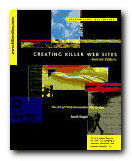
Creating Killer Web SitesSecond generation sites were basically the same, but with with icons replacing words, tiled images replacing the ubiquitous grey background, and banners replacing headlines. His claim for the idea of third generation sites is that they offer a new visual experience in which the visitor is ‘pulled’ through the pages using metaphors and “well-know models of consumer psychology”.

For instance, he’s in favour of ‘splash screens’ – entry pages which act as an advert for the sites they introduce. Then he wants sites to offer an ‘experience’ rather than effective data-sharing. The site maps he reproduces in the latest edition of Creating Killer Web Sites have pages on which there is only one link to anything else. He even promotes the idea of ‘exit’ pages which tell the site visitor that this web experience is over.

Having visited his personal site with its splash screen of the Andy Warhol ‘Marilyn’ prints several times, I find them simply an unnecessary impediment to accessing the valuable advice he makes available beyond. None of this sits easily with the idea that any page should be no more than two or three clicks away from any given point. And why introduce an extra stage in the navigational process which yields no real information? This ‘guided tour’ approach to the web experience works directly against the sprit of hypertext, which should give people the freedom to follow whatever links they choose. Why then has he been such a powerful influence in the last few years?

Well, the truth is that apart from this rather idiosyncratic notion, he has a lot of very useful advice to offer on the practical aspects of site design. Not only is his book elegantly produced, it’s packed with tips and tricks which have proved enduringly popular. Much of his success as a designer is founded on his background in typography and graphics, and he makes no bones about the fact that he wants more control of layout on screen.

His most useful guidance, it seems to me, is focused on the aesthetics of page elements and the visual experience of reading on a monitor. For instance, he maintains his crusade against the horizontal rule <HR> but has abandoned advocacy of the single-pixel gif trick to control white space. He’s now in favour of the non-breaking space <&nbsp;> and he has the honesty to admit that many of these devices are ‘hacks’ to achieve effects denied us by the browser.

Text should be held in a narrow column [like this one] and should be limited to what can be read in about a minute, or four to six screens, before offering a new page. He’s against the use of bullets: “They are ugly, identical, and convey little meaning…design around them in all cases” – and he produces plenty of elegant screen shots and page makeovers which support his arguments.

He’s equally adamant on the use of indents to separate paragraphs – “no matter what it takes to make them” and the use of the <P> tag is designated as Deadly Sin number one. I think he’s just a little quirky in this, because this strategy is clearly striving to imitate the appearance of the printed page where it may not always be appropriate – on screen.

He deals with the most fundamental issues of page layout using clear language, and he illustrates the HTML techniques to achieve each effect in a way which anybody could follow. There’s no tricky programming or Java script to be mastered. My notebook was full in no time of coding tips, URLs, and bibliographic recommendations which I’m itching to follow up.

It’s slightly disappointing that the admirable clarity of his approach in early sections of the book is not extended to those on typography and ‘site makeover’. Here he assumes that all the manipulation will be via graphics, and some chapters are dense with PhotoShop techniques which are not as general as his advice on page layout. There is nothing on choice of fonts or the use of the <FONT> tag, which is still controversial enough to warrant comment. He assumes you’ll already know a lot about the creation and manipulation of images. Yet how many readers outside design studios would be able to make much of advice such as “I flatten this entire page and use adaptive color reduction with no dithering”?

Fortunately, there are full-page reproductions of the HTML code for his designs, which is helpful for analysing and understanding the effects he is discussing. He also has an honest and breezy style – “Hang on. This is going to get messy” – and he spells out the truth of rapid and uneven development:

Designers are facing new challenges: how to design sites during the awkward transition from version 3.0 and 4.0 browsers to the version 5.0 and [more important] 6.0 browsers to come. The limitations of 3.0 browsers require designers to resort to workarounds and tricks

This frankness is one of his key strengths. He admits that he doesn’t know how to write his own cgi scripts, and en passant like a young enthusiast he recommends interesting free services and software – such as Gif Wizard, which will optimise your images – as well as very clever tricks for pre-loading the image for a page in advance of its appearance.

In the latter part of the book he offers predictions for the future – cascading style sheets, then XML will predominate – plus some rash promises on details: “I predict that in late 1998, PNG [a graphic format] will take over. With any luck, GIF will be eradicated like the SmallPox virus by the end of 1999”. We’ll wait and see.

I think it’s clear why Creating Killer Web Sites has become a best-seller. Apart from the fact that it’s very stylishly designed and printed, it concentrates on reproducing the sort of graphically advanced page designs which many people would like to create. Strictly speaking, this is really for site builders who wish to maximise the visual novelties of their design whilst minimising the strain put on bandwidth resources. However, it has so many fascinating insights and practical tips to offer, it’s a design manual you can’t really afford to miss.

© Roy Johnson 2002

Buy the book at Amazon UK

Buy the book at Amazon US


David Siegel, Creating Killer Web Sites: The Art of Third-Generation Site Design (2nd edn) Indianapolis: Hayden, 1997, pp.306, ISBN: 1568304331


More on web design
More on digital media
More on technology


Filed Under: Web design Tagged With: Creating Killer Web Sites, David Siegel, Graphic design, Web design

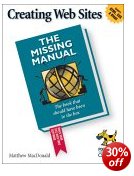
Creating Web Sites: The Missing Manual

July 5, 2009 by Roy Johnson

basic hands-on techniques for beginners

Missing Manuals are a series of technical help books which have come along to fill the space left by software developers who can’t be bothered to explain how their programs work. This one covers lots of software, because it deals with the entire process of creating and running your own web site. Matthew MacDonald starts off by explaining how web sites work and how to decide which is the best type for you. Then it’s time to roll up your sleeves and learn the details of HTML code and how to create a sample site. First he talks you through the basics of page layout, then he takes a big step forward technically to show you how to choose and register a domain name and how to upload files via FTP.

Creating Web Sites: The Missing Manual(My advice for beginners would be to skip this chapter and come back to it later when you are ready to launch.) Following this he looks at HTML editors such as Front Page and Dreamweaver and talks you through their features. I was glad to see however that he also includes free downloadable editors such as Nvu and CoffeCup. Next he talks you through all the most common formatting devices you will need to make your pages look good. Then it’s on to style sheets, which is the correct and the best way to arrange the appearance of what appears on screen.

Next comes adding graphics, which most people want to do, once they’ve started creating text. Some of the techniques he demonstrates involve quite a sophisticated knowledge of style sheets and graphics, but fortunately he spells out the required coding and gives illustrated examples of the results. The same is true of his chapter on tables and layout using styles.

He gives excellent advice on promoting your site to search engines and directories, as well as straightforward explanations of some of the arcane technicalities of search engines.

There’s also a chapter I didn’t really expect – on how to make money with your site by signing up to the Google Ads and Amazon affiliate programs. These really do allow you to “make money whilst you are asleep” – so long as you can attract enough visitors to your site.

He ends with some fairly advanced tips and tricks: using JavaScripts and Dynamic HTML; creating fancy buttons and dropdown menus; and adding multimedia audio and video files. But for those people who want to have a presence on the Web but can’t cope with all the technicalities of building and maintaining pages, he concludes with a chapter on blogging. This really is the quickest and easiest solution.

I have been tinkering with web sites and reviewing web design manuals for years, and all I can say is that this is the best beginners manual I have come across.

© Roy Johnson 2005

Buy the book at Amazon UK

Buy the book at Amazon US


Matthew MacDonald, Creating Web Sites: The Missing Manual, Sebastopol: CA, O’Reilly, 2005, pp.548, ISBN 0596008422


More on web design
More on digital media
More on technology


Filed Under: Web design Tagged With: Creating Web Sites, The Missing Manual, Web design

Creative Web Writing

June 15, 2009 by Roy Johnson

guide to online possibilities for creative writers

Creative Web Writing is Jane Dorner’s latest book which examines the skills you need if you want to put your writing onto the Internet. Her emphasis is on creative writing. She is speaking to those people who have been creating poems and stories in their back rooms and getting nowhere. If you realise that the Internet presents lots of new possibilities, this is her explanation of how it works and what those possibilities are.

Creative Web WritingShe covers collaborative story-telling, research online, interactivity and flexible text, as well as the nuts and bolts of styling for screen reading. Most importantly, she explains the range of new markets, new technologies, and how to apply them. Creative genres are covered, including autobiography, poetry, broadcasting, screen-writing and writing for children. There’s also a very useful survey of the various delivery methods and payments for eBooks.

This is one of the most popular methods for aspiring authors to reach new readers. This section will be required reading if you are thinking of venturing into this world.

She also describes how to look carefully at contracts, how to submit your writing to an electronic publisher, and how to deal with Print on demand (POD) outlets.

The central part of the book deals with new forms of writing using Web technologies. This is one field in which she has clearly done her homework. She shows examples of writing in the form of Blogs (Web-logs) email (epistolary) narratives, fictions illuminated by graphics, the weird world of MUDs and MOOs, Flash-animated writing, and phonetic poetry.

Then she confronts the central problem for all writers working in a hypertext environment – the conflict between traditional linear story-telling and the random, fragmented, interactive experiences which the Web makes possible. The answer is, there’s no easy answer.

Computer games she sees as a powerful paradigm for new story-telling, with additional possibilities offered by SMS messaging via mobile phones, and Big Brother type interactive radio and TV programmes.

She also provides some useful tips on writing style [Keep it short – Get to the point] some interesting notes on copyright in relation to hyperlinking; and there are plenty of useful listings. Software for self-publishing, story-generation, and storyboarding. Writing courses, experimental writers and writing groups, and most useful of all – details of eBook publishers and what they pay.

And by the way, if you’ve not had a lot of success with traditional publishers – don’t worry too much. She explains why the market works against new writers and anything experimental. Read what she has to say, and you might not become rich and famous – but you’ll realise that it is possible to put your work before the digital public.

© Roy Johnson 2003

Creative Web Writing   Buy the book at Amazon UK

Creative Web Writing   Buy the book at Amazon US


Jane Dorner, Creative Web Writing, London: A & C Black, 2002, pp.166, ISBN: 0713658541


More on creative writing
More on writing skills
More on publishing


Filed Under: Creative Writing, Publishing, Writing Skills Tagged With: Creative Web Writing, Creative writing, Electronic Writing, Publishing, Web writing, Writing skills

Critical Guide to Joseph Conrad

July 9, 2009 by Roy Johnson

biography, guidance notes, and literary criticism

This comes from a new series by Routledge which offers comprehensive but single-volume introductions to major English writers. They are aimed at students of literature, but are accessible to general readers who might like to deepen their literary understanding. The approach taken could not be more straightforward. Part one of the Critical Guide to Joseph Conrad is a potted biography, placing Conrad’s life and work in its socio-historical context. Thus we get his early years in Poland, his career as a seaman, his influences and ambitions, and his (relatively slow) rise to fame as a novelist. One of the interesting features of Conrad’s development as a writer is that his early novels were largely adult versions of boy’s adventure stories.

The Complete Critical Guide to Joseph ConradHowever, as his work became richer he tackled themes of intense political complexity. Read Heart of Darkness today and you would swear it had been written quite recently. Part two provides a synoptic view of his stories and novels. The works are described in outline, and then their main themes illuminated. This is followed by pointers towards the main critical writings on these texts and issues. I must say that reading through the synopses of some of his lesser known works made me want to go back to them again.

Part three deals with criticism of Conrad’s work. This is presented in chronological order – from contemporaries such as Richard Curle and his collaborator Ford Madox Ford, via early champions such as F.R. Leavis and Albert Guerard, to critics of the present day, with the focus on colonial and post-colonial criticism.

The book ends with a chronology of his life, a commendably thorough bibliography which covers biography, criticism in books and articles, plus pointers towards specialist Conrad journals.

This is an excellent starting point for students who are new to Conrad’s work – and a refresher course for those who would like to keep up to date with criticism.

© Roy Johnson 2006

Buy the book at Amazon UK

Buy the book at Amazon US


Tim Middleton, The Complete Critical Guide to Joseph Conrad, London: Routledge, 2006, pp.201, ISBN 0415268524


More on Joseph Conrad
Twentieth century literature
More on Joseph Conrad tales


Filed Under: Joseph Conrad Tagged With: English literature, Joseph Conrad, Literary studies, Modernism, The Complete Critical Guide to Joseph Conrad

Critical Guide to Samuel Beckett

July 14, 2009 by Roy Johnson

biography, guidance notes, and literary criticism

This Critical Guide to Samuel Beckett comes from a new series by Routledge which offers comprehensive but single-volume introductions to major English writers. In this case it’s a writer who was Irish, who wrote in English, then in French, then translated his own work back into English. It is a guide aimed at students of literature, but it’s also accessible to general readers who might like to deepen their understanding.

Critical Guide to Samuel BeckettThe approach taken could not be more straightforward. Part one is a potted biography of Beckett, placing his life and work in a socio-historical context. Thus we get his early influences and his move from Trinity College Dublin to life in Paris working as secretary to James Joyce. We are also nursed through an introduction to the literary Modernist movement of which he formed an important part. Part two provides a synoptic view of Beckett’s stories, novels, plays, and poetry.

The works are described in outline, and then their main themes illuminated. This is followed by pointers towards the main critical writings on these texts and issues. Beckett is not an easy writer to categorise. We think of him mainly as a dramatist – but he is equally influential (if not so highly regarded) as a writer of novellas and short stories.

Part three deals with criticism of Beckett’s work. This is presented in chronological order – from the work of the 1960s which sought to explain what seemed at the time an odd view of the world, to critics of the present day.

The book ends with a commendably thorough bibliography which covers biography, criticism in books and articles, plus pointers towards specialist journals.

This is an excellent starting point for students who are new to Beckett’s work – and a refresher course for those who would like to keep up to date with criticism. These guides have proved to be very popular. Strongly recommended.

© Roy Johnson 2000

Buy the book at Amazon UK

Buy the book at Amazon US


David Pattie, The Complete Critical Guide to Samuel Beckett, London: Routledge, 2000, pp.220, ISBN: 041520254X


More on Samuel Beckett
Twentieth century literature
More on biography


Filed Under: Samuel Beckett Tagged With: Complete Critical Guide to Samuel Beckett, Literary studies, Modernism, Samuel Beckett

CSS Cookbook

July 17, 2009 by Roy Johnson

quick solutions to common style sheet problems

Style sheets take all the slog out of designing the appearance of your web pages. No more fiddling with the code in a multitude of pages: just fix the font size, the line spacing, the page width or the size of headings in one file, the style sheet, and that will apply across your whole site. This is a guide to what is possible using the latest specification (2.1) of style sheets, written by Christopher Schmitt – one of the endless number of expert authors O’Reilly manage to locate.

CSS CookbookIt’s aimed at people who want to make a start with style sheets, or who are grappling with their problems and need quick fix solutions. It assumes you know the basics of web design using standard HTML markup, but he does keep the relationship between the two clearly in mind:

As a design language, CSS is focused on presentation, which includes helping web developers control the layout of their pages. HTML tables and other elements, on the other hand, are tools you use to mark up content. The ideal is to have HTML represent the structure of the content as an intellectual abstract level and CSS say how to present it for a particular device.

The presentation couldn’t be simpler. First a problem is specified (You want to indent the first line of a paragraph) and then he shows the CSS code to achieve it, followed by an illustrative screen shot. There’s an explanation of how and why it works as it does, and there are web links to online tutorials and official specifications directly related to that topic.

Each chapter considers one element of a web page that style sheets can control – the font, the page, links, lists, forms, tables, and how to create print-friendly pages.

He shows some of the new effects possible with the latest CSS version 2.1 – creating collapsible menus and tabbed folders, designing forms without using tables, controlling the appearance of content held within table cells, and creating multi-column pages holding the content in place with the very useful float property.

One of the hardest parts of learning about style sheets so far as I am concerned is the language in which it is expressed. It’s a pity there’s so much abstract terminology. Even at intermediate level it’s difficult to grasp immediately statements such as this:

Because these properties aren’t passed to child block-level elements, you don’t have to write additional rules to counter the visual effects that would occur if they were passed.

He finishes with some nifty tips, tricks, and workarounds. How to create a print-friendly style sheet for instance. This removes all the decoration and navigational graphics from a web page to produce something that is comfortably readable when printed out. All this without changing one bit of the page markup.

There’s also a useful appendix listing discussion groups, web resources, downloadable software, and ready-made CSS templates. Like everything else in this book, these take you quickly to solve problems of design.

The latest edition of this book is a hugely enlarged resource – more than double the size of the first. It’s been expanded to include much more information for CSS learners, explaining topics that range from basic web typography and page layout to techniques for formatting lists, forms, and tables. For more advanced users it has also been updated to take into account the behaviour of CSS in the latest versions of web browsers, including Internet Explorer 7, plus Firefox and Opera. You can’t get much more up to date than this.

© Roy Johnson 2009

Buy the book at Amazon UK

Buy the book at Amazon US


Christopher Schmitt, CSS Cookbook, Sebastopol, CA: O’Reilly, third edition, 2009, pp.736, ISBN: 059615593X


More on technology
More on digital media
More on web design
More on computers


Filed Under: HTML-XML-CSS Tagged With: CSS, HTML-XML-CSS, Style sheets, Web design

CSS The Missing Manual

July 8, 2009 by Roy Johnson

easy guide to styling web pages

We all know that cascading style sheets (CSS) is the way to go for web designers. It helps to separate style from content, and you can change the appearance, font, or layout of an entire website with just one tweak of style sheet code. But how d’you do it, and what’s the best way of controlling the appearance of your web pages? David McFarland’s new book CSS – The Missing Manual starts out by listing all the reasons you should wean yourself away from those old HTML habits and explaining why XHTML and the use of style sheets is more efficient. He explains inline and external stylesheets then very gradually shows you how to create one.

CSS The Missing ManualI still find it difficult to get my head round the abstract language of styles (declaration, selector, property, and value) but he spells it out as clearly as possible. But the best part about his approach is that he is systematic, detailed, and very straightforward. Each stage in the process is illustrated with a screenshot – though I think the use of colour printing would have helped. Then it’s on to class selectors, plus divs and spans for creating special effects

After that he moves on to discuss basic formatting – how to adjust the appearance of text on the screen. And i couldn’t help thinking that this should have come earlier. Almost any beginner I can imagine would first of all want to learn how to affect the appearance of text on the page, beforedealing with more complex issues such as ‘cascade inheritance’. So if you’re just starting out, jump straight to chapter six.

The good thing is that he shows you every step of the way: what to type in as CSS code; how to create the effect you need; refresh the browser – and, hey presto! – there it is on screen.

Another thing I like about this series is that all along the learning route they list software which is available as free download to perform the tasks that you need.

© Roy Johnson 2009

Buy the book at Amazon UK

Buy the book at Amazon US


David McFarland, CSS: the Missing Manual, Sebastopol, CA: O’Reilly, 2009, pp. 560, ISBN: 0596802447


More on technology
More on digital media
More on web design
More on computers


Filed Under: HTML-XML-CSS Tagged With: CSS, HTML-XML-CSS, Style sheets, Web design

CVs and Job Applications

July 3, 2009 by Roy Johnson

presenting yourself successfully in writing

If you’re applying for a job, you need all the help you can get. This book is a guide to maximising your chances. CVs and Job Applications is a manual of practical advice and useful tips on how to design your CV and write successful job applications. It focuses on preparing your application and presenting yourself in the best possible light. To do this you will need to think carefully about your own skills, interests, and aptitudes – then match them carefully to companies who are looking for people like you.

CVs and Job ApplicationsThe guidance notes Judith Leigh offers are completely up to date, with advice about locating companies’ web sites and email addresses, plus tips on investigating their policies and recruitment methods. Follow her advice, and it might help you land that job.

On writing your CV you should know that you have sixty seconds to make your pitch – because that’s how long you will have to impress your potential employer. The guidance notes help you to plan and write your CV carefully with no mistakes.

She covers tricky issues such as how to deal with gaps in your career (periods of unemployment for instance, or years raising children) as well as how to fit your entire career, personality, hobbies, and work history onto what might be as little as two pages.

There’s a chapter on writing covering letters and how to tailor their contents to maximise your chances, plus notes on how to fill in application forms.

Then what if your application succeeds? The next stage is an interview, and there are guidelines on how to prepare yourself and deliver your best performance on the day.

The book ends with some sample CVs, job applications, and covering letters, plus notes on the language of job adverts.

This is the latest title in a series of short beginner’s manuals on communication skills from Oxford University Press which have proved very popular. The emphasis is on compact, no-nonsense advice directly related to issues of everyday life. If you do need to apply for a job in writing, this book will help you to make a good impression.

© Roy Johnson 2004

Buy the book at Amazon UK

Buy the book at Amazon US


Judith Leigh, CVs and Job Applications, Oxford: Oxford University Press, 2004, pp.144, ISBN: 0198606141


More on writing skills
More on language
More on grammar


Filed Under: Writing Skills Tagged With: Business, Communication, Curriculum vitae, CV, CVs and Job Applications, Writing skills

Dada: The Revolt of Art

June 14, 2009 by Roy Johnson

Modernism 1915&mdash;1925

Dada is one of those movements in modern art which had an amazingly short life but a lasting influence. It flourished for not much more than the decade between 1915 and 1925, yet some of its legacy is still with us. It’s amazing to think that this influential movement sprang up in the middle of the first world war – though there were pre-echoes of it in the work of abstract expressionism and Russian futurism which just preceded it.

DadaTristan Tzara might have thought up the name Dada, but I doubt that anyone reads a word of what he wrote these days. However, the work of visual artists such as Jean Arp and Sophie Taeuber still speaks as something of lasting value, almost 100 years later. Dadaism was certainly what we would now call a multimedia phenomenon. It involved painting and sculpture, poetry, typography, theatre, and performance art. At one point it even included a boxing match between Jack Johnson – first black world champion – and Arthur Cravan, a poet-boxer Dadist who was the nephew of Oscar Wilde.

What came out of it that will be of enduring value? Well, certainly the use of montage in graphic design is still with us, as is production in what we now call ‘mixed media’. The work of Raoul Hausmann, Georg Groz, John Heartfield, and Kurt Schwitters still seems fresh today – though Schwitters was actually refused membership of the ‘official’ Dada group, to which he responded by setting up his own one-man movement, called Merz.

As a ‘movement’ (though it was never coherent) it spread quickly from its birthplace in Zurich to Berlin, Paris, and even New York. But its principal adherents were forever disagreeing with each other or even repudiating their own former beliefs. By the early 1920s Dada was ready to be swept up by the much stronger forces of surrealism.

This monograph is beautifully illustrated and it ends with a collection of the key declarations and manifestos of the period for those who want a taste of what was thought to be radical protest in art at the time. There’s also a very good bibliography. Pocket size in format and price, it’s an excellent introduction to the subject.

© Roy Johnson 2007

Dada Buy the book at Amazon UK

Dada Buy the book at Amazon US


Marc Dachy, Dada: The Revolt of Art, London: Thames and Hudson, 2006, pp.127, ISBN 0500301190


More on art
More on media
More on design


Filed Under: Art Tagged With: Art, Dada, Decorative arts, Graphic design, Modernism

  • « Previous Page
  • 1
  • …
  • 18
  • 19
  • 20
  • 21
  • 22
  • …
  • 103
  • Next Page »

Get in touch

info@mantex.co.uk

Content © Mantex 2016
  • About Us
  • Advertising
  • Clients
  • Contact
  • FAQ
  • Links
  • Services
  • Reviews
  • Sitemap
  • T & C’s
  • Testimonials
  • Privacy

Copyright © 2026 · Mantex

Copyright © 2026 · News Pro Theme on Genesis Framework · WordPress · Log in