Mantex

Tutorials, Study Guides & More

  • HOME
  • REVIEWS
  • TUTORIALS
  • HOW-TO
  • CONTACT
>> Home / Archives for 2009

Archives for 2009

Guide to Remembrance of Things Past

November 6, 2009 by Roy Johnson

handbook, explanation, plot summary, and characters

After nearly 100 years, Marcel Proust’s The Remembrance of Things Past remains as formidable a reading task as when it first appeared. Indeed, possibly more so – since it was originally published in single volumes at intervals, which gave contemporary readers a chance to digest its contents slowly. But it now exists in seven volumes totalling 3,200 pages, a million and a half words, and containing more than 400 characters.
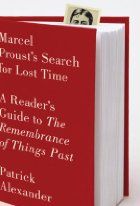
Remembrance of Things PastThis is not an intellectual journey to be undertaken lightly, and even experienced readers need all the help they can get to deal with a literary construction of this magnitude. Patrick Alexander’s guide is an attempt to provide all the assistance that’s required. The book is in three parts. The first offers an overview then a summary of what takes place in each of the seven volumes of the novel. Part two is a who’s who – thumbnail sketches of the principal characters, what they do, and to whom they are related.

Part three offers a brief account of Proust’s life, notes on Paris and the Belle Epoque, and brief essays on French history and the notorious Dreyfus affair in particular.

During the course of his paraphrase, Alexander examines the ‘epiphanies’ for which Proust is famous; he shows the links between characters and events spanning the whole of the seven volumes which will not be apparent to a first-time reader; and he looks at Proust’s techniques of detailed and protracted analysis which, to anyone who has paid close enough attention, are not simply analyses but highly imaginative and extended metaphors which demonstrate his intellectual skill for seeing similarities between apparently disparate objects.

As Alexander points out, Proust’s novel is also an amazing cultural encyclopedia. Whilst the narrative explores issues of love, friendship, jealousy, memory and time, it is also packed with cultural references:

His literary references range from Xenophon to (then) contemporary novelists such as Zola; his musical references cover western music from Palestrina to Puccini, and he refers to more than one hundred individual painters from Botticelli to the avant garde Léon Bakst. All of these references are used to express and illustrate startlingly original insights into every aspect of the human condition, from love and sex to religion and death – and all with a freshness and comic sense of the absurd.

It is often observed by those who have read Proust that so powerful are the evocations of place and the recreation of his life experiences, that readers afterwards find it difficult to believe that they are not their own. “Yes – That’s exactly how it is!” sums up this sort of reaction, though of course it is his genius to have put it into words in the first place.

And for a writer so renowned for prolixity (even longeurs) what is not so frequently observed is the fact that he is much given to placing pithy aphorisms in his text, deeply embedded in huge paragraphs though they might often be.

This book should appeal to the intelligent ‘Common Reader’ who wants to undertake the extended literary journey that a reading of Proust presents. And it will be a reliable guide mainly because it was written by exactly such a person, composed as a homage to a writer he had come to love.

Buy the book at Amazon UK

Buy the book at Amazon US

© Roy Johnson 2009


Patrick Alexander, Marcel Proust’s Search for Lost Time: A Reader’s Guide to The Remembrance of Things Past, New York: Vintage, 2009, pp.3391, ISBN 0307472329


More on Marcel Proust
Twentieth century literature
More on biography

Filed Under: Marcel Proust Tagged With: In Search of Lost Time, Literary studies, Marcel Proust, Modernism, Remembrance of Things Past

Guide to XML for Web Designers

July 5, 2009 by Roy Johnson

full explanation of XML coding and web design

XML is a set of codes which allow you, the user, to define the structure of your documents. These might be any tags – from <title> to <footnote>, from <quotation> to <caption>. People familiar with HTML will feel on home ground here. These tags mean that data can be displayed in whatever way you choose. For instance, once they have been tagged, a collection of books could be displayed in order of author, title, or publication date – with only one command – say, a click on a tab or a menu item.

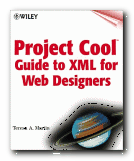
Guide to XMLHowever, before you get too excited, XML has nothing to do with the manner in which the information is displayed on screen. For that, you need to add cascading style sheets. As Teresa Martin points out:

Insert some XML tags into your page and… they’ll just sit there. But, combined with style data, scripting data … you can create some powerful ways to present information

So – XML doesn’t make actions happen: it is used to define and describe a document. She provides quite a lot on the history of these standards – why and how they came into being, and who brought them about. There’s even a chapter on how the W3C deals with submissions and makes decisions about standards. This delays the hands-on instruction if read in page order, but I felt glad for the background.

In fact, en passant, there is a lot of interesting information on how and why XML has grown out of SGML, plus information on the Document Type Definition (DTD) and the Document Object Model (DOM). All this will be of interest to those people who want to know the difference between SGML, HTML, XML, and CSS, as well as those with a curiosity about information design and architecture. She also points to some of the latest developments which will be available soon – XPointer and XLink, which will allow a menu of potential destinations when you click on a hyperlink.

When the XML instructions eventually arrive, they are relatively simple and very similar to HTML. The one difference is that all tags have to be opened and closed without exception. She describes document structure, elements, and format via metaphors – which will be laboured for the technically-minded but reassuring for those like me who want their hands held as we walk into this complex world.

She includes the sensible suggestion that writing the document and adding the tags are kept as two separate processes. Trying to do both at the same time can easily result in a longer writing process, or missing some tags.

XML will be of most interest to people who are working with complex documents such as catalogues and instruction manuals which need to be consistent, or very big single documents such as reference manuals and dictionaries. It’s for creating the possibility of displaying the data in a number of different forms – alphabetically, by subject, author surname, date of publication, or even selected topic.

And if you feel you are going dizzy with all the acronyms and markup language, Teresa Martin has a valuable piece of advice. She suggests that you repeat as a mantra – ‘I can’t do it all’.

© Roy Johnson 2006

Buy the book at Amazon UK

Buy the book at Amazon US


Teresa A. Martin, Project Cool Guide to XML for Web Designers, London-New York: John Wiley, 2006, pp.298, ISBN 047134401X


More on technology
More on digital media
More on web design
More on computers


Filed Under: HTML-XML-CSS Tagged With: Computers, Guide to XML for Web Designers, Technology, Web design, XML

Hackers and Painters

June 20, 2009 by Roy Johnson

software design, open sources, and eCommerce

Paul Graham co-wrote the software for Viaweb, which was bought out by Yahoo for their successful build-it-yourself online stores kit. Hackers and Painters is his reflections on software design, eBusiness, open software, and capitalism today. You might be surprised by the resulting mix. It’s written in an engaging, grab-you-by-the-lapels style, and because he’s studied it, a lot of the argument is conducted via the metaphor of painting. Overall this works, because he is putting the case for craftsmanship, discipline, and originality. He makes an interesting defence of a hacker’s right to disregard copyright – on the grounds that we need to keep their anti-authoritarian attitudes alive to preserve civil liberties, defending a free, strong society.

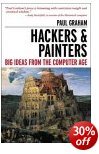
Hackers and PaintersHis next subject is Web-based software. This is where you don’t buy and install software on your own computer. Instead, it sits on a central server, and you interact with it via a web browser – which might be a mobile phone, a PDA, or a telephone. If necessary of course, you could also use a computer. The central item in what’s billed as ‘Big ideas from the computer age’ is upbeat and inspiring advice for would-be start-ups:

There are only two things you need to know about business: build something users love, and make more than you spend. If you get these two right, you’ll be ahead of most startups. You can figure out the rest as you go.

It’s a combination of technological theory, eBusiness strategy, and tips for would-be software developers. But because he’s anti-authoritarian, a supporter of open source software, and all in favour of free enterprise, don’t imagine he’s a traditional radical. One of his essays is an argument in favour not only of individual wealth, but encouraging differences in wealth.

There are two interesting essays on the evolution of programming languages. Non-technical readers don’t need to worry, because they are written in a lively, jargon-free style that’s easy to understand.

Despite my reservations on his economic policies, he shot up in my estimation when he put his cards on the table regarding the academic world:

In any academic field, there are topics that are ok to work on and others that aren’t. Unfortunately the distinction between acceptable and forbidden topics is usually based on how intellectual the work sounds when described in research papers, rather than how important it is for getting good results. The extreme case is probably literature; people studying literature rarely say anything that would be of the slightest use to those producing it.

There is a whole policy review, a major reinvestigation of ‘lit crit’, and a great deal of intellectual soul-searching to be done on the strength of that one observation alone.

At the heart of the book, there’s also an argument in favour of the Lisp programming language. It’s what he used to write his successful venture at Viaweb.

This is a lively and thought-provoking collection of studies which comes from somebody who has both done the programming first hand, and thought a lot about the social consequences of it.

© Roy Johnson 2010

Hackers and Painters   Buy the book at Amazon UK

Hackers and Painters   Buy the book at Amazon US


Paul Graham, Hackers and Painters: Big Ideas from the Computer Age, Sebastopol (CA): O’Reilly, 2010, pp.272, ISBN: 1449389554


More on eCommerce
More on media
More on publishing
More on technology


Filed Under: e-Commerce, Open Sources, Theory Tagged With: Computers, Hackers and Painters, Open Sources, Technology

Hallelujah Junction

May 18, 2009 by Roy Johnson

John Adams’ personal biography and musical Odyssey

John Adams is probably the best-known American composer of classical music alive today. His operas Nixon in China and The Death of Klinghoffer have played to audiences all over the world, and his orchestral sketch Short Ride in a Fast Machine is such a favourite concert opener that you hear it on the radio almost every day in some setting or other. A post-war baby of musical parents, he was raised on the east coast in New England, and after a childhood as a clarinetist of some distinction he moved to study at Harvard. There he seemed destined for a life as an academic composer. But two things seemed to have worked against this: an adventurous, rebellious spirit, and a love of popular American culture, which as he matured in the 1960s included imported English pop music, dance bands (in which his father played) and television. All of these cultural influences have been reflected in his later work.

John AdamsRejecting the conventional route to success, he took another which led him to the west coast, where after a bout of proletarian enthusiasm he gave up the 48 hour week of a warehouse worker to take up a teaching post at the Conservatory of Music in San Francisco. There he threw himself into the cultural experimentalism which was then in vogue. This included the upsurge of jazz and blues music, and the American literary cult of Jack Kerouac, the Beat poets, William Burroughs, and of course drugs of all kinds.

He stuck with the experimental music and the dafter tendencies of modernism for quite some time. I was quite surprised how respectful he is to John Cage, who always strikes me as completely bogus. But he’s very generous in his appreciation of his fellow composers and contemporaries. Philip Glass, Steve Reich, Terry Riley, and Ingram Marshall are all given warm encomiums. There are also, en passant positive sketches of artists such as Dawn Upshaw, Kent Ngano, Peter Sellers, and Conlan Nancarrow.

Gershwin’s Rhapsody in Blue, a work as perfect in its own genre as any that Mozart composed in his, was the product of a supremely confident twenty-four year old who got everything right in one stroke. Its signature motif, the ‘blue note’ flattened seventh, is a rendering on the piano of the keening style of singing from the Negro South. Gershwin threads that motto into a harmonic web of delicious stepwise modulations that take every advantage of the discoveries from fifty or even sixty years earlier. But here, the mood is New World, high energy, with a jubilant lyricism that gives the impression of an irresistible spontaneity. In the hands of Gershwin, the ambiguity and restlessness of those potent Romantic chords is reborn to a new life, not morbidly self-aware and shaded toward the dark end of the emotional spectrum, but full of fresh optimism, busy and brash and thoroughly at ease with itself.

But gradually he began to find his own voice and the techniques which would help him to articulate it. This development was assisted by his moment-of-truth decision to leave atonality behind and embrace tonal harmony as the rockbed for musical expression. It was also accompanied by his determination to stick by his enthusiasm for electronic musical instruments.

Anyone interested in the development of synthesisers, modulators, and multi-track recorders, right up to the computer-programmed methods of sound generation which are now possible will be delighted by the enthusiastic joy in all these gadgets and gizmos that he expresses. At times it’s like reading Popular Mechanics.

He’s also quite prepared to share the downsides of a composer’s life: productions which are badly mauled by critics and audience alike; fallow periods and creative blocks; the political controversies in which he becomes involved because of the contemporary nature of his subject matter.

The central portions of the book describe the genesis and execution of his large scale works – the Harmonielehre, Nixon in China, and The Death of Klinghoffer, yet strangely enough, when it comes to accounts of his more recent works he goes into great detail concerning the religious ideas in El Nino and the scientific and political history behind Doctor Atomic but he says very little about the musical ideas in either opera.

He’s a widely read and cultivated man with a social conscience, and he’s prepared to discuss culture and ideas at a serious level. Just occasionally he skirts dangerously close to a note of self-importance, but this is offset by his willingness to discuss his obvious artistic failures, such as the premiere of The Dharma at Big Sur and his song cycle, the clumsily titled I was Looking at the Ceiling, and Then I Saw the Sky.

Although it’s a personal record, this is an important book on contemporary American classical music – which sits as a useful companion piece to Alex Ross’s recent The Rest is Noise: Listening to the Twentieth Century. John Adams’ official web site is at www.earbox.com

© Roy Johnson 2008

Hallelujah Junction Buy the book at Amazon UK

Hallelujah Junction Buy the book at Amazon US


John Adams, Hallelujah Junction: Composing an American Life, London: Faber, 2008, pp.340, ISBN: 0571231152


More on music
More on media
More on lifestyle


Filed Under: Biography, Music Tagged With: Biography, classical music, Cultural history, Hallelujah Junction, John Adams, Music

Hamlet on the Holodeck

July 11, 2009 by Roy Johnson

reflections on hypertext and story-telling

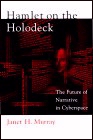
Janet Murray has an intellectual background which will be common to many who have passed through higher education since the 1960s. She is rooted in her training in the humanities (English Literature) – but she has been touched by developments in computer science, and wishes to combine the two disciplines. She holds simultaneously a deep reverence for post-Renaissance book-based traditional learning and an appreciation that digitised texts, non-sequential narratives, and multimedia effects might produce new artistic forms. Hamlet on the Holodeck is an exploration of what has been done to develop these new forms – and what might be done in the future. It is a study which has become a central text in the required reading on hypertext. As a teacher at the Massachusetts Institute of Technology – the home of research and development in multimedia – she knows the field well.

Hamlet on the HolodeckHer examination starts with a survey of science fiction and various modern narratives which explore the possibilities of parallel universes or alternative realities – including 3-D movies and virtual reality simulators. She describes the existing technology with enthusiasm – although in each case she ends up in the realm of ‘Imagine if this could be put to use in …’ rather than what has been done. But this is understandable. After all, we are considering an extremely new technology. When printing was first invented, books were produced which imitated written manuscripts, just as in our own age cinema and radio first imitated the live theatre. Maybe the new digital narrative forms have not yet emerged.

She discusses videogames, virtual dungeons (MUDs and MOOs) and literary hypertexts, including the best known – Michael Joyce’s Afternoon and Stuart Moulthrop’s Victory Garden. She also considers the advantages and weaknesses of Web-based narrative experiments. These include the complex worlds which are generated around TV soap operas for instance – which have archives of back footage linked to fan-generated materials.

The main problem is that she doesn’t really confront the most fundamental philosophical principle of fictional narratives. This is that consumers usually want and appreciate a series of events which has been artfully conceived and structured by somebody else. Such narratives represent, in no matter how diffuse a form, a distinctive point of view or perspective on the world.

There is much discussion of journeys through mazes, fantasy quests, dragon-slaying, and all the usual clichés of games with names such as Pong, Zork, and Doom. However, when it comes to predicting what the new forms might be, these tend to be simply different ways of telling the same story – multiple viewpoints – a strategy which has been adopted in most art forms, and which is not intrinsically connected to computers or hypertext. Her arguments and exposition seem more fruitful when she is discussing the rapidly merging world of the Web and television.

Her examination of current multimedia productions is wide-ranging and thorough, although there are one or two assumptions about what is likely to develop which seem open to question. The first is that computers will somehow participate in the generation of basic narratives. The second is that readers will be invited to participate in the story. The third is that a video games or MUDs are likely to be the most likely form to be developed. These are certainly interesting possibilities, but whether they are necessary elements of the new forms or not, only convincing evidence will tell.

However, these are reservations of a rather theoretical nature. At a practical level, anyone interested in the future possibilities of story-telling using computer technology should read this book. Its comprehensive survey of current practice is an inspiring starting point for what might be achieved in the digital future.

© Roy Johnson 2001

Hamlet on the Holodeck   Buy the book at Amazon UK

Hamlet on the Holodeck   Buy the book at Amazon US


Janet H. Murray, Hamlet on the Holodeck, Cambridge, MA: MIT Press, 1999, pp.324, ISBN: 0262631873


More on digital media
More on technology
More on theory


Filed Under: Media, Theory Tagged With: Hamlet on the Holodeck, Hypertext, Media theory, Narrative, New media, Theory

Handwriting of the Twentieth Century

July 17, 2009 by Roy Johnson

history and development of modern graphology

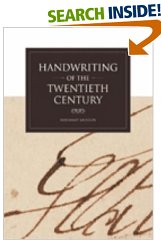
Rosemary Sassoon is a distinguished expert on handwriting, and a typographist celebrated for her font Sassoon Prima, which helps young school pupils learn to read and write. In her latest book, Handwriting of the Twentieth Century, she looks at the effects which various teaching methods and models of good practice have had in the period from 1900 to the present. She charts developments in the teaching and study of handwriting, showing how changing educational policies, economic forces and technological advance have combined to alter the priorities and form of handwriting.

Handwriting of the Twentieth Century Every page is suffused with a love of her subject and a concern for the people she is writing about. This ‘long and sometimes sorry story’ tells also of the sheer pain and hard work of children forced to follow the style of the day, and of the reformers who have sought to simplify the teaching and learning of handwriting.

What emerges very clearly is that handwriting styles pass through various fashions and styles – which is why we can put a rough date on examples – even including our own. The general process she illustrates is one of a gradual move from the ornate copperplate of the Victorian period, to various forms of cursive Italic which are common now.

The book is beautifully illustrated throughout with examples from copybooks and personal handwriting from across the world. She ends with a comparative study of developments in continental Europe and America during the same period – and where the lessons to be learned are exactly the same.

This book is a historical record of techniques, styles and methods. But it also a passionate study of everyday typography, informed by a deep knowledge of her subject. It will be of interest to educationalists, people in teacher training, plus cultural sociologists and historians – as well as typographists and graphologists.

© Roy Johnson 2007

Buy the book at Amazon UK

Buy the book at Amazon US


Rosemary Sassoon, Handwriting of the Twentieth Century, Bristol: Intellect, 2007, pp.208, ISBN: 0415178827


More on typography
More on theory
More on typography
More on digital media


Filed Under: Theory, Typography Tagged With: Education, Handwriting, Handwriting of the Twentieth Century, Typography, Writing, Writing Theory

Handwritten

June 26, 2009 by Roy Johnson

modern hand-produced lettering and typefaces

In an age which presents designers with the software to create any number of computer-generated fonts, design historian Steven Heller considers the lasting strength of typefaces produced by hand. He has a good track record in writing on graphic design, and Handwritten is an excellent example of his work. He divides his chapters into different hand-scripted styles – sleight of hand, scrawl (letterforms that are raw, splotchy, and untidy) scratch (scraped, cut, and gouged fonts) script (type that is sinuous and ornate) stitch (letters that have been sewn, sutured, and embroidered) shadow (dimensional, voluminous, and monumental letterforms).

HandwrittenThese are followed by suggestive (forms that imply the metaphorical, surreal, and symbolic) and sarcastic (the ironic, comical, and satirical in lettering). This seems a reasonable enough approach: these categories represent the attitudes of the designers, though sometimes there is overlap between them.

It’s also a handsomely designed and beautifully produced book – packed with hundreds of coloured, well-presented examples. The sources are amazingly wide-ranging: theatre posters, record albumn covers, comics and graphic novels, book designs, posters, ephemera, and original art works.

The visual range is also good – hand scrawled letters, painted typefaces, words scratched into surfaces, stitched into fabrics, or written onto surfaces (including Stefan Sagmeister’s body – an illustration which turns up everywhere these days).

He features and obviously has a soft spot for the work of Robert Crumb, the American freehand artist who designed lots of, ahem, alternative comics in the 1960s and 1970s. Crumb drove his sex-obsessed vision to very amusing and visually interesting limits – though it has to be said that although the subject matter of his cartoons is very radical, the essence of his visual style is essentially nostalgic. He gets its striking effects from linking psychologically modern subject matter with a quaint folksy visual idiom. This is what Heller categorises as ironic lettering.

There’s a fashion at the moment for adding hand-crafted type to digitally photo-realistic graphics, so as to play one off against the other. These are well represented here. However, I was surprised not to see more examples of freehand design translated into pixellated typography, but the book does end with examples of digital comic books which suggest that more is to come.

Having just taught on a course where students have to learn the discipline of writing descriptive picture captions, I was impressed by the manner in which his are consistently both succinct and imaginative. Each section of the book is prefaced by an essay, and the origins of the examples are meticulously sourced. Artist, designer, photographer, and client are all named on every example.

His explanation is all the more vigorous for being conducted across continents. There is nothing parochial about this compilation. Examples range from the UK and USA, to Mexico, the USSR, France, and Germany. The selections are witty, bitter, satirical, inventive, and sometimes quite violent.

If you are at all interested in typography, graphic design, or even print production values, this is well worth seeing. Serious students and professionals will want to own it.

© Roy Johnson 2004

Handwritten   Buy the book at Amazon UK

Handwritten   Buy the book at Amazon US


Stephen Heller and Mirko Ilic, Handwritten: expressive lettering in the digital age, London: Thames and Hudson, 2004, pp.192, ISBN: 0500511713


More on typography
More on design
More on media
More on web design


Filed Under: Graphic design, Typography Tagged With: Calligraphy, Graphic design, Handwritten, Typography

Harold Nicolson – Jeanne de Henaut

October 5, 2009 by Roy Johnson

Hogarth Press first edition book jacket designs


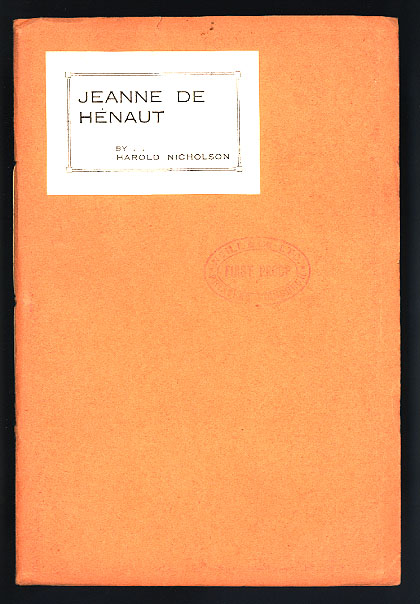
Jeanne de Henaut - first edition

 
Harold Nicolson, Jeanne de Hénaut (1924)

Only 55 copies were printed. This copy has the printer’s “First Proof” stamp and the date “8 Nov. 1924” on the front cover. The author’s name is spelled “Nicholson” on the proof, but this was corrected before publication. This is the only known copy of the First Proof.

previousnext


Hogarth Press studies

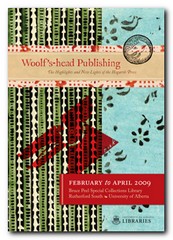
Woolf's-head Publishing Woolf’s-head Publishing is a wonderful collection of cover designs, book jackets, and illustrations – but also a beautiful example of book production in its own right. It was produced as an exhibition catalogue and has quite rightly gone on to enjoy an independent life of its own. This book is a genuine collector’s item, and only months after its first publication it started to win awards for its design and production values. Anyone with the slightest interest in book production, graphic design, typography, or Bloomsbury will want to own a copy the minute they clap eyes on it.

Woolf's-head Publishing Buy the book at Amazon UK
Woolf's-head Publishing Buy the book at Amazon US

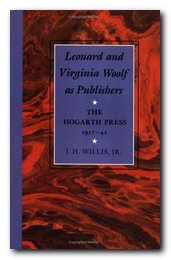
The Hogarth Press Leonard and Virginia Woolf as Publishers: Hogarth Press, 1917-41 John Willis brings the remarkable story of Leonard and Virginia Woolf’s success as publishers to life. He generates interesting thumbnail sketches of all the Hogarth Press authors, which brings both them and the books they wrote into sharp focus. He also follows the development of many of its best-selling titles, and there’s a full account of the social and cultural development of the press. This is a scholarly work with extensive footnotes, bibliographies, and suggestions for further reading – but most of all it is a very readable study in cultural history.

The Hogarth Press Buy the book at Amazon UK
The Hogarth Press Buy the book at Amazon US

© Roy Johnson 2005


Filed Under: Hogarth Press Tagged With: Art, Bloomsbury, Graphic design, Harold Nicolson, Hogarth Press, Jeanne de Henaut, Literary studies

Harold Nicolson biography

September 20, 2009 by Roy Johnson

diplomat, writer, socialite and politician

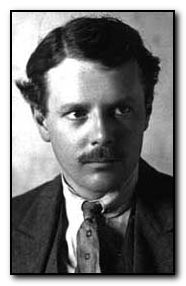
Harold Nicolson biographyHarold Nicolson (1886-1968) was born into an upper middle-class family in Tehran, where his father (Lord Carnock) was the British ambassador to Persia. as it then was. He was educated at Wellington College then Balliol College Oxford, where he graduated with a third-class degree. He entered the diplomatic service in 1908 and was posted to Constantinople where he became a specialist in Balkan affairs. In 1910 he met Vita Sackville-West and despite her reservations about his diplomatic career (and her parents’ about his social status) they married in 1912 and had two sons.

He published biographies of the French poet Verlaine and studies of other literary figures such as Tennyson, Byron, Swinburne, and Saint-Beuve. His first major success (and still probably his best book) was Some People (1927), a witty collection of short stories and character sketches based on people he had met in the diplomatic service.

He and his wife were fringe members of the Bloomsbury Group, as well as visitors to Ottoline Morrell’s weekend parties at Garsington in Oxfordshire. Whilst Vita had affairs with Virginia Woolf and Violet Trefusis, he had liaisons with a series of men, including the literary critic Raymond Mortimer. They had a rather unusual marriage in which they lived separately a lot of the time, wrote to each other on almost a daily basis protesting their undying love to each other, and continued to have affairs with members of their own sex. All of this was recorded by their son in his Portrait of a Marriage.

After the end of the first world war he took part in the Paris Peace Conference, and he was very critical of the punitive reparations extracted by the allies (which also caused his fellow Bloomsburyite John Maynard Keynes to resign from the commission). At the end of 1929 he left the diplomatic service and went to work for Lord Beaverbrook on the Evening Standard. Despite (or maybe because of) his literary skills, he hated journalism: “It is a mere expense of spirit in a waste of shame. A constant hurried triviality which is bad for the mind.”.

In the 1930s, he and his wife bought Sissinghurst Castle, in the rural depths of Kent, the county known as the garden of England. There they created the renowned gardens that are now run by the National Trust. However, during the week he lived at the Albany, the famous bachelor chambers just off Piccadilly in London. He flirted briefly with Sir Oswald Mosley’s fascists, but then entered the House of Commons as National Labour Party member for Leicester West in 1935. (His wife refused to visit the constituency, regarding it as ‘bedint’ – a family slang term for ‘unacceptably low class’.)

He was very active as a parliamentarian, and became a keen supporter of Winston Churchill, especially during the second world war, when he was appointed private secretary to the Minister of Information in the government of national unity. He lost his seat in the 1945 election, and then despite joining the Labour Party, he failed to get back into parliament.

He turned to broadcasting and returned to journalism as an occupation. He was personally acquainted with a wide variety of figures such as Ramsay MacDonald, David Lloyd George, Duff Cooper, Charles de Gaulle, Anthony Eden and Winston Churchill, along with a host of literary and artistic figures. His Diaries provide a rich source of information on the world of diplomacy and politics in the years 1910-1960, and record meetings with Picasso, Diaghilev, Matisse, Marcel Proust, and James Joyce.

He never achieved high office, and when eventually awarded a knighthood, he was so snobbish he felt it as an insult, because he thought he ought to be made a member of the Lords – so that he could escape what he felt as his ‘plebeian’ surname. He spent the latter part of his life writing and developing the gardens at Sissinghurst.


Harold Nicolson biography


Bloomsbury Group – web links

Bloomsbury Group - web links Hogarth Press first editions
Annotated gallery of original first edition book jacket covers from the Hogarth Press, featuring designs by Vanessa Bell, Roger Fry, and others.

Bloomsbury Group - web links The Omega Workshops
A brief history of Roger Fry’s experimental Omega Workshops, which had a lasting influence on interior design in post First World War Britain.

Bloomsbury Group - web links The Bloomsbury Group and War
An essay on the largely pacifist and internationalist stance taken by Bloomsbury Group members towards the First World War.

Bloomsbury Group web links Tate Gallery Archive Journeys: Bloomsbury
Mini web site featuring photos, paintings, a timeline, sub-sections on the Omega Workshops, Roger Fry, and Duncan Grant, and biographical notes.

Bloomsbury Group - web links Bloomsbury: Books, Art and Design
Exhibition of paintings, designs, and ceramics at Toronto University featuring Hogarth Press, Vanessa Bell, Dora Carrington, Quentin Bell, and Stephen Tomlin.

Bloomsbury Group - web links Blogging Woolf
A rich enthusiast site featuring news of events, exhibitions, new book reviews, relevant links, study resources, and anything related to Bloomsbury and Virginia Woolf

Bloomsbury Group - web links Hyper-Concordance to Virginia Woolf
Search the texts of all Woolf’s major works, and track down phrases, quotes, and even individual words in their original context.

Bloomsbury Group - web links A Mrs Dalloway Walk in London
An annotated description of Clarissa Dalloway’s walk from Westminster to Regent’s Park, with historical updates and a bibliography.

Bloomsbury Group - web links Women’s History Walk in Bloomsbury
Annotated tour of literary and political homes in Bloomsbury, including Gordon Square, University College, Bedford Square, Doughty Street, and Tavistock Square.

Bloomsbury Group - web links Virginia Woolf Society of Great Britain
News of events, regular bulletins, study materials, publications, and related links. Largely the work of Virginia Woolf specialist Stuart N. Clarke.

Bloomsbury Group - web links BBC Audio Essay – A Eulogy to Words
A charming sound recording of a BBC radio talk broadcast in 1937 – accompanied by a slideshow of photographs of Virginia Woolf.

Bloomsbury Group - web links A Family Photograph Albumn
Leslie Stephens’ collection of family photographs which became known as the Mausoleum Book, collected at Smith College – Massachusetts.

Bloomsbury Group - web links Bloomsbury at Duke University
A collection of book jacket covers, Fry’s Twelve Woodcuts, Strachey’s ‘Elizabeth and Essex’.

© Roy Johnson 2000-2014


More on Harold Nicolson
More on the Bloomsbury Group
Twentieth century literature
More on biography

Filed Under: Biography, Bloomsbury Group, Harold Nicolson Tagged With: Biography, Bloomsbury Group, Cultural history, Harold Nicolson

Harold Nicolson Diaries 1907-1964

July 11, 2009 by Roy Johnson

20th century diplomacy, literature, and politics

Harold Nicolson was a writer, a politician, and a diplomat – but he is best known as the husband of Vita Sackville-West, and thus by proxy a figure on the fringes of the Bloomsbury Group. He was quite a complex character, and one of the few examples I have come across of someone from the upper reaches of society whose political opinions moved from right to left during the course of life, rather than the other way round. Harold Nicolson’s Diaries is a record of his multi-faceted life.

Harold Nicolson Diaries 1907-1964This book is a compilation of both his diaries and letters – principally to his wife, from whom he spent most of their married life apart, something that might well have contributed to the longevity of their curious union (outlined in their son’s fascinating Portrait of a Marriage). It covers an immensely long period in historical terms – starting before the first world war and continuing through a restless life of politics, literature, travel, and high society hob-nobbing until the advent of the Beatles.

He was the only member of the peace conference that followed the second world war who had also been present at the first. For the majority of these pages (which represent only a small part of his complete diaries) he was either a diplomat or an MP. Surprisingly, for a snob and elitist, he was very critical of the punitive reparations extracted by the allies in 1918 (which also caused John Maynard Keynes to resign from the commission). Nicolson also petitioned the prime minister for the return of the Elgin Marbles to Athens, and he was passionately opposed to war, having fully absorbed the lessons of 1914-1918.

Lots of famous figures whiz through the pages in cameo performances: Winston Churchill, Lawrence of Arabia, Noel Coward, three generations of UK royalty, Konrad Adenauer, James Joyce (“a difficult man to talk to”) – and it is quite obvious that Nicolson isn’t name-dropping. These were simply the circles in which he mixed.

This work throws his collection of character sketches Some People into sharp positive relief, because for all the famous people and the important scenarios he finds himself involved with here, there is none of the artistic flair and the dramatic compression of his fictionalised narratives.

He resigned from the diplomatic service at the end of 1929 and went to work for Lord Beaverbrook on the Evening Standard, which he hated. He considered journalism “a mere expense of spirit in a waste of shame. A constant hurried triviality which is bad for the mind.”

Then he was torn between writing and politics, whilst he and his wife waited impatiently for his mother-in-law to die, so that they could inherit and be spared any worries about money (having in the meanwhile bought a castle). Actually, she spited them both, and left her money to their son.

He eventually got a seat as MP for Leicester (which Vita refused to visit) and settled into a busy life as an active parliamentarian. The inter-war years coverage is full of the rise of fascism, Italy’s attack on Abyssinia (Ethiopia), the abdication crisis, and then the full drama of the second world war, which provide his most inspired entries.

Although on the surface his political allegiances moved leftwards, he was a great admirer of Churchill, and he eventually regretted joining the Labour Party. He never achieved high office, and when eventually awarded a knighthood, he was so snobbish he felt it as an insult, because he thought he ought to be made a member of the Lords – so that he could escape his ‘plebeian’ surname.

Modern readers will have to choke back opinions which seem to come out of the political ark:

I believe that our lower classes are for some curious reason congenitally indolent, and that only the pressure of gain or destitution makes them work.

You know how I hate niggers …But I do hate injustice even more than I hate niggers

But the effort of restraint necessary is eventually worth it – because of the insights he affords into the workings of the English upper class, the oblique glimpses we get into power politics, the guided tours through London clubland, and his revelations about people as diverse as the Duke of Windsor (‘eyes…like fried eggs’) and Henry James (‘a late-flowering bugger’).

© Roy Johnson 2005

Buy the book at Amazon UK

Buy the book at Amazon US


Nigel Nicolson (ed), Harold Nicolson’s Diaries 1907-1964, London: Orion Books, 2005, pp.511, ISBN 075381997X


More on Harold Nicolson
More on the Bloomsbury Group
Twentieth century literature


Filed Under: Harold Nicolson Tagged With: Biography, Bloomsbury Group, Cultural history, Harold Nicolson, Harold Nicolson's Diaries 1907-1964

  • « Previous Page
  • 1
  • …
  • 36
  • 37
  • 38
  • 39
  • 40
  • …
  • 103
  • Next Page »

Get in touch

info@mantex.co.uk

Content © Mantex 2016
  • About Us
  • Advertising
  • Clients
  • Contact
  • FAQ
  • Links
  • Services
  • Reviews
  • Sitemap
  • T & C’s
  • Testimonials
  • Privacy

Copyright © 2026 · Mantex

Copyright © 2026 · News Pro Theme on Genesis Framework · WordPress · Log in