Mantex

Tutorials, Study Guides & More

  • HOME
  • REVIEWS
  • TUTORIALS
  • HOW-TO
  • CONTACT
>> Home / Archives for 2009

Archives for 2009

How to improve your spelling

November 17, 2009 by Roy Johnson

tips and guidance notes on basic spelling skills

1. spellingYou can improve your spelling skills by reading and writing as much as possible – and checking your written work.

2. If you are not sure about the correct spelling of a word, look it up in a good dictionary.

3. The best ways to improve your spelling are:

  • learn commonly mis-spelled words
  • learn the common rules of spelling
  • learn good spelling strategies

Commonly mis-spelled words

4. The most commonly mis-spelled words are probably there/their, its/it’s, to/too/two, and are/our.

5. This problem is caused because these words sound the same as each other. Here’s how to tell them apart.

6. There refers to a place, whereas their means belonging to them.

The table is over there, in the corner

there refers to a place

We are going to their house

their means belonging to them

7. Its means belonging to, whereas It’s is a shortened form of It is.

The dog is in its basket

its means belonging to the dog

It’s too late now

It’s means It is too late

8. To means towards, whereas too means very or in addition, and two is the number 2.

We are going to the concert

here to means towards

It was too cold for swimming

means it was very cold

He ate two chocolate bars

means the number 2

9. Are is part of the verb ‘to be’ – as in we are, whereas our means belonging to us.

We are in the same class at school

This is the verb ‘to be’, as in I am/we are

We have flowers in our garden

That is, the garden belongs to us


Common spelling rules

10. Almost all words have only one correct spelling – but there are occasional exceptions. Judgement for instance can also be spelled judgment.

11. One of the easiest rules to remember is I before E, except after C – but you need to be careful, because there are plenty of exceptions.

I before E

believe – chief – friend – thief

C followed by EI

ceiling – receive – deceit – conceive

Exceptions

either – neither – foreign – height – seize – leisure


Doubling of consonants

12. If a word ends in a vowel and a single consonant, double the consonant before adding -ing or -ed.

swim/swimming     ship/shipped

stop/stopping     occur/occurred

13. If the vowel is unstressed, or if there are two vowels, do not double the consonant.

enter/entering     shout/shouted

develop/developing     appeal/appealed

14. If the word ends in -c, change the -c to -ck before adding the ending.

panic/panicked     picnic/picnicking


Commonly mis-spelled words

The following words are often spelt wrongly. There is no short way round this problem. You simply have to learn the correct spelling.

acceptable – double c, not -ible.

accommodation – double c and double m

achieve – i before e except after c

assess – two lots of double s

believe – i before e except after c

communicate – double m

convenient – i before e except after c

definite – -ite, not -ate

disappear – double p [dis+appear]

disappoint – double p [dis+appoint]

necessary – one c, double s

receive – i before e, except after c

recommend – double c [re+commend]

stationary – means not moving – use a

stationery – paper we write on – use e

success – double c, double s

weird – an exception to the rule

NB! One final point. Using a spelling-checker is not cheating. You should use one to check your work – and learn correct spellings at the same time.

© Roy Johnson 2009


More on How-To
More on literary studies
More on writing skills

Filed Under: How-to guides, Study Skills, Writing Skills Tagged With: Spelling, Writing skills

How to Make Money Scriptwriting

June 19, 2009 by Roy Johnson

practical guide to professional screen writing

This is the second edition of a very successful book which covers all aspects of scriptwriting (or script writing) and making a living as a professional author. It’s the work of a leading literary agent who brings insider tips and guidance on what is a tough market in which to make a living. Julian Friedmann takes a practical, no-nonsense approach which encourages would-be authors to become more aware of what he calls the ‘politics’ of writing. This means paying more attention to the market place; being prepared to fit in to the system of television or screen, and being prepared to deliver to audiences what they want.

ScriptwritingHe paints a picture of a very difficult business which makes big demands of the would-be screenwriter. The only way to succeed is be prepared to collaborate; drop your ego; know that viewer-ratings is All; and ‘murder your darlings’ when required.

There are excellent chapters on how to structure and produce a ‘pitch’, a ‘treatment’ and a ‘step outline’ for a proposed script. But even if you’re good at doing all that, there’s still more to learn: how script editing and script reports work; what ratings, audience share, and programme research mean; how to deal with an agent – or without one; how to handle meetings and negotiate with producers; how to understand a basic agreement and protect your own interests as a writer; and how to survive financially whilst you are waiting for that call from Hollywood.

The emphasis is almost entirely on cinema and television. There’s no mention of the theatre, and radio only gets a very brief mention, although there is one chapter on writing for interactive multi-media.

There’s also no advice on the details of writing techniques: he assumes you know how to write, or can find out elsewhere. His guidance is on how to make a success of scriptwriting from a business point of view. There are full explanations of all the people you need to contact; how to make your work look professional; and how to take rejection without losing heart.

He ends with a very useful series of appendices with includes examples of negotiations with producers; sample memos commissioning a deal; legal contracts; Writers’ Guild minimum Terms of Payment; plus all the contact details for writer’s groups, training courses, and professional associations.

Anyone entering this ferociously competitive field of creative writing needs all the help they can get. Friedmann explains why it is such a tough business, and in doing so he reveals the strategies you need to succeed. You will find advice on writing skills elsewhere. This is insider guidance on how the business works.

© Roy Johnson 2003

How to Make Money Scriptwriting   Buy the book at Amazon UK

How to Make Money Scriptwriting   Buy the book at Amazon US


Julian Friedmann, How to Make Money Scriptwriting, Bristol: Intellect, 2nd edn, 2003, pp.219, ISBN: 184150002X


More on publishing
More on journalism
More on creative writing
More on writing skills


Filed Under: Creative Writing, How-to guides, Publishing, Writing Skills Tagged With: Broadcasting, Film, Journalism, Publishing, Scriptwriting, Television, Writing skills

How to plan research projects

September 29, 2009 by Roy Johnson

approaches to undertaking a major piece of work

Research projects

The length and purpose of research projects will depend on the level of your studies. At third year undergraduate level it might be between 3000 and 8,000 words. This might involve gathering information or making a brief investigation. An MA dissertation on the other hand is usually a longer piece of detailed academic analysis. This might be 15,000 words long or even more. A PhD thesis must be a piece of original research. Typical theses might be between 50,000 and 80,000 words long – or more.

Production
The principal difficulty is generating and handling so much material. Most people do not have the experience of assembling and writing such a long piece of work. You need to develop patience, persistence, and intellectual stamina. The material must also be given structure and coherence. You also need to present the material using the conventions of your subject-discipline.

Planning
Your essay-writing skills are your main source of support for such a task. You will need to shape and re-shape your work according to some plan or outline. This plan might change as you progress, but it will provide reassurance. Think of the work as a very big essay which will take a long time to complete. It is also likely to change both its shape and substance as you progress.

Research ProjectsConfidence
Despite your fears about tackling such a large piece of work, there are several reasons why you can feel confident of success. When you reach this stage you should know quite a lot about your own subject. You should now be accustomed to the language and conventions of your discipline, and aware of its principal concepts. By this stage you should also have all the basic study skills you will need. Remember that unless your project is a PhD thesis, it is unlikely that you are being asked to demonstrate dazzling originality. A research project is designed to give you the chance to show that you can make an in-depth investigation of a topic, and present your findings in an academic manner.

Form
The form of the project will depend on your subject and its conventions. It could be a review of ‘the literature’ of one aspect of your subject. It might be the writing up of a particular case study or investigation. Some reports offer the results of surveys or interviews. Others may be the records of scientific laboratory experiments. You should make yourself aware of the form of research projects in your own subject area.

Selection
Select a topic in which you are genuinely interested. This interest will help to sustain your commitment throughout the research. Completing a long piece of work is very difficult if you become bored with the topic. Be prepared to change the topic [in the early stages] if you are not happy with your first choice. Do this in consultation with your tutor or supervisor.

Topic
The best topics usually emerge from some subject you already know well. Select an item of interest which has arisen during your coursework. Do some preparatory work in narrowing down the subject to a precise focus. Don’t take on something that is too large or poorly defined. Both of these approaches will create additional difficulties. A limited project which is successful will gain more credit than an over-ambitious failure.

Examples
Study examples of other people’s successful projects. Copies of such work are usually kept in departmental libraries. Check what other topics have been covered in your subject or discipline. Discuss the possibilities with your tutor or supervisor, and with other students.

Conventions
The project is an exercise in undertaking a larger piece of work. You must also present your results in the conventional form for your subject. You are not usually expected to be dazzlingly original. You are showing that you have understood your subject, you can research a topic in some depth, and and can use the protocols of your discipline in presenting your results. Many people become very frustrated with the systems of academic quotation and referencing for instance. It’s a good idea to have full control of these at the earliest possible stage. This will save you lots of time later.

The hypothesis
Some projects begin with a clear idea, and evidence is sought to prove its validity. Alternatively, a body of work is investigated until an idea begins to emerge. You might even start from an intermediate position in which a vague hunch is pursued and revised in the light of your investigations. Each one of these approaches can be equally valid. The important thing is to be aware of which one you have chosen. The worst position to be in is floundering and uncertain, between all three.

The method
Keep relating your hypothesis to the evidence, and vice versa. Be prepared to change your hypothesis in the light of evidence if necessary. Do not be tempted to distort the evidence to prove your point. You should make the method clear to yourself first, and this will help you to explain it as part of your report or your dissertation.

Pedagogy
The extended project is used increasingly in further and higher education. It is a convenient teaching method, especially when numbers of teaching staff are getting smaller. Students learn through engagement with their materials and chosen topic. In fact it is a very efficient way of learning, because you are engaging with your subject matter in both a theoretical and practical manner. In one sense, you are teaching yourself.

© Roy Johnson 2009


Filed Under: Study Skills Tagged With: Academic writing, Research, Research Project, Study skills, Writing skills

How to publish your writing

October 31, 2009 by Roy Johnson

guidance and resources for writers

If you wish to publish your writing, you need to learn about the publishing process, marketing your work, and targetting your audience. The web pages listed here deal with all those topics – and more besides.

publish your writingThe writer’s marketplace
This is a selection of best-selling writer’s guides. These list all the information you need for contacting publishers, agents, and editors. They cover book publishing, magazines, newspapers, and specialist outlets for photographers and illustrators. Most of them provide mini-essays and tutorials featuring advice from professional writers.

publish your writingEditing your writing
Guidance snotes on editing, re-writing, and creating structure – plus basic advice on topics such as sentences, paragraphs, headings, titles, punctuation, and spelling.

publish your writingPublishing on the Internet
A selection of guidance manuals on writing for the Web – showing the special skills for creating readable web pages, plus writers’ groups and specialist outlets for creative online writing.

publish your writingePublishing and eBooks
Guidance manuals on how to create eBooks on a budget, using email as a marketing tool, plus writing in other digital formats. This approach takes the cumbersome and expensive printing costs out of publishing your work.

publish your writingWriting for the Web
Three excellent guidance manuals on crafting what you write so that it can be effective when read on line. Writing for the screen is different than writing for print publication: these books explain the differences.

publish your writingWriting for magazines
Writing for magazines is probably the most profitable form of authorship in terms of payment-per-word. But weekly, monthly, and specialist publications are often neglected as a possibile outlet by aspiring writers. This selection of guidance manuals show what markets are available, and how to break into them.

publish your writingWriting for newspapers
Newspapers are the most difficult form of journalism for beginners to break into. And if you manage to get a foot in the door, you will need more than just writing skills. These manuals provide the basics of law, copyright, plagiarism, privacy, and the relationship between the proess and the public.

publish your writingPublish your academic writing
Lecturers in further and higher education are obliged to publish their work if they wish to be promoted. It’s a very competetive environment. These manuals will show you how to convert a piece of academic work into something that can be commercially published. They also show the new possibilities of online publishing – or ‘open access’ as it is starting to be known.

publish your writingBlogging – publish your writing
Blogging is a form of publishing open to everyone – no matter what the level of your writing skills. But if you want readers to come back to your blog pages, it will help if you know some of the protocols of good blog behaviour. These guidance manuals will show you how to set up a blog: it’s easy – takes two minutes. More importantly, they will show you how to craft even a short piece of writing so that visitors will want to come back for more.

publish your writingHow to write book reviews
One way to break into publishing is to review the books you read. You can post the results on Amazon or on book fan sites. It’s good practice at showing engagement with your subject. These guidance notes show you what’s required.

© Roy Johnson 2009


More on publishing
More on journalism
More on creative writing
More on writing skills


Filed Under: Creative Writing, How-to guides, Journalism, Publishing Tagged With: Academic writing, Communication skills, Creative writing, Publishing, Writing skills

How to Research

May 26, 2009 by Roy Johnson

complete guide to post-graduate research methods

Research should not be undertaken lightly. It requires advanced skills, and it’s a big step up from the undergraduate essay. Studies in graduate programs require a lot of research to succeed, so you have to be prepared. Fortunately, there are more and more writing guides available to help – and this is a good one. How to Research deals with the basics in a thorough and thoughtful way.

how to ResearchHow to choose a research topic. What to do if you can’t think of something specific. How to select a suitable supervisor. These are important issues, because getting off on the wrong foot can waste an awful lot of time. It also covers research methods – surveys, experiments, and case studies – and explains their advantages and shortcomings of each one.

Every chapter has its own annotated bibliography – that is, not just details of recommended texts, but a few words of assessment on their value and purpose. The chapters are full of the boxed highlights, questions, and self-assessment exercises which are typical of the Open University’s successful style of distance learning techniques.

The authors cover research reading skills – from gutting a book in five minutes, to longer readings and taking notes. Internet reading is also included. There are useful chapters on time management and data gathering – including some interesting comments on the ethics of interviewing.

If you reach this point in your research, the data then has to be analysed and written up. There’s plenty of guidance on these later stages, including the value of drafting, re-drafting, and editing. Keep that in mind. It can’t all be done in one pass.

The manual is aimed at those who are doing research in the social sciences, as well as in related subjects such as education, business studies, and health and social care. It will be particularly suitable for those who are less experienced. After all, not many people undertake research projects just for the fun of it.

It’s written in a fresh, jargon-free style, and the latest edition has been revised, with up-to-date bibliographies, and it now has new sections on choosing the appropriate research method and searching the Internet.

© Roy Johnson 2010

How to Research   Buy the book at Amazon UK

How to Research   Buy the book at Amazon US


Lorraine Blaxter et al, How to Research, Buckingham: Open University Press, (fourth edition) 2010, pp.328, ISBN: 033523867X


More on study skills
More on writing skills
More on online learning


Filed Under: Study skills Tagged With: Academic writing, How to Research, Research, Research skills, Study skills

How to solve research problems

September 29, 2009 by Roy Johnson

overcoming common difficulties

Research problems – Making a start

Sometimes you spend a lot of time researching your subject, but cannot devise a ‘thesis’ or a proposal. You are doing a lot of preparatory work, reading or gathering information, but you are unable to focus your ideas or come up with a topic you think will be original or fruitful. That is the first of your research problems – deciding on a topic.

Solution
In cases like this, you can try making a digest of your notes, or try to extract from your information those aspects of your subject which interest you most. Have a look at some other examples of research in the same subject area. Remember that you can change your chosen topic later if necessary. It’s often better to make a start with something half-formed, rather than not make a start at all.


Problem – False start

Sometimes a project begins well, but then gradually appears to be unsound. When inspected closely, the central idea might seem incorrect or fruitless. You might find that there’s not as much information on your topic as you had first hoped. Take care! You will need to make a careful distinction between a lack of material, and just a lack of interest in it. An additional problem in such cases is that by this time, you might have produced a substantial amount of work.

Solution 1
In this case you have some tough decisions to make, and they will be dependent upon how much time you have before you. You can either start afresh or make different use of the same material. Of course, you should discuss this decision with your supervisor. If you have only recently started, you could abandon your idea completely. Scrap the materials you have produced, and start work on something new. This is drastic, but better than continuing with a flawed idea. The work you have abandoned might not be entirely wasted. It will have given you the experience of tackling a longer project.

You will have learned something about handling more material than usual. It will also form background information for your next choice of topic. The experience of abandoning work already completed might be quite painful. Try to think of it in this positive light.

Solution 2
If your first idea was not so bad, choose a different aspect of it. Try to look at the same topic or materials from a different perspective. Do all this in consultation with your tutor, so that you don’t make the same mistake again.
Reworking your material may involve a fresh approach, or a new analysis of the information.

Alternatively, you could chop out parts and replace them with new material. Don’t feel guilty about any of this drastic re-working: it’s quite common. The final result might even be improved for this process of renewal.


Problem – Getting bogged down

One common experience is starting off well, then becoming bored with the subject. What at first seemed interesting now becomes laboured and tedious. You might think that you have embarked upon the wrong project, and the work which lies ahead might seem doubly onerous.

Solution
If you have time, take a short break and start again, using a different writing strategy. Alternatively, if you must press on, approach the work from a different angle.
For instance, start working on a different part of the task. Remember – you do not need to write your materials in the same order as the contents page.


Problem – Changing your title or subject

It’s quite common to re-define a research project whilst it is in progress. However, this carries with it the danger that the topic is never properly defined or pinned down. In some cases the re-definition takes you in a different direction, then the subject is re-defined yet again – and you end up with a completely different topic. You are also likely to be using up a lot of the time available for completion.

Solution
Re-definition should always be done within the context of a sound plan. You should always have a clear picture of what you intend to do, even if you have not yet done it. If the discovery of new evidence causes you to change your hypothesis, then think through the implications for the whole piece of work. Resist the temptation to make more changes than are necessary.


Problem – Meeting deadlines

Meeting the completion date is a very common problem. This is partly because it is quite difficult to estimate the time required for research and writing. An interesting discovery part way through the project might unexpectedly capture your attention for longer than you had planned. And of course any number of personal issues might crop up unexpectedly to delay the production of your work. Feeling guilty or procrastinating just makes matters worse.

Solution
The best way to avoid this problem is to be aware of it in advance, and work to a plan. Create a realistic timetable or a schedule of work – and stick to it. If that isn’t enough, you might need to sacrifice other activity to release time for completing the project. In the most extreme cases, you might have to re-negotiate a new cut-off date with your tutor.

© Roy Johnson 2009


Filed Under: Study Skills Tagged With: Academic writing, Research, Research problems, Study skills, Writing skills

How to start blogging

September 14, 2009 by Roy Johnson

a quick guide to creating an online journal

Start blogging

A blog (short for the term ‘web log’) is a form of online diary or journal. It’s rather like having your own personal web site, but somebody else does all the technical work. All you need do is write the contents.

What do people put in their blogs? Answer: just about anything. Most are a sort of public diary where people record the events of their lives – occasionally adding a rambling commentary on the state of the world in general. Others can be a fairly serious record of professional work, with invitations for visitors to comment.

Belle de Jour claimed to be the diary of a London call girl, and was so successful it has now been snapped up by a publisher and turned into a book. The Baghdad Blogger became famous because he sent eyewitness accounts of what was happening during the Anglo-American invasion of Iraq.


Start BloggingBiz Stone’s Blogging: Genius Strategies is an enthusiast’s guidance manual. He hit the blogging scene running, and has made himself an expert overnight. He now works for Blogger, which is owned by Google. Biz takes you from the very first steps of creating a blog, through to the advanced possibilities of syndicating what you write and even making money from it. He’s something of an evangelist, but all his advice is perfectly sound. Good for beginners, but he takes you all the way through to more advanced topics such as content syndication and money-making affiliate programs.

blogging   Buy the book at Amazon UK
blogging   Buy the book at Amazon US


Content

What else can go into a blog? Links to other blogs you find interesting, pictures of your pet dog, observations left behind by your visitors, even snapshots posted from your mobile phone. Here come some examples. Go to an index such as Blogdex.net which lists the most popular and the most recent blogs. Try A Message from Albia, which is a very funny satire of English social and political life purporting to come from a mythical European country. BoingBoing.net is a very popular ragbag of entries, which when I just checked included an item on the youngest video blogger. Even newspapers such as The Guardian have their own blogs.

Blogging began as a medium for Web-based personal diaries, and most people still use it for this purpose. But some bloggers have started to develop the medium for what is essentially self-publishing. They might post notes reflecting briefly on a topic or discuss it with other bloggers, but they also upload essays, articles, or opinion pieces which count as serious pieces of journalism, expressing ideas and points of view which might not be available elsewhere.

It’s a fairly simple process to keep a blog going – once you’ve got it set up. The procedures for signing up and creating a blog are fairly similar in each case. Basically, you subscribe to a blogging service; you set up your blog, choosing from a number of ready-made templates; then you start posting what you have to say.

There’s no point spelling out the procedures in detail here, because online tutorials such as the excellent BlogBasics.com already exist. Read through their suggestions, print out the pages if you wish, then go to Blogger and get started immediately. What I’ll give you here are some general tips, additional support resources, and how to make money from your blog.


Essential BloggingCory Doctorow’s Essential Blogging takes you through all the options of free blogging or paying a small fee to get extra features and more control. It covers all the essentials you might need, and it’s presented in publisher O’Reilly’s impeccably high-standard style. Doctorow is a young guy who has made a big impact in the world of online writing, and he’s now an editor-in-chief at Boing-Boing as well as a successful writer of science fiction. Up to date.

blogging   Buy the book at Amazon UK
blogging   Buy the book at Amazon US


Procedure

Plan first — Before you start, think of a name for your blog, and decide what you are going to write about. It can follow a theme or a topic; it might be all about your home town or your favourite sports team; it could be a record of your trip around the world. I’ve just discovered that a lot of journalists have personal blogs where they record the gossip they leave out of their official reports. It doesn’t even have to be true: a blog is the perfect medium for an online soap opera.

Sign up — When you have decided on a name and a theme, you need to sign up for an account. These come in two flavours – free and subscription. Blogger.com is the most popular, because it’s free; but some people prefer MoveableType or DiaryLand because they offer additional features for a small charge. WordPress.com offers both a free and a commercial version.

Blog commerce — How can you make an income from all this? Well, it’s unlikely that you can do so directly. But there are all sorts of small possible spin-offs. Lots of bloggers sign up as affiliates at Amazon.co.uk and Amazon.com and other commercial sites. You place advertising for Amazon on your blog, any they send you a (modest) residual income for sending customers through to their site to buy books, CDs, and software.

There’s also the possibility of micro-payments. This is a system in which people are prepared to pay a small amount for downloading an article of interest. There’s still some resistance to this idea, but it’s now fairly common in downloading music files – so it might catch on.

The most lucrative source of revenue for many blogs and web sites is the Google Adsense scheme. In exchange for letting Google put advertising on your blog or your web pages, they offer you micropayments each time your visitors click through to the advertiser.


The Weblog HandbookRebecca Blood’s The Weblog Handbook is a guide to creating your own blog. It’s a book for anyone who has ever thought about starting but isn’t sure how to post, where to find links, or even where to go to register. She certainly knows what she’s talking about, as you can see at her own blog rebecca’s pocket. She guides you through the whole process of starting and maintaining a blog and answers any questions that might pop up along the way, such as the elements of good blog design and how to find free hosting. She’s gone on to be a very successful professional blogger.

blogging   Buy the book at Amazon UK
blogging   Buy the book at Amazon US


Advertising

The Google Ads scheme has three big advantages. First, the visitors don’t have to buy anything: you get paid simply for their viewing the ad. Second, the whole thing works automatically. Once the code is in your pages, Google start paying money straight into your bank. Third, Google provide all the scripts and coding, and you can even customise the ads so that they blend into the design of your blog.

One of the cleverest features of Google’s scheme is that the ads are matched to the content of the pages on which they appear. So, if your blog is about music or fashion, the ads will be for CDs and iPod downloads, clothing and online stores. Whatever you write about, the ads will be on the same subject. This is good for Google and good for you, because readers are more likely to click through.

Companies such as Blogger have done everything they can to make the process of setting up a blog as easy as possible. It’s possible to set one up from scratch in just a few minutes. And yet everyone I know – including experienced users – has had some sort of minor problem in doing so. And that includes me.

If you get stuck there are FAQs to answer the most basic queries (“My blog has disappeared. Where has it gone?”). I found these very helpful when setting up my blog because they are full of genuine questions from beginners and answers from more experienced bloggers.


Blogging for Dummies Brad Hill’s advice in Blogging for Dummies is aimed at getting you up and running as quickly as possible – though he begins with what blogs are – and what they are not. He explains the different types of blogs, and how and why they are different from web sites. The good thing is that he looks at all the options and draws up comparison charts which show the features, cost, and options offered by the various providers and software programs. This includes popular features such as the ability to display adverts and upload photos.

blogging   Buy the book at Amazon UK
blogging   Buy the book at Amazon US


GLOSSARY

Blog (noun) – a journal or diary that is on the Internet – Andrew Sullivan has the most popular blog on the Internet.

Blogger (noun) – a person who keeps a blog – Bloggers are revolutionizing the way news is shared.

Blog (verb) – to write a blog – I am going to blog before breakfast this morning.

Blogging (verb) – the action of writing a blog – Blogging is my way of sharing my passions with the world.

Post (verb) – to write and despatch an individual entry on a blog – I will be posting on this issue tomorrow.

Post (noun) – an individual entry on a blog – In yesterday’s post you mentioned that …

© Roy Johnson 2004


More on journalism
More on creative writing
More on writing skills
More on publishing


Filed Under: How-to guides, Journalism, Publishing Tagged With: Blogging, Blogging Essentials, Blogging for Dummies, Communication, Media, Publishing, Weblog Handbook, Writing skills

How to structure an essay

November 21, 2009 by Roy Johnson

What is structure?

Structure is the underlying framework which holds something together. You might not be able to see it, but it’s underneath the outer shape – like the skeleton of a body or the steel girders under the surface of a skyscraper.

The most suitable structure for an essay will depend upon the subject, the title of the essay, or the question to which it is an answer. So the structure for any given piece of work will grow naturally out of these factors. But you can learn about the process fo creating structure by following these guidance notes. Your essays need to be well structured, and this is one simple way of understanding what that means and what is required.

The simplest structure or plan for any essay is as follows:

  1. introduction
  2. main contents
  3. conclusion

This is the basic minimum. Keep in mind that it must start with an introduction and end with a conclusion. Of course, that is rather simplistic, but it’s important that you grasp this basic shape or arrangement of parts.

You could think of it like a sandwich. The introduction and conclusion are like the outer layers of bread, and the main contents are the filling – the meaty or more serious part. You will still need to arrange the main contents in some way – but we’ll come to that next.

Arranging the parts – 1

The first thing to recognise is that the body of the essay – the main arguments – need to be arranged in some way. The arrangement of these parts will depend upon the subject, but it may be any of the following:

  • logical progression
  • increasing significance
  • equal significance
  • chronological order
  • narrative sequence
  • category groupings

Imagine you were writing an essay about French wine. You have decided to discuss four red wines and four white wines. The structure for this essay could be as shown here.

Essay structure

1. Introduction

2. Red wines

  • wine 1
  • wine 2
  • wine 3
  • wine 4

3. White wines

  • wine 1
  • wine 2
  • wine 3
  • wine 4

4. Conclusion

This is clear, simple, and uncomplicated. The red wines have been kept separate from the white wines, so the essay structure is in four distinct parts. There are also four separate examples under red wine and white wine – so the essay is nicely balanced, with equal weight given to each category.

If you are in any doubt, it’s always a good idea to create a clear and simple structure of this kind. But if you felt more ambitious, you could arrange the same elements with a different structure. Let’s see how that can be done.

Arranging the parts – 2

The last example created structure by dividing the wines into reds and whites. But you could just as easily create structure by arranging the wines by region. This could be done using arrangement shown here.

Essay structure

1. Introduction

2. Loire

  • red wine
  • white wine

3. Bordeaux

  • red wine
  • white wine

4. Cotes du Rhone

  • red wine
  • white wine

5. Bugundy

  • red wine
  • white wine

6. Conclusion

It’s the same number of examples, but the arrangement is slightly more complex. Notice that there are now six parts to the essay structure, and an example of red wine and white wine is discussed for each region

This arrangement might also make the essay more interesting to read. Notice how each item is kept separate in the essay plan – so they don’t get mixed up. And each example might be discussed in a paragraph of its own. Next we’ll see how this process can be taken one step further.

Creating essay structure

You might often be asked to write an essay considering the arguments for and against some topic or proposition. For instance – “Consider the arguments for and against congestion charges in city centres.” This is a very common form of writing exercise, because it is forcing you to look at an issue from different points of view.

There are two ways you can arrange the structure for an essay of this type. Here’s the first, which we’ll call Strategy A.

Essay plan – Strategy A

1. Introduction

2. Arguments in favour of congestion charges

  • [traffic] reduces volume
  • [ecology] less air pollution
  • [economy] generates local income
  • [politics] positive social control

3. Arguments against congestion charges

  • [traffic] public transport alternatives
  • [ecology] transfers problem elsewhere
  • [economy] reduces profitable activity
  • [politics] punishes tax-payers

4. Conclusion

The structure is simple, clear, and uncomplicated. The essay is in four parts, and the arguments in favour of congestion charges are kept separate from the arguments against.

Notice that the same topics (traffic, ecology, economy, and politics) are covered in both the case ‘for’ and ‘against’. This gives the essay some structual balance, and it shows that an effort is being made to match the substance of the arguments ‘for’ and ‘against’.

Essay structure – Strategy B

Strategy A kept all the arguments for separate from those against. But here’s Strategy B – which is the most sophisticated essay structure of all.

You can see that in this example the structure is arranged in the form of TOPICS – and each one contains an argument for and against the proposal.

Essay plan

Introduction to congestion charges

TOPIC 1 – Traffic

  • [for] reduces volume
  • [against] public transport alternatives

TOPIC 2 – Ecology

  • [for] less air pollution
  • [against] transfers problem elsewhere

TOPIC 3 – Economy

  • [for] generates local income
  • [against] reduces profitable activity

TOPIC 4 – Politics

  • [for] positive social control
  • [against] punishes tax-payers

Conclusion

The topics are kept separate, and each one is used as the basis for an argument for and against the proposition (of introducing congestion charges).

It’s important if you are using this essay structure to keep the arguments ‘for’ and ‘against’ clearly distinguished and firmly related to the question. And the topics must be clearly identified and matched. That is, you must not put an argument for economy alongside one against traffic.

This strategy should only be used if you are experienced, but the result is a more sophisticated essay. This approach demonstrates that you are able to think clearly, organise your arguments, and produce a piece of writing which delivers what the question is designed to call forth.

© Roy Johnson 2009


More on How-To
More on literary studies
More on writing skills


Filed Under: How-to guides, Literary studies, Study Skills, Writing Skills Tagged With: Essays, Structure, Writing skills

How to study a novel

September 16, 2009 by Roy Johnson

reading novels and effective study skills

Why study a novel?
There’s nothing wrong with reading a novel just to pass the time, or as an alternative to watching TV. But if you want to get more out of your reading experience, if you want to start appreciating the finer points of literature, or if you want to make a serious study of the books you read – then you need to go in at a deeper level. For this you may need new reading techniques.

The tips and skills listed here are not in any order of priority, and some may be more appropriate for the book you are reading than others. Use them in any combination possible, and I guarantee you’ll start seeing things in novels you never saw before.

Method
There isn’t one single formula or a secret recipe for the successful study of a novel. But to do it seriously you should be a careful and attentive reader. This means reading, then re-reading. It means making an active engagement with the book, and it probably means reading more slowly than usual. And it means making notes.

Approach
You can read the novel quickly first, just to get an idea of the story-line. Then you will need to read it again more slowly, making notes. If you don’t have time, then one careful slower reading should combine understanding and note-taking. For instance you could read a novella such as Joseph Conrad’s Heart of Darkness quite quickly, then re-read it more carefully, making detailed notes. But in the case of a long novel such as Charles Dickens’s Bleak House it’s unlikely that you would have enough time to read it more than once. You would need to make the notes at the same time as a single reading.

Make notes
There are two possible types of notes – some written in the pages of the book itself, and others on separate sheets of paper. Those in the book are for highlighting small details as you go along. Those on separate pages are for summaries of evidence, collections of your own observations, and page references for study topics or quotations.

Notes written in the book are absolutely vital if you are going to write about the book – say for a term paper or a coursework essay. They will save you hours of searching through the pages to locate a passage you wish to quote.

Notes in the book
Use a soft pencil – not a pen. Ink is too distracting on the page. Don’t underline whole paragraphs. If something strikes you as interesting, write a brief note saying why or how it is so. If you read on the bus or in the bath, use the inside covers and any blank pages for making notes. Do not of course write in library books – only your own copy. To do so is both insulting to other readers, and very stupid – because you lose the notes when the book is returned.


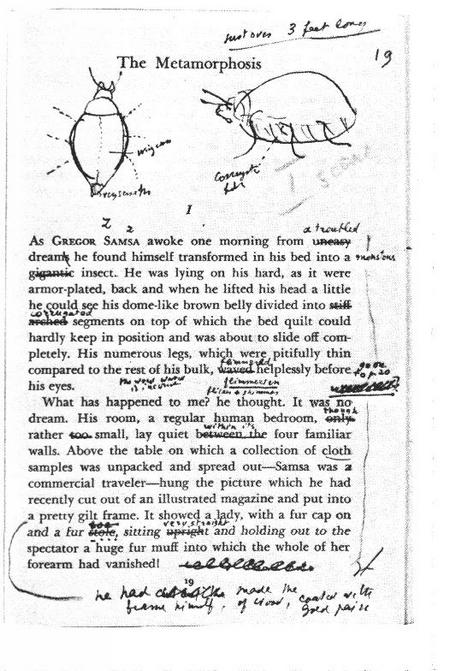
Vladimir Nabokov’s notes on Kafka’s Metamorphosis

Kafka - Nabokov


What to note?
You can nmake a note of anything that strikes you as interesting, but here are some suggestions:

  • the appearance of characters
  • recurring themes or motifs
  • features of the author’s style
  • plot twists or crucial scenes
  • important details of the story

Some do’s and don’ts
Underline up to a couple of lines of the text if necessary – but also put a word or two in the margin that gives it a title. In other words, give a name to what you think is important. Don’t underline whole paragraphs: that creates an ugly page, and it’s a waste of time. Instead, write a note in the top or bottom margin, saying what you think is important. Or put a circle round a name or a special couple of words.

Separate notes
You will definitely remember the characters, events, and features of a novel more easily if you make notes whilst reading. Use separate pages for different topics. You might make a record of

  • characters
  • chronology of events
  • major themes
  • stylistic features
  • narrative strategies

Characters
Make a note of the name, age, appearance, and their relationship to other characters in the novel. Writers usually give most background information about characters when they are first introduced into the story. Make a note of the page(s) on which this occurs. Note any special features of main characters, what other characters (or the author) thinks of them.


Studying FictionStudying Fiction is an introduction to the basic concepts and technical terms you need when making a study of stories and novels. It shows you how to understand literary analysis by explaining its elements one at a time, then showing them at work in short stories which are reproduced as part of the book. Topics covered include – setting, characters, story, point of view, symbolism, narrators, theme, construction, metaphors, irony, prose style, tone, close reading, and interpretation. The book also contains self-assessment exercises, so you can check your understanding of each topic.
Studying Fiction Buy the book at Amazon UK
Studying Fiction Buy the book at Amazon US


Chronology of events
A summary of each chapter will help you reconstruct the whole story long after you have read it. The summary prompts the traces of reading experience which lie dormant in your memory. If the book is divided into chapters, make a short summary of each one as you finish reading it.

A chronology of events might also help you to unravel a complex story. It might help separate plots from sub-plots, and even help you to see any underlying structure in the story – what might be called the ‘architecture of events’.

Major themes
These are the important underlying issues with which the novel is concerned. They are usually summarised as abstract concepts such as – marriage, education, justice, freedom, and redemption. These might only emerge slowly as the novel progresses on first reading – though they might seem much more obvious on subsequent readings.

Seeing the main underlying themes will help you to appreciate the relative importance of events. It will also help you to spot cross-references and appreciate some of the subtle effects orchestrated by the author.

Stylistic features
These are the decorative and literary hallmarks of the writer’s style – which usually make an important contribution to the way the story is told. The style might be created by any number of features:

  • choice of vocabulary
  • imagery and metaphors
  • shifts in tone and register
  • use of irony and humour

Quotations
If you are writing an essay about the novel, you will need quotations from it to support your arguments. You must make a careful note of the pages on which they occur. Do this immediately whilst reading – otherwise tracking them down later will waste lots of time.

Record page number and a brief description of the subject. Write out the quotation itself if it is short enough. Don’t bother writing out long quotations.

Bibliography
If you are reading literary criticism or background materials related to the novel – make a full bibliographic record of every source. In the case of books, you should record – Author, Book Title, Publisher, Place of publication, Date, Page number.

If you borrow the book from a library, make a full note of its number in the library’s classification system. This will save you time if you need to take it out again at a later date.

In the case of Internet and other digital sources (CDs, websites, videos) you need to look at our guidance notes on referencing digital sources.

Maps and diagrams
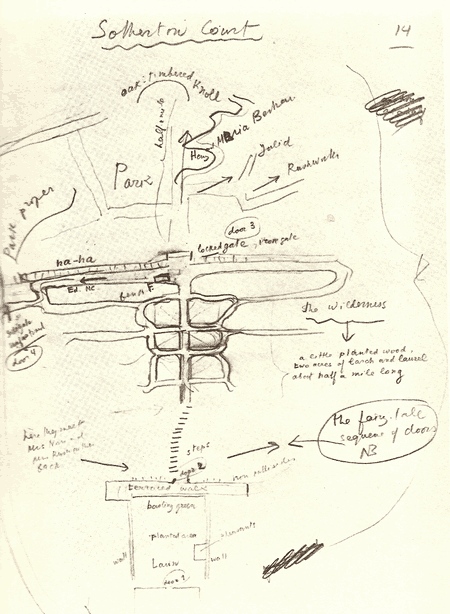
Some people have good visual memories. A diagram or map may help you to remember or conceptualise the ‘geography’ of events. Here’s Vladimir Nabokov’s diagram of the geography of Southerton in Jane Austen’s Mansfield Park.

Mansfield Park diagram

Chapter summaries
Many novels are structured in chapters. After reading each chapter, make a one sentence summary of what it’s about. This can help you remember the events at a later date. The summary might be what ‘happens’ in an obvious sense [Mr X travels to London] but it might be something internal or psychological [Susan realises she is ‘alone’].

Deciding what is most important will help you to digest and remember the content of the novel. The process of deciding will also help you to separate the more important from the less important content.

Making links
Events or characters or details of plot may have significant links between them, even though these are revealed to the reader many pages apart. Always make a note as soon as you see them – because they will be very hard to find later.

Use a dictionary
Some novelists like to use unusual, obscure, or even foreign words. Take the trouble to look these up in a good dictionary. It will help you to understand the story and the author, and it will help to extend the range of your own vocabulary. If you need help choosing a good dictionary for studying, have a look at our guidance notes on the subject.

What is close reading?
When you have become accustomed to looking at a novel in greater depth, you might be interested to know that there are four possible stages in the process of understanding what it has to offer and what can be said about it. These are the four, in increasing degree of complexity.

1. Linguistic
You pay especially close attention to the surface linguistic elements of the text – that is, to aspects of vocabulary, grammar, and syntax. You might also note such things as figures of speech or any other features which contribute to the writer’s individual style. This level of reading is largely descriptive.

2. Semantic
You take account at a deeper level of what the words mean – that is, what information they yield up, what meanings they denote and connote. This level of reading is cognitive. That is, we need to understand what the words are telling us – both at a surface and maybe at an implicit level.

3. Structural
You note the possible relationships between words within the text – and this might include items from either the linguistic or semantic types of reading. This level of reading is analytic. You assess, examine, sift, and judge a large number of items from within the text in their relationships to each other.

4. Cultural
You note the relationship of any elements of the text to things outside it. These might be other pieces of writing by the same author, or other writings of the same type by different writers. They might be items of social or cultural history, or even other academic disciplines which might seem relevant, such as philosophy or psychology. This level of reading is interpretive. We offer judgements on the work in its general relationship to a large body of cultural material outside it.

Next steps
If you want a sample of these four levels of reading illustrated with brief extracts from a short story and a long novel, here are –

  • Katherine Mansfield’s ‘The Voyage’
  • Charles Dickens’s Bleak House

© Roy Johnson 2004


Literary studies links

Study a novel Literary studies guides

Red button Tutorials on 19th century authors

Red button Tutorials on 20th century authors


Filed Under: How-to guides, Literary studies, Study Skills Tagged With: Academic writing, Literary studies, Novels, Study skills, Studying novels

How to study a set text

September 16, 2009 by Roy Johnson

reading and understanding skills

What is a set text?

A set text is usually a book that forms the central part of the content or the background to a course of study. It might be a novel for a course of literary studies, or a collection of essays on social theory for a course on sociology. In GCSE ‘O’ and ‘A’ level literature for instance, the course will consist of a specified collection of poems, the play text of a drama, a novel, and a non-fictional text such as someone’s memoirs or diaries. The same is true in undergraduate university studies.

1. Main objective
Your main task is to grasp the point of what the author is saying. You need to understand the relationship of the book’s subject to the theme(s) of the course you are studying. At some point, you may need to demonstrate what you know in course work assignments or an examination.

2. Development
You should try to follow the stages of the argument or the sequence of events. It will help you to remember this progression if you take careful notes whilst you are reading. You should try to identify and name the main topics.

3. Taking notes
You can write in the margins of the book (if it is your own). Alternatively, keep notes on separate A4 pages. Always make notes whilst you are reading. This will help you to reinforce your learning. Always begin by making a full record of the source:

Author – Title – Publisher – Date

4. Reading strategies
You should develop a variety of reading strategies to suit your reading purpose. Don’t use the same type of reading all the time. Your reading style should be chosen to match the task – getting an overview, detailed study, or maybe searching for information.

5. Skim reading
This is a first quick reading for an overview. You are making a rapid survey of the subject. Glance through the material quickly and pick up the main points. Keep your eye on the general picture. This is a very useful skill which becomes easier with regular practice.

6. Detailed study reading
This is an in-depth reading to absorb information and understand arguments. You will be reading in a concentrated manner. You might need to read a particular section more than once to grasp the point it is making. Take notes – and don’t copy long sections of text. Read with conscious purpose. You’ll get more done!

7. Agreement?
You do not necessarily have to agree with everything that is written in the text. It is a good idea to read critically and vigilantly. Make a note of any points you wish to challenge or query. However, be prepared to challenge your own views too.

8. Speed reading – a warning
Speed reading courses teach ultra-rapid skim-reading techniques. This can be useful for absorbing information at a superficial level. They are rarely suitable for understanding and retaining information. They are unlikely to help if you are engaged in serious academic study. Keep in mind the Woody Allen joke:

“I went on a speed reading course last week – and it really worked! Yesterday I read War and Peace in an hour … It’s about Russia.”

© Roy Johnson 2004


Filed Under: Study Skills Tagged With: Literary studies, Reading skills, Set texts, Study skills, Studying a set text

  • « Previous Page
  • 1
  • …
  • 40
  • 41
  • 42
  • 43
  • 44
  • …
  • 103
  • Next Page »

Get in touch

info@mantex.co.uk

Content © Mantex 2016
  • About Us
  • Advertising
  • Clients
  • Contact
  • FAQ
  • Links
  • Services
  • Reviews
  • Sitemap
  • T & C’s
  • Testimonials
  • Privacy

Copyright © 2026 · Mantex

Copyright © 2026 · News Pro Theme on Genesis Framework · WordPress · Log in