Mantex

Tutorials, Study Guides & More

  • HOME
  • REVIEWS
  • TUTORIALS
  • HOW-TO
  • CONTACT
>> Home / Archives for 2009

Archives for 2009

L.B.Perkin – Darwin

October 5, 2009 by Roy Johnson

Hogarth Press first edition book jacket designs
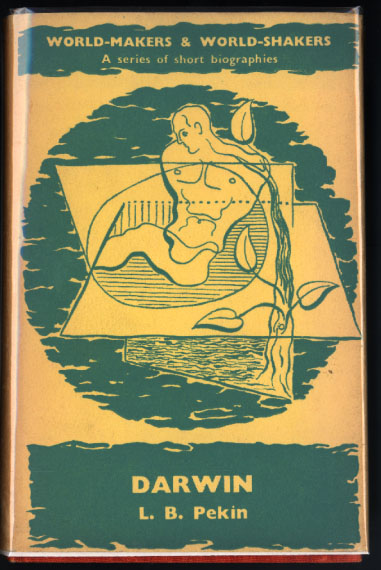
 

L.B.Perkin - Darwin - first edition

 
L.B. Pekin, Darwin (1934) World-Makers and World-Shakers: a series of short biographies.

“L.B. Pekin was the pseudonym of Reginald Snell, who wrote “two Hogarth pamphlets expanding on subjects he had introduced in [earlier] books: The Military Training of Youth: An Enquiry into the Aims and Effects of the O.T.C. (1937) and Co-education (1939). As the titles of his books and pamphlets suggest, Pekin was an innovative educator, highly critical of public schools (the British private boarding school) and in favour of progressive educational reform, including the efforts to broaden the curriculum with more science and mathematics and to introduce sex education and manual training. He strongly opposed the Officer Training Corps and supported coeducation enthusiastically.

The newly formed pacifist organization the Peace Pledge Union (with luminaries Canon Dick Sheppard, Julian Huxley, Rose Macaulay, Arthur Ponsonby, Bertrand Russell, and Vera Brittain among the early sponsors) was so impressed by Pekin’s OTC pamphlet that it ordered several hundred copies from Leonard Woolf for distribution to its members.”

J.H. Willis Jr, Leonard and Virginia Woolf as Publishers: The Hogarth Press 1917-1941

previousnext


Hogarth Press studies

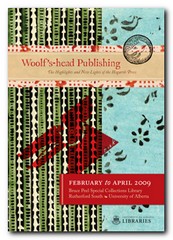
Woolf's-head Publishing Woolf’s-head Publishing is a wonderful collection of cover designs, book jackets, and illustrations – but also a beautiful example of book production in its own right. It was produced as an exhibition catalogue and has quite rightly gone on to enjoy an independent life of its own. This book is a genuine collector’s item, and only months after its first publication it started to win awards for its design and production values. Anyone with the slightest interest in book production, graphic design, typography, or Bloomsbury will want to own a copy the minute they clap eyes on it.

Woolf's-head Publishing Buy the book at Amazon UK
Woolf's-head Publishing Buy the book at Amazon US

The Hogarth Press Leonard and Virginia Woolf as Publishers: Hogarth Press, 1917-41 John Willis brings the remarkable story of Leonard and Virginia Woolf’s success as publishers to life. He generates interesting thumbnail sketches of all the Hogarth Press authors, which brings both them and the books they wrote into sharp focus. He also follows the development of many of its best-selling titles, and there’s a full account of the social and cultural development of the press. This is a scholarly work with extensive footnotes, bibliographies, and suggestions for further reading – but most of all it is a very readable study in cultural history.

The Hogarth Press Buy the book at Amazon UK
The Hogarth Press Buy the book at Amazon US

© Roy Johnson 2005


Filed Under: Hogarth Press Tagged With: Art, Bloomsbury, Darwin, Graphic design, Hogarth Press, L.B.Pekin, Literary studies

Language acquisition – understanding it

August 27, 2009 by Roy Johnson

free pages from our English Language software program

Language acquisition – definition

language acquisition The term ‘language acquisition’ refers to the process by which humans begin to use language in speech.

redbtn In linguistic study it usually refers to child language development, but it can refer to adult acquisition of any language.


Examples

redbtn There are three main theories of language acquisition:

Behaviourist [Skinner] – language is learned by imitation

Cognitive [Piaget] – understanding leads to competence

Innate [Chomsky] – language automatically acquired


Use

redbtn Chomsky’s innateness theory has superseded the others and is now generally accepted as definitive.

redbtn Some knowledge of language acquisition theory is useful to anyone studying the English language, especially to schoolteachers who are teaching youngsters to read and write.

redbtn Speech therapists and audiologists also need to have a substantial knowledge of how language is acquired and developed.

redbtn NB! We acquire language just as we acquire the ability to walk upright. [That’s the current theory, anyway.]

redbtn In the study of language, speech is considered primary and as a system which is entirely separate from writing.

redbtn Children who are learning to write often confuse the two. They produce a written form of speech.

redbtn Maturity is demonstrated by the ability to use a literary style which is completely discrete and separate from speech.

redbtn Humans acquire speech due to their innate programming. Writing on the other hand is a skill which must be learnt in the same way as driving, sewing, or cooking.

redbtn Chomsky has argued that children do not learn language but acquire it by means of an innate facility. This means that they will be able to use language, just as they will walk on two legs or acquire a second set of teeth.

redbtn All children develop their ability to use language at approximately the same age and the same rate, despite any variations in nationality or circumstances.

redbtn In the process of child language development, the acquisition of phonology, semantics, and grammar progresses simultaneously until linguistic maturity is reached around the age of seven.

redbtnAfter this, an individual’s linguistic competence varies according to training, environment and perceived necessity.

redbtn Most people who have not studied child language acquisition would say that children acquire language by imitating what they hear. Even parents of young children are often of this opinion.

redbtn However, scientific research [and careful observation] shows that this is not true. The following is just some of the evidence in support of the innateness theory.

redbtn Young children acquire language universally at roughly the same rate, despite differences in their upbringing.

redbtn Children produce utterances they have never heard. For example, children often say ‘I goed’ instead of ‘I went’ or ‘I felled’ instead of ‘I fell’.

redbtn These mistakes (which amuse parents) are actually proof of the child’s programmed competence. In adding the sound ‘ed’ they are over-applying the rule for forming the past tense.

redbtn In other words, their pre-programmed facility is working. They actually have to learn those irregularities separately. The same process occurs in forming the plural of nouns.

redbtn The rule for this in English is to add ‘s’ or ‘es’ — as in houses, books, roads, toys, and most common nouns.

redbtn However, when it comes to terms such as ‘women’, ‘mice’, ‘sheep’, or ‘narcissus’, the child will over-apply the rule and say ‘mouses’, or ‘womens’ or ‘sheeps’. These mistakes are a positive sign that the innate faculty is operating.

redbtn The truth is that parents imitate children, rather than the other way round. In any supermarket or on any bus, we hear parents repeating a child’s baby-talk. If they are not doing this they are translating the baby talk. What is definitely noticeable by its absence is the child imitating adult speech.

redbtn Adults believe they are teaching children to speak, but research shows that children ignore these attempts and progress at their own pace. The process is useful however, as part of the desirable emotional bonding between adult and child.

redbtnPiaget believed that language competence went hand in hand with understanding the world around us. A child would only be able to speak meaningfully about concepts already internalised.

redbtn For example, a child would have to understand that a specified amount of water will reach vastly differing levels if poured into a narrow beaker or a wide bowl. Only then, would the child be able to verbalise anything concerning this phenomenon.

redbtn Piaget also divided the language learning process into three or four distinct stages. In the 1960s this lead to the practice of teaching foreign languages in primary schools to children of the ‘critical learning age’. This practice was quickly abandoned, because the children were very slow at picking up the foreign language compared with adults who were receiving the same method of tuition.

redbtn Skinner as a behaviourist believed that imitation was all and that children learnt language by imitation.

redbtn Whilst this is true for some factors of the acquisition process — such as learning the exceptions to rules of grammar – all the evidence points to the validity of the innateness theory.

redbtn Learning a foreign language is difficult unless the individual has been exposed to more than one language from infancy.

redbtn In adults, learning a foreign language means gaining a skill rather than drawing on the innate capacity, as in child language acquisition.

redbtn The most efficient way of acquiring a foreign language, therefore, is to be surrounded by native speakers of the language. This is the nearest to the natural process, but it can’t be the same because of the individual’s cognisance with his or her native tongue.

Self-assessment quiz follows >>>

© Roy Johnson 2003


English Language 3.0 program
Books on language
More on grammar


Filed Under: English Language Tagged With: English language, Grammar, Language, Language acquisition

Language change – how to understand it

August 30, 2009 by Roy Johnson

free pages from our English Language software program

Language change – definition

language change The term ‘language change’ refers to the evolution of language.

redbtn All languages are in a continuous process of evolution [as are all living phenomena].


Examples

redbtn Language change occurs in all of the following areas:

Phonology
[pronunciation]
/æ/ as in Harry has become more open in RP
Semantics
[meaning]
‘gay’ meant happy, now it [also] means homosexual
Grammar
[structure]
word-order has replaced inflection in importance

Use

redbtn An awareness and a knowledge of language change is essential for students of language.

redbtn It is a significant topic for linguists, who take a descriptive attitude and accept that change is inevitable. [Value judgements are considered inappropriate.]

redbtn However, prescriptive attitudes to language change are quite common. These can be observed in ‘letters to the editor’ complaining about [what is seen as] ‘a serious decline in the quality of the English Language’.

redbtn Change and evolution affects all living languages, without exception.

redbtn The study of language change falls into two categories – diachronic and synchronic.

redbtn Diachronic study focuses on change which has taken place over the whole duration of a language’s existence.

redbtn Synchronic study focuses on change which is taking place currently.

redbtn Diachronic study has to employ a variety of techniques, because for most of the period of study, sound records do not exist.

redbtn Some of the techniques used for assessing language change in the past are as follows:

  • classifying families of languages
  • study of manuscripts dating back to 500AD in English
  • study of ancient poems in which the rhyme no longer applies
  • representation of animal sounds

redbtn Synchronic study is technically easier because of the availability of recordings of spoken English.

redbtn One example of a current phonological change is the recent rise in intonation at the end of utterances in English. This is particularly prevalent among teenagers.

redbtn There are two main speculative explanations offered for this recent change:

  • unconscious emulation of the language of Australian TV soaps
  • desire for approbation similar to the tag question – “you know?”

redbtn There are two basic attitudes to language change – descriptive and proscriptive.

redbtn A descriptive attitude is one which accepts the inevitability of change in language. It concentrates on describing the way in which language is evolving like any other living phenomenon.

redbtn For instance, if ‘disinterested’ is being used to mean ‘uninterested’ by a sufficiently large number of speakers, this is charted as a feature of development rather than a cause for outrage.

redbtn Language is seen in this descriptive context as a self-perpetuating and highly functional system. This system adopts and discards terms to suit the communication needs of the people using it.

redbtn A descriptive approach to language change is one in which the rules of language are seen as patterns which emerge naturally and historically, and particularly the structural patterns which are crucial to the viability of the language in question.

redbtn For example, a descriptive rule of English is that of word order. A representative English sentence follows the sequence Subject–Verb–Object.

redbtn This particular rule is specially significant for its role in the development and change of the English language. This is because over the centuries word order has taken the place of inflections, and comprehensibility depends on it.

redbtn For example, the utterance ‘The dog bit the man’ comprises the same content as ‘The man bit the dog’ but the meaning is totally altered by the reversal of the position of the two nouns ‘man’ and ‘dog’.

redbtn A prescriptive attitude to language change is one which supports the desire to impose linguistic rules rather than to observe developing patterns.

redbtn Prescriptiveness is shown in attempts to fix or mend the language, which is thought to be in constant danger of erosion or demise. This deterioration is usually perceived as the result of contamination from foreign influx, or from lazy use by some of its native speakers.

redbtn Prescriptive rules are those superficial prohibitions which speak more of etiquette and prestige than of linguistic functionality.

redbtn An example of such a rule is that which forbids the use of a preposition at the end of a sentence – as in ‘Who did you go with?’

redbtn Winston Churchill’s well known utterance ‘Up with this I will not put’ demonstrates the ridiculous result of following such a rule.

redbtn This and many other prescriptive rules originally belonged to Latin. They were spuriously imposed on English during the eighteenth century when Latin was thought to be a perfect language and therefore a suitable blueprint for English grammar.

redbtn Many of the irregularities of English grammar have their origins in this imposition of Latin. However, linguists take the descriptive view that although this influence was artificial and forced, it was just one of the means by which English has evolved.

redbtn The foreign influences creating language change in English occurred chronologically as follows:

  • Native Celts invaded by Angles, Saxons, and Jutes.
  • Celts driven out, along with the Celtic language.
  • Angles, Saxons, and Jutes settle in England (Angle-land).
  • They use Anglo-Saxon of various dialects.
  • Scandinavians invade and settle alongside Anglo-Saxons.
  • Their languages eventually merge.
  • Norman conquests and French settlement create diglossia.
  • English and French co-exist for separate functions.

redbtn Language changes according to the changing needs of its users. It adapts to fulfil any linguistic function demanded of it. In this respect it can be seen as a highly efficient system.

redbtn The essential character of language as a universal human system does not change, but the intrinsic mechanisms within it allow individual languages to respond to the triggers for change.

redbtn Some triggers which have resulted in changes in English language:

  • political – foreign invasion by Angles, Saxons, Jutes, Scandinavians, French in the period AD 500—1400
  • socialforeign influences from Latin, French, American, Australian, Indian, Afro-Carribean
  • cultural – exposure of one language group to another via television, radio, and films
  • geographical – proximity between different language groups, such as Black and Asian immigrants
  • technological – rapid advances in information technology and genetic engineering
  • moral – recent developments in anti-racism and environmentalism

redbtn Grammar, because it is the structure of a language, is very slow to change compared with vocabulary which can be seen as fairly superficial and ephemeral.

redbtn Two significant grammatical changes have occurred during the history of the English language – the loss of inflections, and the transition of verbs and nouns from ‘strong’ to ‘weak’.

redbtn The loss of inflections. English, up to and during the Anglo-Saxon period, had word-endings which indicated the function of individual words in any utterance.

redbtn Word order has replaced the inflections in English in indicating the function of the components of an utterance.

redbtn For example, in the utterance “Faeder ure swa eart in heofenum” [Our Father who art in heaven] the words ‘father’ [subject] ‘our’ [adjective] ‘art’ [verb, present tense] and ‘heaven’ [adverb] all have endings which indicate their grammatical function.

redbtn As the modern English version demonstrates, these inflections are no longer in existence. The only remaining inflection in English is the possessive ‘s’ in a phrase such as ‘Jennifer’s Diary’.

redbtn The transition from ‘strong’ to ‘weak’. During the Anglo-Saxon period, most English verbs were ‘strong ‘ which means that the word changed radically when expressed in the past tense.

redbtn The technical definition of a strong verb is ‘one which changes its stem vowel in the preterite.’

redbtn Currently, English has a few remaining strong verbs: ‘ride’ which becomes ‘rode’ in the past; ‘strive’ which becomes ‘strove’; ‘come’ which becomes ‘came’; and ‘lie’ which becomes ‘lay’.

redbtn The majority of English verbs are classified as ‘weak’. Weak in this context is a purely grammatical term and it relates to the fact that most verbs can be expressed in the past tense by the addition of a dental ending – the final sound in ‘slept’, ‘jumped’ or ‘mended’.

redbtn It seems that eventually all verbs will follow the same trend and that all strong verbs will become weak.

redbtn Strong nouns are those which do not become plural by the addition of the sound ‘s’ or ‘es’ in the plural. The plurals of nouns such as ‘mouse’ ‘sheep’ ‘narcissus’ and ‘ox’ are ‘mice’, ‘sheep’, ‘narcissi’, and ‘oxen’. These are all examples of the few remaining strong nouns in English. Speculation has it that these items will eventually follow the trend in which strong becomes weak.

redbtn Lexical change. Vocabulary changes much more rapidly than does the grammar of any language.

redbtn Grammatical changes have occurred during the course of centuries, whereas a new word phrase or lexical form may enter the language during a matter of only weeks.

redbtn This is because of the relatively superficial significance of lexis compared with the radical function of grammar in a language. Grammar is the basic working system or structure, and as such must remain constant for the perpetuation of the language.

redbtn Some of the mechanisms for lexical change are as follows:

  • coinagemaking up new terms, such as ‘wordprocessor’ and ‘skateboard’
  • ameliorationa word acquires a new positive meaning, as for instance ‘naughty’ used to mean ‘wicked’ but now means ‘mischievous’
  • pejorationa word acquires a new negative meaning, as for instance ‘wicked’ is now used as a slang term to mean ‘exciting’ whereas it used to mean ‘cruel’
  • borrowingtaking a word from another language, as for instance ‘restaurant’ [French] ‘patio’ [Spanish] ‘verandah’ [Indian]
  • eliminationterms being discarded from regular use, as for instance ‘tithing’ [giving a tenth of your earnings to the church]

redbtn Language efficiency. Language as a system is very efficient at adapting to new circumstances and incorporating new phenomena.

redbtn For instance, information technology has recently developed very rapidly. The English language has generated many terms by which to describe the new phenomena. Terms such as ‘floppy disk’, ‘on-line’, ‘Internet’, and ’email’ did not exist thirty years ago.

redbtn In the world of politics, the term ‘doughnutting’ is used to describe the practice of MPs crowding together for the benefit of the TV camera. This is a new term for a new phenomenon.

redbtn The term ‘road rage’ is now used to express violence and aggression among drivers. In this case however it is not the phenomenon which is new, but social attitudes towards it. This in itself has been the trigger for linguistic innovation.

Self-assessment quiz follows >>>

© Roy Johnson 2003


English Language 3.0 program
Books on language
More on grammar


Filed Under: English Language Tagged With: English language, Language change, Language development, Linguistics

Language variety – how to understand it

September 14, 2009 by Roy Johnson

free pages from our English Language software program

Language variety – definition

language variety The term language variety is used to describe the many manifestations of the English language.

redbtn These varieties are derived according to functional principles.

redbtn That is, they stem from an observation of how English is used in a variety of contexts.


Examples

redbtn Speech and writing are the two main varieties of English.

redbtn These can then be broken down into sub-varieties as follows:

SPEECH
Occupational medical, nautical, political, legal
Informal chat with friends or family
Formal job interview, dialogue with doctor
Dialects Standard English, American English, regional dialect
Accents Received Pronunciation, Lancashire accent, American accent
WRITING
Occupational academic, commerce, legal
Informal note to friends or family
Formal job application, letter to doctor
Dialects Standard English, American English
Literature novel, poetry, drama, story

Use

redbtn Many varieties of English are used by everyone in the course of a normal day.

redbtn ‘Style-switching’ is the term applied to the competent use of these linguistic varieties.

redbtn That is, we might use a casual, informal style when speaking to someone at home, and a formal style when writing to the bank manager.

redbtn The concept of language varieties is useful mainly as a tool for stylistic analysis.

redbtn It should be regarded as one of many possible aspects of language study.

redbtn In the context of language study, all varieties of English have potentially equal value or status.

redbtn Analysis of style demands an appreciation of the linguistic features which make up a given variety.

redbtn Written legal language, for example will have some or all of the following features:

  • minimal punctuation
  • use of archaic vocabulary or idioms
  • deviant use of capital letters
  • archaic script style and (sometimes) illuminated initial letters

redbtn These can be seen as the critical stylistic features of the legal variety of written English.

redbtn Identification or definition of a variety is not always a straightforward matter.

redbtn Journalism is considered by some as a variety of English. Others would argue that the term is not usefully applied in this case because of the diverse forms [reports, letters, jokes, pictures, announcements] which go into a journalistic product such as a newspaper.

redbtn This diversity of form and styles negates the usefulness of the application of variety to this particular function.

redbtn Legal language, by contrast, has far fewer possible diversities and therefore is a more clearly defined as a variety.

Self-assessment quiz follows >>>

© Roy Johnson 2004


English Language 3.0 program
Books on language
More on grammar


Filed Under: English Language Tagged With: English language, Language variety, Linguistics, Socio-linguistics

Larkin, Ideology and Critical Violence

July 13, 2009 by Roy Johnson

a case of wrongful critical conviction

During his lifetime, Philip Larkin, the self-effacing ‘Hermit of Hull’ (where he was the University Librarian), was held in public affection as an ‘accessible’ poet, minor novelist, and quirky jazz critic. His death in 1985 was mourned as the passing of – in W. H. Auden’s phrase – ‘a master of the English language’. But with the publication of his Selected Letters, edited by Anthony Thwaite (1992), and Andrew Motion’s biography, Philip Larkin: A Writer’s Life (1993), the tide began to turn.

Germaine Greer characterised Larkin’s verse as ‘anti-intellectual, racist, sexist, and rotten with class-consciousness’ while Tom Paulin condemned the Letters as a ‘revolting compilation which imperfectly reveals the sewer under the national monument that Larkin became’.

Larkin, Ideology and Critical Violence What Paulin and other commentators failed to understand was the fundamental distinction between private and public correspondence. Unless one is a compiler of the dreadful and usually seasonal round robin to friends and acquaintances, letters are written to individuals, and take into account their sensibilities. Larkin certainly knew this, yet a recent eBay auction listed Motion’s biography under the key words: ‘Homosexual Pornography Poet PHILIP LARKIN Nazi’.

John Osborne’s purpose in this adversarial and provocative polemic is to rescue Larkin from both his disciples and his detractors, who have combined and conflated the man with his work. As Osborne cautions, ‘a narrator of invented experiences is not to be confused with an actual author and real ones’.

Read correctly, neither Larkin’s poems nor his prose reveal an ‘anti-Modernist’, Little Englander, blinkered jazz lover, homophobe or racist bigot. On the contrary, he emerges as a magisterially informed, radical and subversive writer, fully conversant with and sympathetic to the plight of oppressed minorities – including African-Americans, immigrants and the white working classes.

In an excellent chapter on ‘Larkin and Modernism: Jazz’, Osborne contends that from its beginnings jazz, with its stylistic and creative innovations, was ‘Modernist music par excellence’ and was seen as such. But Larkin, because of his famous/notorious anti-modernist stance (‘Parker, Pound and Picasso’), liked to pretend that jazz stopped being ‘jazz’ with the bebop revolution of the 1940s. It didn’t, and he knew it.

Osborne also offers a brilliant (and persuasive) interpretation of the poem ‘For Sidney Bechet’ and also notes that Larkin’s other jazz hero was Louis Armstrong who, he suggested, was ‘certainly quite comparable’ in cultural stature with Pablo Picasso. So much for Larkin the private racist and public ‘anti-Modernist’.

Where the ‘pink professoriate’ and ‘self-appointed guardians of public morality’ – including Terry Eagleton, Lisa Jardine – have castigated Larkin as a dyed-in-the-wool Conservative, Osborne reminds us that the only poem he was commissioned to write by the Tory party (‘Going, Going’) was ‘so little to their liking that they brutally censored it before publication’.

Again, far from being unaware of working-class culture, Larkin identified (even if he did not identify with) its consumer novelties: ‘split-level shopping, transistors, deodorants, the Pill, Bri-Nylon, Baby-Doll nighties, the Beatles’ first LP’. In poems like ‘Sunny Prestatyn’, Osborne suggests, Larkin deconstructs the ‘discourse of modern advertising’ as profoundly as does the work of pop artists like Roy Lichtenstein or Andy Warhol.

Despite his myopic scholarly detractors, Larkin’s influence and reputation have been recognised by musicians, artists and creative writers. Leonard Bernstein nominated Larkin as the twentieth century’s greatest poet (Osborne views him as ‘the greatest poet of doubt since [Thomas] Hardy’). The paintings in Damien Hirst’s latest exhibition are all titled after a Larkin poem, while Ian McEwan, Zadie Smith and Julian Barnes have acknowledged his ‘liberating role’ in their work.

Larkin, Ideology and Critical Violence deserves a wide readership. It sheds fresh light on his oeuvre and its sources, and, most importantly, sends one back to the poems (and prose) with sharpened perceptions.

Academic students of literature will also welcome the two chapters on ‘Larkin and Philosophy’. Only occasionally does Osborne lapse into the arcane jargon of the new literary criticism, as in his endorsement of Barbara Everett’s recognition of Larkin’s indebtedness to T.S. Eliot. She, we are informed,

appreciates that this Eliotic citationality desiderates a text-centred rather then an author-centred methodology, the incorporation of elements by other hands generating a problematic of multiplicity, heterogeneity and exteriority that challenges the author’s sovereignty.

Larkin’s response to this intelligence might well have been: ‘In a pig’s arse, friend’. But he would surely have welcomed the aside that ‘The worst that anyone has discovered about Larkin are some crass letters and a taste for porn softer than what passes for mainstream entertainment in contemporary cinema or television (let alone the internet).’

© John White 2008

Larkin, Ideology and Critical Violence   Buy the book at Amazon UK   Buy the book at Amazon US

John Osborne, Larkin, Ideology and Critical Violence: A Case of Wrongful Conviction, Palgrave Macmillan, 2008, pp. 304, ISBN: 1403937060


More on literature
More on the novella
More on literary studies
More on short stories


Filed Under: Literary Studies Tagged With: English literature, Larkin Ideology and Critical Violence, Literary studies, Philip Larkin

Larkin’s Jazz Essays and Reviews

July 14, 2009 by Roy Johnson

Jazz criticism from a major English poet

Larkin’s Jazz is a collection of record and book reviews that has been assembled to flesh out Philip Larkin’s oeuvre of writings on jazz. It also seeks to correct the idea that he was a jazz reactionary — an impression he created himself by his introduction to All What Jazz, the collection of his monthly record reviews for The Daily Telegraph. This also covers a wider time span – starting with a piece he wrote for a school magazine and going up into the early 1980s.

Larkin's Jazz essays It’s a collection of reviews from the Guardan the Observer and elsewhere. What emerges is a rational, humane view of jazz and related topics, a sincere concern for the plight of African-Americans (who he refers to as Negroes – which was PC at the time) and of course a lustful sense of fun for the music. He writes on Count Basie, Billy Holiday, Duke Ellington, Charlie Parker, jazz photography, other jazz critics such as Francis Newton and LeRoi Jones. The editors Richard Palmer and John White do everything they can to reclaim the image of Larkin which has been generated by his biographies and published correspondence:

these book reviews give the lie to the charges of misogynist, racist and anti-modernist curmudgeon levelled against Larkin by politically correct critics who also revealed themselves as incapable of detecting irony or wit in the purple prose that vivifies much of his correspondence.

Whether they do that or not depends partly on how much else any reader already knows about Larkin and his – ahem, idiosyncratic views and tastes. But these pieces are certainly well worth reading in their own right. As a reviewer myself, I noticed how well-crafted the reviews are – amazingly short, yet combining an account of the book or the record, a personal opinion, and a neat sliver of readable journalism as well.

Of course much of what he has to say is about very traditional forms of jazz, and even though that’s clearly his own taste it’s not entirely his own fault. He was reviewing at a time when most print publications on the subject of jazz were rather conservative.

He admires the writing of Whitney Balliett, but sees its limitations:

in the end we are left with the impression of brilliant superficiality. Perhaps that is editorial policy: the New Yorker was always strong on polish. But the only thing you can polish is a surface.

This collection has been edited with loving care. Even the smallest items and least-known names are swaddled in supportive endnotes. It’s one for connoisseurs: devotees of jazz music, or those interested in the opinions and occasional writings of a very influential poet.

© Roy Johnson 2002

Larkin's Jazz essays Buy the book at Amazon UK
Larkin's Jazz essays Buy the book at Amazon US


Richard Palmer and John White (eds) Larkin’s Jazz: Essays and Reviews 1940-84, London: Continuum, 2001, pp.190, ISBN: 0826453465


More on music
More on media
More on lifestyle


Filed Under: Music Tagged With: Jazz, Larkin's Jazz: Essays and Reviews, Music, Philip Larkin

Learn HTML in a Weekend

June 3, 2009 by Roy Johnson

step-by-step tutorials in HTML page design

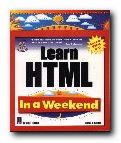
Can you really learn HTML in a weekend? Well, Steve Callihan doesn’t make any rash claims. He only sets out in this beginner’s guide to cover the basics – leaving you to fill in the finer details with later practice. The book is written with the assumption that you have a relatively free weekend. You do some preliminary reading on Friday evening with some basics about hypertext and the basics of a web site. Saturday morning is devoted to the elements of HTML tags, how to create headings, paragraphs, and breaks. It’s organised to teach you what each code does and to give you an overview of HTML.

Learn HTMLSaturday afternoon is described as optional. It deals with some of the refinements of aligning text on the page, wrapping text round images, and dealing with font sizes, colours, and faces. If you have the stamina to keep going, Saturday evening is a ‘bonus’ session covering tables. Don’t take this timetable too seriously. Anyone who can master tables in one evening should apply immediately to the Nobel Prize Foundation.

Sunday morning is devoted to frames – perhaps a section which beginners can skip, because frames are no longer even thought to be a good idea by most web design theorists. The afternoon session on forms is likely to be far more useful, and the evening ‘bonus’ session on graphics will be even more popular. I followed this in detail, since I’ve never been strong on graphics, and it proved to be a straightforward tour through making 3D buttons with Paint Shop Pro.

The book is well illustrated, and there’s a CD with the usual array of free and shareware editors and browsers, so you have all that’s required here to make a start. It truly could be done in a weekend – but why not take a little more time and get it right.

© Roy Johnson 2000

Buy the book at Amazon UK

Buy the book at Amazon US


Steve Callihan, Learn HTML in a Weekend, Rocklin, CA: Prima Publishing, 1999, pp.425, ISBN 0761518002


More on technology
More on digital media
More on web design
More on computers


Filed Under: HTML-XML-CSS, Web design Tagged With: HTML, Learn HTML in a Weekend, Technology, Web design

Learning from Research

May 22, 2009 by Roy Johnson

guidance and case studies in research techniques

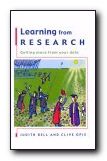
This is an excellent companion volume to Judith Bell’s best-selling Doing Your Research Project. Here she teams up with Clive Opie to present detailed case studies of several types of research. In Learning from Research they cover the descriptive study, the evaluative and experimental study, the ethnographic study, and the survey – as well as research skills in general. Each section of the book contains instructions on how to tackle the project, the scope of the work involved, and how to review the literature.

Learning from ResearchThere’s also a checklist of what to look for and a thoughtful bibliography, with notes on the significance of the items recommended. If you are embarking on research in the humanities or social sciences, this is offers a supportive and well-informed account of the approaches you might take. The book is based on case studies of five postgraduate students who were completing Master of Education or PhD degrees. They were researching part-time – and at a distance. All five faced sharp learning curves, and they discuss openly some of the mistakes they made, the lessons they learnt and how they might have done things differently.

They cover some of the standard tasks in research – defining the limits of a project, making a review of the literature, and obtaining permissions. The most interesting feature of this guidance manual is that it takes into account the fact that most postgraduates these days are part-time, and are often people holding down jobs.

They describe practical examples of collecting data, constructing questionnaires, and how to deal with the results. There’s also a realistic approach to the use of IT in research. Many people mistakenly believe that IT skills are highly developed in higher education – which is not true. So there is straightforward advice on data collection and analysis.

There are also plenty of suggestions for further reading, a helpful series of checklists, and a glossary of terms.

© Roy Johnson 2003

Buy the book at Amazon UK

Buy the book at Amazon US


Judith Bell and Clive Opie, Learning from Research, Buckingham: Open University Press, 2002, pp.261, ISBN 0335206603


More on study skills
More on writing skills
More on online learning


Filed Under: Study skills Tagged With: Academic writing, Education, Learning from Research, Research

Learning Web Design

July 12, 2009 by Roy Johnson

Illustrated and comprehensive introduction to HTML

Jennifer Niederst is a specialist trainer in web design. Her last book, Web Design in a Nutshell, is a best-selling reference guide to the subject. Learning Web Design is her latest – a manual that covers all the basis of HTML design – from a detailed explanation of coding to the principles of good navigation and information design. So what makes this introductory guide any different to the dozens of others that are available?

Learning Web DesignWell, it’s a very handsome production, with every point well illustrated by screenshots and the appropriate code. She also shows how to achieve each major effect using three popular editors – Dreamweaver, GoLive, and FrontPage. But the main strength here is the attractive balance she has struck between tuition and visual presentation.

Her pages are surrounded by indented notes, sidebars, and pull-out boxes offering tips and special workarounds. This form of presentation makes learning lighter and easier. And she’s especially strong on explaining graphics.

I particularly like her approach of explaining details which don’t get mentioned in more official guides. For instance, if you wish to colour a link, the font colour tag must be placed inside the link, otherwise it won’t work.

She also reveals lots of tips, tricks, and workarounds for overcoming some of the frustrating limitations of HTML. I was very glad to pick up a neat trick for creating pop-up windows using a small JavaScript – which answered a current problem on quiz answers I have been designing.

The book ends with a very brief glimpse at advanced techniques using style sheets, and streaming audio and video files. This is one which will appeal to beginners and trainers. Work your way through the tutorials, and you could have a reasonable site up on the Web within a few days.

© Roy Johnson 2002

Buy the book at Amazon UK

Buy the book at Amazon US


Jennifer Niederst, Learning Web Design: A Beginner’s Guide to HTML, Graphics, and Beyond, Sebastopol (CA): O’Reilly, 2001, pp.388 ISBN: 0596000367


More on web design
More on digital media
More on technology


Filed Under: Web design Tagged With: Computers, CSS, HTML, Learning Web Design, Web design

Learning XML

July 15, 2009 by Roy Johnson

overview of XML concepts and applications

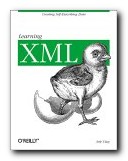
Learning XML is for anyone who wants to understand what XML is and how to use it. Erik Ray shows how to employ the appropriate structure and format to demystify the process of creating XML documents. XML is relatively simple (but very rigorous) set of tags which describe the content of documents. The problem is that you still need to learn Cascading Style Sheets in order to control the appearance of text on the page. Ray covers all that, as well as the other important technologies – such as the Document Type Definition. He also shows how style sheets can be used to format documents – though in a rather abstract manner.

Learning XMLOne or two illustrations would have been useful here. He also explains the principles of Transformation, using XSLT, which allow you to convert an XML document from one form into another. He explains very persuasively why XML is superior to HTML for preparing documents for multi-purpose use. There is also an introduction to the use of XLink and XPointer, which can create bi-directional links between data. These are extremely powerful technologies which will make the next steps in XML programming an exciting prospect for those who want to pass beyond the frustrating limitations of HTML.

This is a book which is suitable for readers who already know some HTML, but who want to know what is coming next. And it’s an overview: the finer details of XML language will have to be acquired elsewhere. It is written in a persuasive and authoritative manner. This is somebody who knows what is going on in the latest phase of Web development.

© Roy Johnson 2003

Buy the book at Amazon UK

Buy the book at Amazon US


Erik T. Ray, Learning XML, Sebastopol (CA): O’Reilly, 2nd edition 2003, pp.432, ISBN: 0596004206


More on technology
More on digital media
More on web design
More on computers


Filed Under: HTML-XML-CSS Tagged With: Computers, Learning XML, Technology, XML

  • « Previous Page
  • 1
  • …
  • 49
  • 50
  • 51
  • 52
  • 53
  • …
  • 103
  • Next Page »

Get in touch

info@mantex.co.uk

Content © Mantex 2016
  • About Us
  • Advertising
  • Clients
  • Contact
  • FAQ
  • Links
  • Services
  • Reviews
  • Sitemap
  • T & C’s
  • Testimonials
  • Privacy

Copyright © 2026 · Mantex

Copyright © 2026 · News Pro Theme on Genesis Framework · WordPress · Log in