Mantex

Tutorials, Study Guides & More

  • HOME
  • REVIEWS
  • TUTORIALS
  • HOW-TO
  • CONTACT
>> Home / 2009 / Archives for October 2009

Archives for October 2009

Analysis of a Shakespeare sonnet

October 31, 2009 by Roy Johnson

sample answer to an examination question

This analysis of a shakespeare sonnet is an example of literary analysis at third year undergraduate level. It’s also an example of an answer to an essay question set for a final-year exam paper. It poses the fairly standard test of analysing one of the sonnets. This is one of three questions to be answered in three hours. So – allowing ten minutes for making notes and maybe an outline plan, this shows what can be done in fifty minutes!

Question
Write an essay on the following sonnet. Your answer should:

  • briefly summarize the argument of the sonnet
  • comment on the language Shakespeare employs and the way that language reflects the sonnet’s argument

You may wish to refer to other sonnets in your answer, but any references to other texts must be relevant to your broader argument.

Sonnet XXII
My glass shall not persuade me I am old,
So long as youth and thou are of one date;
But when in thee time’s furrows I behold,
Then look I death my days should expiate.
For all that beauty that doth cover thee
Is but the seemly raiment of my heart,
Which in thy breast doth live, as thine in me;
How can I then be elder than thou art?
O therefore, love, be of thyself so wary,
As I not for myself but for thee will;
Bearing thy heart, which I will keep so chary
As tender nurse her babe from faring ill.
Presume not on thy heart when mine is slain;
Thou gav’st me thine, not to give back again.


Answer

In Sonnet 22, the speaker contemplates the difference in age between himself and his beloved, and asserts that he obtains youth through his relationship with the young man. In the second quatrain the speaker explains that the reason for this is the love between the himself and the young man which is portrayed as a mutual exchange of hearts, with the implication that the two have become one flesh. The speaker urges the young man to take care of himself and promises to be faithful to the young man. In the couplet, the motivating factor for the poem becomes clear, with the speaker acknowledging that he is afraid that his heart may be broken by the young man.

Although there are no personal pronouns which can confirm the sex of the addressee of the sonnet, the first 126 sonnets are assumed by critics to have been written to a young man. Sonnet 22 appears shortly after the early group of poems which urged the young man to have a child, and is one of the first sonnets to focus upon the speaker’s feelings.

The structure of the sonnet is 4-4-4-2, although there is a change of emphasis and tone after the 8th line which means that the sonnet has a distinguishable octave and sestet.

In the first quatrain, the speaker focuses upon youth and age and the disparity in age between himself and the young man. The opening line shows the speaker looking at himself in a mirror or ‘glass’ and is an echo of the opening line of sonnet 3 in which the young man was urged to look at himself in a mirror as a warning against growing old and remaining childless. The imagery of Q1 emphasises the disparity with ‘old’, ‘youth’, ‘date’, ‘death’ and the metaphor of ‘times furrows’ which effectively describes the wrinkles that the speaker has now and which the young man will have in the future’. The emphasis of this quatrain is on outward, physical appearance. The quatrain ends with the speaker looking forward to his own death which he hopes will be peaceful.

In the second quatrain, the emphasis changes and the poet uses an extended metaphor of the exchange of hearts to describe the mutual love between himself and the young man. The exchange of hearts was and still is a common motif of love poetry. However in this sonnet it is examined in a more literal way with the speaker suggesting that the two have actually exchanged hearts with the outward beauty of the young man being but ‘the seemly raiment of my heart’. Here the clothing imagery and the reference to the young man’s beauty link back to Q1 and the stress on external appearance.

Line 7, ‘which in thy breast doth live as thine in me’ is an allusion to the marriage service in which it is suggested that man and woman become one flesh. This, together with the opening lines which make the same suggestion, have convinced some critics that the relationship between the speaker and the young man is a consummated love affair. This however, is a contentious issue and one upon which critics remain divided.

The final line of Q2 links back to the opening line, with the speaker again referring to the age difference, this time asking the rhetorical question ‘How can I then be elder than thou art?’ again suggesting that the two have become one.

In the 3rd quatrain there is a change of tone, with the speaker making a direct exhortation to his beloved. ‘O therefore love, be of thyself so wary’. The heart imagery continues and the speaker uses similes of ‘nurse’ and ‘babe’ to describe himself and the young man’s heart. These similes have a two fold effect. Firstly, despite the speakers assertions to the contrary, they emphasis the difference in age between the speaker and the young man. However, they also change the imagery of the poems from those of old age such as ‘times furrows’ which was present in Q1, to ones of youth. In his way, the poem moves from age to youth. The structure of the sonnet therefore demonstrates the rejuvenation that the speaker is claiming to receive because of his relationship with the young man.

In the couplet, the motivation for the sonnet becomes clear. The poet is concerned that the young man will leave him and this will break his heart. He uses the word ‘slain’ which suggests murder and is in contrast to the peaceful death of old age that the speaker was wishing for in the first quatrain. The ‘heart’ is again the focus of the couplet, thus linking back to the 2nd and 3rd quatrains. Here however, there is the suggestion that the young man may want to take his heart back or leave the speaker. The poet warns him ‘presume not on thy heart when mine is slain’. The implication is that if the young man breaks the speaker’s heart, he will not get his own heart back – leaving him heartless – with the suggestion of cruelty.

In his sonnet, just as the imagery moves backwards from death to birth but with a final reference to death in the couplet, the quatrains take on new meanings in light of those that follow. Q1 is an assertion that the speaker is not old, Q2 explains the reasons for this assertion. Q3 is an exhortation to the speaker and the couplet explains the fear of being left broken hearted which is the underlying reason for the sonnet.

© 2000 Kathryn Abram – reproduced with permission.


More on language
More on literary studies
More on writing skills
More on creative writing
More on grammar


Filed Under: Literary studies, Study Skills Tagged With: Examinations, Literary studies, sample exam answer, Shakespeare, Writing skills

Bauhaus 1919-1933

October 22, 2009 by Roy Johnson

modernist design movement

Bauhaus was a design movement which sprang up in Germany in post 1914-1918 as a reaction to the efflorescent curlicues of la Belle Epoque. It emphasised (particularly in theory) rectilinear practicality, function over form, and a political element of art for the masses rather than a privileged few. Most of its designers were of course middle-class artists who were caught up in the revolutionary fervour of the Weimar Republic – but its greatest strength in terms of enduring design is that many of its creations are still in production today. Wallpapers are still in print, vintage retro table lamps are either being reproduced at exorbitant prices, or are trading on eBay for not much less.

Bauhaus 1919-1933This is an excellent presentation of the work done there – for a number of reasons. First, it shows a wide range of products – from paintings, furniture, and architecture, to photography and household effects. Second, the illustrations are fresh and well researched. There are illustrations here I have never seen before in books on the subject. And third, there is plenty of historical depth and context, including original photos of the Bauhaus studios and the people who taught there.

The staff list is like a roll call of modernism at its highest – architects Walter Gropius and Mies van der Rohe, designer Herbert Bayer, painters Wassily Kandinsky, Paul Klee, Joseph Albers, and Lionel Feininger, artists El Lizitsky and Moholy-Nagy, plus the constructivists Vladimir Tatlin and Alexander Rodchenko. I was also glad to see that the book included work by the wonderful and much under-rated product designer Marianne Brandt.

marianne brandt

The format of the book is simple and effective. Double page spreads are arranged with explanatory text on the left and colour illustrations on the right. Just the right sort of proportion for this type of book. Full details of each item are provided, and there are links to further information in the appendices.

The range of items is quite astonishing. There are buildings (the Bauhaus workshops themselves) designs and photos of completed architectural projects, furniture, wall hangings, paintings, advertising posters, household objects such as electric lamps and tea sets, rugs, children’s toys, and photographs.

However, form and function were not always harmonised as successfully as they might have been. It has to be said that even a design ‘classic’ such as Gerrit Ritvelt’s armchair (1918) looked as modern as modern could be in 1918 – but as design critic Victor Papanek observes

These square abstractions painted in shrill primaries were almost impossible to sit in; they were extremely uncomfortable. Sharp corners ripped clothing, and the entire zany construction bore no relation to the human body

But the overwhelming impression one takes from a collection like this is of design inventiveness working at all levels – from architecture, interior and furniture design, through fabrics and furnishings, down to graphics and typography.

In fact much of today’s architectural design is directly attributable to the influence of the Bauhaus designers. Rectilinear buildings, minimalist interiors, walls made from glass bricks, bentwood furniture, ceiling to floor windows, uncarpeted hard surface floors. Moreover, the spirit of Bauhaus functionality lives on in the products and styles of stores such as Habitat and IKEA.

I got an email only the other day offering copies of the famous Barcelona chair (Mies van der Rohe 1929) for a mere $3000 – only they called it the ‘Madrid’ chair just to cover themselves. So the spirit of the Bauhaus is definitely alive and doing commercially well today thank you very much.

Bauhaus Buy the book at Amazon UK

Bauhaus Buy the book at Amazon US

© Roy Johnson 2009


Andrew Kennedy, Bauhaus, London: Flame Tree Publishing, 2005, pp.384, ISBN 184451336X


More on architecture
More on technology
More on design


Filed Under: Architecture, Design history, Graphic design, Product design Tagged With: Architecture, Art, Bauhaus, Cultural history, Design, Graphic design, Interior design

Blogging – publish your writing

October 1, 2009 by Roy Johnson

a selection of resources + how to get started

If you want to try the latest thing in Net publishing, it’s called Blogging. A Blog (short for Web Log) is usually a combination of a personal diary, links to items of interest on the Internet, a commentary on them, plus personal thoughts and essays. It is a form of self-publishing, and because you can write whatever you wish is very popular with authors who have strong and unorthodox opinions.

Blogging began as a medium for Web-based personal diaries, and most people still use it for this purpose. But some bloggers have started to develop the medium for what is essentially self-publishing. They might post notes reflecting briefly on a topic or discuss it with other bloggers, but they also upload essays, articles, or opinion pieces which count as serious pieces of journalism, expressing ideas and points of view which might not be available elsewhere.

The mainstream media (MSM) made fun of blogging when it first appeared – but now they can’t get enough of it. Newspapers, radio and TV stations, and magazines of all kinds have their own blogs – and they can’t get enough user-generated content either. That’s writing done by you and me, which they don’t have to pay for.

Some bloggers with access to popular information have suddenly found their hobby has been transformed into a thriving business. Paul Staines’ Guido Fawkes started as an amateur political gossip blog, but now gets 2 million visitors a month and makes him a full time living via advertising. Ric Turner’s Blue Moon did the same thing for supporters of Manchester City FC.

In fact the latest generation of bloggers at the time of writing are uploading digital photographs, video clips, and audio files – which have spawned the term podcasting. It’s also free and easy to do. You simply add your own text into a ready-made form and press the SEND button.

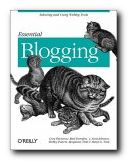
Essential BloggingEssential Blogging offers a tour of the best blogging sites, how to upload and maintain your pages, and how to configure the options to get the best effects. A series of chapters, clearly written by enthusiasts, takes you through which Blog sites and software are available – from Blogger, Radio Userland (free software), Moveable Type, WordPress, and Blosxom. Some of these have developed rapidly beyond mere blogging tools into small-scale content management systems.

Are you likely to make an income from all this? Not directly – but there are all sorts of possible spin-offs. Lots of bloggers sign up as affiliates to Amazon, Google, and other commercial sites. They earn a small residual income from sending potential customers to buy books and software. Click one of the Amazon ads on this page, and you’ll see how it works.

There’s also the possibility of micro-payments. This is a system in which people are prepared to pay a small amount for downloading an article of interest. There’s still some resistance to this idea, but it’s now fairly common in downloading music files – so it might catch on.


Blogging GeniusBlogging: Genius Strategies for Instant Web Content Biz Stone covers most of these new possibilities in his book. He shows how to log onto the most popular site of all – Blogger – and establish your Web presence. Then he shows you how to add colour, text manipulation, and layout variety to your pages, then on to the serious business of making money.

There’s a chapter on arranging archives of your blogs, which can be done on a weekly or monthly basis. He also shows you how you can increase traffic to your blog. This text shows how to turn your home page into a microportal with fresh content to keep your readers coming back.

There are now all sorts of blogging support and development services springing up as the number of bloggers gets bigger and bigger. These range from online tutorials which will show you how to get set up — try BlogBasics — to tracking and site visitor statistics — try BlogFlux. And just to repeat the point yet again — it’s all free. If you want to see our blog, go to mantex.blogspot.com


The Weblog HandbookThe Weblog Handbook Rebecca Blood’s book is for anyone who has ever thought about starting a Weblog but isn’t sure how to post, where to find links, or even where to go to register. She certainly knows what she’s talking about, as you can see if you look at her own blog at RebeccaBlood.net.

She blogs regularly on topics which range from food and knitting to political activism and blogging itself. The Weblog Handbook is a clear and concise guide to everything you need to know about the phenomenon that is exploding on the Web. She expertly guides the reader through the whole process of starting and maintaining a Weblog and answers any questions that might pop up along the way, such as the elements of good Weblog design and how to find free hosting.


Blogging for DummiesBlogging for Dummies Brad Hill’s advice is aimed at getting you up and running as quickly as possible – though he begins with what blogs are – and what they are not. He explains the different types of blogs, and how and why they are different from web sites. The good thing is that he looks at all the options and draws up comparison charts which show the features, cost, and options offered by the various providers and software programs.


return button Publish your writing

© Roy Johnson 2009


More on publishing
More on journalism
More on creative writing
More on writing skills


Filed Under: How-to guides, Journalism, Publishing, Writing Skills Tagged With: Blogging, Blogging for Dummies, Journalism, Publishing, The Weblog Handbook, Writing skills

Common file types

October 31, 2009 by Roy Johnson

Extension Type Characteristics
.aam media file MacroMedia Shockwave
.arc archive file
(obsolete)
Open with PKZip or WinZip
.asp web page active server page – used to code Web pages that connect to databases
.au audio Sound file – open with player – used on older Web pages
.avi video clip Audio/Video Interleaved – movie clip – open with mplayer, IE, or Navigator with plugin
.bak backup file Used by many applications – often created automatically
.bat application DOS batch file – run by double-clicking in Win95 – edit with Notepad
.bmp graphic file Microsoft bitmap – open in MS Paint or graphics program
.cab archive Microsoft installation achive (cabinet file) – similar to .zip archive
.cfg — Configuration file
.cgi — Common Gateway Interface – used to exchange information with a server (often used with Perl)
.chk — Data recovered after running Checkdisk
.css style sheet plain text file containing web page style preferences
.csv data Comma Separated Value file – a way of presenting tabular data in
a text file – usually viewed in MS Excel.
.dat data file Used by several applications. Not to be opened directly.
.dcr media file Macromedia Shockwave movie
.dir media file Macromedia Director file – provides animation and interactivity
.dll dynamic link library Software used by Windows to provide services to applications
.doc document Microsoft Word file
.dot template Microsoft Word template
.drv device driver Used to control hardware – (old)
.dtd text document type definition
.exe application self-extracting or executable file – run by double-clicking in Win95
.faq data file Frequently Asked Questions – almost always a text file
.fla media Macromedia Flash animation file – requires Shockwave
.fnt — Font file
.gif image graphic in GIF format – open in web browser or graphics program
.gz application compressed archive file created by Gzip in the UNIX operating system
.hqx archive Compressed Macintosh file archive created by Binhex
.htm text file hypertext document [same as .html] – open in a web browser – edit in any word-processor or text editor
Dictionary of the Internet - Click for details at AmazonThis dictionary explains the thousands of new terms which have come into use during the last few years. It includes the abbreviations of newsgroups, the language of e-commerce, and the scientific terms used to describe the structure of the Internet. It provides terms on the Web itself, software technology, security, and the arcane language of hackers.
.ico Windows icon Open with an icon editor
.ini — Initialisation file
.jar Java Java compressed archive file
.jav Java cross platform programming language used to create complex interactive forms and special effects
.jpg image Graphic in JPEG format (Joint Photographic Experts Group) View with web browser or image editing program
.js JavaScript part of Web page used to create interactive effects such as mouse roll-overs and pop-up boxes
.jso — Java server page
.kbd data file Keyboard layout data
.log data file Created by many applications – usually a text file – edit in any text editor
.mdb database Database file created by Microsoft Access, a widely-used desktop relational database program; contains the database structure (tables and fields) and database entries (table rows) as well as data entry forms, queries, stored procedures, reports, and database security settings.
.mid audio audio file in MIDI format
.mov video QuickTime movie – view using IE or Netscape using plug-in
.mp3 audio Audio file in MP3 format – CD-quality sound, with 10x compression
.mpg movie Video movie in MPEG format (Motion Picture Experts Group)
.odf data OpenDocument Formula. Spreadsheet formula used by OpenOffice.org and StarOffice Calc; allows the results of calculations performed within the spreadsheet to be automatically entered into one or more cells; based on the OASIS OpenDocument standard and formatted in XML.
.old — Backup file (generic)
.pdf application Portable Document Format – requires Adobe Acrobat reader
.pl application Perl source file – text file, editable in any text editor
.png image graphic in Portable Network Graphics format – can work on all platforms
.ppt application Microsoft PowerPoint file – used for creating slides and overhead presentations
.pub — Microsoft Publisher page template file
.ram audio Real Audio file – open in browser with RealAudio plug-in
.rtf application Rich Text Format –
word-processor file with formatting codes
.scr screen saver
.sea application Self-extracting archive –
Apple-Mac – requires Stuffit
.sig signature Appended to outgoing email messages – editable in text editor
.swf media Macromedia Shockwave Flash animation movie
.sys — DOS system file – device driver or hardware configuration info
.tar application file archive created in the Unix operating system
.tar.gz application .tar archive compressed by Gzip
.tif image Tagged Image File format – graphic file – editable in graphics program
.tmp — temporary file – used by many programs
.ttf — True Type Font file – view with fontview
.txt text contains only ASCII code – also called ‘text file’ – editable in any text editor
.wav audio Sound file in Waveform format
.wsz graphics Winamp skin – visual interface for audio control board
.xls application Microsoft Excel worksheet file
.xml Web page extensible markup language – a plain text file for web pages
.zip application compressed file – open with WinZip or PKZip

© Roy Johnson 2002


Filed Under: How-to guides Tagged With: Common file types, Computers, file extensions, file types, Technology

E.M.Forster – What I Believe

October 4, 2009 by Roy Johnson

Hogarth Press first edition book jacket designs


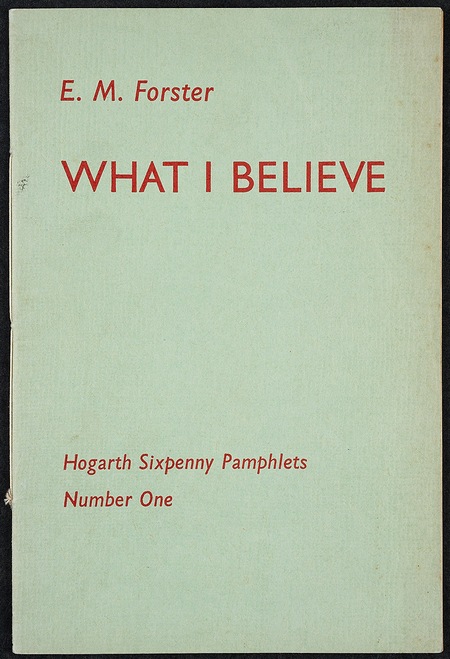
What I Believe - original pamphlet

 
E.M. Forster, What I Believe (1939)

previousnext


Hogarth Press studies

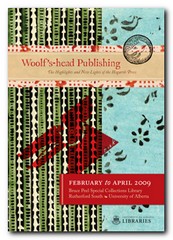
Woolf's-head Publishing Woolf’s-head Publishing is a wonderful collection of cover designs, book jackets, and illustrations – but also a beautiful example of book production in its own right. It was produced as an exhibition catalogue and has quite rightly gone on to enjoy an independent life of its own. This book is a genuine collector’s item, and only months after its first publication it started to win awards for its design and production values. Anyone with the slightest interest in book production, graphic design, typography, or Bloomsbury will want to own a copy the minute they clap eyes on it.

Woolf's-head Publishing Buy the book at Amazon UK
Woolf's-head Publishing Buy the book at Amazon US

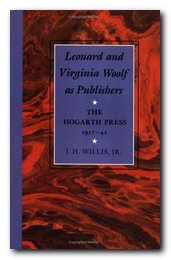
The Hogarth Press Leonard and Virginia Woolf as Publishers: Hogarth Press, 1917-41 John Willis brings the remarkable story of Leonard and Virginia Woolf’s success as publishers to life. He generates interesting thumbnail sketches of all the Hogarth Press authors, which brings both them and the books they wrote into sharp focus. He also follows the development of many of its best-selling titles, and there’s a full account of the social and cultural development of the press. This is a scholarly work with extensive footnotes, bibliographies, and suggestions for further reading – but most of all it is a very readable study in cultural history.

The Hogarth Press Buy the book at Amazon UK
The Hogarth Press Buy the book at Amazon US

© Roy Johnson 2005


Filed Under: Hogarth Press Tagged With: Art, Bloomsbury, E.M.Forster, Graphic design, Literary studies, What I Believe

Eats, Shoots and Leaves

October 20, 2009 by Roy Johnson

a radical defense of traditional punctuation rules

Who would have thought it! A book on punctuation at the top of the best-seller lists. The title refers to joke about a panda who goes into a cafe, orders a sandwich, then pulls out a gun and fires it. The panda had read an encyclopedia entry on itself which contained the unnecessary comma in Eats, Shoots and Leaves. Lynn Truss’s attitude to punctuation is enthusiastic, robust, and uncompromising, as her subtitle makes clear.

Eats, Shoots and LeavesShe wants you to become angry at the misuse of apostrophes and indignant at misplaced commas. She teaches via anecdote, which is probably why the book is so popular. There are no stuffy grammar lessons here, just accounts of bad punctuation, explanations of why they are wrong, and exhortations to keep up standards.

She likens punctuation to good manners – something which should be almost invisible, but which eases the way for readers. And in fact for all her slightly tongue-in-cheek militancy, she takes a non-pedantic line where there are areas of doubt or where punctuation becomes a matter of taste and style.

She takes you on a lively and entertaining tour of the comma, the semicolon, the apostrophe, the colon, and the full stop. Then it’s on to the piquancies of the exclamation and the question mark.

There are several interesting but mercifully brief detours into the history of punctuation – and I couldn’t help smiling when she confessed that her admiration for Aldus Manutius the elder (1450-1515) ran to being prepared to have his children.

Her style is very amusing and, appropriately enough for a book on language, quite linguistically inventive. She knows how to get close to you as a reader and isn’t scared to take risks.

For all her vigilance however, I think she misunderstands one example of the apostrophe – and the point of the joke it is making. A cartoon showing a building with the sign Illiterate’s Entrance could be using the term ‘illiterate’ as a collective singular. She thinks it should read Illiterates’. But we won’t quibble.

She ends by looking at the chaos of random punctuation which now predominates much of email messaging – and feels apprehensive. But I don’t think she needs to worry. For every hyphen or ellipsis to punctuate a gap in thought and sense, there is a new word or a new linguistic invention to compensate. Language may well be a self-compensating and even self-correcting system after all.

Anyone who is unsure about the basics of punctuation will learn some valuable lessons here, and those who already care will have their feelings and understanding confirmed in a very entertaining manner.

Eats, Shoots and Leaves   Buy the book at Amazon UK

Eats, Shoots and Leaves   Buy the book at Amazon US

© Roy Johnson 2009


Lynn Truss, Eats, Shoots & Leaves: The Zero Tolerance Approach to Punctuation, London: Profile Books, 2009, pp.209, ISBN: 0007329067


More on writing skills
More on language
More on grammar


Filed Under: Language use, Writing Skills Tagged With: Eats, Grammar, Language, Punctuation, Shoots & Leaves, Writing skills

ePublishing and eBooks

October 2, 2009 by Roy Johnson

a selection of resources reviewed

One rapidly expanding opportunity for writers using the Internet is the creation of eBooks. These have the advantage that they can be written, stored, and sent electronically. ePublishing is available for whatever you wish; it doesn’t cost much; you can start small; there are no printing, storage, or postage costs; and you can control the whole process from your back bedroom.

eBooks can be read on desktop computers, but many people prefer to use laptops, eBook readers, or PDAs (Personal Digital Assistants) such as the Palm Pilot. Other people print off the pages and read from the conventional page. So you’ve got to be prepared to supply your text in a number of different formats if you want to reach all audiences.

ePublishingCreating E-books
Chris Van Buren and Jeff Cogswell address all these issues, and provide you with all the information you need to make a start. They include a survey of the e-publishing business; planning and creating an e-book; getting the book published; finance and copyright; and a selection of personal success stories. One of the more interesting features of the advice they give is that it’s suitable either for individuals with just one book to market, or for people who might wish to set up as publishers, ready to promote several titles. As usual with the excellent Topfloor ‘Poor Richard’ series, every chapter is packed with recommendations for online resources – many of which are low-budget or free.

You can market your own eBooks, but a very popular alternative is to place titles with distributors like Fatbrain and split the proceeds. There are also electronic versions of conventional publishers who will pay you royalties up to fifty percent.


The Internet Writer's HandbookThe Internet Writer’s Handbook
This is a detailed guide to publishers of the two formats which are most digital – e-zines and e-books. It’s in the form of an international A-Z listing of the best websites for writers to target, with full contact details for all websites listed. It offers plenty of detail on how to submit your work , how much publishers will pay, and even how they are most likely to respond. The topics these publishers cover range from poetry and fiction, through non-fiction writing, to specialist publications.


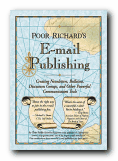
eMail Publishing - Click for details at AmazonEmail Publishing
It’s quickly apparent to most writers that this system means that self-publication is an attractive option. In fact Chris Pirillo argues that email publishing can be much more effective than the Web. How is this? Well, he describes publishing via a web site as “like opening a hamburger stand in a dead-end street”. Not many people will pass by, and even fewer are likely to make a purchase.

On the other hand, almost everybody reads their e-mail, so why not use it as a vehicle for publishing instead? Some of the more popular e-mail newsletters have up to 400,000 regular subscribers. In he outlines all the possibilities – discussion groups, bulletins, and announcement lists – but it’s the free e-mail newsletter which is at the heart of this book. He takes you through all the technicalities of how to run one.

This can be used to promote your writing – or even as a hot and direct form of journalism if you are a non-fiction writer. And this guy knows whereof he speaks. He publishes several email newsletters every day, draws down revenue from advertisers, and earns a living from it.

return button Publish your writing

© Roy Johnson 2009


More on publishing
More on journalism
More on creative writing
More on writing skills


Filed Under: How-to guides, Journalism, Publishing, Writing Skills Tagged With: eBooks, Electronic Writing, Journalism, Newsletters, Publishing, Writing skills

F.L.Lucas – Tragedy

October 4, 2009 by Roy Johnson

Hogarth Press first edition book jacket designs

 
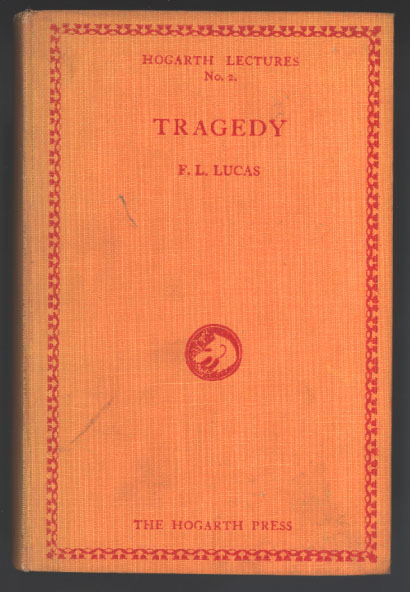
F.L.Lucas - Tragedy - first edition

F.L. Lucas,Tragedy in Relation to Aristotle’s ‘Poetics’ (1927) The Hogarth Lectures on Literature, First Series, No. 2.

F.L. (Peter) Lucas was a former Apostle and classical scholar at King’s College Cambridge. The Woolfs also published his unsuccessful novel The River Flows (1926).

previousnext


Hogarth Press studies

Woolf's-head Publishing Woolf’s-head Publishing is a wonderful collection of cover designs, book jackets, and illustrations – but also a beautiful example of book production in its own right. It was produced as an exhibition catalogue and has quite rightly gone on to enjoy an independent life of its own. This book is a genuine collector’s item, and only months after its first publication it started to win awards for its design and production values. Anyone with the slightest interest in book production, graphic design, typography, or Bloomsbury will want to own a copy the minute they clap eyes on it.

Woolf's-head Publishing Buy the book at Amazon UK
Woolf's-head Publishing Buy the book at Amazon US

The Hogarth Press Leonard and Virginia Woolf as Publishers: Hogarth Press, 1917-41 John Willis brings the remarkable story of Leonard and Virginia Woolf’s success as publishers to life. He generates interesting thumbnail sketches of all the Hogarth Press authors, which brings both them and the books they wrote into sharp focus. He also follows the development of many of its best-selling titles, and there’s a full account of the social and cultural development of the press. This is a scholarly work with extensive footnotes, bibliographies, and suggestions for further reading – but most of all it is a very readable study in cultural history.

The Hogarth Press Buy the book at Amazon UK
The Hogarth Press Buy the book at Amazon US

© Roy Johnson 2005


Filed Under: Hogarth Press Tagged With: Art, Bloomsbury, F.L.Lucas, Graphic design, Hogarth Press, Literary studies

Fowler’s Modern English Usage

October 29, 2009 by Roy Johnson

reprint of the classic first edition

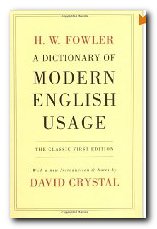
Fowler’s Modern English Usage was first published in 1926. It was an immediate commercial success, selling 60,000 copies in its first year, and it went on to become the most influential set of guidelines on grammar and the use of the English language of the twentieth century. There were later versions revised by Sir Ernest Gowers in 1965 and Robert Burchfield in 1996, but this is a facsimile of Henry Fowler’s original first edition, with an introduction by the linguist David Crystal that sets it in context.

Fowler's Modern English UsageIt’s reproduced photographically from the original – so the entries are arranged in two columns on the page, which was the style for books of this kind at the time. This presentation strikes me as doubly appropriate, because it captures the old-fashioned nature of the original, and it accurately reflects the slightly pedantic tone of the contents. Fowler is not unlike his great lexicological predecessor Samuel Johnson in issuing his judgements wrapped around with ironic asides, which makes for interesting reading.

David Crystal’s introductory essay explains how the book came to be published, and how Fowler was an important transition figure between the old, traditional proscriptive grammarians and the new more tolerant descriptive schools which were to follow.

Strangely enough, Fowler, whose name has become a metonym for his Dictionary, is often used by prescriptivists as an authority to support their arguments – when the fact is that his work as a whole reflects a flexible, subtle, and relativist attitude to language and the way it is used.

Fowler deals with all the classic problems in English language, such as the which/that dilemma, the split infinitive, and ending sentences with a preposition. He covers issues that are difficult even for native speakers of English (such as the who/whom issue).

The central problem is the question of usage. If enough people say different from does that make it right? Fowler was working in the days before any giant collections of real data were being used as a source of evidence to support linguistic claims. And he was using printed sources, not spoken, which today are regarded as primary.

However, it’s difficult to predict if he is going to be prescriptive or relativist on any single topic. Crystal points out that there are plenty of inconsistencies within the Dictionary. On some issues Fowler accepts widespread common usage; at others he asserts that something is right or wrong based on nothing more than his own opinion.

It should be said that the Dictionary is not merely a listing of words and their definitions, as in the normal sense of the term. It’s a compendium of how terms are used grammatically, the problems they pose, and the cultural baggage that surrounds them. A typical entry which captures both his stern sense of what is right and his ironic attitude in trying to correct it is as follows:

aggravate,   aggravation. 1. The use of these in the sense of annoy, vex, annoyance, vexation, should be left to the uneducated. It is for the most part a feminine or childish colloquialism, but obtrudes occasionally into the newspapers. To aggravate has properly only one meaning—to make (an evil) worse or more serious. The right & the wrong use are shown in:   (right) A premature initiative would be calculated rather to a. than to simplify the situation; (wrong) The reopening of the contest by fresh measures that would a. their opponents is the last thing that is desired in Ministerial circles. It is in the participle (and a very stupid, tiresome, aggravating man he is) that the vulgarism is commonest.

You can probably find copies of the first edition Fowler in the few remaining second hand bookshops – but it’s nice to have this reprint to put it back into general circulation again.

Fowler's Modern English Usage   Buy the book at Amazon UK

Fowler's Modern English Usage   Buy the book at Amazon US

© Roy Johnson 2009


David Crystal (ed) Fowler’s Modern English Usage: The Classic First Edition, Oxford: Oxford University Press, 2009, pp.784, ISBN: 0199535345


More on language
More on literary studies
More on writing skills
More on creative writing
More on grammar

Filed Under: Dictionaries Tagged With: Dictionaries, English language, Grammar, Language, Modern English Usage, Reference

Fyodor Dostoyevski – Stavrogin’s Confession

October 4, 2009 by Roy Johnson

Hogarth Press first edition book jacket designs


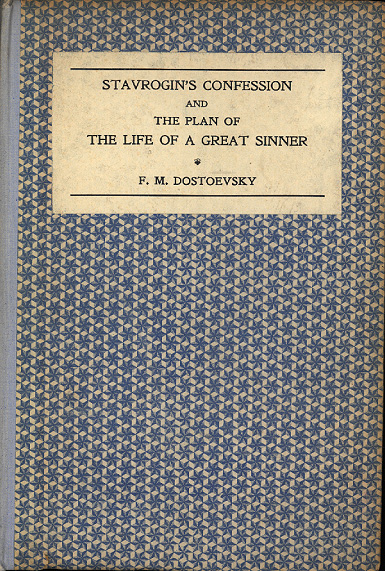
Stavrogin's Confession - first edition

 
Fyodor Dostoyevski, Stavrogin’s Confession, (1922)

This unpublished material from The Possessed was translated by S.S.Koteliansky with Virginia Woolf. The financial success of these Russian translations enabled the press to transform itself from a handpress cottage industry into an established commercial publisher. The origins of the text were explained in their ‘Translator’s note’:

“The Russian government has recently published a small paper-covered book containing Stavrogin’s Confession, unpublished chapters of Dostoyevski’s novel The Possessed, and Dostoyevski’s plan or sketch of a novel which he never actually wrote but which he called The Life of a Great Sinner.”

J.H. Willis Jr, Leonard and Virginia Woolf as Publishers: The Hogarth Press 1917-1941

Leonard Woolf provides an account of the book as a physical object with his customary attention to fine detail:

“These books, which I still think to be beautifully printed and bound, were very carefully designed by Virginia and me, and they were unlike the books published by other publishers in those days. They were bound in paper over boards and we took an immense amount of trouble to find gay, striking, and beautiful papers. The Dostoyevski and Bunin were bound in very gay patterned paper which we got from Czechoslovakia … We printed, I think, 1,000 of each and [sold] the Dostoyevski at 6s. [They] sold between 500 and 700 copies in twelve months and made us a small profit, and they went on selling until we reprinted or they went out of print.”

Leonard Woolf, An Autobiography

previousnext


Hogarth Press studies

Woolf's-head Publishing Woolf’s-head Publishing is a wonderful collection of cover designs, book jackets, and illustrations – but also a beautiful example of book production in its own right. It was produced as an exhibition catalogue and has quite rightly gone on to enjoy an independent life of its own. This book is a genuine collector’s item, and only months after its first publication it started to win awards for its design and production values. Anyone with the slightest interest in book production, graphic design, typography, or Bloomsbury will want to own a copy the minute they clap eyes on it.

Woolf's-head Publishing Buy the book at Amazon UK
Woolf's-head Publishing Buy the book at Amazon US

The Hogarth Press Leonard and Virginia Woolf as Publishers: Hogarth Press, 1917-41 John Willis brings the remarkable story of Leonard and Virginia Woolf’s success as publishers to life. He generates interesting thumbnail sketches of all the Hogarth Press authors, which brings both them and the books they wrote into sharp focus. He also follows the development of many of its best-selling titles, and there’s a full account of the social and cultural development of the press. This is a scholarly work with extensive footnotes, bibliographies, and suggestions for further reading – but most of all it is a very readable study in cultural history.

The Hogarth Press Buy the book at Amazon UK
The Hogarth Press Buy the book at Amazon US

© Roy Johnson 2005


Filed Under: Hogarth Press Tagged With: Art, Bloomsbury, Dostoyevski, Graphic design, Literary studies, Stavrogin's Confession

  • 1
  • 2
  • 3
  • …
  • 8
  • Next Page »

Get in touch

info@mantex.co.uk

Content © Mantex 2016
  • About Us
  • Advertising
  • Clients
  • Contact
  • FAQ
  • Links
  • Services
  • Reviews
  • Sitemap
  • T & C’s
  • Testimonials
  • Privacy

Copyright © 2026 · Mantex

Copyright © 2026 · News Pro Theme on Genesis Framework · WordPress · Log in