Mantex

Tutorials, Study Guides & More

  • HOME
  • REVIEWS
  • TUTORIALS
  • HOW-TO
  • CONTACT
>> Home / Archives for 2009

Archives for 2009

Ottoline Morrell biography

September 20, 2009 by Roy Johnson

society hostess and patron of the arts
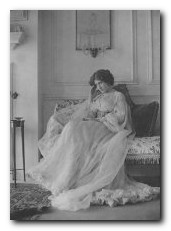
Ottoline Morrell - portraitOttoline Morrell (1873-1938) features in the history of the Bloomsbury Group largely as a hostess and patron of the arts. From 1908 onwards, she entertained a wide circle of political and literary celebrities at her Thursday evening gatherings in Bedford Square, and at her country retreat at Garsington Manor in Oxfordshire. She was born Ottoline Violet Anne Cavendish Bentinck in 1873, acquiring the title of ‘Lady’ when her half-brother inherited the duchy of Portland in 1879, and the family moved into Welbeck Abbey in Nottinghamshire. Ottoline was a cousin of Elizabeth Bowes-Lyon, later to become queen to George VI. She was educated at home and at Somerville College, Oxford, where she studied politics and history.

She married Philip Morrell in 1902 and the marriage lasted for the rest of her life, even though like many members of the Bloomsbury Group, their relationship was far from conventional. They had one child, a daughter, Julian. She had affairs with Bertrand Russell and the painter Augustus John, as well as with Aldous Huxley’s wife, Maria Nijs.
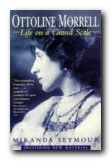
Ottoline MorrellLife on the Grand ScaleHer husband became a Liberal MP (for Blackburn) following the general election in 1906. He was critical of the government’s position on the First World War. They sheltered a number of conscientious objectors on their farm estate at Garsington near Oxford, including Duncan Grant, Clive Bell, and Mark Gertler. It was there that Siegfried Sassoon, recuperating after a period of sick leave, was encouraged to go absent without leave in a protest against the war.

Her friends and guests included Henry James, Lytton Strachey, Bertrand Russell (who was her lover for a number of years), D.H. Lawrence, Siegfried Sassoon, Leonard Woolf and Virginia Woolf, John Middleton Murry, and Aldous Huxley. Not all of these guests were appreciative, and some of them made fun of her behind her back. There are satirical portraits of her as Hermione Roddice in in Lawrence’s Women in Love (1916) and Aldous Huxley’s Crome Yellow (1921). She was also the inspiration for Lady Caroline Bury in Graham Greene’s It’s a Battlefield, and for Lady Sybilline Quarrell in Alan Bennett’s Forty Years On (1968).

Despite all the scoffing about the luxury and extravagance of Garsington – the truth is that the Morrells were sailing close to the financial edge, and eventually they had to sell the entire Garsington estate. This was because Philip Morrell had two illegitimate sons by his previous mistresses, and the boys needed to be educated – privately of course. Because Ottoline Morrell had a brief relationship with one of her members of staff, it’s assumed by some critics that this provided the creative spark for D.H.Lawrence’s Lady Chatterley’s Lover.

Ottoline Morrell


Bloomsbury Group – web links

Bloomsbury Group - web links Hogarth Press first editions
Annotated gallery of original first edition book jacket covers from the Hogarth Press, featuring designs by Vanessa Bell, Roger Fry, and others.

Bloomsbury Group - web links The Omega Workshops
A brief history of Roger Fry’s experimental Omega Workshops, which had a lasting influence on interior design in post First World War Britain.

Bloomsbury Group - web links The Bloomsbury Group and War
An essay on the largely pacifist and internationalist stance taken by Bloomsbury Group members towards the First World War.

Bloomsbury Group web links Tate Gallery Archive Journeys: Bloomsbury
Mini web site featuring photos, paintings, a timeline, sub-sections on the Omega Workshops, Roger Fry, and Duncan Grant, and biographical notes.

Bloomsbury Group - web links Bloomsbury: Books, Art and Design
Exhibition of paintings, designs, and ceramics at Toronto University featuring Hogarth Press, Vanessa Bell, Dora Carrington, Quentin Bell, and Stephen Tomlin.

Bloomsbury Group - web links Blogging Woolf
A rich enthusiast site featuring news of events, exhibitions, new book reviews, relevant links, study resources, and anything related to Bloomsbury and Virginia Woolf

Bloomsbury Group - web links Hyper-Concordance to Virginia Woolf
Search the texts of all Woolf’s major works, and track down phrases, quotes, and even individual words in their original context.

Bloomsbury Group - web links A Mrs Dalloway Walk in London
An annotated description of Clarissa Dalloway’s walk from Westminster to Regent’s Park, with historical updates and a bibliography.

Bloomsbury Group - web links Women’s History Walk in Bloomsbury
Annotated tour of literary and political homes in Bloomsbury, including Gordon Square, University College, Bedford Square, Doughty Street, and Tavistock Square.

Bloomsbury Group - web links Virginia Woolf Society of Great Britain
News of events, regular bulletins, study materials, publications, and related links. Largely the work of Virginia Woolf specialist Stuart N. Clarke.

Bloomsbury Group - web links BBC Audio Essay – A Eulogy to Words
A charming sound recording of a BBC radio talk broadcast in 1937 – accompanied by a slideshow of photographs of Virginia Woolf.

Bloomsbury Group - web links A Family Photograph Albumn
Leslie Stephens’ collection of family photographs which became known as the Mausoleum Book, collected at Smith College – Massachusetts.

Bloomsbury Group - web links Bloomsbury at Duke University
A collection of book jacket covers, Fry’s Twelve Woodcuts, Strachey’s ‘Elizabeth and Essex’.

© Roy Johnson 2000-2014


More on biography
More on the Bloomsbury Group
Twentieth century literature


Filed Under: Bloomsbury Group Tagged With: Biography, Bloomsbury Group, Modernism, Ottoline Morrell

Overcome writer’s block

September 16, 2009 by Roy Johnson

techniques for getting started

Overcome Writer's Block1. Writer’s block is much more common than most people imagine. But it can be overcome. Don’t imagine that you should be able to write impeccably at your first attempt. Most successful writers make several drafts of their work. They edit what they write, correct mistakes, make additions and deletions, and generally re-write extensively. Writing fluently and clearly is an advanced skill.
2. Don’t just sit staring at the blank piece of paper or the editing screen: it will only make you feel worse. Do something else, then come back to the task. Best of all, write something else – something you know you can write. This will help you to feel more confident.

3. Do some different type of writing as a warm-up exercise. Write a note or a letter to one of your friends. Re-write some of your earlier work, or just write something for your own amusement. This may help to release you from the blocked condition.

4. Don’t try composing in your head if you get stuck. Put down even your scrappiest ideas, so that you can see what you are dealing with. It may help you to identify any problems which are holding you back. If in doubt, put it down anyway. You can always delete it or change it later.

5. Get used to the idea of planning and making notes for what you are going to write. Don’t try to work with all the information stored in your head. A sound working plan and good notes will take the strain off you – and will prompt you with ideas, which in turn will prevent any ‘blocks’ developing.

6. Be prepared to make two or three attempts at anything you write. The first may not be very good, but it can be corrected, altered, changed – or even thrown away. Nobody need see your first attempts, so you don’t need to worry how bad they are – provided you pass on to a second or a third draft.

7. Some people develop a block because they think that mistakes and crossings-out on the page will result in ‘wasted paper’. Use scrap paper for your first drafts. The most common causes are a lack of preparation and the misguided idea that it is possible to write successfully at the first attempt.

8. If you are using a computer, you might try printing off your first attempts and editing them on paper. Some people work best in this combination of two mediums. Even professional writers edit on both screen and paper.

9. Writer’s block is a very common problem. Even experienced writers sometimes suffer from it. Don’t think that you are the only person it affects. What you need to know is how to get out of the blocked condition.

10. Here are some statements made by people suffering from writer’s block. They could help you identify your own case if you have this problem. They are followed by tips on how to effect a cure.


‘I’m terrified at the very thought of writing’

Cause – Perhaps you are just not used to writing, or you are out of recent practice. Maybe you are over-anxious and possibly setting yourself standards which are far too high.

Cure – Limber up and get yourself used to the activity of writing by scribbling something on a scrap of paper or keying in a few words which nobody else will see. Write a letter to yourself, a description of the room you are in – anything just to practise getting words onto paper. Remember that your attempts can be discarded. They are a means to an end, not a product to be retained.


‘I’m not sure what to say’

Cause – Maybe you have not done enough preparation for the task in hand, and you don’t have any notes to work from and use as a basis for what you want to say. Perhaps you haven’t yet accumulated enough ideas, comments, or materials on the topic you are supposed to be discussing. Possibly you have not thought about the subject for long enough.

Cure – Sort out your ideas before you start writing. Make rough notes on the topics you wish to discuss. These can then be expanded when you are ready to begin. Brainstorm your topic; read about it; put all your preliminary ideas on rough paper, then sift out the best for a working plan. Alternatively, make a start with anything, then be prepared to change it later.


‘My mind goes blank’

Cause – Maybe you have not done enough preparation on the topic in question and you are therefore short of ideas or things to write about. Perhaps you do not have rough notes or a working plan to help you make a start. Maybe you are frightened of making a false start or saying the wrong thing.

Cure – Make notes for what you intend to write about and sort out your ideas in outline first. Try starting yourself off on some scrap paper or a blank screen. You can practise your opening statement and then discard it once you are started. Put down anything that comes into your head. You can always cross it out or change it later.


‘It’s just a problem of the first sentence’

Cause – These can be quite hard to write! There is quite a skill in striking the right note immediately. You may be thinking ‘How can I make an introduction to something which
I have not yet written?’ Maybe you have not created a plan and don’t know what will follow any opening statement you make. Perhaps you are setting yourself standards which are much too high or unrealistic. Maybe you are fixated on the order of your statements – or just using this as an excuse to put off the moment when you will have to start.

Cure – Leave a blank space at the beginning of what you are going to write. The first sentence can be written later after you have finished the rest. Make a start somewhere else and come back to it later. Alternatively, write any statement you wish, knowing that you will change it later.


‘I’m not quite ready to start yet’

Cause – This could be procrastination, or it’s possible that you have not finished digesting and sorting out your ideas on the subject.

Cure – If it is procrastination, then use the warming up procedure of writing something else of no importance just to get yourself into the mood. If it is not, then maybe you need to revise your notes, drum up a few more ideas, or make a working plan to give you a point from which to make a start.


‘I’ve got too much information’

Cause – If you have several pages of notes, then maybe they need to be digested further. Maybe you have not selected the details which are most important, and eliminated anything which is not relevant.

Cure – Digest and edit your material so as to pare it down to what is most essential. Several pages of notes may need to be reduced to just one or two. Don’t try to include everything. Draw up a plan which includes only that which is most important. If your plan is too long, then condense it. Eliminate anything which is not absolutely necessary for the piece of work in hand.


‘I’m just waiting for one small piece of information’

Cause – Maybe you feel that a crucial piece of background reading – a name, or just a date is holding you up. You may be waiting for a book to be returned to the library. But this is often another form of procrastination – making excuses so as not to face the task in hand.

Cure – Make a start without it anyway. You can always leave gaps in your work and add things later. Alternatively, make a calculated guess – which you can change if necessary at a later stage when you have acquired the missing information. Remember that your first draft will be revised later anyway. Additional pieces of information can be added during the editing process.


‘I’m frightened of producing rubbish’

Cause – Maybe you are being too hard on yourself and setting standards which are unnecessarily high. However, this can sometimes be simply a fear of putting yourself to the test.

Cure – Be prepared to accept a modest achievement at first. And remember that many people under-rate their potential ability. It is very unlikely that anybody else will be over-critical. If you are a student on a course, it is the tutor’s job to help you improve and become more confident.


‘I’m stuck at the planning stage’

Cause – This may be a hidden fear of starting work on the first draft, or it may possibly be a form of perfectionism. It may be that you are making too much of the preparation stages, or alternatively that you are stuck for ideas.

Cure – Make a start on the first draft anyway. You can create a first attempt which may even help you to clarify your ideas as you are writing it. This first draft may then be used to help you devise and finalise another plan – which can then be used as the basis for your second or final draft.


‘I’m not sure in what order to put things’

Cause – Maybe there are a number of possibilities, and you are seeking the best order. Perhaps there is no ‘best’ or ‘right’ order. You are probably looking for some coherence or logical plan for your ideas.

Cure – Draw up a number of different possible plans. Lay them out together, compare them, then select the one which seems to offer the best structure. Be prepared to chop and change the order of your information until the most persuasive form of organisation emerges. Make sure that you do this before you start writing, so that you are not trying to solve too many problems at the same time once you begin.


‘It’s bound to contain a mistake somewhere’

Cause – You may be so anxious to produce good work that your fear of making a mistake is producing the ‘block’. Alternatively, this may be a form of striving for the impossible, or setting yourself unreachably high goals so as to create an excuse for not starting.

Cure – Your first efforts should only be a draft, so you can check for mistakes at a later stage. Be prepared to make a start, then deal with any possible errors when you come to re-write the work later. Very few people can write without making mistakes – even professional authors – so there is no need to burden yourself with this block.

© Roy Johnson 2004


More on How-To
More on study skills
More on writing skills


Filed Under: Study Skills, Writing Skills Tagged With: Academic writing, Study skills, Writer's block, Writing skills

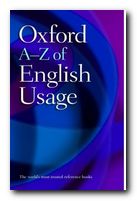
Oxford A-Z of English Usage

June 2, 2009 by Roy Johnson

short guide to intermediate language skills

Do you know the past tense of the verb to dive? Is it dived or dove? Don’t worry – most other native English speakers wouldn’t know either. The same is true of the verb to dream. Is it dreamed or dreamt? That’s slightly less of a worry – because both options are correct. This guide offers straightforward, up-to-date guidance on questions of English usage, all affecting the language we choose.

Oxford A-Z of English Usage Common confusions such as uninterested and disinterested are explained, differences between British and American practice are highlighted, and it takes a realistic attitude towards famous examples such as splitting infinitives, ending a sentence with a preposition, and when it is correct to say you and me or you and I.

There are highlighted mini-essays on issues such as case agreement, Latin plurals, and the endlessly vexed issue of -ise and -ize. Editor Jeremy Butterfield also deals with issues for writers, such as how to punctuate bulleted lists.

There’s a strong element of political correctness at work here in definitions to do with race, colour, and disability, yet he doesn’t offer alternatives to the contractions BC and AD, and he suggests that the equivalent of African-American in the UK is black, which some people might challenge.

There’s an interesting section on what he calls ‘electronic English’, and he does his best to reveal folk etymologies – explaining where and why an expression has become distorted and replaced the original – as in slight of hand, which has successfully transplanted the original sleight of hand.

He takes the trouble to distinguish terms which are often confused in English because their spellings are so similar, and they are very often pronounced almost identically – such as discrete and discreet. And he unravels words which are often mistaken for each other – such as blatant and flagrant.

I would say that this is a book for intermediate to advanced users of English – writers, editors, and students who want to make an effort to get things right. It’s the latest addition to a series which includes Oxford A-Z of Grammar and Punctuation, Oxford A-Z of Spelling, and the Oxford Guide to Plain English – all of which have been very successful.

© Roy Johnson 2007

Oxford A-Z of English Usage   Buy the book at Amazon UK

Oxford A-Z of English Usage   Buy the book at Amazon US


Jeremy Butterfield, Oxford A—Z of English Usage, Oxford: Oxford University Press, 2007, pp.172, ISBN: 0199231532


More on journalism
More on creative writing
More on writing skills
More on publishing


Filed Under: Grammar, Journalism, Language use, Writing Skills Tagged With: Cultural history, English language, Language, Language use, Oxford A-Z of English Usage, Writing skills

Oxford A-Z of Spelling

July 14, 2009 by Roy Johnson

beginner’s guide to the basics of good spelling

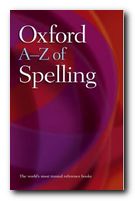
Did you know that yogurt can also be spelled yoghurt or even yoghourt? All three are correct. English spelling is notoriously irregular and can be downright difficult. It’s because our huge vocabulary (the world’s biggest) is made up of words from so many other languages. Don’t feel bad if you need to look up inoculate, haemorrhage and the rule-breaking weird. But if you want to improve your spelling skills, you’ll be well served by the short guide Oxford A-Z of Spelling in the new series from OUP.

Oxford A-Z of Spelling It explains all the basics without going into a lot of off-putting technicalities and jargon. In one sense it is rather like a Dictionary of Difficult Words: it includes 2,000 commonly misspelled (or mis-spelled or mis-spelt) words and hundreds of spelling tips to help you understand the basic rules – and why there are so many exceptions to them. It starts off with guidance notes on how to form plurals, how prefixes and suffixes work, and how to recognise all the irregular cases and exceptions. Then there’s that nagging bugbear of the insecure, the apostrophe – as in Dickens’s novels and men’s clothing

The main entries of the book are an alphabetical listing of common but difficult words, ranging from abattoir to zoos, with a note on what to look out for, and words of a foreign origin signaled to explain unusual spellings.

advise verbUnlike most verbs ending in -ise advise cannot be spelled with an -ize ending. See centre pages for other verbs that always end in -ise.
! Do not confuse advise with advice. Advise is a verb meaning ‘suggest that someone should do something’ (I advised him to leave) whereas advice is a noun that means ‘suggestions about what someone should do’ (Your doctor can give you advice on diet).

These main entries are punctuated by an explanation of beginnings and endings: for- or fore-? -able or -ible? -ance or -ence?. There’s an explanation of grammatical terms, notes on American spelling, and how hyphens are used to form compounds, as in black-haired girl and pick-me-up.

Because the words have been chosen for their irregular or difficult spelling, the book makes a surprisingly interesting read. And I suddenly realised whilst surfing the entries that it also doubles up nicely for use as a spelling quiz. Firmly recommended – especially for beginners.

© Roy Johnson 2007

Oxford A-Z of Spelling   Buy the book at Amazon UK

Oxford A-Z of Spelling   Buy the book at Amazon US


Catherine Soanes and Sheila Ferguson, Oxford A—Z of Spelling, Oxford: Oxford University Press, 2007, pp. 160, ISBN: 0199233470


More on writing skills
More on language
More on grammar


Filed Under: Language use, Writing Skills Tagged With: Language, Oxford A-Z of Spelling, Reference, Reference books, Spelling, Writing skills

Oxford BBC Guide to Pronunciation

July 14, 2009 by Roy Johnson

essential handbook of the English spoken word

How do you pronounce the word controversy? Is it kohn-trov-ersy, or kohn-trov-ersy? And how about schedule – do we say shed-yool, or sked-yool? Pronunciation can be something of a minefield in the UK – especially when it is also linked to class accent and language usage. The Oxford BBC Guide to Pronunciation is is an ideal source for finding out how to pronounce controversial or difficult words and foreign names. Expert guidance is given on how to pronounce 15,000+ less-than-usual terms.

Oxford BBC Guide to Pronunciation Entries run from Aachen and Aalvar Alto, via Maastricht and the Mabinogion, to Zyklon B and zymurgy (which is a type of fermentation, just in case you wondered). There’s a guide to how the word should sound shown by splitting it into its stressed and unstressed parts, then by showing it written in the International Phonetic Alphabet (IPA).

The compilers of this guide – both experts from the BBC’s pronunciation unit, have opted to give just one recommended pronunciation for each term. But if there are serious contenders as alternatives, these are listed too. And the guide to how words should be spoken is based on received pronunciation.

Yet we can no longer really call it ‘BBC English’ – and for very good reasons. The BBC has been forced to use more and more people with non-standard accents as announcers. Now it is quite common for someone with a regional accent to be reading the news (Huw Edwards for instance), or commenting on political matters (as does Newsnight reporter Paul Mason – who is from the same part of the north as me).

What do you do with those people who seek to aggrandise themselves by adopting idiosyncratic pronunciations for their own names? – that is, the Cole-in Powells and Anthony Poles of this world. Why not Cole-in Pole? The editors politely sidestep this issue by observing of the American general that “The unusual pronunciation for the first name is his own” – though no such note is made on the surname of the English novelist and toff.

It has often been rumoured that during the second world war the British government tested suspect German spies (who were claiming to be English) by inviting them to discuss people with weirdly aberrant English family names. I was amazed to find that these had even more variations than I knew:

Featherstonehaugh British family name

feth-uhr-stuhn-haw
fan-shaw
fest-uhn-haw
fee-suhn-hay
feer-stuhn-haw

A great deal of the substance here is how to pronounce foreign terms, and in fact there are special panels which deal with the pronunciation of other languages, ranging from Arabic to Welsh. The entries have been chosen to reflect themes and topics of contemporary relevance, and they include newly-researched material from the BBC’s pronunciation database.

© Roy Johnson 2006

Oxford BBC Guide to Pronunciation   Buy the book at Amazon UK

Oxford BBC Guide to Pronunciation   Buy the book at Amazon US


Oxford BBC Guide to Pronunciation, Oxford: Oxford University Press, 2006, pp.432, ISBN: 0192807102


More on language
More on literary studies
More on writing skills
More on creative writing
More on grammar


Filed Under: Dictionaries Tagged With: BBC, Communication, Dictionaries, Language, Oxford BBC Guide to Pronunciation, Pronunciation, Reference books, speaking

Oxford Companion to Wine

July 16, 2009 by Roy Johnson

encyclopedia covering every aspect of the world’s wines

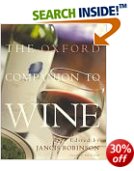
Jancis Robinson was one of the first writers to take a lot of the snobbery out of commenting on wine, and the TV series which made her famous was successful because it combined serious and wide-ranging knowledge with a lightness of touch. This modestly titled Oxford Companion to Wine (which is effectively an encyclopedia) does the same thing. It covers every conceivable aspect of growing grapes, making wine, and drinking the finished product that you can imagine.

Oxford Companion to Wine The whole of the world’s wine regions are described; there are over 600 entries on wine grape varieties; she discusses the how and why of viticulture and wine-making; the history of famous vintages, and even peripheral matters such as label designs, the names of glasses and decanters, and the changes in fashion in the wine trade.

Entries run from abboccato (Italian, medium sweet) to Zweigelt (an Austrian grape variety) and you would be amazed at some of the places which produce wine. Even England gets a two-page entry. Of course France is still the home of serious viticulture, and this is reflected in the depth of information on the grand chateaux, the grape varieties, and the classifications. There’s coverage of some famous vineyards whose terroir is not much more than a couple of fields.

She also deals with the politics and the commerce of the wine trade – describing phenomena such as the ‘flying wine makers’ from the New World areas such as Australia who have been imported back into France in regions such as the Langeudoc and helped to bring the quality of their wines back up again after recent declines.

Another attractive feature of the book is that the entries are cross-referenced – so you start from a wine, go to a grape, then a producer, on to a growing method, then to who has consumed most in recent years. Here’s a typical entry describing a small area on the Cote d’Or where I used to stop off regularly on my way south:

Auxey-Duresses, a village in Burgundy producing medium-priced red and white wines not dissimilar to neighbouring VOLNAY and MEURSAULT respectively, although more austere in style. The vineyards, which include those of the hamlets of Petit Auey and Melin, are located on either side of a valley subject to cooler winds than the main Cote de BEAUNE, PINOT NOIR vineyards, including such PREMIER CRUS as Les Duresses and Le Climat de Val, are grown on the south east slope of the Montagne du Bourdon. White wines, made from CHARDONNAY, account for just above a quarter of the production, covering the slopes adjacent to Meursault. Some vines, atypically for Burgundy, are trained high.

In the past wines from Auxey-Duresses were likely to have been sold under the names of grander neighbours. Many are now labelled as Cote de Beaunes Villages, although the village appellation is becoming more popular. See COTE D’OR and BURGUNDY map.

There are appendices listing a guide to the best vintages and the appellation controlles and their permitted grape varieties, and you can marvel at the ‘aroma wheel’, invented in an attempt to give some sort of scientific rigour to the way tastes and aromas are described.

This new edition of Jancis Robinson’s award-winning magnum opus is a major revision of her earlier work with over 500 new entries and the remainder completely revised to present the latest developments in the fast-moving and increasingly popular wine scene.

It’s beautifully designed and has been completely reset in a larger, more manageable format with new illustrations. The term ‘Companion’ doesn’t really do justice to the encyclopedic nature of this work. I was given a copy as a birthday present by friends, and have used it regularly ever since.

© Roy Johnson 2006

Oxford Companion to Wine   Buy the book at Amazon UK

Oxford Companion to Wine   Buy the book at Amazon US


Jancis Robinson, The Oxford Companion to Wine, Oxford: Oxford University Press, 3rd edition, 2006, pp.840, ISBN: 0198609906


More on lifestyle
More on literary studies
More on writing skills
More on creative writing
More on grammar


Filed Under: Dictionaries, Lifestyle Tagged With: Dictionaries, Oxford Companion to Wine, Reference, Viniculture, Wine

Oxford Dictionary of Allusions

July 14, 2009 by Roy Johnson

guide to popular cultural references – old and new

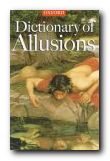
Allusions are a sort of cultural shorthand. If someone is ‘as rich as Croesus’, a comparison is being made with the sixth century BC King of Lydia, who was fabled for his wealth (and it’s pronounced Kree-Sus, by the way). The problem for most of us who haven’t had a classical education, is that many of these references might be lost on us. This completely new reference guide, the Oxford Dictionary of Allusions explains the meaning of allusions used in modern English – from Abaddon to Zorro.

Oxford Dictionary of AllusionsSee what I mean? You probably knew about the masked crusader, but like me, you would have to look up Abaddon to discover that it is ‘the angel of the bottomless pit’ from the Book of Revelation in the Bible. Topics are listed thematically – dancing, danger, darkness – and all entries are cross referenced in an index. The compilers have put a lot of emphasis on contemporary relevance – so although you get Adam and Eve plus Jason and the Argonauts, there are also entries on Cinderella, James Bond, Mary Poppins, and Al Capone. As with most books of this type, one of its chief pleasures is the opportunity to browse idly and come across unexpected gems. There’s everything here – from Barbara Cartland to Dido and Aeneas or from Morgan le Fay to Bridget Jones’s Diary.

© Roy Johnson 2005

Oxford Dictionary of Allusions   Buy the book at Amazon UK

Oxford Dictionary of Allusions   Buy the book at Amazon US


The Oxford Dictionary of Allusions, Oxford: Oxford University Press, 2nd edition 2005, pp.480, ISBN: 0198609191


More on language
More on literary studies
More on writing skills
More on creative writing
More on grammar


Filed Under: Dictionaries Tagged With: Allusions, Dictionaries, Oxford Dictionary of Allusions, Reference, Reference books

Oxford Dictionary of Catchphrases

July 29, 2009 by Roy Johnson

sources of much-quoted words and phrases

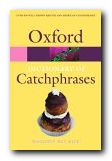
Do the following catchphrases mean anything to you? Can I do you now, sir?, Shut that door!, Who loves ya, baby?, Bono Estente!, and Eat my shorts!. The more of these you know, the older you probably are. This Oxford Dictionary of Catchphrases offers explanations and the original sources of these and many other popular phrases, which in alphabetical terms range from accidento bizarro to Yada, yada, yada – coming from The Fast Show and Seinfeld respectively.

Oxford Dictionary of CatchphrasesAnna Farkas uses as her sources mainly films, television and radio shows, advertising, songs, and music hall acts. She provides full details of who coined or employed each phrase, when they used it, and in what context. Some are no more than a single word stressed in a particular way – such as Miss Piggy’s use of Moi? in The Muppets. This book will appeal hugely to fans of radio and television comedy on both sides of the Atlantic – because in addition to giving the source of a catchphrase, she also offers a potted explanation for its origin.

These explanations are almost as funny as the original, because they are written in a such a dead-pan style. Many of them also go on to provide fascinating details from the programmes and set an ideological context for popular culture.

Don’t mention the war
Spoken repeatedly by Basil Fawlty (John Cleese) in an episode of Fawlty Towers (1975-79). Cleese as the accident-prone hotel manager challenged the bounds of acceptability in British comedy by breaking into SS-style goose-stepping before a party of German guests. Although Basil keeps telling everyone ‘Whatever you do, don’t mention the war’, he seems unable to control himself, infuriating his guests by referring to the Second World War at every opportunity.

If you’ve seen any of these programmes, her flat descriptions somehow allow the humour to rise off the page again in a very satisfying way.

Amazingly rich sources are The Goon Show, Monty Python, The Fast Show, and there are a huge number of phrases and one-liners from David Letterman and Saturday Night Live.

One of the things I warmed to was the fact that she provides new summaries and explanations of sources which generate multiple catchphrases. So, if you’ve just read about Did she want it, sir? from The Fast Show, you get a different set of background details about the show when it comes to Does my bum look big in this?

There’s also lots of interesting trivia – such as who does the voice-overs in South Park and what happened to cartoonist Robert Crumb’s copyright on ‘Keep on Trukin’.

I might seem something of an anorak, but I read the whole collection from beginning to end. Guaranteed to make you smile.

© Roy Johnson 2003

Buy the book at Amazon UK

Buy the book at Amazon US


Anna Farkas, Oxford Dictionary of Catchphrases, Oxford: Oxford University Press, 2003, pp.357, ISBN: 0198607350


More on dictionaries
More on language
More on literary studies
More on grammar


Filed Under: Dictionaries Tagged With: Dictionaries, expressions, Language, Oxford Dictionary of Catchphrases, Sayings, Slang

Oxford Guide to Plain English

June 14, 2009 by Roy Johnson

how to simplify and clarify your writing

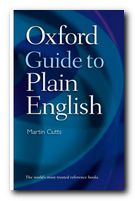
This is a new series from OUP – pocketbook guides on the basics of writing and language skills. They’re small, cheap, cheerful, and compact, yet authoritative – the sort of thing which I imagine would be ideal for students or the average person-in-the-street who wants to take on the first principles of improving their language skills. Oxford Guide to Plain English is written by the research director of the Plain Language Commission.

Plain EnglishIt’s presented in a lively and professional manner, and Martin Cutts uses so many real-life examples you know he’s speaking from deeply-felt practical experience. He offers quick tips for creating a clearer style, better grammar, punctuation, and layout. He explains how to avoid jargon and legalese, and how to use plain English instead. And he has no patience with sloppy communication. For instance, have you ever received an official letter like the example he quotes from the DVLA?

I again return your application for renewal of road fund licence and reiterate the correct amount is £130. I have enclosed a photocopy of your original document you will notice it clearly datestamped 2nd December, some two days after Budget day.

Four mistakes in forty-three words is not bad going for a government [in the UK] which claims it is committed to increased efficiency and clarity of communication!

He shows you how to avoid this sort of thing – and how to replace mistakes with clear meaning. There are hundreds of real examples to show how it’s done, including ‘before’ and ‘after’ examples.

There’s a good list of contemporary cliches and expressions to avoid, including the Plain English expressions which can quite easily replace them.

The basic information is very sound. Sentences twenty words or less; plain words rather than elaborate vocabulary; vigorous and active verbs rather than the passive voice; bulleted lists to explain multiple points of argument; strict but minimalist punctuation; planning as an indispensable tool to good structure; and even avoiding too many grammatical rules.

It even includes advice on writing effective emails, and as an advocate of good spatial design in written communication, I was pleased to see that there was a whole section devoted to good layout.

Good value; good advice; and good format if you want something cheap and cheerful as a start-up or a pocket reference.

© Roy Johnson 2009

Oxford Guide to Plain English   Buy the book at Amazon UK

Oxford Guide to Plain English   Buy the book at Amazon US


Martin Cutts, Oxford Guide to Plain English, Oxford: Oxford University Press, 3rd edition 2009, pp. 272, ISBN: 0199558507


More on writing skills
More on language
More on grammar


Filed Under: Grammar, Language use, Writing Skills Tagged With: Communication, English language, Grammar, Language, Oxford Guide to Plain English, Plain English, Writing skills

Oxford Guide to Word Games

July 29, 2009 by Roy Johnson

puzzles, puns, acrostics, charades, and palindromes

If you like words, wordplay, and peculiarities of the English Language, you’ll love The Oxford Guide to Word Games. What is the difference between elephants and fleas? Answer: an elephant can have fleas, but fleas cannot have elephants. Each chapter deals with a different play on words – ranging from the lowly pun to extremely sophisticated word squares. And there are plenty of surprises along the way. I didn’t realise that charades started out in written, not acted form.

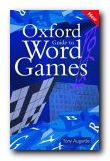
The Oxford Guide to Word Games There are also lots of unusual cases along the way, such as words which can be split into three and even four separate words – as when sometime becomes So-Met-I-Me. An acrostic is formed from the first letter of each line, but it can also be the last, and in more complex examples, elsewhere in the line, including ‘double acrostics’ in which the first and last letter (reversed) of each line are related to each other. The example given is attributed to Queen Victoria.

This leads into the immensely complicated world of word squares, which were the origin of the surprisingly recent (1913) crossword puzzle – now the most world-popular word game. This section actually teaches you how to solve common types of crossword clues.

There’s also a brief history of Scrabble – one of the most commercially successful word games. Here you get tips on how to increase your score, plus a consideration of rare and exotic words – zoae and qibla and more interestingly of the dictionaries that contain them.

The rebus seems to anticipate the text message by five thousand years or so, using a printed symbol to represent a phrase, as in If the gr8 B mt, put : – in other words, ‘If the grate be empty, put coal on’.

Palindromes can be single words (Eve) or sentences – as in the famous Madam, I’m Adam. The general quest seems to be for the longest palindromic utterance, but interestingly, sense recedes as the sentences lengthen, as this example begins to show – Marge lets Norah see Sharon’s telegram.

All sorts of word games are illustrated – pangrams, lipograms, and chronograms – many of which are no longer fashionable, but which retain a period charm. There’s also plenty on tongue-twisters, Spoonerisms, alphabet games, and malapropisms.

Prostitutes appeal to Pope
Doctor Fuchs off to South Pole
March planned for April

This is a witty and entertaining book which manages to include etymological scholarship alongside how to play lexical ping-pong or how to crack a rebus such as EGNC for Aegean Sea. It’s great fun for anyone interested in word play, etymology, and a fun and games approach to language.

© Roy Johnson 2003

Oxford Guide to Word Games   Buy the book at Amazon UK

Oxford Guide to Word Games   Buy the book at Amazon US


Tony Augarde, The Oxford Guide to Word Games, Oxford: Oxford University Press, 2003, pp.304, ISBN: 0198662645


More on dictionaries
More on language
More on literary studies
More on grammar


Filed Under: Language use Tagged With: acrostics, crosswords, Dictionaries, Language, puzzles, rebus, The Oxford Guide to Word Games

  • « Previous Page
  • 1
  • …
  • 59
  • 60
  • 61
  • 62
  • 63
  • …
  • 103
  • Next Page »

Get in touch

info@mantex.co.uk

Content © Mantex 2016
  • About Us
  • Advertising
  • Clients
  • Contact
  • FAQ
  • Links
  • Services
  • Reviews
  • Sitemap
  • T & C’s
  • Testimonials
  • Privacy

Copyright © 2026 · Mantex

Copyright © 2026 · News Pro Theme on Genesis Framework · WordPress · Log in