Mantex

Tutorials, Study Guides & More

  • HOME
  • REVIEWS
  • TUTORIALS
  • HOW-TO
  • CONTACT
>> Home / Archives for 2009

Archives for 2009

Synonyms – how to understand them

September 14, 2009 by Roy Johnson

free pages from our English Language software program

Synonyms – definition

synonyms In a very general sense, synonyms are different words which have the same meaning.


Examples
Word Synonym
kingly royal
pavement sidewalk
youth youngster
strong powerful

Use

redbtn Strictly speaking, such words are rarely [if ever] quite identical to each other.

redbtn There are bound to be semantic, stylistic, regional, or other differences between them.

redbtn It is often said that if two words do have exactly the same meaning, one of them is likely to disappear.

redbtn Moreover, two words might be synonymous in one statement, and different in another.

redbtn NB! Synonyms offer us variety in our expression.

redbtn Synonyms are usually referred to by linguists as ‘near synonyms’, because they argue that no two words mean exactly the same. If they did, one would probably disappear from use.

redbtn English is a language which has ‘borrowed’ from many varied sources during the course of its history. This has created a wide and heterogeneous lexicon. For example, terms which were originally French currently coexist with their Anglo-saxon equivalents:

French Anglo-Saxon
petite small
tour trip
chauffeur driver
aperitif drink
promenade front (as in sea-front)
escritoire desk

redbtn The French term usually carries a prestige value over that of the English equivalent, which is often seen as basic and even crass. This is because of the history of French dominance over the English as a result of the Norman Conquest.

redbtn During the period of French rule after 1066, a state of diglossia existed throughout the south of England. Diglossia means that two languages are used by one society, but applied to two discrete functions. French was used for matters of church and state, whereas English was used by the common people for personal and family discourse.

redbtn The legacy of this diglossia is that we have a multitude of synonyms or near-synonyms at our disposal.

redbtn However, it is usually preferable to state the same idea in a variety of styles, rather than to repeat one definitive term for one specific phenomenon.

redbtn In Shakespeare’s King Lear, the king confesses to being a ‘foolish fond old man’. The use of two near synonyms has a poetic and dramatic effect, as one adjective has the effect of intensifying the other.

Self-assessment quiz follows >>>

© Roy Johnson 2004


English Language 3.0 program
Books on language
More on grammar

Filed Under: English Language Tagged With: English language, Grammar, Language, Synonyms

Syntax – how to understand it

September 14, 2009 by Roy Johnson

free pages from our English Language software program

Syntax – definition

syntax Syntax is the grammatical arrangement of words in a sentence.

redbtn It concerns both word order and agreement in the relationship between words.

redbtn Syntax is primarily concerned with structure of sentences.


Examples

redbtn The following statements follow normal English word order:

The cat sat on the mat.
My old brown leather suitcase.

redbtn The following statements do not follow normal English word order:

The cat on the mat sat.
My brown leather old suitcase.


Use

redbtn Word order is very important in English, because the language is no longer inflected. That is, individual words do not have endings to show which parts of speech they represent.

redbtn Changes to conventional synatx are often used to create dramatic, poetic, or comic effect.

redbtn For instance, poets and song lyricists often change syntactic order to create rhythmic effects:

“I’ll sing to him, each spring to him
And long for the day when I’ll cling to him,
Bewitched, bothered and bewildered am I.”

[RICHARD ROGERS]

redbtn NB! “To boldly go …” is STAR TREK’s famous syntactic inversion [and split infinitive].

redbtn A normal sentence in English usually contains at least three elements: subject, verb, and object.

Subject Verb Object
The cat eats the goldfish
John likes football
Mary chose the wallpaper

redbtn Every language has rules of syntax, and to the linguist the essential rules are descriptive. They are the rules which underpin the life of the language and which are extremely slow to change.

redbtn These are not to be confused with the presecriptive ‘rules’ of traditional grammar [For instance, ‘Never end a sentence with a preposition’].

redbtn An example of a descriptive rule of English syntax is that in the imperative in English, the verb takes the initial position in the sentence, usually directly before the noun which is the object.

Put those books on the table.
Take the lid off after half an hour.
Remove all packaging before heating the soup.
Isolate the switch in case of fault.

redbtn It is important to make a distinction between grammar and syntax, and to realise that syntax is a component of grammar.

redbtn The term ‘grammar’ refers to the whole structure of the language including the naming of its parts, its rules of tense, and its sound system. It is a comprehensive term.

redbtn Syntax only refers to the relationship between the grammatical components of language in use. In other words it is the nature, quality or type of relationship between terms in any given statement which is the province of syntax.

redbtn The construction of the passive voice is a syntactic issue, as it involves word order. The following statement is in the passive voice:

A woman was run over in central London today by a vehicle travelling at high speed.

redbtn If we transfer this to the active voice, we have:

A vehicle travelling at high speed ran over a woman in central London today.

redbtn The semantic content is similar in the two statements, but the emphasis is changed according to whether it is expressed as active or passive.

redbtn The difference between the two versions is dependent on the positioning of the subject and the object in the sentence. In the passive version, the object takes the initial position. This is a syntactic principle.

Self-assessment quiz follows >>>

© Roy Johnson 2004


English Language 3.0 program
Books on language
More on grammar


Filed Under: English Language Tagged With: English language, Grammar, Language, Syntax

T.S.Eliot – Poems

October 3, 2009 by Roy Johnson

Hogarth Press first edition book jacket designs


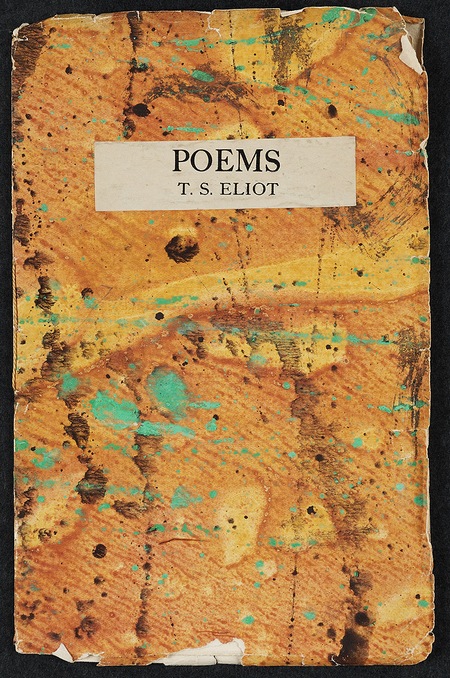
T.S.Eliot - Poems - first edition

 
T.S. Eliot, Poems (1918)

This was the third publication of the Hogarth Press. It includes the poems ‘The Hippopotamus’, ‘Le spectateur’, ‘Mélange adultère de tout’, ‘Lune de miel’, ‘Sweeney among the Nightingales’, ‘Mr. Eliot’s Sunday Morning Service’, and ”Whispers of immortality’. All seven of the poems had appeared previously in the Little Review.

“In 1918 we printed two small books: Poems by T.S. Eliot and Kew Gardens by Virginia. Of Tom’s Poems we printed rather fewer than 250 copies. We published it in May 1919 price 2s. 6d. and it went out of print in the middle of 1920.

We took a good deal of trouble to find some rather unusual, gay Japanese paper for the covers. For many years we gave much time and care to find beautiful, uncommon, and sometimes cheerful paper for binding our books, and, as the first publishers to do this, I think we started a fashion which many of the regular, old established publishers followed. We got papers from all over the place, including some brilliantly patterned from Czechoslovakia, and we also had some marbled covers made for us by Roger Fry’s daughter in Paris. I bought a small quantity of Caslon Old Face Titling type and used it for printing the covers.

Caslon Old Style Titling Font

Caslon Old Style Titling Font

The publication of T.S.Eliot’s Poems must be marked as a red letter day for the Press and for us … Tom showed us some of the poems which he had just written and we printed seven of them and published them in the slim paper covered book. It included three remarkable poems which are still, I think, vintage Eliot: ‘Sweeney among the Nightingales’, ‘Mr. Eliot’s Sunday Morning Service’. and ”Whispers of immortality’.”

Leonard Woolf, An Autobiography

previousnext


Hogarth Press studies

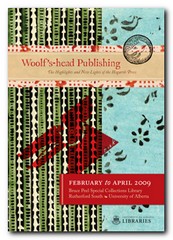
Woolf's-head Publishing Woolf’s-head Publishing is a wonderful collection of cover designs, book jackets, and illustrations – but also a beautiful example of book production in its own right. It was produced as an exhibition catalogue and has quite rightly gone on to enjoy an independent life of its own. This book is a genuine collector’s item, and only months after its first publication it started to win awards for its design and production values. Anyone with the slightest interest in book production, graphic design, typography, or Bloomsbury will want to own a copy the minute they clap eyes on it.

Woolf's-head Publishing Buy the book at Amazon UK
Woolf's-head Publishing Buy the book at Amazon US

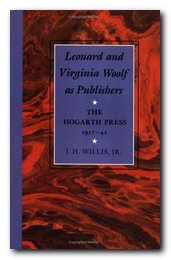
The Hogarth Press Leonard and Virginia Woolf as Publishers: Hogarth Press, 1917-41 John Willis brings the remarkable story of Leonard and Virginia Woolf’s success as publishers to life. He generates interesting thumbnail sketches of all the Hogarth Press authors, which brings both them and the books they wrote into sharp focus. He also follows the development of many of its best-selling titles, and there’s a full account of the social and cultural development of the press. This is a scholarly work with extensive footnotes, bibliographies, and suggestions for further reading – but most of all it is a very readable study in cultural history.

The Hogarth Press Buy the book at Amazon UK
The Hogarth Press Buy the book at Amazon US

© Roy Johnson 2005


Filed Under: Hogarth Press Tagged With: Art, Bloomsbury, Graphic design, Hogarth Press, Literary studies, T.S.Eliot

T.S.Eliot – The Waste Land

October 4, 2009 by Roy Johnson

Hogarth Press first edition book jacket designs


The Waste Land - first edition

 
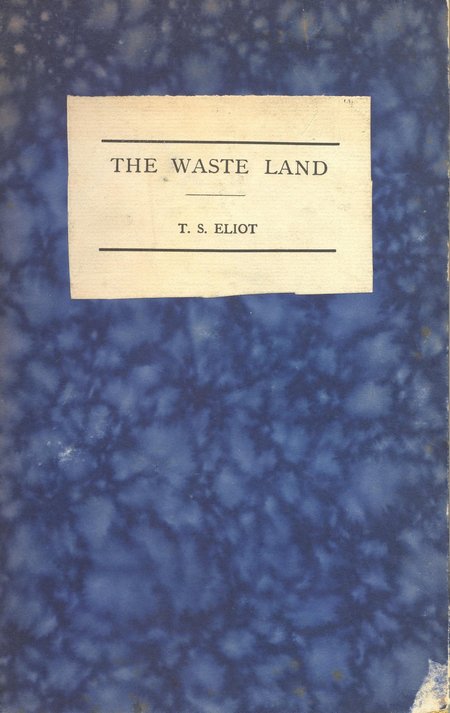
T.S. Eliot, The Waste Land (1923)

This was published three times in America before it appeared under the Hogarth Press imprint. First it had been published in Criterion (October 1922), the magazine of which Eliot himself was editor, which was funded by rich patroness Lady Rothermere. Then it was published in Dial the following month, still without the famous explanatory ‘notes’. Finally it was published in book form by Boni and Liveright in December 1922.

Eliot himself suggested that the explanatory notes were an addition of ‘bogus scholarship’ devised to bulk out the number of pages in an otherwise slim publication. Virginia Woolf set the entire poem in type herself. It was issued in an edition of 470 copies with blue marbled boards probably prepared by Vanessa Bell. T.S. Eliot earned £7 5s. in royalties.

The Waste Land went on to become one of the most famous texts of the modernist movement – along with Virginia Woolf’s Mrs Dalloway and James Joyce’s Ulysses – and an iconic publication for modern poetry.

previousnext


Hogarth Press studies

Woolf's-head Publishing Woolf’s-head Publishing is a wonderful collection of cover designs, book jackets, and illustrations – but also a beautiful example of book production in its own right. It was produced as an exhibition catalogue and has quite rightly gone on to enjoy an independent life of its own. This book is a genuine collector’s item, and only months after its first publication it started to win awards for its design and production values. Anyone with the slightest interest in book production, graphic design, typography, or Bloomsbury will want to own a copy the minute they clap eyes on it.

Woolf's-head Publishing Buy the book at Amazon UK
Woolf's-head Publishing Buy the book at Amazon US

The Hogarth Press Leonard and Virginia Woolf as Publishers: Hogarth Press, 1917-41 John Willis brings the remarkable story of Leonard and Virginia Woolf’s success as publishers to life. He generates interesting thumbnail sketches of all the Hogarth Press authors, which brings both them and the books they wrote into sharp focus. He also follows the development of many of its best-selling titles, and there’s a full account of the social and cultural development of the press. This is a scholarly work with extensive footnotes, bibliographies, and suggestions for further reading – but most of all it is a very readable study in cultural history.

The Hogarth Press Buy the book at Amazon UK
The Hogarth Press Buy the book at Amazon US

© Roy Johnson 2005


Filed Under: Hogarth Press Tagged With: Art, Bloomsbury, Graphic design, Hogarth Press, Literary studies, T.S.Eliot, The Waste Land

Taking notes for essays

August 25, 2009 by Roy Johnson

sample from HTML program and PDF book

1. In preparation for writing an essay, you should be taking notes from a number of different sources: course materials, set texts, secondary reading, or tutorials and lectures. You might gather information from radio or television broadcasts, or from experiments and research projects. The notes could also include your own ideas, generated as part of the essay planning process.

2. The notes you gather in preparation for writing the essay will normally provide the detailed evidence to back up your arguments. They might also include such things as the quotations and page references you plan to use in your essay. Your ultimate objective in planning will be to produce a one or two page outline of the topics you intend to cover.

3. Be prepared for the fact that you might take many more notes than you will ever use. This is perfectly normal. At the note-taking stage you might not be sure exactly what evidence you will need. In addition, the information-gathering stage should also be one of digesting and refining your ideas.

4. Don’t feel disappointed if you only use a quarter or even a tenth of your materials. The proportion you finally use might vary from one subject to another, as well as depending on your own particular writing strategy. Just because some material is not used, don’t imagine that your efforts have been wasted.

5. When taking notes from any source, keep in mind that you are attempting to make a compressed and accurate record of information, other people’s opinions, and possibly your own observations on the subject in question.

6. Your objective whilst taking the notes is to distinguish the more important from the less important points being made. Record the main issues, not the details. You might write down a few words of the original if you think they may be used in a quotation. Keep these extracts as short as possible unless you will be discussing a longer passage in some detail.

7. Don’t try to write down every word of a lecture – or copy out long extracts from books. One of the important features of note-taking is that you are making a digest of the originals, and translating the information into your own words.

8. Some students take so many notes that they don’t know which to use when it’s time to write the essay. They feel that they are drowning in a sea of information.

9. This problem is usually caused by two common weaknesses in note-taking technique:

  • transcribing too much of the original
  • being unselective in the choice of topics

10. There are two possible solutions to this problem:

  • Select only those few words of the source material which will be of use. Avoid being descriptive. Think more, and write less. Be rigorously selective.
  • Keep the essay question or topic more clearly in mind. Take notes only on those issues which are directly relevant to the subject in question.

11. Even though the notes you take are only for your own use, they will be more effective if they are recorded clearly and neatly. Good layout of the notes will help you to recall and assess the material more readily. If in doubt use the following general guidelines.

Taking Notes – GUIDELINES

  1. Before you even start, make a note of your source(s). If this is a book, an article, or a journal, write the following information at the head of your notes: Author, title, publisher, publication date, edition of book.
     
  2. Use loose-leaf A4 paper. This is now the international standard for almost all educational printed matter. Don’t use small notepads. You will find it easier to keep track of your notes if they fit easily alongside your other study materials.
     
  3. Write clearly and leave a space between each note. Don’t try to cram as much as possible onto one page. Keeping the items separate will make them easier to recall. The act of laying out information in this way will cause you to assess the importance of each detail.
     
  4. Use some system of tabulation (as I am doing in these notes). This will help to keep the items separate from each other. Even if the progression of numbers doesn’t mean a great deal, it will help you to keep the items distinct.
     
  5. Don’t attempt to write continuous prose. Notes should be abbreviated and compressed. Full grammatical sentences are not necessary. Use abbreviations, initials, and shortened forms of commonly used terms.
     
  6. Don’t string the points together continuously, one after the other on the page. You will find it very difficult to untangle these items from each other after some time has passed.
     
  7. Devise a logical and a memorable layout. Use lettering, numbering, and indentation for sections and for sub-sections. Use headings and sub-headings. Good layout will help you to absorb and recall information. Some people use coloured inks and highlighters to assist this process of identification.
     
  8. Use a new page for each set of notes. This will help you to store and identify them later. Keep topics separate, and have them clearly titled and labelled to facilitate easy recall.
     
  9. Write on one side of the page only. Number these pages. Leave the blank sides free for possible future additions, and for any details which may be needed later.

Sample notes

What follows is an example of notes taken whilst listening to an Open University radio broadcast – a half hour lecture by the philosopher and cultural historian, Isaiah Berlin. It was entitled Tolstoy’s Views on Art and Morality, which was part of the third level course in literary studies ‘A 312 – The Nineteenth Century Novel and its Legacy.

Isaiah Berlin – ‘Tolstoy on Art and Morality’ 03 Sep 1989

1. T’s views on A extreme – but he asks important questns which disturb society

2. 1840s Univ of Kazan debate on purpose of A
T believes there should be simple answers to probs of life

3. Met simple & spontaneous people & soldiers in Caucasus
Crimean Sketches admired by Turgenev & Muscovites but T didn’t fit in milieu

4. Westernizers Vs Slavophiles – T agreed with Ws – but rejects science (Ss romantic conservatives)

5. 2 views of A in mid 19C – A for art’s sake/ A for society’s sake

6. Pierre (W&P) and Levin (AK) as egs of ‘searchers for truth’

7. Natural life (even drunken violence) better than intellectual

8. T’s contradiction – to be artist or moralist

9. T’s 4 criteria for work of art

  • know what you want to say – lucidly and clearly
  • subject matter must be of essential interest
  • artist must live or imagine concretely his material
  • A must know the moral centre of situation

10. T crit of other writers

Shkspre and Goethe – too complex
St Julien (Flaubert) inauthentic
Turgenev and Chekhov guilty of triviality

11. What is Art? Emotion recollected and transmitted to others
[Wordsworth] Not self-expression – Only good should be transmitted

12. But his own tastes were for high art – Chopin, Beethoven, & Mozart
T Argues he himself corrupted

13. Tried to distinguish between his own art and moral tracts

14. ‘Artist cannot help burning like a flame’

15. Couldn’t reconcile contradictions in his own beliefs
Died still raging against self and society

© Roy Johnson 2003

Buy Writing Essays — eBook in PDF format
Buy Writing Essays 3.0 — eBook in HTML format


More on writing essays
More on How-To
More on writing skills


Filed Under: Writing Essays Tagged With: Academic writing, Essays, Reports, Study skills, Taking notes, Term papers, Writing skills

Taking Your Talent to the Web

July 25, 2009 by Roy Johnson

guide to good usability and web design principles

Jeffrey Zeldman is one of the new generation of writers on web strategy and design. His new book Taking Your Talent to the Web aims to help traditional designers move beyond HTML into the new possibilities of style sheets and XHTML. But this isn’t a practical guide – full of HTML code and suggestions for page design. It’s a carefully structured essay of thoughtful reflections on how the Web actually works, and how you can enhance your designs. It’s aimed at those people with Web sites who want to improve them; at designers who want to offer more functionality to their clients; and at anybody who wants to engage with Web developments using the most advanced techniques available.

Taking Your Talent to the WebHis overall message is that designers must learn to work within limits, must accept compromise, must learn to accept constant change. He is a great believer in The Liquid Page – designs which can flow to fit any browser and screen size. His approach is very similar to Jeffrey Veen, whose The Art and Science of Web Design comes from the same stable.

After discussing the foundations of good design and usability, he spends the middle section of the book dealing with branding, marketing, and working in a design team. These chapters are not nearly so interesting as those in which he tackles the technology. Once he gets back to creating good pages, the temperature rises again.

He is very reassuring on the issue of making the transition from HTML via XHTML to XML. He offers a clear guide to style sheets, showing how to take advantage of this technology to control the appearance of pages – without running foul of browsers. He admits however that until browsers fully support style sheets, designers will continue to use tables to control layout.

There’s an extended discussion of font control. His advice is quite unequivocal – in style sheets the font size should be specified in pixels. This is followed by a short but reassuring introduction to JavaScript. I liked the fact that he puts his emphasis on practical applications, showing how it can be used. And he finishes with a quick review of Java, scaled vector graphics (SGV) and Flash.

It should also be said that he writes in a lively, amusing style which makes some of the more technical passages easier to digest. In fact I think he gets the balance of coding details and web strategies just right – giving you enough information to try out his ideas straight away. This is an attractive book which offers support and encouragement to designers who want to make their sites more usable and more effective.

Buy the book at Amazon UK

Buy the book at Amazon US

© Roy Johnson 2005


Jeffrey Zeldman, Taking Your Talent to the Web, Indianapolis (IN) : New Riders, 2001, pp.426, ISBN: 0735710732


More on web design
More on technology
More on digital media


Filed Under: Web design Tagged With: Taking Your Talent to the Web, Usability, Web design

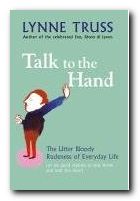
Talk to the Hand

October 20, 2009 by Roy Johnson

The Utter Bloody Rudeness of Everyday Life (or six good reasons to stay home and bolt the door)

Lynne Truss must surely be one of the next participants lined up ready for the TV show Grumpy Old Women – in which celebrity ladies of a certain age ventilate their pet grievances. First she was grumpy about failures of punctuation in Eats, Shoots & Leaves, and now in Talk to the Hand she is being grumpy about modern manners – or lack of them. Fortunately, her grumpiness is served up with generous helpings of witty exposition, well dramatised anecdote, and self-deprecating humour.

Talk to the HandShe rails against people who don’t say ‘Thank you’ when you hold open a door for them – but goes further by analysing the reasons for our social expectations and our reactions to them when thwarted. The same is true for people who let their children run amok in other people’s houses – and are affronted if you don’t share share their self-indulgent view of them.

Fortunately, her own expectations in righting these situations are self-limited:

This book has quite a modest double aim: first, to mourn, without much mature perspective or academic rigour, the apparent collapse of civility in all areas of our dealings with strangers; then to locate a tiny flame of hope in the rubble and fan it madly with a big hat.

She’s against being prescriptive or proscriptive, and has a basic position that can be summed up as “Remember you are with other people; show some consideration.” Her chief bêtes noirs are (fairly predictably) automated telephone call services, shop assistants who don’t pay attention, and most things to do with information technology (‘There’s a WEBSITE for people with INTERNET ADDICTION’ [!])

Strangely enough, she is quite tolerant of people using mobile phones in public places and saying asinine things such as “I’m on the train. We’re just leaving Euston/Manchester/Bristol”. But I was glad to see that she secretly wished physical pain (as I do) to kids who skateboard or cycle on the pavement.

She’s good at cataloguing the language of insolence and contempt in sloppy service expressions – as when the waiter plonks down your main course with “There you go” and when you say “Thank you” replies with “No problems”.

She’s at her weakest when she makes the case for respect, and takes the Armistice Day memorial service as an example which ought to tug at all of our emotional coat tails. But she has lost none of her skill for switching deftly into the persona of the person she’s writing about – conjuring up their vocabulary and tone of voice with her well-attuned ear for speech and language patterns.

Of course what constitutes good manners changes with time. Nobody but a complete oaf would spit in public these days – yet I can remember when “No spitting” was a standard injunction on all public transport, even after the war. The second world war, that is.

Talk to the Hand   Buy the book at Amazon UK

Talk to the Hand   Buy the book at Amazon US

© Roy Johnson 2009


Lynne Truss, Talk to the Hand, London: Profile Books, 2006, pp.240, ISBN: 1861979797


More on lifestyle
More on biography
More on the Bloomsbury Group


Filed Under: Lifestyle Tagged With: Cultural history, Lifestyle, Lynne Truss, Manners, Talk to the Hand

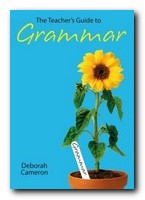
Teacher’s Guide to Grammar

June 3, 2009 by Roy Johnson

teaching language and the national curriculum

The other day I overheard a young girl of around eight ask her mother “What’s a phoneme?” Not surprisingly, her mother didn’t even understand the question. And the girl added, “I think it’s part of a word” – which was not a bad shot. This made me realise just how firmly traditional English grammar was back in our national curriculum. And when I thought of the poor teachers having to implement this policy, my heart sank on their behalf. I think Deborah Cameron would understand and sympathise with this feeling, because this teacher’s guide to grammar is aimed specifically at existing and would-be classroom workers. They now have the unenviable task of introducing what is essentially the study of linguistics into the daily life of schoolchildren.

Teacher's Guide to GrammarCameron starts by dispelling some of the common misconceptions and myths about grammar, and making the important distinction between written and spoken English. Instead of looking at grammatical rules then giving examples, she works the other way round, examining the way language is actually used, then drawing some general lessons from it. First the way words are formed (morphology) then how sentences are built up via regular syntax and well organised phrases.

All the points she makes are illustrated by short modern examples drawn from the way people actually speak and write, and she offers some quite useful tables which I can easily imagine teachers using in their classes.

She delivers some interesting analyses of scientific writing, newspaper headlines, and children’s creative prose to illustrate the use of compression in writing by using noun phrases. The same is true of her treatment of verbs. Instead of dry grammatical definitions, we get a more useful account of the function of different verb forms and modality – making statements about different periods of time and various shades of possibility and probability.

She also offers careful analyses of real examples of student writing – not merely to point out grammatical errors, but to reveal the real structure of the language holding together the meaning underneath the surface. And many of these ‘mistakes’ are features of language which novelists and poets use deliberately for artistic effect.

The whole of the debate over Standard English and dialect/received pronunciation is put into refreshing historical context, as is the use of different registers (which interestingly enough are not a prescribed requirement of the national curriculum).

She demonstrates in a way which classroom teachers will find useful that non-standard speech can co-exist quite easily along with standard writing. And she concludes with an examination of the special circumstances surrounding English as an additional language (EAL).

Anyone faced with the need to understand grammar or explain it to others will find this book useful. It’s good that linguists of Deborah Cameron’s stature are putting their intellectual shoulder to the wheel in helping the classroom teacher.

© Roy Johnson 2007

Teacher's Guide to Grammar   Buy the book at Amazon UK

Teacher's Guide to Grammar   Buy the book at Amazon US


Deborah Cameron, The Teacher’s Guide to Grammar, Oxford: Oxford University Press, 2007, pp.163, ISBN: 0199214488


Filed Under: Grammar, Language use Tagged With: Grammar, Language, Language use, The Teacher's Guide to Grammar, Writing skills

Teaching Academic Writing

June 8, 2009 by Roy Johnson

a toolkit for writing skills in further and higher education

No matter what subjects students engage with in further and higher education, they will be required to produce written work on which they will be assessed. This could be the formal academic essay, a lab report, a project, a case study, or even a reflective journal. Teaching Academic Writing is designed to assist subject lecturers and writing skills tutors whose job it is to help students develop their written work and grasp the conventions of academic argument and expression.

Teaching Academic Writing The need for this assistance has arisen as larger and larger numbers of students enter F & HE – often from non-traditional backgrounds, and sometimes with `English as a second language. The authors (a group of tutors from the Open University) start off by suggesting that teachers should make explicit the writing tasks they set for students. It can no longer be assumed that students will already know what an academic essay requires them to do – or that they will pick up the idea as they go along.

Next comes making them conscious of the appropriate academic register, as well as eradicating grammatical errors. There’s no quick fix for this: it requires a lot of intensive marking and supportive feedback. But I was surprised they didn’t spot the time-saving device of putting guidance notes on line.

However, their suggestions on pre-writing (notes), brainstorming, and planning should be useful as tools for teaching students that almost no form of successful writing comes fully-formed, straight from the head of the writer.

At a time when modular degrees are becoming more popular, it’s important that students are aware of the differing conventions which obtain in various subjects. These can vary from the ‘hard evidence’ required in sciences to the ‘well-informed opinion’ which is accepted as persuasive argument in the arts. Somewhere in between are the social sciences which attempt to combine the two. Once again, they argue very sensibly that these conventions should be made explicit to students if they are to have any chance of succeeding in their work.

They also show examples of such work and offer exercises which are designed to raise students’ awareness of what’s required. The close examination of a case study in business studies reveals the particular difficulty of writing for two audiences at the same time.

The next chapter deals explicitly with the issue of assessment. Once again the advice is to make the assessment criteria clear to both students and tutors alike. And their advice on providing feedback on assessed work is excellent. It would be good to see the marking pro-formas and guidance notes in more widespread general use.

However, what they don’t take into account is the important factor that making assignments thoroughly is a time-intensive activity, and many tutors can skimp on this part of their duties because they know their work will not be closely monitored. Moreover, since much direct teaching and assignment marking in F & HE is now done by hourly paid post-graduates, they are place in the invidious position of working for the rates of a domestic cleaner, exploiting themselves in order to stay in employment. [This is a subject close to my heart, which I discuss in my own book on Marking Essays.]

They finish with a first rate chapter on academic writing in an electronic environment. This covers all the digital tools available – from word-processors and email, to conferencing and discussion forums, and online writing laboratories (OWLs) and the strategies by which materials located on line can be evaluated for their usefulness.

Tutors at any level of F & HE would do themselves a favour by rehearsing the issues raised in this book. It might be written by what is almost a committee, but it’s got a collective’s combined experience written into it.

© Roy Johnson 2005

Buy the book at Amazon UK

Buy the book at Amazon US


Caroline Coffin et al, Teaching Academic Writing, London: Routledge, 2003, pp.175, ISBN 0415261368


More on study skills
More on writing skills
More on online learning


Filed Under: Study skills, Writing Skills Tagged With: Academic writing, Education, Marking Essays, Teaching Academic Writing, Writing skills

Tenses – how to understand them

September 14, 2009 by Roy Johnson

free pages from our English Language software program

Tenses – definition

tenses The term tenses refers to the temporal aspect of verbs in use.

redbtn There are many tenses in English to express past, present, and future.


Examples

PRESENT tense

The child brings joy into their lives.
Paris is the capital of France.
Paul is looking for the cat.

PAST tense

It was a wonderful day for all of us.
Judith had left the key on the table.
Fred had been about to leave when the telephone rang

FUTURE tense

The wedding will be a splendid affair.
I am going to stop smoking.
Stephen goes to college next week.


Use

redbtn All languages have tenses. It is interesting that English is the only modern European language which has no future tense as a designated term.

redbtn The future tense in English is expressed by using other tenses or by the semantic context.

redbtn In the example ‘Stephen goes to college next week’ the term ‘Stephen goes’ is present tense. It is the context in this case – created by the phrase ‘next week’ – which tells us that we are being informed about the future.

redbtn NB! Hold on to your hat! This topic can become quite complex.

redbtn There are many tenses in the English Language. They are all varieties of past, present, and future.

redbtn The following examples have all been placed in a context so that the complexity and the range of English tenses can be appreciated.

redbtn The names for tenses vary from one grammar text book to the next. Don’t worry about the exact name. It is more important to

  • assess whether the statement is in past, present, or future
  • look for any auxiliary verbs (‘to have’ and ‘to be’) used to construct the tense

redbtn Varieties of the past tense

I ran (so that I could be here at this moment)
I have run (all the way here)
I was running (when I fell over a few minutes ago)
I had run (so that I could arrive on time yesterday)
I have been running (and that’s why I’m out of breath now)
I had been running (and that’s why I fell over yesterday)
I used to run (but I have walked for some time now)

redbtn Varieties of the present tense

I run (to work every morining)
I am running (and that’s why I’m out of breath)
I have been running (for fifteen minutes, and I’m still running)

redbtn Varieties of the future tense

I shall run (so that I’ll arrive on time)
I will run (so don’t try to stop me)
I shall be running (to work for the foreeeable future to keep fit)
I shall have run (twelve miles by tomorrow morning)
I shall have been running (to work each morning for two weeks by next Friday)
I run (tomorrow because that’s the day of the race)

redbtn In some instances of these future varieties ‘shall’ and ‘will’ are auxiliaries deriving from the Old English ‘to wish’ or ‘to want’.

redbtn In order to assess whether an action or a state of existence is expressed in the past, present or future tense, it is important to have an idea of a fixed point in time from which the action or state is valued.

redbtn For example ‘I shall have been running’ implies a point in the future from which the past of that time is being viewed.

redbtn “I run into the house and there’s a masked gunman waiting to rob me!” looks like the simple present, but in fact it refers to an event in the past. Technicallly this is known as the vivid present and is mainly used in speech to add a sense of drama to an account of an exciting event.

Self-assessment quiz follows >>>

© Roy Johnson 2004


English Language 3.0 program
Books on language
More on grammar


Filed Under: English Language Tagged With: English language, Grammar, Language, Tenses

  • « Previous Page
  • 1
  • …
  • 73
  • 74
  • 75
  • 76
  • 77
  • …
  • 103
  • Next Page »

Get in touch

info@mantex.co.uk

Content © Mantex 2016
  • About Us
  • Advertising
  • Clients
  • Contact
  • FAQ
  • Links
  • Services
  • Reviews
  • Sitemap
  • T & C’s
  • Testimonials
  • Privacy

Copyright © 2026 · Mantex

Copyright © 2026 · News Pro Theme on Genesis Framework · WordPress · Log in