Mantex

Tutorials, Study Guides & More

  • HOME
  • REVIEWS
  • TUTORIALS
  • HOW-TO
  • CONTACT
>> Home / Archives for 2009

Archives for 2009

Alphabet to Email

May 22, 2009 by Roy Johnson

scholarly study of the history of writing and technology

What is the relationship between writing and technology – including the means by which it is produced? Is there a difference between writing with a quill on velum, a pen on paper, or onto a hard disk using a word-processor. Naomi Baron certainly thinks there is, and she brings considerable erudition from what seems to be an Eng. Lit. background to explore the issues. She begins with a pithy analysis of twentieth century theories of the relationship between the spoken and the written language, then goes on to show how the text as an object evolved – from scroll to codex to printed book, and the effect that this had on both the process of production and consumption of the text.
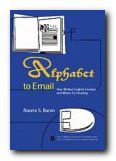
Alphabet to Email Taking the UK as her model, she traces the development of literacy in the UK from the eighth century, showing how literacy is linked to technology. She then discusses the development of the first writings in English up to the birth of print, pointing out that not all writers (including Shakespeare) embraced the technology of their time. Aristocrats writing in the early Renaissance thought it was vulgar to have one’s work printed and published. This leads into the history of notions of authorship – showing how plagiarism, quotation, and copyright are quite modern concepts. There’s lots of historical depth in her examination of the subject, and thought-provoking ideas emerge on almost every page. This is a serious, scholarly work, but readers eager for the email element promised in the title will have to be patient.

The next part of her study deals with the political, legal, and commercial history of book production and its effect on determining authorship and ownership of text. En passant she covers issues of literacy and how it is to be measured, the sociology of reading habits, and then the history of dictionaries in the seventeenth and eighteenth centuries. In the centre of the book, there’s a a lot on the history of the English Language and its development, spelling reform, the history of writing as a physical activity, and the rise of prescriptive grammar and ‘received pronunciation’ in the eighteenth century.

Then suddenly there is a chapter which seems to have come from nowhere. It explores the development of educational theory in American Universities and the rise of the ‘English Comp’ class. She gradually makes contact with what is supposed to be her subject when a consideration of online and collaborative writing – but by the time we get to the development of the WELL and Netscape it’s rather difficult to see where her argument is heading, though she does come back to authorship, ownership, and copyright in an age of compositional hypertext.

Then it’s back to classical Greece and Rome for a chapter on punctuation, retracing our steps via the Renaissance in a consideration of the relationship between writing, punctuation, and how the language is spoken. This section ends with a glance at the punctuation of email – which at least brings the promised subject back into view.

There is then a chapter on communication technology – from the semaphore and the telephone through to email. Are we there at last? Unfortunately not, for having arrived at this point, her discussion expires into very distanced, sociological, and general observations. There are some interesting questions explored. Must we answer email as we feel obliged to answer the phone? But this is a question of etiquette, not writing. There is very little on the most revolutionary writing tool – the word-processor – no analysis of concrete examples, and there are no insights offered which a regular emailer would not come across several times a day.

Her writing is fairly lively, though given the subject matter she occasionally makes some surprising gaffes – ‘who was the audience?’, ”nearly almost’, and ‘Piaget, the Swiss philosopher-come-mathematician’. The study arrives with a good bibliography and a full scholarly apparatus, though there’s an annoying system of notation which sends you through two layers of bibliographic reference to check her sources.

The value of this work is in its historical depth and the connections she reveals between the words on the page and the means of getting them there. She’s at her most interesting in the Renaissance, but she doesn’t in fact have much to say that’s new about electronic writing. Apart from observing that the online world presents new problems for those who communicate by writing, the most useful parts of her exposition are concerned with the distant past, not the present. Nevertheless, anyone interested in the relationship between writing and technology will probably want to read what she has to say about these issues- if only because she covers such a broad historical span.

© Roy Johnson 2001

Alphabet to Email   Buy the book at Amazon UK

Alphabet to Email   Buy the book at Amazon US


Naomi S. Baron, Alphabet to Email: How written English evolved and where it’s heading, London/New York: Routledge, 2001, pp.336, ISBN: 0415186862


More on digital media
More on technology
More on theory

Filed Under: Media, Theory Tagged With: Alphabet to Email, Electronic Writing, Language, Technology, Theory, Writing

Amazon Hacks

May 22, 2009 by Roy Johnson

100 Industrial-Strength Tips and Tools

This book tells you how to get information from Amazon; how to contribute reviews, recommendation lists, and product advice; how to sell stuff; how to make money as an affiliate; and how to harness the power of Amazon’s enormous database using tools they will provide – all for free! There are now lots of opportunities to sell, auction, and broker goods at Amazon. It’s like being in eCommerce with all the headaches taken out.

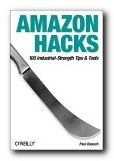
Amazon Hacks Paul Bausch tells you how to do it – using Amazon’s marketplace and Zshops systems. The first part is about how to use and make contributions to the ‘Amazon community’ – how to submit book reviews, make reading suggestion lists, and send gifts to your friends. All of this can be done straight away, with no waiting or steep learning curves. The second part is how to sell through Amazon – which you can do by marketing what you have, or finding out what other people want. And this is either by straight sales or by auctions.

Next comes the affiliates programme, whereby you get a commission for every customer you send to Amazon – so long as they make a purchase. Some people have established full time jobs on the strength of this scheme. It’s fairly simple, and all the steps are explained.

The last part of the book is an account of Amazon Web Services. These are free advanced tools and programs they offer for data recovery – XML, PHP, XSLT, databases, and SOAP. All the coding necessary for embracing these hacks is included.

Because Amazon lists everything about you – the books, CDs, or whatever you have bought or wish to sell – and because they allow you access to this information – you can even call up listings of products onto your own web site. This includes both what you want to sell, but it can also include lists of what other people want to buy.

Amazon are exploring innovations in eCommerce, even making their databases available to potential competitors. I suspect that anyone who follows all the opportunities offered here could make profits from these new departures.

If there is one small drawback, it’s that he doesn’t discuss the criticisms which many affiliates level against Amazon. They seem to offer more and more opportunities, yet squeeze the bonuses tighter and tighter. It’s a cat and mouse world where clever entrepreneurs have to stay one step ahead of the game. But at least you can try it all out for free!

This is a book which will appeal to Amazon users, anyone who deals in books, music, and all the other products which Amazon retails – and in particular those who would like to join Amazon affiliates and need help in getting set up.

© Roy Johnson 2003

Amazon Hacks   Buy the book at Amazon UK

Amazon Hacks   Buy the book at Amazon US


Paul Bausch, Amazon Hacks: 100 Industrial-Strength Tips & Tools, Sebastapol CA: O’Reilly, 2003, pp.280, ISBN: 0596005423


More on eCommerce
More on media
More on publishing
More on technology


Filed Under: e-Commerce, Technology Tagged With: Affiliate selling, Amazon, Business, e-Commerce, Technology

Ambient Findability

July 10, 2009 by Roy Johnson

why designers must keep users in mind

Peter Morville was co-author (with Louis Rosenfeld) of one of the essential books on information architecture, Information Architecture for the World Wide Web. This is his solo follow-up, which looks at the latest features of on-line life and tries to see what lies ahead. Ambient Findability is a very positive, almost excited, view of the last decade in web development. His central thesis is that information literacy, information architecture, and usability are all critical components of a new world order.

Ambient Findability He believes we have almost an ethical imperative to design the best possible software and web services to enhance the quality of our online life. All this has come about because of the unprecedented developments in data manipulation, connectivity, hyperlinking, and interactive services which have emerged in the last few years.

His new take on arranging information and navigational systems insists that they must be constructed around what the user requires, not the designer, and that they must be constructed with maximum findability in mind. The users, purchasers, or consumers are now Kings – because of their experiences on sites such as eBay and Amazon.

Never before has the consumer had so much access to product information before the point of purchase.

He looks at wayfinding systems in the natural world, then considers the relationship between language and information retrieval, including how we define meta-data. He sets great store by the theory of information analyst Calvin Moores, who suggested that people will not seek information that makes their jobs harder, even if it might benefit the organisation they work for.

For this reason, he has positive things to say about gossip and browsing. We are conditioned by evolution to pick up signals and recognise what he calls ‘textual landmarks’ in our search for information and our interpretation of the world. “Technology moves fast. Evolution moves slow.”

Because computers are becoming smaller and smaller, he then moves on to an encomium for the mobile device. This is followed by the technology which comes closest to fulfilling his desire for maximum findability – GPS (Global Positioning Systems).

He then looks at the issues of reconciling good web design with the competing demands of usability and efficient marketing – and solves the problem with a mantra that summarises his principal thesis: “Findability precedes usability. You can’t use what you can’t find.”

This leads into what I take to be the heart of the book – his take on the state of information architecture today. First he explains the competing views regarding the ‘semantic web’, which centre around definitions of meta-data so far as I understand it. Then he argues that these views can be reconciled if we accept the traditional roles of taxonomies for defining data – along with what he called ‘folksonomies’ whereby people put their own definitions on tagged objects.

This is not as important a book as Information Architecture for the World Wide Web, but it’s a thought-provoking guide to recent web developments and what might happen next in the online world. It’s full of interesting and provocative ideas, relevant graphics (first time I’ve seen colour in an O’Reilly publication!) and all the references are fully sourced.

© Roy Johnson 2005

Ambient Findability   Buy the book at Amazon UK

Ambient Findability   Buy the book at Amazon US


Peter Morville, Ambient Findability, Sebastopol, CA: O’Reilly, 2005, pp.188, ISBN: 0596007655


More on information design
More on design
More on media
More on web design


Filed Under: Information Design, Web design Tagged With: Ambient Findability, Findability, Information design, Navigation, Search, Usability, Web design

Among the Bohemians

July 11, 2009 by Roy Johnson

unconventional ways of living: 1900-1940

For almost half a lifetime I have marvelled at the way Bloomsbury bohemians organised their private lives. Switching partners, even sexes in their life choices? They took it in their stride. Menage a trois? Easy-peasy. Menage a quatre? Can be done. How on earth did they manage it? Virginia Nicholson’s Among the Bohemians is largely an answer to that question. She looks in detail at the way bohemian English people (largely artists and writers) organised their lives in what we would now call an ‘alternative’ manner and went out of their way to live La Vie Boheme.

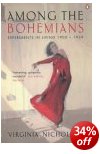
Among the Bohemians It’s an enormously entertaining book, packed with anecdotes on every page and written by the daughter of Quentin Bell, who was the son of Vanessa Bell, who in her turn was Virginia Woolf’s sister. This is a very telling provenance. She deals fairly comprehensively with her relatives and friends from the Bloomsbury Group about whom we already know a great deal, but the other figures who feature strongly are Augustus John, Eric Gill, Dylan Thomas, Robert Graves, plus minor figures such as Nina Hamnett, Betty May, Mark Gertler, and Ethel Mannin.

The book is arranged around a clever structural device which abandons a chronological narrative and instead bases chapters on themes. How did they cope with money and poverty? How did they arrange their sex lives? How should children be raised? What was their line on interior decor? This makes for a lively read.

The general picture which emerges is that of a group of upper middle class people who decided to kick against the stifling mores of late-Victorian and Edwardian society. Many of them were spoilt toffs and talented wasters who were merely playing at being Bohemian, and there is a distinct theme of nostalgie de la boue in some of the more extreme cases – but given the period, at least they were having a serious tilt at convention.

Some such as Virginia Woolf and Leonard Woolf, Lytton Strachey, Duncan Grant managed to combine unorthodox behaviour with a certain degree of professional success. But others slummed it, cadged drinks, or in the case of Dylan Thomas, stole other people’s shirts.

There is a particularly good chapter on interior design in which she analyses the various phases of Bohemian domestic aesthetics – from what Osbert Lancaster satirised as ‘First Russian Ballet Period’ to what she calls (poking fun at the Omega Group) ‘Jumble Sale chic’. Many of these fashions are still with us, though of course they no longer seem shocking, as they did at the time. This was a period in which even brightly coloured crockery was considered outré.

On the downside, some of them do not come off well out of her account: Ottoline Morrell taking two baths a year; Wyndham Lewis writing to his benefactor ‘Where’s the fucking stipend?’; Ruthven Todd stealing from the Grigsons who were supporting him; Augustus John neglecting his children; Eric Gill having sex with his. Much of it was not very politically correct – and that’s putting it mildly.

But her account is much more than gossip and amusing anecdotes, for she includes lots of well-digested social history on topics such as servants, the introduction of tinned food, and the price of wine and restaurant meals, This was the period which started cross dressing, make-up and smoking for women, occasional nude bathing, barefoot children left unsupervised, and for some of the hard cases, taking drugs.

It’s also a fully scholarly piece of work with properly referenced citations, notes on all the major and minor characters, and a huge bibliography. She has done us all the favour of reading the memoirs, the novels, and the journalism of all these now half-forgotten people – Gerald Brenan, Ethel Mannin, Roy Campbell – and digesting their experiences in a most delightful way.

She is perfectly aware that many of them were failed artists and part-time bohemians, well-to-do people who were playing at Artistic Life. And yet she can see that in the context of a world which served up boiled cabbage and stewed prunes with custard, a group which opted for wine, olives, and cooking with garlic represented the choice of Life.

I might be susceptible to literary and more particularly Bloomsbury gossip, but I found this book a real page turner. For me it will stay close at hand as a valuable source of reference to the period 1900—1940, and maybe even as an inspiration if I ever feel like being penniless but happy.

© Roy Johnson 2004

Among the Bohemians   Buy the book at Amazon UK

Among the Bohemians   Buy the book at Amazon US


Virginia Nicholson, Among the Bohemians, London: Penguin Books, 2003, pp.362, ISBN: 014028978X


Among the Bohemians – video lecture


More on lifestyle
More on biography
More on the Bloomsbury Group


Filed Under: Bloomsbury Group, Lifestyle Tagged With: Among the Bohemians, Biography, Bloomsbury Group, Bohemianism, Lifestyle

An Essay on Typography

June 19, 2009 by Roy Johnson

classic study of the aesthetics and morals of good design

This is Eric Gill’s memorable and engagingly dogmatic work on unchecked commercialism, moral living – oh, and on typographic design too. An Essay on Typography is where Gill firmly established what he believed type design should be, what it should do, and how it should be done. I read Gill’s Essay from cover to cover, then I immediately read it again. It’s short, (133 pages, plus an introduction and afterword) but quite enjoyable.

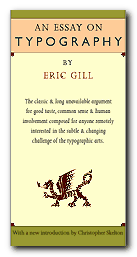
An Essay on Typography The unassuming size of the book does not affect its flow as it is set in Gill’s own face, Joanna. Although the use of some odd contractions and word breaks may take a little warming up to, the book is a testament to book design and layout concerns as discussed in sections The Procrustean Bed and The Book.

In the section entitled Lettering, Gill lends his views on letter form history and follows their evolution from Trajan’s Column in Rome to the printed page of the 1930’s with his own engravings presented to illustrate the walk-through.

At times Gill is somewhat idealistic but many of the arguments he makes are timeless and most of his advice is practical- consisting of basic truths which will apply to the craft no matter what tools or level of technology are employed in the creation and implementation of letter forms.

In Typography, a clear line is drawn between mechanized industry, seen as the work of many as opposed to fine craftsmanship, being the work of the individual. With his focus more on the social aspect of these ‘two worlds’ of typography, Gill explores and defines the limits inherent to each:

…the commercial article at its best is simply physically serviceable and, per accidens, beautiful in its efficiency; the work of art at its best is beautiful in its very substance and, per accidens, as serviceable as an article of commerce

The exceptions to its usefulness are the occasional segue into what seems a little like preaching (this essay is thoroughly peppered with religious references) and some ideas he proposes, such as letter-spaced italics for emphasis, that have thankfully fallen by the typographic wayside. Or perhaps when he coyly proposes to abolish lettering as we know it in favor of what he calls ‘Phonography’ (a form of shorthand), in But Why Lettering. I would equate this to today’s practice of flame-baiting online.

© Delve Withrington 2000

An Essay on Typography   Buy the book at Amazon UK

An Essay on Typography   Buy the book at Amazon US


Eric Gill, An Essay on Typography, David R. Godine [1993], pp.144, ISBN: 0879239506


More on typography
More on design
More on media
More on web design


Filed Under: Individual designers, Typography Tagged With: An Essay on Typography, Eric Gill, Fonts, Graphic design, Typography

An Introduction to Book History

June 18, 2009 by Roy Johnson

authorship, writing, printing, publishing, and reading

Book history is one of the most recent and interesting branches of literary studies. It asks questions such as ‘What is a text?’, ‘What is a book?’, and ‘How do we read?’ The answers to these questions are much more complex than you might imagine. David Finkelstein and Alistair McCleery start An Introduction to Book History by outlining the main theories and critical debates that have informed book history studies over the last hundred years.

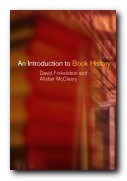
An Introduction to Book HistoryIt’s amazing how many different fields of study this leads to – the physical production of texts; how accurate they are; what they ‘mean’; and how they are interpreted by readers. These same questions of authorship, textual integrity, and the unique nature of a work also apply in other art forms.

In cinema, music, theatre, and television there may even be interventions from other hands. But it is writing and especially printing which are at the heart of the most important intellectual developments of the modern world, and to which they devote their first two introductory chapters. Much of their argument rests on the work of previous historians of the book and literacy, writers such as Walter Ong, Henri-Jean Martin, and Elizabeth Eisenstein.

They trace the changing role of the writer – from anonymous religious copyist in the early Renaissance, and authors working under systems of courtly patronage, to the modern concept of a creative independent working in the free commercial market supplying literary products and services.

Next comes a consideration of the practical aspects of what happens after a manuscript leaves the author. Printers, book distributors, publishers, readers, and even agents. All of these, they argue, can all affect a text; and they should certainly be seen as part of the context out of which the text arises.

Then they move on to consider what has been described as the ‘missing link’ in book history – the reader. For as many theorists have argued, the text exists in a state of potential whilst it remains as words printed on a page: it only springs into a life of real meaning when it is interpreted in the reader’s mind.

Why therefore aren’t there as many different interpretations of a text as there are different readers – all equally valid? Well, the answer to this conundrum is supplied by Stanley Fish when he comes up with the notion of ‘interpretive communities’. People sharing cultural values are likely to interpret the text in the same way.

They end by looking at the future of books and readers, An interesting detail here is that despite all the prophets of doom, a greater number of books are being read than ever before – but by fewer readers.

I was hoping for a little more on the book as a physical object, and I think longer consideration of digital literature on line might have informed their arguments. But they provide a comprehensive critical introduction to the development of the book and print culture.

© Roy Johnson 2005

An Introduction to Book History   Buy the book at Amazon UK

An Introduction to Book History   Buy the book at Amazon US


David Finkelstein and Alistair McCleery, An Introduction to Book History, Abingdon: Routledge, 2005, pp.160, ISBN: 0415314437


More on literature
More on the novella
More on literary studies
More on short stories


Filed Under: Literary Studies Tagged With: An Introduction to Book History, Bibliography, Book history, Cultural history, Literary studies

An Introduction to Literary Studies

July 2, 2009 by Roy Johnson

how to understand, analyse, and write about literature

An Introduction to Literary Studies is aimed at serious students of English and American literature at college and university level. It’s designed to show you how to approach studying literature in a practical and theoretical manner, how to understand some of the fundamental concepts of literary studies, and how to articulate your understanding by writing academic essays. Mario Klarer begins by looking at some of the very basic issues – what is fiction? what is a poem? and what are the parts of these genres we look at when we study literature?

An Introduction to Literary Studies He examines character, plot, point of view, then metaphor, imagery, and symbols. There’s also a chapter on drama too, for those who still think this is related to literary studies. Next comes a section on theoretical approaches to literature. This is where most students will need help. That’s because the developments of critical theory in the post-war period have been bewildering, to say the least. He touches on rhetoric, formalism, structuralism, semiotics, and deconstruction, Marxism, feminism, and reader-response theory. All his explanations are given in a straightforward manner and he covers definitions of key terms such as ‘literature’, ‘text’, and ‘author’ – which might seem unproblematic, until you look below the surface.

There’s a full chapter on how to write a scholarly paper, lots of suggestions for further reading, and a glossary of terms used in both literary studies and the consideration of narratives in other genres such as film.

This latest second edition fully updates the highly successful first edition to provide greater guidance for online research and to reflect recent changes to MLA guidelines for referencing and quoting sources.

So, in a sense, this book is alerting students to the issues which can be considered in the practice of literary studies. It is showing what is possible, alerting you to themes, theories, and approaches you might not have considered, and pointing you towards sources of further information – which is just what an ‘introduction’ should do.

© Roy Johnson 2004

An Introduction to Literary Studies   Buy the book at Amazon UK

An Introduction to Literary Studies   Buy the book at Amazon US


Mario Klarer, An Introduction to Literary Studies, Andover: Routledge, 2nd edn, 2004, pp.173, ISBN: 0415333822


More on literature
More on the novella
More on literary studies
More on short stories


Filed Under: Literary Studies, Theory Tagged With: Introduction to Literary Studies, Literary criticism, Literary studies, Study skills, Theory

Analysing essay questions

August 22, 2009 by Roy Johnson

sample from HTML program and PDF book

1. Analysing essay questions is the first thing you should do before you start answering them. You should read the question very carefully. Study it closely, and try to analyse its full meaning. Make an effort to understand the problem it is posing, the principal issue or concept behind it, or the topic it is asking you to explore.

2. One way you can help yourself in this is to write out the question fully and accurately on the papers you will be using for your essay plan.

3. Most questions contain within them (even if by implication both key terms and instruction terms. Let’s look at a couple of examples.

4. “Examine the significance of Iago’s role in Othello”

Examine here is an instruction term because it tells you to discuss the topic in a general manner.

Iago’s role is a key term because it sets
the limit of the question and is asking you to focus attention on this particular aspect of the play.

5. “Compare and contrast liberal-democracy and state-socialism as forms of government”

Compare and contrast are instruction terms because they indicate that you should be looking for any similarities and emphasising differences in the two systems of government.

The words liberal-democracy and state-socialism are key terms because they specify the two forms of government that should be examined.

6. Other typical instruction terms are – Discuss, Evaluate, Illustrate, Outline, Review, Trace, Explain – because they tell you what to do with the topic and which approach your answe to the question should take.

7. Most common problems in understanding questions usually arise from a failure to pay close enough attention to what they actually say. This often results in –

  • Answering the wrong question
  • Misunderstanding the question topic
  • Failing to see the emphasis of the question
  • Not following the instructions

8. Contrary to what many people think, questions are not set to catch you out, to surprise you with something new, or to be especially difficult and cause intellectual pain. In almost all cases they are set to give you the opportunity to show what you have learned in a course of study.

© Roy Johnson 2003

Buy Writing Essays — eBook in PDF format
Buy Writing Essays 3.0 — eBook in HTML format


More on How-To
More on writing essays
More on writing skills


Filed Under: Writing Essays Tagged With: Academic writing, Analysing questions, Essay questions, Essays, Study skills, Term papers, Writing skills

Analysing fiction – a glossary

November 1, 2009 by Roy Johnson

a checklist of literary terms

Analysing fiction requires that you are able to name and describe the features of a story or a novel that you find interesting. This means having a clear understanding of language and grammar, plus the basic elements of narrative prose. The definitions below are just the beginning. This is where the complex process of analysing fiction starts.

Vocabulary
The author’s choice of individual words – which may be drawn from various registers such as colloquial, literary, technical, slang, journalism, and may vary from simple and direct to complex and sophisticated.

Grammar
The relationships of the words in sentences, which might include such items as the use of adjectives for description, of verbs to denote action, switching between tenses to move between present and past, or any use of unusual combinations of words or phrases to create special effects.

Syntax
The arrangement and logical coherence of words in a sentence. The possibilities for re-arrangement are often used for emphasis or dramatic effect.

Figures of speech
The rhetorical devices often used to give decorative and imaginative expression to literature. For example – simile, metaphor, puns, irony.

Literary devices
The devices commonly used in literature to give added depth to a work. For example, imagery, point of view, symbolism, allusions.

Tone
The author’s attitude to the subject as revealed in the style and the manner of the writing. This might be for instance serious, comic, or ironic.

Narrator
The person telling the story. This may be the author, assuming a full knowledge of characters and their feelings: this is an omniscient narrator. It might alternatively be a fictional character invented by the author. There may also be multiple narrators. You should always be prepared to make a clear distinction between Author, Narrator, and Character – even though in some texts these may be (or appear to be) the same.


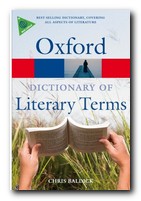
Analysing Fiction - Dictionary of Literary TermsChris Baldick’s Dictionary of Literary Terms has entries which range from definitions of ‘the absurd’ to ‘zeugma’. It’s also a guide to grammatical terms, traditional drama, literary history, and textual criticism. It contains over 1000 of the most troublesome literary terms you are likely to encounter. Some of the longer entries and explanations become like short essays on their subject.

Analysing fiction Buy the book from Amazon UK
analysing fiction Buy the book from Amazon US


Narrative mode
This is usually either the first person singular (‘I am going to tell you a story about…’) or the third person singular (‘The duchess felt alarmed…’).

Narrative
The story which is being told: that is, the history of the events, characters, or whatever matters the narrator wishes to relate to the reader.

Characterisation
The means by which characters are depicted or created – commonly by accounts of their physical appearance, psychological characteristics, direct speech, and the opinions of the narrator or other characters about them.

Point of view
The literary strategy by which an author presents the events of a narrative from the perspective of a particular person – which may be the narrator or may be a fictional character. The point of view may be consistent, or it may switch between narrator and character(s). It should not be confused with the mere opinion of a character or the narrator.

Structure
The planned underlying framework or shape of a piece of work. The relationship between its parts in terms of arrangement or construction.

Theme
The underlying topic or issue, often of a general or abstract nature, as distinct from the overt subject with which the work deals. It should be possible to express theme in a single word or short phrase – such as ‘death’, ‘education’, or ‘coming of age’.

Genre
The literary category or type (for instance, short story, novella, or novel) to which the work belongs and with whose conventions it might be compared. We become aware of genre through cultural experience and know for instance that in detective stories murder mysteries are solved; in fairy stories beautiful girls marry the prince; and in some modern short stories not much happens.

Cultural context
The historical and cultural context and the circumstances in which the work was produced, which might have some bearing on its possible meanings. A text produced under conditions of strict censorship might conceal its meanings beneath symbolism or allegory.

© Roy Johnson 2009


More on language
More on literary studies
More on writing skills
More on creative writing
More on grammar


Filed Under: 19C Literature, 20C Literature, How-to guides, Literary studies, Study Skills Tagged With: Analysing Fiction, Literary studies, Literary terms, Reading skills, Study skills

Analysis of a Shakespeare sonnet

October 31, 2009 by Roy Johnson

sample answer to an examination question

This analysis of a shakespeare sonnet is an example of literary analysis at third year undergraduate level. It’s also an example of an answer to an essay question set for a final-year exam paper. It poses the fairly standard test of analysing one of the sonnets. This is one of three questions to be answered in three hours. So – allowing ten minutes for making notes and maybe an outline plan, this shows what can be done in fifty minutes!

Question
Write an essay on the following sonnet. Your answer should:

  • briefly summarize the argument of the sonnet
  • comment on the language Shakespeare employs and the way that language reflects the sonnet’s argument

You may wish to refer to other sonnets in your answer, but any references to other texts must be relevant to your broader argument.

Sonnet XXII
My glass shall not persuade me I am old,
So long as youth and thou are of one date;
But when in thee time’s furrows I behold,
Then look I death my days should expiate.
For all that beauty that doth cover thee
Is but the seemly raiment of my heart,
Which in thy breast doth live, as thine in me;
How can I then be elder than thou art?
O therefore, love, be of thyself so wary,
As I not for myself but for thee will;
Bearing thy heart, which I will keep so chary
As tender nurse her babe from faring ill.
Presume not on thy heart when mine is slain;
Thou gav’st me thine, not to give back again.


Answer

In Sonnet 22, the speaker contemplates the difference in age between himself and his beloved, and asserts that he obtains youth through his relationship with the young man. In the second quatrain the speaker explains that the reason for this is the love between the himself and the young man which is portrayed as a mutual exchange of hearts, with the implication that the two have become one flesh. The speaker urges the young man to take care of himself and promises to be faithful to the young man. In the couplet, the motivating factor for the poem becomes clear, with the speaker acknowledging that he is afraid that his heart may be broken by the young man.

Although there are no personal pronouns which can confirm the sex of the addressee of the sonnet, the first 126 sonnets are assumed by critics to have been written to a young man. Sonnet 22 appears shortly after the early group of poems which urged the young man to have a child, and is one of the first sonnets to focus upon the speaker’s feelings.

The structure of the sonnet is 4-4-4-2, although there is a change of emphasis and tone after the 8th line which means that the sonnet has a distinguishable octave and sestet.

In the first quatrain, the speaker focuses upon youth and age and the disparity in age between himself and the young man. The opening line shows the speaker looking at himself in a mirror or ‘glass’ and is an echo of the opening line of sonnet 3 in which the young man was urged to look at himself in a mirror as a warning against growing old and remaining childless. The imagery of Q1 emphasises the disparity with ‘old’, ‘youth’, ‘date’, ‘death’ and the metaphor of ‘times furrows’ which effectively describes the wrinkles that the speaker has now and which the young man will have in the future’. The emphasis of this quatrain is on outward, physical appearance. The quatrain ends with the speaker looking forward to his own death which he hopes will be peaceful.

In the second quatrain, the emphasis changes and the poet uses an extended metaphor of the exchange of hearts to describe the mutual love between himself and the young man. The exchange of hearts was and still is a common motif of love poetry. However in this sonnet it is examined in a more literal way with the speaker suggesting that the two have actually exchanged hearts with the outward beauty of the young man being but ‘the seemly raiment of my heart’. Here the clothing imagery and the reference to the young man’s beauty link back to Q1 and the stress on external appearance.

Line 7, ‘which in thy breast doth live as thine in me’ is an allusion to the marriage service in which it is suggested that man and woman become one flesh. This, together with the opening lines which make the same suggestion, have convinced some critics that the relationship between the speaker and the young man is a consummated love affair. This however, is a contentious issue and one upon which critics remain divided.

The final line of Q2 links back to the opening line, with the speaker again referring to the age difference, this time asking the rhetorical question ‘How can I then be elder than thou art?’ again suggesting that the two have become one.

In the 3rd quatrain there is a change of tone, with the speaker making a direct exhortation to his beloved. ‘O therefore love, be of thyself so wary’. The heart imagery continues and the speaker uses similes of ‘nurse’ and ‘babe’ to describe himself and the young man’s heart. These similes have a two fold effect. Firstly, despite the speakers assertions to the contrary, they emphasis the difference in age between the speaker and the young man. However, they also change the imagery of the poems from those of old age such as ‘times furrows’ which was present in Q1, to ones of youth. In his way, the poem moves from age to youth. The structure of the sonnet therefore demonstrates the rejuvenation that the speaker is claiming to receive because of his relationship with the young man.

In the couplet, the motivation for the sonnet becomes clear. The poet is concerned that the young man will leave him and this will break his heart. He uses the word ‘slain’ which suggests murder and is in contrast to the peaceful death of old age that the speaker was wishing for in the first quatrain. The ‘heart’ is again the focus of the couplet, thus linking back to the 2nd and 3rd quatrains. Here however, there is the suggestion that the young man may want to take his heart back or leave the speaker. The poet warns him ‘presume not on thy heart when mine is slain’. The implication is that if the young man breaks the speaker’s heart, he will not get his own heart back – leaving him heartless – with the suggestion of cruelty.

In his sonnet, just as the imagery moves backwards from death to birth but with a final reference to death in the couplet, the quatrains take on new meanings in light of those that follow. Q1 is an assertion that the speaker is not old, Q2 explains the reasons for this assertion. Q3 is an exhortation to the speaker and the couplet explains the fear of being left broken hearted which is the underlying reason for the sonnet.

© 2000 Kathryn Abram – reproduced with permission.


More on language
More on literary studies
More on writing skills
More on creative writing
More on grammar


Filed Under: Literary studies, Study Skills Tagged With: Examinations, Literary studies, sample exam answer, Shakespeare, Writing skills

  • « Previous Page
  • 1
  • …
  • 7
  • 8
  • 9
  • 10
  • 11
  • …
  • 103
  • Next Page »

Get in touch

info@mantex.co.uk

Content © Mantex 2016
  • About Us
  • Advertising
  • Clients
  • Contact
  • FAQ
  • Links
  • Services
  • Reviews
  • Sitemap
  • T & C’s
  • Testimonials
  • Privacy

Copyright © 2026 · Mantex

Copyright © 2026 · News Pro Theme on Genesis Framework · WordPress · Log in