speed, search engine, and conversion rate secrets
Andy King scored a big hit in 2003 with his first book Speed Up Your Site. It’s a guide which still has its own live web site where you can analyse the effectiveness of your web pages. His latest magnum opus Website Optimization goes way beyond that in scope and depth. It’s a guide to maximising every aspect of a website and its performance. It’s an amazingly practical manual, with page after page of ideas, suggestions, and strategies for getting your pages more widely known and read.
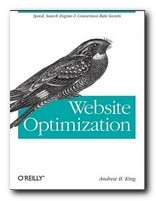 On the whole, it’s not too technical, and he supplies snippets of code only when necessary. All the tips are within the grasp of anyone who is used to running a web site, and along the way he explains the principles of search engine optimization (SEO) as well as briefing you on how SEs treat your site. This is an up-to-date account of how search engines such as Yahoo and Google rank your pages and deal with search requests. He also presents real-life case studies in which he shows ‘before and after’ makeovers of professional sites. These are most instructive in that the ‘before’ pages look attractive and professional enough – until their underlying weaknesses are analysed and rectified. The improvements give what are claimed as up to fifty times more site visitors per day, and in the case of a cosmetic dentist the need to employ more staff and move to bigger offices in Philadelphia.
The first half of the book deals with search engine marketing optimization, which can be expensive as one enters the world of paid advertising. But the second concentrates on things which anyone can do and afford – making pages smaller, lighter, and faster by trimming off the surplus fat. In an age of faster and faster broadband connections, web users are simply not prepared to wait more than a couple of seconds for a page to appear – so you’ve got to make important pages lean and speedy:
Web page optimization streamlines your content to maximise display speed. Fast display speed is the key to success with your website. It increases profits, decreases costs, and improves customer satisfaction (not to mention search engine rankings, accessibility, and maintainability).
All of these issues are dealt with in detail – and I particularly liked the fact that he was prepared to repeat some of the techniques when they occurred in different contexts. It’s not always easy to grasp some of these technologies in one simple pass. Especially as – in the case of optimizing images – he explains no less than sixteen possibilities for cutting file size and speeding up downloads.
He’s also keen on the optimization of style sheets and shows an amazing variety of techniques for creating what he calls ‘CSS Architecture’. Here too there are no less than ten strategies explained which offer cleaner, tighter, coding and the use of structural markup to beat browser peculiarities and rendering delays.
Most of his explanations are clearly articulated, but occasionally he lapses into less than elegant repetition and jargon, which could deter the inexperienced:
By converting old-style nonsemantic markup into semantic markup, you can more easily target noncontiguous elements with descendant selectors.
Fortunately, this sort of thing only happens occasionally.
There are some very nifty tricks for creating buttons and rollover techniques using style sheets, which saves the time to download a graphic files button, and thus once again speeds up page rendering.
He puts in two chapters on advanced web performance and optimizing JavaScipt and Ajax on your site which I have to admit went beyond my technical competence. But then it’s back to terra firma with understanding the metrics of your site’s performance – that is, knowing how to analyse the statistical data returned by website analysers such as Google’s Analytics and WebTrends.
I’ve never been able to understand before what page ‘bounce rate’ was until it was explained here – and I was astonished when I saw the results from some of my own pages!
As the search for more detailed information and for planning campaigns goes on – so the process becomes more like a science. There are graphs and formulae scattered around these pages to prove this. It’s the same for Pay Per Click advertising (PPC). All I can say is that if you are in this league, Andy King is your friend, and his advice is here thick on the ground to help you.
© Roy Johnson 2008

Andrew King, Website Optimization, Sebastopol, CA: O’Reilly, 2008, pp.367, ISBN: 0596515081
More on eCommerce
More on media
More on publishing
More on technology

 Studying Fiction is an introduction to the basic concepts and technical terms you need when making a study of stories and novels. It shows you how to understand literary analysis by explaining its elements one at a time, then showing them at work in short stories which are reproduced as part of the book. Topics covered include – setting, characters, story, point of view, symbolism, narrators, theme, construction, metaphors, irony, prose style, tone, close reading, and interpretation. The book also contains self-assessment exercises, so you can check your understanding of each topic. It was written by the same author as the guidance notes on this page that you are reading right now.

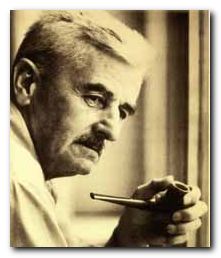 William Faulkner (1897—1962) grew up in Oxford, Mississippi, and lived there for the rest of his life – with only brief intermissions for travel and working in Hollywood as a screenwriter. He was one of the major American writers of the early twentieth century. He established the white protestant version of the American south, reflecting its values of that period – the collapse of the white land owning aristocracy and the inability (at that time) of the blacks to shake off the legacy of slavery. Faulkner was a literary experimentalist, influenced by the modernist period, and he sometimes makes extreme demands on his readers. He uses stream of consciousness, fragmented chronology, shifting point of view, and multiple narrative voices. Even in some of his plain narratives, the story is expressed in sentences which sometimes go on for two or three pages at a time.
 As I Lay Dying (1930) is a good point to start. It charts the journey of a poor family to bury their mother Addie Bundren in Jefferson. They make the coffin themselves and survive crossing the flooded Yoknapatwapha river, a fire, and other largely self-inflicted problems, to finally reach their goal. The novel is told in the rapidly intercut voices of the family members – including the dead mother. It is simultaneously funny, and tragic – a small scale epic which Faulkner wrote in the space of six weeks.
 The Sound and The Fury is generally regarded as his greatest work. It is a narrative tour de force in which Faulkner views the decline of the south through the point of view of four characters. The novel centres on the once-aristocratic Compson family, who appear in his other novels. The siblings Quentin and Caddy fall from a state of innocence and succumb to the family pattern of incest, erotomania, and suicide. One of their brothers is severely mentally handicapped. The first part of the novel is told entirely from his point of view – and of course he ‘sees’ the truth of much that is going on. The other narrator is the black servant who is powerless but ‘endures’. It is a work of astonishing brilliance, written in a sombre and lyrical mood.
 Sanctuary (1931) is an example of Faulkner writing simultaneously at his best and worst. The novel was produced to make money, and is a sort of rural South whodunit which centres on a particularly grizzly crime. All the southern Gothic elements are here. The main plot revolves around Temple Drake, a coquettish college girl who likes to secretly sneak out of her college dorm to attend dances. She takes one step too far onto the wild side, and the result is a helter-skelter ride down into the moral abyss. The novel also includes a psychopathic bootlegger, corrupt local officials, the trial of an innocent man, and a public lynching. It was Faulkner’s only best-seller.