Mantex

Tutorials, Study Guides & More

  • HOME
  • REVIEWS
  • TUTORIALS
  • HOW-TO
  • CONTACT
>> Home / Archives for 2009

Archives for 2009

Digital Filmmaking

June 18, 2009 by Roy Johnson

professional advice on embracing new technology

Mike Figgis is the director of one of my favourite films, Liebestraum, as well as the much better known Leaving Las Vegas. He’s multi-talented as a director, a musician, and a writer; but like most film directors (most recently David Lynch) he’s now embracing the new possibilities of digital filmmaking. Suddenly, all the laborious paraphernalia of the Hollywood film-making process can be concentrated into a cheap hand-held digital camera that we could buy from Amazon for less than the price of an entry level laptop.
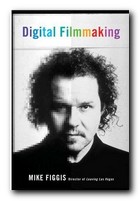
Digital FimmakingFiggis has taken on the new possibilities that these technological developments have made available. And in this book he’s sharing his reflections on the art of film-making in a way which is addressing both an amateur YouTube enthusiast or a serious film school would-be at the same time.

And none of his advice is theoretical: he’s actually using the new technology in making his own films. It’s not so much a book of practical tips: this is more the philosophy of film-making. But he’s acutely anti-snobbish about using the new equipment available. His emphasis is on the love of your equipment – get to know it, use its features, and don’t imagine your talent is being held back by lack of access to the latest kit.

It’s a terrific insight into the consciousness of a creative person: he thinks out loud concerning the creative process – all the time keeping in mind the practical matters of the medium in which he is working and how much it costs.

As the story progresses from one level of film technology to the next, you can feel his creative hunger coming off the page. Instead of telling camera and lighting technicians what you’re looking for, why not do it all yourself? Which is what he did – even after being enmeshed with Hollywood. Indeed, as he argues, especially after being so. The new technology puts more control into the hands of the director.

He goes into a lot of interesting professional detail on such matters as lighting, camera movement(s) and dealing with actors – on all of which issues it seems he likes being in control, but with a sympathetic respect for the professionalism of others.

I was interested to note that when it got to the point of post-production editing, he dealt with the problem of having so much, in fact too much material – and the solution to this problem is what’s called in the IT world ‘meta-tagging’ – that is, you need to name and log what you’ve got, in order to control the architecture of the final product.

His two final topics are music on soundtracks and film distribution – on both of which he knows whereof he speaks. He’s a qualified music teacher and a former keyboards player with Roxy Music. It was his soundtrack for Liebestraum which first alerted me to the quality of his work. He has lots of ingenious suggestions for independent filmmakers and ideas galore for anybody who is prepared to engage in new digital technology.

It’s a pity the book isn’t illustrated – because from the text it’s quite clear that Figgis makes a detailed record of his work process, and it would have been useful to see a few screenshots of the effects and techniques he’s talking about. But as a guide to the new possibilities of film-making, it’s truly inspirational.

© Roy Johnson 2007

Digital Filmmaking   Buy the book at Amazon UK

Digital Filmmaking   Buy the book at Amazon US


Mike Figgis, Digital Filmmaking, London: Faber, 2007, pp.158, ISBN: 0571226256


More on digital media
More on technology
More on theory

Filed Under: Media Tagged With: Digital Fimmaking, Film, Media, Open Sources

Digital Magazine Design

June 27, 2009 by Roy Johnson

magazine design principles – plus practical examples

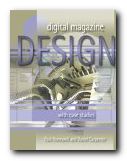
Digital Magazine Design is a guide to computer-based graphic design principles based on modern magazine production and its requirements. The manual provides detailed descriptions of all the necessary rules of design, and uses these rules to cast a critical eye over a selection of contemporary high-street magazines. It starts off by emphasising the need for understanding basic interface metaphors. If we know our way around one desktop, we can usually work out how to find our way round another. The same is true of print publications.

Digital Magazine DesignThere is a convention to the order of items in a magazine of which casual readers are often unaware. Then Paul Honeywell goes through the elements of page design – using grids to structure graphics and text; controlling the density and appearance of the text by using line-spacing, hyphenation, and tracking. There’s also quite a lot of technical detail pertaining to colour mixing and the use of images.

A couple of chapters deal with the details of digital type design – though more illustrations would have been useful in demonstrating the issues at point here. There’s also advice on using a bureau when it is appropriate to outsource work. This goes into the details of file types, pre-press document checks, and keeping an accurate account of work flow.

The second part demonstrates how the tools of design can be applied to the
analysis and practice of contemporary magazine design. It’s a collection of case studies – ranging from Hi-Fi News, Kerrang!, She, and Empire, to Classic FM magazine.

These cover analysis of magazine design, with before and after accounts of layout and typography – complete with effects on sales and readership. There’s a lot of description here, where an illustration would have been far more effective.

These are post-graduate projects – revealed in the use of academic signposting (‘This essay aims to closely analyse …’) – which might easily have been edited out. This could easily be done if the book ever goes to a second edition.

© Roy Johnson 2003

Digital Magazine Design   Buy the book at Amazon UK

Digital Magazine Design   Buy the book at Amazon US


Paul Honeywell and Daniel Carpenter, Digital Magazine Design, Bristol: Intellect, 2003, pp.160, ISBN: 1841500860


More on publishing
More on journalism
More on creative writing
More on writing skills


Filed Under: Journalism, Publishing Tagged With: Digital Magazine Design, Graphic design, Journalism, Publishing, Writing skills

Discourse and Ideology in Nabokov’s Prose

July 3, 2009 by Roy Johnson

Routledge Harwood Studies in Russian Literature

Vladimir Nabokov’s work has been widely regarded as an elaborate series of linguistic games in which a variety of clever and seductive narrators invite readers to collude in a system of aesthetic and moral beliefs which are held so firmly that to dissent from them would seem like heresy or not playing the game. Editor David Larmour explains the title of this collection of essays as an exploration of the ‘system of power relations in which the author, text, and reader are enmeshed’. In other words, Nabokov’s strategies are seen as open to challenge, with the clear implication that he has been getting away with it for far too long.

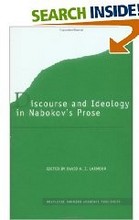
Discourse and Ideology in Nabokov's ProseHe is well known for his ‘strong opinions’, and some of his subject matter and authorial attitudes are very often seen as dubious – especially in Lolita, which gets special extended treatment here. Galya Diment starts the collection with her best efforts to defend Edmund Wilson from the damage inflicted on him by Nabokov in their now famous friendship-turned-dispute over the translation of Pushkin’s Eugene Onegin. Then Brian Walter makes a lengthy criticism of Bend Sinister to say not much more than that it is not one of his best novels.

Galina Rylkova reveals a literary precedent for The Eye in a novel by Mikhail Kuzmin called Wings published in 1906. She has no problem in establishing the parallels between the two texts, but most of her lofty interpretive claims are undermined by her failure to see that Nabokov’s narrator Smurov is a self-deceiving liar and a totally unreliable narrator. He is a comic-pathetic character who is a vehicle for one of Nabokov’s most brilliant experiments in narrative – an experiment which was only matched in subtlety by his later Spring in Fialta.

David Larmour contributes an essay which looks at the relationship between sex and sport in Glory. But like many of the other contributors he accepts almost at face value what Nabokov has to say in his introductions – which were written at a later date. There is no acknowledgement of ‘Trust the tale, not the teller’, or ‘Death of the author’, whichever you prefer.

Paul Miller offers a chapter which demonstrates that Kinbote, narrator of Pale Fire is a homosexual – something which I would have thought any reader above the age of fifteen would realise without being told. There are some perceptive analyses of the American crewcut, but not much more than can be accessed by any reasonably attentive reader.

What struck me was how long it takes these writers to say so little. They come from what is now the bygone age of pre-Internet writing – one which persists in the modern world only thanks to the requirements of tenure in the US and the Research Assessment Exercise in the UK.

Tony Moore makes a valiant attempt to offer what he calls a feminist reading of Lolita, even enlisting the help of Camille Paglia, but his argument that Humbert Humbert changes his moral stance and his prose style at the end of the novel doesn’t seem very convincing, especially when it simply ignores the fact that Humbert is guilty of murder.

There’s also a full-on rad fem reading of Lolita from Elizabeth Patnoe which combines personal testimony and high moral outrage in a very unprofessional manner, ignoring any distinction between the worlds of fiction and reality. At the end of a long tortuous argument, one is left wondering why she bothers reading the novel.

She also has an annoying habit of describing almost every narrative twist as ‘doubling’ – a term she uses indiscriminately as a synonym for ‘ambiguous’, ‘dubious’, ‘disingenuous’, ‘devious’, ‘evasive’, and other related terms.

Fortunately the collection is rounded off by two sensible chapters by Donald Johnson and Suellen Stringer-Hye which place Nabokov in the context of popular culture and America in the 1960s. The collection is based on papers given at an academic conference. It’s obviously one for the literary specialist, but Nabokov enthusiasts will not want to miss it – even if it’s to sharpen their own critical analysis against the views being expressed.

© Roy Johnson 2004

Buy the book at Amazon UK

Buy the book at Amazon US


David H.J.Larmour (ed), Discourse and Ideology in Nabokov’s Prose, London: Routledge, 2002, pp.176, ISBN 0415286581


More on literature
More on the novella
More on literary studies
More on short stories


Filed Under: Literary Studies, Vladimir Nabokov Tagged With: Discourse & Ideology in Nabokov's Prose, Literary criticism, Literary studies, Vladimir Nabokov

Doing Creative Writing

July 6, 2009 by Roy Johnson

a guide for undergraduate and postgraduate students

Can creative writing actually be taught? Well – judging from the number of college and university courses devoted to the subject, and the number of books written about it, the answer appears to be ‘Why not?’ Steve May teaches at Bath Spa University , and Doing Creative Writing is an attempt to support students whilst they choose a suitable course, what to expect when they embark on it, how to organise themselves as writers, and what possibilities exist for a writer once the course has finished.

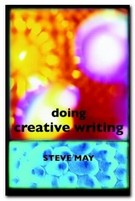
Doing Creative WritingApart from having the desire to write, not many students know what is involved in the process. His first two chapters argue the case for teaching creative writing against the advice of such lofty figures as Henry James, who believed that it could not be taught.

He uses music as an analogy: nobody would expect to pick up a clarinet (as they might a pen) and perform a Mozart concerto without learning how to play the instrument first.

The next section will be of vital interest to anyone planning to study creative writing in higher education. He looks at the way it is taught in the US and the UK; he explains the variety of reasons why such courses are offered; and he provides guidance for judging the calibre of the people teaching the subject. Not many people realise that some of the best ‘qualified’ (published writers) might well be employed on a part-time basis and paid at hourly rates.

When you’ve enrolled on your course, what can you expect to happen? You’ll have to get used to the idea of the seminar or workshop in which you’ll be expected to present your own work and have it discussed by fellow students. He gives advice on how to handle the feedback you will be given – and how to give your own when you in your turn become ‘the audience’.

He tackles head-on the often vexed issue of assessment in creative work. Be warned! These workshops might form part of your assessment – so don’t think these sessions are an easy option where you can sit back and just listen. He shows real-life examples of the criteria UK and US institutions use, and he emphasises the element of self-assessment or reflective writing which is common to both.

The last part of the book is dedicated to the techniques of creative writing – where to write, how to write, what to write about, what materials to use, and how to present the finished work.

He also includes some real-life case studies of students who have taken creative writing courses and the variety of paths their careers have taken; and finally there’s a useful bunch of recommendations for further reading.

This is a useful adjunct to books which focus on the techniques of creative writing (such as Ailsa Cox’s recent Writing Short Stories) and it’s obviously aimed at students with ambitions in creative writing course who may not know which course to choose – or what to expect when they get there.

© Roy Johnson 2007

Creative Writing   Buy the book at Amazon UK

Creative Writing   Buy the book at Amazon US


Steve May, Doing Creative Writing, London: Routledge, 2007, pp.152, ISBN: 0415402392


More on creative writing
More on writing skills
More on publishing


Filed Under: Creative Writing, The Short Story, Writing Skills Tagged With: Creative writing, Doing Creative Writing, Short stories, Writing skills

Doing English

June 16, 2009 by Roy Johnson

preparing for literary studies at undergraduate level

This book is designed to make students of literature think more deeply about the subject. It explains the development of English Literature as an academic discipline and poses fundamental questions about the activity – such as ‘What is English [Literature] and what is studying it supposed to mean?’ Robert Eaglestone’s book aims to help students prepare for studying literature at undergraduate level. He offers a gentle introduction to literary theory – but without lots of jargon.

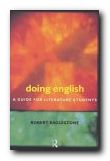
Doing English If students read what he has to say, they will certainly be more confident in confronting some of the challenges and contradictions which exist in literary studies in universities. For instance, tutors commonly deduct marks from students for poor written expression – and quite right too. Yet why do so many literary critics get published when their work is almost unintelligible? These are questions worth asking. He explains the rise in ‘Eng Lit’ and uncovers some of the hidden assumptions which lie beneath the surface of traditional attitudes to it. This is in fact an explanation of the ideology of ‘Eng. Lit.’ – but he cleverly avoids even using the term.

He unpacks the concept of the literary canon and looks in detail at Shakespeare studies as a prime example. This is followed by issues of interpretation which are summed up in the expressions ‘the intentional fallacy’ and ‘the death of the author’.

The latter parts of the book are devoted to considering the relationships between English Literature and cultural identity, politics, and educational policy. His consideration of these larger strategic issues make me think that this book will be as valuable to teachers as to students. It will help them clarify their ideas about their objectives and teaching strategies in the classroom.

There is an excellent and deeply annotated bibliography. Any student [or teacher] reading even a few of the titles he recommends will be well prepared to put their own approach to literary studies into a well-informed ideological context. [But they don’t have to mention the term.]

© Roy Johnson 2009

Doing English   Buy the book at Amazon UK

Doing English   Buy the book at Amazon US


Robert Eaglestone, Doing English: A guide for literature students, London: Routledge, 3rd edition 2009, pp.192, ISBN: 0415284236


More on literature
More on the novella
More on literary studies
More on short stories


Filed Under: 19C Literature, 20C Literature, Literary Studies Tagged With: Doing English, English literature, Literary studies, Study skills

Doing your Research Project

November 10, 2009 by Roy Johnson

best-selling guide to research methods and techniques

Judith Bell is a distinguished authority on educational practice, and she had the foresight to produce what many students crave – a clearly written guide to research methods. The result was Doing your Research Project, a source of reference and a guide to good research practice which has become a best-seller. It was produced for students in education and the social sciences, but anybody embarking on a lengthy written project would profit from reading this book.

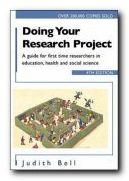
Research ProjectThe strength of her approach is clarity and good organisation. Separate chapters deal with each stage of undertaking a project in a way which explains exactly what is required, and it’s written in a humane and friendly manner. Topics covered include the selection of a research subject, collecting data and keeping records, reviewing the literature, designing questionnaires, interpreting evidence, and presenting the findings. The book has sold more than 200,000 copies by the way.

What I liked particularly was the fact that she covers exactly those issues which intimidate many students when they first tackle a lengthy project. How to identify a proposal from amongst the materials you have assembled; how to keep track of your notes; how to actually produce such a long piece of work; and what to do with the results you finally assemble.

This is an excellent guide to research methods and writing which well deserves the success it has found as the more-or-less standard work in this area. It’s suitable for anyone producing an undergraduate project, an MA or MEd dissertation, or even a PhD thesis.

Make sure you get the latest fifth edition, because it’s been updated to include materials on the use of computers and information technology. It also has more examples of research in a wider range of disciplines, and additions to checklists. There are also new materials on research diaries, plagiarism, and the use of Internet resources. Each chapter has a summary checklist and its own suggestions for further reading. There’s also a full bibliography.

Doing your Research Project   Buy the book at Amazon UK

Doing your Research Project   Buy the book at Amazon US

© Roy Johnson 2010


Judith Bell, Doing Your Research Project: A Guide for First-Time Researchers in Education and Social Science, 5th edition, Buckingham: Open University Press, 2010, pp.290, ISBN: 0335235824


More on writing skills
More on online learning


Filed Under: Study skills Tagged With: Academic writing, Project design, Projects, Research, Study skills

Don’t Make Me Think

July 2, 2009 by Roy Johnson

illustrated guide to new web strategies and usability

This is one of the new generation of web usability manuals. The objective isn’t to produce sophisticated pages full of tricky code. It’s more concerned with general strategies – based not on what web designers can do, but on what web users actually need. Steve Krug’s sub-title makes his approach clear – ‘A Common Sense Approach to Web Usability’. He admits from the outset of Don’t Make Me Think that he will only comment on successful sites. [This is the opposite approach to Flanders and Willis’s very successful Web Pages that Suck]. And like many other instances of successfully applied common sense, his advice comes from carefully observed details. In almost every example of successful implementation here, you feel like saying ‘Oh yes – that seems so obvious now!.’

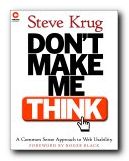
Don't Make Me ThinkHe’s particularly good at analysing the finer points of positioning instructions on the page, the careful use of navigation devices, and the reduction of all text and choices to an unambiguous minimum. That’s the point of his title. We want to get through web sites with the least possible thought and struggle. He has a light, friendly style, and almost every point he makes is elegantly illustrated by examples from well known web sites which you can check. He offers a detailed study of tabs for navigation, then a few sample pages as tests to see if his theories work – which they do.

There’s also a lot of good advice on the design of home pages – using and organising the screen real estate as efficiently as possible and maximising the information conveyed by visual messages. His arguments are illustrated with analyses and makeovers of well known sites.

He’s very strong on usability testing, and offers good reasons why it should be done as early in the design process as possible. He also shows how it can be done very simply, and even argues that a small group of three or four testers is enough.

This is a pricey but very elegant publication from New Riders – who have set new standards in book production values. It’s amongst their web design best sellers – and quite rightly so.

© Roy Johnson 2000

Buy the book at Amazon UK

Buy the book at Amazon US


Steve Krug, Don’t Make Me Think: A Common Sense Approach to Web Usability, Indianapolis (IN): New Riders, 2000, pp.195, ISBN 0789723107


More on web design
More on digital media
More on technology


Filed Under: Web design Tagged With: Don't Make Me Think, Navigation, Usability, Web design

Dora Carrington biography

September 17, 2009 by Roy Johnson

painter, designer, bohemian, bisexual

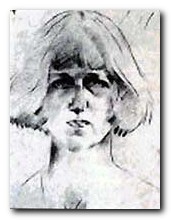
Dora Carrington - portraitDora Carrington (1893-1932) was an artist and bohemian who loved and was loved by both men and women. She was born Dora de Houghton Carrington in Hereford, the daughter of a Liverpool merchant. As a somewhat wilful youngster, she found her family background quite stifling, adoring her father and loathing her mother. She attended Bedford High School, which emphasized sports, music, and drawing. The teachers encouraged her drawing and her parents paid for her to attend extra art classes in the afternoons. In 1910 she won a scholarship to the Slade School of Art in London and studied there with Henry Tonks.
The Slade at that time was a centre of what we would now call radical chic. She embraced the bohemian opportunity it offered – going to live in Gordon Square in Bloomsbury, and immediately becoming entangled in romantic liaisons with fellow painters Paul and John Nash, Christopher (‘Chips’) Nevinson, and Mark Gertler, who had a very strong influence on this first phase of her life as an artist.

She also teamed up with fellow artists Dorothy Brett and Barbara Bagenal, and they started a new fashion at the school by cutting their hair into the shape of pudding-basins and wearing plain, deeply unfashionable clothes. They were called the ‘crop heads’. She did well at the Slade, winning several prizes and moving quickly through the courses. Despite her bohemianism however, her style of painting and drawing was firmly traditional, and it fitted with the aesthetic of the Slade at that time.

She was unaffected by the craze for Post-Impressionism which followed Roger Fry‘s famous 1910 exhibition at the Grafton Galleries which Virginia Woolf claimed changed human nature that year. Her personal life was dominated by the tempestuous relationship she conducted with Gertler and Nevinson which resulted in a form of unhappiness for all concerned. Although she behaved in a provocative manner, she refused to choose between them, or to have a sexual relationship with either of them.

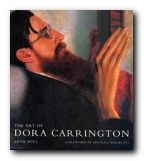
The Art of Dora CarringtonGertler introduced her to the society hostess Lady Ottoline Morrell, and thus into the Bloomsbury Group. In 1914 she met D.H. Lawrence and David Garnett, then joined Roger Fry’s new artists’ co-operative, the Omega Workshops, where was moderately successful in her decorative art work. It was while visiting Morrell at Garsington Manor in 1915 that Carrington made a connection that was to change the rest of her life.

She was introduced to the writer Lytton Strachey (who was in love with Mark Gertler at the time). Gertler felt that since Strachey was a confirmed homosexual, he could safely encourage their friendship. When Strachey made a sexual pass at her, she retaliated by going to his room at night with the intention of cutting off his long red beard. He awoke on her approach, and she immediately fell in love with him. It was a love that would last for the rest of her life and would even cause her to follow him from life into death.

Possessed of a remarkable personal fascination, she seemed to cast a spell on those around her. She figures in a number of novels, among them D.H. Lawrence‘s Women in Love (as Minette Darrington); Wyndham Lewis’ The Apes of God (as Betty Blythe); Rosamund Lehmann’s The Weather in the Streets (as Anna Corey); and Aldous Huxley’s Chrome Yellow (as Mary Bracegirdle). However, Carrington’s behaviour was viewed rather critically by another regular visitor to Garsington – D.H.Lawrence:

“She was always hating men, hating all active maleness in a man. She wanted passive maleness.”

She was not well known as a painter during her lifetime as she painted only for her own pleasure, did not sign her works, and rarely exhibited them. She painted and made woodcuts for the Hogarth Press, which was founded by Leonard Woolf as a therapeutic exercise for his wife Virginia.

The Life of Dora CarringtonAlthough she had kept Gertler at bay for five years, she gave herself to Strachey from the outset – then ended up having a sexual relationship with both men at the same time, even though Strachey was really a homosexual. But in 1917 Carrington ended her relationship with Gertler, and went to live with Strachey in a rented mill house.

Carrington’s father died in 1918 leaving her a small inheritance that allowed her to feel more independent. The following year she met Ralph Partridge, an Oxford friend of her younger brother Noel, who assisted Leonard Woolf at the Hogarth Press. Both Carrington and Lytton Strachey fell in love with Partridge, who accepted that she would not give up her platonic relationship or living arrangements with Strachey. She married Partridge in 1921, and Strachey with characteristic generosity paid for their wedding. All three of them went on the honeymoon to Venice. Strachey wrily observed:

“everything is at sixes and sevens – ladies in love with buggers and buggers in love with womanisers, and the price of coal going up too. Where will it all end?”

However, this somewhat unusual domestic arrangement seemed to work for all three parties. Carrington divided her time between looking after Strachey and her own art work. She painted on almost any medium she could find including glass, tiles, pub signs, and the walls of friends’ homes. Meanwhile, she had an affair with Gerald Brenan, who was an old army friend of Ralph Partridge.

Brenan had moved to southern Spain, where the three of them visited him (a visit he describes in South from Granada). Following this she developed a lengthy correspondence with him. The affair lasted for years, and it was painful for both of them – particularly Brenan. In 1923 she met Henrietta Bingham, the daughter of the American Ambassador to the Court of St. James. Carrington actively pursued Henrietta and they subsequently became lovers. The relationship was also another ménage à trois, since Henrietta had previously been Strachey’s lover.

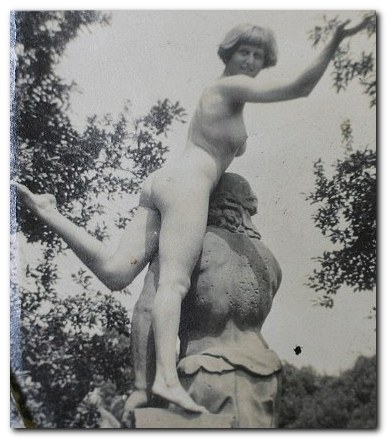
Dora Carrington biography

Yes – that’s Dora Carrington

The following year Strachey purchased the lease to Ham Spray House near Hungerford in Wiltshire. Carrington, Strachey, and Partridge lived there from 1924 until 1932. Her role there was to take care of the domestic chores, care for Strachey, and decorate the house. Her decision is ironic given her early rebellion against traditional roles for women in her day.

The decision might have also robbed her of time for her own art, though by her own account she was only happy when domestically settled. During 1925, Carrington met Julia Strachey, Lytton’s niece and a novelist who had once been a Parisian model and an art student at the Slade. Julia frequently visited Ham Spray, and though she was married to Stephen Tomlin, she briefly became another of Carrington’s lovers.

In 1926 Ralph Partridge started an affair with Frances Marshall, and went to live with her in London. This more or less (but not formally) ended his marriage to Carrington, although he continued to visit her most weekends.

In 1928 Carrington met Bernard (‘Beakus’) Penrose, a friend of Partridge’s and the younger brother of the artist Roland Penrose. She experienced renewed creativity while she had an affair with him, and collaborated with him on the making of three films. However, he wanted Carrington to make an exclusive commitment to him, a demand she refused because she could not end her relationship with Strachey. The affair, her last one with a man, ended badly when Carrington became pregnant and chose to have an abortion.

In November 1931 Strachey became violently ill and in late December he took a turn for the worse. Doctors were unable to correctly diagnose the problem, and in fact he had stomach cancer. Carrington attempted suicide by shutting herself in the garage with the car running, but Partridge rescued her and she recovered enough to spend the last few days of Strachey’s life taking her turn nursing him.

He died in January after seventeen years of living with her. She became depressed, borrowed a gun from a neighbour, and shot herself. She was found before she died and Ralph Partridge, Frances Marshall, and David Garnett arrived at Ham Spray House in time to say good-bye. She was just short of her thirty-ninth birthday.


Bloomsbury Group – web links

Bloomsbury Group - web links Hogarth Press first editions
Annotated gallery of original first edition book jacket covers from the Hogarth Press, featuring designs by Vanessa Bell, Roger Fry, and others.

Bloomsbury Group - web links The Omega Workshops
A brief history of Roger Fry’s experimental Omega Workshops, which had a lasting influence on interior design in post First World War Britain.

Bloomsbury Group - web links The Bloomsbury Group and War
An essay on the largely pacifist and internationalist stance taken by Bloomsbury Group members towards the First World War.

Bloomsbury Group web links Tate Gallery Archive Journeys: Bloomsbury
Mini web site featuring photos, paintings, a timeline, sub-sections on the Omega Workshops, Roger Fry, and Duncan Grant, and biographical notes.

Bloomsbury Group - web links Bloomsbury: Books, Art and Design
Exhibition of paintings, designs, and ceramics at Toronto University featuring Hogarth Press, Vanessa Bell, Dora Carrington, Quentin Bell, and Stephen Tomlin.

Bloomsbury Group - web links Blogging Woolf
A rich enthusiast site featuring news of events, exhibitions, new book reviews, relevant links, study resources, and anything related to Bloomsbury and Virginia Woolf

Bloomsbury Group - web links Hyper-Concordance to Virginia Woolf
Search the texts of all Woolf’s major works, and track down phrases, quotes, and even individual words in their original context.

Bloomsbury Group - web links A Mrs Dalloway Walk in London
An annotated description of Clarissa Dalloway’s walk from Westminster to Regent’s Park, with historical updates and a bibliography.

Bloomsbury Group - web links Women’s History Walk in Bloomsbury
Annotated tour of literary and political homes in Bloomsbury, including Gordon Square, University College, Bedford Square, Doughty Street, and Tavistock Square.

Bloomsbury Group - web links Virginia Woolf Society of Great Britain
News of events, regular bulletins, study materials, publications, and related links. Largely the work of Virginia Woolf specialist Stuart N. Clarke.

Bloomsbury Group - web links BBC Audio Essay – A Eulogy to Words
A charming sound recording of a BBC radio talk broadcast in 1937 – accompanied by a slideshow of photographs of Virginia Woolf.

Bloomsbury Group - web links A Family Photograph Albumn
Leslie Stephens’ collection of family photographs which became known as the Mausoleum Book, collected at Smith College – Massachusetts.

Bloomsbury Group - web links Bloomsbury at Duke University
A collection of book jacket covers, Fry’s Twelve Woodcuts, Strachey’s ‘Elizabeth and Essex’.

© Roy Johnson 2000-2014


More on art
More on design
More on biography
More on the Bloomsbury Group
Twentieth century literature


Filed Under: Art, Biography, Bloomsbury Group Tagged With: Art, Biography, Bloomsbury Group, Cultural history, Dora Carrington

Drafts of essays

August 22, 2009 by Roy Johnson

sample from HTML program and PDF book

1. Don’t imagine that you should be able to produce a fluent and successful essay at your first attempt. Even professional writers don’t work like that. You should think of writing as a process in which the first stages are sketches or rough drafts. These will help you to produce something more polished and fluent at a later stage.

2. The advantages of working in this way are enormous. You can disregard the fine details and concentrate on generating your arguments. The writing does not need to be grammatically correct. You can come back later to make corrections.

3. There is no need to worry too much about the structure of what you produce. If new ideas come to mind, you can write them down. Anything can be changed later, when you do more work on the essay.

4. This writing strategy assumes that you are prepared to do this extra work. You should try to avoid thinking of the first draft as the finished essay, no matter how much effort you have put into its production. Regard it instead as the raw material from which a more considered and well-crafted second draft will be produced. You should be prepared for extensive re-writing.

5. A word-processor is an ideal writing tool for working with drafts. You can choose to keep polishing and refining the same basic document, saving it to incorporate each set of changes. Alternatively, you can create and save separate drafts. These may then be compared and mixed until you have produced something to your satisfaction.

© Roy Johnson 2003

Buy Writing Essays — eBook in PDF format
Buy Writing Essays 3.0 — eBook in HTML format


More on writing essays
More on How-To
More on writing skills


Filed Under: Writing Essays Tagged With: Academic writing, Drafts, Essays, Study skills, Term papers, Writing skills

Dreamweaver The Missing Manual

July 8, 2009 by Roy Johnson

complete manual and guide to popular web editor

The ‘Missing Manual’ series is the brainchild of best-selling author David Pogue. These guides provide printed instructions for software normally issued without them. Dreamweaver seems to be the web design tool of choice for both serious amateurs and professionals. It offers lots of powerful tools which allow you to control everything from the details of page design to larger issues of style sheets, JavaScript interactivity, and Web management. Dreamweaver is to web pages as a word processor is to normal documents. That is, it has multiple commands which format the page in any way you wish. And the good thing is, you don’t have to learn any of the underlying code.

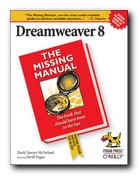
Dreamweaver 8 The Missing Manual You can preview the results in multiple browsers – whichever you have installed. This manual covers all the conventional topics of web design – tables, frames, links, text formatting, and layout – but without once discussing the hieroglyphics of coding which must deter so many people wishing to design their own pages. It also deals with the more advanced features of web design, using style sheets, forms, layers, and multimedia such as Flash and Shockwave.

I think this is what has made Dreamweaver so popular – it caters for the amateur who doesn’t need to learn code; the semi-pro who needs power tools on a reasonable budget; and even the pro who wants site maintenance and management. It handles all these levels of task with ease.

Dreamweaver has lots of terrific features – such as a tool which will convert tags from upper to lower case – that is from from <B> to <b>. Why is this important? Because XML – to which we’re all heading – requires lower case tags. This makes it a powerful conversion tool, amongst other things.

There’s even a feature for re-organising existing sites which will automatically update all your links and folders. In addition, you can run a site past the program and it will show you any orphaned pages and broken links. These are excellent features for both amateur and professional users.

David McFarland’s explanations are painstaking and thorough, and these Missing Manuals are produced at O’Reilly Associates – which guarantees high quality production values.

© Roy Johnson 2006

Buy the book at Amazon UK

Buy the book at Amazon US


David McFarland, Dreamweaver: The Missing Manual, Sebastopol (CA): Pogue Press/O’Reilly, 2006, pp.960, ISBN: 0596100566


More on web design
More on digital media
More on technology


Filed Under: Web design Tagged With: Dreamweaver, HTML, HTML-XML-CSS, Web design

  • « Previous Page
  • 1
  • …
  • 25
  • 26
  • 27
  • 28
  • 29
  • …
  • 103
  • Next Page »

Get in touch

info@mantex.co.uk

Content © Mantex 2016
  • About Us
  • Advertising
  • Clients
  • Contact
  • FAQ
  • Links
  • Services
  • Reviews
  • Sitemap
  • T & C’s
  • Testimonials
  • Privacy

Copyright © 2026 · Mantex

Copyright © 2026 · News Pro Theme on Genesis Framework · WordPress · Log in