Mantex

Tutorials, Study Guides & More

  • HOME
  • REVIEWS
  • TUTORIALS
  • HOW-TO
  • CONTACT
>> Home / Archives for 2009

Archives for 2009

the eBay survival guide

May 22, 2009 by Roy Johnson

how to make money on eBay – and avoid losing your shirt

I rarely talk about computers when socialising – otherwise you easily get branded an IT bore. But I was at a dinner party recently with neighbours where it suddenly turned out that half the table were trading on eBay! There are amazing bargains to be had. It turned out that we were eating off antique plates the hostess had bagged to match up with family heirlooms. But for tender mortals like you and me, there needs to be some hand-holding through the jungle of bids, deadlines, and prospective bidding. That’s where guidance manuals such as eBay the smart way, eBay Hacks and the eBay survival guide come in.

the eBay survival guideMichael Banks is an experienced trader with twenty years of eCommerce experience, and he talks you through the basics in a friendly and encouraging manner. First he gives a clear account of the huge variety of services, downloads, and support materials at the eBay site, then explains how the auctions (and the sales) actually work . There are lots of different ways of trading, and he covers them all.

Then he shows you how to find things using eBay’s powerful search engine. This includes neat tricks such as including plurals and deliberate mis-spellings in your search terms.

He deals with the central issue of ‘How much is it worth?’ – which is a much easier question to ask than to answer. His advice is that you need to cross-check with other auctions of the same object; look into price guides; and track what other people are searching for and buying.

Selling items is a more complex business than buying – not because of eBay, but because more of your own time is tied up in handling and posting stock to customers. There are also lots of different ways to set a selling price: you can have a minimum, a reserve, and a buy-it-now price.

He shows you how to describe, display, and illustrate the goods you want to sell. This might sound fairly simple – but you’ve got to remember that you need to stand out from thousands of other sellers, and you’ve got to be completely accurate, otherwise you might get negative feedback.

eBay has a fairly detailed system of resolving complaints and offering protection for both buyers and sellers. If you’re worried about getting into difficulties, he explains quite clearly how to solve problems.

As a buyer, if you really have your heart set on securing a bargain, you might need to get into the skills of bidding at the last possible minute – or ‘sniping’ as it is known in the trade. Once again, he shows you how to do it, and even how to outwit other people who may be doing the same thing.

He finishes by showing you how to recognise scams and misleading descriptions of products for sale. Thanks to eBay’s gigantic database of information on its buyers, sellers, and the history of all their transactions, it’s possible to locate all the information you need to protect yourself.

It’s quite true that some people make a full time living just buying and selling on eBay. If you fancy putting your toes into the waters of eCommerce, this would be an excellent place to start.

© Roy Johnson 2005

the eBay survival guide   Buy the book at Amazon UK

the eBay survival guide   Buy the book at Amazon US


Michael Banks, the eBay survival guide, San Francisco: No Starch Press, 2005. ISBN: 1593270631


More on eCommerce
More on media
More on publishing
More on technology

Filed Under: e-Commerce Tagged With: Business, e-Commerce, eBay, Technology, the eBay survival guide

The Economist Style Guide

June 16, 2009 by Roy Johnson

best-selling guide to English usage and style rules

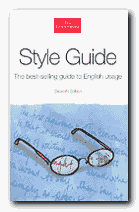
The Economist prides itself on good quality writing. The Economist Style Guide is the print version of their in-house guide on grammar and English usage which they issue to all their journalists. It’s designed to promote precision and clarity in writing – and the advice it offers is expressed in a witty and succinct manner. It gives general advice on writing skills, points out common errors and cliches, offers guidance on consistent use of punctuation, abbreviations and capital letters, and contains an exhaustive range of reference material.

The Economist Style GuideIt also includes a special section on American and British English, a fifty-four page fact checker, and a glossary. I particularly like the section called ‘Common Solecisms’ which warns against popular misunderstandings and points to words often used incorrectly.

Anticipate does not mean expect. Jack and Jill expected to marry; if they anticipated marriage, only Jill might find herself expectant.

The emphasis of the illustrative examples is on current affairs, politics, economics, and business – but the lessons in clear expression and the examples of tangled syntax and garbled journalese will be instructive to all writers who wish to sharpen their style.

It takes quite a tilt at the language of political correctness – and I think some of the following advice might be challenged. But it is so refreshingly un-stuffy, one reads on with a smile in the mind.

Avoid, where possible, euphemisms and circumlocutions promoted by interest-groups. In most contexts the hearing-impaired are simply deaf. It is no disrespect to the disabled sometimes to describe them as crippled. Female teenagers are girls, not women. The underprivileged may be disadvantaged, but are more likely just poor.

The guidance is arranged in logical, separate sections – political terms, metaphors, apostrophes, spelling, Americanisms – so you can easily find what you need. The bulk of the advice deals with common problems of English such as the difference between ‘compare with‘ and ‘compare to‘, but I was glad to see that rather like Keith Waterhouse (Waterhouse on Newspaper Style they do not leave the excesses of their own profession unexamined.

Avoid expressions used only by journalists, such as giving people the thumbs up, the thumbs down or the green light. Stay clear of gravy trains and salami tactics.

© Roy Johnson 2010

The Economist Style Guide   Buy the book at Amazon UK

The Economist Style Guide   Buy the book at Amazon US


The Economist Style Guide, London: Economist Books, 10th edition 2010, pp.272, ISBN: 1846681758


More on journalism
More on creative writing
More on writing skills
More on publishing


Filed Under: Journalism, Language use, Writing Skills Tagged With: Journalism, Style guides, The Economist Style Guide, Writing skills

The Edwardians

July 22, 2009 by Roy Johnson

Vita Sackville-West’s best-selling novel

The Edwardians first appeared in 1930, and was a deliberate attempt on Vita Sackville-West’s part to write a best-seller. The amazing thing is that like so many of the other things she did in her rich and unusual life, she succeeded. It sold 20,000 copies in its first two months, outstripping the success of her friend, lover, and fellow author Virginia Woolf. It’s a story of the aristocratic milieu from which she herself sprang, and is a rich blend of sentimental nostalgia for a world which had almost disappeared by the time she came to write it, and a critical analysis of some of the reasons why that disappearance occurred.

The Edwardians The principal characters are from a single grand family: Lucy a widowed baroness, Sebastian her young Duke-to-be son, his sister Viola, and the glamorous Lady Roehampton who becomes his mistress. But the main character is the Elizabethan house where they live – served by its small army of servants. What makes her account of the period artistically successful is that she divides the tensions in her own opinions between the various characters. All the positive portrayal of the Edwardian haute monde is given full force, but it is offset by the sceptical views of outsiders such as the explorer Leonard Anquetil who sees through the shallowness and pointlessness of the characters’ lives.

The writing is elegant, well-paced, witty, and vocabulary-rich without being intimidating – all qualities which West’s original publisher Leonard Woolf correctly predicted would make the book a best-seller. She’s rather a playful narrator, speaking to the reader, or pretending that there are things which must be left unsaid, out of deference to propriety:

“It makes one’s blood run cold, doesn’t it, to think of the hands one’s letters might fall into? I suppose it’s a letter to …” and here she uttered a name so august that in deference to the respect and loyalty of the printer it must remain unrevealed.

West keeps the narrative very firmly in her own hands as an omniscient narrator. And at times she is given to brief apercus which are like a watered-down version of Proust. The explorer Anquetil reflects on his brief invitation to a weekend party at the Great House:

For his own part, he felt convinced that he would never see Chevron again; the incident would be isolated in his life; he was too active for England ever to hold him long, and already he had other plans in preparation, but the short incursion into this strangely segregated world had surprisingly enriched him, as one is enriched by any experience one had believed to be entirely outside the scope of one’s sympathies, and which unexpectedly acquires a life of its own in a new reach of one’s comprehension.

The only plot as such is the succession of affairs embarked on by Duke-to-be Sebastian as he vainly attempts to break free from the weight of tradition in which the House, the Estate, and family expectations gradually engulf him. A much larger issue is the conduct of the entire class itself, and how it tries to preserve itself through property, marriage, and inheritance. This is satirically presented, and is counterbalanced by a surprisingly sympathetic view of the new and rising forces of the Edwardian era which, together with the imminent debacle of 1914-18 would virtually wipe it off the map altogether.

The novel offers a wonderfully rich lesson in the social history of a bygone world: not only the fine details of social ranking below and above stairs, but such arcana as the distinctions between a carriage, a victoria, and a brougham as modes of transport, plus the social niceties of giving offence whilst appearing to be polite by proffering two or three fingers instead of the full five when shaking hands.

Vita Sackville-West was herself an aristocratic snob of the highest order, but this novel is proof positive that gifted authors can rise above the limitations of their own opinions to create a picture of the world which is rich, complex, and even capable of expressing values which they themselves do not hold. Highly recommended.

© Roy Johnson 2004

artie shaw Buy the book at Amazon UK

artie shaw Buy the book at Amazon US


Vita Sackville-West, The Edwardians, London: Virago, 2003, pp.349, ISBN 0860683591


More on Vita Sackville-West
More on the novella
More on literary studies
More on short stories


Filed Under: Vita Sackville-West Tagged With: Bloomsbury Group, Literary studies, Modern fiction, The Edwardians, Vita Sackville-West

The Elements of Style

July 19, 2009 by Roy Johnson

best-selling short guide to good writing style

This style guide is a well-loved American classic. It was originally written during the first world war by William Strunk who was then a professor at Cornell, and it has since been updated to its third edition by E.B.White, one of his former pupils. You might wonder why it’s still in print and just as popular as ever. The answer is obvious to anyone who has ever opened a book on grammar in search of solutions to common writing problems.

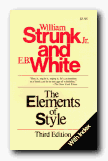
The Elements of StyleStrunk’s clever strategy was to edit down the complexities of English grammar into just those few basic elements which would help people to improve their writing skills. His central rule is to keep everything as simple as possible – or “Omit needless words”. For instance, he kicks off immediately with the apostrophe, the comma, and other points of punctuation which create the most common problems.

Only when he has cleared these out of the way does he get down to what he calls the ‘Elementary Principles of Composition’. One of these first principles is something which I write on three of every four student essays: “Make the paragraph the unit of composition” and “Begin each paragraph with a sentence that supports the topic”. This is the foundation on which he builds his main suggestions for clear writing, which are focused on always creating the direct, the specific, and the concrete statement, rather than striving for special effects.

His approach sometimes seems a little old-fashioned when it includes grammatical terms such as ‘nonrestrictive clauses’ which we don’t really need to know. But every point of advice is well illustrated by examples of good and bad practice, so the reader is left in no doubt in recognising the problem and how to correct it.

He skips lightly over quotation and references, saving most of his energy for an extended chapter on words which are commonly confused or misused – such as Among/Between and That/Which.

The final chapter added by E.B.White is a list of twenty-one guidelines for clear and good writing from which anyone could profit. The suggestions range from keeping the audience in mind, avoiding pretension and too many qualifiers, to hints on the choice of effective vocabulary.

I saw this book recommended in a web site design manual published only a few weeks ago, and it’s certainly true that anyone who needs a brief and clear introduction to the principles of effective writing should get a copy. In fact Strunk’s insistence on the pursuit of brevity is particularly appropriate for the digital era. It’s also amazingly good value.

© Roy Johnson 2002

the elements of style Buy the book at Amazon UK

the elements of style Buy the book at Amazon US


William Strunk Jr and E.B. White, The Elements of Style (4th edition) London: Longman, 1999, pp.105, ISBN 020530902X


More on writing skills
More on language
More on grammar


Filed Under: Writing Skills Tagged With: Style guides, The Elements of Style, Writing skills, Writing style

The Elements of Typographic Style

May 31, 2009 by Roy Johnson

Best-selling classic manual – the typographist’s Bible

Subscribers to Internet lists dealing with fonts and typography often ask “Which books would you recommend as a guide to good design principles?”. And no matter how many responses emerge, one book comes out on top every time – Robert Bringhurst’s The Elements of Typographic Style. It’s a book packed with design wisdom. Bringhurst has produced what is essentially a first principles of typography – a grammar of good taste based on the relationship between form and content of printed matter.

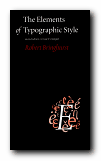
The Elements of Typographic StyleIt’s also a very beautiful book in its own right. You will not fail to discover visual pleasures on almost every page, and the text is illustrated with such an astonishing variety of beautiful fonts, that this almost doubles as a catalogue of type designs. It is obvious from almost every word that he’s thought profoundly about the fundamental issues of printed words on the page, and he often has insights to offer on topics most of us take for granted. He can conjour poetry out of the smallest detail, and he offers a scholarly yet succinct etymology of almost every mark that can be made – from the humble hyphen to the nuances of serifs on Trajan Roman or a Carolingian Majuscule.

The well-made page is now what it was then: a window into history, language and the mind: a map of what is being said and a portrait of the voice that is silently speaking.

As you would expect, he traces the development of type from its origins in eleventh century China to the present, and he deals with such extremely subtle distinctions as the differences in quality of letter forms produced by pressing hot metal onto paper, by offset litho (laying the letter on top of the paper) or by the digital means of charged electrons on the screen. he doesn’t actually have much to say about computers and typography, and yet his brief comments summarise almost everything there is to say about digital type:

Good text faces for the screen are therefore as a rule faces with low contrast, a large torso, open counters, sturdy terminals, and slab serifs or no serifs at all. [And he might have added – ‘a large x-height’.]

He does seem to become a little fanciful when discussing the mathematics of page proportions, especially when maintaining an extended comparison with the musical scale, and he misses the chance to give historical examples of page design, rather than the mathematical tables which populate this part of the book. But it seems almost churlish to complain when everything is so beautifully presented.

He ends with two very useful chapters – one of which analyses commonly available fonts (“prowling the specimen books” as he calls it). Paragraph-length potted histories are followed by suggestions on how the font is best used. This is typical of the manner in which he very elegantly combines scholarship and a cultivated taste with the requirements of a practical guidance manual.

Bringhurst is also a novelist, and he brings a prose style of some distinction to the subject, ornamenting his text with the lyrical jargon of typography, and quite obviously relishing terms such at the pilcrow, the octothorpe, the virgule, guillemets and chevrons, and the solidus; as well as the romance of small caps, analphabetic symbols, the shape of pages, the order of footnote symbols, the ‘looser dressing’ and the ‘larger torso’ of a font.

The book ends with a fascinating tour of sorts and characters, revealing the subtle functions of the cedilla and the ogonek; the umlaut and the diaeresis; the ligatures aesc, and oethel; the prime, the macron, and the vinculum. He completes this tour de force with several more appendices: a glossary of typographic terms; a listing of type designers; another of typefoundries; a recapitulation of the main recommendations in the text; and a list of further reading.

This is a wonderful book which fully deserves its widespread reputation as a classic and the ultimate guide for laying out pages in print of on screen. Anyone who wishes to gain insights into the aesthetics and the finer details of good design should read this book. Anyone with a serious typographic intent should own it.

© Roy Johnson 2000

The Elements of Typographic Style   Buy the book at Amazon UK

The Elements of Typographic Style   Buy the book at Amazon US


Robert Bringhurst, The Elements of Typographic Style (2nd edn), Toronto: Hartley & Marks, 1996, pp.351, ISBN: 0881791326


More on typography
More on design
More on media
More on web design


Filed Under: Graphic design, Typography Tagged With: Fonts, Graphic design, Information design, Printing, Typographic style, Typography

The Elements of User Experience

June 19, 2009 by Roy Johnson

concise guide to navigational and usability theory

Usability has so far been dominated by the work of Jakob Nielsen – but now there are new voices emerging. John Lenker recently set out his ideas on what he calls ‘flowpaths’, and now here comes Jesse James Garrett with The Elements of User Experience, which is his pitch on the essence of navigational clarity in web design. First he argues the case for user-centred design. All sites must be organised to make it easy for visitors to find what they want. He has had a diagram on his web site for some time now illustrating the point.

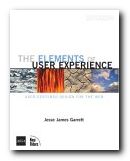
The Elements of User Experience This book is an amplification of that basic concept. It’s an idea that the user experience is enacted at five levels. These correspond to the way in which a site is constructed: Surface – Skeletal – Structure – Scope – Strategy. They represent each part of our engagement in a web site – from the buttons we press, the way they are arranged, the design of pages, the links between them, and how all aspects of a site are co-ordinated to deliver its essential purpose. He is wise enough to realise that everything does not easily fit into such convenient categories, but he then explores each level in depth.

First comes the strategy document – a concise statement of the project’s objectives. He’s very keen on clarifying aims, drawing up specifications, and making content inventories. The idea of all this is to prevent ‘mission creep’.

Interestingly he doesn’t pad his argument out with lots of examples, but concentrates on explaining each level of his basic concepts in depth. He has an easy style, and he avoids jargon.

He’s very good on making subtle distinctions – between for instance information architecture and information design. And like many recent commentators, he argues the case for having multiple navigation systems. After all, why not give visitors to a site a variety of routes for getting from one place to another.

It’s at this point that the book becomes most interesting – when he looks at the details of information architecture and shows how they must be related to what appears on the page. There’s some excellent advice on using wireframes here for instance. These are the outline plans which show the underlying structure of a given page.

This is a clear and refreshingly concise account of planning, organising, and thinking through the design of a successful Web site. It’s a book which gives an overview of site-building concepts, and it will appeal to site designers as well as to project managers and usability consultants.

© Roy Johnson 2003

User Experience   Buy the book at Amazon UK

User Experience   Buy the book at Amazon US


Jesse James Garrett, The Elements of User Experience, Indianapolis (IN): New Riders, 2003, pp.189, ISBN: 0735712026


More on information design
More on design
More on media
More on web design


Filed Under: Information Design Tagged With: Information design, Navigation, Usability, Web design

The End of Print

June 8, 2009 by Roy Johnson

illustrated guide to  popular US avant-garde typographist

David Carson designs jarring and visually chaotic magazine spreads, posters, and print ads which have consistently challenged the boundaries of legibility and typography. His modest San Diego, California, studio has become the epicentre of a new graphic anti-aesthetic that has stirred ongoing debate among fellow designers such as Neville Brody, who observed that his work prophesies ‘the end of print’. This comment inspired the title of Carson’s new book, the first comprehensive collection of his decade-long output of graphic imagery.

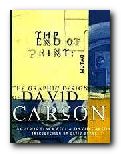
The End of PrintIn past lives, Carson was a top-ranked competitive surfer and a high school sociology teacher. However, during a two-week workshop on graphic arts he discovered his calling. He landed his first major design assignment as art director of Transworld Skateboarding in 1983, and he later moved on to Surf magazine. In 1990, Carson headed the much-praised Beach Culture.

This is where his irreverent but often ingenious layouts consistently pitted editorial substance against graphic style. Carson’s creative vision came out on top – in its six-issue stint, Beach Culture won over 150 design awards. As the art director of Ray Gun, his unconventional look has been shamelessly emulated by a slew of similar start-up magazines.

Recently, Carson has shifted from spokesman for Left-Coast subculture to the corporate arena, taking on larger projects that include print ads for Nike and a television commercial for Citibank, as well as collaborations with musician David Byrne and photographer Albert Watson.

The End of Print was designed by Carson, and ironically, this proves to be the most disappointing aspect of the book. For those designers and readers who want to learn more about Carson’s graphic work and philosophy must do so on his terms. The text of the book is presented in the confusing and often incoherent typography typical of a Ray Gun layout. Those not willing to read the garbled introduction and inarticulate essays may surrender in frustration. However the book manages to stand on its own as a purely visual document, a fascinating chronicle of David Carson’s creative mind.

Like the collage artist Kurt Schwitters, who collected his materials from curbside rubbish, Carson finds much of his inspiration in the visual garbage of modern-day living. Handlettered signs, torn and layered poster kiosks and the eroded storefronts encountered in city streets serve as backdrops which Carson equates into the digital realm. Many of these found objects and photographs are reproduced in the book and they offer insight into Carson’s design approach.

One page reproduces a Carson ad selling a Beach Culture T-shirt sight unseen, with the premise that “if you like the look of the magazine, you probably would like the shirt.” Likewise, if you like the design of David Carson, you probably will like this book.

© Philip Krayna 2000

David Carson   Buy the book at Amazon UK

David Carson   Buy the book at Amazon US


Lewis Blackwell and David Carson, The End of Print: The Graphic Design Of David Carson, Chronicle Books, 1995, pp.160, ISBN: 0811830241


More on typography
More on design
More on media
More on web design


Filed Under: Individual designers, Typography Tagged With: David Carson, Graphic design, Media, The End of Print, Typography

The Essence of Computing Projects

June 14, 2009 by Roy Johnson

project writing skills for higher education

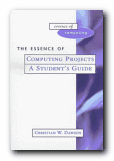
Projects are now a major part of most undergraduate and postgraduate courses – especially in sciences, business studies, and information technology. Students are required to draw on a number of different but important skills to complete their projects, and it’s not easy to know what’s involved. The Essence of Computing Projects is designed to explain what’s required. It covers surveying the literature, project writing skills, documenting software, time management, project management, and presentation skills.

Project writing skills The chapters follow the logical sequence of undertaking a project, starting from defining the nature of research itself, choosing a project and writing a proposal, then planning what you are going to write – including timing and scheduling.

When it comes to the process of searching and reviewing the literature, Christian Dawson makes sensible distinctions between what is required at undergraduate and postgraduate level. The chapter which deals with actually writing the project confronts some of the most common problems – and how to overcome them. Running out of time, dealing with interruptions and computer crashes; dealing with your supervisor; and working in teams.

The latter part of the book deals with the presentation of your report in written form. Here he stresses the importance of abstracts and structure, presenting data in graphs, pie charts, and bar charts, academic referencing, and two items of special interest – commenting on program code and writing user guides.

Finally he deals with the oral presentation skills required to present your project. It also looks forward to what follows in academic terms – publishing your work, funding, and intellectual ownership and copyright issues.

If you have a project as part of the next stage in your studies, this guide will give you an excellent account of what’s required. You will have to flesh out the details – but that’s exactly as it should be, isn’t it.

© Roy Johnson 2000

Computing Projects   Buy the book at Amazon UK

Computing Projects   Buy the book at Amazon US


Christian W. Dawson, The Essence of Computing Projects – A Student’s Guide, London: Prentice Hall, 2000, pp.176, ISBN: 013021972X


More on study skills
More on writing skills
More on online learning


Filed Under: Computers, Study skills, Writing Skills Tagged With: Computers, Computing projects, Project management, Technology

The Fight for English

June 14, 2009 by Roy Johnson

how language pundits ate, shot, and left

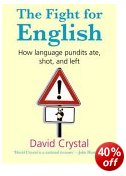
David Crystal is a prolific writer on the subject of English language and the way it is used. His output ranges from scholarly works of reference such as The Cambridge Encyclopedia of Language, to popular studies of modern usage such as his recent Words, Words, Words which tries to keep track of concepts of language. This latest book The Fight for English is his defence of descriptive grammar. In a sense it’s his riposte to the very popular work by Lynne Truss, Eats, Shoots, and Leaves which knocked Harry Potter off the best-seller lists two or three years ago.

Descriptive grammarShe was arguing for an adherence to traditional notions of grammar and correctness. Crystal is here saying that language changes all the time and that there is nothing you can do about it. What he offers is a historical tour through what has been written about the English language. This tour takes him from AElfric in 1000 AD to the present. Our language started with a cultural mix of Latin, English, and French (with English very much at the bottom of the prestige table) but all the time it was absorbing an enormous number of loan words. (This is why the lexicon in English is bigger than other languages – and why there are so many irregularities of spelling and grammar.)

The advent of printing began the process of standardisation – though it was hampered at first by lots of regional variations. Then early attempts at spelling reform were thwarted by lack of agreement between competing suggestions.

The first textbooks on grammar began to appear in the late sixteenth century and were followed by attempts to ‘regulate’ language via institutions such as the Royal Society. These too were unsuccessful – just as those of the Academie Francaise continue to be today.

Crystal has a high regard for Dr Johnson, compiler of the first really authoritative dictionary in English – but as he points out, even Johnson realised, after his monumental efforts to pin down the spelling and meaning of words, that language changes:

This is a lesson everyone who studies language eventually learns. You cannot stop language change. You may not like it; you may regret the arrival of new forms and the passing of old ones; but there is not the slightest thing you can do about it.

He makes what can be a complex issue easy to understand by breaking his argument down into separate short chapters – Standards, Grammar, Punctuation, Spelling – and so on. And he presents the whole development of English as a constant flux, with tensions between linguistic pedants and actual popular usage. It’s a process which he sees as self-correcting:

Languages seem to operate with an unconsciously held system of checks and balances. If a group of people go wildly off in one linguistic direction, using a crate of new words, eventually—if they want to continue as part of society and be understood by its other members—they will be pulled back, and they will drop some of their neologisms. At the same time, a few of the new words will have been picked upon by the rest of the community. And so a language grows.

He mounts a vigorous attack on prescriptive grammarians, then the same on the pronunciation police – demolishing all their pontifications with the same argument – that the ‘standards’ which they claim to be absolute are often either recent innovations, or are already out of date.

The latter part of the book is an assessment of the current state of English language teaching in schools, and an explanation of why he finds hope in the National Curriculum, which he helped to frame. This is a user-friendly book, written in a plain-speaking style, and his arguments are ultimately convincing. But he’s not as funny as Lynne Truss.

© Roy Johnson 2007

The Fight for English   Buy the book at Amazon UK

The Fight for English   Buy the book at Amazon US


David Crystal, The Fight for English, Oxford: Oxford University Press, 2007, pp.256, ISBN: 0199229694


Filed Under: Grammar, Language use Tagged With: Descriptive grammar, English language, Grammar, Language, The Fight for English

The Forest for the Trees

July 3, 2009 by Roy Johnson

advice to writers – from an experienced editor

All authors, editors and publishers should read this book. Even those who think they know all about writing and the publishing process will find fresh ideas and perceptive insights. Betsy Lerner has a wealth of experience, from her youthful beginnings at Simon & Schuster to becoming executive editor at Doubleday and now as a literary agent. She writes with style, empathy, wit, realism, and above all humanity. In The Forest for the Trees she identifies five ‘writer types’, all of them familiar.

The Forest for the TreesThe Ambivalent Writer is one who can’t commit to a one idea for a story from the many possibles and who does not realise that writing is 90 per cent sheer sticking power. The Natural Writer is the one for whom writing appears to come easily. Or is that the myth of not realising that hard writing makes easy reading? Lerner’s definition of the ‘natural’ is one who is always writing. She cites Thurber who never quite knew when he was or wasn’t at it, ‘Sometimes my wife comes up to me at a party and says, “Dammit, Thurber, stop writing.”‘ For ‘natural’, maybe one should read ‘persistent’.

The Wicked Child relies on ‘kiss-and-tell’: someone who exposes family relationships, friends, acquaintances (or even, like Philip Roth, a whole tribe) in a more or less disguised fashion. personal relationships. The Self-promoter will do anything for fame – there are many such writers today, but it is a shock to realise that Walt Whitman shamelessly trumpeted himself from the roof-tops and sucked up to celebrity writers of the day. Emily Dickinson on the other hand died with 2000 poems unpublished .

The Neurotic makes a great fuss about the process itself – writing has to be done with an HB pencil, or on lined paper of exactly the right width. Few of these quirks are as eccentric as Dame Edith Sitwell who needed to start the day’s work by lying in an open coffin, but every reader will recognise such stalling techniques.

The second half of the book deals with the publishing process – everything from finding an agent to the book jacket and sales conference. Authors should be aware of what editors are looking for and what they can realistically expect from a publishing house. It would seem that a wad of rejection letters followed eventually by a book without a launch party and no reviews is completely the norm. And if authors turn up to read their books in local bookshops only to find they haven’t got any copies to sell, that’s par for the course too.

Naturally every author is looking for validation, but ten per cent of all titles earn ninety per cent of all revenues. Publishers are clearly going to concentrate on those at the top of their lists. Yet the truth seems to be that even the publishers don’t know which books are going to be in that top ten per cent. If they did, they probably wouldn’t print any of the others at all.

Lerner concludes: ‘Most of the disappointment that writers experience in having a book published can be traced back to their initial expectations – what most writers don’t understand … is that landing a contract and being published do not guarantee the fulfillment of all their hopes and dreams.’

Why do we do it?

© Jane Dorner 2004

The Forest for the Trees   Buy the book at Amazon UK

The Forest for the Trees   Buy the book at Amazon US


Betsy Learner, The Forest for the Trees: An Editor’s Advice to Writers, New York: Riverhead Books/Penguin Putnam, revised and updated edition 2010, pp.304, ISBN: 159448483X


More on creative writing
More on writing skills
More on publishing


Filed Under: Creative Writing, Publishing, Writing Skills, Writing Skills Tagged With: Creative writing, Editing, Publishing, The Forest for the Trees, Writing skills

  • « Previous Page
  • 1
  • …
  • 77
  • 78
  • 79
  • 80
  • 81
  • …
  • 103
  • Next Page »

Get in touch

info@mantex.co.uk

Content © Mantex 2016
  • About Us
  • Advertising
  • Clients
  • Contact
  • FAQ
  • Links
  • Services
  • Reviews
  • Sitemap
  • T & C’s
  • Testimonials
  • Privacy

Copyright © 2026 · Mantex

Copyright © 2026 · News Pro Theme on Genesis Framework · WordPress · Log in