new media design principles, plus tips on inspiration
Hillman Curtis is one of the new generation of multi-media designers – with a background in writing and rock music rather than art college. This is his credo on the process of professional new media design – which is centred on listening carefully to what clients want, and helping them to articulate their ideas. It’s a glamorous production, with big margins, glossy paper, and double-spread photos.
 In the first part of the book he spells out his approach to designing and managing projects. He gets his stimulus from magazines, movies, and other people’s Web sites, collecting examples of good design for inspiration. One of the main purposes of this book is to communicate this personal enthusiasm – which he does very well.
You feel as if you’re only a couple of steps away from your own award-winning designs. The down side is, he doesn’t go into any technical detail on how to do it. In the central section of the book he gives examples of the people whose work has inspired him – graphic designers Saul Bass, Kyle Cooper and Joseph Müller-Brockman, painter Mark Rothko, plus film directors David Mamet and Sydney Lumet.
I’ll visit a gallery, buy or borrow a few CDs, see a couple of movies, and study my favourite movies on DVD. I’ll read art history, film theory … and of course I immerse myself constantly in design books and magazines.
It’s interesting to note how the possibilities of motion and the Web has led to these Flash designers thinking of themselves as directors of sixty second movies which must deliver a theme, plus a coherent and complete experience.
When it comes to the technical matters discussed in part three, he hands over the baton to other writers, so what we get is a series of essays from experts. These are on colour theory, design with grids, font construction, and Web page layout. These are quite useful primers, particularly if you want a quick introduction to HTML and XML. He also includes a chapter on usability from Steve Krug’s excellent Don’t Make Me Think, and a there’s a finale encouraging would-be movie makers to try their hands at digital video.
© Roy Johnson 2005

Hillman Curtis, MTIV: Process, Inspiration and Practice for the New Media Designer, Indianapolis (IN): New Riders, 2002, pp.240, ISBN: 0735711658
More on digital media
More on technology
More on theory
 Nadine Gordimer (1923—2014) was born into a privileged white middle-class family in the Transvaal, South Africa. She began reading at an early age, and published her first story in a magazine when she was only fifteen. Her wide reading informed her about the world on the other side of apartheid – the official South African policy of racial segregation – and that discovery in time developed into strong political opposition to apartheid. She attended the University of Witwatersrand for one year. Her first book was a collection of short stories, The Soft Voice of the Serpent (1952). In addition to writing, she lectured and taught at various schools in the United States during the 1960s and 1970s. She was awarded the Nobel prize for Literature in 1991.
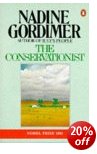 The Conservationist (1974) concerns a white industrialist who farms his land (with native help) at the weekend and genuinely wants to make his presence a positive contribution. But most of all he wants to preserve his power and his privileged way of life – despite being surrounded by poverty and suffering. He just doesn’t understand that the indigenous population are the natural owners of the land, and the result is disastrous – for him.
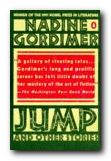 Jump Her development as a writer of short stories is wonderful. She starts off in modern post-Checkhovian mode presenting situations which have little drama but which invite the reader to contemplate states of being or moods which illustrate the ideologies of South Africa. Technically, Nadine Gordimer experiments heavily with point of view, narrative perspective, unexplained incidents, switches between internal monologue and third person narrative (rather like Virginia Woolf) and a heavy use of ‘as if’ prose where narrator-author boundaries become very blurred.
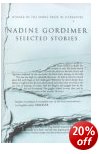 Selected Stories As her work matured, her style and methods underwent a similar development to those of Virginia Woolf. Some of her stories became more lyrical, more compacted and symbolic, abandoning any semblance of conventional story or plot in favour of a poetic meditation on a theme. There are some stories which make enormous demands upon the reader. Sometimes on first reading it’s even hard to know what is going on. But gradually a densely concentrated image or an idea will emerge – the equivalent of a Joycean ‘epiphany’ – and everything falls into place. Her own collection of Selected Stories are UK National Curriculum recommended reading.