Mantex

Tutorials, Study Guides & More

  • HOME
  • REVIEWS
  • TUTORIALS
  • HOW-TO
  • CONTACT
>> Home / Archives for 2009

Archives for 2009

The Usual Suspects and Other Cliches

July 1, 2009 by Roy Johnson

all the low down and the full monty on street-cred lingo

At first you might wonder why anybody would want to look into the origins of a cliché. But the more I read the examples in The Usual Suspects, the more they emphasise the tired, stale nature of expressions we often take for granted – or even worse, sometimes use without thinking first. This of course is based on the widely held belief that using cliché is a stylistically bad thing – though there are some people who actually defend them. (They can also be used ironically, but that isn’t taken up here.)
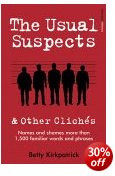
the usual suspectsThese issues are debated by Betty Kirkpatrick in the introductory essay to her collection which considers both the definition of cliché (when does an expression become a cliché for instance?) and the various categories of cliché. She debates intelligently with authorities such as Fowler and Eric Partridge and even considers how clichés blend easily into idioms, proverbs, catchphrases, vogue phrases, and allusions. Her entries run from the proverb cliché absence makes the heart grow fonder to You wish! and zero hour. She includes both traditional clichés, as in beat about the bush, and more recent usages such as spend more time with my family – which is what politicians and public figures say when they’ve been sacked – which neatly combines cliché with euphemism.

She also identifies what she calls ‘filler clichés’ such as at the end of the day, you know what I mean, and with all due respect. My own pet hates – used repeatedly, day after day by Sean Rafferty on BBC Radio 3 – are as it were and so to speak, both completely meaningless fillers which send me reaching for the off switch or tuning in to Jazz FM.

So a typical entry in this collection runs as follows:

push the envelope is an idiom cliché which is also a vogue cliché. It means to try to achieve more than seems possible, to take a risk, as A good coach is constantly driving the athlete to break new barriers, encouraging him to push the envelope. The cliché dates from the turn of the twentieth century, but the phrase may go back to early aviation test flights (1940s) where the ‘envelope’ refers to the line on a graph that represents the limit of an aircraft’s known capabilities.

It’s interesting to notice that in some clichés – such as flotsam and jetsam – the words in the phrase are almost never used separately from each other.

Most of the explanations listed are quite easy to understand – as in the case of to spend a penny. Even young people must know that this was once the standard charge for entering a public toilet. But maybe non-English readers will not. For this reason I suspect the book might be specially useful for people with English as a second or other language.

© Roy Johnson 2005

The Usual Suspects and Other Cliches   Buy the book at Amazon UK

The Usual Suspects and Other Cliches   Buy the book at Amazon US


Betty Kirkpatrick, The Usual Suspects and Other Clichés, London: A & C Black, 2005, pp.222, ISBN: 0713674962
Filed Under: Language use Tagged With: Cliche, Language, Language use, The Usual Suspects

The Visual Display of Information

July 20, 2009 by Roy Johnson

best-selling illustrated essays on presenting information

The Visual Display of Information is the earliest of the three books on information design which Edward Tufte has written, designed, and published himself. In it he develops his theory of “a language for discussing graphics and a practical theory of data graphics” The first chapter plots the rise of data maps, which he claims didn’t really develop properly until the late seventeenth century, and then took off in the nineteenth – from which he gives some very elegantly illustrated examples. The centrepiece of this section is Charles Joseph Minard’s time chart of Napoleon’s retreat from Moscow. This shows in a really interesting manner the devastating reduction in the size of the army plotted again geographic location and ambient temparature. It is a fascinating mixure of three levels of information rendered as a graphical image.

Graphical excellence is the well-designed presentation of interesting data – a matter of substance, of statistics, and of design.

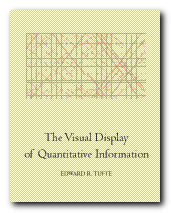
The Visual Display of InformationI was surprised to find how his writing is even more compacted and elliptical than in a book such as Visual Explanations written nearly twenty years later. Here he writes of a map “achieving statistical graphicacy, even approaching the bivariate scatterplot”. You’ve got to be prepared to hack your way through a lot of this sort of thing.

In a discussion of the integrity of graphical data and statistics that lie he gives examples from Britain’s national debt during the war of American Independence – which show graphs going up whilst the truth goes down. This is very convincing – though I couldn’t easily get used to his habit of referring to ‘data’ in the plural.

He has the interesting notion that ‘data-ink’ ought to be minimised. In other words, any information will stand out more clearly the less printing is done to present it.: “The number of information-carrying dimensions depicted should not exceed the number of dimensions in the data”. You’ve got to be prepared to leap from traffic deaths and government expenditure to the properties of chemical elements, and be prepared for lots of detail on the difference between boxplots, bar charts, histograms, and scatterplots.

He’s basically in favour of simplifying representation – reducing what he calls ‘chart-junk’. That is, anything which does not contribute to revealing information. Yet there remain strange contradictions. One of his edicts (which seems sensible) is that “Graphics can be shrunk way down – Many data graphics can be reduced in area to half their currently published size with virtually no loss in legibility and information.” Yet he often presents examples of bad (but visually attractive) graphics across double page spreads. And he’s not bashful. When it comes to naming one of his own designs (a list of voting patterns in the 1980 US elections) it becomes not a mere list but a ‘SUPERtable’.

But this is a stimulating and attractive production. I was surprised that there wasn’t a formal bibliography, but he chooses to foreground his references directly into the generous page margins as a design feature. He developed a graphic style for this book which he has stuck to ever since. The basic formula is beautiful illustrations, some occupying a whole page, with the relevant text condensed in a crisp and economic style. No topic exceeds a double page spread, and the book is produced from very high quality paper, printed like a work of art, and bound as if it were a rare first edition.

© Roy Johnson 2002

The Visual Display of Information   Buy the book at Amazon UK

The Visual Display of Information   Buy the book at Amazon US


Edward Tufte, The Visual Display of Quantitative Information, Cheshire, CT: Graphics Press, 1997, pp.156, ISBN: 0961392126


More on information design
More on technology
More on digital media


Filed Under: Graphic design, Information Design Tagged With: Displaying information, Edward Tufte, Graphic design, Information design, The Visual Display of Information

The Voyage a close reading

September 19, 2009 by Roy Johnson

how to analyse prose fiction

Close reading is the most important skill you need for any form of literary studies. It means paying especially close attention to what is printed on the page. It is a much more subtle and complex process than the term might suggest. Close reading means not only reading and understanding the meanings of the individual printed words; it also involves being sensitive to all the subtle uses of language in the hands of skilled writers.

This can mean anything from a work’s particular vocabulary, sentence construction, and imagery, to the themes that are being explored. It also includes the way in which the story is being told, and the view of the world that it offers. It involves almost everything from the smallest linguistic items to the largest issues of literary understanding and judgement.

One of the first things you need to acquire for serious literary study is a knowledge of the vocabulary, the technical language, indeed the jargon in which literature is discussed. You need to acquaint yourself with the technical vocabulary of the discipline and then go on to study how its parts work.

What follows is a short list of features you might keep in mind whilst reading. They should give you ideas of what to look for. It is just a prompt to help you get under way.

Close reading – Checklist

Vocabulary
The author’s choice of individual words – which might vary from plain and simple to complex and ‘literary’.

Syntax
The arrangement of words in sentences. Often used for emphasis or dramatic effect.

Figures of speech
The rhetorical devices used to give decoration and imaginative expression to literature, such as simile, metaphor, puns, alliteration, and irony.

Literary devices
The devices commonly used in literature to give added depth to the work, such as imagery or symbolism.

Rhythm
The cadence or flow of words and phrases – including stress and repetition.

Narrator
Ask yourself, who is telling the story.

Narrative mode
First or third person narrator. (‘I am going to tell you …’ or ‘He left the room in a hurry’)

Point of view
The perspective from which the events of the story are related.

Characterisation
How a character is created or depicted.

Dramatisation
How any dramatic elements of a piece of work are created and arranged.

Plot
How the elements of the story are arranged.

Tone
The author’s attitude to the subject as revealed in the manner of the writing

Structure
The shape of the piece of work, or the connection between its parts.

Theme
The underlying topic or issue, as distinct from the overt story.

How to read closely

Close reading can be seen as a form of special attention which we bring to a piece of writing. It involves thinking more deeply than usual about the implications of the words on the page. Most normal people do this automatically, without being specially conscious of the fact. The academic study of literature brings the process more to the surface and makes it explicit. There are four levels or types of reading which become progressively more complex.

Language – You pay especially close attention to the surface elements of the text – that is, to aspects of vocabulary, grammar, and syntax. You might also note such things as figures of speech or any other features which contribute to the writer’s individual style.

Meaning – You take account at a deeper level of what the words mean – that is, what information they contain, plus any further meanings they might suggest.

Structural – You note the possible relationships between words within the text – and this might include items from either the language or the meanings.

Cultural – You note the relationship of any elements of the text to things outside it. These might be other pieces of writing by the same author,
or other writings of the same type by different writers. They might be items of social or cultural history, or even other academic disciplines which might seem relevant, such as philosophy or psychology.

Close reading is not a skill which can be developed to a sophisticated extent overnight. It requires a lot of practice in the various linguistic and literary disciplines involved – and it requires that you do a lot of reading.

The good news is that most people already possess the basic skills required. They have acquired them automatically through being able to read – even though they haven’t been conscious of doing so. This is rather like many other things which we learn unconsciously. After all, you don’t need to know the names of your leg muscles in order to walk down the street.


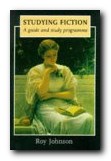
The Voyage a close readingStudying Fiction is an introduction to the basic concepts and the language you will need for studying prose fiction. It explains the elements of literary analysis one at a time, then shows you how to apply them. The guidance starts off with simple issues of language, then progresses to more complex literary criticism.The volume contains stories by Arthur Conan Doyle, Katherine Mansfield, Thomas Hardy, Joseph Conrad, D.H. Lawrence, and Charles Dickens. All of them are excellent tales in their own right. The guidance on this site was written by the same author.
Buy the book from Amazon UK
Buy the book from Amazon US


Now here’s an example of close reading in action. The short passage which follows comes from Katherine Mansfield’s short story The Voyage. This concerns the journey made by a young girl at night on a ferry with her grandma. If you wish to read the complete story in conjunction with these tutorial notes, it is available free at Project Gutenberg.

redbtn The Voyage

If you would like to treat this as an interactive exercise, read the passage through a number of times. Make notes, and write down all you can say about what goes to make up its literary ‘quality’. That is, you should scrutinise the passage as closely as possible, name its parts, and say what devices the author is using. Don’t be afraid to list even the most obvious points.

Don’t worry if you are not sure what name to give to any feature you notice. You will see the technical vocabulary being used in the discussion notes which follow, and this should help you pick up this skill as we go along.

Fenella’s father pushed on with quick, nervous strides. Beside him her grandma bustled along in her crackling black ulster; they went so fast she had now and again to give an undignified little skip to keep up with them. As well as her luggage strapped into a neat sausage, Fenella carried clasped to her grandma’s umbrella, and the handle, which was a swan’s head, kept giving her shoulder a sharp little peck as if it too wanted her to hurry. … Men, their caps pulled down, their collars turned up, swung by; a few women all muffled scurried along; and one tiny boy, only his little black arms and legs showing out of a white wooly shawl, was jerked along angrily between his father and mother; he looked like a baby fly that had fallen into the cream.

Here are some comments, using the checklist as a guide. The objective is not to be totally exhaustive, mulling over every single word and punctuation mark in the paragraph. Rather, it’s to develop the skill of being sensitive to language, and to notice special effects when they are offered.

It’s also true that a really in depth close reading is much easier if you know the author’s work well – so that you can see regular patterns of language use and recurrent effects and themes.

Vocabulary
The language of the passage is fairly plain and simple. Apart from the term ulster (an overcoat) which might not be familiar to readers today, most of the terms used would be known even to a reasonably well-educated child. And this is entirely appropriate since Mansfield is relating the story to us largely from a child’s point of view. Her use of terms such as ‘>little skip’, ‘ neat sausage’, ‘tiny boy’, and baby fly reinforce this effect.

Syntax
The word order and grammar is that of normal written English. The only feature I can observe here under this heading is that in some clauses she separates the subject from its verb by interposing dependent clauses – ‘Men, their caps pulled down, their collars turned up, swung by’. But this is just giving variety to her construction of sentences.

Rhythm
She creates a briskness and liveliness in her prose to match the business of what is going on in the scene. This is done by the variation of sentence length. The first is quite short, the second is longer, but it is split into two which have a similar construction to the first.

It’s also done by her use of a form of repetition called parallelism. Notice how ‘quick, nervous strides’ is echoed by ‘crackling black ulster’: the construction is ‘adjective + adjective + noun’.

Figures of Speech
Under figures of speech you might have noticed the simile – ‘like a baby fly that had fallen into the cream’. That is, the small baby boy is directly compared to a fly. Then there is an example of onomatopoeia in the phrase ‘crackling black Ulster‘ – because the words themselves sound like the thing they are describing.

There is also an example of anthropomorphism in the swan’s-head-handled umbrella giving Fenella a ‘sharp little peck’ on the shoulder. That is, the inanimate object is spoken of as if it were alive – and once again this is entirely appropriate given that the story is being told from the child’s point of view.

Mansfield also uses alliteration more than once. In ‘crackling black Ulster’ there is repetition of the ‘a’, ‘ck’, and ‘l’ sounds; and in ‘white wooly shawl’ there is repetition of the ‘w’ and the ‘l’ sounds.

Tone
This can be quite a difficult feature to pin down accurately, but I think in this passage you could say that there was a light, brisk and somewhat playful attitude to what is going on. That’s the safest way of defining tone – describing the author’s attitude to the subject as briefly as possible. The tone here is entirely appropriate – because we are being invited to see the world from a child’s point of view.

Narrative mode
This is the traditional manner of story-telling using the third person and omniscient narrator. That is, Fenella is referred to as ‘she’ and Katherine Mansfield, as the person telling the story, does not intrude as an ‘I’ speaking directly to the reader. Moreover, as narrator, she knows what is going on in her characters’ heads and their feelings. She is ‘all-knowing’, which is what ‘omniscient’ means.

Narrator
This must be Katherine Mansfield, because she does not invent another person who stands between herself and the reader, telling the story. This might seem rather obvious, but some authors invent a fictional narrator who tells the story, and might even be a character in it.

Characterisation
It’s not easy to say a lot, based on such a short extract. But you might observe that ‘grandma bustled along’, which gives the impression of a lively older woman. (This is confirmed by events later in the story). And the observations about the umbrella and the little boy, as well as the ‘little skip’ Fenella is forced to make, help to establish her as a young girl.

Notice that Mansfield as narrator does not tell us that Fenella is a young girl: we work this out from the few details we have been given. Notice too that this information about the characters is being given piecemeal as the story progresses. We are being left to put together these pieces ourselves.

Point of view
Many of these small details – the peck from the swan’s head umbrella, the little boy looking like a fly – help to establish that the story is being told from Fenella’s point of view. That is, the events of the story are being shown as she would experience and see them. This is quite an important feature of prose fiction.

Drama
It’s not easy to say much about this based on such a short extract – or if we were reading the story for the first time. But most of the tension in the story is created by the fact that we are not quite sure what is going on. But returning with more knowledge of the story, we might note that the father is ‘nervous’ because he is due to be separated from his mother and his daughter. The grandmother ‘bustles’ along because she has the task of conveying Fenella to her new life.

Meanwhile Fenella is busy observing the world around her. Notice a small (and dramatic) detail of the world she sees. The little boy is being ‘jerked along angrily between his father and mother’ [my emphasis]: that is, the way some adults treat their children is not so pleasant.


We’ll stop at this point. It’s not really possible to say anything about plot, structure, or theme unless you’ve read the whole story. But almost everything listed was accessible even if you were reading the passage for the first time.

Literary studies are not conducted in such detail all the time, but it is very important that you try to develop the skill of reading as closely as possible. It really is the foundation on which everything else is based.

The next point to make about such close reading is that it becomes easier if you get used to the idea of reading and re-reading a piece of work. The Russian novelist Vladimir Nabokov (famous for Lolita) once observed that “Curiously enough, one cannot read a book: one can only re-read it”.

What he meant by this apparently contradictory remark is that the first time we read a book we are busy absorbing information, and we cannot appreciate all the subtle connections there may be between its parts – because we don’t yet have the complete picture before us. Only when we read it for a second time (or even better, a third or fourth) are we in a position to assemble and compare the nuances of meaning and the significance of its details in relation to each other.

That’s why the activity is called ‘close reading’. You should try to get used to the notion of reading and re-reading very carefully, scrupulously, and in great detail.

Finally, let’s try to dispel a common misconception. Many people ask, when they first come into contact with close reading: “Doesn’t analysing a piece of work in such detail spoil your enjoyment of it?” The answer to this question is “No – on the contrary – it should enhance it.” The simple fact is that we get more out of a piece of writing if we can appreciate all the subtleties and the intricacies which exist within it. Nabokov also suggested that “In reading, one should notice and fondle the details”.

© Roy Johnson 2004


More on Katherine Mansfield
Twentieth century literature
More on the Bloomsbury Group
More on short stories


Filed Under: Katherine Mansfield, Study Skills Tagged With: Academic writing, Bloomsbury Group, Close reading, Katherine Mansfield, Literary studies, Study skills

The Way We Write

May 22, 2009 by Roy Johnson

interviews with award-winning writers

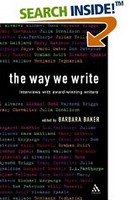
There are any number of books on the theory of writing (Ron Kellogg, Mike Sharples, Naomi Baron) but we rarely hear from writers themselves about how they tackle this most personal of all expressive mediums and the writing techniques they use. Barbara Baker interviewed award-winning writers in a number of genres: writers of children’s fiction, novelists, play and screen writers, poets, and short story writers. And even though the interviews were conducted by phone, fax, or face to face, the editor is scrupulously absent, leaving the writers to talk for themselves. The most immediate and interesting thing is how unromantic most of them are about writing. They see the process of creation as a practical matter, and are much rooted in physical practicalities.

Writing techniquesRaymond Briggs for instance talks about how cartoon stories have to fit into thirty-two pages, because it has to be a multiple of eight because of the way paper is folded. It’s also interesting to note that the majority of the writers interviewed still write their first drafts by hand: “I write with a fountain pen and black ink. My fountain pens are very precious to me and I would never take them out of the house.” (Graham Swift). These might then be transferred to word-processors for editing, but there seems to still be a charm or intimacy about writing with pen on paper – a feeling I recognise, having just done that for this review.

Most of them like to be alone, and to write in their own workroom, no matter how cluttered or unprofessional it might be. However, the poet U.A.Fanthorpe doesn’t have a room, can write anywhere, and even uses the back of her hand if there’s no paper available. And people tempted by a puritanical ethic might keep in mind that writers as distinguished as Vladimir Nabokov, Marcel Proust, and Patrick White wrote in bed.

Julian Fellowes has some interesting things to say about writing for the screen – most notably how little directions are necessary:

One of the things I think is fatal is the film-school idea of writing the directions in very abrupt shorthand. It is impossible to read and puts off 99 people out of 100, and I cannot imagine why they tell students to do it!

Another feature which crops up amongst most of them is not knowing what the ending of a novel will be whilst they are writing it. Many just start with an idea, a character, or just an image – then work forwards.

And it’s amazing just how insecure even some of the most successful are. Margaret Dabble – Lady Holroyd – daughter of a novelist and wife of a famous biographer – speaks of “The insecurity of a writer’s position is extreme … With every [book] I think, ‘This is the one that will be turned down’.”

Some of the authors come across as incredibly smug: “Writing comes easily to me…I have a gift for language” but most of them are very modest – happy if they can find the time for writing and grateful for being published. And that majority also have one other thing in common – they find writing hard work; they go through several drafts before they are satisfied; and they are writing all the time.

Aspirant writers might take comfort from the fact that out of eighteen writers (and award-winners at that) only two had any formal training. Anyone who aspires to producing some published story, poem, novel, or screenplay will find interest and encouragement here.

© Roy Johnson 2008

The Way We Write   Buy the book at Amazon UK

The Way We Write   Buy the book at Amazon US


Barbara Baker (ed), The Way We Write: Interviews with Award-Winning Writers, London: Continuum, 2007, pp.234, ISBN: 0826491227


More on creative writing
More on writing skills
More on publishing


Filed Under: Creative Writing, Writing Skills, Writing Skills Tagged With: Creative writing, The Way We Write, Writing skills

The Weekend Novelist

July 15, 2009 by Roy Johnson

fundamental  techniques of novel-writing explained

The Weekend Novelist is a guide to novel-writing techniques which teaches by two principal features. The authors Robert J. Ray and Bret Norris (both experienced creative writing workshop tutors) first take you through the basics elements of novels by showing structure, character, and plot being created in the work of successful novelists. Then they set exercises which allow you to practise the techniques you have just learned. Actually, there’s a third strand too.

The Weekend Novelist Running through the chapters is a practical example of a novel in the process of being created – though Trophy Wives reads as if it’s going to be closer to a Jackie Collins novel rather than Nostromo or To the Lighthouse. Nevertheless, they are demonstrating for would-be novelists all the things they need to take into account. They start quite reasonably with the concept of structure, encouraging writers to sketch out diagrams of their stories.

This is backed up with some very useful analyses of novel plots, showing how they are built on standard models such as the journey, the quest, and the rise from rags to riches.

As points of reference they use contemporary fiction such as the Harry Potter novels, Ian McEwan’s Amsterdam and Zadie Smith’s White Teeth, as well as examples from classics such as Jane Eyre, Moby Dick, and The Great Gatsby.

Sometimes the advice is conveyed by emotive metaphors – “When your prose speeds up your brain catches fire. When your brain catches fire, ideas spark” – and at other times they draw heavily on a scene by scene construction technique which is drawn from the world of television and cinema.

In fact there is so much concentration on concepts such as ‘the back story’, ‘chain of events’, ‘climax’, and ‘the importance of carefully chosen objects’ that I suspect it will be just as much interest to screenwriters and dramatists.

There’s quite a lot of plot synopsis, and as a result of using the same plot lines in most of their exercises, there’s also a good deal of repetition and overlap. But the upside of this feature is that you get to consider these stories in depth, and they make you aware of the complexities and careful planning which goes into the development of a successful novel.

Given their title, I was surprised there wasn’t more advice on personal time management, but they are telling you how to write – not when. Besides which, I doubt if many people with serious designs on writing novels will limit themselves merely to free time at weekends.

The approach is very encouraging and hand-holding. You need to plan, plan, plan. Then write, stick at it, and be prepared to revise and edit.

It’s realistic, because it realises you don’t have all the time in the world. And it urges you repeatedly not to sit staring out of the window, but to get pen to paper, fingers to keyboard. Their advice is a mixture of writing techniques, warnings, and encouragement. All you need to do is follow it, and you could have a best-seller on your hands.

© Roy Johnson 2005

The Weekend Novelist   Buy the book at Amazon UK

The Weekend Novelist   Buy the book at Amazon US


Robert J. Ray and Bret Norris, The Weekend Novelist, London: A & C Black, 2005, pp.268, ISBN: 0713671432


More on creative writing
More on writing skills
More on publishing


Filed Under: Creative Writing, Writing Skills Tagged With: Creative writing, Publishing, The Weekend Novelist, Writing skills

The Whole Internet

July 2, 2009 by Roy Johnson

updated version of first complete Internet guide

The Whole Internet was one of the earliest-ever computer books to become a best-seller. That was in 1992, when the first major wave of Net users needed information, and there as very little of it about. Ed Krol produced a manual which was well informed, comprehensive, and examined the technology in detail. However, it wasn’t very easy to read, and you needed to grapple with an arcane command-line interface which assumed you had grown up with Unix as a second language.

The Whole InternetThis new version is an update and complete re-write. It is based on the big changes which have come over the Net and the way it is used in the last eight years. Number one development of course is the Web, which moves up from a subsidiary chapter in the original to occupy the centre of this edition. Former features such as Gopher, Archie, and Veronica on the other hand are relegated to a footnote section called ‘Archaic Search Technologies’.

But this difference also makes the manual easier to read and understand. The emphasis has been changed from how the Net works, to how it can be used. There is far less impenetrable code cluttering the pages. Instead we get clean screen shots and nice photographs of what the Net looks like on screen, not at the DOS prompt. Ed Krol has been been very fortunate in choosing his co-author, and their co-operation has produced a far more readable book.

They cover all the basics which someone new to the Net would need to know. How to send email and follow the conventions of netiquette.; what to do with attachments; how to behave on mailing lists; understanding newsgroups; and how to deal with security, privacy, and Spam. They explain how to choose from a variety of Web browsers (including even one for the Palm Pilot). I was struck by how much more accessible all this technology has become in the short time since I struggled through the first edition.

This radical shift in user-centred design is also reflected by the inclusion of completely new chapters on Net commerce, banking, gaming, and personal finance. After a chapter on how to create your own Webages, there is an introduction to what are called ‘esoteric and emerging technologies’ – conferencing, streaming audio and video, and electronic books. This is a very successful attempt to cover the full range of the Net and its activities in a non-snobbish manner. They end with practical information – maximising the effectiveness of your Internet connection, searching techniques, and they offer a thick index of recommended resources.

The original Whole Internet may have been a more striking phenomenon because of its originality at the time, but this new edition has the potential to reach even more readers, largely because it explains the Net and shows how it can be used in a way which is much more attractive and accessible. It has gone straight onto my bibliography of essential Net reading, and I will certainly be recommending it to all my students.

© Roy Johnson 2000

Buy the book at Amazon UK

Buy the book at Amazon US


Kiersten Connor-Sax and Ed Krol, The Whole Internet: The Next Generation, Sebastopol: O’Reilly, 1999, pp.542, ISBN 1565924282


More on technology
More on digital media
More on online learning
More on computers


Filed Under: Computers, Techno-history Tagged With: Computers, Media, Techno-history, Technology, The Internet, The Whole Internet

The Writer’s Handbook

July 22, 2009 by Roy Johnson

addresses, contacts, resources, and advice for writers

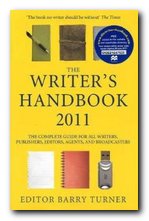
The Writer’s Handbook is the ‘other’ reference manual for writers and people working in the media. It lists publishers in the UK and the US, offers advice to would-be writers on how to place their work, and counsels them on how to deal with agents and middlemen if they have the luck to be ‘accepted’. It’s a comprehensive guide which even goes into the detail of listing the key personnel you need to contact if that deathless prose of yours is ever to see the light of public day. How does it differ from the more established Writers and Artists Year Book?

The Writer's HandbookWell, it spreads itself just a little more generously across a wider range of media. There’s a bit more here on newspapers and magazines, more on radio, TV, small presses and theatre companies. There’s a particularly good section on library services, and there are tips on writing from well-known authors.

It’s updated every year, and many of the entries are annotated with subjective but useful comments on how much people pay – an important issue for hard-pressed writers. New features for the latest edition include how to crack the American market; e-books and the future of hard print; how to get into travel writing; and how newspaper serialisations work.

This is the information you will need for Getting Published. Recent editions have also featured best-seller lists and articles written by successful authors. There’s not a lot to choose between this and the Yearbook. Have a look at both and decide which one suits you.

© Roy Johnson 2000

The Writer's Handbook   Buy the book at Amazon UK

The Writer's Handbook   Buy the book at Amazon US


Barry Turner (ed), The Writer’s Handbook, London: Macmillan, (issued annually) pp.832, ISBN: 0230207294


More on publishing
More on writing skills
More on creative writing
More on grammar


Filed Under: Creative Writing, Journalism, Publishing Tagged With: Creative writing, Journalism, Publishing, Reference books, The Writer's Handbook

The writer’s marketplace

October 2, 2009 by Roy Johnson

a selection of resources

You’ve written a short story, a novel, poems, your memoirs, or even an article on goldfish or steam engines. The problem is, how to get your work published? How can you find a publisher who will accept what you have produced? You need to be aware of the writer’s marketplace.

If you’ve had a preliminary stab at this, you’ve no doubt received a few rejection slips. Don’t be put off. Everybody gets them. It is not necessarily to do with the quality of your work. It’s much more likely to be a question of matching what you have to offer with what a publisher is looking for. Publishers have audiences and markets. They want to supply these markets with the products which sell.

Some publishers specialise in antiques, travel, or local history; others concentrate on modern fiction, historical fiction, or science fiction. You need to match what you have to offer with what they are looking for. It’s no good sending your family saga to a publisher who specialises in chic lit or travel guides. And if the latest fad in publishing is for Running Over Lemons from a House in Provence – that’s what they will be looking for.

However, many long term best-sellers have been written for niche audiences – such as Walter Wainwright’s walking guides to the Lake District, or Elizabeth David’s cookbooks. So the first thing to do is get to know your market. Fortunately, this problem has been around so long that there are now several excellent books on the market to help you with all the issues involved.

Writer's MarketplaceThe Writers’ & Artists’ Yearbook
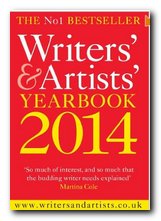
Without doubt, this is the most successful. It’s a number one best-seller which offers details of publishers, agents, and outlets in the US and UK. It tells you what they are looking for, where to contact them, and how to submit your work. But the real value for beginners is in the short essays offering advice to would-be writers and media workers which punctuate the listings. They cover fiction and poetry; drama scripts for TV, radio, theatre, and film; graphic illustration and design; plus photography and music.

The other features which make it particularly useful are general information on publishing methods, copyright and libel, income tax and allowances, and a list of annual competitions and their prizes. Recent editions have also included lists of the year’s bestsellers – including both the number of copies sold and the amount of money they’ve made. It is issued annually, and gets bigger each year.
Buy the book from Amazon UK
Buy the book from Amazon US
 

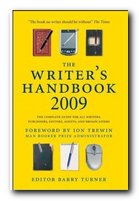
writer's marketplaceThe Writer’s Handbook
Barry Turner’s rival book does much the same thing – but focuses its attention on writers, and covers a slightly broader spread of media. In addition to the key areas of UK and US book publishers and agents, magazines, screen writing, TV and radio, theatre, film and video and poetry, this edition contains features on the appeal of biography; the uses and abuses of the English language; the challenges and rewards of self-publishing; writing poetry; and media contracts. This is well worth considering as an alternative.

Both of these books have extensive listings of all the outlets for creative work – fiction, journalism, sound broadcasting, photography, reporting, and editing. They also include mini-essays on various aspects of the publishing business, advising you how to place your work, where to find agents, and even how to sort out your tax problems after you hit the jackpot.
Buy the book from Amazon UK
Buy the book from Amazon US
 

writer's marketplaceThe Guardian Media Directory
If your writing is more geared to the mainstream media – newspapers, magazines, radio, and television, the Guardian annual directory is establishing itself as the major source of advice. It lists the addresses, phone numbers, websites and key personnel for companies in every sector of the media, from digital television to magazines, regional newspapers to publishing houses, think tanks to charities. This edition contains over 10,000 contacts and has been redesigned throughout.

There are lots of resources for writers on the Internet: the problem is knowing where to find them. Even trawling through search engine results can be time-consuming, and sometimes a dispiriting experience. Thank goodness then when somebody else has done all the research and written up the results.
Buy the book from Amazon UK
Buy the book from Amazon US
 

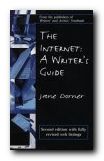
writer's marketplaceThe Internet: A Writer’s Guide
The main strength of Jane Dorner’s guide is that she is a professional writer who practices what she writes about. She writes for print and screen, and promotes her work via a personal web site. This book explores both the new opportunities for writers created by the Internet and the practicalities of publishing on your own site.

She touches on writing groups which exist in the form of mailing lists, websites, newsletters, chat groups, and conferences, and she also deals with eBooks plus annotated lists of all the sources a writer could possibly wish for – from libraries to bookshops, dictionaries to writing circles, newspapers to writing style guides, electronic publishers to free Internet service providers.
Buy the book from Amazon UK
Buy the book from Amazon US
 

Writer’s Market
This provides no-nonsense advice and authoritative guidance you need to get published and to get paid. With updated listings and ‘need-to-know’ publishing advice, Writer’s Market gives writers over 4,000 listings for consumer magazines, book publishers, trade journals, and contests and awards. It also includes complete contact information for fifty top literary agents.

There are dynamic interviews with established writers, plus publishers, editors and successful freelancers. This is essential publishing information and advice, including pay rates, a guide to book publisher imprints and valuable self-marketing tips. If you want to find out what’s available, or if you are really serious about placing what you have written with a commercial publisher – then sooner or later you will need one of these books. There are others, but these are the best; and every professional writer I have known has one or more of them on the shelf.
Buy the book from Amazon UK
Buy the book from Amazon US
 

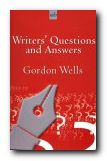
writer's marketplaceWriters’ Questions and Answers
Writers who wish to publish their work are often baffled by some of the mysteries of the publishing process itself. How can you get the attention of a publisher? Do you need an agent? How much can you expect to get paid? Should you submit an outline – or the complete work? Gordon Wells’ book answers these question, plus lots more which are frequently asked by people trying to get a foothold in the world of published writing.

The press always seems to have stories of first-time authors who have been paid a five or six-figure advance for their first novel. But those who have tried to do the same thing know that it’s a far more common experience to be dealing with rejection slips. How do you break into this seemingly charmed world?

Well, these guidance notes certainly tell you how to learn from rejection – and what to do about it. The advice is all practical, realistic, and based on the clear-eyed realisation that if you wish to succeed in this extremely competitive world – you need to know how it works.

Wells tackles all the most frequently asked questions – Who is the best person to approach with your masterpiece? Does vanity publishing work? What makes a best-seller? What if somebody poaches your ideas? Which publishers pay best?

If you want to move beyond the comforts of your local writers’ circle into the world of commercial publishing, you should read what he has to say. Keep dreams of success in mind by all means, but take the trouble to learn how professional writers actually work.
Buy the book from Amazon UK
Buy the book from Amazon US
 

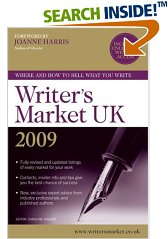
The Writer's MarketWriter’s Market UK 2009
This is a huge, 1,000 page compendium of advice, resources, and detailed information on how writers can locate markets and get their work into print. It has feature articles written by well-known authors giving advice on breaking into print. These are surrounded by listings of publishers, magazines, literary agents, and broadcast outlets. Then come specialized resources such as prizes and competitions, bursaries and fellowships, writers groups, and web sites.

The feature articles are precisely the sort of advice that aspirant writers are most likely to want and need. How to tackle the various genres of fiction writing: the short story, children’s writing, crime, and the novel. What agents and publishers are looking for – and how to approach them. Writing for radio, the Web, newspapers and magazines are all covered well,

There are essays on how books are designed, financed, and marketed, plus why you should know about contracts and legal issues. There are articles on the odd but very profitable field of ghost writing, and when you have made lots of money how to deal with agents, and how to promote your work once it’s published.

There are huge listings of bursaries, prizes, competitions, writers’ foundations, and all sorts of support to help the struggling want-to-be. And testing it out for being up to date, I found all sorts of on line resources for would-be writers: magazines, forums, self-help groups, web sites full of resources, writing software, plus competitions and prizes.

Given the differences in page and font sizes, it’s difficult to do a direct quantitative comparison with its two main rivals, but having looked through all three recently, I’d say that this gives the other two a very good run for their money.
Buy the book from Amazon UK
Buy the book from Amazon US

return button Publish your writing

© Roy Johnson 2009


More on creative writing
More on writing skills
More on publishing


Filed Under: Creative Writing, How-to guides, Journalism, Publishing, Writing Skills Tagged With: Creative writing, Journalism, Publishing, The Writer's Handbook, Writer's Market, Writers' and Artists' Yearbook, Writing skills

Thinking with Type

July 5, 2009 by Roy Johnson

critical guide for designers, writers, editors, students

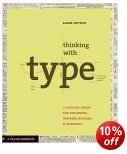
Ellen Lupton’s new design guide is in three parts. The first of Thinking with Type deals with the range, choice, and nature of the typeface you can use; the second shows how it can be squeezed, adjusted, and re-arranged for effect; and the third deals with the underlying structures upon which good page design is built. Actually, there’s a fourth as well – an appendix offering a list of hints on editing and punctuation, plus a comprehensive bibliography.

Thinking with TypeEach part is accompanied by an essay explaining key concepts, and then a set of practical demonstrations illustrating that material. Part One delivers an excellent tutorial in the history and analysis of moveable type – from its origins in the Renaissance printing houses through to the designs for digital type which have arisen in the last twenty years. She writes in a light, rapid, and elegant style which packs a lot into a small space. What she has to say has obviously been distilled through many years teaching the subject.

Letters gather into words, words build into sentences. In typography ‘text’ is defined as an ongoing sequence of words, distinct from shorter headlines or captions. The main text is often called the ‘body’, comprising the principal mass of content. Also known as ‘running text’, it can flow from one page, column, or box to another. Text can be viewed as a thing—a sound and sturdy object—or a fluid poured into the containers of page or screen. Text can be solid or liquid, body or blood.

Part Two enters the semi-philosophic realm of the relationships between text and space. Here she explains how layout is used as an aid to comprehension, navigation, and structure. She also extends this discussion to include hypertext and human interface design.

This is followed by solidly reliable advice on the basic techniques of type kerning, line spacing, text alignment, and creating structure and hierarchies of significance in a text by spatial placement and visual emphasis.

Part Three deals with grids – the hidden systems for arranging content within the space of a page or a screen. In fact grids are shown in use in the presentation of information in a variety of media magazines and books, catalogues and newspapers, and she even quotes Edward Tufte’s example of railway timetables.

The book itself is beautifully designed and produced. Each topic is covered in a single or double page spread; marginal notes point to the sources of quotations and suggestions for background reading; and almost every other page includes a colour graphic illustrating the issue in question.

© Roy Johnson 2004

Thinking with Type   Buy the book at Amazon UK

Thinking with Type   Buy the book at Amazon US


Ellen Lupton, Thinking with Type: A critical guide for designers, editors, and students, New York: Princeton Architectural Press, 2004, pp.176, ISBN: 1568984480


More on typography
More on design
More on media
More on web design


Filed Under: Graphic design, Typography Tagged With: Ellen Lupton, Graphic design, Thinking with Type, Typography

Thomas Hardy biography

September 30, 2009 by Roy Johnson

Thomas Hardy biographyhis life and major writings

1840. Thomas Hardy born in Dorchester – father a bricklayer, later a builder, musical easy-going; mother hardworking, ambitious, and very literate. Both parents, despite later prosperity, shared class anxiety and fear of being pulled back down into poverty. Dorset at this period still had remnants of pre-industrial revolution. Hardy therefore witnessed first-hand the death of old pastoral traditions and the rise of industrialisation.

1848-. Educated in Dorset schools – including Latin and French, plus applied mathematics and commercial studies. Strong auto-didactic impulse. Influenced by schoolmaster Horace Moule – a classicist and dipsomaniac.

1856. Articled to Dorchester architect – then employed as an assistant. Hardy witnesses the hanging of a young woman – a scene he was to use thirty years later in Tess of the d’Urbervilles.

1862. Travelled to London to seek work – employed as a architectural draughtsman. Prizewinner in competitions and elected to the Architectural Association. He explores the cultural life of London, visiting museums, attending plays and operas, and begins writing poetry in earnest.

1863. Literary ambitions begin – begins to write poetry and continues studies. Poems rejected.

1866. Gradual loss of religious faith.

1867. Returns to Dorset and writes first novel – The Poor Man and the Lady, which is rejected by publishers.

1869. Disappointed by literary rejections – returns to work as an architect in Weymouth. Re-writes first novel as Desperate Remedies.

1870. Hardy travels to St. Juliot to work on the restoration of the church. He meets Emma Gifford in Boscastle, Cornwall – marries her four years later.

1871. Desperate Remedies published at Hardy’s own expense – then remaindered.

1872. Under the Greenwood Tree – copyright sold for £30. Hardy’s first success as a writer. Leslie Stephen (Virginia Woolf’s father) commissions writing for the Cornhill Magazine.

1873. A Pair of Blue Eyes is published in three volumes. Hardy now relinquishes architecture as a career to write full-time. Horace Moule, his close adviser and friend, commits suicide in Cambridge.

1874. Far from the Madding Crowd begins as serial in the Cornhill Magazine. Hardy marries Emma Gifford – honeymoon in Paris – then returns to live in Tooting, London. Lives the life of a literary lion.

1875. The Hand of Ethelberta serialised in the Cornhill Magazine. The Hardys return to live in Dorset.

1878. The Return of the Native serialised in Belgravia and then published in three volumes – to which Hardy attached a map of ‘Wessex’ to show the novel’s locations. With the success of this novel, he begins to experience life as a celebrity. He joins the Saville Club.

1879. Began to write short (and long) stories with ‘The Distracted Young Preacher’.

1880. The Trumpet Major. Hardy begins to design and supervises the building of his own home at Max Gate in Dorset.

1881. A Laodicean is written mostly in bed, where Hardy is recovering from a serious illness.

1882. Two on a Tower is serialised in the Atlantic Monthly then issued in three volumes.

1884. Hardy is made a Justice of the Peace and begins to receive visits from aristocracy.

1886. The Mayor of Casterbridge is serialised in the Graphic then brought out in two volumes the same year.

1887. The Woodlanders is issued in three volumes. The Hardys visit France and Italy – but the marriage is not very successful. When they return, he begins habit of visiting London for ‘the season’. Hardy actually discourages Emma’s own literary ambitions.

1888. Hardy’s first collection of stories published as Wessex Tales – and Hardy publishes the first of three essays on the theory of fiction – The Profitable Reading of Fiction.

1889. Tillotson’s Fiction Bureau commissions a novel (Tess) but then rejects it on grounds of blasphemy and obscenity. It is also rejected by other publishers.

1891. Tess of the d’Urbervilles serialised in the Graphic. Copyright Bill passed in the United States – which turns out to be financially beneficial to Hardy.

1892. Hardy’s father dies. The Pursuit of the Well-Beloved is serialised in the Illustrated London News

1893. Meets Florence Henniker in Dublin – the subject of his most intense romantic attachment to artistic ladies. He writes The Spectre of the Real in collaboration with her.

1894. The third volume of short stories – Life’s Little Ironies – published in one volume.

1895. Osgood-Mcilvaine begins bringing out the first collected edition of Hardy’s works. The set includes the first edition of Jude the Obscure. The novel receives harsh criticism, prompting Hardy to give up novel writing.

1898. Hardy’s first collection of verse published as Wessex Poems – comprising work from the 1860s and 1890s, and illustrated by Hardy himself.

1899. Boer war begins. Growing physical separation between Hardy and Emma.

1901. Another collection of verse – Poems of the Past and Present – is published.

1903. Part One of The Dynasts appears. This is Hardy’s extended verse-play about the Napoleonic wars which he intends as his masterpiece.

1905. Meets Florence Dugdale, who is forty years younger than Hardy and becomes his secretary.

1908. The Dynasts is completed. Death of George Meredith and Swinburne leave Hardy most celebrated English writer.

1910. Awarded the Order of Merit – having previously refused a knighthood. Receives the freedom of Dorchester. Relationship with Florence Dugdale deepens.

1912. A ‘definitive’ edition of Hardy’s works, the Wessex Edition, is published by Macmillan. It is a chance for Hardy to thoroughly revise his body of work. Emma suddenly dies in November.

1913. Hardy visits Cornwall in search of his and Emma’s youth, and begins to write poems about her. Awarded a D.Litt at Cambridge University and became an Honorary Fellow of Magdalene College – fulfilling partially one of his early aspirations.

1914. Marries Florence Dugdale [who is forty years younger]. Burns all his notebooks and private papers. Hardy’s pessimism strengthened by the outbreak of First World War.

1917. Moments of Vision Hardy’s fifth collection of verse published. Begins work on dictating to Florence what was to become The Life of Thomas Hardy.

1923. Visited by the Prince of Wales, friendship with T.E.Lawrence. Second marriage as disappointing as the first.

1924. Hardy adapts Tess for the stage, and become romantically attached to Gertrude Bugler, who plays the title role.

1928. Hardy dies – and is buried with full honours in Poet’s Corner in Westminster Abbey. However, his heart, which had been cut out of his body first, was put in a biscuit tin and buried alongside his first wife in Stinsford churchyard, Dorset.

© Roy Johnson 2009


The Complete Critical Guide to Thomas HardyThe Complete Critical Guide to Thomas Hardy is a good introduction to Hardy criticism. It includes a potted biography of Hardy, an outline of the stories, novels, and poetry, and pointers towards the main critical writings – from the early influential full length study by D.H. Lawrence to critics of the present day. Also includes a thorough bibliography which covers biography, criticism in books and articles, plus pointers towards specialist Hardy journals.


More on Thomas Hardy
More on the novella
More on literary studies
More on short stories


Filed Under: Thomas Hardy Tagged With: Biography, Literary studies, Thomas Hardy

  • « Previous Page
  • 1
  • …
  • 83
  • 84
  • 85
  • 86
  • 87
  • …
  • 103
  • Next Page »

Get in touch

info@mantex.co.uk

Content © Mantex 2016
  • About Us
  • Advertising
  • Clients
  • Contact
  • FAQ
  • Links
  • Services
  • Reviews
  • Sitemap
  • T & C’s
  • Testimonials
  • Privacy

Copyright © 2026 · Mantex

Copyright © 2026 · News Pro Theme on Genesis Framework · WordPress · Log in