Mantex

Tutorials, Study Guides & More

  • HOME
  • REVIEWS
  • TUTORIALS
  • HOW-TO
  • CONTACT
>> Home / Archives for 2009

Archives for 2009

the Online Learning idea book

July 17, 2009 by Roy Johnson

95 ways to enhance technology-based learning

I’ve been teaching online learning courses almost as long as they have existed, and I know that both course designers and students need as much support as they can get. This book is aimed at the tutors and course designers and has the sole aim of helping them make the experience of learning on line more interactive, more enjoyable, and more effective. There are two in-built problems with online courses. Schools, colleges, and universities (to say nothing of commercial enterprises) want to eliminate expensive tutor-contact time, and make courses available any hour of the day. But anything beyond elementary lessons requires students to produce work which is assessed by a live tutor – who needs to be paid for reading on screen or on paper. That’s the first problem: it’s not easy to teach complex issues and subjects on a computer screen.
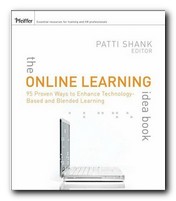
the Online Learning idea bookThe second is that making online courses truly interactive is an expensive business. Confronting students with rich learning experiences usually ends up requiring Flash animations, specially shot video footage, or interactive games of one kind or another – all of which are costly to produce. Faced with these problems, many teachers end up doing nothing more than sticking their lecture notes online in the form of downloadable Word files.

This book is a collection of techniques and strategies which have been tried out by practising teachers – who are confident enough to give their names and the web addresses of their own materials. Suggestions start at a point even before formal learning begins, with ideas for ‘learning agreements and ‘study schedules’ which students sign up to and which hopefully keep them on track and up to date. Some struck me as mildly utopian, but I liked the ‘eLearning Portfolio’, which would undoubtedly be useful.

The next section deals with learning via social interaction – collaborative projects and team-working – then what follows naturally from that, learning via discussion. The guidance ‘rules’ for forum postings are sound – though in my experience it’s quite difficult to enforce these without seeming over-controlling.

For completely individual learners working in isolation, the suggestions include visual diaries, email biographies, shared bookmarks, ‘visiting’ expert speakers (using podcasts), the ‘mini quest’ (which I would call a ‘small project’) blogs, and peer editing.

Synchronous learning activities rely heavily on chat, instant messaging, and pre-arranged forums. The main thrust in the suggestions made here are to enable participants to feel comfortable interacting with each other.

When it comes to self-assessment exercises we are into puzzles and games, flash cards, drag-and-drop activities, and multiple choice questions. But be warned – these can be expensive, unless you use off-the-shelf templates.

The latter part of the book deals with the actual structure, design, and navigation systems of online courses. This offers templates to cut down on design time, tips for maximising usability, and ideas for creative design – including some very funny clips at www.zefrank.com.

One interesting feature in my reading of this book was that ideas for one learning strategy or technique would come to me whilst I was busy reading about suggestions for something completely different.

Two things are for certain: the range of suggestions is amazing, and you’re sure to find something amongst them which will appeal to you. The editor Patti Shank has wisely stuck to a very tight formula for presenting these ideas. None takes up more than three pages, including screenshots, and the authors are even asked to show how their ideas can be adapted for other uses. This is a boon for online course designers.

© Roy Johnson 2007

Buy the book at Amazon UK

Buy the book at Amazon US


Patti Shank (ed) the Online Learning idea book, San Francisco: John Wiley, 2007, pp.354, ISBN: 0787981680


More on online learning
More on technology
More on digital media
More on web design
More on computers

Filed Under: Online Learning Tagged With: Distance learning, eLearning, eLearning design, Online learning, Technology, the Online Learning idea book

The Oxford Companion to Jazz

July 1, 2009 by Roy Johnson

essays on jazz musicians and jazz history

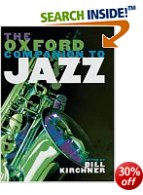
This latest addition to the distinguished Oxford Companion series comes with an encomium from record producer George Avakian: “No book on jazz has ever attempted the scope of this monumental collection of 60 studies by 59 writers. [It] is both a reference work for the scholar and a rewarding book to be dipped into by the casual reader.” Edited by composer, educator, and saxophonist Bill Kirchner, The Oxford Companion to Jazz is both impressive and slightly disappointing.

Companion to Jazz The essays are uneven in quality, there are several typographical errors, some of the black and white photographs are poorly reproduced, there are no ‘Notes on Contributors’, and the eye-straining ‘Selected Bibliography’ and ‘Index of Names and Subjects’ are not accompanied by a discography – although several essays are, in effect, record reviews. But this stout Companion has more strengths than weaknesses, and is a valuable addition to jazz literature. Kirchner’s contributors include such notable critics and musicians as Dan Morgernstern, Gunther Schuller, Patricia Willard, Bill Crow, Digby Fairweather, and Richard M. Sudhalter. There are also essays from Loren Schoenberg, Dick Katz, Mike Zwerin, Lewis Porter, Brian Priestly, Will Friedwall, Scott De Veaux, Max Harrison and Ted Gioia.

The topics covered range from ‘African Roots of Jazz’ (Samuel A. Floyd, Jr.) and ‘European Roots of Jazz’ (William H. Youngren) – which present two opposing views of the same topic. Extended essays also cover such neglected subjects as ‘The Jazz Age, Appearances and Realities’ and ‘Big Bands and Jazz Composing and Arranging after World War II’.

There are chapters dealing with jazz styles – such as ragtime, swing, bop (an excellent piece by De Veaux), third stream, and fusion – and the locations of jazz – New Orleans, New York, California, and Kansas City. Even Europe, Japan, Canada and Australia are exhumed and examined.

Acknowledged jazz masters (and mistresses) receive individual (and sometimes overlapping) evaluations: Bessie Smith, King Oliver, Jelly Roll Morton, Sidney Bechet, Bix Beiderbecke, Duke Ellington, Coleman Hawkins, Lester Young; Ella Fitzgerald, Billie Holiday and Sarah Vaughan (in a perceptive essay by Patricia Willard). There are also chapters on the modern masters Charlie Parker, Miles Davis, Thelonious Monk, Charles Mingus, and John Coltrane – though ‘cutting edge’ instrumentalists and vocalists of the past two decades receive short (or no) shrift.

Separate entries on the instruments of jazz offer some revealing insights – Michael Ullman on the clarinet, Gunther Schuller on the trombone, Don Heckman on the saxophone, Randy Sandke on the trumpet, Bill Crow on the bass, Burt Korall on the drums, Neil Tesser on ‘The Electric Guitar and Vibraphone in Jazz: Batteries Not Included’. There are also several essays on pianists.

In one of the best essays, ‘Jazz Improvisation and Concepts of Virtuosity’, David Demsey explains that ‘in a great soloist’s repertoire, every tune is like a familiar subject of conversation: although fresh ideas are always emerging, the language needed to communicate them has a consistency for each individual.’

He then applies this observation to the recorded work of masters ranging from Louis Armstrong to Ornette Coleman. He makes a good point in his suggestion that:

It is in the solitude of the practice room – ‘the woodshed’ – where, for even the most inexperienced student and the legendary jazz master alike, the basic elements of form and harmony are ingrained, new melodies or voice-leading pathways are learned, and experiments are made in rhythmic manipulation.

The Oxford Companion to Jazz, like the music and musicians it celebrates, is hugely enjoyable but best taken in measured doses. Holding this massive tome open takes two hands. If, as the editor hopes, it also sends (or introduces) the serious or casual reader to the recorded performances of the artists discussed, so much the better.

© John White 2005

Companion to Jazz Buy the book at Amazon UK

Companion to Jazz Buy the book at Amazon US


Bill Kirchner (ed), The Oxford Companion to Jazz, Oxford: Oxford University Press, 2005, pp.864, ISBN: 019512510X


More on music
More on media
More on lifestyle


Filed Under: Music Tagged With: Jazz, Modernism, Music, Oxford Companion to Jazz

The Oxford Dictionary of Music

June 30, 2009 by Roy Johnson

definitions and an encyclopedia of musical matters

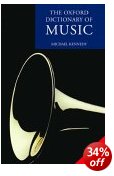
Actually this is what should be called (for the want of a better term) a dictionary of classical music, because it does not seek to cover all musical genres. Entries run from the note A to the Polish soprano Teresa Zylis-Gara, and include major (and minor) composers plus their works, famous performers and conductors, characters from operas, musical concepts and genres, musical instruments, and even mini-essays on topics such as ‘Electronic Music’.

The Oxford Dictionary of MusicIt’s as up-to-date as one could expect for a work of reference of this kind. There are 12,500 entries on all aspects of the subject, and topics stretch from music of the twelfth and thirteenth centuries to potted biographies of contemporary composers such as Judith Weir and performers such as Cecilia Bartoli. I checked against (for instance) George Benjamin (b. 1960) and Thomas Adès (b. 1970) – and both of them had entries.

Its one nod towards ‘popular’ music is to include mention of song composers such as Irving Berlin and Cole Porter. For anyone interested in music, whether as a student, concert-goer, record collector or Radio 3 listener, it is a welcoming book – in which the author shares his enthusiasm for the obvious as well as the obscure. To give a very typical illustrative example, the section on American composer John Adams runs as follows:

Adams, John (Coolidge) (b Worcester, Mass, 1947). Amer. composer, conductor, and clarinetist. Studies Harvard Univ. and comp. with Kirchner, Del Tredici, and Sessions. Head, comp. dept. San Francisco Cons. 1972-82. Comp-in-res., San Francisco SO 1979-85. One of minimalists, he has deliberately forged an eclectic idiom which borrows from most of the major 20th cent. composers and from jazz. Comps.:

OPERAS: * Nixon in China (1984-7) ; The * Death of Klinghoffer (1990-1); I was looking at the ceiling and then I saw the sky, mus. th. (1994-5); Doctor Atomic (2003-5).

ORCH.: Common Tones in Simple Time (1980); Shaker Loops, str. (1983); Harmonielehre (1984-5); Tromba lontana (1986); Short ride in a fast machine (1986); The Chairman Dances (1987); Fearful Symetries (1988); Eros Piano, pf, orch. or chamber orch. (1989); Chamber conc. (1991); El Dorado (1991); vn. conc. (1993).

VOICE(S) & ORCH. OR ENS.: Christian Zeal and Activity, spkr. on tape., ens. (1973); Grounding, 3 solo vv., instr., elec. (1975); Harmonium, ch., orch. (1980); Grand Pianola Music, 2 sop., 2 pf., small orch. (1981-2); The Wound Dresser, bar., orch. or chamber orch. (1988).

CHAMBER MUSIC: Pf. quintet (1970); American Standard, unspecified ens. (1973).

PIANO: Ragamarole, (1973); China Gates, (1977); Phrygian Gates, (1977).

TAPE ONLY: Onyx, (1975); Light Over Water, (1983).

The entire body text is set in Times New Roman, which for works of reference is a little unfashionable these days – but which I felt was sympathetic to the subject of classical music.

This latest revised edition has been supplemented with 1,000 new entries; lists of composers works have been brought up to date; and the entries now also include musical directors, critics, producers, and designers. Whether we call it ‘classical’ music or anything else, everything you might wish to know about it is covered here. [It’s also now available in a slightly abridged paperback edition.]

© Roy Johnson 2012

Dictionary of Music Buy the book at Amazon UK

Dictionary of Music Buy the book at Amazon US


Michael Kennedy, The Oxford Dictionary of Music, (revised edition) Oxford: Oxford University Press, sith edition, 2012, pp.976, ISBN: 0199578109


More on music
More on media
More on lifestyle


Filed Under: Dictionaries, Music Tagged With: Dictionaries, Music, Oxford Dictionary of Music, Reference

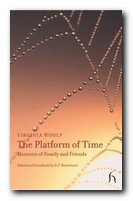
The Platform of Time

July 25, 2009 by Roy Johnson

Virginia Woolf’s Memoirs of Family and Friends

This is a new collection of largely unfamiliar memoirs, edited by the Bloomsbury scholar S.R.Rosenbaum (who also edited The Bloomsbury Group). It includes the first ever publication of Woolf’s long sought-after and newly recovered talk on her role in the famous (and infamously silly) Dreadnought Hoax which she delivered to Rodmell Women’s Institute in 19940. The Platform of Time collection also includes the complete version of her memoir of her nephew Julian Bell, who was killed in the Spanish Civil War in 1937.

The Platform of Time The Bloomsbury Group were very fond of writing memoirs. They even had a Memoir Club where members read out their compositions for each others’ amusement. And Virginia Woolf’s family was also much given to written records of their relationships. Her own father Sir Leslie Stephen compiled a photograph albumn and wrote an epistolary memoir to commemorate the death of his wife Julia in 1895. It’s now available as The Mausoleum Book.

The Bloomsberries also wrote sketches of their relatives and friends, on some occasions to reinforce the friendship network, and on others to provide an obituary for the Times. There are examples of both in this collection: two very warm sketches Woolf wrote in memory of her father, recounting the cheerful way he read to his children, taught them each morning, and played with them sailing toy boats in Kensington Gardens. These recollections counteract the rather severe portraits of Leslie Stephen given elsewhere

Many of Woolf’s memoirs ooze with the sort of confident generalisations of the post-Victorian era celebrating itself in the coterie of what they would call the national press, but which was in fact a tiny minority, talking to itself. Speaking of her aunt, the famous Victorian photographer Julia Cameron, Woolf writes:

Mrs Cameron had a gift for ardent speech and picturesque behaviour which has impressed itself on the calm pages of Victorian biography. But it was from her mother, presumably, that she inherited her love of beauty and her distaste for the cold and formal conventions of English society.

There is quite a sympathetic portrait of Ottoline Morell, who during her own lifetime had to endure the affront of writers who accepted her generous hospitality at Garsington and Bedford Square, then went home to write spitefully satirical accounts of her.

The collection also includes what are called ‘fantasy memoirs’ – fanciful inventions based loosely on the lives of Saxon Sydney Turner and John Maynard Keynes. These are witty, allusive sketches which explore the outer limits of biography – something she was to bring to a stunning climax in Orlando, her meditation the life of her then lover Vita Sackville West.

In fact many of the sketches reveal more about the author than they do about their ostensible subject. For instance, you would never guess from her encomium to the celebrated war poet and ‘hero’ Rupert Brooke that he in fact never saw military action, and died of a mosquito bite.

One of the longest pieces is her account of attending a meeting of the Women’s Co-Operative Guild, along with her husband Leonard Woolf. Life as We Have Known It is a thoughtful and reflective meditation on the women of the co-operative movement in the 1930’s, a very practical piece of feminist sympathising, and a paean for social-democratic values which foreshadows the arguments she was to develop in Three Guineas a few years later.

This is a useful collection from the Hesperus Press, which produces reprints and updated compilations which are given a scholarly editing and are elegantly designed and printed. If you don’t have these pieces in other forms, this is an excellent edition.

© Roy Johnson 2008

The Platform of Time Buy the book at Amazon UK

The Platform of Time Buy the book at Amazon US


Virginia Woolf, The Platform of Time: Memoirs of Family and Friends, London: Hesperus, 2008, pp.262, ISBN: 1843917114


More on Virginia Woolf
Virginia Woolf – web links
Virginia Woolf – greatest works
Virginia Woolf – criticism
More on the Bloomsbury Group


Filed Under: Bloomsbury Group, Virginia Woolf Tagged With: Biography, Bloomsbury Group, Cultural history, The Platform of Time, Virginia Woolf

The Psychology of Writing

June 30, 2009 by Roy Johnson

attitudes to writing amongst professional authors

Anyone who has attempted to produce a piece of half-way serious writing will know that the psychological states we go through can range from anxious anticipation, thoughtful cogitation, through anguished production, to teeth-gnashing editing and re-writes. Ronald Kellog’s excellent study The Psychology of Writing examines every one of these stages in the process. The structure of the book follows the development of writing from its (sometime) origin in thought, through pre-writing and planning [very thoroughly explored] to the varieties of text production and the psychological states which sometimes assist it (including trance and alcohol abuse).

Writing a letterHis method in each chapter is to launch the topic theoretically (Knowledge, Writing Strategies) then discuss empirical and anecdotal evidence, and finally inspect the scientific research. Some of the results are of the uninspiring ‘47% did, 53% didn’t’ variety, but the result is commendably thorough. He draws on many types of writing for his examples, yet keeps coming back (for understandable reasons) to creative writing. Why then in the attempts to ‘measure’ or explain quality in writing didn’t the exceptions to his claims not occur to him? Yes – most writers need long and hard-earned experience, and practice and skill development. But how does one explain the Rimbauds, Chattertons, and Keats of this world who were producing masterpieces at an age when the rest of us were struggling with our ‘A’ levels?
I would guess that those following this line of psychological research might profit from taking (for example) concepts such as the intentional and the affective fallacy into account. There also seemed to be an unspoken assumption that the writer and reader are part of what the literary critic Stanley Fish calls the same ‘interpretive community’. A quick dose of deconstruction might not go amiss in helping to shake this idea a little.

Some of the jargon might be accessible to psychologists, but I can’t help feeling that terms such as ‘relative automatization’ and ‘satisficing [sic] heuristic’ will deter many potential readers. On the other hand there were occasional inspired flashes which I wished could have been developed further – on plagiarism, ideas processors and ‘invisible writing’ for instance.

Even though the prose was rather dry and the argument occasionally sagged in ploughing its way through the data, everything perked up again with the concluding chapters. The scholarship throughout is exemplary, and the book is rounded off with a magnificent bibliography and a good index. Computer users may be interested to know that there are chapters dealing with word-processing packages and outliners – as well as programmes which cause the screen to flash if your writing slows down!

© Roy Johnson 2000

The Psychology of Writing   Buy the book at Amazon UK

The Psychology of Writing   Buy the book at Amazon US


Ronald T. Kellog, The Psychology of Writing, Oxford: Oxford University Press, 1994, pp.253, ISBN: 0195081390


More on creative writing
More on writing skills
More on publishing


Filed Under: Creative Writing, Theory Tagged With: Creative writing, The Psychology of Writing, Writing skills, Writing Theory

The Real McCoy

June 27, 2009 by Roy Johnson

the true stories behind our everyday phrases and sayings

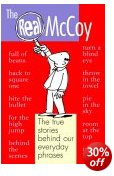
English is incredibly rich language, full of colorful and unusual phrases and sayings. This is one of those books which offers explanations for commonly used expressions. For instance, why do we say ‘know your onions’, ‘straight as a die’, and ‘the apple of your eye’? The answer in the last example is that the pupil was once supposed to be round. The Real McCoy is unusual as an expression in that nobody really knows its true origin.

The Real McCoyAnother typical example is ‘Mad as a hatter’. I knew this one, because it comes from the mercury poisoning used in felt hat manufacture – a former speciality in the town where I live. Most of the entries are very short. However, there are occasional special sections dealing with groups of – such as Biblical expressions, colours, eating and drinking, foreign countries, legends and myths, parts of the body and expressions coined by Shakespeare. Most of the entries are ploddingly obvious. I think that just about everybody knows that ‘full of beans’ means ‘lively and in high spirits’ and that the origin comes from vegetable protein.

However, there were one or two expressions I had certainly not thought about, such as ‘curry favour’ which has nothing to do with cooking or the Indian subcontinent, but comes from the expression curry as in to groom a horse with a coarse brush or comb.

And I certainly didn’t realise that a devil’s advocate was originally an official Catholic appointment during the process of beatification. The person’s role was to challenge the case being made for sainthood.

It’s an easy and lightweight approach to the subject. The entries come with no evidence or credible sources, and there’s no bibliography or list of further reading.

This could be useful as a Xmas or birthday present for someone who hasn’t yet thought much about the quirky nature of language. For something more substantial you will need to go to books such as The Oxford Dictionary of Idioms or Michael Quinion’s Port Out, Starboard Home.

© Roy Johnson 2005

The Real McCoy   Buy the book at Amazon UK

The Real McCoy   Buy the book at Amazon US


Georgia Hole, The Real McCoy, Oxford: Oxford University Press, 2005, pp.200, ISBN: 0192806114


Filed Under: Language use Tagged With: English language, Language, Language use, The Real McCoy

The Renaissance Computer

July 16, 2009 by Roy Johnson

information architecture in early print technology

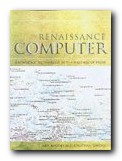
The Renaissance Computer is a collection of essays which seek to explore the similarities, connections, and lessons to be drawn from a comparison of the advent of digital technology with the age of print in the immediate post-Gutenberg period. In the 15th century the printing press was the ‘new technology’. The first ever information revolution began with the advent of the printed book, enabling Renaissance scholars to formulate new ways of organizing and disseminating knowledge.

The Renaissance ComputerThe basic argument is that the proliferation of printed texts was as revolutionary and presented similar problems of information architecture, storage, and retrieval as we feel we have now in our digital age. The earliest attempts at memory and storage systems were remarkably similar to the Windows operating system, though the fact that they were made physically manifest made them cumbersome and non-portable. Nevertheless, it would have been wonderful to visit Giulio Camillo’s memory theatre, where a visitor occupied the stage, and all the knowledge of mankind was stored on the tiered rows of what would normally be seats.

Editor Jonathan Sawday looks at precursors of the modern computer in the work of Milton, Hobbes, Pascal, Liebnitz, and Descartes. There’s a chapter on the role of illustrations in early modern books, another looks at the role of the index, title page, marginalia, and contents page as early examples of hypertext and navigation.

The authors also point to the amazing persistence of some outmoded technological forms:

Recent work on the circulation of manuscript collections of poetry in the seventeenth century…has demonstrated that this form of publication survived for two centuries after the invention of the printing press. The modern researcher who, seated in the rare book rooms of the Huntington Library or the British Library, laboriously copies out passages from an early printed book is participating in an ancient tradition.

There is a very interesting (and more readable) chapter on Thomas Heywood’s Gunaikeion (1624), an encyclopedia on women. The link with computers is no more than the suggestion that it’s a cut and paste composition, but the content sounds so interesting it made me feel I wanted to read a copy.

These chapters are scholarly academic conference papers – and the have both their strengths and weaknesses. Wide ranging and well informed, but often looking for connections where none exist or finding them to little purpose.

The idea of a Renaissance computer is only a catchy idea. These studies are of how information was organised in text form, how it was understood and retrieved, and how the Renaissance book tackled issues of information architecture which many people now think of as something new.

© Roy Johnson 2002

The Renaissance Computer   Buy the book at Amazon UK

The Renaissance Computer   Buy the book at Amazon US


Neil Rhodes and Jonathan Sawday (eds), The Renaissance Computer: knowledge technology in the first age of print, London: Routledge, 2000, pp.212, ISBN: 0415220645


More on information design
More on design
More on media
More on web design


Filed Under: Information Design, Literary Studies, Media Tagged With: Computers, Cultural history, Information architecture, Information design, The Renaissance Computer

The Rest is Noise

July 17, 2009 by Roy Johnson

classical music in the twentieth century

Alex Ross is the music critic for the New Yorker magazine who blogs prolifically at The Rest is Noise. And even though he doesn’t have comments switched on at his site, his postings are required reading for anyone who wants to keep abreast of classical music – especially as seen from New York city. His tastes and references are amazingly eclectic and unstuffy. One minute he’s analysing the latest staging of the Ring Cycle and next he’s reporting on developments in contemporary rock music or a recently discovered private recording of a John Coltrane radio broadcast.

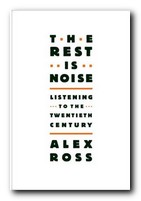
The Rest is Noise This is his long-awaited first book and major oeuvre as a critic, tracing the development of twentieth century classical music from the first night of Strauss’s Salome (no accent) in 1905 to John Adams‘s Nixon in China in 1987. He has an amazingly developed sense of cultural history- reminding us whilst discussing the development of Thomas Mann‘s traditional musical ideas in relation to Schoneberg that Leon Trotsky spent the years 1907 to 1914 in exile in Vienna where these modernist moves were being played out, alongside the work of Karl Kraus, Oskar Kokoshka, and Egon Schiele. He darts back and forth in time in a way which is at first bewildering, but there’s a good reason for doing so – usually to show how far back cultural convergences began.

His narrative is spiced by what might be called the higher musical gossip. He slips in references and anecdotes which sparkle like gems on the page. Schoneberg’s bon mot on his exile in California: ‘I was driven into Paradise’, and Charlie Parker spontaneously quoting from The Firebird when he spotted Igor Stravinsky was in the audience at Birdland one night.

It’s an approach which relies heavily on anecdote and cultural montage – but his juxtapositions are all backed up by scholarly references which are kept wisely at the back of the book, They don’t encumber the narrative.

His descriptions of symphonies and major orchestral works are a mixture of technical analysis and an impressionistic account of what is going on:

In the last bars, the note B aches for six slow beats against the final C-major chord, like a hand outstretched from a figure disappearing into light.

Maybe the mixture is just about right. After all, it’s difficult to write about music, which is essentially abstract. When you think about it, music doesn’t mean anything, even though it can be incredibly moving and beautiful. Though that, of course, is meaning of a kind.

The Spirit of Schoenberg presides over the first part of the book: all other music seems to be measured against his purist ethos and practice. This phase ends with the premiere of Berg’s Lulu in 1937. My only disappointment in this section was his account of Duke Ellington, which concentrated on his not-to-be-performed opera Boola and failed to bring out the element of small-scale symphonies or concertos which characterised much of his sub three-minute compositions for 78 rpm recordings.

In the second part, Shostakovich is let off the hook somewhat. As a way of explaining his capitulation to Stalinism, Ross describes him as having ‘divided selves’ – though to do him credit, Ross doesn’t try to conceal the privileges he enjoyed (spacious Moscow flat with three pianos, for which he thanked Stalin personally) whilst his contemporaries were being led of to the Gulag or despatched with a bullet in the back of the head.

It’s interesting to read of the style wars of the 1940s and 1950s with the benefit of half a century’s hindsight. Major composers such as Stravinsky were being written off by people who are now forgotten – and it’s even more amazing to read that the champions of atonal music and the concerts arranged to promote them were funded by the CIA.

Ross clearly has his heroes – Strauss (despite his Nazi associations) Schoenberg, and Stravinsky. And even though he may not have intended it, Pierre Boulez emerges from the narrative as a distinctly pushy, unpleasant piece of self-aggrandisement.

I was surprised that he took John Cage so seriously – somebody who has always struck me as completely bogus – but he gives a touching account of Aaron Copland, who suffered harassment and criticism in his own country during the McCarthy trials for his leftish sympathies, despite his having written such iconic evocations of America as Appalachian Spring and Fanfare for the Common Man

There’s a whole chapter on Benjamin Britten, where I was glad to see that Ross doesn’t shy away from the much-ignored fact that much of Britten’s work deals with the sexual and emotional violation of young boys. He even reveals that Britten (in a Michael Jackson moment) took the juvenile star of his 1954 The Turn of the Screw (David Hemmings) into his own bed. But Ross’s account of Britten is far from smutty. There’s a several page long account of Peter Grimes which is the most extended musical analysis in the whole book.

He ends his narrative with an account of the American minimalists – the music still apparently split into two camps, but this time ‘uptown’ and ‘downtown’ – and he has a roundup of developments in Europe following the collapse of communism and the Berlin Wall. His story concludes with a part-wish, half-expectation that classical and popular music will somehow embrace each other in a way which will create new forms in the twenty-first century.

This is a very readable, indeed a compelling work which combines love of the subject with a detailed knowledge of its history and cultural context. It’s the sort of book that makes you feel like reading with a piano keyboard to hand in order to follow the formal sequences and chord progressions he describes. Unmissable for anyone interested in twentieth century music.

© Roy Johnson 2007

The Rest is Noise Buy the book at Amazon UK

The Rest is Noise Buy the book at Amazon US


Alex Ross, The Rest is Noise: listening to the twentieth century, New York: Farrar, Strauss and Giroux, 2007, pp.624, ISBN: 0374249393


More on music
More on media
More on lifestyle


Filed Under: Music Tagged With: Alex Ross, classical music, Cultural criticism, Cultural history, Music, The Rest is Noise

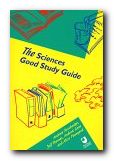
The Sciences Good Study Guide

July 12, 2009 by Roy Johnson

best-selling introduction to study skills for sciences

This is a set text on one of the Open University’s science foundation courses, and it has quite rightly become a best-seller. It’s written for maths, science, engineering, and technology students approaching further education or undergraduate courses – possibly after a long break from study. The Sciences Good Study Guide can be used as an introductory workbook or as a source of reference. It deals with reading and note-taking, essay writing, working with numbers, and preparing for examinations. The main features worth recommending are its use of realistic examples and the friendly manner in which it addresses the reader. It’s packed with practical exercises and activities, and it aims to make studying more enjoyable and rewarding.

The Sciences Good Study GuideThere is also an extra maths help section with exercises and answers which allows you to assess your own skills. It’s an invaluable source of ‘hints and tips’, helping you to learn more effectively and develop study strategies that really work. Another important feature is that it engages the reader as actively as possible by posing questions, highlighting important points, setting short quizzes, and breaking up the exposition into manageable chunks.

It contains lots of good advice on general study skills – note-taking, reading, time-management, and confidence building – but the centrepiece is a section on maths – one of the most daunting topics for most beginners. It also covers working with diagrams, flow charts, and graphs and tables; working with numbers and tables; using a computer efficiently; conducting experiments, and writing essays and reports.

The book is designed to meet the needs of a range of learners – not just those involved in distance education. It will appeal to beginning and experienced students alike, including those: starting to study at college or university; taking access or study skills courses; looking afresh at how they study.

This approach to active and [in educational jargon] ‘open’ learning is particularly suitable for anyone embarking on a distance-learning course, or students engaged in any form of independent learning. In fact there are now separate versions of these guides for arts and social sciences. At its current price this is exceptionally good value.

© Roy Johnson 2000

Sciences Good Study Guide   Buy the book at Amazon UK

Sciences Good Study Guide   Buy the book at Amazon US


Andrew Northedge et al, The Sciences Good Study Guide, Buckingham: The Open University, 1998, pp.470, ISBN: 0749234113


More on study skills
More on writing skills
More on online learning


Filed Under: Study skills Tagged With: Academic writing, Sciences, Study guides, Study skills, The Sciences Good Study Guide

The Short Story – essential works

September 21, 2009 by Roy Johnson

tutorial and guide to important texts

The short story is as old as the earliest tale-telling. Many longer narratives such as epics and myths (such as the Bible) contain short episodes which can be extracted as stories. But as a distinct literary genre, the short story came into its own during the early nineteenth century. Many writers have created successful short stories – but those which follow are the prose artists who have had most influence on its development in terms of form. We will be adding more guidance notes and examples as time goes on.


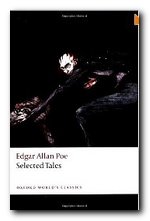
Tales of Mystery & Imagination Edgar Allen Poe is famous for his Tales of Mystery and Imagination. These are tight, beautifully crafted exercises in plot, suspense, psychological drama, and sheer horror. He also invented the detective story. This is the birth of the modern short story. Poe was writing for magazines and journals. He has a spectacularly florid style, and his settings of dungeons and crumbling houses come straight out of the Gothic tradition. He’s most famous for stories such as ‘The Pit and the Pendulum’, ‘The Black Cat’, and ‘The Fall of the House of Usher’ which vividly dramatise extreme states of psychological terror, anxiety, and what we would now call existential threat. He also theorised about the story, claiming that every part should be contributing to the whole, and the story should be short enough to read at one sitting. This edition is good because it includes the best of the stories, plus some essays and reviews. An ideal starting point.
Buy the book from Amazon UK
Buy the book from Amazon US


How short is short?

There is no fixed length for a short story. Readers generally expect a character, an event of some kind, and a sense of resolution. But Virginia Woolf got most of this in to one page in her experimental short story Monday or Tuesday. There are also ‘abrupt fictions’ of a paragraph or two – but these tend to be not much more than anecdotes.

There’s an often recounted anecdote regarding a competition for the shortest possible short story. It was won by Ernest Hemingway with an entry of one sentence in six words: “For sale: baby shoes, never worn.”

There are also quite long stories – such as those written by Henry James. If the narrative sticks to one character and one issue or episode, they remain stories. If they stray into greater degrees of complexity and develop expanded themes and dense structure – then they often become novellas. Examples of these include Herman Melville’s Billy Budd, Joseph Conrad’s Heart of Darkness and Thomas Mann’s Death in Venice.


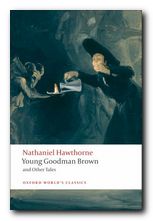
Hawthorne stories Nathaniel Hawthorne produced stories that are beautifully crafted studies in symbolism, moral ambiguity, and metaphors of the American psyche. His tales are full of characters oppressed by consciousness of sin, guilt, and retribution. They explore the traditions and the consequences of the Puritanism Europe exported to America. Young Goodman Brown and Other Stories in the Oxford University Press edition presents twenty of Hawthorne’s best tales. It’s the first in paperback to offer his most important short works with full annotation in one volume.
Buy the book from Amazon UK
Buy the book from Amazon US

A Day in the Country Guy de Maupassant brought the subject matter of the story down to an everyday level which shocked readers at the time – and can still do so now. He also began to downgrade the element of plot and suspense in favour of character revelation. He was a relative of Flaubert, a novelist manqué, and bon viveur who died at forty-three of syphilis in a madhouse. Nevertheless he left behind him an oeuvre of more than 300 stories. His tone is objective, detached, and often deeply ironic; and he is celebrated for the exactness and accuracy of his observations, and the balance and precision of his style. Although most of his stories appear at first to be nothing more than brief and rather transparent anecdotes, the best succeed in giving impressionistic but truthful insights into the hidden lives of people caught amidst the trials of everyday existence.
Buy the book from Amazon UK
Buy the book from Amazon US


Short Story Charles E. May, The Short Story: the reality of artifice, London: Routledge, 2002, pp.160, ISBN 041593883X. This is a study of the development of the short story as a literary genre – from its origins to the present day. It takes in most of the major figures – Poe, Hawthorn, James, Conrad, Hemingway, Borges, and Cheever. There’s also a very useful chronology, giving dates of significant publications, full notes and references. and annotated suggestions for further reading. Despite the obvious US weighting here, for anyone who needs an overview of the short story and an insight into how stories are analysed as part of undergraduate studies, this is an excellent place to start.
Buy the book from Amazon UK
Buy the book from Amazon US


Katherine Mansfield short storiesKatherine Mansfield is one of the few major writers who worked entirely within the short story form. Her finest work is available in just one volume. She followed Chekhov in paring down the dramatic element of the short story to a minimum, whilst raising its level of subtlety and psychological insight to new heights. Every smallest detail within her stories is carefully chosen to complete a pattern which the whole tale symbolises. She was also an early feminist in presenting many of her stories from a convincingly radical point of view. In this she was rather like her friend and contemporary, Virginia Woolf with whom she discussed the new literary techniques they were both developing at the same time. Unfortunately, Katherine Mansfield died at only thirty-five when she was at the height of her powers.
Buy the book from Amazon UK
Buy the book from Amazon US

James Joyce - Dubliners - book jacket James Joyce published Dubliners in 1916 and established himself immediately as a great writer. This has been an enormously influential collection which helped to establish the form of the modern short story. These are studies of Dublin life and characters written in a stark, pared-down style. Most of the characters and scenes are mean and petty – sometimes even tragic. Joyce had difficulty finding a publisher for this his first book, and it did not appear until many years after it had been written. It was severely attacked because the names of actual persons and places in Dublin are mentioned in it. Several of the characters introduced in Dubliners eventually reappear in his great novel Ulysses. In terms of literary technique, Joyce is best known for his use of the ‘epiphany’ – the revealing moment or experience used as a focal point for the purpose of the story.
Buy the book from Amazon UK
Buy the book from Amazon US


The Whiplash Ending

It used to be thought that the ‘point’ of a short story was best held back until the last paragraph. The idea was that the reader was being entertained – and then suddenly surprised by a revelation or an unexpected reversal or twist. O. Henry popularised this device in the US. However, most serious modern writers after Chekhov came to think that this was rather a cheap strategy. They proposed instead the relatively eventless story which presents a situation that unfolds itself to the reader for contemplation.


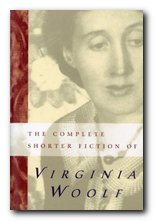
Virginia Woolf stories Virginia Woolf took the short story as it had come to be developed post-Chekhov, and with it she blended the prose poem, poetic meditations, and the plotless event. Her finest achievements in this form – Kew Gardens, Sunday or Monday, and The Lady in the Looking-glass‘ – create new linguistic worlds without the prop of a story line. These offer a poetic evocation of life and meditations on time, memory, and death. This edition contains all the classic short stories such as The Mark on the Wall, A Haunted House, and The String Quartet – but also the shorter fragments and experimental pieces such as Mrs Dalloway in Bond Street. These ‘sketches’ (as she called them) were used to practice the techniques she used in her longer fictions. Nearly fifty pieces written over the course of Woolf’s writing career are arranged chronologically to offer insights into her development as a writer. This is well presented and edited in a scholarly manner by Susan Dick.
Buy the book from Amazon UK
Buy the book from Amazon US

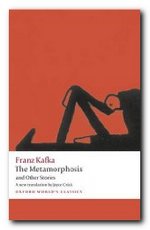
Metamorphosis Franz Kafka created stories and ‘fragments’ (as he called them) which are a strange, often nightmarish mixture of tale and philosophic meditation. Start with Metamorphosis – the account of a young salesman who wakes up to find he has been transformed into a giant insect. This particular collection also includes Kafka’s first publication – a slim volume of what he called ‘Meditations’ – as well as the forty-page ‘Letter to his Father’. It also contains the story in which he predicted the horrors of the concentration camps – ‘In the Penal Colony’. Kafka is famous for having anticipated in his work many of the modern states of psychological angst, alienation, and existential terror which became commonplace later in the century.
Buy the book from Amazon UK
Buy the book from Amazon US


Epiphanies and Moments

James Joyce’s contribution to the short story was a device he called the ‘epiphany’. Following Guy de Maupassant and Chekhov, he wrote the series of stories Dubliners which were pared down in terms of literary style and focussed their effect on a revelation. A sudden remark, a symbol, or moment epitomises and clarifies the meaning of a complex experience. This usually comes at the end of the story – either for the character in the story or for the reader. Katherine Mansfield and Virginia Woolf followed a similar route of playing down action and events in favour of dramatising insights into character and states of mind. Woolf called these ‘moments of being’.


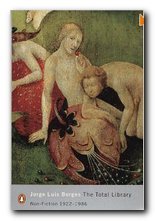
Jorge Luis Borges - The Total Library Jorge Luis Borges like Katherine Mansfield, only wrote short stories. He was an Argentinian, much influenced by English Literature. His tales manage to combine literary playfulness and a rich style with strange explorations of mind-bending ideas. He is credited as one of the fathers of magical realism, which is one feature of Latin-American literature which has spread worldwide since the 1960s. His stories often start in a concrete, realistic world then gradually slide into strange dreamlike states and end up leaving you to wonder where on earth you are, and how you got there. Funes, the Memorious explores the idea of a man who cannot forget anything; The Garden of Forking Paths is a marvellous double-take on the detective story; and Tlon, Uqbar, Orbis Tertius is a pseudo-essay concerning encyclopedia entries of an imaginary world – which begin to invade and multiply within our own. He also wrote some rather amusing literary spoofs, which are collected in this edition.
Buy the book from Amazon UK
Buy the book from Amazon US

Ernest Hemingway trained as a newspaper reporter and began writing short stories in the post-Chekhov period, consciously influenced by his admiration for the Russian novelist Turgenev. He is celebrated for his terseness and understatement – a sort of literary tough-guy style which was much imitated at one time His persistent themes are physical and moral courage, stoicism, and what he called ‘grace under pressure’. Because his stories are so pared to the bone, free of all superfluous decoration, and so reliant on the closely observed detail, they fit well within the modernist style. He once won a bet that he could write a short story in six words. The result was – ‘For sale: baby shoes. Never worn.’ His reputation as a novelist has plummeted recently, but his stories are still worth reading.
Buy the book from Amazon UK
Buy the book from Amazon US

John Cheever is a story writer in the smooth and sophisticated New Yorker school. His writing is urbane, thoughtful, and his social details well observed. What he writes about are the small moments of enlightenment which lie waiting in everyday life, as well as the smouldering vices which lurk beneath the polite surface of suburban America. This is no doubt a reflection of Cheever’s own experience. For many years as a successful writer and family man he was also an alcoholic and led a secret double life as a homosexual. His main themes include the duality of human nature: sometimes dramatized as the disparity between a character’s decorous social persona and inner corruption. His is a literary approach which has given rise to many imitators, perhaps the best known of whom is Anne Tyler. He’s sometimes called ‘the Checkhov of the suburbs’.

Nadine GordimerNadine Gordimer is one of the few modern writers who have developed the short story as a literary genre beyond what Virginia Woolf pushed it to in the early modernist phase. She starts off in modern post-Chekhovian mode presenting situations which have little drama but which invite the reader to contemplate states of being or moods which illustrate the ideologies of South Africa. Technically, she experiments heavily with point of view, narrative perspective, unexplained incidents, switches between internal monologue and third person narrative and a heavy use of ‘as if’ prose where narrator-author boundaries become very blurred. Some of her stories became more lyrical, more compacted and symbolic, abandoning any semblance of conventional story or plot in favour of a poetic meditation on a theme. All of this can make enormous demands upon the reader. Sometimes, on first reading, it’s even hard to know what is going on. But gradually a densely concentrated image or an idea will emerge – the equivalent of a Joycean ‘epiphany’ – and everything falls into place. Her own collection of Selected Stories are UK National Curriculum recommended reading.
Buy the book from Amazon UK
Buy the book from Amazon US
 

© Roy Johnson 2004


More on literature
More on the novella
More on literary studies
More on short stories


Filed Under: 19C Literature, 20C Literature, Literary studies, Short Stories, The Short Story Tagged With: Edgar Allen Poe, English literature, Ernest Hemingway, Franz Kafka, Guy de Maupassant, James Joyce, John Cheever, Jorge Luis Borges, Katherine Mansfield, Literary studies, Nadine Gordimer, Nathaniel Hawthorne, The Short Story, Virginia Woolf

  • « Previous Page
  • 1
  • …
  • 81
  • 82
  • 83
  • 84
  • 85
  • …
  • 103
  • Next Page »

Get in touch

info@mantex.co.uk

Content © Mantex 2016
  • About Us
  • Advertising
  • Clients
  • Contact
  • FAQ
  • Links
  • Services
  • Reviews
  • Sitemap
  • T & C’s
  • Testimonials
  • Privacy

Copyright © 2026 · Mantex

Copyright © 2026 · News Pro Theme on Genesis Framework · WordPress · Log in