Mantex

Tutorials, Study Guides & More

  • HOME
  • REVIEWS
  • TUTORIALS
  • HOW-TO
  • CONTACT
>> Home / Archives for 2009

Archives for 2009

Twentieth Century Russian Novels

October 2, 2009 by Roy Johnson

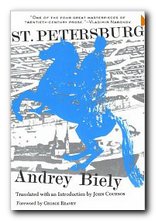
Russian novels - St Petersburgrecommended classic reading

St Petersburg (1916) Andrei Biely (pseudonym of Boris Nikolaevich Bugaev) is a much-neglected figure from the period of modernist experimentation. He was a novelist, a poet, a theorist, and literary critic. His major work is a novel with a ticking bomb (concealed in a sardine can) at its centre – a sort of meditation on violence. It’s the story of the hapless Nikolai Apollonovich, a never-do-well who is caught up in revolutionary politics and assigned the task of assassinating a certain government official — his own father. Nikolai is pursued through the impenetrable Petersburg mists by the ringing hooves of the famous bronze statue of Peter the Great. It is not unlike James Joyce’s Ulysses in its literary experimentation, and in being concerned with the events one day in one city. But the experimentation is of a different kind. Biely was a symbolist and a mystic. He uses his poetic style in this novel to bring the city to life as if it were a living, breathing being.
Russian novels - 20th Century Buy the book from Amazon UK
Russian Novels - 20th Century Buy the book from Amazon US


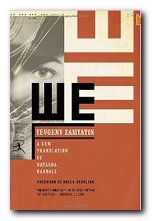
Russian novels - We - ZamyatinWe (1921) Yevgeny Zamyatin is also an unjustly neglected master of the school of experimental modernism which flourished in Russia until the early 1920s. His one novel is a very original science-fiction dystopia, and a satirical critique of the Russian revolution (which he had supported) as he saw it being betrayed by the forces of totalitarianism. It is a novel which deserves to be much better known. In a totally regulated society where people are known by numbers, two lovers embody irrational urges towards which the state is hostile. The novel was tragically prophetic of the Stalinism which was to come. It is written in a dazzlingly poetic and experimental style, and it was quite clearly the model for both Aldous Huxley’s Brave New World (1932) and George Orwell’s Nineteen Eighty-Four (1949). Both of these writers had read the novel: this, the original, is far superior. Do yourself a favour: add this to your reading list.
Russian novels - 20th Century Buy the book from Amazon UK
Russian Novels - 20th Century Buy the book from Amazon US


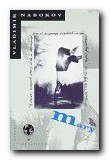
Russian novels - Nabokov - MaryMary (1923) Vladimir Nabokov is a great Russian writer, even though he left the country in flight from the revolution in his youth, and spent the rest of his life in exile, living in Germany, America, and Switzerland. In fact he wrote half of his huge output in English. He represents the playful, experimental side of modernism which the Stalinists did their best to stamp out. His writing is amazingly stylish – rich in imagery, erudite, stuffed full of verbal tricks and special effects.

Of course he is best known for Lolita, which he wrote in English whilst living in America. But he wrote novels in Russian during the 1920s and 1930s whilst living in Germany. He can be very lyrical as he is in his early novels Mary and Glory (1932) where he evokes the raptures of youthful pleasures, and the discovery of passion and loss. His lyrical prose records a young Russian exile’s recollections of his first love affair. But the woman in question clearly symbolises his relationship with Russia. He is also good at a creating a marvellous sense of awe in contemplating the quiet aesthetic pleasures in everyday events and special moments of being.
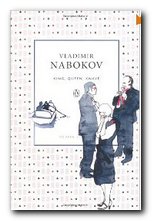
Russian novels - King,Queen,KnaveOther novels such as King, Queen, Knave show a much darker side to his nature, with its focus on adultery, deception, and cruelty. These traits are taken to an uncomfortable extreme in Laughter in the Dark (1932) which plots the downfall of a man who runs off with a young girl who, when he is rendered blind in a car accident, secretly moves her lover in to live under the same roof. The sleazy pair of them torment the protagonist in a particularly gruesome fashion. This theme of the older man driven to self-destruction by desire for a younger woman was something Nabokov explored again in The Enchanter which he wrote in Paris in 1939, and twenty years later in Lolita which he wrote in English whilst teaching in an American college.
Russian novels - 20th Century Buy the book from Amazon UK
Russian Novels - 20th Century Buy the book from Amazon US

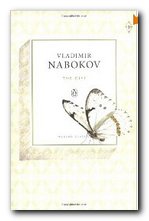
Russian novels - The Gift - NabokovThe Gift (1936) is generally held to be the greatest of Nabokov’s Russian novels. It deals with the ironies and agonies of exile. It’s also the last of the novels Nabokov wrote in his native Russian language and the crowning achievement of that period in his literary career. It’s also his ode to Russian literature, evoking the works of Pushkin, Gogol, and others in the course of its narrative, and it also has at its centre a critique of Chernyshevsky. It is the story of Fyodor Godunov-Cherdyntsev, an impoverished émigré poet living in Berlin, who dreams of the book he will someday write – a book very much like The Gift. The novel plays the most pleasurable kind of havoc with conventional notions of narrative structure and linguistic protocol. It also includes a deeply felt fictionalisation of the murder of Nabokov’s own father in 1922 whilst he was attempting to stop a political assassination.
Russian novels - 20th Century Buy the book from Amazon UK
Russian Novels - 20th Century Buy the book from Amazon US


Russian novels - The Master and MargaritaThe Master and Margarita (1940) Mikhail Bulgakov was originally a doctor. His early works The Diary of a Country Doctor and The White Guard are written in a lucid, plain style not unlike Chekhov (who was of course also a doctor). In the 1920s and 1930s Bulgakov turned to the theatre, and despite conflicts with the Stalinists at the height of their purges, he managed to survive just long enough to complete his masterpiece. The Master and Margarita is a wonderful mixture of realism and fantasy which offers a satirical view of communist Russia. The story involves the arrival of the Devil into Moscow, causing all sort of mischief and disruption. This is interspersed with chapters re-telling the story of Pontius Pilate and the crucifixion of Jesus Christ, plus other sections related to an artist and his relationships with his art and his lover. All three layers of the story are blended with spellbinding imaginative force.
Russian novels - 20th Century Buy the book from Amazon UK
Russian Novels - 20th Century Buy the book from Amazon US


Russian novels - Doctor ZhivagoDr Zhivago (1957) Boris Pasternak is principally a poet so far as Russian literature is concerned, but it is his novel by which he is best known to the general reading public in the West. He was awarded the Nobel prize for it, but forced to turn it down by the Soviet authorities. This is a sprawling epic of the Russian revolution, a passionate love story, and a memorable portrait of a doctor-poet caught up in the wheels of history. Zhivago seeks to do good and live with simple dignity, but his efforts are thwarted by war, revolution, and his love affair with Lara, who is married to a Bolshevik general. Critical opinion has been somewhat divided over this work, with some readers seeing it as no more than a nineteenth century novel in disguise. With the general reading public however, it has never lost its appeal.
Russian novels - 20th Century Buy the book from Amazon UK
Russian Novels - 20th Century Buy the book from Amazon US


Russian novels - One Day in the Life of Ivan DenisovichOne Day in the Life of Ivan Denisovitch (1962) This is the short novel that made Alexander Solzhenitsyn famous overnight. It recounts a typical day’s work, deprivation, and suffering of a prisoner in one of Stalin’s labour camps. Publication was ‘allowed’ as part of Krushchev’s post 1956 attack on Stalin and his legacy. The facts of the story were deliberately understated to meet the censor’s requirements at the time. It catapulted Solzhenitsyn to fame, and yet within a couple of years his work was banned again.

Solzhenitsyn writes in a simple, restrained style in which ornamentation is stripped away in favour of moral purpose. The results celebrate a stoical, almost puritan heroism in the face of all that the Russian people have had to endure – government-constructed poverty, war, political corruption, censorship, and totalitarian repression.
Russian novels - The First CircleThe First Circle (1968) This novel is set in a special research-cum-detention centre reserved for mathematicians and scientists who are nevertheless political prisoners. This is what might be called a novel of ideas, as the characters discuss the political and historical forces which have brought them to their present unjust imprisonment. Of the main characters, one is eventually released, another is sent off to a much harsher regime, and the third remains where he is. It is based very closely on Solzhenitsyn’s own experiences of his first period of imprisonment by the Stalinist regime.
Russian novels - 20th Century Buy the book from Amazon UK
Russian Novels - 20th Century Buy the book from Amazon US

Russian novels - August 1914August 1914 (1984) This is the first part of a multi-volume epic, a historical novel on a grand scale about the origins of the Soviet Union and how communism came to take root there. Solzhenitsyn sees the Battle of Tannenberg at the start of the First World War as the first major turning point in this process. Using a range of modernist-cum-experimental techniques, he sets in motion a huge cast of characters against the backdrop of this decisive battle. The whole enterprise was called The Red Wheel. There were further volumes in the cycle published, but towards the end of his life Solzhenitsyn transferred most of his energy into books arguing for social and political reform – rather in the same manner as Tolstoy.
Russian novels - 20th Century Buy the book from Amazon UK
Russian Novels - 20th Century Buy the book from Amazon US

Russian novels - Lenin in ZurichLenin in Zurich (1976) This is a short novel composed of some separate chapters from The Red Wheel. It focuses largely on Lenin in exile, immediately prior to his triumphant return in a sealed train to St Petersburg’s Finland Station. It’s a very interesting study, because Solzhenitsyn is clearly critical of Lenin as one of the central architects of communism – yet he narrates the story largely from Lenin’s point of view. Steeped in history, this is a major attempt at a political and psychological portrait of a historical figure.
Russian novels - 20th Century Buy the book from Amazon UK
Russian Novels - 20th Century Buy the book from Amazon US

© Roy Johnson 2009

redbtn  Nineteenth Century Russian Novels


More on literary studies
More on writing skills
More on creative writing
More on grammar


Filed Under: 20C Literature Tagged With: Literary studies, Russian literature, Russian novels, The novel, Twentieth Century Russian novels

Twentieth-century Britain: an introduction

July 14, 2009 by Roy Johnson

Politics. history, and society in 20th C Britain

This introductory history comes from a new series by Oxford University Press. They are written by specialists, aimed at the common reader, and offer an introduction to the main cultural and philosophical ideas which have shaped the western world. Kenneth Morgan’s account of Twentieth-century Britain begins with great éclat at the First World War. This was a politically much more complex issue than we are normally led to believe, and he reminds us of the contemporary political contradictions which are now often forgotten.

Twentieth-century Britain: a short introductionThen he goes on to the General Strike of 1926; the artistic influence of the Bloomsbury Group; the depressions of the 1930s; and Britain’s attempts to stay out of war until it was finally dragged into 1939 and its aftermath. It’s a slightly strange experience to read the social history of a century, much of which one has lived through oneself. If nothing else, it’s a reminder that the inevitable generalisations of a brief survey often fail to capture the depths and complexities of ‘what it was really like’.

I could hardly believe my eyes when he described the 1960s as ‘that miserable decade’ . Economically turbulent it might have been, but socially and culturally it was the most liberating, creative, and dynamic period I can ever remember.

He’s on much firmer ground when he deals with the social unrest of the 1970s and 1980s, with their strikes, high unemployment, inner city riots, and falling production.

However, the long view does have some advantages, such as helping to keep events in perspective. The Falklands/Malvinas war for example:

it seemed improbable that a war to retain these distant and almost valueless outposts, scarcely known to British people before the fighting began other than from postage stamps, would encourage a revived mystique of imperial grandeur … But the jingoism of the Falklands [triumph] petered out almost as soon as it began.

Yet I still question his overview from time to time. It seems unwise to the point of ill-judged to conclude his upbeat account of the end of the century with the image of the Millennium Dome – surely the most potent symbol of government vainglory and financial mismanagement imaginable.

But for those who want an overview, or those who would like the major themes revealed, this approach is speedy and efficient. This is a very interesting and attractive format – a small, pocket-sized book, stylishly designed, with illustrations, endnotes, suggestions for further reading, and an index.

© Roy Johnson 2005

Buy the book at Amazon UK

Buy the book at Amazon US


Kenneth O. Morgan, Twentieth Century Britain: A Very Short Introduction, Oxford: Oxford University Press, 2005, pp.128, ISBN: 019285397X


Filed Under: 20C Literature Tagged With: Cultural history, History, Literary studies, Twentieth-century Britain

Txtg: The Gr8 Db8

June 14, 2009 by Roy Johnson

text messaging analysed, described, and defended

Ever since Text messaging first began there have been moans and complaints that it was lowering standards of literacy, corrupting our youth, and bringing about the collapse of Western civilization. Even the normally rational John Sutherland, writing in the Guardian, complained about texting:

Linguistically, it’s all pigs ear … it masks dyslexia, poor spelling and mental laziness. Texting is penmanship for illiterates.

Txtg: The Gr8 Db8David Crystal has answers for every one of these common objections. Texting isn’t even that new: writing in abbreviated forms has been around for a long time. Other languages (such as Hebrew and Arabic) do not use vowels as part of their writing system. In actual fact, the amount of abbreviating and acronyms such as ROFL is quite small. And most convincing of all to me, users in other languages all follow more or less the same ‘rules’ for abbreviation.

What’s more, the use of pictograms and logographs have been around for a long time; the rebus or word puzzle is an ancient tradition in UK and other cultures; and reducing terms to their initial letters is deeply enshrined in our culture – as in pm, NATO, eg, asap, OK, and GHQ.

The same is true for omitting letters, or ‘clipping’ as it’s known technically. Mr and Mrs are cases in point. Any form of word shortening makes complete sense in an SMS system, and nobody has any problem failing to recognise Tues(day), approx(imately), biog(raphy), mob(ile), gov(ernment), poss(ible), and uni(versity.

Crystal has a good chapter on the amazing literary aspirations of the SMS poets and writers – people who compose haikus, short stories, and even serial novels using this extraordinarily restricted form.

In terms of users, women are more adept and enthusiastic than men, and another interesting feature he reveals is that text messaging was late to take off in the USA – for two reasons. One was that phone calls were cheaper there, and the other is that many people need to drive to get about, unlike European countries and Japan, where the country is smaller and more people use public transport.

The content of text messages varies from personal greetings and co-ordinating social activity to political electioneering, advertising, and even schemes to quit smoking. Crystal lists plenty of examples which I imagine will be good stimulus material for the A level students doing language projects who will find this book particularly useful.

At a more advanced level, he also looks at how other languages handle text messaging. Unsurprisingly, it turns out that all of them do more or less the same thing, though some even mix English abbreviations with their own language – which is called ‘code-mixing’. This is an example from German:

mbsseg = mail back so schnell es geht (‘as fast as you can’)

He ends by allaying the fears of all those who think text messaging lowers any kind of standards of literacy, or communication. In fact the reverse is true. And to prove that he’s done his homework he ends with a huge glossary of terms and multiple lists of text message abbreviations in eleven different languages. U cnt gt btr thn tht!

© Roy Johnson 2009

Txtg: The Gr8 Db8   Buy the book at Amazon UK

Txtg: The Gr8 Db8   Buy the book at Amazon US


David Crystal, Txtng: The Gr8 Db8, Oxford: Oxford University Press, 2009, pp.256, ISBN: 0199571333


More on digital media
More on technology
More on theory


Filed Under: Language use, Media, Slang Tagged With: Communication, Grammar, Language, Media, Technology, Text messaging, Texting

Type in Motion

May 24, 2009 by Roy Johnson

typography in graphic animations for Web and video

This book sets itself an ambitious target – to depict graphic animations of typography on the static, printed page. Bellantoni and Woollman do reasonably well under these circumstances. It’s is a high-energy, brilliantly coloured coffee-table book [with a fairly dreadful cover] – but also a serious exploration of the latest trends in type design in commercial and fine art. Double-page spreads are devoted to the work of individual artists or design agencies in this field. They cover film credits, promotions, conceptual video, early TV ads, and cinema presentations.

Graphic AnimationThe collection starts with stills from the work of film title animator Saul Bass. [Remember ‘Psycho’ and ‘The Man with a Golden Arm’? – there’s a new site for him at www.saulbass.tv]. Unfortunately, even though some pages are covered in thumbnails of the sequences, the animation element has to be spelled out in words, which somewhat defeats the object.

Some cinema animations could just as easily have been illustrated with a single frame. The examples which look most interesting on the page are the shots of orthodox typography on promotional CDs (described in artsy-hype-speak as ‘interactive press kits’) and one page of ‘Shakespeare in 3D’ where text and footnotes intersect each other at ninety degrees.

Some of the video and TV sequences on the other hand are very difficult to follow because they are reproduced in small black and white thumbnails, and the pages in general are so crowded that we are not drawn in to contemplate the typeface. Perhaps the most surprising feature of all in a study of this kind is that the typefaces used in the examples are not explored in any technical detail, but are described in generic terms – ‘sans-serif, bold, outlined’.

This is an art book, with some of the pretentiousness which often goes with this genre – for instance: “270% Confessional explores the concept of multiple linearities, functioning at several levels simultaneously. The type sequence is an exploration of memory, verbal communication, and the visualization of a conscience.”

It’s a book which in fact deserves to be a film, or at least a website with .MPGs of the effects they discuss. Nevertheless, I imagine that those people working in graphic animation will welcome this as a convenient survey and a print resource. It’s a pity that there’s no index or bibliography, which might have given it more chance of being taken seriously.

© Roy Johnson 2005

Type in Motion   Buy the book at Amazon UK

Type in Motion   Buy the book at Amazon US


Jeff Bellantoni and Matt Woollman, Type in Motion: Innovations in Digital Graphics, 2nd edn, London: Thames and Hudson, 2005, pp.176, ISBN: 0500512434


More on typography
More on digital media
More on technology
More on theory


Filed Under: Media, Typography Tagged With: Animated graphics, Design, Media, Multimedia, Typography

Typography bibliography

October 30, 2009 by Roy Johnson

Typography bibliography   Gavin Ambrose & Paul Harris, The Fundamentals of Typography, Lausanne: AVA, 2006, pp.176, ISBN 2940373450.

Typography bibliography   Tom Arah, Web Type: Start Here!, Lewes: ILEX, 2004, pp.192, ISBN: 1904705189.

Typography bibliography   Jeff Bellantoni and Matt Woollman, Type in Motion: Innovations in Digital Graphics, 2nd edn, London: Thames and Hudson, 2005, pp.176, ISBN 0500512434

Typography bibliography   John D. Berry, dot-font: talking about fonts, New York: Mark Batty Publishing, 2006, pp.126, ISBN: 0977282708

Typography bibliography   Charles Bigelow, Paul Hayden Duensing, and Linnea Gentry (eds) Best of Fine Print on Type and Typography, San Francisco: Fine Print/Bedford Arts, 1988.

Typography bibliography   Lewis Blackwell, Twentieth Century Type, Rizzoli International Publications/Calmann & King, 1992, pp.256, ISBN 084781596X

Typography bibliography   Lewis Blackwell, 20th Century Type: Remix, London: Lawrence King, 1998, pp.191, ISBN 1856691160. New edition of a historical survey of 100 years of innovation in typographic design – presented in elegantly publication which has become a favourite amongst designers.

Typography bibliography   Lewis Blackwell and David Carson, The End of Print: The Graphic Design Of David Carson, Chronicle, 1995, pp.160, ISBN: 0811811999. California dreaming. Father of ultra-distressed type. Carson came to fame by designing Raygun and has remained popular with the avant garde ever since.

Typography bibliography   Lewis Blackwell and David Carson, David Carson: 2nd Sight: Grafik Design After the End of Print, Universe Books, 1997, pp.176, ISBN: 0789301288. Follow-up to best-selling title above. More of Carson’s influential work – where type and graphics begin to merge with each other.

Typography bibliography   Joseph Blumenthal, The Printed Book in America, Boston: David R. Gondine, 1997.

Typography bibliography   Alexander Branczyk et al, Emotional Digital: A sourcebook of contemporary typographics, London: Thames & Hudson, 2001, pp.312, ISBN 0500283109. Showcase presentation of modern type design from the best of today’s studios – both traditional and avant-gard. Examples shown in wide range of applications. Beautifully produced book.

Typography bibliography   Robert Bringhurst, The Elements of Typographic Style (2nd edn), Vancouver: Hartley & Marks, 1996, pp.351, ISBN 0881791326. The Bible of typography. Beautifully designed and poetically written encyclopedia of all things typographic. Impossible to recommend this book too highly.

Typography bibliography   Christopher Burke, Paul Renner: the art of typography, London: Hyphen Press, 1999, pp.223, ISBN 1568981589. Scholarly biography of the designer of the Futura typeface. Mixes graphic design issues with politics and social history. Elegantly produced and well illustrated.

Typography bibliography   Sebastian Carter, Twentieth Century Type Designers, New York: W.W.Norton, (new edition) 1995.

Typography bibliography   Warren Chappell, A Short History of the Printed Word, New York: Alfred A. Knopf, 1970.

Typography bibliography   Carl Dair, Design With Type, Toronto: University of Toronto Press, 1982.

Typography bibliography   Geoffrey Dowding, Finer Points in the Spacing and Arrangement of Type, (Revised edition), Vancouver: Hartley & Marks, 1995, pp.96, ISBN 0881791199. Does what it says on the tin. Dowding reflects on the more subtle points of punctuation and letter spacing. Elegant, restrained, and well-produced.

Typography bibliography   William Addison Dwiggins, Layout in Advertising, New York: Harper and Brothers, 1948.

Typography bibliography   James Felici, The Complete Manual of Typography, Berkeley (CA): Peachpit Press, 2003, pp.360, ISBN 0321127307.

Typography bibliography   Adrian Frutiger, Type, Sign, Symbol, Zurich: ABC Verlag, 1980.

Typography bibliography   Simon Garfield, Just My Type, London: Profile Books, 2010, pp.352, ISBN: 1846683025

Typography bibliography   Eric Gill, An Essay on Typography, London, 1936, reissued Boston: David R. Godine 1993, pp.144, ISBN: 0879239506. Gill’s essay is a slightly quirky plea for the aesthetics and morals of good design principles. This has become a design classic. Produced in Gill’s own typeface – Johanna.

Typography bibliography   Bob Gordon and Maggie Gordon, The Complete Guide to Digital Graphic Design, London: Thames and Hudson, 2002, pp.224, ISBN 050028315X. Typography is only one part of this survey of contemporary design – but the book is so beautifully illustrated and produced, it acts as an excellent example of page structure and layout.

Typography bibliography   Bob Gordon, Making Digital Type Look Good, London: Thames and Hudson, 2001, pp.192, ISBN 0500283133. Beautifully designed and elegantly printed study. Includes the anatomy of type, rendering, technology, and fine tuning. Clarifies all the complexities of font technology in a very straightforward manner – showing how tracking, kerning, and hyphenation can be used to good effect.

Typography bibliography   Nicolette Gray, A History of Lettering: Creative Experiment and Letter Identity, Boston: David R. Gondine, 1986.

Typography bibliography   Robert Harling, The Letter Forms and Type Designs of Eric Gill, Boston: David R. Gondine, 1977.

Typography bibliography   New Hart’s Rule for Compositors and Readers, London: Oxford University Press, 1999, pp.182, ISBN 019212983X. Compact style guide to typographical and presentational niceties – from punctuation and spacing, to hyphenation, foreign words, symbols, and proof-correction.

Typography bibliography   Oldrich Hlavsa, A Book of Type and Design, New York: Tudor Publishing, 1960.

Typography bibliography   Richard Hollis, Graphic Design: a concise history, London: Thames and Hudson, 1994, pp.224, ISBN: 0500202702. Compact, well-illustrated, and good-value history of twentieth century design – including graphics and typography.

Typography bibliography Sally Hughes, Design and Typography, Computer Step, 1998, pp.193, ISBN 1840780045. Well-illustrated and simple introduction to typography and desk top publishing – every point illustrated by examples.

Typography bibliography   Indie Fonts, Buffalo, NY: P-Type Publications, 2002, pp.408, ISBN: 0963108220. Beautifully produced collection of over 2000 fonts from eighteen of the most innovative independent type designers.

Typography bibliography   W. Pincus Jaspert, W. Turner Berry, and A.F. Johnson, The Encyclopaedia of Type Faces, New York: Blandford Press, 1986.

Typography bibliography   Rob Roy Kelly, American Wood Type, New York: Van Nostrand Rheinhold, 1969.

Typography bibliography   Robin Kinross, Modern Typography: An Essay in Critical History, Chronicle Books/Princeton Architectural Press, 1996, pp.208, ISBN 0907259057.

Typography bibliography   Alexander Lawson, Anatomy of a Typeface, London: Hamish Hamilton, 1990, pp.428, ISBN 0241132673.

Typography bibliography   Alexander Lawson, Printing Types: An Introduction, Boston: Beacon Press, 1971.

Typography bibliography   Ellen Lupton, Thinking with Type: A critical guide for designers, editors, and students, New York: Princeton Architectural Press, 2004, pp.176, ISBN 1568984480

Typography bibliography   Mac McGrew, American Metal Typefaces of the Twentieth Century, New Castle Delaware: Oak Knoll Press, 1993.

Typography bibliography   Ruari McLean, The Thames and Hudson Manual of Typography, Thames and Hudson, 1980, ISBN 0500680221. Popular, good-value, and well illustrated general introduction to typography. Covers all aspects of the craft, but ends with focus on book design.

Typography bibliography   Ruari McLean, Jan Tschichold: Typographer, Boston: David R. Gondine, 1975.

Typography bibliography   Stanley Morison, Letterforms, Montreal: Hartley and Marks, 1997, pp.128, ISBN 0881791369

Typography bibliography   Stanley Morrison, First Principles of Typography, New York: The Macmillan Company, 1936.

Typography bibliography   Stanley Morrison, A Tally of Types, Cambridge: Cambridge University Press, 1973.

Typography bibliography   Robert Norton, Types Best Remembered/Types Best Forgotten, Parsimony Press, 1993, ISBN 1884606008. Collection of well-known typefaces, complemented by negative and positive criticism.

Typography bibliography   Bruce Rogers, Paragraphs on Printing, New York: Dover Publications, 1979.

Typography bibliography   Julian Rothenstein and Mel Gooding (eds), 130 Alphabets and Other Signs, London: Thames and Hudson, 1993, pp.183, ISBN 0500277419. A charming sample book of signs, symbols, alphabets, rules, swashes, and pictograms. Highly recommended.

Typography bibliography   Julian Rothenstein and Mel Gooding (eds), A B Z: More Alphabets and Other Signs, London: Redstone Press, 2003, pp.221, ISBN:1870003330. Another charming sample book of font sets, signs, symbols, alphabets, rules, swashes, and pictograms. Highly recommended.

Typography bibliography   Rosemary Sassoon, Computers and Typography, Oxford: Intellect, 1993, pp.164, ISBN 1871516234. Articles on text massage; layout and readability; new alphabets using bitmapped fonts; the history of typography and its effects; the visual analysis of a page of text; and Sassoon’s essay on perception and type design related to writing for children.

Typography bibliography   Rosemary Sassoon, Handwriting of the Twentieth Century, London: Routledge, 1999, pp.208, ISBN 0415178827. Developments in the teaching and study of handwriting over the course of the 20th century. A historical record of techniques, styles and methods. Beautifully illustrated with examples – from guidance manuals, schoolbooks, clerks’ registry entries, and personal handwriting.

Typography bibliography   Erik Spiekermann & E.M. Ginger, Stop Stealing Sheep and find out how type works, Adobe Press/Hayden Books, 1993, ISBN 0672485435. Very popular introduction to the general principles of typography. Well designed and illustrated.

Typography bibliography   Walter Tracy, Letters of Credit: A View of Type Design, Boston: David R. Godine, 1986, ISBN 0879236361.

Typography bibliography   Jan Tschichold, Asymmetric Typography, London: Faber & Faber, 1967.

Typography bibliography   Jan Tschichold, The Form of the Book: Essays on the Morality of Good Design, Vancouver: Hartley & Marks, 1991, pp.181, ISBN 0881791164. Short essays from Tschichold’s ‘late’ period on some of the most fundamental issues of arranging type on paper. Eloquent opinions on page shape, margins, text spacing, and even blank pages.

Typography bibliography   Jan Tschichold, The New Typography: A Handbook for Modern Designers, Berkeley: University of California Press, 1995, pp.236, ISBN: 0520071476. Manifesto of the modernist movement. Tschichold’s ‘early’ period, politically committed argument for ‘form follows function’. Original illustrations, and printed in period style.

Typography bibliography   Jan Tschichold, Treasury of Alphabets and Lettering: A Source Book, W.W. Norton, 1995, pp.236, ISBN 0393701972.

Typography bibliography   D.B. Updike, Printing Types: Their History, Forms and Use, New York: Dover Publications, 1980.

Typography bibliography   Hugh Williamson, Methods of Book Design: The Practice of an Industrial Craft, New haven: Yale University Press, 1985.

Typography bibliography   Adrian Wilson, The Design of Books, San Francisco: Chronicle Books, 1995, pp.159, ISBN 081180304X.

Typography bibliography   Jon Wozencroft, The Graphic Language of Neville Brody, London: Thames & Hudson, 1988, pp.160, ISBN 0500274967. Comprehensive survey of Brody’s graphics and typography – in two very popular and well-illustrated volumes. Best-seller.

© Roy Johnson 2009


More on typography
More on technology
More on digital media


Filed Under: How-to guides, Typography Tagged With: Bibliographies, Design, Fonts, Typography

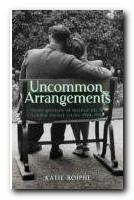
Uncommon Arrangements

July 16, 2009 by Roy Johnson

married life in London literary circles 1900-1939

Most people know about the strange personal relationships which existed amongst the Bloomsbury Group, of whom it was said that they were a “a circle of friends who lived in squares and loved in triangles.” But the truth is that many other people in the artistic and literary circles of the period 1910-1930 were making what might politely be called ‘experiments in living’, or less politely, ‘having your cake and halfpenny as well’. In Uncommon Arrangements Katy Roiphe takes six examples of marriages and partnerships which were tested almost to the limit. These people were consciously overthrowing the restraints they felt Victorian and Edwardian mores were placing upon personal liberty – particularly the right to have sex with whoever one chose.

Uncommon ArrangementsHer examples include H.G.Wells whose wife Jane tolerated his long string of mistresses, including Rebecca West, the one featured here. Katherine Mansfield gave as good as she got from her faithless husband John Middleton Murry. The feisty Elizabeth von Armin (Katherine Mansfield’s cousin) clung masochistically to Earl Russell, even whilst he treated her with disdain and physical violence. Vanessa Bell lived with her lover Duncan Grant, who was a homosexual. Una Troubridge performed a slavish role as wife and helpmeet to her lesbian ‘husband’ Radcliffe Hall, whilst Hall (who called herself ‘John’) enjoyed a nine year affair with a young Russian Evguenia Souline.

The examples might reflect only the author’s tastes and enthusiasms, but in all of them the men come out worst as monsters of egoism, opportunism, double standards, and worse.

H.G. Wells treated his wife like a doormat, pleading that she could not meet his sexual needs, and all the time protesting that he loved her dearly. John Middleton Murry left his wife Katherine Mansfield on her own when she was suffering a terminal illness, and wrote endless letters saying how much he missed her. And Earl Russell (Bertrand Russell’s brother) engaged not one mistress alongside his marriage, but two. The same was true of Philip Morrell, who announced to his wife Ottoline that both his mistresses were pregnant, in the hope she would help him out of an embarrassing scrape – which she did.

The one exception she explores is Vanessa Bell, who managed to keep her husband Clive Bell, her lover Duncan Grant, and her ex-lover Roger Fry co-existing as friends together under the same roof without any overt friction.

Katy Roiphe reveals the facts and recreates dramatic episodes of these people’s lives in a successful journalistic manner, but when it comes time to analyse contradictory behaviour she often retreats behind rhetorical questions. Why did X tolerate this? Why did Y never leave him/her?

Her evidence for these accounts comes from what they left behind in letters and diaries. This is a slightly risky procedure, because what they said needs to be placed in its context. The motivation for saying something needs to be taken into account, and contradictions with other evidence noted.

But there’s a more obvious and serious weakness in her approach: it’s that she fails to recognise the legal and economic basis of marriage, and (to quote Frederick Engels) its relationship to the family, private property, and the state. She is more interested in comparing these social pioneers with the plight of contemporary relationships. As she rightly observes

Marriage is perpetually interesting; it is the novel that most of us are living in.

Of course, as Victoria Glendenning has observed, “physical fidelity was not greatly valued in the marriages of the British upper classes” – which is true, so long as the all-important conventions of inheritance are not disturbed. The niceties and social concerns of who couples with whom are something of a smokescreen; they are the superstructure of which concern for preserving inherited capital are the base. And as soon as we look at the economic foundations of these relationships, many of the mysteries evaporate immediately.

Jane Wells tolerated her husband’s flagrant infidelities because he was rich and kept her in economic security. Elizabeth von Armin kept the receipts for items she purchased for her own home, so as to be able to prove ownership in the event of a dispute with her husband Earl Russell – a dispute which did eventually take place in the courts of law.

Una Troubridge clung to her humiliating position as Radcliffe Hall’s lesbian ‘wife’ for nine years, and was rewarded by being made Solo Executrix to Hall’s will – whereupon she took economic revenge on her former rival.

In fact these cases of strange arrangements could have been made more acutely with other examples. She could have included Harold Nicolson and Vita Sackville West, as well as Leonard and Virginia Woolf, both of whose marriages tolerated sexual plurality (though Virginia’s tolerance was never tested) as well as the most extraordinary union between Dora Carrington and Ralph Partridge, who lived together with the man they both loved, Lytton Strachey.

It might be that the solution found by Harold Nicolson and Vita Sackvill-West was easier to tolerate. They both had lovers of the same sex. Does this leave people less existentially threatened? (to sound for a moment like Katie Roiphe). But when Vita ‘eloped’ with Violet Trefusis, Nicolson and Dennis Trefusis chartered an airplane and flew across the Channel to bring them back.

This book raises a number of contentious issues which are still of interest today. Ho does one reconcile the desire for sexual freedom with the comforts and protection of pair-bonded monogamy? Can women ever have the same sort of freedoms as men unless they have economic independence?

It’s a readable and very stimulating narrative, but it lacks a serious theoretical underpinning – though she does in the end show that many of her chosen examples, no matter how radical they appeared to be on the surface, were at a structural level clinging to the Victorian conventions they thought they were rebelling against. After all, the Bloomsbury radicals were still summoned to breakfast, luncheon, and dinner by bells rung by servants at fixed times throughout the day.

But readers who don’t already know the shenanigans and the apparently ‘curious arrangements’ of this sub-group will be very entertained. This book doesn’t pretend to answer any of these questions, but it presents examples of pioneers who thought the struggle worth fighting for.

© Roy Johnson 2008

Uncommon Arrangements Buy the book at Amazon UK

Uncommon Arrangements Buy the book at Amazon US


Katie Roiphe, Uncommon Arrangements, London: Virago, 2008, pp. 343, ISBN 1844082725


More on lifestyle
More on biography
More on the Bloomsbury Group


Filed Under: Bloomsbury Group, Lifestyle Tagged With: 20C Literature, Biography, Bloomsbury Group, Cultural history, Lifestyle, Marriage, Uncommon Arrangements

Understanding Comics

July 8, 2009 by Roy Johnson

the techniques, philosophy, and interpretation of comics

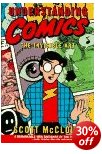
Whenever there is a discussion or an exchange of messages concerning comics or visual narratives, one name crops up again and again – Scott McCloud. Understanding Comics is his now classic work on the comic designer’s art. It’s presented in the form of a comic itself – but don’t let that fool you. He could just as easily given his book the sub-title ‘The Philosophy of Graphic Narratives’. He starts with a chapter defining what comics are (sequential visual art) and shows something of their history, going back as far as Egyptian wall paintings in 1300 BC.

Understanding ComicsIf at first this seems rather obvious or over-simplified, two or three pages into chapter two, he is discussing the theory of visual perception and the nature of iconic language. Next comes the sequencing of action and the decision of what goes into (and what can be left out of) each visual panel of a comic. There’s a very interesting comparison of American and Japanese techniques in which he argues that some of the special effects of the Manga comics arise from different traditions of perception in the East.

He explains the depiction of time and motion via the panel or frame. In fact after doing the same thing for emotion by the use of symbols, he extends his argument to claim that we are in an age where a whole new visual language is in the process of being invented.

The traditional modes of dealing with narrative via showing and telling are demonstrated by the same story being related via pictures and words, then re-combined to show the comic creator’s skill in offsetting one medium against the other to avoid tautology and maximise expressive density.

This is a book which will entrance any comic lovers or anybody who has an interest in media studies or how ideas and stories are transmitted.

Quite a lot of these issues of graphics, narrative, point of view, and are now an active part of online, web-based information. I’m sure he will be aware of that, and I’m sure he will take it into account in any future editions.

He ends with what is obviously a heartfelt plea that comics should be taken seriously as a cultural genre, and he extends this to claim that they haven’t yet even scratched the surface of what they are capable of expressing.

© Roy Johnson 2000

Understanding Comics Buy the book at Amazon UK

Understanding Comics Buy the book at Amazon US


Scott McCLoud, Understanding Comics, New York: HarperCollins, 1994, pp.217, ISBN 006097625X


More on art
More on media
More on design


Filed Under: Art, Graphic design, Media Tagged With: Comics, Design, Graphic design, Media, Media theory, Narratives, Theory, Understanding Comics

Understanding Media

July 9, 2009 by Roy Johnson

re-issue of classic 1960s media studies text

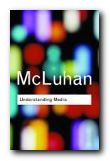
This is the book which made McLuhan famous with the phrase ‘The medium is the message’. Understanding Media was issued as a warning to the many pundits who refused to take seriously what we now call ‘media studies’ – though his range was much wider than just communication. The first part is a critique of contemporary culture – ‘electric’ as he calls it. Much of this is couched in rash generalisations and dressed up in some of his slightly batty distinctions – such as those he makes between ‘hot’ and ‘cool’ media. All this is steeped in a rich soup of cultural references. On any single page you might be taken from Matthew Arnold and Edward Gibbon, to de Tocqueville, E.M. Forster, and the World Health Organisation.

Understanding MediaThe second part consists of meditations on cultural phenomena ranging from clothing and money, to transport, comics, radio, and the telephone. These tend to be thought-provoking and patchy rather than systematic – but it has to be remembered that reflections on the cultural significance of television shows, advertising and motor cars was something of a novelty forty years ago.

Since all media are extensions of ourselves, or translations of some parts of ourselves into various materials, any study of one medium helps us to understand all the others.

He has interesting observations to make on anything from clocks and bicycles to advertising and weapons – and these are often delivered in a witty and epigrammatic manner.

There’s a lot of generalising about the relationship between technology and history (or ‘civilization’ as it was still called back then) and he places a great deal of reliance on books such as Arnold Toynbee’s A Study of History and Louis Mumford’s The City in History.

His reflections on the typewriter made me wish he had lived long enough to comment on the word-processor and the computer – surely two of the most powerful and widely used devices of the ‘electronic age’. This is a lively and a thought-provoking book. If you didn’t read it first time round, this is a good chance to catch up.

© Roy Johnson 2003

Understanding Media   Buy the book at Amazon UK

Understanding Media   Buy the book at Amazon US


Marshall McLuhan, Understanding Media, (first published 1964) London: Routledge, 2001, pp.392, ISBN: 0415253977


More on digital media
More on technology
More on theory


Filed Under: Media, Theory Tagged With: Communication, Marshall McLuhan, Media, New media, Theory, Understanding Media

Understanding Virtual Universities

July 15, 2009 by Roy Johnson

course design and construction for online learning

Teachers in higher education are under increasing pressure to develop novel methods of learning, to understand the latest developments in IT, and to make their courses available on line. The purpose of Understanding Virtual Universities is to help them gain an overview of what is involved. Roy Rada is very good at giving the overall picture – explaining the architecture of a university-wide learning program. He also describes in detail the courseware production cycle, and the role that individuals play in the process. He arranges his contents into four parts: virtual learning in relation to the student, the teacher, the administrator, and society in general. He explains the benefits of group and collaborative learning.

Understanding Virtual UniversitiesThis is undoubtedly fine in theory, but I sometimes felt that he didn’t take much account of real practice. My own experience suggests that students are often reluctant to engage in collaborative projects – particularly with people they hardly know. The most convincing example he describes is the group hypertext project on Tennyson’s In Memoriam – the long Victorian poem divided into sections to which are linked related documents, commentary, and criticism. This leaves behind a project which can still be accessed at the University of Virginia.

The experiments on which he reports make it quite clear that IT is most effective when it is combined with other, mixed learning activities in what he calls ‘studio’ classes. In this respect, I was rather surprised that he doesn’t cover any of the better-known Virtual Learning Environments (VLEs) such as WebCT, Blackboard, and Learnwise.

For any teachers thinking of developing such courseware there are some detailed reports on the testing and results achieved – in courses ranging from Geography to ‘Design and Analysis of Algorithms.’ There’s a chapter on the history of teaching methods which I feared might be boring but which offered a fascinating survey, ranging from ancient Egypt to Web-based archives in the modern university.

He also includes a consideration of which subjects are best served by online courses – and he even looks the funding and cost-benefits of online learning, as well as the consequences of pursuing these innovations at the same time as maintaining quality assurance.

This leads into a consideration of the IT systems educational organisations need to have in place to deal with student records, finance, and administration. He then explores the partnerships and collaborative schemes between education and businesses which are providing courses for employees in the workplace. This also includes a consideration of revenue opportunities in the form of consultancies, franchises, and specialist publishing.

His range is wide, and he is very well informed. If there’s a weakness it’s that he flits around from one topic to another rather quickly, never exploring any issue in depth. But that’s also the strength of the book, because he cover all aspects of running Web-based learning in an institution. Many people might have a deep knowledge of one aspect of Web-based learning, but few people have an overview.

© Roy Johnson 2002

Buy the book at Amazon UK

Buy the book at Amazon US


Roy Rada, Understanding Virtual Universities, Bristol: Intellect, 2001, pp.122, ISBN: 1841500526


More on online learning
More on technology
More on digital media
More on web design
More on computers


Filed Under: Online Learning Tagged With: Course design, Education, eLearning, Online learning, Technology, Understanding Virtual Universities

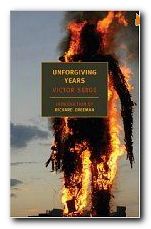
Unforgiving Years

October 22, 2009 by Roy Johnson

revolutionary hopes betrayed

Victor Serge is one of the most undeservedly neglected writers of the twentieth century. In his introduction to this recent translation of Unforgiving Years, Serge scholar Richard Greeman speculates that this might be because he cannot be easily categorised into any national literary tradition. Serge was born of Russian emigré parents in Brussels. He travelled widely throughout Russia and Europe as a revolutionary, and he wrote in French. Indeed, this linguistic fact may well have saved his life, because he was one of the few Oppositionists in Stalin’s reign of terror who was given permission to leave the Soviet Union – largely as a result of an international protest organised in France.

Unforgiving YearsUnforgiving Years is one of his last great works, written in exile in Mexico around the same time as Memoirs of a Revolutionary and The Case of Comrade Tulayev. It covers the years 1939-1945 and is split into four distinct sections, each one of which illustrates a facet of ‘Midnight in the Twentieth Century’ as Europe was plunged into horrifying conflicts dominated (at first) by two conflicting forms of totalitarianism. The first section is set in Paris at an unspecified period just before the outbreak of war.

Two secret agents, Sasha and Nadine, decide they no longer believe in the infallibility of the Party and its policies, and they decide to escape – knowing that they will be hunted down and possibly assassinated by agents – as many people were at the time. Every move they make is fraught with danger, and they fear betrayal at every step – even from each other. The Spanish civil war has ended in defeat, the liberal democracies are capitulating before the threat of Nazism, and Stalin is purging everyone in his wake – even including leading intellectuals and his best military commanders, just when he will need them most.

In part two, one of their comrades is sent on a mission to a frozen Leningrad besieged by the Germans in 1941 – to endure unimaginable hardships in support of one corrupt regime resisting another. Although Serge’s sympathies are clearly with the Russian people and not with the Stalinist aparatchicks, he might not have known at the time of writing that Stalin turned out to be responsible for killing more Russians than Hitler.

Daria – the only character to appear in all four parts of the book – tries hard to be a loyal Party agent, but she cannot stop herself questioning the perverted logic of any means, no matter how corrupt, justifying some theoretical ends. She cannot rid herself of humane sympathies for the people she sees suffering around her. In a novelistic sense she stands in for Serge himself, desperately trying to locate a set of values which will accommodate both aspirations towards democratic socialism and a liberal humanism which she can hardly even admit to herself.

Part three takes place in a Berlin devastated by allied carpet bombing as the Reich nears its apocalyptic end. Daria has volunteered for a mission behind enemy lines, working as a nurse under an assumed identity. Serge’s skill in this section is to recount the events from the points of view of loyal (non-Nazi) Germans, their belief in the war almost at breaking point. All the official news is ridiculously optimistic propaganda, and the entire population is surrounded by officials with orders to root out and destroy the slightest signs of doubt in the Fuhrer’s omnipotent wisdom – just as was happening in the East.

Throughout all the horrendous conditions he describes, the Comrades all behave impeccably – with only their ideological doubts bringing them down to the level of normal human beings. Of course they reflect the intellectual journey which Serge had made himself. But it should be borne in mind that the saintly Daria/Erna, whilst sleeping with young men out of compassion and tending war-shattered enemies in her capacity as a spy behind the front line, is in fact reporting back to a regime which was systematically slaughtering its soldiers who had come back from fighting the Nazis because they might have been tainted with democratic ideas – and were actually accused of being German spies. The Comrades can be admired for their aspirations, but they clung on to their allegiances for too long – though of course it’s easy for us to say that now.

In part four Daria has finally broken ranks with the Party and escapes to the New World to start a new life. She eventually locates Sasha and Nadine, who have retired to run a plantation in rural Mexico – hidden away from everyone. Sasha has resolved his ideological dilemma by making a connection with the primitive forces of an almost prehistoric world, yet he still wonders ‘Where did we go wrong?’ Nadine has ‘retreated’ into a mild form of schizophrenia. But just as they have feared all along, the Party will not forgive recusants, and a visiting archeologist turns out to be a Stalinist agent. He infiltrates himself into their confidence, poisons Sasha and Daria, then moves on to his next assignment.

It’s possibly the bleakest of all Serge’s novels – and no wonder. He himself was still being pursued by Stalin’s agents when he died (of a heart attack) in Mexico in 1946. Anyone not used to his narrative techniques might find the story difficult to follow. He was trying to escape the form and the methods of the traditional bourgeois novel by downgrading the individual in favour of the mass – a theory he expounds in Literature and Revolution. Fortunately he never quite managed it, but since he also fused his narrative with a poetic lyricism, the results are magnificent.

Unforgiving Years Buy the book at Amazon UK

Unforgiving Years Buy the book at Amazon US

© Roy Johnson 2009


Victor Serge, Unforgiving Years, New York: New York Review Books, 2008, pp.341, ISBN 1590172477


More on Victor Serge
Twentieth century literature
More on biography


Filed Under: Victor Serge Tagged With: Literary studies, The novel, Unforgiving Years, Victor Serge

  • « Previous Page
  • 1
  • …
  • 86
  • 87
  • 88
  • 89
  • 90
  • …
  • 103
  • Next Page »

Get in touch

info@mantex.co.uk

Content © Mantex 2016
  • About Us
  • Advertising
  • Clients
  • Contact
  • FAQ
  • Links
  • Services
  • Reviews
  • Sitemap
  • T & C’s
  • Testimonials
  • Privacy

Copyright © 2026 · Mantex

Copyright © 2026 · News Pro Theme on Genesis Framework · WordPress · Log in