Mantex

Tutorials, Study Guides & More

  • HOME
  • REVIEWS
  • TUTORIALS
  • HOW-TO
  • CONTACT
>> Home / Archives for 2009

Archives for 2009

Remix: The Copyright Wars

December 22, 2009 by Roy Johnson

Making Art and Commerce Thrive in the Hybrid  Economy

Lawrence Lessig is a lecturer in law at Harvard University and a leading authority on copyright and intellectual property rights in the digital age. He helped to found the Creative Commons movement, and he’s a former member of the Electronic Freedom Foundation. His works are a passionate defence of the rights of the individual to the creativity of the past, and a crusade against those forces which try to limit the free exchange of information. Remix: The Copyright Wars is his manifesto on the topic.
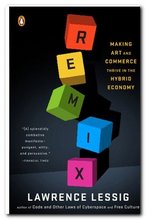
Copyright warsThis is the latest in a long line of books he has written in support of such causes – explaining in non-legal language the way in which human rights have been eroded by the vested interests of big business. Whilst upholding the right of all content originators to make a living from what they create, he believes that the current copyright laws restrict the free exchange of information. He also argues that all creativity builds on the creativity of the past, and it is modern technology which has democratised and speeded up the process.

In the past, you could own the ‘source code’ to Shakespeare’s works, but only printing press owners could make copies. Now, as soon as something becomes digitised, any kid in his back bedroom can copy at will. This has given rise to a panic over copyright, which he explores in some depth.

First of all he examines the ‘war against piracy’ in the American courts by a close inspection of the terms in which it is commonly pursued:

In my view, the solution to an unwinnable war is not to wage war more vigorously. At least when the war is not about survival, the solution to an unwinnable war is to sue for peace, and then to find ways to achieve without war the ends that the war sought.

You would almost think he was talking about the Americans in Afghanistan – but no, this is the ‘copyright wars’.

He cites many examples where companies have paid out legal fees ten times greater than the lost revenue they were seeking to recoup.

He agrees with Chris Anderson and Cory Doctorow that the Nay-sayers and prophets of doom on all this are wrong. The future is not likely to be an either/or choice between prohibition and control versus unbridled anarchy. It’s much more likely to be a creative symbiosis of past and future technologies.

He then addresses the central theme of the book – how much is it possible to quote from someone else’s work in a new work for private or public consumption? The rules and general practice are quite different, depending on the medium. With printed text it is a perfectly normal, accepted practice to quote from someone else’s work. In fact academic writing specifically requires a knowledge and accurate quotation of previous works in the same subject.

But use the same approach with audio recordings and you’ll end up with a solicitor’s ‘cease and desist’ letter from Sony or Decca. And his argument is that this restriction is a brake on both creativity and freedom of information.

On mixed media he also makes the very good point that the sort of well-edited video clips with over-dubbed sound tracks shown in TV political satire (and now on blogs) are more effective than long-winded essays taking 10,000 words to make the same point.

Most people today don’t even have time to read long articles. They get their information in much shorter chunks. As he puts it, very pithily – “text is today’s Latin”. It’s an extreme view, but you can see his point.

A propos of which, he also practices what he preaches. He developed a style of presentation which uses rapid display of short, memorable phrases or pictures. Here’s an example which takes a while to load, but is well worth the wait. It’s quite old now, but it demonstrates a technique of presentation which will not date: sound and text being used together for maximum effect.

One thing about his writing I found quite inspiring is that for every bold proposition he makes, he looks at the possible objections to it. (In fact a whole section of his web site is devoted to criticisms of his work.)

He makes a profound distinction between what he calls read-only (RO) and read-write (RW) culture. Both are important, but they have the difference that RO encourages passive reception, whereas RW encourages a written, that is a creative response. This leads him to argue for the enhanced value of all ‘writing’ – by which he means not only text, but the manipulation of other media, such as the audio and video files which are the stock-in-trade of the mashup artists.

His point is that these collage-type works are definitely not examples of parasitic imitation, and that in almost all cases they reveal a skilled appreciation of the medium.

The second part of the book is an investigation of eCommerce – conducted at a level just as radical and profound. He looks Google, Amazon, and Netflix as examples of businesses that have become successful by defying the normal laws of commerce. They allow other companies to share their information, and in Amazon’s case they even allow competitors onto their site. By doing this they make more money, and they control more of the field.

For the sake of those people who didn’t catch it first time round, he explains Chris Anderson’s Long Tail Principle. He then looks at the ‘sharing economies’ to which the Internet has given birth – the Open Source projects and the Wikipedias which exist on the voluntary efforts of volunteers.

Next he passes on to what he calls the ‘hybrid economies’ – companies such as Slashdot and Last.fm who offer a community but make money by advertising revenues. The subtle distinctions between these different models have to be handled carefully – otherwise sensibilities (and revenue streams) might be affected.

He looks at the ethical and practical conflicts between Old and New economies – those based on greed and naked competition, and those based in the ‘hybrid’ sector of sharing and cooperation. Eventually this takes us back to the issue of copyright, where he has some radical proposals for reform.

The first is that basically all genuinely amateur use of copyrighted material should be exempt from prosecution. It is pointless issuing legal writs against some kid sampling and posting on YouTube. The second is a suggestion that copyright is returned to its original status – a fourteen year term which is renewable if the owner so wishes.

Next comes a suggestion called ‘clear title’ – which means that the item being copyrighted needs to be clearly defined. Then comes the de-criminalisation of P2P file sharing, and the end of prosecuting sampling and mashups. As he suggests, supported by people in the pop music business, there is no evidence to prove that a sample or mashup detracts from sales of the original. All of these seem perfectly reasonable – though I suspect vested corporate interests would think otherwise.

This is a passionate and thought-provoking book on the ethics of copyright and creativity in an age of rapid technological change. It is radical, free-thinking, and a challenge to anyone participating in the digital world right now. Lawrence Lessig is a voice to take note of. But you’ll have to move fast. He seems to be in a permanent state of rapid development, and by the time you’ve read this, his latest book, he’ll have moved on elsewhere. If you go to his official site at lessig.org you’ll see what I mean.

Remix: The Copyright Wars   Buy the book at Amazon UK

Remix: The Copyright Wars   Buy the book at Amazon US

© Roy Johnson 2010


Lawrence Lessig, Remix: Making Art and Commerce Thrive in the Hybrid Economy, London: Penguin Books, 2008, pp.327, ISBN: 0143116134


More on eCommerce
More on media
More on publishing
More on technology

Filed Under: e-Commerce, Media, Open Sources Tagged With: Business, Copyright, e-Commerce, Media, Open Sources, Remix: the copyright wars, Theory

Repetition in essays

August 24, 2009 by Roy Johnson

sample from HTML program and PDF book

1. There are two types of repetition which you should try to avoid in essays:

  • ideas or arguments
  • important words or phrases

2. Repeating ideas or arguments suggests that you have not thought enough about the question and its implications. You are not offering enough substance in your response.

3. The solution to this problem is to generate more ideas at the planning stage. A well-constructed plan will help you to avoid duplicating your arguments – because you should be able to see the topic defined in your notes.

4. The repetition of words and phrases is a trickier issue. Many questions will obviously call for topics to be named in the course of your discussion. However, you should avoid the irritating effect caused by excessive repetition – especially of key terms or specialist vocabulary.

5. Avoid the excessive repetition of any important or key terms from the essay question in the body of your essay. Unless the nature of the topic makes it impossible to do so, try to find other way of expressing the central idea of the question. This will also demonstrate that you have understood it, and it will add variety to your expression.

6. Repeating the exact words of the question in the introduction to an essay is a very common weakness. Avoid this approach: it creates a very lame effect. A much better strategy is to show that you understand the question by ‘translating’ it into your own terms.

7. The same is sometimes true of conclusions. An exact repetition of the question (especially if you have also used it in the introduction) creates a weak and disappointing effect.

8. If you are tempted to repeat words or phrases, there are two general solutions to the problem:

  • re-phrase the concept in your own words
  • use a thesaurus – either a book, or the one in your word-processor

9. If you use a thesaurus, take care to choose a near-synonym from the same subject area and not another field of meaning altogether. For example, in an essay on educational policy where you wish to avoid repeating the term ‘education’, it would be no good choosing the terms ‘nurture’ or ‘care’ just because they are listed. These belong to the sphere of child-rearing. You might however choose ‘pedagogic’ or ‘academic’.

10. The converse of this strategy is to rephrase the concept. Demonstrate your understanding of the question by putting it into your own words. This not only avoids the boring effect of repetition, it also demonstrates to your tutor that you have grasped the subject concerned.

11. In an essay which deals predominantly with one thing or person, there is no need to keep repeating the name. For instance, instead of ‘Othello says … then Othello tries … and Othello’s speeches show …’ you can simply use ‘he’ or ‘his’ after the first mention of the name. So long as you do not introduce another name or topic, it should be clear to the reader that you are still referring to the same thing or person.

12. Alternatively, in such an essay, you might use terms such as ‘the hero … the protagonist … the Moor’. However, this approach should be handled with great care, as it can easily seem mannered and pretentious.

13. Keep in mind the general subject of your essay and the context in which its details are being discussed. You cannot simply pluck words from a dictionary or a thesaurus and use them as if they all had the same value.

14. Writers who lack experience often begin successive sentences with the same words instead of finding some form of substitute or variation. Rigorous editing and re-writing are answers to this problem. The following [weak] example is taken from what is otherwise a competent essay in literary studies.

To J C Ballard, the history that emerges from Empire of the Sun is not there merely to provide background or local colour. Empire of the Sun assumes that the reader has some knowledge of its historical content. The novel assumes that the reader has some knowledge ofAsiatic history …

16. This could have been improved by avoiding the second mention of the novel’s title and deleting the phrase which follows it, since it is repeated in the next sentence:

To J C Ballard, the history that emerges from Empire of the Sun is not there merely to provide background or local colour. The novel assumes that the reader has some knowledge of its context in Asiatic history …

© Roy Johnson 2003

Buy Writing Essays — eBook in PDF format
Buy Writing Essays 3.0 — eBook in HTML format


More on writing essays
More on How-To
More on writing skills


Filed Under: Writing Essays Tagged With: Academic writing, Essays, Repetition, Reports, Study skills, Term papers, Writing skills

Research for essays

August 24, 2009 by Roy Johnson

sample from HTML program and PDF book

1. The amount of background reading and research you are required to do for producing an essay will depend largely upon the level of your studies. Don’t imagine that every essay question requires the same approach.

2. In studies leading up to and including GCSE ‘A’ level (twelfth grade in the USA), tutors will probably be quite satisfied if you demonstrate close acquaintance with the course material (the article, novel, text book, or chapter under consideration). Most essay assignments will be set to check that you have engaged with this material. You are not normally expected to deal with much more.

3. At first year undergraduate level, tutors will be primarily interested in checking that you have grasped the basics of your subject. In further or higher education, most of this subject-matter will come from lectures, text books, and possibly tutorial discussion. [Science subjects may also have ‘practicals’.] The core or set texts will be considered most important, but reading beyond this would be welcomed.

4. At second or third year undergraduate level you will be increasingly expected to range beyond the course materials as a demonstration of your own intellectual curiosity and your ability to understand and discuss the opinions of others. Secondary reading will probably be recommended and considered necessary.

5. At third year and particularly beyond into postgraduate studies, your grasp of the subject will probably be closely related to your acquaintance with the ‘literature’ of your subject. This requires wide-ranging reference to secondary and even tertiary material. You will be expected to show that you are aware of the work of others, and can incorporate their concepts into your own arguments.

6. However, in almost all subjects, the most important point is that you should be closely acquainted in detail with the primary and basic materials of your subject. This may be texts (novels, the Bible, historical studies) works of art (music scores, paintings, films) scientific work (research papers, the results of experiments), or some body of knowledge.

7. In some subjects you may be required to produce a ‘review of the literature’. That is, you are asked to summarise the views of others on a particular topic. This review acts as a demonstration that you have grasped and can discuss the issues of a subject as they are currently perceived. In this case, the range of material you discuss will be determined by what is available. [Keep in mind, however, that discussing other people’s arguments is no substitute for your own insightful reading, first hand experience, or fresh, original enquiry.]

8. How many books should you choose as background support for your essay or project? Many students make the mistake of equating quantity with quality. The strength of your essay will not be simply proportionate to the number of books you take out of the library.

9. Don’t imagine that the ‘secret’ answer to an essay question lies locked away in some secondary text, which would answer all your problems if only you could locate it . This is not true. Most essays simply require the production of a moderately well-informed argument in response to a question, with evidence to support your claims.

10. There is another essay-writing myth of a similar kind. Don’t think that success will rest on your locating the most recent, fashionable, or obscure item from the short loan collection in the library. Unless the question specifically calls for a discussion of the most up-to-date research, this is unlikely to be the case. The majority of essay questions can be answered using standard text books and traditional course material.

11. With the exception of those subjects which call for a review of current research, you should avoid turning your essay into a catalogue or summary of the views of others. An essay which is ssentially ‘X says this … whereas Y claims that … and Z points out that …’ creates a bad impression on two counts. It reads like intellectual name-dropping, and it suggests that you can’t be bothered generating an argument of your own.

12. Remember that the research or opinions of others should be used to reinforce your argument – not the other way round. You should present your own case first, then explain your argument, set out your evidence, and discuss the issues involved. Only when you have finished doing this should you bring in the work of others to support your case.

13. Some students mistakenly imagine that the solution to the problem of essay writing is to borrow as many books as possible from the library. They think ‘The answer must be in there somewhere!’ This is probably not a good idea – because in doing so you burden yourself with too much material to search through.

14. Your time and effort will probably be more effective if you select just a few books which are directly relevant to the task involved. Take a few moments to survey any book before you go to the trouble of borrowing it. If it is not appropriate – leave it on the shelf.

15. You are likely to benefit more by reading and digesting two or three relevant texts, rather than skimming through several in a superficial manner. This will be profitable to you both intellectually and in terms of producing a good essay.

16. In most subjects you should make a clear distinction between primary, secondary, and tertiary sources. For instance, in literary studies Jane Austen’s Mansfield Park would be a primary text. A critical work by A.B. Smith called Jane Austen’s Heroines would be a secondary text because it represents Smith’s opinions of Jane Austen’s work. A book of critical theory by C.D. Jones called The Ideas of A.B. Smith would be a tertiary text because it deals with Jones’s opinions of Smith’s opinions of Jane Austen.

17. You can see that each of these texts takes us one step further away from the primary source – which is Mansfield Park. This would be equally true in other disciplines such as history, sociology, and philosophy. [Some contemporary theorists such as deconstructionists would not make these distinctions. For the most radical of such people, all texts might be regarded as primary.]

18. When you are given suggestions for further reading by your tutors, these lists represent possible avenues of exploration related to the topic. These bibliographies should save you time hunting for relevant material. However, don’t imagine that it is necessary to read every one of the suggested titles. Browse through the texts in the library if possible, but select just those which you think will be most helpful.

19. Making these distinctions calls for good reading skills. You should be able to look through a book quickly, making an assessment of its value to your purpose. Take note of what level it is aimed at, how wide or narrow its scope, and what is its relevance to your task.

20. Your reading and research may also take you into the realm of electronic sources – the digital texts, databases, and on-line information of the Internet. Here too you should be realistic and selective. Don’t imagine that just because somebody has created a Web page on your subject, it necessarily contains information more important than the dusty volumes in your library. You still need to evaluate the usefulness and relevance of what you find.

21. Similarly, don’t imagine that hours and hours spent surfing is any guarantee that you will find what you require. Although a great deal of data is being made available electronically, there is still much work to be done in the digitising of information.

22. However, searching the Internet is certainly a powerful form of research. You can recover documents from the other side of the world in a matter of seconds, ‘visit’ libraries without moving from your chair, and download information which was updated only twenty-four hours ago – or less. One resource you might find very useful is other people’s bibliographies. Because the Net has such a friendly and generous population, you will discover that fellow students and academic staff are often willing to share the fruits of many hours’ labour. You might take advantage of this – and put back into the system some of your own endeavours.

© Roy Johnson 2003

Buy Writing Essays — eBook in PDF format
Buy Writing Essays 3.0 — eBook in HTML format


More on writing essays
More on How-To
More on writing skills


Filed Under: Writing Essays Tagged With: Academic writing, Essays, Reports, Research, Study skills, Term papers, Writing skills

Robert Graves – The Feather Bed

October 5, 2009 by Roy Johnson

Hogarth Press first edition book jacket designs


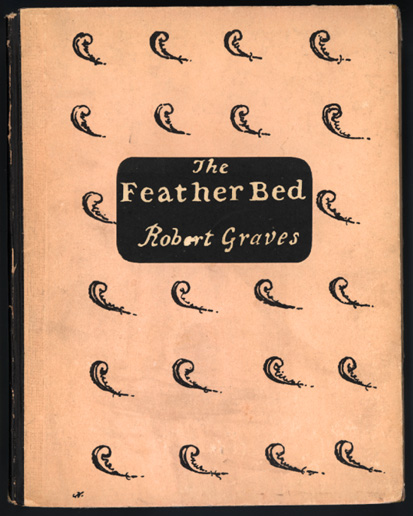
The Feather Bed - first edition

 
Robert Graves, The Feather Bed (1923)

Cover design by William Nicholson. Number 210 of 250 copies signed by the author.

“As the books and pamphlets on political subjects grew in number and importance, the Woolfs continued to publish more volumes of poetry, fiction, and literary criticism in 1926 than in any other areas. A significant event was the publication of another book in 1926 by Robert Graves. He published a pamphlet on poetry and brought with him Laura Riding. Graves met Laura Riding Gottschalk in 1926 after he had published his first Hogarth Press essay on modern poetry.”

J.H. Willis Jr, Leonard and Virginia Woolf as Publishers: The Hogarth Press 1917-1941

The Hogarth Press published a total of seven works by Graves, the first of which was The Feather Bed. This book consists of an “Introductory Letter” to John Crowe Ransom (his name misspelled “Ransome”) and an unconventional poem: a young man’s monologue that focussed on “internal debate about the nature of love, sexuality, and the religious calling of nuns and priests”. The book generated interest and sold quite well, though no subsequent edition of the poem was issued. The painter William Nicholson, Graves’s father-in-law, provided the cover for the book.

Elizabeth Willson Gordon, Woolf’s-head Publishing: The Highlights and New Lights of the Hogarth Press

previousnext


Hogarth Press studies

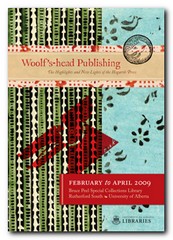
Woolf's-head Publishing Woolf’s-head Publishing is a wonderful collection of cover designs, book jackets, and illustrations – but also a beautiful example of book production in its own right. It was produced as an exhibition catalogue and has quite rightly gone on to enjoy an independent life of its own. This book is a genuine collector’s item, and only months after its first publication it started to win awards for its design and production values. Anyone with the slightest interest in book production, graphic design, typography, or Bloomsbury will want to own a copy the minute they clap eyes on it.

Woolf's-head Publishing Buy the book at Amazon UK
Woolf's-head Publishing Buy the book at Amazon US

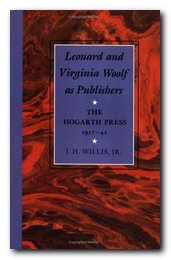
The Hogarth Press Leonard and Virginia Woolf as Publishers: Hogarth Press, 1917-41 John Willis brings the remarkable story of Leonard and Virginia Woolf’s success as publishers to life. He generates interesting thumbnail sketches of all the Hogarth Press authors, which brings both them and the books they wrote into sharp focus. He also follows the development of many of its best-selling titles, and there’s a full account of the social and cultural development of the press. This is a scholarly work with extensive footnotes, bibliographies, and suggestions for further reading – but most of all it is a very readable study in cultural history.

The Hogarth Press Buy the book at Amazon UK
The Hogarth Press Buy the book at Amazon US

© Roy Johnson 2005


Filed Under: Hogarth Press Tagged With: Art, Bloomsbury, Graphic design, Hogarth Press, Literary studies, Robert Graves, The Feather Bed

Roger Fry – Twelve Original Woodcuts

October 3, 2009 by Roy Johnson

Hogarth Press first edition book jacket designs


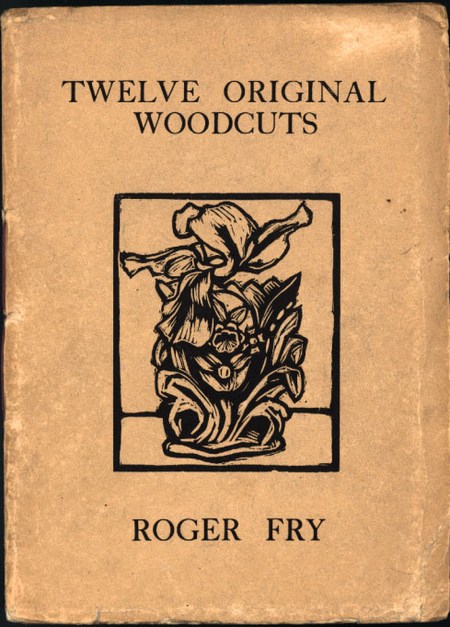
Roger Fry - Twelve Original Woodcuts - first edition

 
150 copies were printed. Squarish octavo, unpaginated, title page + 12 original woodcuts, each printed on a separate sheet.

A copy of the third impression, printed in 1922 is currently described as: “Internally the pages are bright and clean, and the woodcuts are good impressions. The original wrapper has a small closed tear along the front top edge, and a bit of light soiling, otherwise in very good condition. Very scarce in any of the impressions. Price $3,000.00”

See digital slide show of this publication at Duke University Library

previousnext


Hogarth Press studies

Woolf's-head Publishing Woolf’s-head Publishing is a wonderful collection of cover designs, book jackets, and illustrations – but also a beautiful example of book production in its own right. It was produced as an exhibition catalogue and has quite rightly gone on to enjoy an independent life of its own. This book is a genuine collector’s item, and only months after its first publication it started to win awards for its design and production values. Anyone with the slightest interest in book production, graphic design, typography, or Bloomsbury will want to own a copy the minute they clap eyes on it.

Woolf's-head Publishing Buy the book at Amazon UK
Woolf's-head Publishing Buy the book at Amazon US

The Hogarth Press Leonard and Virginia Woolf as Publishers: Hogarth Press, 1917-41 John Willis brings the remarkable story of Leonard and Virginia Woolf’s success as publishers to life. He generates interesting thumbnail sketches of all the Hogarth Press authors, which brings both them and the books they wrote into sharp focus. He also follows the development of many of its best-selling titles, and there’s a full account of the social and cultural development of the press. This is a scholarly work with extensive footnotes, bibliographies, and suggestions for further reading – but most of all it is a very readable study in cultural history.

The Hogarth Press Buy the book at Amazon UK
The Hogarth Press Buy the book at Amazon US

© Roy Johnson 2005


Filed Under: Hogarth Press Tagged With: Art, Bloomsbury, Graphic design, Literary studies, Roger Fry, Woodcuts

Roger Fry a biography

July 25, 2009 by Roy Johnson

portrait of Bloomsbury’s art theorist by premier writer

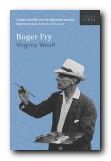
This is one of the last books Virginia Woolf wrote, and it is a tribute from one artist to another, an account of Fry’s aesthetics, and one of her many excursions into biography. Actually, Roger Fry A Biography is almost a joint production, because much of the text is direct quotations from Fry’s own journals and his letters to friends. It starts with his family background of radical Quakers, a quite strict upbringing, and his interest in science and the natural world.

Roger Fry A Biography He was a studious youth who blossomed when he went to Cambridge and was elected to the semi-secret society of Apostles who were what would be called free-thinkers (and coincidentally formed the basis of what would later be the Bloomsbury Group). He was older than the other members of this group, and always held in high regard by them. Despite getting a first in science, he switched to the study of Art and travelled to Italy and France on a sort of autodidactic Grand Tour to bring himself into contact with the masters.

Apart from her obvious sympathy with his artistic ideas, Woolf’s approach is largely descriptive. There is little attempt at analysis of her material. And we have to put up with her reticence on personal matters to a a degree which is almost infuriating. As a young man Fry forms a relationship with a woman old enough to be his mother, who teaches him ‘the art of love’, and they remain friends to the end of life. Yet this relationship is covered in less than a paragraph, and the woman isn’t even named.

Ever after Cambridge, his problem was how to earn a living from art, and even when he got married to fellow art-lover Helen Coombe, he was still living off an income from his father. But he found work as a lecturer, wrote art criticism, got nowhere as a painter, and was eventually employed by Pierpont Morgan to buy pictures for the Metropolitan Museum of Art.

Woolf makes a great deal of his organising the 1910 Post-Impressionist exhibition which caused such a rumpus (and which she claimed changed human nature). She sees this as a turning point in Fry’s life, and yet the strange thing is that at the very point that he joins the Bloomsbury Group (and where she has first-hand knowledge of his relationships with its members) she remains annoyingly coy about his personal life.

You would not know from her account that he had an affair with her sister Vanessa Bell. His life as a human being is replaced by the artistic debates which raged about Post-Impressionism, Fry’s own artistic theories, and the foundation of the Omega workshops.

Lots of well-known figures flit across the pages – George Bernard Shaw, Elgar, Lytton Strachey, André Gide – but we are as remote from his personal life as ever. Even his late life affair with Helen Anrep is mentioned almost parenthetically – though he was to live with her for the rest of his life (whilst his wife died slowly from a brain disease in a Retreat at York).

You can see why Woolf found his critical theory interesting. He was searching for a synthesis which would embrace visual art and literature, and he was modest enough to admit that his aesthetic opinions were subjective and limited:

But agreeing that aesthetic apprehension is a pre-eminently spiritual function does not imply for me any connection with morals. In the first place the contemplation of Truth is` likewise a spiritual function but is I judge entirely a-moral. Indeed I should be inclined to deny to morals (proper) any spiritual quality—they are rather the mechanism of civil life—the rules by which life in groups can be rendered tolerable and are therefore only concerned directly with behaviours.

She writes very appreciatively of his book on Cezanne, his life in London and St Remy de Provence, and his search for an all-embracing critical theory. All his life he had sought official recognition but it was denied him time and time again. Finally, in 1933 he was appointed Slade Professor of Art at Cambridge, but a year later he died.

© Roy Johnson 2005

Roger Fry biography Buy the book at Amazon UK

Roger Fry biography Buy the book at Amazon US


Virginia Woolf, Roger Fry: A Biography, London: Vintage, 2003, pp.314 ISBN: 0099442523


More on Virginia Woolf
Virginia Woolf – web links
Virginia Woolf – greatest works
Virginia Woolf – criticism
More on the Bloomsbury Group


Filed Under: Art, Biography, Bloomsbury Group, Individual designers, Virginia Woolf Tagged With: Art, Biography, Bloomsbury, Cultural history, Roger Fry, Theory, Virginia Woolf

Roger Fry biography

September 21, 2009 by Roy Johnson

artist, critic, designer

Roger Fry - portraitRoger Fry was an influential art historian and a key figure in the Bloomsbury Group. He was born in 1866 in Highgate, London, into a wealthy Quaker family. He studied at King’s College, Cambridge, where he took a first in the Natural Science ‘tripos’. Much to his family’s regret, he decided after university to pursue an artistic career rather than continue his scientific studies. In 1891 Fry went to Italy and then Paris, to study painting. He began to lecture on art, and became a critic and author. He made his debut in art criticism in 1893 with a review of George Moore’s book Modern Art for the Cambridge Review. Then in 1894 he began lecturing on Italian art for the Cambridge Extension Movement (classes for working people).
He married the artist Helen Coombe in 1896, but although his career as an artist and critic was a success, his personal life was troubled. His wife suffered from mental illness and had to be committed to an institution, where she stayed until her death in 1937. Fry was left to look after their children Pamela and Julian.

His first book on Giovanni Bellini, was published in 1899. He regularly contributed articles and criticism to the magazines Monthly Review and The Athenaeum, and in 1903 he was involved in the founding of Burlington Magazine, acting as joint editor between 1909-18, and making it into one of the most important art magazines in Britain. From 1905 to 1910, he was the Curator of Paintings for the Metropolitan Museum in New York.

Roger Fry - biographyHe first met the artists Clive Bell and Vanessa Bell in 1910, when they invited him to lecture at Vanessa’s Friday Club. This was the artistic equivalent of her brother Thoby’s literary soirees held on Thursday evenings. He subsequently became a regular member of the Bloomsbury Group, and Virginia Woolf later wrote his biography. His affair with her sister Vanessa Bell began in 1911 when he accompanied the Bells on a holiday to Turkey. It ended when she transferred her affections to Duncan Grant in 1913.

In 1910, Fry organized the first Post-Impressionist exhibition (and indeed, coined the phrase) for the Grafton Galleries in London, and later published books on Cézanne (1927), and Matisse (1930). In 1913, he organized the Omega Workshops, a collective that encouraged the involvement of young artists in the design and decoration of everyday functional objects. This remained active until 1919.

Fry re-edited and updated a collection of his best articles and writings to produce his best known book, Vision and Design which was published in 1920. As well as Western art, the book examined the use of form and aesthetics in ethnic art from Africa, America and Asia. It was a great success, reinforcing his position as England’s leading critic and it is still recognised as an extremely influential work in the development of modernist theory.

In his ideas, Fry emphasised the importance of ‘form’ over ‘content’: that is, how a work looks, rather than what it is about. He thought that artists should use colour and arrangement of forms rather than the subject to express their ideas and feelings, and that works of art should not be judged by how accurately they represent reality.

In his personal life, it was not until 1924 after several short lived relationships (including affairs with Nina Hamnett, one of the Omega artists; and Josette Coatmellec, which ended tragically with her suicide), that he found happiness with Helen Anrep. Twenty years his junior, she left her husband and became a great support to Fry in his career, and lived with him until his death.

Roger Fry - etching - wine glassIn 1933 Fry was offered the post of Slade Professor at Cambridge and began a series of lectures on the nature of art history that he was never to complete. The text for the lectures was published after his death in 1939 as Last Lectures. Fry died on 9 September 1934 following a fall at his London home. His ashes were placed in the vault of Kings College Chapel, Cambridge, in a casket decorated by Vanessa Bell.

Roger Fry


Bloomsbury Group – web links

Bloomsbury Group - web links Hogarth Press first editions
Annotated gallery of original first edition book jacket covers from the Hogarth Press, featuring designs by Vanessa Bell, Roger Fry, and others.

Bloomsbury Group - web links The Omega Workshops
A brief history of Roger Fry’s experimental Omega Workshops, which had a lasting influence on interior design in post First World War Britain.

Bloomsbury Group - web links The Bloomsbury Group and War
An essay on the largely pacifist and internationalist stance taken by Bloomsbury Group members towards the First World War.

Bloomsbury Group web links Tate Gallery Archive Journeys: Bloomsbury
Mini web site featuring photos, paintings, a timeline, sub-sections on the Omega Workshops, Roger Fry, and Duncan Grant, and biographical notes.

Bloomsbury Group - web links Bloomsbury: Books, Art and Design
Exhibition of paintings, designs, and ceramics at Toronto University featuring Hogarth Press, Vanessa Bell, Dora Carrington, Quentin Bell, and Stephen Tomlin.

Bloomsbury Group - web links Blogging Woolf
A rich enthusiast site featuring news of events, exhibitions, new book reviews, relevant links, study resources, and anything related to Bloomsbury and Virginia Woolf

Bloomsbury Group - web links Hyper-Concordance to Virginia Woolf
Search the texts of all Woolf’s major works, and track down phrases, quotes, and even individual words in their original context.

Bloomsbury Group - web links A Mrs Dalloway Walk in London
An annotated description of Clarissa Dalloway’s walk from Westminster to Regent’s Park, with historical updates and a bibliography.

Bloomsbury Group - web links Women’s History Walk in Bloomsbury
Annotated tour of literary and political homes in Bloomsbury, including Gordon Square, University College, Bedford Square, Doughty Street, and Tavistock Square.

Bloomsbury Group - web links Virginia Woolf Society of Great Britain
News of events, regular bulletins, study materials, publications, and related links. Largely the work of Virginia Woolf specialist Stuart N. Clarke.

Bloomsbury Group - web links BBC Audio Essay – A Eulogy to Words
A charming sound recording of a BBC radio talk broadcast in 1937 – accompanied by a slideshow of photographs of Virginia Woolf.

Bloomsbury Group - web links A Family Photograph Albumn
Leslie Stephens’ collection of family photographs which became known as the Mausoleum Book, collected at Smith College – Massachusetts.

Bloomsbury Group - web links Bloomsbury at Duke University
A collection of book jacket covers, Fry’s Twelve Woodcuts, Strachey’s ‘Elizabeth and Essex’.

© Roy Johnson 2000-2014


More on biography
More on the Bloomsbury Group
Twentieth century literature


Filed Under: Bloomsbury Group Tagged With: Art, Biography, Bloomsbury Group, Modernism, Roger Fry

Roger’s Profanisaurus: Magna Farta

July 16, 2009 by Roy Johnson

hilarious dictionary of slang, smut, indecency, and filth

Do you know the difference between an air biscuit and a trouser cough, or the relationship between a pearl necklace and mammary dandruff? Do you know what an art pamphlet and a bongo periodical have in common? Welcome to the world of Viz, linguistic invention, and ribald scatology. Roger’s Profanisaurus is what I would call an ‘advanced’ and deliberately rude dictionary of slang.

Roger's Profanisaurus: Magna Farta The entries are compiled from contributions to the monthly comic magazine. It assumes as a starting point the lowest and most wide-ranging street language for sexual matters, body functions, and gender preference. And it is blisteringly funny, mainly because each expression is defined by the use of further slang terms which are provocatively allusive, offered in a cod serious tone, and take every opportunity to introduce further vulgarity.

You have to be deep into the laddish frame of reference to know what’s going on. But if you’re interested in the connections between slang and linguistic imagination the effort is well worth it, believe me.

Stanky n. The glaze that is left on the shaft of the choad after a bout of kipper splitting. May be zuffled on curtains or wiped on a stankey-chief.

Even the spoof cross-referencing is funny, because one obscure term is often defined by others which themselves need explanation, or are cloaked in comic metaphor – as in

rear gunner n. In aviation terms, a gunner who shoots one of his own side by firing his lamb cannon (qv) into their bomb bay (qv).

snookered behind the red Unable to sink the pink due to the time of month. The only pot on is a difficult brown.

Some of them are clearly comic inventions, such as

Snogging water;   a male grooming lotion that smells like Joan Collins’ knickers. After shave.

but the majority are explanations of common terms, such as horizontal jogging, rear admiral, and tradesman’s entrance, and there’s also lots of rhyming slang and examples of street language ‘shown’ in the work of famous writers.

You’ll need a strong stomach to take in all the lavatory terms, but essentially it’s kind-hearted smut and self-consciously outrageous sexism – not at all vicious. And there are also, en passant, some interesting sociological details:

Sports bag n. A handy cottaging accessory in which one partner stands to conceal his feet and avoid detection by lavatory attendants looking under the door.

The latest and hugely enlarged edition has just appeared which the publisher describes as “an exhaustive lexicon of four letter filth which contains over 10,000 useful words and phrases to turn the air bluer than a baboon’s arse.”

For those who may not know, the Roger in the title is ‘Roger Mellie, the Man on the Telly’ – one of the regular characters in Viz who specialises in vulgarity. This book is filthy, extremely funny, and very well informed. Since its first appearance it has gone through many new editions. Make sure you get the latest and biggest.

© Roy Johnson 2007

Roger's Profanisaurus: Magna Farta   Buy the book at Amazon UK

Roger's Profanisaurus: Magna Farta   Buy the book at Amazon US


Roger’s Profanisaurus Rex IV: The Magna Farta, London: Dennis Publishing, 2007, pp.480, ISBN: 095485778X


More on language
More on literary studies
More on writing skills
More on creative writing
More on grammar


Filed Under: Dictionaries, Slang Tagged With: Dictionaries, Language, Magna Farta, Roger's Profanisaurus, Slang

Roget’s Thesaurus

July 16, 2009 by Roy Johnson

best-selling reference for word alternatives and opposites

Roget’s Thesaurus is a classic and much-loved compilation of synonyms and antonyms. It was first published in the middle of the nineteenth century, and although the arrangement of its entries has been modified from time to time, it has remained in print ever since. When do you need a thesaurus? Basically, most people use them to find alternatives for words which they wish to avoid repeating. And they are very popular with fans of crossword puzzles.

Roget's Thesaurus If you’ve already shown off by using the word ‘benevolence’, you look up the term and discover ‘philanthropy’, ‘generosity’, ‘benignity’, ‘charity’, and ‘unselfishness’ as synonyms (same or near-same meaning). The headword is also explored in its form as a noun, verb, adverb, and adjective. Thesauri (that’s the plural) also include antonyms (opposite meaning) and Roget has always given examples of expressions in common usage.

So in this case, it includes ‘good Samaritan’ and clichés such as ‘heart in the right place’ and ‘milk of human kindness’. Roget’s is a thesaurus which you dip into for some nugget of information, and stay there tasting and sampling for much longer than you had intended.

The book has always been a big favourite with crossword puzzle fans, because the entries throw up alternative word possibilities of the kind which are often locked in their clues.

It’s a treasure trove of verbal information (sorry – another cliché) which is why the original compiler’s name has always been retained in the title as a guarantee of value. Make sure you get the latest edition, because lots of quotations have been added.

© Roy Johnson 2004

Roget's Thesaurus   Buy the book at Amazon UK

Roget's Thesaurus   Buy the book at Amazon US


Roget’s Thesaurus, London: Penguin, 2004, pp.848, ISBN: 0140515038


More on language
More on literary studies
More on writing skills
More on creative writing
More on grammar


Filed Under: Dictionaries Tagged With: Antonyms, Dictionaries, Language, Reference, Roget's Thesaurus, Synonyms

Rupert Brooke biography

September 21, 2009 by Roy Johnson

national icon of the young ‘doomed’ poet

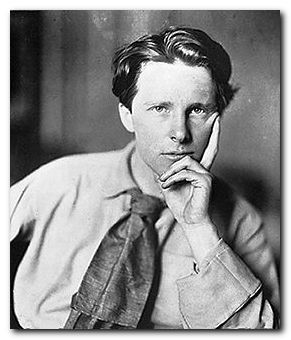
Rupert brooke biographyRupert Brooke (1887—1915) was only ever on the fringe of the Bloomsbury Group – but he was well acquainted with its central figures, such as Virginia Woolf and Lytton Strachey. He was born in Rugby in Warwickshire, where his father taught classics and was a housemaster at the famous public school. He himself attended the school, along with Duncan Grant. The boy soon grew into a man whose handsome figure transfixed admirers of both sexes. He was almost six foot tall, academically clever, and good at sports – representing the school in cricket and rugby. He was also highly creative: he wrote verse throughout his childhood, having gained a love of poetry from reading Browning.

In 1906 he won a scholarship to King’s College at Cambridge University, and whilst there he became a member of the Apostles, a semi-secret debating society whose other members included Bertrand Russell, E.M.Forster, Lytton Strachey, Leonard Woolf, and John Maynard Keynes. He helped to found the Marlowe Society drama club, acted in plays, and wrote poetry.

In 1910 his father died suddenly, and Brooke was for a short time in Rugby a deputy housemaster. Thereafter he lived on an allowance from his mother. His first intimate relationship is thought to have been with Denham Russell-Smith, the younger brother of one of his close friends at Rugby.

In 1911 Brooke published his first collection of verse, Poems, and his work was featured in the periodical Georgian Poetry, edited by his friend, Sir Edward Marsh. Over the next twenty years, the book sold almost 100 000 copies. He became famous and popular in both literary and political circles.

He was a leader of a group of young ‘Neo-pagans’, who slept outdoors, embraced a religion of nature, and took up vegetarianism. Astonishing though it might seem, at one time Virginia Woolf joined them in Grantchester to swim naked at midnight in Byron’s Pool where Lord Byron used to bathe whilst a student at Cambridge. Other Neo-Pagan hangers-on included Augustus John, then in his heyday of wandering gypsy-Bohemian. Virginia Woolf wrote of this phase in a memoir:

Under his influence the country near Cambridge was full of young men and women walking barefoot, sharing his passion for bathing and fish diet, disdaining book learning, and proclaiming that there was something deep and wonderful in the man who brought the milk and in the woman who watched the cows.

In 1911 Brooke was secretly engaged to Noel Olivier, five years his junior. The affair was for all participants frustrating and subsequently Brooke had an affair with the actress Cathleen Nesbitt. Overworked and emotionally empty, Brooke suffered a nervous breakdown.

In the spring of 1912, Brooke and Ka Cox went to Germany, where in a mood of homesickness he wrote a poem about his home ‘The Old Vicarage, Grantchester’, which is among his most admired poems.

Oh, is the water sweet and cool,
Gentle and brown, above the pool?
And laughs the immortal river still
Under the mill, under the mill?
Say, is there Beauty yet to find?
And Certainty? and Quiet kind?
Deep meadows yet, for to forget
The lies, and truths, and pain?… oh! yet
Stands the Church clock at ten to three?
And is there honey still for tea?

It is interesting to note that Brooke’s method of poetic composition was to first of all assemble a list of pairs of rhyming words, and then fill in the lines which preceded them. The Old Vicarage is now occupied by the Cambridge physicist Mary Archer and her husband Jeffrey, the ‘novelist’, former politician, and ex-jailbird.

The group of five sonnets called 1914 that Rupert Brooke wrote in December 1914 and finished in January 1915 became, within a few months, some of the most praised and widely read poems of their day. They glorified England and the idea of dying for England.

IF I should die, think only this of me:
That there’s some corner of a foreign field
That is for ever England. There shall be
In that rich earth a richer dust concealed;
A dust whom England bore, shaped, made aware,
Gave, once, her flowers to love, her ways to roam,
A body of England’s, breathing English air,
Washed by the rivers, blest by suns of home.

In fact, he never saw active service.

His poetry gained many enthusiasts and he was taken up by Edward Marsh, who brought him to the attention of Winston Churchill, who was at that time First Lord of the Admiralty. Through these connections he was commissioned into the Royal Naval Volunteer Reserve as a temporary Sub-Lieutenant shortly after his 27th birthday and took part in the Royal Naval Division’s Antwerp expedition in October 1914.

He sailed with the British Mediterranean Expeditionary Force on 28 February 1915 but developed sepsis from an infected mosquito bite. He died on 23 April 1915 off the island of Lemnos in the Aegean on his way to a battle at Gallipoli. As the expeditionary force had orders to depart immediately, he was buried at in an olive grove on the island of Skyros, Greece.


Rupert Brooke


Bloomsbury Group – web links

Bloomsbury Group - web links Hogarth Press first editions
Annotated gallery of original first edition book jacket covers from the Hogarth Press, featuring designs by Vanessa Bell, Roger Fry, and others.

Bloomsbury Group - web links The Omega Workshops
A brief history of Roger Fry’s experimental Omega Workshops, which had a lasting influence on interior design in post First World War Britain.

Bloomsbury Group - web links The Bloomsbury Group and War
An essay on the largely pacifist and internationalist stance taken by Bloomsbury Group members towards the First World War.

Bloomsbury Group web links Tate Gallery Archive Journeys: Bloomsbury
Mini web site featuring photos, paintings, a timeline, sub-sections on the Omega Workshops, Roger Fry, and Duncan Grant, and biographical notes.

Bloomsbury Group - web links Bloomsbury: Books, Art and Design
Exhibition of paintings, designs, and ceramics at Toronto University featuring Hogarth Press, Vanessa Bell, Dora Carrington, Quentin Bell, and Stephen Tomlin.

Bloomsbury Group - web links Blogging Woolf
A rich enthusiast site featuring news of events, exhibitions, new book reviews, relevant links, study resources, and anything related to Bloomsbury and Virginia Woolf

Bloomsbury Group - web links Hyper-Concordance to Virginia Woolf
Search the texts of all Woolf’s major works, and track down phrases, quotes, and even individual words in their original context.

Bloomsbury Group - web links A Mrs Dalloway Walk in London
An annotated description of Clarissa Dalloway’s walk from Westminster to Regent’s Park, with historical updates and a bibliography.

Bloomsbury Group - web links Women’s History Walk in Bloomsbury
Annotated tour of literary and political homes in Bloomsbury, including Gordon Square, University College, Bedford Square, Doughty Street, and Tavistock Square.

Bloomsbury Group - web links Virginia Woolf Society of Great Britain
News of events, regular bulletins, study materials, publications, and related links. Largely the work of Virginia Woolf specialist Stuart N. Clarke.

Bloomsbury Group - web links BBC Audio Essay – A Eulogy to Words
A charming sound recording of a BBC radio talk broadcast in 1937 – accompanied by a slideshow of photographs of Virginia Woolf.

Bloomsbury Group - web links A Family Photograph Albumn
Leslie Stephens’ collection of family photographs which became known as the Mausoleum Book, collected at Smith College – Massachusetts.

Bloomsbury Group - web links Bloomsbury at Duke University
A collection of book jacket covers, Fry’s Twelve Woodcuts, Strachey’s ‘Elizabeth and Essex’.

© Roy Johnson 2000-2014


More on biography
More on the Bloomsbury Group
Twentieth century literature


Filed Under: Bloomsbury Group Tagged With: Biography, Bloomsbury Group, Literary studies, Poetry, Rupert Brooke

  • « Previous Page
  • 1
  • …
  • 66
  • 67
  • 68
  • 69
  • 70
  • …
  • 103
  • Next Page »

Get in touch

info@mantex.co.uk

Content © Mantex 2016
  • About Us
  • Advertising
  • Clients
  • Contact
  • FAQ
  • Links
  • Services
  • Reviews
  • Sitemap
  • T & C’s
  • Testimonials
  • Privacy

Copyright © 2026 · Mantex

Copyright © 2026 · News Pro Theme on Genesis Framework · WordPress · Log in