Mantex

Tutorials, Study Guides & More

  • HOME
  • REVIEWS
  • TUTORIALS
  • HOW-TO
  • CONTACT
>> Home / 2009 / Archives for October 2009

Archives for October 2009

Unforgiving Years

October 22, 2009 by Roy Johnson

revolutionary hopes betrayed

Victor Serge is one of the most undeservedly neglected writers of the twentieth century. In his introduction to this recent translation of Unforgiving Years, Serge scholar Richard Greeman speculates that this might be because he cannot be easily categorised into any national literary tradition. Serge was born of Russian emigré parents in Brussels. He travelled widely throughout Russia and Europe as a revolutionary, and he wrote in French. Indeed, this linguistic fact may well have saved his life, because he was one of the few Oppositionists in Stalin’s reign of terror who was given permission to leave the Soviet Union – largely as a result of an international protest organised in France.

Unforgiving YearsUnforgiving Years is one of his last great works, written in exile in Mexico around the same time as Memoirs of a Revolutionary and The Case of Comrade Tulayev. It covers the years 1939-1945 and is split into four distinct sections, each one of which illustrates a facet of ‘Midnight in the Twentieth Century’ as Europe was plunged into horrifying conflicts dominated (at first) by two conflicting forms of totalitarianism. The first section is set in Paris at an unspecified period just before the outbreak of war.

Two secret agents, Sasha and Nadine, decide they no longer believe in the infallibility of the Party and its policies, and they decide to escape – knowing that they will be hunted down and possibly assassinated by agents – as many people were at the time. Every move they make is fraught with danger, and they fear betrayal at every step – even from each other. The Spanish civil war has ended in defeat, the liberal democracies are capitulating before the threat of Nazism, and Stalin is purging everyone in his wake – even including leading intellectuals and his best military commanders, just when he will need them most.

In part two, one of their comrades is sent on a mission to a frozen Leningrad besieged by the Germans in 1941 – to endure unimaginable hardships in support of one corrupt regime resisting another. Although Serge’s sympathies are clearly with the Russian people and not with the Stalinist aparatchicks, he might not have known at the time of writing that Stalin turned out to be responsible for killing more Russians than Hitler.

Daria – the only character to appear in all four parts of the book – tries hard to be a loyal Party agent, but she cannot stop herself questioning the perverted logic of any means, no matter how corrupt, justifying some theoretical ends. She cannot rid herself of humane sympathies for the people she sees suffering around her. In a novelistic sense she stands in for Serge himself, desperately trying to locate a set of values which will accommodate both aspirations towards democratic socialism and a liberal humanism which she can hardly even admit to herself.

Part three takes place in a Berlin devastated by allied carpet bombing as the Reich nears its apocalyptic end. Daria has volunteered for a mission behind enemy lines, working as a nurse under an assumed identity. Serge’s skill in this section is to recount the events from the points of view of loyal (non-Nazi) Germans, their belief in the war almost at breaking point. All the official news is ridiculously optimistic propaganda, and the entire population is surrounded by officials with orders to root out and destroy the slightest signs of doubt in the Fuhrer’s omnipotent wisdom – just as was happening in the East.

Throughout all the horrendous conditions he describes, the Comrades all behave impeccably – with only their ideological doubts bringing them down to the level of normal human beings. Of course they reflect the intellectual journey which Serge had made himself. But it should be borne in mind that the saintly Daria/Erna, whilst sleeping with young men out of compassion and tending war-shattered enemies in her capacity as a spy behind the front line, is in fact reporting back to a regime which was systematically slaughtering its soldiers who had come back from fighting the Nazis because they might have been tainted with democratic ideas – and were actually accused of being German spies. The Comrades can be admired for their aspirations, but they clung on to their allegiances for too long – though of course it’s easy for us to say that now.

In part four Daria has finally broken ranks with the Party and escapes to the New World to start a new life. She eventually locates Sasha and Nadine, who have retired to run a plantation in rural Mexico – hidden away from everyone. Sasha has resolved his ideological dilemma by making a connection with the primitive forces of an almost prehistoric world, yet he still wonders ‘Where did we go wrong?’ Nadine has ‘retreated’ into a mild form of schizophrenia. But just as they have feared all along, the Party will not forgive recusants, and a visiting archeologist turns out to be a Stalinist agent. He infiltrates himself into their confidence, poisons Sasha and Daria, then moves on to his next assignment.

It’s possibly the bleakest of all Serge’s novels – and no wonder. He himself was still being pursued by Stalin’s agents when he died (of a heart attack) in Mexico in 1946. Anyone not used to his narrative techniques might find the story difficult to follow. He was trying to escape the form and the methods of the traditional bourgeois novel by downgrading the individual in favour of the mass – a theory he expounds in Literature and Revolution. Fortunately he never quite managed it, but since he also fused his narrative with a poetic lyricism, the results are magnificent.

Unforgiving Years Buy the book at Amazon UK

Unforgiving Years Buy the book at Amazon US

© Roy Johnson 2009


Victor Serge, Unforgiving Years, New York: New York Review Books, 2008, pp.341, ISBN 1590172477


More on Victor Serge
Twentieth century literature
More on biography

Filed Under: Victor Serge Tagged With: Literary studies, The novel, Unforgiving Years, Victor Serge

Virginia Woolf – A Room of One’s Own

October 4, 2009 by Roy Johnson

Hogarth Press first edition book jacket designs


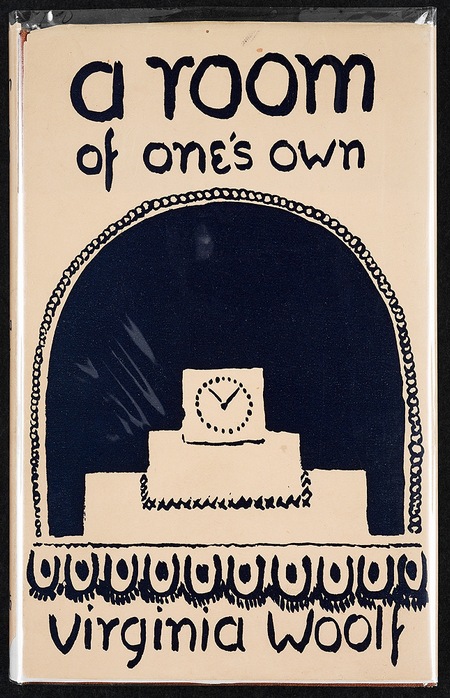
A Room of One's Own - first edition

 
Virginia Woolf, A Room of One’s Own (1929) Cover design by Vanessa Bell.

This has become one of the cornerstone’s of feminist theory in relation to literature. It’s a sparkling, critical, and wide-ranging expose of male privilege and the way in which women have been excluded from cultural life. However, as John Willis argues in his study of the text, Woolf omitted to mention the work of other women writers on the same subject which had appeared prior to her own.

“There was more fiction than fact in Woolf’s most famous and beloved feminist polemic. The occasion was an address to the young women of Newham and Girton colleges on the subject of women and fiction, which she subsequently rewrote into the expanded form of the published book. Woolf’s form followed function. She created clever and pointed fictions before their eyes, inventing, among others, Shakespeare’s thwarted sister Judith and the young modern novelist Mary Carmichael. There were few facts partly because she presumed to dislike them and partly because the works on women containing the facts (all erroneous) had been written by men. Woolf chose not to recognise the existence of useful, accurate, and understanding accounts of women by women. Nor did she mention directly the achievements of women such as [Millicent Garrett] Fawcett, [Ray] Strachey, or [Margaret Llewellyn] Davis. Strachey’s The Cause: A Short History of the Women’s movement in Great Britain (1928) was a year old when Woolf created her story of her own room and an inheritance of £500 per year, yet there is only a brief quotation from it, identified in a footnote. Facts aside, the wit and irony of her writing, her satirical exposure of patriarchal attitudes, her leaps of intuitive understanding, [and] her subjective experience made the book memorable and influential.”

J.H. Willis Jr, Leonard and Virginia Woolf as Publishers: The Hogarth Press 1917-1941

The first one hundred copies of [the first, limited edition] were for sale by the Hogarth Press, and the price was substantial. The Hogarth Press’s trade edition, issued at the same time, was priced at 5s; the print run was 3,040 copies. The press published a number of books that come at the same question of women’s lives and positions in different ways. One of particular interest is Life As We Have Known It (1931), a collection of autobiographical sketches of guildswomen, for which Woolf wrote an introductory letter.

Elizabeth Willson Gordon, Woolf’s-head Publishing: The Highlights and New Lights of the Hogarth Press

previousnext


Hogarth Press studies

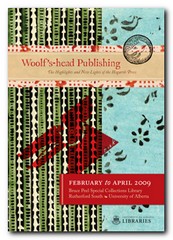
Woolf's-head Publishing Woolf’s-head Publishing is a wonderful collection of cover designs, book jackets, and illustrations – but also a beautiful example of book production in its own right. It was produced as an exhibition catalogue and has quite rightly gone on to enjoy an independent life of its own. This book is a genuine collector’s item, and only months after its first publication it started to win awards for its design and production values. Anyone with the slightest interest in book production, graphic design, typography, or Bloomsbury will want to own a copy the minute they clap eyes on it.

Woolf's-head Publishing Buy the book at Amazon UK
Woolf's-head Publishing Buy the book at Amazon US

The Hogarth Press Leonard and Virginia Woolf as Publishers: Hogarth Press, 1917-41 John Willis brings the remarkable story of Leonard and Virginia Woolf’s success as publishers to life. He generates interesting thumbnail sketches of all the Hogarth Press authors, which brings both them and the books they wrote into sharp focus. He also follows the development of many of its best-selling titles, and there’s a full account of the social and cultural development of the press. This is a scholarly work with extensive footnotes, bibliographies, and suggestions for further reading – but most of all it is a very readable study in cultural history.

The Hogarth Press Buy the book at Amazon UK
The Hogarth Press Buy the book at Amazon US

© Roy Johnson 2005


Filed Under: Hogarth Press Tagged With: A Room of One's Own, Art, Bloomsbury, Graphic design, Hogarth Press, Literary studies, Virginia Woolf

Virginia Woolf – Between the Acts

October 5, 2009 by Roy Johnson

Hogarth Press first edition book jacket designs


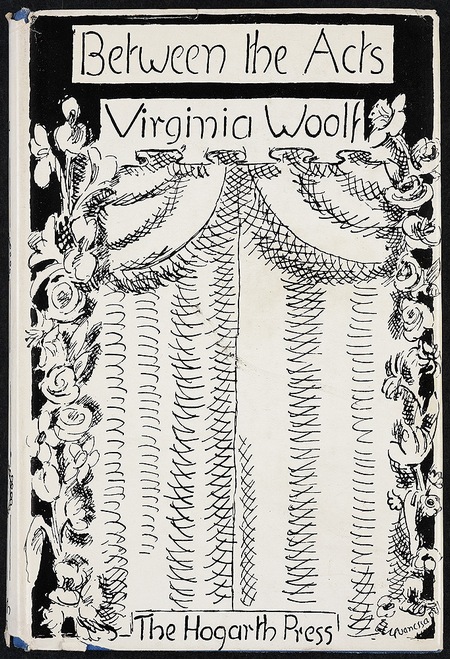
Between the Acts cover - first edition
Virginia Woolf, Between the Acts (1939) Cover design by Vanessa Bell.

“Leonard Woolf decided after Virginia’s death to publish Between the Acts as she had written it, editing only for spelling and minor textual errors. John Lehmann supported him completely in this decision. The critical success and popularity of the book give evidence that Virginia had found her way into a new fusion of form and vision after The Years. After her death, Leonard carefully planned for the future, husbanding her stories, essays, and letters for judiciously timed collections. Over the next seventeen years, through 1958, Leonard published eight posthumous collections of Virginia’s writing, releasing a volume every two or three years on a schedule that approximated her production when alive. In this way Leonard kept Virginia’s name before the public and assisted in her growing critical acclaim. Even in death, Virginia Woolf remained the most productive and profitable of the Hogarth Press writers.”

J.H. Willis Jr, Leonard and Virginia Woolf as Publishers: The Hogarth Press 1917-1941

previousnext


Hogarth Press studies

Woolf's-head Publishing Woolf’s-head Publishing is a wonderful collection of cover designs, book jackets, and illustrations – but also a beautiful example of book production in its own right. It was produced as an exhibition catalogue and has quite rightly gone on to enjoy an independent life of its own. This book is a genuine collector’s item, and only months after its first publication it started to win awards for its design and production values. Anyone with the slightest interest in book production, graphic design, typography, or Bloomsbury will want to own a copy the minute they clap eyes on it.

Woolf's-head Publishing Buy the book at Amazon UK
Woolf's-head Publishing Buy the book at Amazon US


The Hogarth Press
Leonard and Virginia Woolf as Publishers: Hogarth Press, 1917-41 John Willis brings the remarkable story of Leonard and Virginia Woolf’s success as publishers to life. He generates interesting thumbnail sketches of all the Hogarth Press authors, which brings both them and the books they wrote into sharp focus. He also follows the development of many of its best-selling titles, and there’s a full account of the social and cultural development of the press. This is a scholarly work with extensive footnotes, bibliographies, and suggestions for further reading – but most of all it is a very readable study in cultural history.

The Hogarth Press Buy the book at Amazon UK
The Hogarth Press Buy the book at Amazon US

© Roy Johnson 2005


Filed Under: Hogarth Press Tagged With: Art, Between the Acts, Bloomsbury, Graphic design, Literary studies, Virginia Woolf

Virginia Woolf – Jacob’s Room

October 4, 2009 by Roy Johnson

Hogarth Press first edition book jacket designs


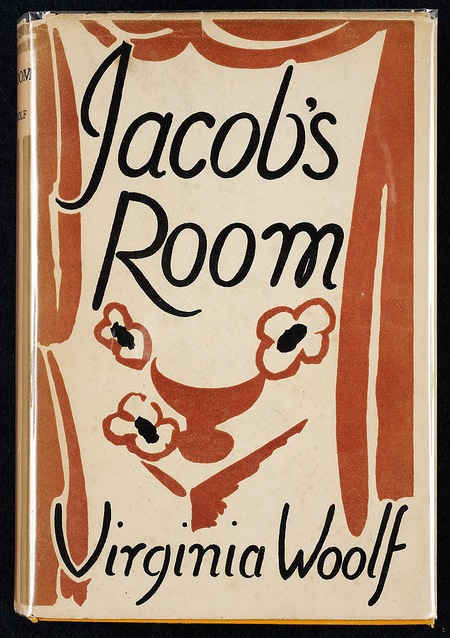
Jacob's Room cover - first edition

Virginia Woolf, Jacob’s Room (1922) Cover design by Vanessa Bell

This was the first of Virginia Woolf’s novels to be self-published. She took the opportunity of being free from someone else’s editorial control to push the boundaries of her experimental literary technique. It thus marked an important step in modernism and a breakthrough to a greater degree of self-confidence in her work.

“Virginia’s Jacob’s Room was our first major work, a full-length novel. 1,200 copies of it were printed for us by R. and R. Clark of Edinburgh. [It] was published in October 1922 and began at once to sell fairly briskly, and I had a second impression of 1,000 copies printed by Clark. By the end of 1923 we had sold 1,413 copies; the cost of printing and publishing up to that date had been £276 1s. 6d. and the receipts had been £318 6s. 0d., so that our publisher’s profit was £42 4s. 6d. We though that we had done extremely well.”

Leonard Woolf, An Autobiography

The publication of Jacob’s Room includes a series of firsts in and of itself. It is the first novel published by the Press: it is also the first book to have a dust jacket…The dust jacket for Jacob’s Room was a “collaborative effort: Vanessa made the drawing, Virginia chose the terra-cotta colouring, and Leonard Woolf advised alterations to the lettering”. The dust jacket, however, was not well received. Leonard recalls that because the design “did not represent a desirable female or even Jacob or his room, and it was what in 1923 many people would have called reproachfully post-impressionist. It was almost universally condemned amongst the booksellers”.

Elizabeth Willson Gordon, Woolf’s-head Publishing: The Highlights and New Lights of the Hogarth Press

previousnext


Hogarth Press studies

Woolf's-head Publishing Woolf’s-head Publishing is a wonderful collection of cover designs, book jackets, and illustrations – but also a beautiful example of book production in its own right. It was produced as an exhibition catalogue and has quite rightly gone on to enjoy an independent life of its own. This book is a genuine collector’s item, and only months after its first publication it started to win awards for its design and production values. Anyone with the slightest interest in book production, graphic design, typography, or Bloomsbury will want to own a copy the minute they clap eyes on it.

Woolf's-head Publishing Buy the book at Amazon UK
Woolf's-head Publishing Buy the book at Amazon US

The Hogarth Press Leonard and Virginia Woolf as Publishers: Hogarth Press, 1917-41 John Willis brings the remarkable story of Leonard and Virginia Woolf’s success as publishers to life. He generates interesting thumbnail sketches of all the Hogarth Press authors, which brings both them and the books they wrote into sharp focus. He also follows the development of many of its best-selling titles, and there’s a full account of the social and cultural development of the press. This is a scholarly work with extensive footnotes, bibliographies, and suggestions for further reading – but most of all it is a very readable study in cultural history.

The Hogarth Press Buy the book at Amazon UK
The Hogarth Press Buy the book at Amazon US

© Roy Johnson 2005


Filed Under: Hogarth Press Tagged With: Art, Bloomsbury, Graphic design, Hogarth Press, Jacob's Room, Literary studies, Virginia Woolf

Virginia Woolf – Kew Gardens

October 3, 2009 by Roy Johnson

Hogarth Press first edition book jacket designs


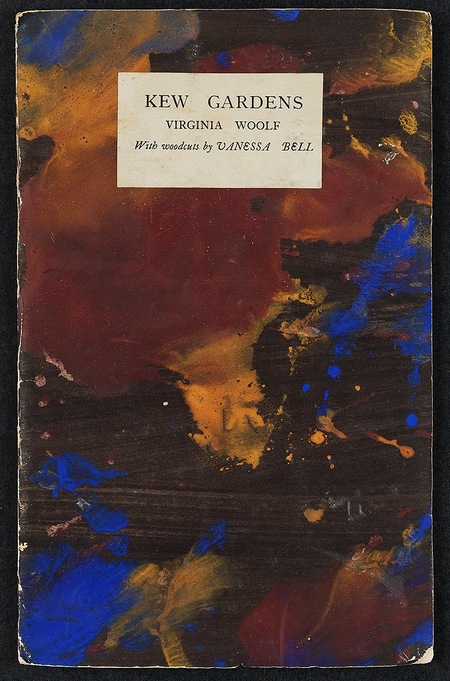
Kew Gardens cover - first edition

 
Virginia Woolf, Kew Gardens (1919)

This publication contained only ten pages of text, with illustrations by Vanessa Bell.

“In 1918 we printed two small books: Poems by T.S. Eliot and Kew Gardens by Virginia. Of Kew Gardens we printed about 170 copies (the total sold of the first edition was 148). We published it on 12 May 1919 at 2s. When we started printing and publishing with our Publication No. 1, we did not send out any review copies, but in the case of Prelude, Tom’s Poems, and Kew Gardens we sent review copies to The Times Literary Supplement. By 31 May we had sold forty-nine copies of Kew Gardens On Tuesday 27 May, we went to Asham and stayed there for a week, returning to Richmond on 3 June. In the previous week a review of Kew Gardens had appeared in the Literary Supplement giving it tremendous praise. When we opened the door of Hogarth House, we found the hall covered with envelopes and postcards containing orders from booksellers all over the country. It was impossible for us to start printing enough copies to meet these orders, so we went to a printer, Richard Madely, and got him to print a second edition of 500 copies, which cost us £8 9s. 6d. It was sold by the end of 1920 and we did not reprint.”

Leonard Woolf, An Autobiography

previousnext


Hogarth Press studies

Woolf's-head Publishing Woolf’s-head Publishing is a wonderful collection of cover designs, book jackets, and illustrations – but also a beautiful example of book production in its own right. It was produced as an exhibition catalogue and has quite rightly gone on to enjoy an independent life of its own. This book is a genuine collector’s item, and only months after its first publication it started to win awards for its design and production values. Anyone with the slightest interest in book production, graphic design, typography, or Bloomsbury will want to own a copy the minute they clap eyes on it.

Woolf's-head Publishing Buy the book at Amazon UK
Woolf's-head Publishing Buy the book at Amazon US

The Hogarth Press Leonard and Virginia Woolf as Publishers: Hogarth Press, 1917-41 John Willis brings the remarkable story of Leonard and Virginia Woolf’s success as publishers to life. He generates interesting thumbnail sketches of all the Hogarth Press authors, which brings both them and the books they wrote into sharp focus. He also follows the development of many of its best-selling titles, and there’s a full account of the social and cultural development of the press. This is a scholarly work with extensive footnotes, bibliographies, and suggestions for further reading – but most of all it is a very readable study in cultural history.

The Hogarth Press Buy the book at Amazon UK
The Hogarth Press Buy the book at Amazon US

© Roy Johnson 2005


Filed Under: Hogarth Press Tagged With: Art, Bloomsbury, Graphic design, Hogarth Press, Kew Gardens, Literary studies, Virginia Woolf

Virginia Woolf – Monday or Tuesday

October 4, 2009 by Roy Johnson

Hogarth Press first edition book jacket designs


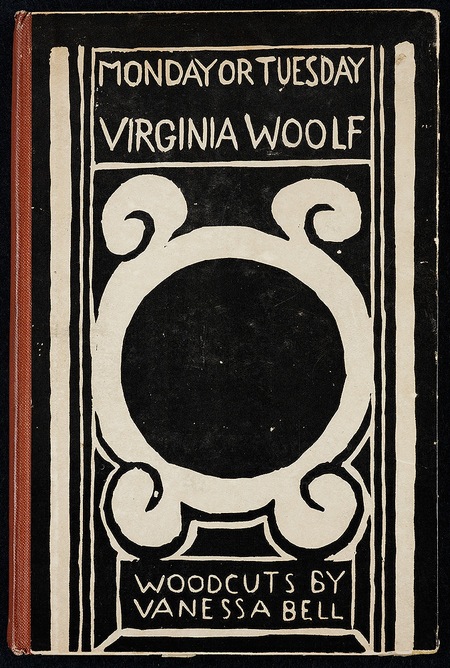
Monday or Tuesday cover - first edition

Virginia Woolf, Monday or Tuesday (March, 1921) Cover design and woodcut illustrations by Vanessa Bell

This was a collection of seven short stories. It contains: ‘A Haunted House’, ‘A Society’, ‘Monday or Tuesday’, ‘An Unwritten Novel’, ‘The String Quartet’, ‘Blue and Green’, and ‘Solid Objects’.

“At the end of the first year, April 1922, the book had sold a total of 503 copies, showing a deficit to the press of £8 3s. 9d. During the next two years, the book averaged 70 copies per year. When Leonard Woolf closed out the account at the end of March 1924, Monday or Tuesday in three years had sold only 643 copies and made a slim profit of £18 17s. 10d. Virginia, as author, was awarded approximately one fifth of the third year’s profit, amounting to £2 16s. 5d. With such modest returns, the press and its authors just managed to stay afloat during the first five years of existence.”

J.H. Willis Jr, Leonard and Virginia Woolf as Publishers: The Hogarth Press 1917-1941

previousnext


Hogarth Press studies

Woolf's-head Publishing Woolf’s-head Publishing is a wonderful collection of cover designs, book jackets, and illustrations – but also a beautiful example of book production in its own right. It was produced as an exhibition catalogue and has quite rightly gone on to enjoy an independent life of its own. This book is a genuine collector’s item, and only months after its first publication it started to win awards for its design and production values. Anyone with the slightest interest in book production, graphic design, typography, or Bloomsbury will want to own a copy the minute they clap eyes on it.

Woolf's-head Publishing Buy the book at Amazon UK
Woolf's-head Publishing Buy the book at Amazon US

The Hogarth Press Leonard and Virginia Woolf as Publishers: Hogarth Press, 1917-41 John Willis brings the remarkable story of Leonard and Virginia Woolf’s success as publishers to life. He generates interesting thumbnail sketches of all the Hogarth Press authors, which brings both them and the books they wrote into sharp focus. He also follows the development of many of its best-selling titles, and there’s a full account of the social and cultural development of the press. This is a scholarly work with extensive footnotes, bibliographies, and suggestions for further reading – but most of all it is a very readable study in cultural history.

The Hogarth Press Buy the book at Amazon UK
The Hogarth Press Buy the book at Amazon US

© Roy Johnson 2005


Filed Under: Hogarth Press Tagged With: Art, Bloomsbury, Graphic design, Literary studies, Monday or Tuesday, Virginia Woolf

Virginia Woolf – Mr Bennett and Mrs Brown

October 4, 2009 by Roy Johnson

Hogarth Press first edition book jacket designs


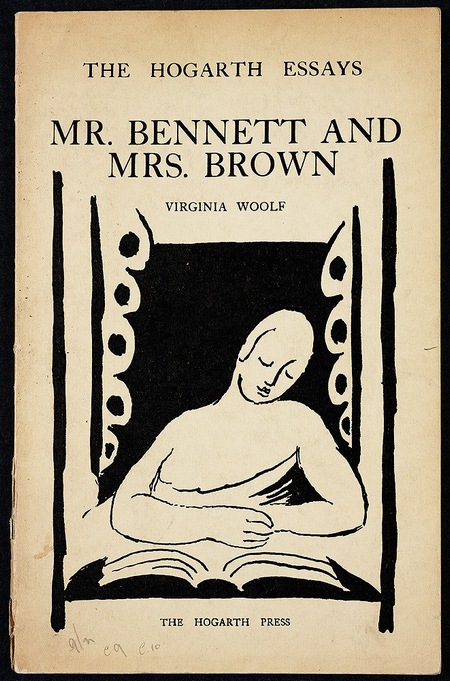
Mr Bennett and Mrs Brown - first edition

Virginia Woolf, Mr. Bennett and Mrs. Brown (1924) Cover design by Vanessa Bell. The Hogarth Essays, First Series, No.1. First impression of 1,000 copies, Printed by Hazel, Watson and Viney, 2s.6d.

This was part of the first series of Hogarth Essays, which were published between 1924 and 1925. It was first written as a response to Arnold Bennett’s criticism of Jacob’s Room which appeared in Cassell’s Weekly in March 1923, and first published in the literary pages of the Nation and Athenaeum which was edited by Leonard Woolf. Later, it was re-worked and extended, then delivered as a lecture to an undergraduate literary society in Cambridge and published as ‘Character in Fiction’ in Eliot’s Criterion.

“In 1924 the Woolfs also started their first series, the Hogarth Essays, by publishing four pamphlets: Virginia Woolf’s Mr. Bennet and Mrs. Brown (October); Roger Fry’s The Artist and Psycho-Analysis (November)’ a thorough and knowledgeable defense of the artist against Freud’s reductive theories; Theodora Bosanquet’s Henry James at Work (November); and T.S. Eliot’s Homage to John Dryden (November).

With the advantage of hindsight, we can see that Virginia Woolf’s essay number one and Eliot’s essay number four in the Hogarth series were two of the most significant statements by the early modernists in the refashioning of attitudes towards fiction and poetry. They have become minor classics, their terminology passing into the vocabulary of criticism.”

J.H. Willis Jr, Leonard and Virginia Woolf as Publishers: The Hogarth Press 1917-1941

previousnext


Hogarth Press studies

Woolf's-head Publishing Woolf’s-head Publishing is a wonderful collection of cover designs, book jackets, and illustrations – but also a beautiful example of book production in its own right. It was produced as an exhibition catalogue and has quite rightly gone on to enjoy an independent life of its own. This book is a genuine collector’s item, and only months after its first publication it started to win awards for its design and production values. Anyone with the slightest interest in book production, graphic design, typography, or Bloomsbury will want to own a copy the minute they clap eyes on it.

Woolf's-head Publishing Buy the book at Amazon UK
Woolf's-head Publishing Buy the book at Amazon US

The Hogarth Press Leonard and Virginia Woolf as Publishers: Hogarth Press, 1917-41 John Willis brings the remarkable story of Leonard and Virginia Woolf’s success as publishers to life. He generates interesting thumbnail sketches of all the Hogarth Press authors, which brings both them and the books they wrote into sharp focus. He also follows the development of many of its best-selling titles, and there’s a full account of the social and cultural development of the press. This is a scholarly work with extensive footnotes, bibliographies, and suggestions for further reading – but most of all it is a very readable study in cultural history.

The Hogarth Press Buy the book at Amazon UK
The Hogarth Press Buy the book at Amazon US

© Roy Johnson 2005


Filed Under: Hogarth Press Tagged With: Art, Bloomsbury, Graphic design, Hogarth Press, Literary studies, Mr Bennett and Mrs Brown, Virginia Woolf

Virginia Woolf – Mrs Dalloway

October 4, 2009 by Roy Johnson

Hogarth Press first edition book jacket designs


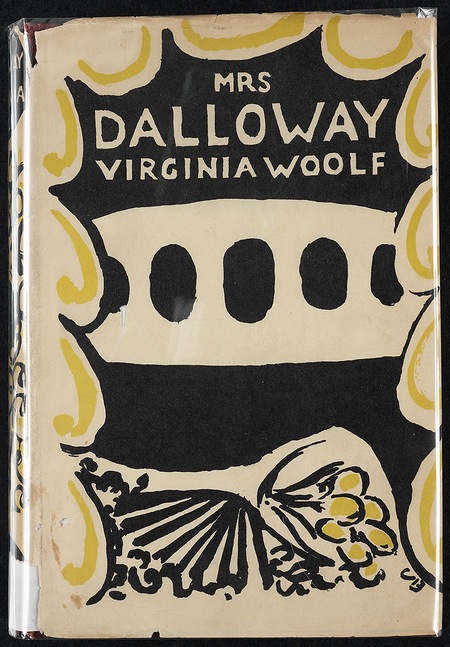
Mrs Dalloway cover - first edition
Virginia Woolf, Mrs. Dalloway (1925) Dust jacket designed by Vanessa Bell.

This novel appeared only a few weeks after the publication of The Common Reader and although the reviews were mixed, the book had sold 2,000 copies by the end of the year.

This is the first of Virginia Woolf’s three great masterpieces (along with To the Lighthouse and The Waves. In it, she developed the experimental literary techniques which had been tried out in Jacob’s Room and brought them to an achievement of a high order.

“The reviews when they came were mixed, and so was Bloomsbury’s reaction. E.M. Forster praised Mrs Dalloway and Virginia, gallantly kissing her hand and telling her the novel was better than Jacob’s Room and he was very pleased; but Vita Sackville-West was doubtful; and Lytton Strachey, admiring The Common Reader more, thought the novel was a flawed stone. Readers bought the book, however, and the sales were brisk. By June 18, one month after publication, Virginia noted that 1,250 copies had been sold … Leonard issued a second impression of 1,000 copies in November 1925.”

J.H. Willis Jr, Leonard and Virginia Woolf as Publishers: The Hogarth Press 1917-1941

Vanessa Bell’s design for the jacket of the novel features a bouquet of flowers. Diane Gillespie notes that the “design in which first the white, then the black dominates, the cover anticipates, if only in a general way, the alternating exhilaration and fear, sanity and insanity, as well as life and death which pervade the book”.

Elizabeth Willson Gordon, Woolf’s-head Publishing: The Highlights and New Lights of the Hogarth Press

previousnext


Hogarth Press studies

Woolf's-head Publishing Woolf’s-head Publishing is a wonderful collection of cover designs, book jackets, and illustrations – but also a beautiful example of book production in its own right. It was produced as an exhibition catalogue and has quite rightly gone on to enjoy an independent life of its own. This book is a genuine collector’s item, and only months after its first publication it started to win awards for its design and production values. Anyone with the slightest interest in book production, graphic design, typography, or Bloomsbury will want to own a copy the minute they clap eyes on it.

Woolf's-head Publishing Buy the book at Amazon UK
Woolf's-head Publishing Buy the book at Amazon US

The Hogarth Press Leonard and Virginia Woolf as Publishers: Hogarth Press, 1917-41 John Willis brings the remarkable story of Leonard and Virginia Woolf’s success as publishers to life. He generates interesting thumbnail sketches of all the Hogarth Press authors, which brings both them and the books they wrote into sharp focus. He also follows the development of many of its best-selling titles, and there’s a full account of the social and cultural development of the press. This is a scholarly work with extensive footnotes, bibliographies, and suggestions for further reading – but most of all it is a very readable study in cultural history.

The Hogarth Press Buy the book at Amazon UK
The Hogarth Press Buy the book at Amazon US

© Roy Johnson 2005


Filed Under: Hogarth Press Tagged With: Art, Bloomsbury, Graphic design, Hogarth Press, Literary studies, Mrs Dalloway, Virginia Woolf

Virginia Woolf – Reviewing

October 4, 2009 by Roy Johnson

Hogarth Press first edition book jacket designs


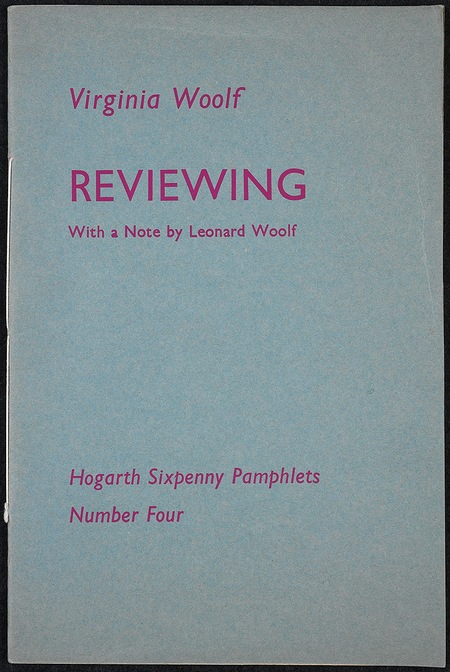
Reviewing - original pamphlet
Virginia Woolf, Reviewing (1939)

previousnext


Hogarth Press studies

Woolf's-head Publishing Woolf’s-head Publishing is a wonderful collection of cover designs, book jackets, and illustrations – but also a beautiful example of book production in its own right. It was produced as an exhibition catalogue and has quite rightly gone on to enjoy an independent life of its own. This book is a genuine collector’s item, and only months after its first publication it started to win awards for its design and production values. Anyone with the slightest interest in book production, graphic design, typography, or Bloomsbury will want to own a copy the minute they clap eyes on it.

Woolf's-head Publishing Buy the book at Amazon UK
Woolf's-head Publishing Buy the book at Amazon US

The Hogarth Press Leonard and Virginia Woolf as Publishers: Hogarth Press, 1917-41 John Willis brings the remarkable story of Leonard and Virginia Woolf’s success as publishers to life. He generates interesting thumbnail sketches of all the Hogarth Press authors, which brings both them and the books they wrote into sharp focus. He also follows the development of many of its best-selling titles, and there’s a full account of the social and cultural development of the press. This is a scholarly work with extensive footnotes, bibliographies, and suggestions for further reading – but most of all it is a very readable study in cultural history.

The Hogarth Press Buy the book at Amazon UK
The Hogarth Press Buy the book at Amazon US

© Roy Johnson 2005


Filed Under: Hogarth Press Tagged With: Art, Bloomsbury, Graphic design, Literary studies, Reviewing, Virginia Woolf

Virginia Woolf – Roger Fry

October 4, 2009 by Roy Johnson

Hogarth Press first edition book jacket designs


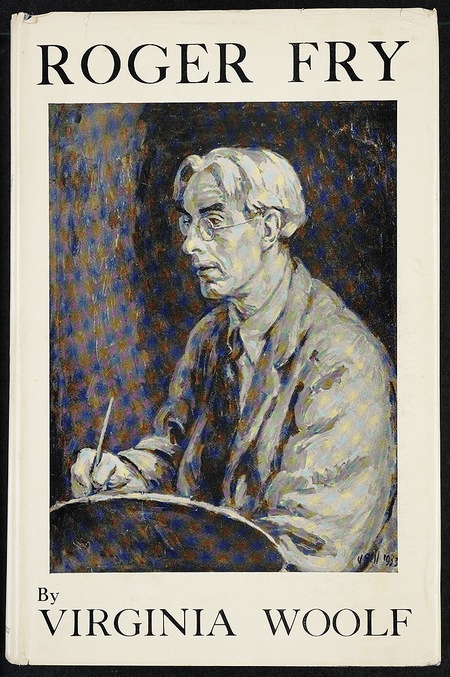
Roger Fry - first edition

 
Virginia Woolf, Roger Fry (1940). Cover design and portrait of Roger Fry by Vanessa Bell

“Virginia’s biography of Roger Fry, a study of the painter and art critic, had been urged on her by Fry’s widow, Margery, and by Vanessa Bell after his death in 1934. It was her next book after Three Guineas (1938) and the last book she published with the press whilst she was still alive. Leonard thought she should not have undertaken it, and when it was completed, he thought it one of her four books written against the grain. Virginia often found the research and writing both restrictive and burdensome, curtailed as she was by propriety from treating openly Fry’s personal and sexual life (his passionate affair with Vanessa, for example); yet much of the work was intellectually and artistically challenging as she strove to create a critical biography of a man she had known and deeply admired since 1911.”

J.H. Willis Jr, Leonard and Virginia Woolf as Publishers: The Hogarth Press 1917-1941

previousnext


Hogarth Press studies

Woolf's-head Publishing Woolf’s-head Publishing is a wonderful collection of cover designs, book jackets, and illustrations – but also a beautiful example of book production in its own right. It was produced as an exhibition catalogue and has quite rightly gone on to enjoy an independent life of its own. This book is a genuine collector’s item, and only months after its first publication it started to win awards for its design and production values. Anyone with the slightest interest in book production, graphic design, typography, or Bloomsbury will want to own a copy the minute they clap eyes on it.

Woolf's-head Publishing Buy the book at Amazon UK
Woolf's-head Publishing Buy the book at Amazon US

The Hogarth Press Leonard and Virginia Woolf as Publishers: Hogarth Press, 1917-41 John Willis brings the remarkable story of Leonard and Virginia Woolf’s success as publishers to life. He generates interesting thumbnail sketches of all the Hogarth Press authors, which brings both them and the books they wrote into sharp focus. He also follows the development of many of its best-selling titles, and there’s a full account of the social and cultural development of the press. This is a scholarly work with extensive footnotes, bibliographies, and suggestions for further reading – but most of all it is a very readable study in cultural history.

The Hogarth Press Buy the book at Amazon UK
The Hogarth Press Buy the book at Amazon US

© Roy Johnson 2005


Filed Under: Hogarth Press Tagged With: Art, Bloomsbury, Graphic design, Literary studies, Roger Fry, Virginia Woolf

  • « Previous Page
  • 1
  • …
  • 4
  • 5
  • 6
  • 7
  • 8
  • Next Page »

Get in touch

info@mantex.co.uk

Content © Mantex 2016
  • About Us
  • Advertising
  • Clients
  • Contact
  • FAQ
  • Links
  • Services
  • Reviews
  • Sitemap
  • T & C’s
  • Testimonials
  • Privacy

Copyright © 2026 · Mantex

Copyright © 2026 · News Pro Theme on Genesis Framework · WordPress · Log in