Mantex

Tutorials, Study Guides & More

  • HOME
  • REVIEWS
  • TUTORIALS
  • HOW-TO
  • CONTACT
>> Home / Archives for 2009

Archives for 2009

Left to Right

June 13, 2009 by Roy Johnson

the cultural shift from words to pictures

This is a dream production in terms of graphic design – a lavishly illustrated and beautifully produced book which cuts no corners in delivering a luxury product. But it also has a serious argument explored in the text. The thesis is that the modern world has witnessed a shift away from the written word towards the visual image as a form of communication. In other words a shift from left to right of the cerebral cortex in our way of thinking.
graphic designThe book takes a historical survey from the early years of the last century to the present to prove the point, and the theoretical claims are supported by quotes from cultural theorists such as Susan Sontag, Roland Barthes, and Marshall McLuhan. It’s a very lavish production, with thick matte paper; huge page margins; full colour; acres of blank space; colour-coded chapter dividers; and well-selected graphics given all the breathing space they need.

However, I’m not sure that David Crow’s central argument is proven. We communicate a great deal these days with logos, symbols, and icons it’s true, but compared with the daily avalanche of words, the proportion is trivial.

He’s arguing that visual culture is replacing literary culture, but the examples he cites are of magazines which have merely increased the percentage of graphics they use. Commercial companies have to make their advertising act quickly – hence the use of pictures rather than words – but that is not the same as graphics replacing language as a cultural influence.

Lots of bold theoretical claims are made, in a way which somehow don’t need to be made. The examples shown are simply new and interesting visual images: they are not displacing words as an influence or introducing new cultural paradigms: they are simply fresh visual inventions.

The second part of the book deals with the history and development of writing systems – though his source for this is the rather self-confessedly lightweight Story of Writing, rather than the far more scholarly Henri-Jean Martin’s The History and Power of Writing or Walter Ong’s Orality and Literacy. This leads into an encomium on the work of Otto Neurath, who proposed a ‘language’ of symbols, then the work of Charles K. Bliss doing a similar kind of thing.

Next he moves on to typographic experimentation on 1970s and 1980s UK. There are some interesting details on the way new effects were created technically, and we’re introduced to graphically innovative designers of the digital age such as Neville Brody, Peter Saville, and Malcolm Garrett. All the left-cortex right-cortex nonsense is left behind, and the study really comes to life. I would be happy to read a book-length study of this period alone if he chose to write one.

The latter part of the book is a celebration of digital possibilities – for as he rightly claims, the computer is

at once a typewriter, a retrieval device, a page layout engine, a photo retouching tool, an edit suite, a recording studio, a television and a radio.

The same is increasingly true of the mobile phone, with which he concludes. I was quite relieved to leave all the left-brain right-brain and language/visuals dichotomy argument behind and concentrate on graphic design and digital technology, which is where his heart obviously lies – and where he would be best employed concentrating his attention in future publications of this quality.

© Roy Johnson 2006

Left to Right   Buy the book at Amazon UK

Left to Right   Buy the book at Amazon US


David Crow, Left to Right: the cultural shift from words to pictures, Lausanne: AVA Publishing SA, 2006, pp.192, ISBN: 2940373361


More on design
More on media
More on web design

Filed Under: Graphic design Tagged With: Design, Design theory, Graphic design, Theory

Leonard & Virginia Woolf – Two Stories

July 27, 2009 by Roy Johnson

Hogarth Press bibliographic designs

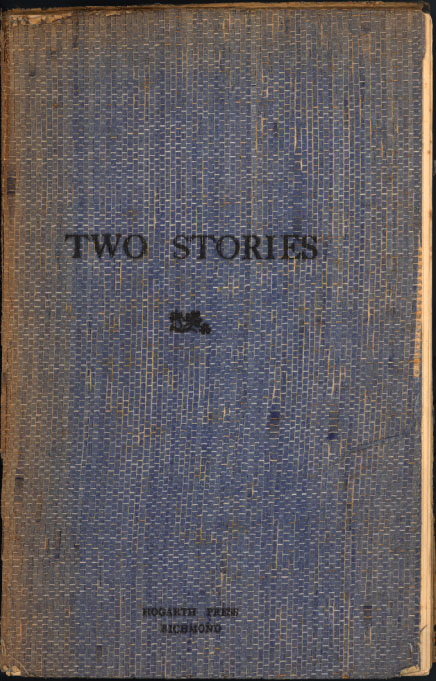
Two Stories

 
Leonard and Viginia Woolf, Two Stories (1917)

This was the first publication of the Hogarth Press. It contains the story Three Jews by Leonard Woolf and the essay The Mark on the Wall by Virginia Woolf, with four small woodcuts by Dora Carrington. 150 copies were printed. It had 34 pages and sold for 1s. 6d.

We decided to print a paper-covered pamphlet containing a story by each of us and try to sell it by subscription to a limited number of people … We set to work and printed a thirty-two page pamphlet, demy octavo … We bound it ourselves by stitching it into paper covers.

The total number finally sold was 134, and all but five or six of them were friends or acquaintances … The total cost of production was £3 7s. 0d., which included the noble sum of 15s to Carrington for the woodcuts, 12s. 6d. for paper, and 10s. for the cover paper. The two authors were not paid any royalty. The total receipts turned out to be £10 8s. 0d., so that the net profit was £7 1s. 0d.

Leonard Woolf, An Autobiography

previousnext


Hogarth Press studies

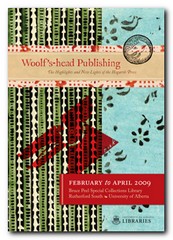
Woolf's-head Publishing Woolf’s-head Publishing is a wonderful collection of cover designs, book jackets, and illustrations – but also a beautiful example of book production in its own right. It was produced as an exhibition catalogue and has quite rightly gone on to enjoy an independent life of its own. This book is a genuine collector’s item, and only months after its first publication it started to win awards for its design and production values. Anyone with the slightest interest in book production, graphic design, typography, or Bloomsbury will want to own a copy the minute they clap eyes on it.

Woolf's-head Publishing Buy the book at Amazon UK
Woolf's-head Publishing Buy the book at Amazon US

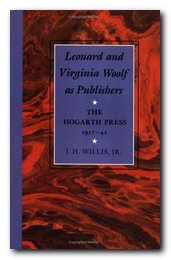
The Hogarth Press Leonard and Virginia Woolf as Publishers: Hogarth Press, 1917-41 John Willis brings the remarkable story of Leonard and Virginia Woolf’s success as publishers to life. He generates interesting thumbnail sketches of all the Hogarth Press authors, which brings both them and the books they wrote into sharp focus. He also follows the development of many of its best-selling titles, and there’s a full account of the social and cultural development of the press. This is a scholarly work with extensive footnotes, bibliographies, and suggestions for further reading – but most of all it is a very readable study in cultural history.

The Hogarth Press Buy the book at Amazon UK
The Hogarth Press Buy the book at Amazon US


Bloomsbury Group links

Red button Bloomsbury Group – tutorials, critical studies, resources

Red button Bloomsbury Group – portraits and biographies

Red button The Bloomsbury Group – Who Were They?

Red button Hogarth Press book jacket cover designs

© Roy Johnson 2005


Filed Under: Hogarth Press Tagged With: Art, Bloomsbury, Graphic design, Hogarth Press, Leonard Woolf, Literary studies, Two Stories, Virginia Woolf

Leonard Woolf – Fear and Politics

October 4, 2009 by Roy Johnson

Hogarth Press first edition book jacket designs


Fear and Politics - first edition

 
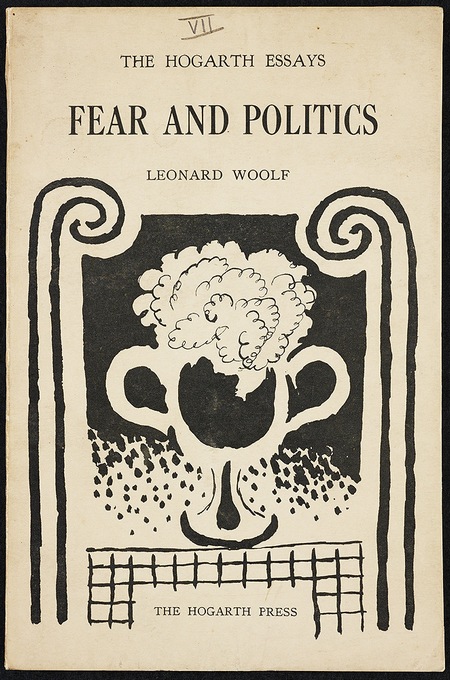
Leonard Woolf, Fear and Politics (1925) Cover design by Vanessa Bell

This is number 7 in the first series of Hogarth Essays, which began in 1924. It was the first of Leonard Woolf’s political contributions to the press. Cover design by Vanessa Bell. In his essay, Leonard writes from the point of view of the animals in a zoo:

“Human beings delude themselves that a League of Nations or Protection or armies and navies are going to give them security and civilization in their jungle.” According to the narrator, who is an elephant, humans “are the savagest race of carnivora known in the jungle, and they will never be happy and civilized, and the world will never be safe for democracy or for any other animal, until each human animal is confined in a separate cage.”

J.H. Willis Jr, Leonard and Virginia Woolf as Publishers: The Hogarth Press 1917-1941

previousnext


Hogarth Press studies

Woolf's-head Publishing Woolf’s-head Publishing is a wonderful collection of cover designs, book jackets, and illustrations – but also a beautiful example of book production in its own right. It was produced as an exhibition catalogue and has quite rightly gone on to enjoy an independent life of its own. This book is a genuine collector’s item, and only months after its first publication it started to win awards for its design and production values. Anyone with the slightest interest in book production, graphic design, typography, or Bloomsbury will want to own a copy the minute they clap eyes on it.

Woolf's-head Publishing Buy the book at Amazon UK
Woolf's-head Publishing Buy the book at Amazon US

The Hogarth Press Leonard and Virginia Woolf as Publishers: Hogarth Press, 1917-41 John Willis brings the remarkable story of Leonard and Virginia Woolf’s success as publishers to life. He generates interesting thumbnail sketches of all the Hogarth Press authors, which brings both them and the books they wrote into sharp focus. He also follows the development of many of its best-selling titles, and there’s a full account of the social and cultural development of the press. This is a scholarly work with extensive footnotes, bibliographies, and suggestions for further reading – but most of all it is a very readable study in cultural history.

The Hogarth Press Buy the book at Amazon UK
The Hogarth Press Buy the book at Amazon US

© Roy Johnson 2005


Filed Under: Hogarth Press Tagged With: Art, Bloomsbury, Fear and Politics, Graphic design, Hogarth Press, Leonard Woolf, Literary studies

Leonard Woolf – Quack! Quack!

October 5, 2009 by Roy Johnson

Hogarth Press first edition book jacket designs


Quack! Quack! - first edition
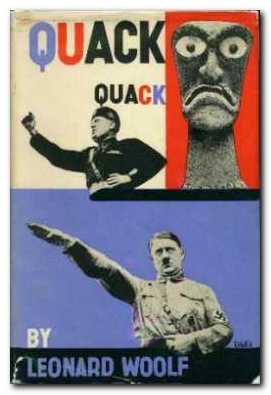
Leonard Woolf, Quack, Quack! (May, 1935) 2,000 copies, Printed by R & R Clark, 7s.6d.

“In his next two Hogarth Press books after the disappointment of After the Deluge (1931), Leonard Woolf published what he thought about Mussolini and his Fascist ambitions in Quack, Quack! (1935) and The League and Abyssinia (1936). The title of Quack, Quack! suggests the barnyard sounds of the orating Hitler and MUssolini. With devastating effect, Woolf matched photographs of the eye-bulging Hawaiian war god Kukailimoku to those of the gesticulating bellicose dictators. Woolf’s two-hundred page attack on fascism concentrated on the savage quackery of modern totalitarianism but also discussed the intellectual sources he found in Carlyle, Nietzsche, and Spengler. Woolf’s list of heroes who battled against the totalitarians for the light of civilization began with Erasmus and Montaigne and included Thomas More, Giordano Bruno, Spinoza, Descartes, Voltaire, Rousseau, Kant, and Goethe.”

J.H. Willis Jr, Leonard and Virginia Woolf as Publishers: The Hogarth Press 1917-1941

The striking, boldly-coloured dust jacket for this book was designed by E.McKnight Kauffer. A cheap edition of the book was published in 1936, priced at 2s.6d; it was reprinted again in 1937.

Elizabeth Willson Gordon, Woolf’s-head Publishing: The Highlights and New Lights of the Hogarth Press

previousnext


Hogarth Press studies

Woolf's-head Publishing Woolf’s-head Publishing is a wonderful collection of cover designs, book jackets, and illustrations – but also a beautiful example of book production in its own right. It was produced as an exhibition catalogue and has quite rightly gone on to enjoy an independent life of its own. This book is a genuine collector’s item, and only months after its first publication it started to win awards for its design and production values. Anyone with the slightest interest in book production, graphic design, typography, or Bloomsbury will want to own a copy the minute they clap eyes on it.

Woolf's-head Publishing Buy the book at Amazon UK
Woolf's-head Publishing Buy the book at Amazon US

The Hogarth Press Leonard and Virginia Woolf as Publishers: Hogarth Press, 1917-41 John Willis brings the remarkable story of Leonard and Virginia Woolf’s success as publishers to life. He generates interesting thumbnail sketches of all the Hogarth Press authors, which brings both them and the books they wrote into sharp focus. He also follows the development of many of its best-selling titles, and there’s a full account of the social and cultural development of the press. This is a scholarly work with extensive footnotes, bibliographies, and suggestions for further reading – but most of all it is a very readable study in cultural history.

The Hogarth Press Buy the book at Amazon UK
The Hogarth Press Buy the book at Amazon US

© Roy Johnson 2005


Filed Under: Hogarth Press Tagged With: Art, Bloomsbury, Graphic design, Hogarth Press, Literary studies, Quack! Quack!

Leonard Woolf – Stories of the East

October 3, 2009 by Roy Johnson

Hogarth Press first edition book jacket designs


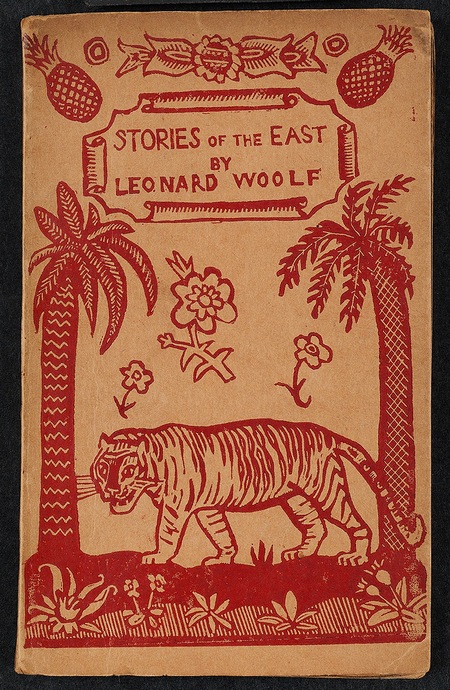
Stories of the East - first edition

Leonard Woolf, Stories of the East (1919)

This publication contained three short stories – ‘Pearls and Swine’, ‘A Tale Told by Midnight’, and ‘The Two Brahmans’, with a cover illustration by Dora Carrington.

These three pieces are of vital importance in understanding Leonard Woolf’s mistrust of and dislike for colonialism. The stories provide disturbing commentaries about the disintegration of the colonial process and the uncomfortable moral ground occupied by the servants of the British Government in Ceylon prior to the Great War.

“Stories of the East was published in April 1921 in 300 copies and very nearly sold out. At the end of the first year, the Hogarth Press had sold over 230 copies, to realise a profit of £6 11s. 5d. When Leonard Woolf closed the account in January 1924, Stories of the East had sold 267 copies. Of the six books published by Hogarth in 1925, Leonard’s stories outsold all but Gorky’s second book, The Notebooks of Tchekhov and Virginia’s Monday or Tuesday, and in the scale of press operations it was a successful venture.”

J.H. Willis Jr, Leonard and Virginia Woolf as Publishers: The Hogarth Press 1917-1941


This book had a yapp binding, as does Prelude, and Eliot’s Poems. Dating from the nineteenth century, the yapp binding is limp, with “overlapping flaps or edges on three sides” and was originally used for binding Bibles meant to be carried in the pocket.

Elizabeth Willson Gordon, Woolf’s-head Publishing: The Highlights and New Lights of the Hogarth Press

previousnext


Hogarth Press studies

Woolf's-head Publishing Woolf’s-head Publishing is a wonderful collection of cover designs, book jackets, and illustrations – but also a beautiful example of book production in its own right. It was produced as an exhibition catalogue and has quite rightly gone on to enjoy an independent life of its own. This book is a genuine collector’s item, and only months after its first publication it started to win awards for its design and production values. Anyone with the slightest interest in book production, graphic design, typography, or Bloomsbury will want to own a copy the minute they clap eyes on it.

Woolf's-head Publishing Buy the book at Amazon UK
Woolf's-head Publishing Buy the book at Amazon US

The Hogarth Press Leonard and Virginia Woolf as Publishers: Hogarth Press, 1917-41 John Willis brings the remarkable story of Leonard and Virginia Woolf’s success as publishers to life. He generates interesting thumbnail sketches of all the Hogarth Press authors, which brings both them and the books they wrote into sharp focus. He also follows the development of many of its best-selling titles, and there’s a full account of the social and cultural development of the press. This is a scholarly work with extensive footnotes, bibliographies, and suggestions for further reading – but most of all it is a very readable study in cultural history.

The Hogarth Press Buy the book at Amazon UK
The Hogarth Press Buy the book at Amazon US

© Roy Johnson 2005


Filed Under: Hogarth Press Tagged With: Art, Bloomsbury, Graphic design, Leonard Woolf, Literary studies, Stories of the East

Leonard Woolf Autobiography – Vol I

July 5, 2009 by Roy Johnson

politics, life,  and literature – 1880 to 1969

Leonard Woolf is probably best known as the husband of Virginia Woolf, but in fact he had a remarkable life and set of achievements quite apart from his wife. He was a political activist and one of the founders of the League of Nations (which became the United Nations); he was a novelist and a journalist; and throughout the whole of his adult life he was a professional publisher, in charge of the very successful Hogarth Press, which he founded and ran successfully for fifty years.

Leonard Woolf Autobiography - Vol IThe first volume of his autobiography deals with his childhood in a prosperous upper middle-class Jewish family and his early memories of growing up in late Victorian London, then his intellectual flowering when he went to Cambridge. The are some wonderful character sketches of his contemporaries, who became luminaries of the Bloomsbury Group, including Saxon Sydney Turner, Lytton Strachey, and Clive Bell.

You also get full details of all the property leases and house buyings of this group as it established its regular system of one place in town and another in the countryside. Some of his more inspired passages are his tirades against mysticism, religious belief, and any surrender to irrationalism. He has a seductively convincing underpinning to his philosophic position that Nothing matters, which he interprets in a non-passive manner – no doubt his own brand of G.E.Moore’s ethics, which he absorbed at Cambridge along with the rest of the Apostles.

Occasionally he’s quite humorous, and he is certainly a humane, rational, and honest man; yet he seems slightly naive in claiming that money is not really important – a claim contradicted by his obsessive habit of listing every penny he spent and earned throughout his fife. But these are minor human inconsistencies.

The next part (a whole volume in its original publication) deals with a part of his life of which most literary enthusiasts know nothing – his work as a colonial administrator in Ceylon. These pages include scenes you would not normally associate with this pillar of Bloomsbury: supervising floggings and executions; eliminating outbreaks of rinderpest; trekking through jungles; and issuing certificates for celebrity big game hunters.

He comes across as a thoroughly decent, intelligent, hard-working man, with a particularly sharp eye for the underdog and a love of animals which makes him an animal liberationist before his time. His experiences in Ceylon made him increasingly anti-imperialist, so he quit the service in 1911 and married Virginia Woolf instead.

He lived an astonishingly rich and varied life post 1912 (covered in Volume II) engagement with the co-operative movement, a gradual shift to the Left in political terms, and friendships with all the leading literary and political figures of the day – H.G.Wells, G.B.Shaw, Bertrand Russell, Ramsay MacDonald, and T.S.Eliot. There are also sustained portraits of Ottoline Morrell, Isobel Colefax, Sigmund Freud (whose complete works he published) and Ramsay MacDonald. He also provides an impassioned account of the political dark years of the 1930s.

Politically, he was a left-wing realist. He served on endless committees, fighting for causes in which he believed. Yet he realised that the people amongst whom he worked, and the mechanisms they pursued, were deadly boring. Unlike many fellow travellers of the inter-war years, he was also well aware that the communists (in Soviet terms) killed more people than they helped or saved.

He’s very revealing on the mechanics of running a small independent publishing company, and he presents the profits and balance sheets of the Hogarth Press with the very conscious aim of revealing what most other writers talk about but never confess – how much they make from their writing.

As an autobiography, it’s long overdue for a reissue, but in the meantime, the two volume Oxford Paperbacks edition offers the full text with good indexes. Leonard Woolf went up in my estimation as a result of reading this memoir, and I am looking forward now to both his collected leters, and in particular to the letters he exchanged on almost a daily basis with his ‘lover’ Trekkie Parsons.

© Roy Johnson 2000

redbtnSee volume two of this autobiography

Leonard Woolf Buy the book at Amazon UK

Leonard Woolf Buy the book at Amazon US


Leonard Woolf, An Autobiography: 1880-1911 v. 1, Oxford: Oxford Paperbacks, 1980, pp.320, ISBN: 0192812890


More on biography
More on Leonard Woolf
Twentieth century literature
More on the Bloomsbury Group


Filed Under: Biography, Bloomsbury Group, Leonard Woolf Tagged With: Autobiography, Biography, Bloomsbury Group, Cultural history, Hogarth Press, Leonard Woolf, Leonard Woolf: Autobiography - Vol I

Leonard Woolf Autobiography – Vol II

July 5, 2009 by Roy Johnson

politics, life, and literature 1911-1969

Leonard Woolf is probably best known as the husband of Virginia Woolf, but in fact he had a remarkable life and set of achievements quite apart from his wife. He was a political activist and one of the founders of the League of Nations (which became the United Nations); he was a novelist and a journalist; and throughout the whole of his adult life he was a professional publisher, in charge of the very successful Hogarth Press, which he founded and ran successfully for fifty years.

Leonard Woolf: AutobiographyThe first volume of his autobiography dealt with his childhood in a prosperous upper middle-class Jewish family and his early memories of growing up in late Victorian London, then his intellectual flowering when he went to Cambridge. The are some wonderful character sketches of his contemporaries, who became luminaries of the Bloomsbury Group, including Saxon Sydney Turner, Lytton Strachey, and Clive Bell.

He comes across as a thoroughly decent, intelligent, hard-working man, with a particularly sharp eye for the underdog and a love of animals which makes him an animal liberationist before his time. His experiences in Ceylon made him increasingly anti-imperialist, so he quit the service in 1911 and married Virginia Woolf instead.

This second volume covers his astonishingly rich and varied life post 1912 – engagement with the co-operative movement, a gradual shift to the Left in political terms, and friendships with all the leading literary and political figures of the day – H.G.Wells, G.B.Shaw, Bertrand Russell, Ramsay MacDonald, and T.S.Eliot. There are also sustained portraits of Ottoline Morrell, Isobel Colefax, Sigmund Freud (whose complete works he published) and Ramsay MacDonald. He also provides an impassioned account of the political dark years of the 1930s.

Politically, he was a left-wing realist. He served on endless committees, fighting for causes in which he believed. Yet he realised that the people amongst whom he worked, and the mechanisms they pursued, were deadly boring. Unlike many fellow travellers of the inter-war years, he was also well aware that the communists (in Soviet terms) killed more people than they helped or saved.

He’s very revealing on the mechanics of running a small independent publishing company, and he presents the profits and balance sheets of the Hogarth Press with the very conscious aim of revealing what most other writers talk about but never confess – how much they make from their writing.

In the last part of his memoir, written when he was eighty-five, it has to be said that he rambles quite a lot, and goes over ground he has already covered earlier. But this does help to reinforce the tremendous variety in his life. He felt that all his political efforts amounted to nothing, and that the Hogarth Press had been successful because it had been kept small scale and independent. He’s probably a bit too hard on himself politically, and anybody with a CV half as long could hold their head up high.

However, this is not a memoir full of gossip or personal revelation. You would never know from this that his wife fell in love with another woman, or that he had a largely sexless relationship with her. Nor would you ever guess that for the last thirty years of his life he shared the wife of his business associate on a weekend-weekday basis.

As an autobiography, it’s long overdue for a reissue, but in the meantime, the two volume Oxford Paperbacks edition offers the full text with good indexes. Leonard Woolf went up in my estimation as a result of reading this memoir, and I am looking forward now to both his collected leters, and in particular to the letters he exchanged on almost a daily basis with his ‘lover’ Trekkie Parsons.

© Roy Johnson 2000

redbtnSee volume one of this autobiography

Buy the book at Amazon UK

Buy the book at Amazon US


Leonard Woolf, An Autobiography: 1911-1969 v. 2, Oxford: Oxford Paperbacks, 1980, pp.536, ISBN: 0192812904


More on biography
More on Leonard Woolf
Twentieth century literature
More on the Bloomsbury Group


Filed Under: Biography, Bloomsbury Group, Leonard Woolf Tagged With: Autobiography, Biography, Bloomsbury Group, Cultural history, Hogarth Press, Leonard Woolf, Leonard Woolf: Autobiography - Vol II

Leonard Woolf biography

September 19, 2009 by Roy Johnson

lifeline, literature, publishing, politics

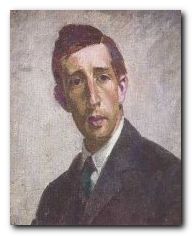
Leonard Woolf biographyLeonard Sidney Woolf was born in London in 1880, the third of ten children of Solomon Rees Sydney and Marie (de Jongh) Woolf. When his father died in 1892, Woolf was sent to board at the Arlington House School, a preparatory school near Brighton. From 1894 to 1899 he studied on a scholarship as a day student at St. Paul’s, a London public school noted for its classical studies. In 1899 he won a classical scholarship to Trinity College, Cambridge.
At Cambridge, Woolf became part of a youthful group of intellectuals who were elected to an elite group called ‘The Apostles’. The members of this group included Lytton Strachey, Clive Bell, Thoby Stephen, John Maynard Keynes and E.M. Forster, who were students, and Bertrand Russell, who was a Fellow. These people eventually formed the core of the Bloomsbury Group.

In 1902 Woolf earned his B.A. degree but stayed on at Cambridge for a fifth year to study for the civil service examination. He left Trinity College in October 1904 to become a cadet in the Ceylon Civil Service. His professional progress was rapid. In August 1908 he was appointed an assistant government agent in the Southern Province, assigned to administer the District of Hambantota.

As part of the Bloomsbury Group, Woolf met Virginia Stephen, Thoby’s sister, and twice proposed marriage to her. He was twice refused. Woolf returned to England in May 1911 for a year’s leave, expecting to return to Ceylon later. In July, however, he proposed to Virginia yet again, and this time she accepted him.

Partly because he chose to marry Virginia and partly because of a growing distaste for colonialism, Woolf resigned from the Ceylon Civil Service early in 1912 (as George Orwell was to do over a decade later). It was at this time that the Bloomsbury Group began to gain momentum as an intellectual and artistic force, and Leonard Woolf was at the centre of it.

In 1913 Woolf published his first novel, The Village and the Jungle, based on his experiences in the colonial service. This was followed by The Wise Virgins in 1914.

Like most other members of the Bloomsbury Group, Woolf was a pacifist and an opponent of Britain’s involvement in the First World War. However, he was spared becoming a conscientious objector, because he was rejected by the military as unfit for duty.

With the outbreak of the war, Woolf turned his attention to politics and sociology. He joined the Labour Party and the Fabian Society and became a regular contributor to New Statesman. In 1916 he wrote International Government which outlined future possibilities for a international agency to enforce peace in the world. The book was incorporated by the British government in its proposals for a League of Nations at Geneva. Woolf was later active in the League of Nations Society and the League of Nations Union.

During the war years Woolf spent a lot of his time caring for his wife Virginia, who was then suffering extreme manic-depression. To provide her with a relaxing hobby they bought a small hand printing press in 1917 and set up the Hogarth Press – named after their home in Richmond. Their first project was a pamphlet containing a story by each of them, printed and bound by themselves.

Other small books followed, written by their friends including T.S. Eliot, Katherine Mansfield and E.M. Forster. Many of the book jackets were designed by Virginia’s sister, the designer and painter Vanessa Bell. Within ten years, the Hogarth Press was a full-scale publishing house and included on its list such seminal works as Eliot’s The Waste Land, Virginia Woolf’s Jacob’s Room and Freud’s Collected Papers, which were translated into English by Julian Strachey, Lytton Strachey’s brother. Leonard Woolf remained the main director of the publishing house from its beginning in 1917 until his death in 1969.

After the war, Leonard Woolf occupied himself more and more with political work. He became editor in 1919 of International Review, and edited the international section of Contemporary Review from 1920 through 1922. He was literary editor of Nation Athenaeum from 1923 to 1930 and joint editor of Political Quarterly from 1931-1959. Woolf also served during the period between the wars as secretary of the Labour Party’s advisory committees on international and colonial questions.

Leonard looked after his wife Virginia through all her periods of depression, right up to the point of her suicide in 1941. They remain a couple who typify the Bloomsbury Group through their personal lives and their prodigious creative output. What is less well known about Leonard Woolf however, is that the latter part of his life was no less radical at a personal level. Love Letters reveals the whole story of this extraordinary episode.

During the Second World War he began an affair with a painter and book illustrator Trekkie Parsons, who was married to a publisher – at that time on active military service. Leonard was 61, Trekkie 39. He wanted her to get a divorce and marry him, but instead she persuaded him to move into the house next door to her in London and she spent the weekends with him at Monk’s House in Rodmell.

When her husband came back from the war, their lives not surprisingly became more complex. She spent the weekends with her husband and the week with Leonard. She took holidays with the two men separately, and acted as hostess for them both. This arrangement worked smoothly for the next twenty-five years.

When Trekkie and Leonard were not together they talked through the post. Trekkie sealed up their correspondence, and it was only opened after her death. Linked by excerpts from her diary, the letters shine with details of daily life: of gardens and glow-worms, books and plays; of Leonard’s publishing and politics; of Trekkie’s struggle to balance her professional and personal life. This remarkable exchange of letters tells the story of two contrasting personalities, their love for one another and their unusual and creative domestic arrangement.

Among Woolf’s most important writings are After the Deluge (1931-51), a multi-volume modern political and social history, and his five-volume autobiography, Sowing (1960), Growing (1961), Beginning Again (1964), Downhill All The Way (1967) and The Journey Not The Arrival Matters (1969). He died August 14, 1969.


Leonard Woolf biography


Bloomsbury Group – web links

Bloomsbury Group - web links Hogarth Press first editions
Annotated gallery of original first edition book jacket covers from the Hogarth Press, featuring designs by Vanessa Bell, Roger Fry, and others.

Bloomsbury Group - web links The Omega Workshops
A brief history of Roger Fry’s experimental Omega Workshops, which had a lasting influence on interior design in post First World War Britain.

Bloomsbury Group - web links The Bloomsbury Group and War
An essay on the largely pacifist and internationalist stance taken by Bloomsbury Group members towards the First World War.

Bloomsbury Group web links Tate Gallery Archive Journeys: Bloomsbury
Mini web site featuring photos, paintings, a timeline, sub-sections on the Omega Workshops, Roger Fry, and Duncan Grant, and biographical notes.

Bloomsbury Group - web links Bloomsbury: Books, Art and Design
Exhibition of paintings, designs, and ceramics at Toronto University featuring Hogarth Press, Vanessa Bell, Dora Carrington, Quentin Bell, and Stephen Tomlin.

Bloomsbury Group - web links Blogging Woolf
A rich enthusiast site featuring news of events, exhibitions, new book reviews, relevant links, study resources, and anything related to Bloomsbury and Virginia Woolf

Bloomsbury Group - web links Hyper-Concordance to Virginia Woolf
Search the texts of all Woolf’s major works, and track down phrases, quotes, and even individual words in their original context.

Bloomsbury Group - web links A Mrs Dalloway Walk in London
An annotated description of Clarissa Dalloway’s walk from Westminster to Regent’s Park, with historical updates and a bibliography.

Bloomsbury Group - web links Women’s History Walk in Bloomsbury
Annotated tour of literary and political homes in Bloomsbury, including Gordon Square, University College, Bedford Square, Doughty Street, and Tavistock Square.

Bloomsbury Group - web links Virginia Woolf Society of Great Britain
News of events, regular bulletins, study materials, publications, and related links. Largely the work of Virginia Woolf specialist Stuart N. Clarke.

Bloomsbury Group - web links BBC Audio Essay – A Eulogy to Words
A charming sound recording of a BBC radio talk broadcast in 1937 – accompanied by a slideshow of photographs of Virginia Woolf.

Bloomsbury Group - web links A Family Photograph Albumn
Leslie Stephens’ collection of family photographs which became known as the Mausoleum Book, collected at Smith College – Massachusetts.

Bloomsbury Group - web links Bloomsbury at Duke University
A collection of book jacket covers, Fry’s Twelve Woodcuts, Strachey’s ‘Elizabeth and Essex’.

© Roy Johnson 2000-2014


More on Leonard Woolf
Twentieth century literature
More on the Bloomsbury Group


Filed Under: Bloomsbury Group, Leonard Woolf Tagged With: Biography, Bloomsbury Group, Cultural history, Leonard Woolf

Leslie Stephen biography

September 21, 2009 by Roy Johnson

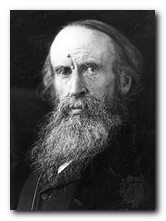
Leslie Stephen (1832-1904) has every right to be considered the father of the Bloomsbury Group, since it was his sons and daughters who eventually formed the network of friends and lovers which came to be given that name. But he was equally distinguished in his own right – as an author, critic, and a mountaineer. He is perhaps best known as the editor and principal author of the Dictionary of National Biography. Born in Kensington, London, he was raised in a family which belonged to the Clapham sect of evangelical Christian social reformers. He was educated at Eton College, then at Trinity Hall, Cambridge where he remained for several years as a fellow and a tutor of his college.

Leslie Stephen biographyHe became an Anglican clergyman, but in 1865 renounced his religious beliefs and left the church. In 1869 he married Harriet Thackeray, the daughter of William Makepeace Thackeray. They had a daughter Laura (1870-1945) who developed a form of incurable brain disease and was institutionalised for the majority of her life. When his wife died rather suddenly in 1875 he married Julia Prinsep Jackson, the widow of Herbert Duckworth. She brought with her two sons, George and Gerald, the latter of whom went on to found the Duckworth publishing company.
Settling at Hyde Park Gate in Kensington, London, he made his living as a journalist, editing the Cornhill Magazine which published the work of Robert Louis Stevenson, Thomas Hardy, and Henry James. He also contributed to the Saturday Review. Macmillan, and other periodicals. In his spare time he became a famous mountaineer, and was the first person to climb a number of Alpine peaks. He was one of the first presidents of the Alpine Club and wrote The Playground of Europe which became a mountaineering classic.

With his second wife he had four children – two sons, Thoby and Adrian, and two daughters, Vanessa and Virginia who became Vanessa Bell the painter, and Virginia Woolf the writer. He was the first editor of the Dictionary of National Biography and he wrote The Science of Ethics which was widely adopted as a standard textbook on the subject.

When his second wife died in 1895, his daughter Vanessa took over the running of the Stephen household. He established what both his daughters describe as an emotionally demanding regime – but it has to be said that as a free-thinker, he also gave them free reign to pursue their artistic ambitions. In fact it is often observed that although Virginia, like other women of her time, did not go to university, she nevertheless received a first-class education at home, merely by being given free access to her father’s library.

When Leslie Stephen died in 1904 all four of the Stephen children lost no time in setting up home independently in what they saw as a more liberal and tolerant atmosphere. They even decorated their new premises in Gordon Square Bloomsbury in lighter colours, as a reaction to the dark tones of the Victorian period they were leaving. However, the politically liberal, free-thinking (non-religious) intellectual atmosphere their father left them as an inheritance was to form the basis of what they had created within a few years as founding members of the Bloomsbury Group.


Leslie Stephen


Bloomsbury Group – web links

Bloomsbury Group - web links Hogarth Press first editions
Annotated gallery of original first edition book jacket covers from the Hogarth Press, featuring designs by Vanessa Bell, Roger Fry, and others.

Bloomsbury Group - web links The Omega Workshops
A brief history of Roger Fry’s experimental Omega Workshops, which had a lasting influence on interior design in post First World War Britain.

Bloomsbury Group - web links The Bloomsbury Group and War
An essay on the largely pacifist and internationalist stance taken by Bloomsbury Group members towards the First World War.

Bloomsbury Group web links Tate Gallery Archive Journeys: Bloomsbury
Mini web site featuring photos, paintings, a timeline, sub-sections on the Omega Workshops, Roger Fry, and Duncan Grant, and biographical notes.

Bloomsbury Group - web links Bloomsbury: Books, Art and Design
Exhibition of paintings, designs, and ceramics at Toronto University featuring Hogarth Press, Vanessa Bell, Dora Carrington, Quentin Bell, and Stephen Tomlin.

Bloomsbury Group - web links Blogging Woolf
A rich enthusiast site featuring news of events, exhibitions, new book reviews, relevant links, study resources, and anything related to Bloomsbury and Virginia Woolf

Bloomsbury Group - web links Hyper-Concordance to Virginia Woolf
Search the texts of all Woolf’s major works, and track down phrases, quotes, and even individual words in their original context.

Bloomsbury Group - web links A Mrs Dalloway Walk in London
An annotated description of Clarissa Dalloway’s walk from Westminster to Regent’s Park, with historical updates and a bibliography.

Bloomsbury Group - web links Women’s History Walk in Bloomsbury
Annotated tour of literary and political homes in Bloomsbury, including Gordon Square, University College, Bedford Square, Doughty Street, and Tavistock Square.

Bloomsbury Group - web links Virginia Woolf Society of Great Britain
News of events, regular bulletins, study materials, publications, and related links. Largely the work of Virginia Woolf specialist Stuart N. Clarke.

Bloomsbury Group - web links BBC Audio Essay – A Eulogy to Words
A charming sound recording of a BBC radio talk broadcast in 1937 – accompanied by a slideshow of photographs of Virginia Woolf.

Bloomsbury Group - web links A Family Photograph Albumn
Leslie Stephens’ collection of family photographs which became known as the Mausoleum Book, collected at Smith College – Massachusetts.

Bloomsbury Group - web links Bloomsbury at Duke University
A collection of book jacket covers, Fry’s Twelve Woodcuts, Strachey’s ‘Elizabeth and Essex’.

© Roy Johnson 2000-2014


More on biography
More on the Bloomsbury Group
Twentieth century literature


Filed Under: Bloomsbury Group Tagged With: Biography, Bloomsbury Group, leslie Stephen, Literary studies

Letterforms

July 10, 2009 by Roy Johnson

essays on type classification, history, and bibliography

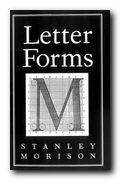
Stanley Morison (1889-1967) was an English typographer, designer and historian of printing. Self-taught, having left school after his father abandoned his family, Morison became an editorial assistant on Imprint magazine in 1913. As a conscientious objector he was imprisoned during the First World War but became design supervisor at the Pelican Press in 1918. In 1922 he founded the Fleuron Society dedicated to typographical matters and edited the society’s journal The Fleuron from 1925 to 1930. Letterforms contains two of his scholarly essays on the classification of type designs.

Letterforms The quality of the publication’s artwork and printing was considered exceptional. From 1923 to 1967 Morison was typographic consultant for the Monotype Corporation where his research and adaptation of historic typefaces in the 1920s and 1930s, including the revival of the Baskerville and Bembo types. He pioneered the great expansion of the company’s range of typefaces and hugely influenced the field of typography to the present day.

Morison was also typographical consultant to The Times from 1929 to 1960 and in 1931 he was commissioned by the newspaper to produce a new easy to read typeface for the publication. The typeface Morison developed with graphic artist Victor Lardent, Times New Roman was first used by the newspaper in 1932 and was published by Monotype in 1933.

He edited the History of the Times from 1935 to 1952 and was editor of the Times Literary Supplement between 1945 and 1948, and he was a member of the editorial board of Encyclopaedia Britannica from 1961 until his death.

This slender and beautifully produced volume contains two of his essays. The first, from 1961, is on the classification of typographical variations and was written as the introduction to a collection of type examples which is not yet complete. The second is from 1962 and concerns fifteenth and sixteenth century Italian scripts.

It’s a pity that the first longer essay is not (yet) illustrated by examples, because it forms a magisterial introduction to its subject. Morison’s writing is spare, compressed, and authoritative – and he moves effortlessly between texts in Italian, French, German, and Latin to make his argument.

What he traces is not only the history of type design, but also writing on it as a subject worthy of study. For it was almost two centuries after the advent of printing with moveable type that people began to take it seriously as an art rather than just a technical process of transferring writing into print.

He traces all the important names – Aldus, Caslon, Fournier, Baskerville, Boldoni, Clarke, Blades, Hart (of Hart’s Rules fame) and Updike, up to his own work on Fleuron. It’s an odd text – an introduction to a set of typographical examples which does not yet exist. But it is of obvious historical significance, giving as it does a synoptic view of a whole discipline.

The second essay is also an introduction – but this time to a set of writing books which had been produced in 1962. This essay too traces the state of what could and could not be known about typography in the fifteenth and sixteenth century – but in this case there are excellent illustrations from the works in question.

He inspects the history and development of chancery cursive writing and the roman capital lettering in Italy with a scholarship with is at once astonishingly modest and breathtakingly thorough. This is a book for typography specialists from publishers who specialise in such works. Thank goodness they exist.

© Roy Johnson 2001

Buy the book at Amazon UK

Buy the book at Amazon US


Stanley Morison, Letterforms, Montreal: Hartley and Marks, 1997, pp.128, ISBN 0881791369


More on typography
More on technology
More on digital media


Filed Under: Typography Tagged With: Fonts, Graphic design, Letterforms, Typography

  • « Previous Page
  • 1
  • …
  • 50
  • 51
  • 52
  • 53
  • 54
  • …
  • 103
  • Next Page »

Get in touch

info@mantex.co.uk

Content © Mantex 2016
  • About Us
  • Advertising
  • Clients
  • Contact
  • FAQ
  • Links
  • Services
  • Reviews
  • Sitemap
  • T & C’s
  • Testimonials
  • Privacy

Copyright © 2026 · Mantex

Copyright © 2026 · News Pro Theme on Genesis Framework · WordPress · Log in