Mantex

Tutorials, Study Guides & More

  • HOME
  • REVIEWS
  • TUTORIALS
  • HOW-TO
  • CONTACT
>> Home / Archives for 2009

Archives for 2009

Nineteenth-century Britain: introduction

July 13, 2009 by Roy Johnson

History, politics, and society in 19th century Britain

This introductory guide comes from a new series by Oxford University Press. They are written by specialists, aimed at the common reader, and offer an introduction to the main cultural and philosophical ideas which have shaped the western world. Christopher Harvie and Colin Matthew take head on the issue that the interpretation of historical events (even when we know the ‘facts’) is a political, an ideological issue. It was refreshing to see this form of Marxism still alive and well in their new Nineteenth-century Britain.
Nineteenth-century Britain: a short introductionThe early part of the century is dominated by the French revolution and Britain’s ambiguous role in the following Napoleonic wars. Thereafter, the emphasis, as one might expect, is on a steadily growing population, on urbanisation, industrialisation, and above all on trade. Theirs strikes me as a solidly traditional form of history – dominated by politics, government, law, and social reforms – though they do find space to mention writers, artists, and social philosophers whose ideas might have had an effect on the development of the nation.

This volume, like many of the others in this series, is like listening to a lecture delivered by a distinguished academic – but to an audience of peers. There are no concessions; details are not explained; and the reader is left to supply the context.

At the centre of the account and the century is the Great Exhibition of 1851 – just as the Festival of Britain was to be a century later. There’s a very strong sense of optimism and confidence. It’s a rich social tapestry: educational reforms; public health initiatives; the development of the railways; free trade; and the steady decline of religious belief.

I was rather pleased in a parochial sense to note the repeated prominence of my own home city of Manchester in the development of political radicalism.

They cite as illustrative evidence the work of the great Victorian writers – Charles Dickens, George Eliot, Anthony Trollope, and Thomas Hardy.

The latter part of the book is devoted to a survey of the lower, middle, and upper classes, their habits, beliefs and their political affiliations.

The sense of a historical narrative picks up with greater and greater momentum towards the end, and the closing pages made me eager to pick up all the threads in its sister publication Twentieth-century Britain. This is a very interesting and attractive format – a small, pocket-sized book, stylishly designed, with illustrations, endnotes, suggestions for further reading, and an index.

© Roy Johnson 2005

Buy the book at Amazon UK

Buy the book at Amazon US


Christopher Harvie and Colin Matthew, Nineteenth Century Britain: A Very Short Introduction, Oxford: Oxford University Press, 2005, pp.1171, ISBN: 0192853988


Filed Under: 19C Literature Tagged With: Cultural history, History, Literary studies, Nineteenth-century Britain

Nostromo – a review

October 13, 2009 by Roy Johnson

revolution and capital accumulation in Latin America

Nostromo is generally regarded by most Conrad commentators as his greatest novel. It embraces wide ranging themes of political struggle, international capitalism, the expansion of Europe and the United States into Latin America, various forms of personal heroism and sacrifice, and the dreams and obsessions which can lead people to self-destruction. The location of the novel is Costaguana, a fictional country on the western seaboard of South America, and the focus of events is in its capital Sulaco, where a silver mine has been inherited by English-born Charles Gould but is controlled by American capitalists in San Francisco.

Nostromo reviewCompeting military factions plunge the country in a state of civil war, and Gould tries desperately to keep the mine working. Amidst political chaos, he dispatches a huge consignment of silver, putting it into the hands of the eponymous hero, the incorruptible Capataz de Cargadores, Nostromo. However, things do not go according to plan. It is almost impossible to provide an account of the plot without giving away what are called in movie criticism ‘plot spoilers’. But the silver does not reach its intended destination, and the remainder of the novel is concerned with both the civil conflict and the attitudes of the people who know that the silver exists, and their vainglorious attempts to acquire it.

The novel has a curious but on the whole impressive structure. The first part of the book is an extraordinarily slow-moving – almost static – account of Costaguana and the back-history of the main characters in the story. Then the central section – more than half the novel – is taken up with the dramatic events of just two or three days and nights in which rebel forces attack the town, the silver is smuggled out, and the scene is set for disaster.

This central section of the novel which covers the scenes of military insurgency and high drama conveys very convincingly the uncertainty of civil war, the powerlessness of individuals, and the force of large scale events. Bandits suddenly become generals, all normal communications are cut off, and nobody can be sure where to turn to for law and order. Amazingly, around two hundred pages of narrative cover only two or three days of action – much of it at night.

The main point of Conrad’s story is that the silver of the mine corrupts almost all who come into contact with it. The inheritance and running of the mine estrange Charles Gould from his wife; once Nostromo has concealed the silver, his knowledge of its location eventually corrupts him; and the rebel leader Sotillo is driven almost made with desire to possess it. Only the saintly Emilia Gould has the strength to resist it, refusing to know where it is buried, even when the information is offered by the last person to know, on his death bed.

A great deal of the narrative tension in this long novel turns on who knows what about whom, and many of the key scenes are drenched in dramatic irony built on coincidences which have all the improbability of the nineteenth century novel hanging about them. At one point a completely new character suddenly appears as a stowaway on a boat, and then improbably survives a collision with another ship in the dark by hanging onto the other boat’s anchor. And this is merely a plot device allowing him to transmit misleading information to his captors – and incidentally allows Conrad to indulge in a rather unpleasant bout of anti-Semitism.

In common with many other novels from Conrad’s late phase, the narrative is conveyed to us in a very complex manner. It passes from third person omniscient narrator to first person accounts of events by fictional characters. Authorial point of view and the chronology of events both change alarmingly; the narrative is sometimes taken over temporarily by a fictional character, or is recounted via an improbably long letter which we are meant to believe is being written (in pencil) in the heat of gunfire and other tumultuous events.

There’s also a great deal of geographic uncertainty. As reports come in from one end of the country to the other, and the loyalty of one province and its leaders is mentioned in relation to another – as well as its strategic position on the seaboard – I began to wish for a map to conceptualise events.

Once a heroic solution has been found for the plight of the beleaguered loyalists (an epic Paul Revere type ride on horseback by Nostromo) the story suddenly flashes forward to the successful years of recovery and the aftermath. Nostromo seeks to consolidate his successful position by a judicious marriage, but is distracted by his passionate love for his intended’s younger sister. Even this detail is linked to the silver of the mine, and it brings about the truly tragic finale.

Despite all Conrad’s stylistic peculiarities (and even some lapses in grammar) this is a magnificent novel which amply repays the undoubtedly demanding efforts required to read it. But that is true of many modern classics – from Mrs Dalloway to Ulysses and Remembrance of Things Past.

Buy the book at Amazon UK

Buy the book at Amazon US

© Roy Johnson 2009


Joseph Conrad, Nostromo: A Tale of the Seaboard, Oxford: Oxford University Press, 2008, pp.524, ISBN: 0199555915


More on Joseph Conrad
Twentieth century literature
More on Joseph Conrad tales


Filed Under: Joseph Conrad Tagged With: English literature, Joseph Conrad, Literary studies, Modernism, Nostromo

Nouns – how to use them correctly

September 11, 2009 by Roy Johnson

free pages from our English Language software program

Nouns – definition

nouns Nouns are the words we use for the names of objects, feelings, states of being, natural things, and groups.
Examples
objects lamp, hat, gate, spoon, book
feelings joy, sadness, fear, anger
states of being confusion, agreement, war
natural things thunder, electricity, gravity, speed
groups herd, pack, catalogue, crowd

Use

redbtn We went to town and bought a lamp

redbtn The joy she felt was clear for all to see.

redbtn The trouble was caused by a power failure.

redbtn Thunder could be heard from a distance of three miles.

redbtn The cow with the curly horn was the most spectacular of the herd.

redbtn Nouns constitute much of the content of both speech and writing. They can usefully be categorised as follows:

  • Common nouns
  • Proper nouns
  • Abstract nouns

redbtn Common nouns. This is the term for objects such as ‘book’, ‘coat’, ‘window’, ‘apple’, ‘man’, ‘woman’.

redbtn Proper nouns. This is the term for names of people, places, days of the week, months of the year. Proper nouns are written with an initial capital letter:

John Smith November
Tuesday Buckingham Palace

redbtn Abstract nouns. This is the term for feelings such as ‘anger’, ‘joy’, ‘fear’, ‘sadness’, and for other intangible phenomena such as ‘beauty’, ‘philosophy’, ‘gravity’, ‘humour’.

redbtn Plurals of nouns are formed in a variety of ways in English.

redbtn Speech. Many nouns are made plural by the addition of a voiced /z/ or voiceless /s/ sibilant or ‘s’ sound as in tins /z/ mats /s/ sweets /s/ cows /z/

redbtn Writing. In writing the examples above would be pluralised by the simple addition of the letter ‘s’.

redbtn Other nouns require an extra syllable to form a plural, according to their use in speech or writing.

redbtn Speech. The plural of the terms ‘house’, ‘ostrich’, and ‘entrance’ are formed as follows:

hou/z/e/z/ ostrich/e/z/ entrance/z/

redbtn Writing. The written form of these plurals is constructed by adding the letter ‘s’ — except in the case of ‘ostrich’ where ‘e’ and ‘s’ are added.

redbtn In these cases, the written version is echoing the spoken word where, for ease of articulation, a vowel sound is added when forming the plural.

redbtn Irregular plurals. English has many words which are borrowings from other languages. The result of this is a number of irregular plurals:

SINGULAR PLURAL
analysis analyses
crisis crises
appendix appendices
narcissus narcissi
amoeba amoebae

redbtn English also has compounds such as the following, called ‘plurals in the first element’:

mothers-in-law [not mother-in-laws]
spoonsful [not spoonfuls]
passers-by [not passer-byes]
courts-martial [not court-martials]

redbtn However, there are also examples of the converse. That is, where the plural is formed in the final element in terms such as:

girlfriends grownups takeoffs

redbtn Archaic plurals. Some plurals are formed by the addition of ‘en’, because of the origin of the word in Old English:

children oxen brethren

redbtn The term ‘chicken’ is the archaic plural of the word ‘chick’. Over the centuries however, it has come to stand for the singular. The plural is now formed by the addition of a final ‘s’ in ‘chickens’.

redbtn Collective nouns. This is the term for one single term which refers to a group of items. Many English collective nouns refer to animals. For example, flock (sheep), brace (game-birds), set (badgers), pride (lions).

redbtn Terms such as ‘den’ (of robbers) ‘team’ (of players) ‘queue’ (of people) ‘party’ (of delegates) are also collective nouns.

redbtn Participles as nouns. Some nouns are formed from verb participles. For example, it is common to refer to ‘the cleaning’ which may be done weekly.

redbtn Film-makers used this form in producing The Shining, and houses are protected by various kinds of ‘cladding’.

redbtn Noun-phrases. These are utterances which may act as subject, object or predicate in a sentence. In other words they function exactly as a single noun, but they comprise more than one word.

redbtn Here are some examples, based on one common, single noun (book)

the book
the interesting book
the book on the shelf
the book which my friend gave me

redbtn All of these noun phrases could be used to start or to finish a sentence:

The book on the shelf is the one I was looking for in the first place.

John gave me the book on the shelf.

Self-assessment quiz follows >>>

© Roy Johnson 2003


English Language 3.0 program
Books on language
More on grammar


Filed Under: English Language Tagged With: English language, Grammar, Language, Nouns, Parts of speech

Numbers in essays

August 24, 2009 by Roy Johnson

sample from HTML program and PDF book

1. A general rule for the presentation of numbers (excluding those dealing with science and mathematics) is that numbers below a hundred are written, and numbers above one hundred are presented by digits:

four brown horses ten years old
she is twenty-two 3,500 tonnes of coal
286 casualties 200 metres long

2. Notice that numbers expressed in more than a single word are hyphenated:

thirty-six     ninety-eight     fifty-five

3. Even above one hundred, round numbers are often expressed as words:

one thousand     two million     three billion

4. However, very large numbers are often expressed in a combination of figures and units of millions or billions:

Social benefit payments were running at $7.8 million per day compared with only $5.6 million a year ago.

5. Where two different series of quantities are being discussed, it may clarify matters if words are used for one series and numbers for the other:

Ten wards in the county emergency hospital contained 16 beds each, but fifteen others contained as many as 30.

6. The following example taken from a piece of journalism illustrates this general rule with mention of numbers both below and above one hundred.

One of the nuclear weapons systems would be a four-boat Trident strategic missile fleet with 512 warheads compared with the 192 urged by Labour and the Liberal Democrats to match the numbers in the Polaris fleet it replaces.

7. Do not begin sentences with a numeral (such as 46 or 107). Either rearrange the sentence, or write out the number (as Forty-six or One hundred and seven).

8. Decimals and percentages should be expressed in figures, and the word ‘percent’ should be written out, except in scientific writing:

With interest currently running at 8 percent, the total monthly repayment figure would be almost $2.5 million.

9. When expressing dates before the Christian era, remember to put the numbers of the earlier date first, and give the later date in full to avoid confusion:

Nebuchadnezzar (1792-1750 BC) not Nebuchadnezzar (1792-50 BC)

10. Dates after the Christian era should be expressed in the same way, but with the era written first:

Nebuchadnezzar (1792-1750 BC) but Pope Sixtus III (AD 432-440)

11. The use of Roman numerals is normally confined to the names of monarchs and popes, for the acts of plays, and for the volumes and subdivisions of books:

Edward VI Pope Pius IV
Othello III.iv.18 Chapter XII
Part III Act V, Sc 3

12. In numbers above a thousand or more, the thousands are marked off with a comma:

10,000 BC     1,500 metres

13. Notice that the plurals of numbers are formed by the addition of s alone. The apostrophe is not required:

in the 1920s     pilots of 747s

© Roy Johnson 2003

Buy Writing Essays — eBook in PDF format
Buy Writing Essays 3.0 — eBook in HTML format


More on writing essays
More on How-To
More on writing skills


Filed Under: Writing Essays Tagged With: Academic writing, Essays, Numbers, Reports, Study skills, Term papers, Writing skills

Numbers, Tables, and Charts

May 24, 2009 by Roy Johnson

practical guidance on the visual presentation of data

Have you ever seen a document containing numbers, tables, and charts – and been unable to understand the information being displayed. Of course you have; and the fault is not yours. The data has simply not been presented effectively. This book deals with the data presentation skills required to show numbers, tables, and graphs in documents and presentations. Many people assemble their data honestly enough when writing reports and giving presentations, but they often do so without thinking how incomprehensible it might be to the audience.

Numbers, Tables, and ChartsOxford University Press have just brought out a series of beginner’s manuals on communication skills. The emphasis is on no-nonsense advice directly related to everyday life. The authors show you how to present numerical data to make its outcomes more self-evident and more easily digestible. This is done by putting figures into a logical order, adding focus to the data, and using layout to guide the reader’s eye towards what is significant.

They cover how to design tables. It’s amazing how much clearer these can be made by removing unnecessary grid lines, aligning numbers and column headings, creating clear titles and headings, and removing any ‘chart junk’.

Graphs should be uncluttered, simple, non-misleading in terms of scale and numbers, and used to illustrate a clear message.

They show how to construct graphs and bar charts so that they immediately reveal the significance of the data they contain. There are also examples of when to use pie charts, scattergrams, and pictographs (small icons)

There’s also useful writing skills advice on how to integrate numbers and statistics into the text of documents. For instance, don’t start sentences with figures or digits, and how to mix the use of words and digits to clarify meaning, as in nine 6-inch rulers and three 5-a-side football matches.

Most presentation of data is these days done using office software packages, so it’s good that they give this a mention, with tips for creating good handouts.

They finish with a case study which tracks the raw data of some school exam results from gathering to final presentation. The grades and numbers can be presented in different ways, and the head teacher must choose the best way for a meeting with the governors.

The chapters of this book are short, but almost every page is rich in hints and tips. The strength of this approach is that it avoids the encyclopedic volume of advice which in some manuals can be quite frightening. This is a book which will reassure those who need it.

The all-time star in this field is Edward Tufte, on whose work they draw substantially. I was glad to see him listed in the bibliography. This is a cheap and cheerful version of the same layout principles he promotes in his beautifully designed books.

© Roy Johnson 2003

Numbers, Tables, and Charts   Buy the book at Amazon UK

Numbers, Tables, and Charts   Buy the book at Amazon US


Sally Bigwood and Melissa Spore, Presenting Numbers, Tables, and Charts, Oxford: Oxford University Press, 2003, pp.144, ISBN: 0198607229


More on information design
More on design
More on media
More on web design


Filed Under: Information Design, Study skills Tagged With: Charts, Communication, Data presentation, Information design, Numbers, Presenting information, Tables, Writing skills

Old Friends (Clive Bell)

May 23, 2009 by Roy Johnson

sketches of the Bloomsbury Group and its members

Clive Bell was one long term member of the Bloomsbury Group who did not leave behind a substantial oeuvre. These are biographical sketches and his memories of various Bloomsbury figures with whom he was closely associated over thirty years. Some of his reflections are offered as correctives to the false impressions which began to circulate about the Bloomsbury Group and its influences shortly after its heyday.

Bloomsbury Group It’s easy to forget that Bloomsbury was under critical attack by the cultural establishment from 1930 onwards. Despite the fact that many of them were radicals and socialists, their aestheticism led them to be attacked from both left and right in the period leading up to the war. Bell’s subjects are those people he knew best – and for longest. For instance, Lytton Strachey who he had met at Cambridge in 1899; John Maynard Keynes who was also at Cambridge and was a fellow member of the Apostles and the Midnight Society.

There’s also Virginia Woolf whose sister he married; and Roger Fry with whom he shared an interest in art criticism – to say nothing of a personal connection with Vanessa Bell, about whom he has surprisingly little to say.

He writes as if he still had one foot in the glorious nineties of the previous century: he’s much given to bitchy point-scoring and bon mots a la Whistler and Wilde, and his style is Mandarin – lofty, opinionated, and full of the posturing which he deplores in his subjects.

His account of Lytton Strachey recalls the formation of the Midnight Society at Trinity College Cambridge, which was to form the nucleus of the Bloomsbury Group, and certain moments are unforgettable: for instance, John Maynard Keynes sending word to the conscientious objection tribunal that he was far too busy to attend.

His writing on Roger Fry takes him deep into the realm of art criticism and the debate about ‘Significant form’ which they had discussed throughout their long friendship. But he completely dismisses his competence as a practising artist, reducing his achievement to ‘those plain white pots and plates … he did for the Omega’ – though he rates his as the greatest ever critic of art.

Some of his other opinions will surprise modern readers. On Virginia Woolf he states quite firmly:

Neither male nor female can be wholly objective about Three Guineas; but for my part I feel sure it is her least admirable production.

But of course this seminal text was dedicated to exposing the prejudice, cant, hypocrisy, and sham which formed the basis of the very class to which Clive Bell belonged – and of which he was a shining example.

Yet considering that he knew all these people so well – he was after all married to Virginia Woolf’s sister – there is remarkably little personal revelation about any of them. You would not know that Keynes and Strachey were homosexuals, or that Roger Fry had been his wife’s lover.

Bloomsbury is famous for the complex personal relations and the gossip of its members, yet Bell’s overall message is that we should be cautious about believing everything they wrote and said about each other – because quite a lot of it (he claims) was simply not true. And he knew because he was there.

He was amazingly well connected in the art world, and devotes a chapter to his relationships with Matisse, Derain, Cocteau, Satie, and Poulenc. This chapter culminates in a famous party which included Stravinsky, Picasso, James Joyce, and Marcel Proust. Joyce arrived late and fell asleep; Proust showed up even later, enquiring of Stravinsky which of Beethoven’s work he admired most. “I detest Beethoven” was the reply. One can almost imagine Proust saying “I’ll get my coat” – except that he would already have been wearing it.

© Roy Johnson 2000

Buy the book at Amazon UK

Buy the book at Amazon US


Clive Bell, Old Friends, London: Cassell, 1956, pp.200, ISBN 030431479X


More on biography
More on the Bloomsbury Group
Twentieth century literature


Filed Under: Bloomsbury Group Tagged With: Biography, Bloomsbury Group, Clive Bell, Literary studies, Old Friends

Omega and After

May 21, 2009 by Roy Johnson

Bloomsbury and the decorative arts

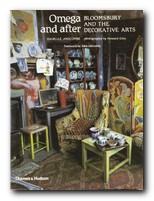
The Bloomsbury Group was largely composed of writers and intellectuals, but there were lots of artists and designers within their ranks too. This well illustrated guide focuses on the highpoint of their endeavours – the Omega Workshops which flourished in the period 1913—1919. This venture was the brainchild of Roger Fry, who recruited Vanessa Bell (his lover at the time) and Duncan Grant as co-directors for an opening in Fitzroy Square in 1913, deep in the heart of Bloomsbury.

Omega and After That was not an auspicious date for the debut of an enterprise which sought to bring Post-Impressionist design to the general public. But in fact it survived throughout the whole of the first world war, even though it was never commercially successful. Fry organised painters, designers, and ceramicists to supply goods which were colourfully and playfully made to bring Modern Art into the home – of those who could afford it. Although the works were produced by people we now see as influential members of the modernist movement in the arts, individual productions were made anonymously, signed only with the letter omega.

A number of famous names were associated with the workshop: at one time or another Henri Gaudier-Brzeska, Paul Nash, David Bomberg, Dora Carrington, William Roberts, and Mark Gertler all had connections with the Omega.

At the launch of the project, artist and writer Wyndham Lewis was also a member; but he quickly split away from the group in a dispute over Omega’s contribution to the Ideal Homes Exhibition. Lewis circulated a letter to all shareholders, making accusations against the company and Roger Fry in particular, and pouring scorn on the products of Omega and its ideology. This subsequently led to his establishing the rival Vorticist movement and the publication in 1916 of its two-issue house magazine, BLAST.

The Omega workshops produced everything, from furniture and paintings to rugs, wallpaper, and children’s toys. All of these are wonderfully illustrated in this collection of photographs which are rarely seen anywhere else.

The text recounts the story of the enterprise and its shaky beginnings. A somewhat amateurish co-operative; the introduction of modernist clothes via Nina Hamnet (the Queen of Bohemia); and the tortured love triangle which existed between its directors.

Isabelle Anscombe devotes an entire chapter to Vanessa Bell, studiously avoiding for as long as she can the fact that she was Roger Fry’s lover; but she is forced to eventually concede that Fry was replaced by Duncan Grant. Her husband Clive Bell, who was friendly with all three of them, is kept out of the picture altogether.

The latter part of the book (the ‘After’ of her title) follows the fortunes of Vanessa Bell and Duncan Grant as they continued their work in decorative arts, at the same time as tracing developments in contemporary design taste in Britain. Both of them continued to put all their decorative efforts into their house at Charleston – which is now a museum to Bloomsbury and its visual culture.

But ultimately, it is the wonderful illustrations which are the centre of interest here: interiors, ceramics, fabrics, book jackets, and portrait photographs of the principal artists. This book is well worth tracking down for anybody with an interest in the decorative arts and the visually creative side of Bloomsbury.

© Roy Johnson 2000

Omega and After Buy the book at Amazon UK

Omega and After Buy the book at Amazon US


Isobelle Anscombe, Omega and After: Bloomsbury and the Decorative Arts, London: Thames and Hudson, 1984, pp.176, ISBN 0500273626


More on design
More on biography
More on the Bloomsbury Group
Twentieth century literature


Filed Under: Bloomsbury Group, Lifestyle, Product design Tagged With: Bloomsbury Group, Decorative arts, Design, Omega worshops

On Being Ill

October 5, 2009 by Roy Johnson

Hogarth Press first edition book jacket designs


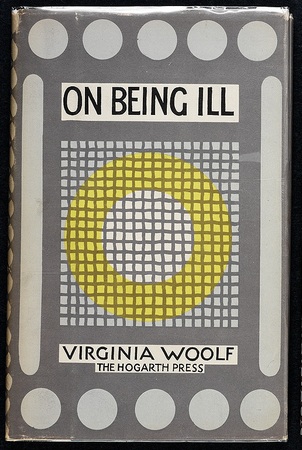
On Being Ill cover - first edition

 
Virginia Woolf, On Being Ill (1930) Cover design by Vanessa Bell.

“Not until 1930 did [Virginia and Leonard Woolf] hand print another of Virginia’s works, a small essay On Being Ill. To possible critics of the slightly botched printing of On Being Ill Virginia composed a tongue-in-cheek form letter which she never sent. Such a charming disclaimer could well serve as a summing up of the Woolf’s hand printing over the years. Beginning “Dear Madam,” Virginia agreed that “the colour is uneven, the letters not always clear, the spacing inaccurate, and the word ‘campion’ should read ‘companion””. Her defense was that she and Leonard were amateur printers without formal training, who fit in their hobby amid busy lives. But, she added, the volume was already worth more than it cost because of over-subscription, so that although “we have not satisfied your taste, we hope that we have not robbed your purse”.

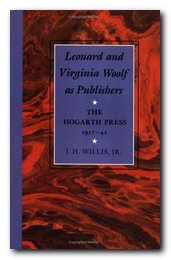
J.H. Willis Jr, Leonard and Virginia Woolf as Publishers: The Hogarth Press 1917-1941

One of the last books hand printed by the Woolfs, On Being Ill is a fairly short essay by Woolf that explores not only illness, but also solitude, sympathy, and reading. Woolf writes, for example, that in illness “It is to the poets that we turn. Illness makes us disinclined for the long campaigns that prose exacts” The words of On Being Ill are both written and printed by Woolf. The book shows a greater sophistication than some of the earlier books, though there are still some errors that remind one that humans rather than machines created the book.

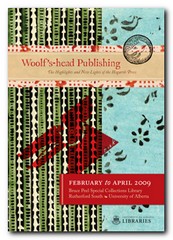
Elizabeth Willson Gordon, Woolf’s-head Publishing: The Highlights and New Lights of the Hogarth Press

previousnext


Hogarth Press studies

Woolf's-head Publishing Woolf’s-head Publishing is a wonderful collection of cover designs, book jackets, and illustrations – but also a beautiful example of book production in its own right. It was produced as an exhibition catalogue and has quite rightly gone on to enjoy an independent life of its own. This book is a genuine collector’s item, and only months after its first publication it started to win awards for its design and production values. Anyone with the slightest interest in book production, graphic design, typography, or Bloomsbury will want to own a copy the minute they clap eyes on it.

Woolf's-head Publishing Buy the book at Amazon UK
Woolf's-head Publishing Buy the book at Amazon US

The Hogarth Press Leonard and Virginia Woolf as Publishers: Hogarth Press, 1917-41 John Willis brings the remarkable story of Leonard and Virginia Woolf’s success as publishers to life. He generates interesting thumbnail sketches of all the Hogarth Press authors, which brings both them and the books they wrote into sharp focus. He also follows the development of many of its best-selling titles, and there’s a full account of the social and cultural development of the press. This is a scholarly work with extensive footnotes, bibliographies, and suggestions for further reading – but most of all it is a very readable study in cultural history.

The Hogarth Press Buy the book at Amazon UK
The Hogarth Press Buy the book at Amazon US

© Roy Johnson 2005


Filed Under: Hogarth Press Tagged With: Art, Bloomsbury, Graphic design, Hogarth Press, Literary studies, On Being Ill

On Writing Well

July 26, 2009 by Roy Johnson

best-selling guide to sharpening your writing style

William Zinsser is professional journalist (former writer and editor on the New York Herald Tribune) who manages to express a love of writing and an appreciation of good style without ever dragging readers into the swamps of grammatical nit-picking and rule-governed instruction. In On Writing Well he expresses himself in an urbane and conversational style typical of popular magazines. This is a reassuring approach for those who want a guided tour of writing issues, held by the hand of someone experienced in the craft. It’s rather like having a writing coach at your shoulder as he talks you through what writers think and the decisions they make.

On Writing Well He’s particularly alert to the fear of those who lack confidence. The first part of the book is taken up with his principal recommendations. These are to cultivate brevity and clarity, and to omit any form of ‘clutter’. He has some wonderful examples of equivocation, ambiguity, and deliberate obfuscation drawn from American public life – including such gems from Alexander Haigh as “at this juncture of maturization” [that is ‘now’] and “We must push this to a lower decibel of public fixation. I don’t think there’s much of a learning curve to be achieved in this area of content.”

He then covers the means by which this clarity is to be achieved. It involves, logically enough, choosing your words carefully, and developing a unity of approach and subject matter.

The third part of the book deals with different forms of writing – such as reportage, interviews, and travel writing. It also covers scientific writing, business and even sports. These chapters are aimed at aspiring journalists, but there’s much to be learned from such details as his sharp-eyed analysis of the travel cliché: ‘villages nestling‘ and ‘byways half-forgotten‘:

Half the sights seen in a day’s sightseeing are quaint, especially windmills and covered bridges

The latter part of the book relaxes into its real subject – journalism – on which Zinsser speaks with feeling about its craft and techniques. In fact he ends by giving a paragraph-by-paragraph account of writing a travel article, explaining the subject options, the choice of vocabulary, and the strategies of approach which he tried and rejected. There’s a certain amount of patting himself on the back after-the-event in this, but aspiring writers might find it interesting to be taken through the generation of a piece of work in this way.

At its best, this approach will make readers sensitive to the effects they produce, and at its weakest it’s like a well-written guidebook on ‘How to Write Stories for Magazines’. But on balance, more people are likely to improve their writing by becoming conscious of rhythm and structure than are likely to fall into the abyss of verbal entertainment which fails.

© Roy Johnson 2006

On Writing Well   Buy the book at Amazon UK

On Writing Well   Buy the book at Amazon US


William Zinsser, On Writing Well: The Classic Guide to Writing Nonfiction (6th edn), New York: Harper, 2006, pp.336, ISBN: 141775057X


More on writing skills
More on language
More on dictionaries


Filed Under: Creative Writing, Journalism, Writing Skills, Writing Skills Tagged With: Creative writing, Journalism, On Writing Well, Writing skills

Online Course Design – a bibliography

October 30, 2009 by Roy Johnson

Online Course Design  Laurel Alexander, Education & Training on the Internet: An essential source for students, teachers and education providers, Plymouth: Internet Handbooks, 2000, pp. 192, IBSN 1840253460. Guide to online resources for students and tutors. Exstensive listings of online courses in UK and abroad.

Online Course Design  Tom Boyle, Design for Multimedia Learning, London: Prentice Hall, 1997, pp.240, ISBN 0132422158. Software and media for creating learning programs. Slightly dated now, but sound on basic principles.

Online Course Design  Stephanie Browner, Stephen Pulsford, and Richard Sears, Literature and the Internet: A Guide for Students, Teachers, and Scholars, London/New York: Garland, 2000, pp.191, ISBN 0815334532. Popular guide to resources, techniques, and issues for literary studies classes.

Online Course Design  Alan Clarke, Designing Computer-Based Learning Materials, London: Gower, 2001, pp.196, ISBN 0566083205. Practical design principles – from conception to evaluation.

Online Course Design  Jason Cole & Helen Foster, Using Moodle, Sebastopol: O’Reilly, (second edition) 2007, pp.266, ISBN 059652918X. Clear and straighforward guide to course design using the open source virtual learning environment Moodle.

Online Course Design  Julia Duggleby, How to be an Online Tutor, Hampshire: Gower, 2000, pp.158, ISBN: 0566082470. Simple guidance notes for online tutors and course authors. Suitable for those working on community-based education.

Online Course Design  D. R. Garrison and Terry Anderson, E-Learning in the 21st Century: A Framework for Research and Practice, London: Routledge, 2003, pp.167, ISBN 0415263468. Course design – from planning and authorship, through to evaluation and assessment. Largely theoretical.

Online Course Design Duncan Grey, The Internet in School, London: Cassell, 1999, pp.155, ISBN: 0304705314. Guide to equipment, policies, and resources for teachers.

Online Course Design  Irene Hammerich and Claire Harrison, Developing Online Content: the Principles of Writing and Editing for the Web, New York: John Wiley, 2002, pp.384, ISBN 0471146110. The principles of writing and editing for the Web.

Online Course Design Reza Hazemi, Stephen Hailes, and Steve Wilbur (eds) The Digital University: Reinventing the Academy, London: Springer Verlag, 1998, pp.307, ISBN 1852330031. Academic essays on the e-Learning revolution.

Online Course Design   Silvina P. Hillar, Moodle 1.9 English Teacher’s Cookbook, Birmingham: Pakt Publishing, 2010, pp.207, ISBN: 1849510881

horton-2

Online Course Design  William K. Horton, Designing Web-Based Training : How to Teach Anyone Anything Anywhere Anytime, John Wiley & Sons, 2000, pp.640, ISBN: 047135614X. Best-selling guide to all aspects of instructional design and writing for web-based training materials. Highly recommended.

Online Course Design  Bob Hughes, Dust or Magic: Secrets of Successful Multimedia Design, London: Addison-Wesley, 2000, pp.264, ISBN 0201360713. Amusing and thought-provoking study of working on multimedia projects – from web design to CD-ROM and interactive video.

Online Course Design  William W. Lee and Diana L. Owens, Multimedia-Based Instructional Design, San Fransisco (CA): Jossey-Bass, 2000, pp.357, ISBN 0787951595.

Online Course Design  Roger Lewis and Quentin Whitlock, How to Plan and Manage an E-learning Programme, London: Gower,2003,pp.185,ISBN 0566084244. Practical step-by-step guide to planning, designing, and managing online learning courses – will apeal in particular to managers and administrators.

Online Course Design  Patrick J. Lynch and Sarah Horton, Web Style Guide, New Haven: Yale University Press, 1999, pp.164, ISBN: 0300076754. Excellent web site design guide. Originally written for medical students at Yale. Concentrates on design principles and navigation.

Online Course DesignMarguerita McVay Lynch, The Online Educator: A guide to creating the virtual classroom, New York/London: Routledge, 2002, pp.170, ISBN: 0415244226. Complete guide to designing and teaching online courses. Recommended.

Online Course Design  Robin Mason and Frank Rennie, eLearning: the key concepts, London: Routledge, 2006, pp.158, ISBN 0415373077

Online Course Design  Jakob Nielsen, Designing Web Usability: The Practice of Simplicity, Indiananapolis (Ind): New Riders, 2000, pp.420, ISBN: 156205810X. Nielsen puts speed and simplicity of access above all else in this tutorial on Web site design which pulls no punches. Fully illustrated with good and bad examples. Recommended.

Online Course Design  Jakob Nielsen and Marie Tahir, Homepage Usability: 50 websites deconstructed, Indiananapolis, (Ind): New Riders, 2002, pp.315, ISBN: 073571102X. Neilsen shows the strengths and weaknesses of famous web sites – and offers his own makeovers of their home pages.

Online Course Design  Jonathan and Lisa Price, Hot Text: Web Writing that Works, Indianapolis (IN): New Riders, 2002, pp.507, ISBN 0735711518. Professional-level manual on how to write, structure, and edit information for the Web. Highly recommended.

Online Course Design  Roy Rada, Understanding Virtual Universities, Bristol: Intellect, 2001, pp.122, ISBN 1841500526. Course design and construction for online learning.

Online Course Design  William H. Rice IV, Moodle Teaching Techniques, Birmingham UK: Pakt, 2007, pp.172, ISBN 184719284X

Online Course Design  William H. Rice, Moodle: E-Learning Course Development, Packt Publishing: Birmingham, 2006, pp.236, ISBN 1904811299.

Online Course Design  William H. Rice, Moodle 1.9 Teaching Techniques, Packt Publishing: Birmingham, 2010, pp.200, ISBN 1904811657.

Online Course Design  Karen Schriver, Dynamics in Document Design, New York (NY): John Wiley and Sons, 1997, ISBN: 0471306363. Wide-ranging academic and practical study in design theory and applications – with arguments for professionalism in design.

Online Course Design  Patti Shank (ed) the Online Learning idea book, San Francisco: John Wiley, 2007, pp.354, ISBN 0787981680

Online Course Design Jeff Stanford, Moodle 1.9 for Second Language Teaching, Birmingham: Packt, 2009, pp.505, ISBN 1847196241

Online Course Design  John Whalley, Theresa Welch, Lee Williamson, E-Learning in FE, London: Continuum, 2006, pp.118, ISBN 0826488625

© Roy Johnson 2009


Filed Under: How-to guides Tagged With: Bibliographies, Course design, Education, Online learning

  • « Previous Page
  • 1
  • …
  • 57
  • 58
  • 59
  • 60
  • 61
  • …
  • 103
  • Next Page »

Get in touch

info@mantex.co.uk

Content © Mantex 2016
  • About Us
  • Advertising
  • Clients
  • Contact
  • FAQ
  • Links
  • Services
  • Reviews
  • Sitemap
  • T & C’s
  • Testimonials
  • Privacy

Copyright © 2026 · Mantex

Copyright © 2026 · News Pro Theme on Genesis Framework · WordPress · Log in