Mantex

Tutorials, Study Guides & More

  • HOME
  • REVIEWS
  • TUTORIALS
  • HOW-TO
  • CONTACT
>> Home / 2009 / Archives for October 2009

Archives for October 2009

George Rylands – Poems

October 5, 2009 by Roy Johnson

Hogarth Press first edition book jacket designs
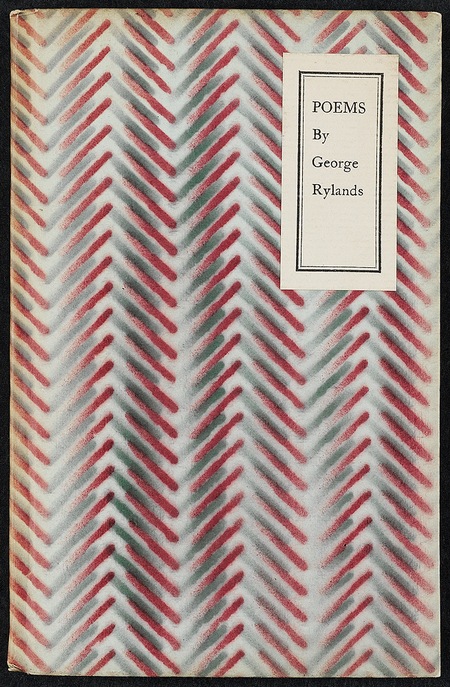
 
Poems by George Rylands - first edition

 
George Rylands, Poems (1931)

“George (“Dadie”) Rylands as an undergraduate moved in the Cambridge Apostles circuit of young men who caught the attention of Maynard Keynes and Lytton Strachey. He became the Woolfs’ short-term but beloved assistant from July to December 1924 and then returned to Cambridge where he became a fellow of King’s College in 1927. The Woolfs published two volumes of Rylands’s poetry, Russet and Taffeta (1925), people by Perditas and Corydons, and Poems (1931) about Chloe and Flora amid the flowers and hay-scented farmlands. The Woolfs also published his fellowship dissertation, Words and Poetry (1928). For all their skillful lyricism, Rylands’s Poems are like pressed flowers, nosegays colourless and dry, preserved from change. Only one year older than William Plomer and two years older than Christopher Isherwood, Rylands wrote not of his generation but of a generation before the FirstWorld War.”

J.H. Willis Jr, Leonard and Virginia Woolf as Publishers: The Hogarth Press 1917-1941

There is generous use of white space in this, the second book of Rylands’ poetry hand printed by the Woolfs… There is a typo in the imprint, placing a comma rather than a period after Leonard’s initial.

Elizabeth Willson Gordon, Woolf’s-head Publishing: The Highlights and New Lights of the Hogarth Press

previousnext


Hogarth Press studies

Woolf's-head Publishing Woolf’s-head Publishing is a wonderful collection of cover designs, book jackets, and illustrations – but also a beautiful example of book production in its own right. It was produced as an exhibition catalogue and has quite rightly gone on to enjoy an independent life of its own. This book is a genuine collector’s item, and only months after its first publication it started to win awards for its design and production values. Anyone with the slightest interest in book production, graphic design, typography, or Bloomsbury will want to own a copy the minute they clap eyes on it.

Woolf's-head Publishing Buy the book at Amazon UK
Woolf's-head Publishing Buy the book at Amazon US

The Hogarth Press Leonard and Virginia Woolf as Publishers: Hogarth Press, 1917-41 John Willis brings the remarkable story of Leonard and Virginia Woolf’s success as publishers to life. He generates interesting thumbnail sketches of all the Hogarth Press authors, which brings both them and the books they wrote into sharp focus. He also follows the development of many of its best-selling titles, and there’s a full account of the social and cultural development of the press. This is a scholarly work with extensive footnotes, bibliographies, and suggestions for further reading – but most of all it is a very readable study in cultural history.

The Hogarth Press Buy the book at Amazon UK
The Hogarth Press Buy the book at Amazon US

© Roy Johnson 2005


Filed Under: Hogarth Press Tagged With: Art, Bloomsbury, Graphic design, Hogarth Press, Literary studies, Poems

Goodbye to Berlin – Christopher Isherwood

October 5, 2009 by Roy Johnson

Hogarth Press first edition book jacket designs

 
Goodbye to Berlin - first edition

 
Christopher Isherwood, Goodbye to Berlin (1939)

“Before leaving for China, Isherwood had completed “The Landauers”, “On Ruegen Island”, and “A Berlin Diary (Winter 1932-33)” and given them to John Lehmann, who was beginning his negotiations with the Woolfs to become managing director of the press. Lehmann collected the various stories from the first Berlin diary to the last and arranged them in novel form as Goodbye to Berlin (1939), and the novel was published by the Hogarth Press under Lehmann’s supervision in March.

Goodbye to Berlin, thanks in part to the audacious spirit of Sally Bowles, became another fast-selling, popular success for Isherwood and the Hogarth Press. Reviewers were generally enthusiastic, although troubled by the fragmented structure and the omnipresent narrator Christopher Isherwood who bore the author’s name. Few of them saw at the time the irony, art, and control with which Isherwood had shaped his characters and assembled his episodes. Edmund Wilson, almost alone, saw Goodbye to Berlin in terms that would become obvious to later more observant critics. Reviewing the American edition by Random House, Wilson noted that Isherwood was a master of social observation whose eye was “accurate, lucid and cool; and it is a faculty which brings its own antidote to the hopelessness and horror he describes”. Isherwood’s prose, added Wilson, was “a perfect medium for his purpose”, allowing the reader “to look right through Isherwood and to see what he sees”.

J.H. Willis Jr, Leonard and Virginia Woolf as Publishers: The Hogarth Press 1917-1941

previousnext


Hogarth Press studies

Woolf's-head Publishing Woolf’s-head Publishing is a wonderful collection of cover designs, book jackets, and illustrations – but also a beautiful example of book production in its own right. It was produced as an exhibition catalogue and has quite rightly gone on to enjoy an independent life of its own. This book is a genuine collector’s item, and only months after its first publication it started to win awards for its design and production values. Anyone with the slightest interest in book production, graphic design, typography, or Bloomsbury will want to own a copy the minute they clap eyes on it.

Woolf's-head Publishing Buy the book at Amazon UK
Woolf's-head Publishing Buy the book at Amazon US


The Hogarth Press
Leonard and Virginia Woolf as Publishers: Hogarth Press, 1917-41 John Willis brings the remarkable story of Leonard and Virginia Woolf’s success as publishers to life. He generates interesting thumbnail sketches of all the Hogarth Press authors, which brings both them and the books they wrote into sharp focus. He also follows the development of many of its best-selling titles, and there’s a full account of the social and cultural development of the press. This is a scholarly work with extensive footnotes, bibliographies, and suggestions for further reading – but most of all it is a very readable study in cultural history.

The Hogarth Press Buy the book at Amazon UK
The Hogarth Press Buy the book at Amazon US

© Roy Johnson 2005

Filed Under: Hogarth Press Tagged With: Art, Bloomsbury, Goodbye to Berlin, Graphic design, Hogarth Press, Literary studies

Harold Nicolson – Jeanne de Henaut

October 5, 2009 by Roy Johnson

Hogarth Press first edition book jacket designs


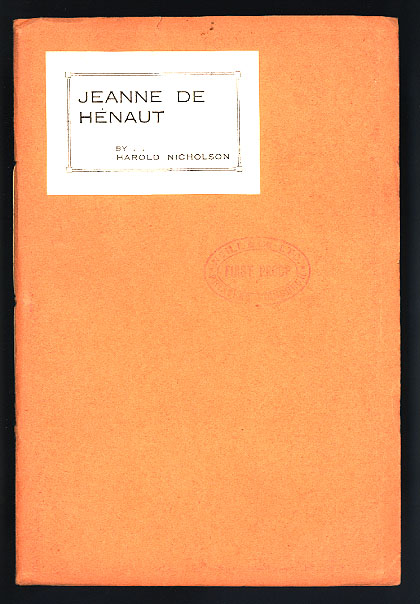
Jeanne de Henaut - first edition

 
Harold Nicolson, Jeanne de Hénaut (1924)

Only 55 copies were printed. This copy has the printer’s “First Proof” stamp and the date “8 Nov. 1924” on the front cover. The author’s name is spelled “Nicholson” on the proof, but this was corrected before publication. This is the only known copy of the First Proof.

previousnext


Hogarth Press studies

Woolf's-head Publishing Woolf’s-head Publishing is a wonderful collection of cover designs, book jackets, and illustrations – but also a beautiful example of book production in its own right. It was produced as an exhibition catalogue and has quite rightly gone on to enjoy an independent life of its own. This book is a genuine collector’s item, and only months after its first publication it started to win awards for its design and production values. Anyone with the slightest interest in book production, graphic design, typography, or Bloomsbury will want to own a copy the minute they clap eyes on it.

Woolf's-head Publishing Buy the book at Amazon UK
Woolf's-head Publishing Buy the book at Amazon US

The Hogarth Press Leonard and Virginia Woolf as Publishers: Hogarth Press, 1917-41 John Willis brings the remarkable story of Leonard and Virginia Woolf’s success as publishers to life. He generates interesting thumbnail sketches of all the Hogarth Press authors, which brings both them and the books they wrote into sharp focus. He also follows the development of many of its best-selling titles, and there’s a full account of the social and cultural development of the press. This is a scholarly work with extensive footnotes, bibliographies, and suggestions for further reading – but most of all it is a very readable study in cultural history.

The Hogarth Press Buy the book at Amazon UK
The Hogarth Press Buy the book at Amazon US

© Roy Johnson 2005


Filed Under: Hogarth Press Tagged With: Art, Bloomsbury, Graphic design, Harold Nicolson, Hogarth Press, Jeanne de Henaut, Literary studies

Hogarth Press – Book Jackets

October 3, 2009 by Roy Johnson

Hogarth Press - Book Jackets - colophon - Bell

Hogarth Press first edition book jacket designs

1917.   Leonard & Virginia Woolf,   Two Stories

1918.   Katherine Mansfield,   Prelude

1918.   T.S. Eliot,   Poems

1918.   Virginia Woolf,   Kew Gardens

1921.   Leonard Woolf,   Stories of the East

1921.   Roger Fry,   Twelve Original Woodcuts

1921.   Virginia Woolf,   Monday or Tuesday

1922.   Fyodor Dostoyevski,   Stavrogin’s Confession

1922.   Virginia Woolf,   Jacob’s Room

1923.   T.S. Eliot,   The Waste Land

1923.   Robert Graves,   The Feather Bed

1924.   Virginia Woolf,   Mr Bennett and Mrs Brown

1924.   Harold Nicolson,   Jeanne de Hénaut

1924.   Leonard Woolf,   Fear and Politics

1925.   Virginia Woolf,   The Common Reader

1926.   Virginia Woolf,   Mrs Dalloway

1927.   F.L. Lucas,   Tragedy

1927.   Virginia Woolf,   To the Lighthouse

1927.   Sigmund Freud,   The Ego and the Id

1929.   Virginia Woolf,   A Room of One’s Own

1930.   Maurice Dobb,   Russia To-Day and To-Morrow

1930.   Virginia Woolf,   On Being Ill

1931.   Virginia Woolf,   The Waves

1931.   George Rylands,   Poems

1931.   William Plomer,   Sado

1932.   Virginia Woolf,   The Common Reader – II

1933.   Rebecca West,   Letter to a Grandfather

1934.   L.B. Pekin,   Darwin

1935.   R.C. Trevelyan,   Beelzebub and Other Poems

1935.   Leonard Woolf,   Quack, Quack!

1937.   Virginia Woolf,   The Years

1938.   Virginia Woolf,   Three Guineas

1939.   Hogarth Press,   Hogarth Sixpenny Pamphlets

1939.   E.M. Forster,   What I Believe

1939.   Virginia Woolf,   Reviewing

1939.   Christopher Isherwood,   Goodbye to Berlin

1940.   Virginia Woolf,   Roger Fry

1941.   Virginia Woolf,   Between the Acts

1942.   Virginia Woolf,   The Death of the Moth


Hogarth Press studies

Woolf's-head Publishing Woolf’s-head Publishing is a wonderful collection of cover designs, book jackets, and illustrations – but also a beautiful example of book production in its own right. It was produced as an exhibition catalogue and has quite rightly gone on to enjoy an independent life of its own. This book is a genuine collector’s item, and only months after its first publication it started to win awards for its design and production values. Anyone with the slightest interest in book production, graphic design, typography, or Bloomsbury will want to own a copy the minute they clap eyes on it.

Woolf's-head Publishing Buy the book at Amazon UK
Woolf's-head Publishing Buy the book at Amazon US

The Hogarth Press Leonard and Virginia Woolf as Publishers: Hogarth Press, 1917-41 John Willis brings the remarkable story of Leonard and Virginia Woolf’s success as publishers to life. He generates interesting thumbnail sketches of all the Hogarth Press authors, which brings both them and the books they wrote into sharp focus. He also follows the development of many of its best-selling titles, and there’s a full account of the social and cultural development of the press. This is a scholarly work with extensive footnotes, bibliographies, and suggestions for further reading – but most of all it is a very readable study in cultural history.

The Hogarth Press Buy the book at Amazon UK
The Hogarth Press Buy the book at Amazon US

© Roy Johnson 2005

Filed Under: Hogarth Press Tagged With: Art, Bloomsbury, First editions, Graphic design, Hogarth Press, Literary studies

Hogarth Sixpenny Pamphlets

October 4, 2009 by Roy Johnson

Hogarth Press first edition book jacket designs


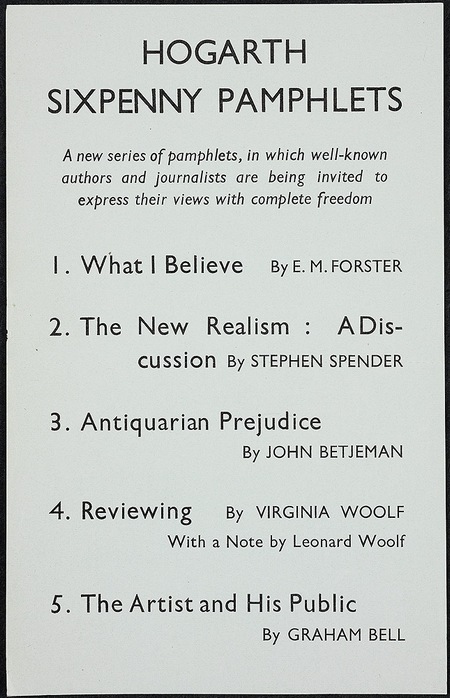
Hogarth Sixpenny Pamphlets - original advertising flyer
Hogarth Sixpenny Pamphlets 1940 – advertising flyer

previousnext


Hogarth Press studies

Woolf's-head Publishing Woolf’s-head Publishing is a wonderful collection of cover designs, book jackets, and illustrations – but also a beautiful example of book production in its own right. It was produced as an exhibition catalogue and has quite rightly gone on to enjoy an independent life of its own. This book is a genuine collector’s item, and only months after its first publication it started to win awards for its design and production values. Anyone with the slightest interest in book production, graphic design, typography, or Bloomsbury will want to own a copy the minute they clap eyes on it.

Woolf's-head Publishing Buy the book at Amazon UK
Woolf's-head Publishing Buy the book at Amazon US

The Hogarth Press Leonard and Virginia Woolf as Publishers: Hogarth Press, 1917-41 John Willis brings the remarkable story of Leonard and Virginia Woolf’s success as publishers to life. He generates interesting thumbnail sketches of all the Hogarth Press authors, which brings both them and the books they wrote into sharp focus. He also follows the development of many of its best-selling titles, and there’s a full account of the social and cultural development of the press. This is a scholarly work with extensive footnotes, bibliographies, and suggestions for further reading – but most of all it is a very readable study in cultural history.

The Hogarth Press Buy the book at Amazon UK
The Hogarth Press Buy the book at Amazon US

© Roy Johnson 2005

Filed Under: Hogarth Press Tagged With: Art, Bloomsbury, Graphic design, Hogarth Press, Literary studies

How to publish your writing

October 31, 2009 by Roy Johnson

guidance and resources for writers

If you wish to publish your writing, you need to learn about the publishing process, marketing your work, and targetting your audience. The web pages listed here deal with all those topics – and more besides.

publish your writingThe writer’s marketplace
This is a selection of best-selling writer’s guides. These list all the information you need for contacting publishers, agents, and editors. They cover book publishing, magazines, newspapers, and specialist outlets for photographers and illustrators. Most of them provide mini-essays and tutorials featuring advice from professional writers.

publish your writingEditing your writing
Guidance snotes on editing, re-writing, and creating structure – plus basic advice on topics such as sentences, paragraphs, headings, titles, punctuation, and spelling.

publish your writingPublishing on the Internet
A selection of guidance manuals on writing for the Web – showing the special skills for creating readable web pages, plus writers’ groups and specialist outlets for creative online writing.

publish your writingePublishing and eBooks
Guidance manuals on how to create eBooks on a budget, using email as a marketing tool, plus writing in other digital formats. This approach takes the cumbersome and expensive printing costs out of publishing your work.

publish your writingWriting for the Web
Three excellent guidance manuals on crafting what you write so that it can be effective when read on line. Writing for the screen is different than writing for print publication: these books explain the differences.

publish your writingWriting for magazines
Writing for magazines is probably the most profitable form of authorship in terms of payment-per-word. But weekly, monthly, and specialist publications are often neglected as a possibile outlet by aspiring writers. This selection of guidance manuals show what markets are available, and how to break into them.

publish your writingWriting for newspapers
Newspapers are the most difficult form of journalism for beginners to break into. And if you manage to get a foot in the door, you will need more than just writing skills. These manuals provide the basics of law, copyright, plagiarism, privacy, and the relationship between the proess and the public.

publish your writingPublish your academic writing
Lecturers in further and higher education are obliged to publish their work if they wish to be promoted. It’s a very competetive environment. These manuals will show you how to convert a piece of academic work into something that can be commercially published. They also show the new possibilities of online publishing – or ‘open access’ as it is starting to be known.

publish your writingBlogging – publish your writing
Blogging is a form of publishing open to everyone – no matter what the level of your writing skills. But if you want readers to come back to your blog pages, it will help if you know some of the protocols of good blog behaviour. These guidance manuals will show you how to set up a blog: it’s easy – takes two minutes. More importantly, they will show you how to craft even a short piece of writing so that visitors will want to come back for more.

publish your writingHow to write book reviews
One way to break into publishing is to review the books you read. You can post the results on Amazon or on book fan sites. It’s good practice at showing engagement with your subject. These guidance notes show you what’s required.

© Roy Johnson 2009


More on publishing
More on journalism
More on creative writing
More on writing skills


Filed Under: Creative Writing, How-to guides, Journalism, Publishing Tagged With: Academic writing, Communication skills, Creative writing, Publishing, Writing skills

Information Design a bibliography

October 28, 2009 by Roy Johnson

Information Design a bibliography  Espen J. Aarseth, Cybertext: Perspectives on Ergodic Literature, Baltimore: Johns Hopkins University Press, 1997, ISBN: 0801855780. Details at Amazon

Information Design a bibliography  Christopher Alexander, Sara Ishikawa, Murray Silverstein, A Pattern Language: Towns, Buildings, Construction, Oxford: Oxford University Press, 1977, ISBN: 0195019199. Details at Amazon

Information Design a bibliography  Laura Arlov, GUI Design for Dummies, Foster City (CA): IDG Books, 1997, ISBN: 0764502131. Details at Amazon

Information Design a bibliography  Rudolph Arnheim, Visual Thinking, Berkeley and Los Angeles (CA): University of California Press, 1969, ISBN: 0520018710. Details at Amazon

Information Design a bibliography  Robin Baker, Designing the Future: the computer transformation of reality, London: Thames & Hudson, 1993, pp.208, ISBN 0500015783. Well illustrated coffee-table book on product and information design, with emphasis on graphics and the arts.

Information Design a bibliography  Stuart K. Card, Jock D. Mackinlay and Ben Shneiderman Readings in Information Visualization: Using Vision to Think, San Francisco: Morgan Kaufmann Publishers, pp.686, 1999, ISBN 1558605339. A collection of scholarly papers, mainly from researchers at Xerox PARC – very technical – for specialists only.

Information Design a bibliography  Alan Clarke, Designing Computer-Based Learning Materials, London: Gower, 2001, pp.196, ISBN 0566083205. Guide to the principles of designing training and instructional materials – from conception through to testing and evaluation.

Information Design a  bibliography  Marlana Coe, Human Factors for Technical Communicators, New York (NY): John Wiley & Sons, 1996, ISBN: 0471035300. Details at Amazon

Information Design a bibliography  Stephen Few, Information Dashboard Design, Sebastopol, CA: O’Reilly, 2006, pp.211, ISBN 0596100167

Information Design a  bibliography  Jennifer Fleming, Web Navigation: Designing the User Experience, Sebastapol (CA): O’Reilly, 1998, pp.253, ISBN 1565923510. Excellent guide to the principles of web design and navigation. Focuses on information architecture plus site usability effectiveness rather than HTML coding. Highly recommended.

Information Design a  bibliography  Ben Fry, Visualizing Data, Sebastopol (CA): O’Reilly, 2007, pp.366, ISBN 0596514557

Information Design a bibliography  Jesse James Garrett, The Elements of User Experience, Indianapolis (IN): New Riders, 2003, pp.189, ISBN 0735712026.

Information Design bibliography Thea M. van der Geest, Web Site Design is Communication Design, Amsterdam: John Benjamins, 2001, pp.165, ISBN 9027232024

Information Design a bibliography  Robert L. Harris, Information Graphics: A Comprehensive Illustrated Reference, New York/London: Oxford University Press, 1999, pp.448, ISBN: 0195135326. Details at Amazon

Information Design a  bibliography  James Hartley, Designing Instructional Text, London: Kogan Page, 3rd edn 1994, pp.183, ISBN 074941037X. Guide to the presentation of instructions – from paper size, through clear writing, to the use of diagrams and illustrations.

Information Design a  bibliography  William K. Horton, Designing Web-Based Training : How to Teach Anyone Anything Anywhere Anytime, John Wiley & Sons, 2000, pp.640, ISBN: 047135614X. Best-selling guide to all aspects of instructional design and writing for web-based training materials.

Information Design a  bibliography  William K. Horton, Illustrating Computer Documentation, New York (NY): John Wiley and Sons, 1991, ISBN: 0471538450. Details at Amazon

Information Design a  bibliography  William K. Horton, Designing and Writing Online Documentation, New York (NY): John Wiley and Sons, 1994, ISBN: 0471306355. Details at Amazon

Information Design bibliography  Bob Hughes, Dust or Magic: Secrets of Successful Multimedia Design, London: Addison-Wesley, 2000, pp.264, ISBN 0201360713. Amusing and thought-provoking study of working on multimedia projects – from web design to CD-ROM and interactive video.

Information Design a bibliography  Information Design Journal. http://www.benjamins.nl

Information Design a  bibliography  Robert Jacobson (ed) Information Design, Cambridge (MA): MIT Press, 1999, pp.357, ISBN: 026210069X. Collected papers setting out arguments for the professional status of information designers – with examples of their work.

Information Design a bibliography  James Kalbach, Designing Web Navigation, Sebastopol (CA): O’Reilly, 2007, pp.394, ISBN 0596528108

Information Design a bibliography  Ellen Lupton and Abbott Miller, Design Writing Research: Writing on Graphic Design, London: Phaidon, 1996, pp.211, ISBN: 0714838519. This is a beautifully designed and exquisitely illustrated book which is a must for anyone interested in graphics, information design, typography, or media studies.

Information Design a bibliography  Patrick J. Lynch and Sarah Horton, Web Style Guide, New Haven: Yale University Press, 1999, pp.164, ISBN: 0300076754. Excellent web site design guide. Originally written for medical students at Yale. Concentrates on design principles and navigation.

Information Design a bibliography  David Macauley, Cathedral: The story of its construction, Boston: Houghton Mifflin, 1973, ISBN: 0395175135. Details at Amazon

Information Design a bibliography  Robert McKim, Experiences in Visual Thinking, (2nd edn) Boston: PWS Publishing Company, 1972, ISBN: 0818504110. Details at Amazon

Information Design a bibliography   Peter Morville, Ambient Findability, Sebastopol, CA: O’Reilly, 2005, pp.188, ISBN 0596007655

Information Design a bibliography  Kevin Mullet and Sano, Darrell, Designing Visual Interfaces: Communication Oriented Techniques, Englewood Cliffs (NY): Prentice Hall, 1995, ISBN: 0133033899. Details at Amazon

Information Design a  bibliography Jennifer Fleming, Web Navigation: Designing the User Experience, Sebastopol: O’Reilly, 1998, pp.253 plus CD-ROM, ISBN 1565923510

Information Design a  bibliography  Jakob Nielsen, Usability Engineering, San Francisco (CA): Academic Press Professional/Morgan Kaufmann, 1994, ISBN: 0125184069. Details at Amazon

Information Design a  bibliography  Jakob Nielsen, Designing Web Usability: The Practice of Simplicity, Indianapolis (Ind): New Riders, 2000, pp.420, ISBN: 156205810X. Nielsen puts speed and simplicity of access above all else in this tutorial on Web site design which pulls no punches. Fully illustrated with good and bad examples. Recommended.

Information Design a  bibliography  Jakob Nielsen and Marie Tahir, Homepage Usability: 50 websites deconstructed, Indianapolis, (Ind): New Riders, 2002, pp.315, ISBN: 073571102X. Neilsen shows the strengths and weaknesses of famous web sites – and offers his own makeovers of their home pages.

Information Design a  bibliography  Donald A. Norman, The Design of Everyday Things (formerly The Psychology of Everyday Things) New York: Doubleday/Currency, 1998, ISBN: 0385267746. Classic study of usability in modern product engineering – establishes the principles of user-centred design. Highly recommended.

Information Design bibliography  Elizabeth Orna, Information Strategy in Practice, London: Gower, 2004, pp.163, ISBN 0566085798.

Information Design a  bibliography  Elizabeth Orna, Making Knowledge Visible, Aldershot, UK: Gower, 2005, pp.212, ISBN 0566085631.

Information Design a bibliography  Elizabeth Orna with Graham Stevens, Managing Information for Research, Buckinghamshire: Open University Press, second edition 2009, pp.271, ISBN 0335221424

Information Design a bibliography  Elizabeth Orna, Practical Information Policies, Hampshire: Gower, 2nd edn, 1999, pp.375, ISBN: 0566076934.

Information Design a  bibliography  James G. Paradis, and Muriel L. Zimmerman, The MIT Guide to Science and Engineering Communication, Cambridge (MA): MIT Press, 1997, ISBN: 0262161427. Details at Amazon

Information Design a bibliography  William Pena, Problem Seeking: An Architectural Programming Primer, (3rd edn) Washington (DC): American Institute of Architects Press, 1987.

Information Design a  bibliography  Jonathan and Lisa Price, Hot Text: Web Writing that Works, Indianapolis (IN): New Riders, 2002, pp.507, ISBN 0735711518. Professional-level manual on how to write, structure, and edit information for the Web. Highly recommended.

Information Design a bibliography  Louis Rosenfeld, and Peter Morville, Information Architecture for the World Wide Web, Sebastapol (CA): O’Reilly, 1998, pp.224, ISBN 1565922824. Advanced level web design concepts, focussing on the principles of efficient labelling, searching, and navigational aids. Highly recommended.

Information Design a bibliography  Jeffrey Rubin, Handbook of Usability Testing, New York (NY): John Wiley and Sons, 1994, ISBN: 0471594032. Details at Amazon

Information Design a  bibliography  D. Sano, Designing large-scale web sites: A visual design methodology, New York (NY): John Wiley & Sons, 1996, ISBN: 047114276X. Details at Amazon

Information Design a bibliography  Karen Schriver, Dynamics in Document Design, New York (NY): John Wiley and Sons, 1997, ISBN: 0471306363. Wide-ranging academic and practical study in design theory and applications – with arguments for professionalism in design. Recommended.

Information Design a bibliography  Nathan Shedroff, Experience Design, Indianapolis (IN): New Riders, 2001, pp.304, ISBN 0735710783. Double page graphic spreads of photos and web sites, with accompanying comments – all in avant garde [hard to read] typographic layout.

Information Design bibliography   Jenifer Tidwell, Designing Interfaces, Sebastopol, CA: O’Reilly, 2005, pp.331, ISBN 0596008031.

Information Design a bibliography  Edward Tufte, The Visual Display of Quantitative Information, Cheshire (CT): Graphics Press, 1983, ISBN 096139210X. The first of Tufte’s now-famous, beautifully illustrated books on information design in theory and practice. Highly recommended.

Information Design a bibliography  Edward Tufte, Envisioning Information, Cheshire (CT): Graphics Press, 1990, pp.126, ISBN 0961392118. The second in the Tufte Trilogy – focussing on ‘increasing information depth on paper’. Just as attractive as the other volumes. Highly recommended.

Information Design a bibliography  Edward Tufte, Visual Explanations. Images and quantities, evidence and narrative, Cheshire (CT): Graphics Press, 1997, pp.156, ISBN 0961392126. More from Tufte – arguing the need for accuracy, detail, precision, and truth in the presentation of quantities. Highly recommended.

Information Design a bibliography  Jeffrey Veen, The Art & Science of Web Design, Indianapolis (IN): New Riders, 2001, pp.259, ISBN 0789723700. How the Web works, and why user-centred design is necessary. Analyses of successful sites, and how to use style sheets to control the layout of your pages. Highly recommended.

Information Design a bibliography  Toni Weller (ed), Information History in the Modern World, London: Palgrave Macmillan, 2011, pp.211, ISBN: 0230237371

Information Design a bibliography  Peter Wildbur and Michael Burke, Information graphics: Innovative solutions in contemporary design, London: Thames and Hudson, 1998, ISBN: 0500018723. Details at Amazon

Information Design bibliography  Robin Williams and John Tollett, The Non-Designer’s Web Book, Berkeley (CA): Peachpit, 2nd edn, 2000, pp.304, ISBN 0201710382. Beginners’ design manual – with emphasis on graphic design. Well illustrated and nicely designed. Details at Amazon

Information Design a bibliography  Christina Wodtke, Information Architecture: Blueprints for the Web, Indianapolis (IN): New Riders, 2002, pp.348, ISBN 0735712506. Gentle and easy-to-read introduction to the main concepts of Information Architecture. Well illustrated with screenshots. “Think first. Design second.”

Information Design a bibliography  Richard Saul Wurman, Information anxiety: What to do when information doesn’t tell you what you need to know, New York: Doubleday/Bantam, 1989, ISBN: 0553348566. Details at Amazon

Information Design a bibliography  H. J. G. Zwaga, T. Boersma & H. C. M. Hoonhout (eds) Visual Information for Everyday Use: Design and Research Perspectives, London: Taylor and Francis, 1999, pp.338, ISBN 0748406719. Details at Amazon

© Roy Johnson 2009


More on information design
More on design
More on media
More on web design


Filed Under: Information Design Tagged With: Bibliographies, Information design

Information Technology glossary

October 27, 2009 by Roy Johnson

computers, information technology, and the Internet

Access provider
an organisation that provides access to the Internet. Also known as Internet Service Provider (ISP)

Address
The identification of a physical or virtual distinct entity in a network. On the Internet, this network address is called a URL (Uniform Resource Locator). For instance: http://www.gsh.org. [It is important to type these accurately.]

Anonymous ftp
A publicly available Internet file site. Users must sign on as anonymous and enter their email address to connect to an anonymous ftp site.

Apache
An open source Web server package, mostly used on Linux and Solaris platforms.

Applet
A self-contained mini-executable program, such as one written in the Java programming language. It connects with or is designed to work with a larger ‘partner’ program.

Application servers
Software used to provide an interface between systems to enable Web services.

Archie
A program that locates files that are freely available on anonymous ftp sites across the Internet. To use Archie, telnet to one of these sites and login as archie. Type help to obtain full instructions.

ASCII
American Standard Code for Information Interchange. A standard for digital representation of letters, numbers, and control codes; understood by most computers.

ASP
Active Server Pages – a scripting language created by Microsoft for dynamically created web pages and database functions. Web pages created with ASP usually have an .asp suffix.

Attachment
A binary file (such as a document, spreadsheet, or graphic) which is delivered as part of an email message. [NB – some mailing systems will not accept attachments.]

AUP
Acceptable Use Policy. A binding document signed by all users that explains the rules of Internet use at an institution.

Auto responder
An email message that is sent automatically in response to a message to another email address. Also known as Autobot or Infobot.

Backbone
The Central network infrastructure of the Internet is often referred to as the backbone and its allows data to travel from one network to another.

Backup
To make a second copy of a file as a safety measure. The copy may be held on a floppy disk, a zip disk, or on CD-ROM.

Bandwidth
A Term used to describe how much data you can send through a connection to the Net. The transmission capacity of a given medium, in terms of how much data the medium can transmit in a given amount of time. The greater the bandwidth, the faster the rate of data transmission. Information carrying capacity of a communication channel.

Baud rate
The speed at which a modem can deal with information, measured in bits per second, 56Kbps is currently fastest.

Binary
Files which contain eight-bit bytes (as distinct from ASCII files which contain seven-bit bytes). Some systems can only accept ASCII.

BIOS
Basic Input-Output System. This is the small but fundamental program which starts up your computer and allows you to access your software programs.

Bit
An acronym for BInary digiT. It is the basic unit of information in the computer world. A bit is a digit in binary form and carries one of two
values, 0 or 1.

Bitnet
An autonomous network of academic and research sites.

Bookmark
A word or picture ‘marked’ so that you can jump to it by name from
within a list. Also used by browsers to mark frequently visited web sites.

Boot
To switch on a computer. If the machine is re-started whilst running, this is called ‘re-booting’.

Browser
Software that allows users to access and navigate the World Wide Web. Some Web browsers, such as Mosaic and Netscape, are graphical. Lynx is a text-based browser.

BBS
Bulletin Board Service. A forum for users to browse and exchange information. Computer BBSs are accessible by telephone via a personal computer and a modem. Many BBSs are small operations run by a single person that allow only several users to log on at the same time. Some are much larger and allow hundreds of users to login simultaneously to use the system. Huge, commercial examples are America Online, CompuServe, and Prodigy.

Byte
A single computer character, generally eight bits. For example, the letter ‘G’ in binary code is 01000111.

Cache
A section of computer memory set aside for storing frequently-used data from a disk drive, speeding up the transfer of information.

Cascading style sheets
An extension to HTML which allows style features (colour, font size, spacing, and page-layering) to be specified for certain elements of a hypertext document. CSSs are especially useful for making a global change to multiple web pages – because the style is specified just once, often in a separate file.

CD-ROM
Compact Disk – Read Only Memory: A record like storage medium that uses digital and optical laser technology to store about 600Mb of text, pictures, and sound on a single disk. With newer versions (CD-ROMXA, CDTV, CD-i) animations and moving pictures can be retrieved from the discs.

CD-R
Compact Disk – Recordable: blank compact disks on which data can be recorded – but once only.

CD-RW
Compact Disc Re-Writable format: these are blank compact disks that can be recorded over and over again, like a floppy disk.

CGI
Common Gateway Interface – an interactive system installed on Web servers to automatically process information entered into Web page forms.

Checkbox
A small square box which, when clicked on, displays a cross or
tick to show that an option has been selected.

Chip sockets
Most of the microchips used in a computer are soldered directly to the circuit boards but some, including the main processor and some memory components, are mounted into sockets. This is so that they can be easily replaced or upgraded.

Clipboard
A section of a computer’s memory where you can temporarily copy chunks of text, data, graphics, or pictures. Once in the clipboard, the item can be pasted into another part of a document, or transferred to any other application. The clipboard normally holds one object at a time.

Command prompt
The C:> sign in DOS at which codes are typed. These commands control the computer. For many people, this system has been replaced by the Graphic User Interface [GUI] of Windows.

Commercial online services
A company that, for a fee, allows computer users to dial in via modem to access its information and services, which can include Internet access. Examples are America Online, CompuServe, Delphi, and Prodigy.

Compression
A technique to reduce the size of a file in order to make it more manageable and quicker to download. Compressed files have to be extracted using a utility such as PKZip or WinZip. Such files usually have a .zip extension.

Control panel
This is where many of Window’s settings can be viewed. Here you will find icons for most functions including printers, modems and sound.

Cookies
Small text files created by an Internet web site and stored on the user’s computer. A cookie contains information that can help speed access on subsequent visits, such as passwords and details of the user’s display facilities.

CSS (Cascading Style Sheets)
A way of assigning visual style to the content of Web pages. The style sheet deals with colour, fonts, and the position of text – leaving HTML code to describe the structure of the content.

DBA
DataBase Administrator – is software which administers databases. It can carry out the maintenance of a database, including the applications and content structure.

Database
A computer holding large amounts of information that can be searched by an Internet user. A storehouse of information on the Net.

Default setting
The computer or software settings made by the manufacturer. These will remain in place unless you decide to change them.

Defragmentation
Over time, the files on a computer’s hard disk drive become disorganised. Running a defragmentation program restores order and speeds up the reading and writing of data.

DHTML
Dynamic HTML – an integration of JavaScript, Cascading Style Sheets, and the Document Object Model. With DHTML, the content of a web page can move across the screen or respond to user inputs.

Dialogue box
A box which appears on screen, inviting input from the user. Usually to set options, or choose a name for saving files.

Dialup Internet connection
Lets a user dial into an Internet service provider using a modem and telephone line to access the Internet. The user is presented with a text-based set of menus which are used to navigate the Internet. (See SLIP or PPP connections)

Directory
A list of files or other directories on a computer at an Internet site. (Same thing as a folder.)

Domain
The part of the Internet address that specifies your computer’s location in the world. The address is written as a series of names separated by full stops. The most common top level domains are .edu education (US), .net network resource, .com commercial, .gov public bodies

DOS
Disk Operating System. This is a standard operating system, created by Microsoft before the dawn of Windows. DOS manages how files are stored on your computer. It is controlled through commands typed at the command prompt. Even Windows 95 and Windows 98 are still fundamentally dependent on DOS.

Download/upload
To download is to transfer a file from another computer to the user’s computer. To upload is to send a file to another computer.

DVD
Digital Video Disk: This new medium can store large amounts of data on one disk that looks like a CD, including full length films with high-quality sound and pictures.

E-commerce
Performing business transactions on the Internet – which may include the use of credit cards, ‘shopping trolleys’, forms, and secure servers.

Email
Allows users to send and receive messages to each other over the Internet.

Email address
A code representing a unique email user on the Internet. Examples might include – joe-bloggs@sitename.com, g.allthorpe@yahoo.co.uk

Emoticons
Smileys [ these things 🙂 ] and other character art used to express feelings in email communication.

Encryption
A process that turns files into gobbledegook so that they cannot be read, other than by programs containing the appropriate password-protected encryption software.

Executable files
These are programs or self-extracting files with an .exe filename extension. Clicking on an executable file will start the program running.

Expansion cards
Small circuit boards which are plugged into the main motherboard. They are used for controlling the video output, processing sounds, or communicating with modems and network cards.

Extensions
Files are identified by a three or four letter or number code, called an extension. This comes after the full stop following the filename. Common types include .doc and .txt for word-processor documents. Files ending in .gif and .jpg generally contain images. Files ending in .exe and .com usually contain executable programs which load into memory and carry out a set of instructions.

Extranet
A type of Internet Web site that is a closed community protected by a password and/or firewalls. It is typically provided by businesses for suppliers and key customers.

FAQ
Frequently Asked Questions. Files on the Net which store the answers to common questions. If you are stuck, check the FAQs first, before you ask you own question.

FAT
File Allocation Table. The part of a computer’s disk system that decides how and where disk storage space is allocated.

FTP
File Transfer Protocol. An application program that uses TCP/IP protocol to allow you to move files from a distant computer to a local computer using a network like the Internet.

Filter
Hardware or software designed to restrict access to certain areas on the Internet.

Finger
Software that allows the user to enter the address of an Internet site to find information about that system’s users or a particular user. Some finger addresses return other topic-specific information.

Firewall
A security system, usually for networked computers, which controls access in and out of the network.

Flame
To send a harsh, critical email message to another user, usually someone who has violated the rules of netiquette. May be used as a verb or a noun.

Folder/Directory
Two words for the same thing – a space on your hard disk to store related files or documents.

Frames
A device in HTML which allows multiple windows to be viewed simultaneously in one browser screen. Often used by Web designers to assist navigation.

Free-Net
Any one of more than two dozen freely accessible Internet sites, primarily offering community and educational information.

Freeware
Software programs that are free to use, but the author retains control of the original code.

Gigabyte
A measurement of storage space. Equal to a thousand megabytes.

Gopher
A menu-based system for browsing Internet information.

GUI
Graphical user interface. Software designed to allow the user to execute commands by pointing and clicking on icons or text. It’s pronounced ‘Gooey’.

Hacker
A computer user who illegally visits networked computers to look around or cause harm.

Hard disk
A high capacity storage device that a computer uses for programs and data, measured in megabytes or gigabytes. Information held on a hard disk is safe when the power is withdrawn.

Hits
The number of requests for files made to a Web server. A much misunderstood term. It is not the number of unique visitors. A typical Web page is made up of one HTML file, plus a number of graphics. One request for this page results in several hits.

Home page
The first page a user sees when visiting a World Wide Web site.

Host
An Internet company providing storage space for web sites on their server computer(s).

HTML
Hypertext Markup Language. The programming language of the World Wide Web, HTML software turns a document into a hyperlinked World Wide Web page.

HTTP
HyperText Transfer Protocol: The protocol used to provide hypertext links between pages. It is the standard way of transferring HTML documents between Web servers and browsers.

HTTPS
HyperText Transfer Protocol Secure – is used to secure Web sites by using encrypted traffic to and from the user by means of Secure Socket Layer (SSL).

Hypertext/hyperlink
A highlighted word or graphic in a document that, when clicked upon, takes the user to a related piece of information on the Internet. When the cursor passes over a link, it usually changes from an arrow to a pointing hand.

Icon
A small picture displayed on-screen to identify a command or file. Many word-processors use an icon of a magnifying glass to indicate it will start a search function.

Infobot (or mailbot)
An email address that automatically returns information requested by the user.

Internet
The global network of networks that connects more than three million computers (called hosts). The Internet is the virtual space in which users send and receive email, login to remote computers (telnet), browse databases of information (gopher, World Wide Web, WAIS), and send and receive programs (ftp) contained on these computers.

Internet account
Purchased through an Internet service provider, the account assigns a password and email address to an individual or group.

Intranet
A private internal network based on TCP/IP, usually for the information of staff within a business or an organisation.

IRC
Internet Relay Chat. Interactive, real-time discussions between people using text messages. Users log into designated Net computers and join discussions already in progress.

Internet server
A computer that stores data that can be accessed via the Internet.

ISDN
Integrated Services Digital Network – a set of communications standards offered by telephone carriers which provides users with fast Internet connections.

ISP
Internet Service Provider. Any organization that provides access to the Internet. Many ISPs also offer technical assistance to schools looking to become Internet information providers by placing their school’s information online. They also help schools get connected to the Net.

Internet site
A computer connected to the Internet containing information that can be accessed using an Internet navigation tool such as ftp, telnet, gopher, or a Web browser.

IP address
Every computer on the Internet has a unique numerical IP address
assigned to it, such as 123.456.78.9.

J2EE
Java 2 Enterprise Edition. Middleware written in Java used in critical, large-scale networked developments, such as electronic banking.

Java
A programming language developed by Sun Microsystems used for cross-platform Web-based applications. Its primary contribution to the Web has been in the form of Java Server Pages (JSP), J2EE  and it is also used in ‘applets’ – mini-programs written in Java that run in browsers.

JavaScript
A scripting language developed by Netscape that adds interactivity to web pages. Its name reflects a shared syntax with the Java programming language.

JPEG
A widely-used graphic file format. Acronym of the Joint Photographic Experts Group. (It’s pronounced ‘Jay-peg’.)

JSP
Java Server Pages – a scripting language based on Java for developing dynamic Web pages and sites. It is typically used on Solaris and Linux platforms.

Junk email
Email messages which are received, but not asked for or even wanted. (Also known as ‘spam’.)

Keyword
A word or words which can be searched for in documents or menus.

Killer application
A software program which is so successful that it corners the market, or inspires people to upgrade their equipment in order to be able to use it.

Knowbot
Software that searches Internet ‘white pages’ and lists of users at large institutions, to find a person’s name and address.

LAN
Local Area Network: A private transmission that interconnects computers within a building or among buildings for the purpose of sharing voice, data, facsimile, and/or video.

Linux
A version of the Unix operating system designed to run on PCs. Controversial because it has been developed as part of the Open Sources movement and given away free of charge. Very popular for Web servers and appliances.

Logon
To sign on to a computer system.

Mailing lists (or Listserv)
There are more than 4,000 topic-oriented, email-based message bases that can be read and posted to. Users subscribe to the lists they want to read and receive messages via email. Mailing lists are operated using listserv software. Thus, many users call mailing lists ‘listservs’. There are two types of lists: moderated and unmoderated. Moderated lists are screened by a human before messages are posted to subscribers. Messages to unmoderated lists are automatically forwarded to subscribers.

Megabyte
A measure of storage space. 1 Mb roughly translates to a million characters of text, or 180,000 words.

Menu
A list of information that leads to documents or other menus.

Middleware
Applications and servers designed to take content from otherwise incompatible back-end data sources (often legacy – that is outdated – systems) and pass it on to Web front-ends.

Mirror
Some FTP sites are so heavily used that in order to relieve the load, their entire contents are copied to and made available by other sites. These are then known as ‘mirror sites’.

Modem
Acronym for MOulate DEModulate. An electronic device that attaches to a computer and links that computer to the online world via a telephone line. Modems are available for any computer, can be internal or external, and come in several speeds, known as the baud rate. The higher the baud rate, the faster the modem. A modem of 56,000 baud is now considered the standard. Most Internet service providers allow you to dial into their systems at rates up to 33,600 baud and beyond.

Motherboard
The main printed circuit board inside a computer, containing the main processing chip, memory chips, plus all the other circuits needed to control the disk drives, the keyboard, and to communicate with plug-in extension cards.

MP3
A popular, highly compressed file format used for music.

MPEG
A family of multimedia standards developed by the Motion Picture Experts Group, commonly used to refer to audio or visual files saved with MPEG compression schemes. Files usually have an .mpg extension (pronounced ‘Em-Peg’).

MySQL
An Open Source development of the SQL language for talking to databases. Most commonly used amongst small business users and run on Linux operating systems.

National Information Infrastructure
The official U.S. government name for the Internet and other computer networks. Commonly known as the Information Superhighway.

Netiquette
The rules of conduct for Internet users. Violating netiquette could result in flaming or removal from a mailing list. Some service providers will even cancel a user’s Internet account, denying him or her access to the Net, if the violation is severe enough.

Netscape
Internet navigation software that allows users to access information through a graphical, point-and-click interface rather than text-only screens or menus. Netscape is known as a Web browser because it accesses World Wide Web information formatted into special home pages using hypertext. Other graphical Web browsers include Microsoft’s Internet Explorer, Mozilla Firefox, Google Chrome, and Opera.

Net surfer
Someone who browses the Internet with no definite destination.

Network
A group of computers that are connected in some fashion. Most school networks are known as LANs, or Local Area Networks, because they are networks linking computers in one small area. The Internet could be referred to as a WAN, or a Wide Area Network, because it connects computers in more than one local area.

Newsgroups
These are the bulletin boards of the Internet. There are around 20,000 groups covering every subject under the sun. Most IAPs have a newsgroup server which periodically takes all new messages from a newsgroup feed and adds the messages which have been posted by its own users. To access the newsgroups stored on your IAPs newsgroup server you need a newsreader program.

OCR
Optical Character Recognition. Software that translates a scanned image of printed or typewritten text into a plain text file that can be read by a word processor.

Online/Offline
When you are logged onto a computer through your modem, you are said to be online. When you are using your computer but are not connected to a computer through your modem, you’re said to be working offline.

Operating System
The operating system or OS is a program, or a collection of programs, that manages all your computer’s resources – disk drives, RAM, display screen – and controls how files are stored and retrieved.

Packet
A bundle of data transmitted across a network. It contains the source address (where the packet has come from) the destination address (where it’s going to) a packet identifier (what sort of packet it is) and the data being sent.

PC card
Short for PCMCIA – Personal Computer Memory Card International Association. It is a standard-sized module used in laptops for memory expansion and other peripherals, including modem cards.

PCI
Peripheral Component Interconnect. A type of connector on computer motherboards, used for expansion or adapter cards.

PDF
Portable Document Format – a file format developed by Adobe Systems for capturing formatted page layouts for distribution. Requires the proprietary Adobe Acrobat Reader, which is now given away free of charge.

PHP
A scripting language used for developing dynamic Web pages and sites. It is typically used on Solaris and Linux platforms.

Plug-in
An extra bit of software which has to be added to a Web browser before a certain type of file can be viewed. Recent browsers come with the most popular plug-ins pre-installed.

Portal
A Web site that acts as a doorway or introduction to many other Web sites that are sometimes grouped into categories [Yahoo is a famous example].

Posts
Email messages sent to a mailing list or Usenet newsgroup to be read by subscribers or others on the Internet.

Program
Used as a noun – a series of instructions which tell a computer what to do. Used as a verb – the act of writing or revising a program.

Public domain software
Shareware programs that are free to use and modify, as the author has relinquished control over the code.

RAM
Random Access Memory. A computer’s working memory, where programs store information when they are running. The bigger it is, the less time your computer will have to wait to get data from the hard disk drive.

Registry
A large, constantly changing file in Windows 95, containing details of how your computer is set up, and all the programs stored on the hard disk.

RFC
Request for Comments. Online documents that have to do with technical standards for the Internet.

Scandisk
A Windows utility that checks the integrity of data stored on a hard disk drive, identifies problems, and where possible puts them right.

Scanner
A machine that scans a printed image, such as a photograph or a page of text, and turns it into a file that can be displayed and manipulated on a computer.

SCSI
Small Computer System Interface [pronounced ‘Scuzzy’]. A high speed data interface that uses a card, which plugs into an ISA [integrated system architecture] socket on the computer motherboard. SCSI cards that use PCI slots are also available.

Search engine
An online service which can trawl through the contents of the Web (Websites, newsgroups, email addresses) looking for specific phrases or words. The engine asks you for keywords and then provides a list of web sites that contain your chosen words. Clicking on the listed web sites will take you to the relevant web page.

Sectors
Hard disk drives are split into tracks and sectors, which is a way for the computer to identify where particular files or pieces of data are stored.

SGML
Standard Generalised Markup Language – a meta-language that provides a comprehensive set of syntax rules for marking up the structure of documents and data. [HTML is a subset of SGML.]

Shareware
Software programs that you can try before you buy. If you decide to use a program, you should send a payment to the author or publisher.

Signature file
Return address information such as name, telephone number, and email address that users put at the bottom of email messages. Known as a ‘sig’.

SLIP or PPP
Serial Line Internet Protocol (SLIP) or Point to Point Protocol (PPP) Internet connections. Both allow a computer to connect to the Internet using a modem and telephone line. Users then navigate the Internet using software on their own computer. This is in contrast to using a Dialup Internet Connection, where a user is forced to navigate the Net using a text-based set of menus.

SOAP
Simple Object Access Protocol – which provides a way for applications to communicate with each other using XML.

Spam
Slang for posting the same message to multiple newsgroups – frowned on by most people on the Internet.

SQL
Structured Query Language – a standard language for talking to databases.

SSL
Secure Socket Layer – secures Web sites with encrypted traffic to and from the site user (see HTTPS).

Streaming
A technology for delivering audio or video files so that they can be heard or seen whilst downloading, without having to wait for the complete file.

Style sheet
A template or a file which defines the layout of a document or a series of documents.

Telnet
Allows users remote access to computers, most often at libraries, universities,
and government agencies.The remote computer thinks you are using its own keyboard.

Templates
A ready-prepared document layout. Many word-processors have simple pre-formed letterheads, fax headers, memos, and invoices. To customise them for your own needs, you simply change the sample text.

Text-based Internet account
The user must use Unix commands to navigate the Internet.

Unix
A computer operating system which allows multiple clients to access one host at the same time.

URL
Uniform Resource Locater. This is the (rather clumsy) name for the address of any resource on the Internet. You type the URL into your browser, and are taken to that address.

Usenet newsgroups
More than 17,000 topic-oriented message bases that can be read and posted to. Also called newsgroups.

UUencode
A means of translating binary data so that it can be sent as an ASCII file across the Internet. (You need a decoder to convert it back into its native format at the other end.

Virus
A special type of program which is designed for malicious purposes. It spreads by attaching itself to other programs and then carrying out unwanted and often damaging operations.

Veronica
A computer program that helps users find what they are looking for on gopher servers around the world. Instead of looking through menus, Veronica allows users to enter keywords to locate the gopher site that holds the information they want.

Virtual
A computer-generated environment.

VRML
Virtual Reality Modelling Language. This is a file format which allows you to create 3D graphics for the Internet.

WAIS
Wide Area Information Servers These servers allow users to conduct full-text keyword searches in documents, databases, and libraries connected to the Internet. Pronounced ‘Ways’.

Wizard
A self-activating program that guides you through a simple set-up routine for a particular feature or application.

World Wide Web
A revolutionary browsing system that allows point-and-click navigation of the Internet. The Web is a spiderweb-like interconnection of millions of pieces of information located on computers around the world. Web documents use hypertext, which incorporates text and graphical links to other documents and files on Internet-connected computers.

XML
Extensible Markup Language – a new standard for marking up documents and data. It is based on SGML, but with a reduced feature set that is more appropriate for distribution via the Web. XML allows authors to create customised tags not available in HTML.

XSL
Extensible Style Language – a system for controlling the presentation of XML documents and structured data.

Zipping
The process of compressing a file so it takes up less space. There are two types of Zip files, normal (which require a program to extract them) and self-executing that open up automatically. PKZip and WinZip are popular zipping and unzipping programs.

© Roy Johnson 2009


Information Technology links

Information Technology glossary Books on information technology

Red button Books on computers

Red button Books on the history of technology


More on How-To
More on literary studies
More on writing skills


Filed Under: How-to guides, Study Skills Tagged With: Computers, Glossary, Information Technology, Internet, Technology

Information Technology timeline

October 1, 2009 by Roy Johnson

milestones in IT development

1617. Scottish mathematician John Napier invents logarithms and constructs set of ‘rods’ or ‘bones’ for performing mechanical calculations.

1642. French mathematician and philosopher Blaise Pascal constructs and demonstrates a mechanical adding machine.

1666. German mathematician Gottfried Leibniz writes on the value of binary numbers in De Arte Combinatore.

1694. Leibniz constructs first mechanical device to successfully perform all four arithmetic functions (addition, subtraction, multiplication, and division).

1804. French engineer Joseph Jacquard develops punched card system for programming looms – weaving cloth to match a set of commands. Holes in the cards correspond to binary Open/Closed. This system of in-putting data into machines persists until 1960s

1823. English engineer Charles Babbage invents The Difference Engine – the first mechanical computer.

1834. Babbage designs and starts to build ‘Analytic Engine’ – Augusta Lovelace [Byron’s daughter] writes the first computer program.

1847. English mathematician George Boole publishes ‘Mathematical Analysis of Logic’ and uses the ideas of binary numbering to fuse logic with algebra.

1925. American engineer Vannevar Bush designs and builds the first multipurpose mechanical analogue computer.

1936. English mathematician Alan Turing puts together binary notation and Boolean logic to produce tests for mathematical probability. He proposes ‘Universal Turing Machine’ – a theoretical construct which contains all the logical and mathematical elements of what would be a modern analogue computer.

1940. American electrical engineer Claude Shannon uses Boolean logic to optimise relay-switching circuits in his MA thesis at MIT.

1945. Vannevar Bush publishes ‘As We May Think’ in Atlantic Monthly, outlining what we now call ‘hypertext’. Hungarian mathematician John van Neumann conceives the first stored computer program.

1948. First computer using stored program built at Manchester University. Turing’s proposal for a ‘Turing Computing Engine’.

1962. ‘Spacewar’ – first graphical computer game.

1968. Douglas Englebart demonstrates ‘windows’ and mouse in San Francisco.

1969. Myron Krueger develops first prototypes of virtual reality.

1974. Ted Nelson self-publishes Computer Lib and Dream Machines outlining his ideas on hypertext in paper form. Standard General Markup Language (SGML) first invented as a universal publishing language.

1975. Bill Gates and Paul Allen found Microsoft

1978. Philips and Sony introduce the laserdisk (analogue video)

1981. IBM introduces the first PC

1983. Microsoft launches its first version of Windows. Myron Krueger Artificial Reality

1984. Apple-Mac launched – DNS (Domain Naming System) introduced – Number of Internet hosts reaches 1,000

1985. Commodore Amiga launched (powerful graphics facility) – First Amstrad released in UK.

1987. Ted Nelson’s Literary Machines describes Project Xanadu – his scheme for electronic commerce and micro-payments. Hypercard (hypertext program) added to the Apple-Mac. Number of Internet hosts reaches 10,000

1989. Tim Berners-Lee develops Hypertext Markup Language (HTML) and the World Wide Web at CERN in Geneva. Howard Rheingold’s Tools for Thought. Number of Internet hosts reaches 100,000

1990. Archie (search tool) released by McGill University. Microsoft launches Windows 3.0

1991. CERN launches the World Wide Web. Howard Rheingold’s Virtual Reality – an early work on the sociology of computer users. Gopher (search tool) released by University of Minnesota.

1992. Veronica (search tool) released by University of Nevada. Number of Internet hosts reaches 1,000,000

1993. Marc Andreessen, NCSA, and University of Illinois develop Mosaic – the first graphical interface to the WWW. A recorded 341,634 per cent growth rate in Web traffic.

1994. First eCommerce (shopping malls and banks) arrive on the Web, and Web traffic second only to FTP-data transfers. Linux 1.0 open source operating system released.

1995. First search engines developed. Sun launches JAVA programming.

1996. Browser wars begin between Netscape and Microsoft. Web censorship in China, Saudi Arabia, Singapore, Germany, and New Zealand.

1998. Extensible Markup Language (XML) introduced. Dotcom boom takes off. Estimated size of Web – 320 million pages.

2000. Dotcom crash begins (April). Size of Web estimated at one billion pages.

2003. Google claims a searchable database of 3.6 billion web pages.

2005. Google claims a searchable database of 8.2 billion web pages.

2006. Google claims a searchable database of 25 billion web pages.

2008. Google claims a searchable database of 1.0 trillion (1,000,000,000,000) web pages.

© Roy Johnson 2009


More on technology
More on digital media
More on online learning
More on computers


Filed Under: Computers, How-to guides Tagged With: Computers, Cultural history, IT Timeline, Technology

Katherine Mansfield – Prelude

October 3, 2009 by Roy Johnson

Hogarth Press first edition book jacket designs


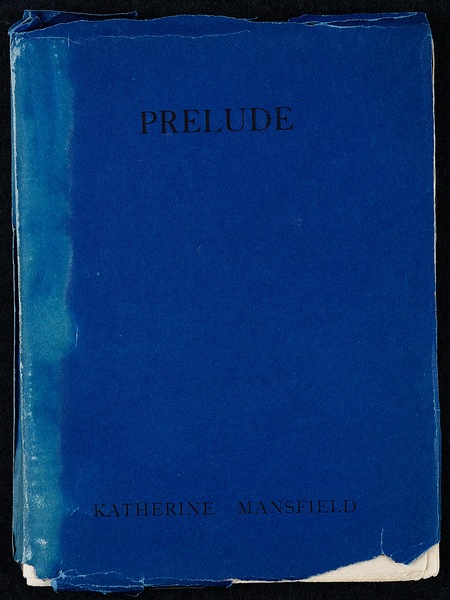
Katherine Mansfield - Prelude - first edition

Katherine Mansfield, Prelude (1918)

This was the second publication of the Hogarth Press. It was a re-write of her long short story The Aloe which she had begun in 1915. 300 copies were printed.

“It is a sixty-eight-page book and we printed and bound it entirely with our own hands. The edition must have consisted of nearly 300 copies for, when it went out of print, we had sold 257 copies. Virginia did most of the setting and I did all the machining.”

Leonard Woolf, An Autobiography


“Prelude was published by the Hogarth Press in July 1918, an edition of 300 copies selling at 3s. 6d. It was a book of 68 pages, 19 X 14.5 cm, set in Caslon and bearing the dedication “To L.H.B. and J.M.M.” The early pages had been set by Barbara Hiles, a former student at the Slade who now worked for the Press, then mostly by Virginia Woolf, who recorded that her top speed at hand-setting was one page in an hour and a quarter. The book finally was not run off on the hand press at Hogarth House, but at a jobbing printer’s in Richmond, with Leonard himself working the machine.

The book was clearly the work of amateurs, but cleanly done and unpretentious. The Woolfs misnamed the story The Prelude in both the heading preceding section I, and in the running head as far as p.19. After the first few copies, they removed from the front of the dark blue paper jacket the line block of a woman’s head, surrounded by the spiky leaves and the flowers of the aloe and from the back cover another head, with the leaves now fallen into rather a Medusa-like severity, which had been designed by Mansfield’s friend, the Scottish painter J.D.Fergusson.”

Aloe - colophon

Vincent O’Sullivan (ed), The Aloe

previousnext


Hogarth Press studies

Woolf's-head Publishing Woolf’s-head Publishing is a wonderful collection of cover designs, book jackets, and illustrations – but also a beautiful example of book production in its own right. It was produced as an exhibition catalogue and has quite rightly gone on to enjoy an independent life of its own. This book is a genuine collector’s item, and only months after its first publication it started to win awards for its design and production values. Anyone with the slightest interest in book production, graphic design, typography, or Bloomsbury will want to own a copy the minute they clap eyes on it.

Woolf's-head Publishing Buy the book at Amazon UK
Woolf's-head Publishing Buy the book at Amazon US

The Hogarth Press Leonard and Virginia Woolf as Publishers: Hogarth Press, 1917-41 John Willis brings the remarkable story of Leonard and Virginia Woolf’s success as publishers to life. He generates interesting thumbnail sketches of all the Hogarth Press authors, which brings both them and the books they wrote into sharp focus. He also follows the development of many of its best-selling titles, and there’s a full account of the social and cultural development of the press. This is a scholarly work with extensive footnotes, bibliographies, and suggestions for further reading – but most of all it is a very readable study in cultural history.

The Hogarth Press Buy the book at Amazon UK
The Hogarth Press Buy the book at Amazon US

© Roy Johnson 2005


Filed Under: Hogarth Press Tagged With: Art, Bloomsbury, Graphic design, Hogarth Press, Katherine Mansfield, Literary studies, Prelude

  • « Previous Page
  • 1
  • 2
  • 3
  • 4
  • …
  • 8
  • Next Page »

Get in touch

info@mantex.co.uk

Content © Mantex 2016
  • About Us
  • Advertising
  • Clients
  • Contact
  • FAQ
  • Links
  • Services
  • Reviews
  • Sitemap
  • T & C’s
  • Testimonials
  • Privacy

Copyright © 2026 · Mantex

Copyright © 2026 · News Pro Theme on Genesis Framework · WordPress · Log in